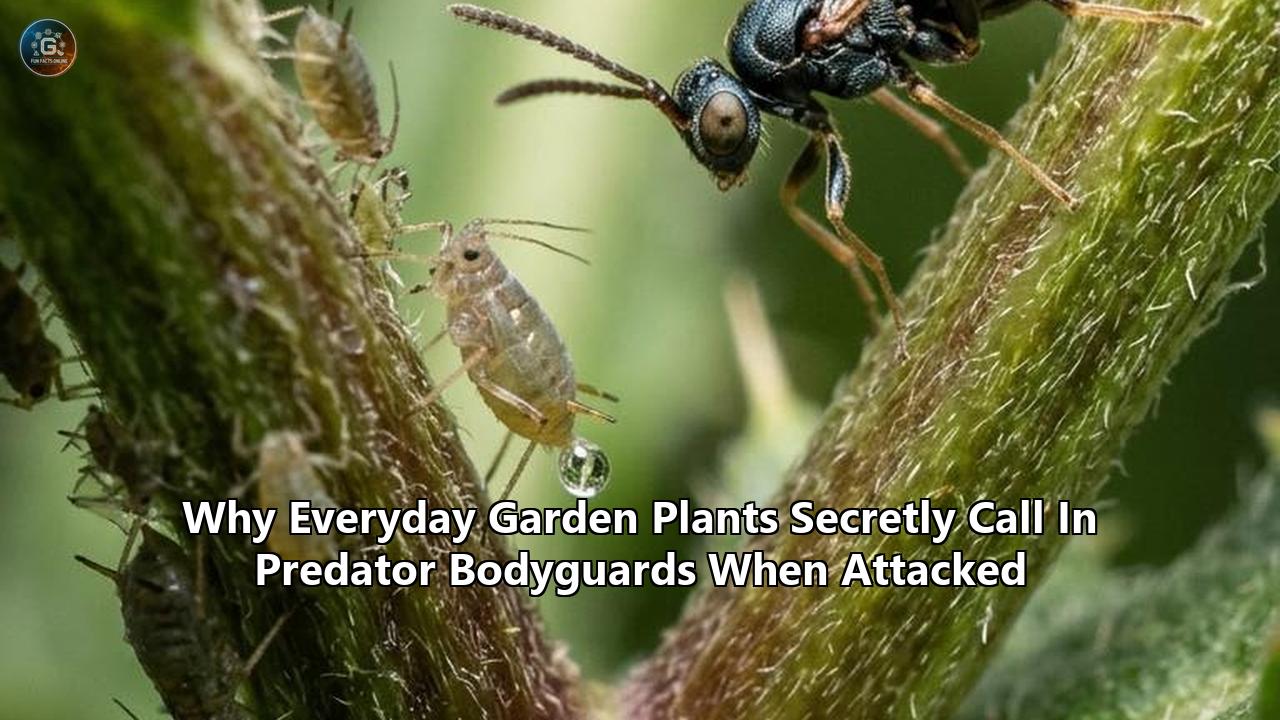
When a hornworm caterpillar sinks its mandibles into the flesh of a backyard tomato leaf, the initial damage appears purely mechanical: severed veins, torn cell walls, and lost photosynthetic tissue. Yet within seconds of that first bite, an invisible, high-stakes tactical deployment begins.
Rather than suffering in silence, common garden plants execute a sophisticated chemical broadcast, releasing specialized airborne compounds that drift across the garden beds to summon ruthless, highly specialized predatory bodyguards. Within hours, tiny parasitoid wasps, predatory mites, and carnivorous assassin bugs arrive on the scene, following the chemical plume straight to the feeding pest.
Recent analytical breakthroughs in chemical ecology and plant molecular biology have unveiled the precise biochemical mechanisms governing this indirect defense network. Researchers utilizing real-time laser microscopy, cellular calcium biosensors, and mass-spectrometry air sampling have mapped how everyday flora—from backyard cabbages and sweet corn to common beans and heirloom tomatoes—distinguish between an accidental tear and insect predation, deciphering chemical components of insect saliva to synthesize tailor-made distress signals known as Herbivore-Induced Plant Volatiles (HIPVs).
This expanding body of research is fundamentally reshaping botanical science and modern agriculture. Far from being passive targets at the mercy of pests, plants actively orchestrate a multi-trophic battlefield. As agricultural scientists translate these laboratory discoveries into commercial pest-management tools, understanding how plants defend themselves through airborne alerts has become one of the most promising frontiers in eliminating synthetic chemical pesticides from modern farming.
┌──────────────────────────────────────────────────────────────────────────┐
│             THE TRI-TROPHIC INSECT DEFENSE CASCADE                       │
├──────────────────────────────────────────────────────────────────────────┤
│                                                                          │
│  [ PEST ATTACK ]                                                         │
│        │  Caterpillar feeds on leaf; introduces elicitors (FACs/Inceptin)│
│        ▼                                                                 │
│  [ LEAF RECOGNITION ]                                                    │
│        │  Cell-surface receptors (e.g., INR) bind salivary elicitors     │
│        ▼                                                                 │
│  [ SIGNAL TRANSDUCTION ]                                                 │
│        │  Rapid cytosolic [Ca²⁺] spike & Jasmonic Acid (JA) cascade      │
│        ▼                                                                 │
│  [ VOLATILE SYNTHESIS & BROADCAST ]                                      │
│        │  Release of GLVs ((Z)-3-hexenal) + Terpenoids (DMNT, TMTT)     │
│        ▼                                                                 │
│  [ PREDATOR RECRUITMENT ]                                                │
│           Parasitoid wasps & predatory mites track scent trail to host   │
│                                                                          │
└──────────────────────────────────────────────────────────────────────────┘
The Molecular Scent Trail: Decoding the Chemical 911 Beacon
When a plant leaf is damaged, the immediate olfactory result is familiar to anyone who has smelled fresh-cut grass. That crisp, green scent consists of Green Leaf Volatiles (GLVs)—six-carbon aldehydes, alcohols, and esters produced within seconds of cellular disruption. But when a pest attacks, the plant does not simply release standard wound compounds. It customizes the mixture into a targeted chemical distress beacon.
                     ┌───────────────────────────────┐
                     │     MEMBRANE LIPIDS           │
                     │  (α-Linolenic / Linoleic Acid)│
                     └───────────────┬───────────────┘
                                     │ Lipoxygenase (LOX) Pathway
                                     ▼
                     ┌───────────────────────────────┐
                     │      GREEN LEAF VOLATILES     │
                     │   (Z)-3-hexenal, (E)-2-hexenal│
                     │      (Z)-3-hexenyl acetate    │
                     └───────────────────────────────┘
                                     │
                     ┌───────────────┴───────────────┐
                     │                               │
           [ Immediate Broadcast ]        [ Internal / Neighbor Priming ]
         Attracts generalist hunters     Triggers guard cell Ca²⁺ influx
         (Geocoris, predatory mites)     Prepares neighboring tissues
The synthesis of these airborne signals relies on three primary biochemical pathways operating inside plant cells:
- The Lipoxygenase (LOX) Pathway: Converts polyunsaturated fatty acids (such as $\alpha$-linolenic acid) released from damaged cell membranes into rapid-response Green Leaf Volatiles, including (Z)-3-hexenal, (E)-2-hexenal, and (Z)-3-hexenyl acetate. These volatile molecules vaporize instantly at ambient temperatures, dispersing through the boundary layer of air surrounding the foliage within seconds.
- The Terpenoid Pathway: Operating through both the plastidial MEP (methylerythritol phosphate) pathway and the cytosolic mevalonate pathway, this network synthesizes complex monoterpenes, sesquiterpenes, and homoterpenes. Prominent examples include (E)-4,8-dimethyl-1,3,7-nonatriene (DMNT), (E,E)-4,8,12-trimethyl-1,3,7,11-tridecatetraene (TMTT), linalool, $\beta$-ocimene, and $(E)$-$\beta$-caryophyllene. These heavier molecules take several hours to produce but persist in the surrounding air for extended periods, serving as high-precision directional beacons.
- The Shikimic Acid Pathway: Generates aromatic volatiles and benzenoids, most notably methyl salicylate (MeSA)—an airborne ester derivative of salicylic acid—and indole, a nitrogenous aromatic molecule that functions as a powerful airborne attractant for select parasitoids.
The resulting plume is not a single chemical, but an intricate ratio of dozen of compounds. A mechanical tear caused by a falling branch or a pair of garden shears produces an initial burst of GLVs that rapidly fades. In contrast, insect herbivory triggers sustained, evolving emissions of terpenes, esters, and aromatics that can continue for days, altering the plant's atmospheric signature and advertising the exact location, density, and species of the attacker.
The Saliva Sensor: How Plants Identify Their Attackers
Plants lack eyes, ears, and a nervous system, raising a fundamental biological question: how does a garden tomato or string bean tell the difference between a lawnmower blade and a caterpillar's jaw? The answer lies in specialized molecular sensors embedded in plant cell membranes that detect chemical components within insect oral secretions.
When an insect feeds, it deposits saliva and regurgitant directly onto the freshly torn cellular surface. These fluids contain distinct molecular signatures known as Herbivore-Associated Molecular Patterns (HAMPs). Over evolutionary history, plants have evolved cell-surface immune receptors capable of recognizing these HAMPs with extraordinary specificity.
                     ┌────────────────────────────────────┐
                     │   CATERPILLAR SALIVARY ELICITORS   │
                     │  (Volicitin, Inceptin, FACs, Cael) │
                     └─────────────────┬──────────────────┘
                                       │
                                       ▼
                     ┌────────────────────────────────────┐
                     │    PLANT CELL SURFACE RECEPTOR     │
                     │        (e.g., INR Receptor)        │
                     └─────────────────┬──────────────────┘
                                       │
                                       ▼
                     ┌────────────────────────────────────┐
                     │     SIGNALING TRANSDUCTION         │
                     │  • Plasma membrane depolarization  │
                     │  • Cytosolic [Ca²⁺] influx         │
                     │  • MAPK3/6 Phosphorylation         │
                     │  • Jasmonic Acid-Isoleucine (JA)   │
                     └─────────────────┬──────────────────┘
                                       │
                                       ▼
                     ┌────────────────────────────────────┐
                     │       INDIRECT DEFENSE LAUNCH      │
                     │  • Terpenoid Synthase Expression   │
                     │  • HIPV Emission (DMNT, MeSA)      │
                     │  • Extrafloral Nectar (EFN) Surge  │
                     └────────────────────────────────────┘
The biochemical diversity of these salivary elicitors reflects millions of years of plant-insect coevolution:
1. Fatty Acid-Amino Acid Conjugates (FACs)
First identified in the beet armyworm (Spodoptera exigua), volicitin ($N$-(17-hydroxylinolenoyl)-L-glutamine) is an FAC formed when linolenic acid from the plant's own leaf tissue combines with glutamine inside the caterpillar's gut. When the caterpillar regurgitates this compound during mastication, the plant senses its own modified fatty acid as a foreign biological threat, initiating a defense cascade.
2. Inceptins
These peptide elicitors, common in the regurgitant of fall armyworms and cabbage loopers, are truncated fragments of the plant's own chloroplastic ATP synthase $\gamma$-subunit proteins. The caterpillar's digestive enzymes inadvertently break down the plant protein into specific peptide chains (such as +ICDSNPRVR+). Cell-surface receptors on legumes, particularly the INR (Inceptin Receptor) leucine-rich repeat receptor-like protein (LRR-RLP), bind these fragments instantly, initiating systemic defense.
3. Caeliferins and Bruchins
Caeliferins are sulfated fatty acid compounds found in the regurgitant of grasshoppers (Caelifera), while bruchins are long-chain $\alpha,\omega$-diols esterified with fatty acids found in weevils. Both trigger targeted phytohormone bursts upon contact with broken foliage.
"The plant is essentially eavesdropping on the digestive process of its attacker," explains Dr. Ted Turlings, a pioneer of chemical ecology at the University of Neuchâtel. "The insect cannot simply choose to stop producing these enzymes and digestive peptides—they are vital for digesting leaf tissue. The plant has seized upon that physiological necessity and turned it into an unmaskable fingerprint."
The binding of a HAMP to its matching receptor triggers an immediate cascade inside the plant cell:
- Membrane Depolarization: The electrical potential across the plasma membrane drops within seconds.
- Cytosolic Calcium Influx ($[Ca^{2+}]_{cyt}$): Calcium channels open, sending a pulse of calcium ions throughout the cytoplasm.
- Kinase Phosphorylation: Mitogen-activated protein kinases (MAPK3 and MAPK6) are activated, transmitting the danger signal to the nucleus.
- Phytohormonal Reprogramming: The plant rapidly synthesizes jasmonic acid (JA) and its active form, jasmonoyl-isoleucine (JA-Ile), for chewing pests, or salicylic acid (SA) for piercing-sucking insects like aphids.
This hormonal activation unlocks defensive genes, shutting down growth mechanisms and shifting cellular metabolism toward the production of chemical deterrents and airborne volatiles. This molecular recognition process is at the core of how plants defend themselves without possessing an active nervous system.
The Airborne Cavalry: Who Answers the Botanical SOS?
The emitted volatile blend acts as a precise directional vector for insect predators and parasitoids equipped with specialized olfactory receptors on their antennae. In natural and garden ecosystems, a variety of beneficial organisms rely on these botanical distress calls to find their prey.
┌────────────────────────────────────────────────────────────────────────────┐
│                  COMMON GARDEN BOTANICAL BODYGUARD GUILDS                  │
├───────────────────────┬────────────────────────────┬───────────────────────┤
│ Plant Host & Threat   │ Emitted Volatiles (HIPVs)  │ Recruited Bodyguard   │
├───────────────────────┼────────────────────────────┼───────────────────────┤
│ Tomato                │ (Z)-3-hexenyl acetate,     │ Cotesia congregata    │
│ Hornworm Caterpillar  │ β-caryophyllene, MeSA      │ (Braconid Wasp)       │
├───────────────────────┼────────────────────────────┼───────────────────────┤
│ Lima Bean             │ DMNT, (E)-β-ocimene,       │ Phytoseiulus          │
│ Spider Mites          │ Linalool, Methyl Salicylate│ persimilis (Mite)     │
├───────────────────────┼────────────────────────────┼───────────────────────┤
│ Cabbage / Brassica    │ Allyl isothiocyanate,      │ Cotesia glomerata /   │
│ Cabbage White Larvae  │ (E)-2-hexenal, Nitriles    │ Cotesia rubecula      │
├───────────────────────┼────────────────────────────┼───────────────────────┤
│ Sweet Corn            │ Indole, Terpenoids,        │ Microplitis           │
│ Armyworm / Earworm    │ (E)-β-farnesene            │ mediator (Wasp)       │
├───────────────────────┼────────────────────────────┼───────────────────────┤
│ Sweet Pepper / Tomato │ β-caryophyllene,           │ Encarsia formosa /    │
│ Aphids & Whiteflies   │ α-pinene, Decanal          │ Macrolophus pygmaeus  │
└───────────────────────┴────────────────────────────┴───────────────────────┘
1. Parasitoid Wasps: The Endoparasitic Specialists
Parasitoid wasps represent the most sophisticated biological response force in the garden. Wasps of the Braconidae, Ichneumonidae, and Trichogrammatidae families do not consume the leaf-eating pests directly. Instead, adult females utilize the plant's volatile scent trail to pinpoint the exact location of host caterpillars or aphids.
Upon arrival, the female wasp uses her ovipositor to inject dozens of eggs directly into the living caterpillar, accompanied by specialized polydnaviruses that suppress the pest's immune system. As the wasp larvae develop internally, they feed on non-vital hemolymph, leaving vital organs intact until pupation. The caterpillar continues to feed initially, but its appetite plummets as the internal parasites develop, sparing the host plant from severe defoliation.
                  ┌─────────────────────────────────────┐
                  │    Caterpillar Infests Cabbage      │
                  └──────────────────┬──────────────────┘
                                     │
                                     ▼
                  ┌─────────────────────────────────────┐
                  │ Plant Emits Volatiles (Allyl ITC)   │
                  └──────────────────┬──────────────────┘
                                     │
                                     ▼
                  ┌─────────────────────────────────────┐
                  │ Cotesia glomerata Detects Signal    │
                  └──────────────────┬──────────────────┘
                                     │
                                     ▼
                  ┌─────────────────────────────────────┐
                  │ Wasp Oviposits Eggs into Larva      │
                  │   • Polydnavirus suppresses pest    │
                  │   • Parasitoid larvae consume pest  │
                  │   • Host feeding drops sharply      │
                  └─────────────────────────────────────┘
A prime example occurs in brassicas (cabbages, broccoli, kale) under assault by the larvae of the small cabbage white butterfly (Pieris rapae). Feeding caterpillars trigger the emission of volatile nitriles and isothiocyanates. The solitary parasitoid Cotesia rubecula can differentiate between the volatile blend of a cabbage damaged by an unparasitized caterpillar and one that has already been parasitized, choosing uninfected hosts to avoid larval competition.
2. Predatory Mites (Phytoseiulus persimilis)
In one of the earliest documented cases of indirect defense, detailed by Dutch entomologists Marcel Dicke and Maurice Sabelis, common Lima bean plants (Phaseolus lunatus) attacked by two-spotted spider mites (Tetranychus urticae) synthesize a blend of (E)-$\beta$-ocimene, linalool, DMNT, and methyl salicylate. Blind predatory mites (Phytoseiulus persimilis) navigate via airborne sensory organs on their front legs, traveling upwind along this concentration gradient to eradicate the spider mite colonies.
3. Generalist Predators: The Rapid-Response Strike Teams
Generalist insect predators do not require specific host species; they simply seek abundant hunting grounds.
- Big-eyed Bugs (Geocoris spp.) and Minute Pirate Bugs (Orius spp.): These predators home in on pulses of methyl salicylate and GLVs, quickly suppressing populations of flea beetles, thrips, and caterpillar eggs.
- Hoverfly Larvae (Syrphidae) and Green Lacewings (Chrysoperla carnea): Adult hoverflies and lacewings do not hunt pests themselves, but they track aphid-induced plant volatiles to lay their eggs directly amidst dense aphid infestations, ensuring their ravenous larvae emerge surrounded by food.
4. Avian Predators: The Vertebrate Aerial Fleet
Indirect plant defense extends beyond the arthropod world. Controlled field trials have demonstrated that insectivorous birds, such as great tits (Parus major) and blue tits (Cyanistes caeruleus), actively use tree volatiles to optimize their foraging paths. When forest trees like willows, oaks, and apples are infested by defoliating caterpillars, the elevated output of terpenes and aromatics signals profitable feeding areas to passing birds, which rapidly strip the caterpillars from the canopy.
The Subterranean Front: Calling For Help Beneath the Soil
The plant's indirect defense network is not confined to the above-ground canopy [2.5.1]. A mirrored communication system operates beneath the soil surface, protecting root systems from subterranean pests [2.5.1].
┌────────────────────────────────────────────────────────────────────────────┐
│                    BELOW-GROUND TRI-TROPHIC SIGNALING                      │
├────────────────────────────────────────────────────────────────────────────┤
│                                                                            │
│       [ Western Corn Rootworm Larva ]                                      │
│               │                                                            │
│               │ Chews through maize root parenchyma                        │
│               ▼                                                            │
│       [ Maize Root Exudation ]                                             │
│               │                                                            │
│               │ Roots synthesize and release (E)-β-caryophyllene           │
│               ▼                                                            │
│       [ Rhizosphere Diffusion ]                                            │
│               │                                                            │
│               │ Volatile diffuses through soil pore water network          │
│               ▼                                                            │
│       [ Nematode Recruitment ]                                             │
│               │                                                            │
│               │ Entomopathogenic nematodes (Heterorhabditis megidis)       │
│               │ migrate along the chemical gradient                        │
│               ▼                                                            │
│       [ Pest Eradication ]                                                 │
│                 Nematodes enter rootworm larva, releasing lethal           │
│                 bioluminescent bacteria (Photorhabdus luminescens)         │
│                                                                            │
└────────────────────────────────────────────────────────────────────────────┘
A prominent example of this underground dynamic occurs in maize (Zea mays) attacked by larvae of the western corn rootworm (Diabrotica virgifera virgifera), a destructive agricultural pest. As rootworm grubs chew through the root cortex, the damaged root cells synthesize and exude the volatile sesquiterpene (E)-$\beta$-caryophyllene into the rhizosphere [2.5.1].
This molecule diffuses through air pockets and moisture films in the soil, creating an underground chemical trail [2.5.1]. Entomopathogenic nematodes (Heterorhabditis megidis and Steinernema feltiae) detect this signal from several centimeters away, navigating through the soil matrix toward the damaged root [2.5.1].
Upon locating the rootworm grub, the nematodes burrow into its body cavity and release symbiotic bacteria (Photorhabdus luminescens), which kill the host within 48 hours and convert its internal tissues into nutrition for the reproducing worms [2.5.1].
Furthermore, plant vascular systems enable whole-organism defense integration:
- Shoot-to-Root Signaling: Leaf chewing by foliar caterpillars can induce protective terpene emissions in the root zone, preparing subterranean tissues for systemic herbivory.
- Root-to-Shoot Signaling: Root feeding by nematodes alters the foliar volatile profile, modulating the attraction of parasitoids to the leaf canopy above.
Eavesdropping, Mimicry, and Counter-Adaptation
Because volatile emissions disperse freely through open air, the plant's chemical broadcast can be intercepted by non-target organisms. This creates a complex ecological web where allies, competitors, and higher-level predators all listen to the same signals.
                          ┌───────────────────────────┐
                          │    ATTACKED PLANT         │
                          │   Emits Volatiles (HIPVs) │
                          └─────────────┬─────────────┘
                                        │
         ┌──────────────────────────────┼──────────────────────────────┐
         │                              │                              │
         ▼                              ▼                              ▼
┌──────────────────┐          ┌───────────────────┐          ┌──────────────────┐
│ BENEFICIAL ALLY  │          │  4th TROPHIC LEVEL │          │ COMPETITOR/PEST  │
│ Primary Parasitoid│          │ Hyperparasitoid   │          │ Adjacent Pests   │
│ Hunts caterpillar│          │ Attacks beneficial│          │ Target weakened  │
│ to protect plant │          │ wasp larva        │          │ host plant       │
└──────────────────┘          └───────────────────┘          └──────────────────┘
1. The Fourth Trophic Level: Hyperparasitoid Ambush
While primary parasitoid wasps protect the plant by hunting herbivores, those wasps are themselves hunted by hyperparasitoids—parasitic wasps that lay their eggs inside primary parasitoid larvae.
Research shows that hyperparasitoids such as Lysibia nana detect altered volatile blends emitted by plants hosting parasitized caterpillars. When a Pieris caterpillar is parasitized by Cotesia glomerata, chemical changes in the caterpillar's saliva alter the plant's volatile output. Lysibia nana tracks this specific shift to locate and parasitize the developing Cotesia larvae inside the caterpillar, inadvertently undermining the plant's long-term defense strategy.
2. Herbivore Counter-Measures and Deception
Some herbivorous insects have evolved biochemical countermeasures to suppress or alter plant distress signals:
- Salivary Effectors: The caterpillars of the corn earworm (Helicoverpa zea) secrete glucose oxidase in their saliva, an enzyme that suppresses the plant's jasmonic acid pathway by artificially elevating salicylic acid levels, reducing the plant's ability to synthesize volatile predator attractants.
- Signal Hijacking: Silverleaf whiteflies (Bemisia tabaci) feed on phloem sap while introducing effectors that manipulate the host plant's communication network. The infested plant emits false cues that lead neighboring plants to prepare defenses against fungal pathogens rather than piercing-sucking insects, leaving surrounding crops vulnerable.
┌────────────────────────────────────────────────────────────────────────────┐
│                    VOLATILE SENSORY TRANSDUCTION                           │
│                (How Neighboring Plants "Smell" Danger)                     │
├────────────────────────────────────────────────────────────────────────────┤
│                                                                            │
│       [ Airborne GLV: (Z)-3-hexenal ]                                      │
│                      │                                                     │
│                      ▼                                                     │
│       [ Influx Through Open Stomatal Pores ]                               │
│                      │                                                     │
│                      ▼                                                     │
│       [ Interaction with Guard Cells & Mesophyll ]                         │
│                      │                                                     │
│                      ▼                                                     │
│       [ Rapid Cytosolic Calcium Wave ([Ca²⁺]cyt) ]                         │
│                      │                                                     │
│                      ▼                                                     │
│       [ Defense Priming: Epigenetic & Enzymatic Readiness ]                │
│                      │                                                     │
│                      ▼                                                     │
│       [ Faster, Stronger Toxin & Nectar Production Upon Attack ]           │
│                                                                            │
└────────────────────────────────────────────────────────────────────────────┘
3. Plant-to-Plant Eavesdropping and Defense Priming
Neighboring plants also detect these airborne signals. Landmark imaging studies conducted by Dr. Masatsugu Toyota's research group visualized how undamaged plants "smell" their neighbors' distress.
Using fluorescent biosensors to track real-time calcium dynamics, researchers discovered that green leaf volatiles—specifically (Z)-3-hexenal and (E)-2-hexenal—enter undamaged receiver leaves directly through their stomatal pores. Within one minute of exposure, the stomatal guard cells register a sharp cytosolic calcium surge ($[Ca^{2+}]_{cyt}$), which cascades across the mesophyll tissue.
This intake does not immediately trigger full-scale toxin production, which would consume valuable metabolic energy. Instead, it primes the neighboring plant's immune system. The receiving plant prepares its defense machinery so that when a pest eventually lands, the primed plant synthesizes protective compounds and emits volatile body-guard signals far faster and more intensely than an unprimed neighbor. The evolutionary dynamics illustrate just how plants defend themselves through delicate ecological trade-offs, where calling for help risks tipping off secondary competitors.
Extrafloral Nectar: Retaining the Mercenaries
Attracting predatory insects with volatile perfumes is an effective short-term tactic, but keeping them on the foliage requires a tangible reward. To sustain their defensive forces, many plants produce specialized sugar-rich rewards known as Extrafloral Nectar (EFN).
Unlike floral nectar, which is positioned within blossoms to facilitate pollination, extrafloral nectaries are located directly on leaves, petioles, stems, and bracts. These glands secrete a nutrient-dense solution of:
- Simple sugars (sucrose, glucose, fructose)
- Free amino acids (essential building blocks for predatory insects)
- Defensive proteins and enzymes that prevent microbial contamination of the nectar pool
                  ┌─────────────────────────────────────┐
                  │    Herbivore Attack on Leaflet      │
                  └──────────────────┬──────────────────┘
                                     │
                                     ▼
                  ┌─────────────────────────────────────┐
                  │ Jasmonic Acid (JA) Signaling Wave   │
                  └──────────────────┬──────────────────┘
                                     │
                                     ▼
                  ┌─────────────────────────────────────┐
                  │ Extrafloral Nectary Activation      │
                  │ (Petioles, Stipules, Leaf Margins)  │
                  └──────────────────┬──────────────────┘
                                     │
                                     ▼
                  ┌─────────────────────────────────────┐
                  │ Secretion of Carbohydrates & Amino  │
                  │   • Provides sustenance to ants     │
                  │   • Sustains parasitoid wasps       │
                  │   • Establishes 24/7 armed patrols  │
                  └─────────────────────────────────────┘
When a plant is attacked, elevated jasmonic acid levels trigger an immediate increase in both the volume and amino-acid concentration of extrafloral nectar.
This reward system creates mutualistic defensive partnerships:
- Ant Patrols (Formicidae): In species like broad beans (Vicia faba), passiflora, and wild cotton, ants feed on extrafloral nectaries day and night. In exchange for carbohydrates, they attack, kill, or throw off any caterpillars, beetle larvae, or insect eggs they encounter on the foliage.
- Parasitoid Longevity: Adult parasitoid wasps do not consume their larval hosts; they require external carbohydrates to survive. Access to extrafloral nectar doubles or triples the lifespan of a female wasp, increasing the number of pest caterpillars she can parasitize on that host plant.
From Biology to Agriculture: Harnessing Botanical Defense Networks
Modern agriculture's heavy reliance on broad-spectrum chemical insecticides has led to widespread pesticide resistance, groundwater contamination, and the decline of beneficial pollinator populations. Consequently, agronomists are turning to tri-trophic chemical signaling as an ecological alternative for crop protection.
┌────────────────────────────────────────────────────────────────────────────┐
│                    APPLIED CHEMICAL ECOLOGY IN AGRICULTURE                 │
├────────────────────────────────────────────────────────────────────────────┤
│                                                                            │
│  [ PUSH COMPONENT ]                          [ PULL COMPONENT ]            │
│  Intercropped Desmodium                      Trap Crop Perimeter           │
│  • Emits repellent GLVs                      • Emits attractive volatiles  │
│  • Attracts parasitoid wasps                 • Concentrates pest insects   │
│          ▲                                           │                     │
│          │                                           ▼                     │
│  ┌───────┴───────────────────────────────────────────┴───────┐             │
│  │                     MAIN CROP FIELD                       │             │
│  │                       (e.g., Maize)                       │             │
│  │                                                           │             │
│  │   • Synthetic HIPV Dispensers release controlled MeSA     │             │
│  │   • Nanosensors detect early volatile emission bursts     │             │
│  │   • Parasitoids patrol canopy without synthetic sprays    │             │
│  └───────────────────────────────────────────────────────────┘             │
│                                                                            │
└────────────────────────────────────────────────────────────────────────────┘
1. The Push-Pull Intercropping System
Pioneered by Professor Zeyaur Khan and colleagues at the International Centre of Insect Physiology and Ecology (ICIPE) in Kenya, the "Push-Pull" strategy uses plant communication to protect staple crops like maize and sorghum across Sub-Saharan Africa.
- The Push: Farmers intercrop maize with silverleaf desmodium (Desmodium uncinatum). Desmodium naturally emits a continuous blend of volatile monoterpenes and sesquiterpenes that repel stemborer moths (Busseola fusca) while simultaneously attracting parasitoid wasps to the field.
- The Pull: Around the field perimeter, farmers plant Napier grass (Pennisetum purpureum). Napier grass emits volatile attractants that lure stemborer moths away from the interior maize. When the caterpillars hatch and bore into the Napier grass, the plant produces an unpalatable, gummy sap that traps and kills over 80% of the larvae.
This chemical strategy doubles maize yields for smallholder farmers while improving soil health and eliminating the need for synthetic insecticides.
┌────────────────────────────────────────────────────────────────────────────┐
│               THE PUSH-PULL STRATEGY SCHEMATIC (ICIPE SYSTEM)              │
├────────────────────────────────────────────────────────────────────────────┤
│                                                                            │
│       [ NAPIER GRASS PERIMETER ] (The "Pull")                              │
│       ▲ Emits attractive scents; produces gummy sap that traps larvae      │
│       │                                                                    │
│   ┌───┴────────────────────────────────────────────────────────────────┐   │
│   │   [ INTERCROPPED DESMODIUM ] (The "Push")                          │   │
│   │   ▲ Emits repellent terpenes; suppresses parasitic Striga weed     │   │
│   │   │                                                                │   │
│   │   ▼                                                                │   │
│   │   [ MAIZE CASH CROP ]                                              │   │
│   │     Protected canopy; zero pesticide residue; higher grain yields   │   │
│   └───┬────────────────────────────────────────────────────────────────┘   │
│       │                                                                    │
│       ▼                                                                    │
│       [ NAPIER GRASS PERIMETER ] (The "Pull")                              │
│                                                                    │
└────────────────────────────────────────────────────────────────────────────┘
2. Synthetic HIPV Dispensers (PredaLure and Controlled-Release Devices)
In commercial orchards, vineyards, and greenhouse operations, growers are deploying controlled-release dispensers of synthetic plant volatiles.
- Devices releasing precise microgram quantities of methyl salicylate (MeSA) mimic an active pest outbreak, drawing lacewings, ladybugs, and predatory mites into the canopy before pest populations cross economic injury thresholds.
- Controlled trials in apple orchards demonstrate that slow-release MeSA lures increase predator densities up to fourfold, suppressing woolly apple aphid infestations without chemical sprays.
3. Re-Arming Domesticated Crops Through Genetic Introgression
Centuries of crop breeding prioritized yield, sugar content, and visual appeal over chemical defenses. In the process, many modern hybrids lost their ancestral ability to produce specific bodyguard volatiles [2.5.1].
For example, most North American commercial maize lines lost the ability to synthesize the root volatile (E)-$\beta$-caryophyllene, leaving them vulnerable to western corn rootworm [2.5.1]. By locating the missing terpene synthase gene (TPS23) in ancestral European and wild maize relatives (teosinte), geneticists have restored the gene to modern lines [2.5.1]. In field trials, the restored varieties successfully recruit entomopathogenic nematodes, reducing root damage by over 60% compared to non-emitting controls [2.5.1].
By studying how plants defend themselves in natural ecosystems, agronomists are replacing blanket pesticide applications with precision chemical ecology.
Future Frontiers: Nanosensors, Optogenetics, and Climate Threats
As researchers map these chemical defense networks, emerging technologies are connecting laboratory discoveries directly to field applications.
┌────────────────────────────────────────────────────────────────────────────┐
│                       FUTURE RESEARCH AND APPLICATION                      │
├──────────────────────────┬─────────────────────────────────────────────────┤
│ Innovation / Challenge   │ Mechanism and Operational Impact                │
├──────────────────────────┼─────────────────────────────────────────────────┤
│ Real-Time Field PTR-MS   │ Mass-spectrometry platforms sample greenhouse   │
│ Volatile Monitoring      │ air to detect pest attacks before symptoms show │
├──────────────────────────┼─────────────────────────────────────────────────┤
│ Carbon Nanotube Sensors  │ Plant-mounted electronic leaves register early  │
│ (Living Biosensors)      │ GLV release to trigger targeted biocontrol      │
├──────────────────────────┼─────────────────────────────────────────────────┤
│ Atmospheric Pollutant    │ Tropospheric ozone and diesel exhaust break     │
│ Degradation of HIPVs     │ down terpene plumes, blinding parasitoids       │
├──────────────────────────┼─────────────────────────────────────────────────┤
│ CRISPR Volatile Pathway  │ Enhances promoter regions of terpene synthases  │
│ Optimization             │ to amplify indirect defenses without yield loss │
└──────────────────────────┴─────────────────────────────────────────────────┘
Real-Time Volatile Monitoring
High-throughput Proton-Transfer-Reaction Time-of-Flight Mass Spectrometers (PTR-ToF-MS) and field-deployable carbon-nanotube sensors are being installed in commercial greenhouses and orchards. These electronic "noses" analyze air chemistry continuously, identifying the volatile signatures of spider mites or caterpillars hours after feeding begins. This enables growers to release targeted biocontrol insects precisely when and where an outbreak starts, long before leaf damage is visible to the naked eye.
The Disruption of Atmospheric Signaling by Climate Change
This chemical communication network faces substantial environmental threats. Atmospheric pollutants, particularly elevated tropospheric ozone ($O_3$), nitrate radicals ($NO_3$), and diesel particulate emissions, react aggressively with unsaturated volatile organic compounds.
Ozone rapidly oxidizes delicate monoterpenes and GLVs mid-air, halving the effective range of the plant's distress call. Parasitoid wasps and predatory mites searching downwind find the chemical scent trail broken, reducing their foraging efficiency and allowing herbivore outbreaks to expand unchecked.
                  ┌─────────────────────────────────────┐
                  │ Attacked Plant Emits Volatile Plume │
                  │     (DMNT, Linalool, (Z)-3-hexenal) │
                  └──────────────────┬──────────────────┘
                                     │
                                     ▼
                  ┌─────────────────────────────────────┐
                  │ Atmospheric Pollution Interference  │
                  │ (Ozone O₃, Hydroxyl Radicals, NOₓ)  │
                  └──────────────────┬──────────────────┘
                                     │
                                     ▼
                  ┌─────────────────────────────────────┐
                  │ Chemical Degradation of Scent Trail │
                  │  • C=C double bonds oxidized        │
                  │  • Plume continuity disrupted       │
                  │  • Effective signal distance halved │
                  └──────────────────┬──────────────────┘
                                     │
                                     ▼
                  ┌─────────────────────────────────────┐
                  │ Predatory Bodyguards Fail to Arrive │
                  │ Pest Populations Explode Unchecked  │
                  └─────────────────────────────────────┘
Current research focuses on identifying which volatile compounds are most resilient to oxidative degradation, guiding the breeding of climate-resilient crop varieties that can maintain communication with their bodyguard networks even under elevated ozone conditions.
Practical Garden Takeaways: Supporting the Backyard Defense Network
Home gardeners can leverage these natural defense principles to build resilient, self-protecting garden beds:
- Avoid Broad-Spectrum Insecticides: Chemical sprays kill parasitoid wasps, hoverflies, and predatory mites, disrupting the third trophic level and allowing resilient pests to rebound without natural checks.
- Plant Diverse Companion Guilds: Intercropping vegetables with aromatic herbs (dill, fennel, coriander, sweet alyssum) provides essential nectar and pollen for adult parasitoid wasps and hoverflies between pest outbreaks.
- Incorporate Plants with Extrafloral Nectaries: Growing broad beans, passionflowers, and sunflower varieties supplies natural carbohydrate rewards that sustain predatory ant patrols and beneficial wasps.
- Permit Low-Level Infestations: A completely sterile garden prevents plants from establishing baseline priming and starves beneficial predators; allowing minor pest presence preserves the food chain necessary for rapid biological defense.
The everyday plants in backyard gardens and agricultural fields are active participants in a complex ecological network. By perceiving their attackers, synthesizing precise chemical signals, and recruiting an aerial defense force, plants demonstrate that survival in nature relies on communication, chemistry, and mutual defense.
Reference:
- https://pmc.ncbi.nlm.nih.gov/articles/PMC11266131/
- https://pmc.ncbi.nlm.nih.gov/articles/PMC12324489/
- https://www.frontiersin.org/journals/plant-science/articles/10.3389/fpls.2023.1135000/full
- https://community.element14.com/technologies/sensor-technology/b/blog/posts/scientists-record-plants-communicating-with-each-other-to-warn-them-of-potential-threats
- https://www.researchgate.net/publication/251638027_Attracting_carnivorous_arthropods_with_plant_volatiles_The_future_of_biocontrol_or_playing_with_fire
- https://journals.plos.org/plosbiology/article?id=10.1371/journal.pbio.1001435
- https://globalplantcouncil.org/perceiving-predators-understanding-how-plants-sense-herbivore-attack/
- https://www.eurekalert.org/news-releases/1004490
- https://www.researchgate.net/publication/374781375_Green_leaf_volatile_sensory_calcium_transduction_in_Arabidopsis
- https://www.youtube.com/watch?v=54I0ZhFKNzE
- https://pmc.ncbi.nlm.nih.gov/articles/PMC11314544/
- https://pure.uva.nl/ws/files/1909203/27930_125995y.pdf
- https://pubmed.ncbi.nlm.nih.gov/29774237/
- https://blog.waikato.ac.nz/bioblog/2019/04/plants-their-predators-early-warning-systems/
- https://www.mdpi.com/2223-7747/11/10/1350
- https://www.researchgate.net/publication/7629156_Herbivore-Induced_Plant_Volatiles_Mediate_In-Flight_Host_Discrimination_by_Parasitoids
- https://www.researchgate.net/journal/Nature-Communications-2041-1723/publication/374781375_Green_leaf_volatile_sensory_calcium_transduction_in_Arabidopsis/links/652f48d6b5c77c79f9c021c9/Green-leaf-volatile-sensory-calcium-transduction-in-Arabidopsis.pdf
- https://ideas.repec.org/a/nat/natcom/v14y2023i1d10.1038_s41467-023-41589-9.html
- https://www.pnas.org/doi/10.1073/pnas.2520719123
- https://pmc.ncbi.nlm.nih.gov/articles/PMC11354320/
- https://www.pnas.org/doi/10.1073/pnas.0804488105
- https://academic.oup.com/ee/article/55/1/nvaf108/8300778
- https://www.researchgate.net/publication/399236132_Plants_Anticipating_Help_A_New_Hypothesis_in_Plant_Defence_Theory
- https://www.frontiersin.org/journals/plant-science/articles/10.3389/fpls.2026.1873253/pdf
- https://www.semanticscholar.org/paper/Species%E2%80%90specific-scents%2C-targeted-enemies%3A-Volatile-Mezzomo-Leong/55e6587b5ad3dba0e8f048f735396b401b0ee7bd
- https://www.researchgate.net/publication/276831495_Plant-plant_communication_mediated_by_airborne_signals_Ecological_and_plant_physiological_perspectives
- https://pmc.ncbi.nlm.nih.gov/articles/PMC13095879/
- https://www.researchgate.net/publication/38018647_Explaining_evolution_of_plant_communication_by_airborne_signals
- https://www.frontiersin.org/journals/ecology-and-evolution/articles/10.3389/fevo.2014.00008/full
- https://elifesciences.org/reviewed-preprints/111313