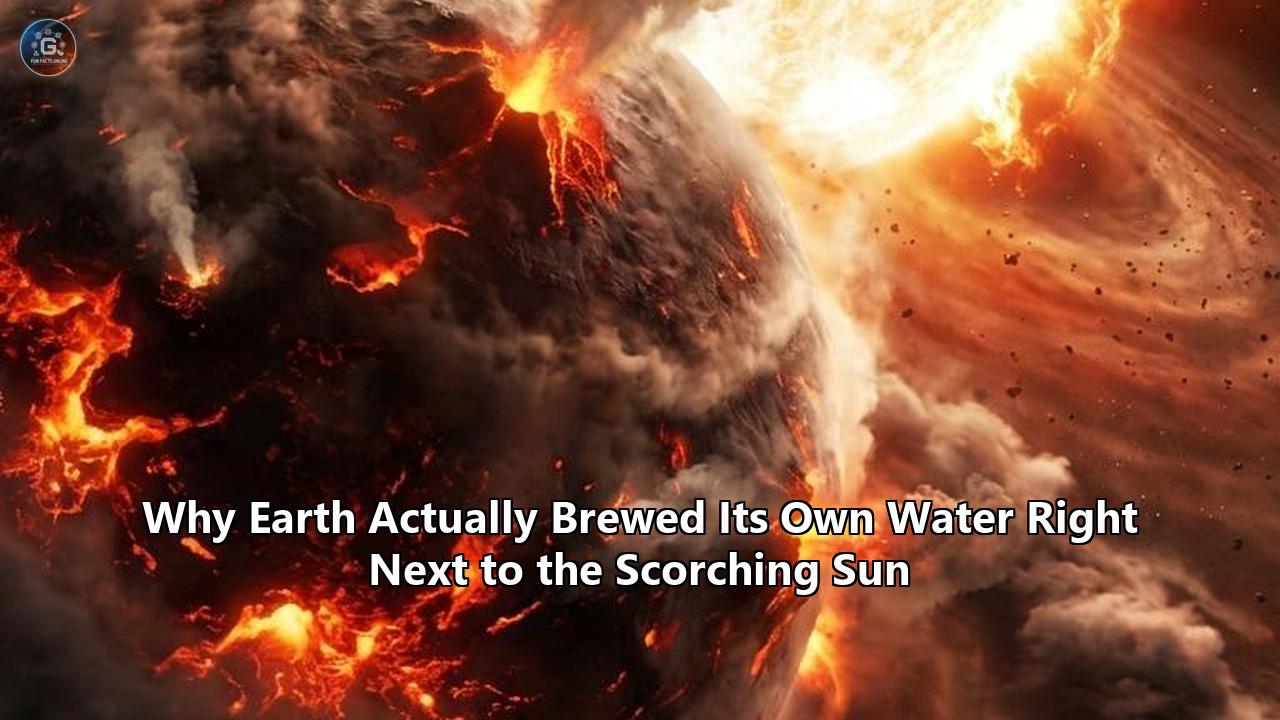
A series of high-pressure laboratory experiments and isotopic analyses of primordial meteorites have confirmed that Earth did not rely on a late bombardment of icy comets or asteroids to fill its oceans. Instead, the planet synthesized its vast water reservoirs internally, directly within the searing inner protoplanetary disk, right beside the young Sun.
The findings, published across landmark investigations in Nature by an international consortium led by the Carnegie Institution for Science and the Institut de Physique du Globe de Paris (IPGP), and in Icarus by researchers at the University of Oxford, dismantle a fifty-year orthodoxy in planetary science.
For decades, models of the early Solar System maintained that the inner disk at 1 astronomical unit (AU) was far too scorching for volatile compounds like water to condense. Conventional wisdom dictated that the infant Earth formed bone-dry and had to wait tens of millions of years for an external courier service—a "late veneer" of carbon-rich, water-laden space rocks scattered inward from beyond Jupiter—to deliver its surface oceans.
The latest experimental and physical data invert that narrative.
By squeezing silicates and iron to immense pressures exceeding 600,000 atmospheres inside laser-heated diamond anvil cells, researchers have demonstrated that molecular hydrogen captured from the Sun’s primordial gas envelope reacted directly with oceans of molten rock on the embryonic Earth. This reaction stripped oxygen from magma minerals, manufacturing vast quantities of water in situ while stripping pure liquid iron downward to forge the planet's core.
Simultaneously, synchrotron X-ray mapping of rare, pristine enstatite chondrite meteorites has verified that the building blocks of the inner Solar System contained vast, intrinsic reservoirs of hydrogen all along. Earth did not merely inherit its oceans as a cosmic afterthought; it brewed them in a planetary blast furnace.
The Snow Line Fallacy and the Late Veneer Myth
To understand why these discoveries have upended terrestrial geochemistry, one must look at the mechanical trap that captured planetary physics in the early 1970s.
Following the equilibrium condensation models pioneered by Lawrence Grossman and John S. Lewis, astrophysicists modeled the early Solar nebula as a smooth, hot disk of gas and dust cooling outward from the center. In these classical thermal profiles, condensation temperatures determined which minerals could solidify at any given orbital distance.
Close to the Sun, only refractory oxides and nickel-iron metal could freeze out of the gas phase at temperatures between 1,400 and 1,800 Kelvin. Further out, silicates condensed.
Water ice, however, could only stabilize at temperatures below roughly 160 to 180 Kelvin. That thermal boundary—the "snow line" or "ice line"—sat somewhere between 2.5 and 3.0 AU, in the heart of what is now the asteroid belt.
Because Earth formed at 1.0 AU, inside the snow line, early models asserted that any water vapor in the local gas would have been prevented from condensing into the growing terrestrial embryos. The planetesimals that accreted to build proto-Earth were thus assumed to be completely desiccated.
For more than half a century, consensus models investigating the origin of earth water treated the inner Solar System as an arid wasteland, requiring dynamic interventions to explain how a blue planet could exist in a zone of fire.
THE CANONICAL "SNOW LINE" MODEL (TRADITIONAL VIEW)

    [ Proto-Sun ] ---------> 1.0 AU (Earth) ---------> 2.7 AU (Snow Line) ---------> Outer Disks
       Inferno                  Bone-Dry                    Ice Condensation           Vast Ice
      Radiation               Planetesimals                 Threshold (160 K)          Gas Giants
          |                         |                               |                      |
          +-------------------------+-------------------------------+----------------------+
                                    |                               |
                              Assumed unable                   Hydrated Clays &
                              to retain water                 Carbonaceous Chondrites
This theoretical deficit gave rise to the "late veneer" hypothesis. Under this model, terrestrial planet formation was a violent, multi-stage process.
First, the dry proto-Earth grew to over 90 percent of its final mass through the accretion of anhydrous inner-disk rocky embryos. Then, during a subsequent chaotic era—accelerated by the gravitational migration of giant planets like Jupiter and Saturn—water-rich projectiles from beyond the snow line were slung into the inner Solar System. These impactors slammed into the crust, depositing a late skin, or veneer, of volatile-rich clays, organics, and water that pooled on the surface to produce our hydrosphere.
The first candidates blamed for this delivery were comets: dirty snowballs composed of primitive astrophysical ice. Yet as mass spectrometry advanced, cometary delivery collapsed under isotopic scrutiny. Spectroscopic measurements of comets—from Comet Halley to the Rosetta spacecraft’s high-precision analysis of 67P/Churyumov-Gerasimenko—showed that cometary water is heavily enriched in deuterium, possessing a deuterium-to-hydrogen (D/H) ratio up to three times higher than that of Earth's oceans.
The paradigm then shifted toward carbonaceous chondrites (specifically CI and CM chondrites), meteorites from the outer asteroid belt that boast water contents of up to 10 to 15 percent by weight and D/H ratios reasonably close to modern seawater.
Yet the carbonaceous chondrite model suffered from severe geochemical discrepancies. If Earth’s volatiles were imported via a late veneer of carbonaceous material representing just 1 to 2 percent of its total mass, the concentrations of other volatile elements—such as carbon, nitrogen, and the heavy noble gases—do not cleanly balance.
More crucially, the nucleosynthetic isotope anomalies of Earth’s mantle—the precise nuclear isotopic mixtures of chromium, titanium, nickel, and calcium—do not match carbonaceous asteroids. Instead, they match inner-disk enstatite chondrites, rocks that canonical models dismissed as devoid of water.
Planetary geochemists found themselves backed into a conceptual corner: the rocks that physically built Earth were supposed to be dry, while the wet rocks in the outer solar system did not match the chemical DNA of the planet.
The High-Pressure Reactor: Magma Ocean Meets Primordial Atmosphere
The resolution to this impasse came not from looking outward at asteroid belts, but by examining the mechanics of planetesimals growing inside gas-rich disks.
The new experimental study, authored by a team featuring Francesca Miozzi, Anat Shahar, Edward Young, and James Badro, demonstrates that when an infant planet grows within its first few million years, its physics are governed by a continuous interaction between a molten interior and a captured envelope of nebular gas.
THE HIGH-PRESSURE MAGMA OCEAN SYNTHESIS

      Primordial H2 Nebular Gas Envelope
     ~~~~~~~~~~~~~~~~~~~~~~~~~~~~~~~~~~~~~
      \    \    \   H2 Dissolution   /    /    /
       v    v    v                  v    v    v
     =============================================  Surface Interface
      Molten Silicate Magma Ocean (T > 4,000 K)

      REACTION:  FeO(melt) + H2(dissolved)  --->  Fe^0(metal) + H2O(steam)
                                                       |
                                                       v
      "Iron Rain": Molten metal blebs sink --------+
      scavenging H and Si into the core            |
                                                   v
     ---------------------------------------------
      Solidifying Silicate Mantle
     ---------------------------------------------
      Liquid Metallic Iron-Nickel Core (Fe-H-Si alloy)
In the earliest stages of planetary accretion, before the parent molecular cloud’s protoplanetary gas disk dissipates, a growing rocky embryo that exceeds roughly 0.2 to 0.3 times the mass of modern Earth possesses enough gravitational pull to capture a thick, primary envelope dominated by molecular hydrogen ($H_2$).
At the same time, the gravitational energy released by millions of colliding planetesimals, compounded by the decay of short-lived radioactive isotopes like Aluminum-26 ($^{26}\text{Al}$), generates colossal heat. The surface does not solidify into rock; it liquefies into a turbulent, churning global magma ocean hundreds or even thousands of kilometers deep.
For years, astrophysicists modeled these two domains—the hydrogen atmosphere and the molten silicate mantle—as separate systems. The new work recreates their interface under the actual conditions of young planetary embryos: pressures between 16 and 60 Gigapascals (GPa) and temperatures exceeding 4,000 Kelvin (over 6,700 degrees Fahrenheit).
To achieve this in the laboratory, the research team placed synthetic mantle silicates containing iron oxide along with hydrogen gas inside diamond anvil cells. Squeezed between the diamond tips to planetary pressures and struck with high-powered infrared lasers, the rock melted instantaneously in the presence of hydrogen.
The resulting chemical reaction was immediate and decisive.
Under extreme pressure, molecular hydrogen dissolves into the silicate melt at rates far higher than previously documented, displaying an exponential dependence on temperature. Once dissolved, the hydrogen behaves as an aggressive chemical reducing agent. It attacks the iron oxide dissolved in the molten silicate:
$$\text{FeO}_{(\text{melt})} + \text{H}_{2\,(\text{dissolved})} \rightleftharpoons \text{Fe}^0_{(\text{metal})} + \text{H}_2\text{O}_{(\text{melt/fluid})}$$
The hydrogen strips oxygen directly from the iron monoxide ($\text{FeO}$) within the liquid rock.
This single reaction yields two profound outcomes:
- Endogenous Water Production: It manufactures massive quantities of endogenous water ($\text{H}_2\text{O}$), which dissolves directly into the magma ocean and outgases into the atmosphere as superheated steam. The experiments revealed that this reaction can generate water concentrations reaching several weight percent of the entire magma melt. Scaled to the dimensions of a young Earth, this process easily manufactures between two and ten times the volume of modern Earth’s oceans right at the boundary layer.
- Precipitation of the Core: The reduction strips the iron atom of its oxygen bond, converting it into droplets of pure, unbonded liquid metal ($\text{Fe}^0$). These dense metallic blebs, seen suspended in the quenched diamond anvil samples, fall via gravity through the lighter silicate slush in a planetary process known as "iron rain". As these iron droplets descend to form the planet's central metallic core, they dissolve additional hydrogen into the metal lattice.
This high-pressure chemical pathway fundamentally recasts the origin of earth water from a fragile dynamical accident into an inevitable thermodynamic outcome.
"We don't actually think about it like water coming to Earth," explains Anat Shahar of the Carnegie Earth and Planets Laboratory. "We think about it as: If I were Earth, could I make water just in the process of planet formation? The answer is an unambiguous yes. Even if all of the rocky material that collided to form the growing planet was completely dry, these interactions between the molecular hydrogen atmosphere and the magma ocean generate copious amounts of water."
Solving the 70-Year Density Deficit of the Core
The chemical engine demonstrated by Miozzi, Shahar, Badro, and Young does more than explain where the oceans came from; it resolves a persistent discrepancy in terrestrial geophysics: the light element density deficit of Earth's core.
Ever since the pioneering seismic experiments of Francis Birch in 1952, geophysicists have known that the Earth's liquid outer core is roughly 8 to 10 percent less dense than pure liquid iron-nickel alloy at the corresponding pressures (136 to 330 GPa) and temperatures (4,000 to 6,000 Kelvin).
For seven decades, theorists debated what "light elements" were alloyed with the iron. Candidates included sulfur, silicon, oxygen, carbon, and hydrogen. However, standard low-pressure geochemical models struggled to identify a single, self-consistent mechanism that could pump enough light elements into the metal without violating the observed composition of the overlying mantle.
The hydrogen-magma ocean reaction matches these conditions directly.
REACTIONS AT THE MAGMA-METAL FRONTIER

          [ Primitive Atmosphere ]
                     |  H2
                     v
          [ Magma Ocean: FeO, SiO2 ]
           |                      |
           | H2 + FeO -> H2O + Fe | H2 reduces SiO2 -> Si in metal
           v                      v
     MANTLE OXIDATION         METALLIC DROPLETS ("Iron Rain")
     Fe2O3 enriched           Fe + H + Si alloyed
           |                      |
           v                      v
     Upper Mantle             Sinks to Earth's Core
     Oxidized to FMQ          Accounts for 8-10% density deficit
Under the thermodynamic equilibria documented in the Nature paper, as the atmospheric hydrogen dissolves into the silicate melt and reduces $\text{FeO}$ to metallic iron, large quantities of hydrogen partition directly into the sinking molten iron droplets.
Simultaneously, at temperatures above 4,000 Kelvin, the hydrogen-driven reduction extends to silicon dioxide ($\text{SiO}_2$), driving elementary silicon into the metallic phase alongside the hydrogen.
When the metallic droplets aggregate at the center of the planet, they form an iron-nickel core naturally alloyed with dissolved hydrogen and silicon. The researchers calculated that the mass of hydrogen locked inside Earth's core today could equal several ocean masses.
This hidden hydrogen reservoir simultaneously satisfies the core's missing density requirement while serving as the underground geochemical sister to the water lingering in the mantle and crust.
Furthermore, this reaction explains the oxidation state of the Earth's mantle.
The primitive material that built Earth was chemically reduced, yet modern mantle rocks exhibit an elevated oxygen fugacity—they possess significant amounts of oxidized ferric iron ($\text{Fe}^{3+}$) relative to ferrous iron ($\text{Fe}^{2+}$).
Planetary scientists long struggled to explain what oxidized the mantle.
The Miozzi and Shahar experiments confirm that the self-contained synthesis of water, combined with high-pressure iron disproportionation (where $3\text{Fe}^{2+}$ breaks down into $2\text{Fe}^{3+} + \text{Fe}^0$), strips out the metallic iron, sinks it to the core, and leaves the silicate mantle systematically oxidized.
The planet’s mantle oxidation, core composition, and ocean volume are three expressions of the same primordial chemical reaction.
The Oxford Evidence: Hydrogen Hidden in Inner-Disk Meteorites
While diamond anvil cells were showing how hydrogen gas interacts with molten rock, a parallel investigation at the University of Oxford looked at surviving fragments of the ancient inner Solar System.
Led by Tom Barrett and James Bryson of Oxford’s Department of Earth Sciences, the study, published in Icarus, examined the Antarctic meteorite LAR 12252.
METEORITE FORENSICS: ENSTATITE VS. CARBONACEOUS

PROPERTY                    CARBONACEOUS CHONDRITES (CI/CM)    ENSTATITE CHONDRITES (EC)
-----------------------------------------------------------------------------------------
Formation Region            Outer Asteroid Belt (> 2.7 AU)    Inner Solar System (~ 1.0 AU)
Historical Assumption       "Wet" (Up to 15 wt% water)        "Bone-dry" (< 0.01 wt% water)
Nucleosynthetic Match       Poor mismatch with Earth          Nearly identical isotopic twin
  (Ti, Cr, Ni, O, Ca)
New Synchrotron Finding     Altered hydrated clays            Intrinsic H2S in matrix
Hydrogen Potential          High                              Enough to form 3-5 Earth oceans
LAR 12252 belongs to a class of space rocks known as enstatite chondrites.
These meteorites are remnants of the inner protoplanetary disk, formed in the hot, high-density environment close to the young Sun.
Geochemists consider enstatite chondrites to be our planet's closest chemical relatives: their isotopic ratios across oxygen, calcium, titanium, chromium, and nickel are indistinguishable from those of Earth and the Moon.
For decades, they were presumed to be almost dry because of their formation in the scorching inner disk.
A preliminary 2020 study by Laurette Piani at the Centre de Recherches Pétrographiques et Géochimiques (CRPG) in Nancy, France, challenged that presumption by detecting unexpected hydrogen in enstatite chondrites. Skeptics responded that this hydrogen could be terrestrial contamination—water vapor absorbed from Earth's atmosphere or ice melt in the deserts where the meteorites were recovered.
To settle the question, Barrett and Bryson brought LAR 12252 to the Diamond Light Source synchrotron in Oxfordshire. Using an intense beam of X-rays to generate nanoscale maps of the meteorite’s atomic bonds, the Oxford team searched for the precise molecular homes of volatile compounds.
They did not look merely at the chondrules—the millimeter-sized spherical silicate beads that melted during transient heating events—but at the pristine, fine-grained matrix holding them together.
The synchrotron spectra revealed high concentrations of hydrogen chemically bound to sulfur, forming hydrogen sulfide compounds locked within the crystalline matrix.
Crucially, the concentration of hydrogen in this pristine matrix was five times higher than in the non-crystalline parts of the chondrules.
When the researchers examined portions of the meteorite marked by terrestrial weathering, such as rust veins, the hydrogen sulfide was absent. The hydrogen was native to the asteroid from its birth 4.55 billion years ago.
The implications of this finding reshape the inventory of the inner nebula:
- The building blocks of Earth did not condense as bone-dry rocks; they trapped hydrogen directly from the solar nebula through gas-grain adsorption and sulfide synthesis.
- The pristine enstatite chondrite matrix contains enough intrinsic hydrogen to supply at least three to five times the mass of water in modern Earth's oceans.
- The proto-Earth did not require volatile-rich material from beyond the asteroid belt; the raw elemental ingredients of water were built into the dust grains of 1 AU from the first moments of accretion.
"Because the likelihood of this hydrogen sulfide originating from terrestrial contamination is very low, this research provides vital evidence to support the theory that water on Earth is native," said Tom Barrett upon the release of the Oxford data. "It is a natural outcome of what our planet is made of."
Isotopic Forensics: Reading the Atomic Clocks of Seawater
Isotopic forensics have long formed the principal battleground for resolving the origin of earth water, specifically through the ratio of deuterium to ordinary hydrogen (D/H).
Hydrogen consists of a single proton orbited by an electron. Deuterium ($^2\text{H}$ or $\text{D}$) is a heavier, stable isotope whose nucleus contains a proton plus a neutron.
Because deuterium is roughly twice as massive as ordinary hydrogen (protium, $^1\text{H}$), physical processes like evaporation, condensation, gravitational escape, and chemical exchange partition the two isotopes at varying rates.
The D/H ratio of a water reservoir acts as a chemical fingerprint, preserving an atomic record of its thermal and chemical history.
ISOTOPIC LANDSCAPE: DEUTERIUM-TO-HYDROGEN (D/H) RATIOS

  Reservoir                                 D/H Ratio (relative to VSMOW)
  -----------------------------------------------------------------------
  Solar Nebula Gas (Primordial Sun)         ~ 2.0 x 10^-5   (δD ≈ -860‰)  [Ultra-Light]
  Baffin Island Deep Mantle Picrites        ~ 1.2 x 10^-4   (δD ≈ -218‰)  [Light / Primordial]
  Enstatite Chondrites (Inner Disk Rocks)   ~ 1.1–1.4 x 10^-4 (δD ≈ -100 to -400‰)
  Modern Earth Oceans (VSMOW)               = 1.558 x 10^-4 (δD = 0‰)     [Terrestrial Standard]
  Carbonaceous Chondrites (Outer Asteroids) ~ 1.4–1.7 x 10^-4 (δD ≈ -100 to +100‰)
  Oort Cloud & Jupiter-Family Comets        ~ 3.0–5.0 x 10^-4 (δD ≈ +300 to +1000‰) [Heavy]
On Earth, the standard benchmark is Vienna Standard Mean Ocean Water (VSMOW), where:
$$\left(\frac{\text{D}}{\text{H}}\right)_{\text{VSMOW}} = 1.5576 \times 10^{-4} \quad (\delta\text{D} \equiv 0‰)$$
When researchers measured the D/H ratios of outer-system comets, they found numbers soaring between $3 \times 10^{-4}$ and $5 \times 10^{-4}$ ($\delta\text{D}$ from $+300‰$ to over $+1,000‰$). Comets were rapidly ruled out as primary ocean suppliers.
Carbonaceous chondrites, by contrast, show D/H ratios clustering near $1.5 \times 10^{-4}$ ($\delta\text{D}$ around $-100‰$ to $+100‰$), which led to the long-standing assumption that they delivered the oceans.
However, the primordial solar nebula—the vast hydrogen gas cloud from which the Sun and planetary atmospheres condensed—had an extremely "light" D/H ratio: roughly $2 \times 10^{-5}$ ($\delta\text{D} \approx -860‰$).
If Earth captured its water by reacting a nebular hydrogen atmosphere with a magma ocean, why is seawater today not as light as the solar nebula?
The new studies explain this through two physical processes:
1. High-Pressure Magma-Metal Isotopic Fractionation
As hydrogen dissolves into the molten silicate magma and partitions into the descending metallic core, the heavier deuterium isotope preferentially remains in the silicate melt, while ordinary protium ($^1\text{H}$) dissolves more readily into the metallic iron core.
Core formation naturally elevated the D/H ratio of the remaining silicate mantle and primitive atmosphere above the ultra-light solar value.
2. Hydrodynamic Photoevaporative Escape
The young Sun was an active magnetic rotator emitting extreme ultraviolet (XUV) radiation hundreds of times more intense than today. This high-energy flux heated Earth’s upper hydrogen atmosphere, driving hydrodynamic escape—a wind blowing light gases into space.
Because ordinary protium ($^1\text{H}$) is half the mass of deuterium, it escaped into the vacuum far more rapidly than deuterium. Over tens of millions of years, hydrodynamic escape distilled the atmosphere, stripping out light hydrogen and concentrating the remaining deuterium.
When you run modern escape kinetics forward from an initial enstatite-nebular mixture ($\delta\text{D} \approx -400‰$ to $-200‰$), the reservoir lands at the VSMOW value ($\delta\text{D} = 0‰$).
Earth's isotopic signature does not require an asteroid delivery; it is the isotopic scar of a planet that shed its hydrogen envelope while keeping the oxygen-bonded water behind.
Deep Mantle Archives: The Rocks That Kept the Secret
Geological evidence preserving this ancient process was buried deep within Earth's interior, sheltered from billions of years of plate tectonic recycling and atmospheric contamination.
In 2015, a research team led by Lydia Hallis, then at the University of Hawaii, analyzed archaic basaltic picrites exposed at Baffin Island in the Canadian Arctic and on the Disko Island coast of West Greenland. These basalts represent primary partial melts of the deep, primitive mantle, rising through volcanic plumes from near the core-mantle boundary without interacting with the crust.
Using high-resolution secondary ion mass spectrometry (NanoSIMS), Hallis analyzed melt inclusions—microscopic droplets of magma trapped inside ancient, magnesium-rich olivine crystals during crystallization.
The results were startling: the water inside the Baffin Island olivines possessed a $\delta\text{D}$ value down to $-218‰$, the lightest, most deuterium-depleted hydrogen isotopic signature ever measured in terrestrial rocks.
Accompanying this light hydrogen were primordial helium-3 to helium-4 ($^3\text{He}/^4\text{He}$) ratios up to 50 times higher than atmospheric levels, proof that this deep mantle reservoir has remained un-degassed since the accretion of the planet.
MANTLE HYDROSPHERE ARCHITECTURE

  Depth (km)
      0 +------------------------------------------+  Surface Crust (Oceans: 1.0 Ocean Mass)
        |                                          |
    410 + - - - - - - - - - - - - - - - - - - - - -+  Transition Zone Top
        |  Ringwoodite & Wadsleyite Reservoir      |  (Hydrous minerals hold
        |  Contains 1 to 3 "Ocean Masses" of H2O   |   1.0 to 2.0 wt% H2O in crystal lattice)
    660 + - - - - - - - - - - - - - - - - - - - - -+  Transition Zone Base
        |                                          |
        |  Lower Mantle (Bridgmanite, Periclase)   |
        |  Deep Mantle Plumes (Baffin Island)      |
        |  Preserve Primordial δD = -218‰          |
   2890 +==========================================+  Core-Mantle Boundary (D'' Layer)
        |                                          |
        |  Liquid Iron-Nickel Core                 |
        |  Hydrogen alloyed directly into metal    |
        |  Contains equivalent of several oceans   |
   5150 + - - - - - - - - - - - - - - - - - - - - -+
The Baffin Island discoveries revealed that Earth’s deep interior does not look like late-arriving carbonaceous asteroids. It preserves an indigenous, low-D/H signature inherited directly from the solar nebula.
The planet’s mantle transition zone—spanning depths between 410 and 660 kilometers—reinforces this architecture.
In 2014, a team led by Graham Pearson of the University of Alberta analyzed a battered diamond brought up from the transition zone by Kimberlite magmas in Juína, Brazil. Inside the diamond lay a sub-microscopic inclusion of ringwoodite, a high-pressure polymorph of olivine.
Infrared spectroscopic analysis revealed that the ringwoodite inclusion was loaded with water, containing roughly 1.5 weight percent $\text{H}_2\text{O}$ locked into its crystal lattice.
Calculations confirmed that if the entire transition zone holds even 1 percent water by weight, this subterranean zone alone contains one to three times the total volume of all oceans on Earth's surface combined.
Water is not a scarce surface film; it is a major mineralogical component of the planetary interior.
Additional proof comes from the Moon.
Under the canonical Giant Impact hypothesis, the Moon formed roughly 4.51 billion years ago when a Mars-sized protoplanet, Theia, collided with the young Earth.
For decades, the Moon was assumed to have lost all its water in that catastrophic impact.
Beginning in 2008, however, geochemical analyses by Alberto Saal of Brown University and the late Erik Hauri of the Carnegie Institution showed that Apollo 15 and 17 volcanic glass beads and olivine-hosted melt inclusions contained high levels of indigenous lunar water—up to 1,200 parts per million.
More importantly, the lunar water possessed a D/H ratio and an oxygen isotope signature identical to Earth's mantle.
The Moon was born wet.
Because the giant impact occurred tens of millions of years before the putative "late veneer" of asteroids could have swept in, the proto-Earth and Theia must have already possessed their water reserves before the impact.
The hydrosphere was locked into the Earth-Moon system from its inception.
Exoplanet Parallels: Sub-Neptunes and Super-Earths
The breakthrough in understanding Earth's internal chemistry was driven not by looking at our own Solar System, but by scanning exoplanets orbiting distant stars.
NASA’s Kepler Space Telescope, followed by TESS (Transiting Exoplanet Survey Satellite) and the James Webb Space Telescope (JWST), revealed that our Solar System is an outlier.
The most common planets in the Milky Way are sizes completely absent from our Sun's retinue: worlds between the sizes of Earth and Neptune. These planets fall into two categories, separated by a distinct gap known as the "radius valley" or Fulton gap, located between 1.7 and 2.0 Earth radii ($R_\oplus$):
- Sub-Neptunes (2.0 to 3.5 $R_\oplus$): Worlds with rocky/molten cores wrapped in thick envelopes of hydrogen and helium.
- Super-Earths (1.0 to 1.7 $R_\oplus$): Dense, rocky planets stripped of extensive primary hydrogen envelopes.
THE PLANETARY EVOLUTION SPECTRUM

       Young Sub-Neptune                    Photoevaporation / Escape                Mature Water-Rich World
       (During Accretion)                   (Over 100 Myr to 1 Gyr)                  (Super-Earth / Earth-like)

       /\  /\  /\  /\  /\                   ~~~~~~~~~~~~~~~~~~~~~~~~~
      /  \ Primordial /  \                 (  High stellar XUV flux  )               [ Thin Atmosphere ]
     (   H2 Atmosphere    )    ------->    (  strips light hydrogen  )    ------->   ====================
      \  /            \  /                 (  into outer space       )               [ Steam / Liquid Ocean ]
       \/==============\/                   ~~~~~~~~~~~~~~~~~~~~~~~~~                --------------------
       |  Magma Ocean   |                                                            | Silicate Mantle  |
       |  H2 + FeO ->   |                                                            | Oxidized         |
       |  H2O + Core    |                                                            |------------------|
       \----------------/                                                            | Fe-H-Si Core     |
Through the AEThER project—a multi-institutional research initiative centered at the Carnegie Institution for Science—scientists realized that these ubiquitous exoplanets offer a real-time window into the early stages of Earth’s birth.
"Exoplanet discoveries gave us a much greater appreciation of how common it is for just-formed planets to be surrounded by atmospheres that are rich in molecular hydrogen during their first several million years of growth," said Anat Shahar. "Eventually these hydrogen envelopes dissipate, but they leave their fingerprints on the young planet's composition."
JWST transmission spectroscopy has observed atmospheres of sub-Neptunes like GJ 1214 b and TOI-270 d, finding signatures of heavy elements, carbon dioxide, and abundant water vapor.
Astrophysicists initially wondered whether these worlds were born as icy comets out past distant snow lines and migrated inward.
The high-pressure diamond anvil cell experiments confirm they did not have to migrate at all.
Any rocky planet growing to more than a fraction of Earth's mass inside a primordial gas disk captures hydrogen and cooks vast quantities of water in its molten surface.
When stellar radiation gradually boils away the outer hydrogen veil, it exposes a dense, water-rich core.
Earth followed this same developmental path.
Our planet is an evolved, post-sub-Neptune super-Earth that held onto its manufactured water while shedding its volatile hydrogen shell.
Astrobiological Fallout: Water Is a Geological Inevitability
The realization that Earth manufactured its own water fundamentally changes our assessment of planetary habitability across the universe.
Under the traditional late veneer delivery model, ocean-covered worlds were treated as astronomical anomalies. For an Earth-sized world to obtain oceans, a rare and precarious series of gravitational events had to align:
- Giant gas planets had to form in orbits that remained dynamically unstable.
- Those giant planets had to migrate in a trajectory that scattered water-rich asteroids from beyond the snow line inward toward the terrestrial zone.
- The icy projectiles had to hit the terrestrial planet without hitting it with so much kinetic energy that they vaporized and blasted the atmosphere into interstellar space.
- The delivery had to cease before delivering so much water that the entire planet was drowned in a global ocean tens of kilometers deep, suppressing landmass formation and nutrient cycles.
Under this old paradigm, water-bearing planets were an improbable cosmic jackpot.
The new chemistry overturns that fragile framework.
If the origin of earth water is a natural byproduct of accreting rock within a hydrogen-rich protoplanetary disk, then water is not an accidental import. It is a thermodynamic certainty.
Every rocky planet that grows to roughly a third of Earth's mass inside a star’s primordial gas disk will possess:
- A molten surface capable of dissolving atmospheric gas.
- Iron oxides available for reduction.
- The pressure and temperature conditions required to synthesize water and precipitate a metallic core.
HABITABILITY EQUATION COMPARISON

  Old "Late Veneer" Hypothesis               New "In Situ Synthesis" Model
  ---------------------------------          -----------------------------------
  * Requires giant planet migration          * Inherent property of planet accretion
  * Requires icy asteroid bombardment        * Independent of outer system architecture
  * Delicate timing window                   * Occurs within first few million years
  * Earth-like water is a rarity             * Water-rich rocky worlds are universal
This means that watery, habitable-zone planets should exist around a vast percentage of the roughly 100 billion stars in our galaxy. The presence of surface and interior water does not require the complex architecture of our own outer Solar System—a massive Jupiter, an orbital resonance with Saturn, or a fortuitous belt of carbonaceous asteroids.
The raw ingredients and the processing plant are built directly into the chemistry of planet formation itself.
Unresolved Fronts and the Road Ahead
Despite this unified picture, critical pieces of the planetary jigsaw puzzle remain under active investigation.
The first front concerns the timing and mechanics of nebular gas dissipation. For an embryonic Earth to capture a hydrogen envelope that drives magma ocean reduction, it must accrete a significant fraction of its mass—at least 0.2 to 0.3 Earth masses—before the solar nebula clears.
Astronomical observations of young star clusters suggest that protoplanetary gas disks survive for only 2 to 5 million years.
Astrophysicists are now refining accretion models to determine whether pebble accretion—the rapid, drag-assisted inward spiraling of millimeter-sized dust grains—can build terrestrial cores fast enough to capture their nebular gas before it is blown away by early stellar winds.
CHRONOLOGY OF EARLY TERRESTRIAL WATER SYNTHESIS

  T = 0 Myr        Solar Nebula collapses; dust and gas disk forms
  T = 1 - 3 Myr    Rapid accretion of planetary embryos (0.2–0.5 M⊕)
                   Enstatite-like precursors trap native hydrogen
                   Gravitational capture of primary H2 nebular atmosphere
  T = 3 - 5 Myr    Global Magma Ocean active (T > 4,000 K, P up to 60 GPa)
                   H2 reduces FeO: Copious endogenous H2O generated
                   Metallic iron-nickel core precipitates, absorbing H and Si
  T = 5 - 10 Myr   Nebular gas clears; XUV photoevaporation drives hydrogen escape
                   Atmosphere enriched in deuterium to match VSMOW
  T = 30 - 50 Myr  Giant Impact with Theia forms the Moon
                   Pre-existing water redistributed through Earth-Moon system
  T = 100+ Myr     Magma ocean solidifies; mantle degasses steam; oceans pool
A second question involves other light volatile elements: carbon, nitrogen, and the noble gases.
While the hydrogen-magma reaction cleanly explains water and core density, the behavior of nitrogen and carbon at extreme pressures and temperatures is more complex.
High-pressure petrologists are running diamond anvil cell experiments to determine whether carbon and nitrogen dissolved into early magma oceans alongside hydrogen, or whether a modest flux of late-arriving asteroids did contribute a portion of the atmospheric nitrogen and organic compounds that later kickstarted biology.
Finally, future astronomical observatories are preparing to put this geochemical model to a definitive observational test.
NASA’s Habitable Worlds Observatory (HWO), slated for the late 2030s and 2040s, alongside ground-based mega-telescopes like the Extremely Large Telescope (ELT) in Chile, will directly image Earth-sized exoplanets in the habitable zones of nearby stars.
By measuring the atmospheric compositions and water vapor abundances of rocky worlds in planetary systems that completely lack Jupiter-like gas giants, astronomers can verify whether water exists everywhere.
If these isolated rocky worlds routinely harbor steam and oceans, it will provide final observational confirmation for the laboratory experiments: that planets do not wait for water to fall from the stars.
They brew their oceans from within, forging water out of raw rock and gas in the searing crucible of their own creation.
Reference:
- https://www.space.com/newborn-earth-produced-its-own-water
- https://carnegiescience.edu/how-did-earth-get-its-water-0
- https://source.washu.edu/2020/08/meteorite-study-suggests-earth-may-have-always-been-wet/
- https://www.earth.ox.ac.uk/article/scientists-uncover-crucial-evidence-origin-water-earth
- https://read.qxmd.com/read/41167513/experiments-reveal-extreme-water-generation-during-planet-formation
- https://skyandtelescope.org/astronomy-news/the-origin-of-earths-water/
- https://www.sensorindustries.com/the-mystery-of-earths-water-a-journey-through-science/
- https://carnegiescience.edu/where-did-earth-get-its-water
- https://www.earth.com/space/scorching-planets-are-creating-their-own-water-from-fire/
- https://www.universetoday.com/articles/early-hydrogeniron-reactions-key-to-planetary-habitability
- https://gizmodo.com/a-meteorite-from-alaska-challenges-theory-of-how-earth-got-its-water-2000590233
- https://pmc.ncbi.nlm.nih.gov/articles/PMC5394251/
- https://www.icr.org/article/12476/
- https://www.extremetech.com/science/earths-water-may-have-been-born-in-a-lake-of-magma
- https://www.universetoday.com/articles/early-hydrogeniron-reactions-key-to-planetary-habitability
- https://www.youtube.com/watch?v=YoedcIMURBs
- https://arxiv.org/abs/2511.01351
- https://www.researchgate.net/publication/397087129_Experiments_reveal_extreme_water_generation_during_planet_formation
- https://astrobiology.com/2023/04/17/earth-was-shaped-by-primordial-hydrogen-atmospheres/
- https://wodnesprawy.pl/en/where-did-earths-water-come-from/
- https://www.yourweather.co.uk/news/science/new-study-throws-earth-s-hydrogen-hypothesis-out-of-the-water.html
- https://www.planetary.org/articles/how-did-earth-get-its-water
- https://en.wikipedia.org/wiki/Origin_of_water_on_Earth
- https://www.semanticscholar.org/paper/Core-envelope-miscibility-in-sub-Neptunes-and-Gilmore-Stixrude/ca689758e870a789b23f2cc0de255ef915c6d247
- https://www.sciencedaily.com/releases/2023/04/230412131118.htm
- https://epss.ucla.edu/epss-professors-discover-earths-water-shaped-by-primordial-h2-atmospheres/