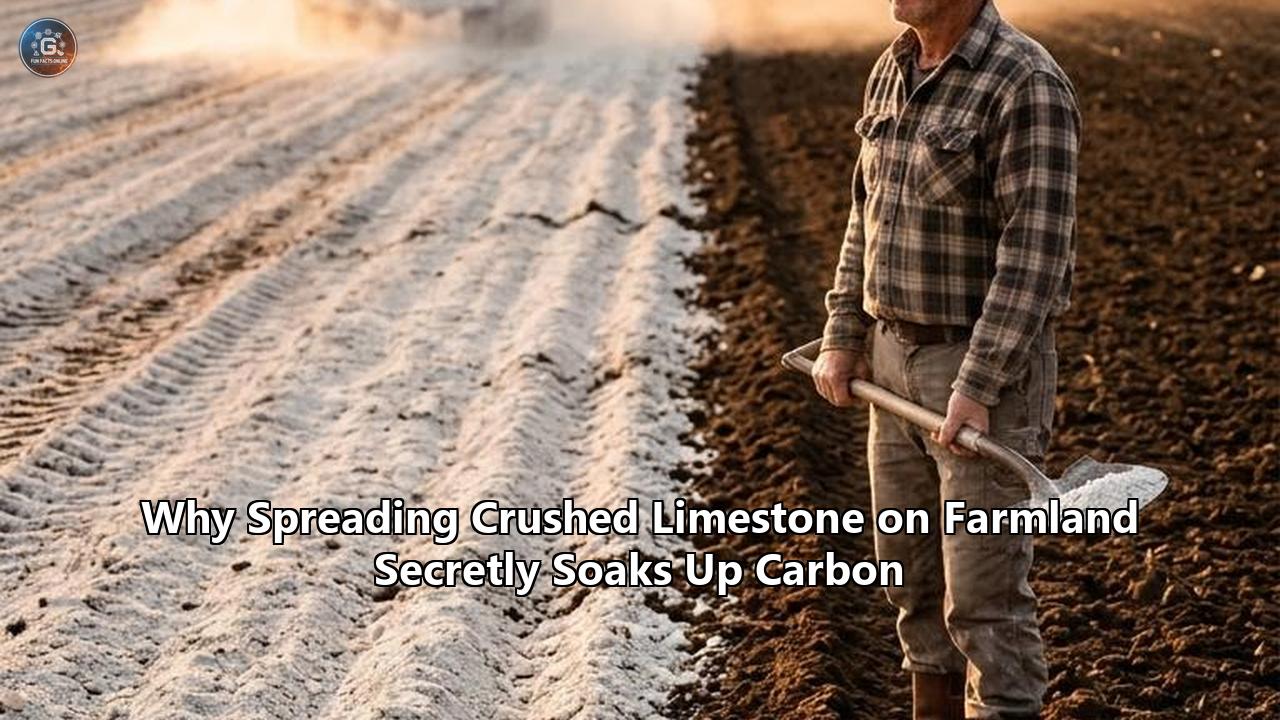
For more than a century, agricultural wisdom across the American heartland has dictated a simple, mechanical chore: every few autumns, after the combines clear the corn and soybeans, trucks roll across the fields slinging pale grey powder over the bare earth. Spreading crushed limestone—known to every agronomist as "liming"—is done to neutralize soil acidity, flush out aluminum toxicity, and coax higher yields from stubborn ground.
According to long-standing global climate guidelines, however, those same trucks were doing something else: polluting. For decades, international climate authorities, including the United Nations Intergovernmental Panel on Climate Change (IPCC), have operated under the official assumption that agricultural lime dissolves in field acid to release its carbon directly into the atmosphere as carbon dioxide gas ($CO_2$).
That assumption was upended when a Yale University-led research team published a definitive study in the journal Nature, revealing that agricultural liming across the Mississippi River Basin has quietly functioned as a massive, century-long net carbon sink.
Analyzing 120 years of water records collected from the mouth of the Mississippi River alongside advanced geochemical transport models, the researchers discovered that spreading crushed carbonate stone on Midwest croplands has removed an estimated 300 to 400 million metric tons of $CO_2$ from the atmosphere since 1900. Rather than venting carbon into the sky, the chemical interaction between rainfall, soil air, and powdered limestone transforms atmospheric gas into stable bicarbonate ions that wash through groundwater into rivers and out to the Gulf of Mexico, locking the carbon away for tens of thousands of years.
"One of the exciting things about this result is that it aligns climate action with something that is already good for farmers," said Dr. Tim Jesper Suhrhoff, a geochemist at the Yale Center for Natural Carbon Capture and lead author of the study. "Better soil pH management can improve yields and soil health, and our work shows that it can also be good for the climate. That gives us another reason to expand limited access to it where it is sensible".
The revelation challenges global emissions accounting rules and opens an immediate pathway for scalable climate action. It demonstrates that the world’s agricultural soils have secretly been operating a planetary carbon sink, pointing the way toward how farmers can be recognized—and paid—for an environmental service they have been providing for generations.
The Accounting Blind Spot That Misled Global Climate Models
To understand why this discovery sent shockwaves through both soil science and environmental policy, one must examine the accounting convention that governed agricultural carbon emissions for the past three decades.
Under the IPCC’s Tier 1 methodology for greenhouse gas inventories, governments tally agricultural emissions using a straightforward formula: every ton of calcite limestone ($CaCO_3$) spread on cropland is assumed to release roughly 0.12 metric tons of carbon (equivalent to 0.44 tons of $CO_2$) into the atmosphere. The reasoning appeared sound on paper: limestone is a carbonate rock, meaning it already contains carbon forged hundreds of millions of years ago from the skeletal remains of ancient marine organisms. When that stone encounters acid, the carbonate molecule breaks apart, producing calcium ions, water, and $CO_2$.
Because farmers heavily apply synthetic nitrogen fertilizers that acidify the soil as they break down, policy experts assumed that the applied limestone was perpetually sizzling away, liberating its ancient carbon back into the atmosphere.
The Yale research team, collaborating with geochemists at the Georgia Institute of Technology, discovered that this model was built on a flawed counterfactual. It blamed the lime for emissions that were actually triggered by anthropogenic acidity, completely ignoring the carbon-capturing potential of natural soil processes.
Conventional IPCC Assumption:
Applied Limestone (CaCO3) + Soil Acidity ===> CO2 Gas Released to Air

What Actually Happens in Farm Soil:
Soil Acidity releases CO2 regardless of lime.
Applied Limestone + Rainwater + Soil CO2 ===> Dissolved Bicarbonate (Trapped for Millennia)
"Current guidelines that penalize liming assume that if we didn't lime, there would be no emissions, but that's not the case," Dr. Suhrhoff explained. "It is the reaction of acidity with the soil that creates $CO_2$ emissions, not the addition of the lime itself. In the absence of strong synthetic acids, liming does not lead to net emissions; it actually removes $CO_2$ from the atmosphere through the formation of bicarbonate".
When nitrogen fertilizers like anhydrous ammonia or urea are applied to cropland, microbial nitrification converts ammonium ($NH_4^+$) into nitrate ($NO_3^-$), releasing free hydrogen ions ($H^+$)—pure acid. If a farmer never applies a single grain of limestone, those acid ions do not simply vanish. They attack the native minerals and indigenous carbonates already present in the subsoil and underlying bedrock, releasing carbon dioxide anyway.
By attributing those unavoidable fertilizer-driven emissions to the crushed limestone that farmers spread on top, global accounting frameworks systematically penalized an amendment that, under field conditions, was busy neutralizing acid and sequestering ambient carbon.
The Reaction in the Root Zone: Chemical Mechanics of Carbon Trapping
The fundamental science of this process takes place in the top few inches of topsoil, where biology and geology intersect in a dense, moisture-rich environment.
Cropland soil is not dead dirt; it is a breathing biome. Plant roots respire, and billions of bacteria, fungi, and nematodes consume decaying crop residue, breathing out carbon dioxide. Because soil pore spaces are confined, this biological respiration drives the concentration of $CO_2$ beneath the surface up to 10 to 100 times higher than in the open atmosphere. In ambient air, $CO_2$ levels hover around 425 parts per million (ppm); inside agricultural soil, $CO_2$ levels routinely reach 5,000 to 30,000 ppm.
When rain filters down through the soil profile, it dissolves that concentrated $CO_2$, forming a weak, natural acid known as carbonic acid:
$$CO_2 + H_2O \rightleftharpoons H_2CO_3$$
When a farmer spreads crushed agricultural limestone—primarily calcium carbonate ($CaCO_3$), or dolomitic limestone containing both calcium and magnesium carbonate ($CaMg(CO_3)_2$)—the fine rock particles dissolve in the presence of this carbonic acid. The resulting chemical reaction transforms both the rock and the gas:
$$CaCO_3 + H_2CO_3 \rightarrow Ca^{2+} + 2HCO_3^-$$
$$\text{Limestone} + \text{Dissolved Carbon Dioxide} \rightarrow \text{Calcium Ion} + \text{Two Bicarbonate Ions}$$
This reaction is the linchpin of the entire process. For every mole of calcium carbonate dissolved by carbonic acid, two moles of bicarbonate ($HCO_3^-$) are created.
- One mole of carbon originates from the pulverized rock itself.
- The second mole of carbon is pulled directly out of the soil air—carbon that was drawn out of the atmosphere mere weeks or months earlier by the growing crop canopy through photosynthesis.
Instead of remaining as a gas that can migrate back into the sky, the carbon is converted into a liquid ion: dissolved bicarbonate. Bicarbonate is stable, non-volatile, and chemically locked. As long as the surrounding water does not encounter extreme acidity, that carbon cannot convert back into $CO_2$ gas. It enters the hydrologic cycle and moves downward, past the root zone, into groundwater aquifers, drainage tiles, local streams, and eventually into the continent's major river arteries.
The Strong Acid Complication
The balance becomes complicated when strong mineral acids enter the equation. When limestone reacts with nitric acid ($HNO_3$) derived from synthetic fertilizer, the reaction changes:
$$CaCO_3 + 2HNO_3 \rightarrow Ca^{2+} + 2NO_3^- + H_2O + CO_2\uparrow$$
In this specific pathway, the carbonate in the rock is converted directly into carbon dioxide gas and lost to the atmosphere.
For decades, scientists had not resolved which reaction dominated in real-world agricultural basins: the carbonic acid pathway that sequesters carbon, or the nitric acid pathway that vents it.
The Yale team answered this question by examining historical water-quality data gathered by the U.S. Geological Survey (USGS) at Baton Rouge and New Orleans spanning from 1900 to 2020. By cross-referencing agricultural lime sales records, fertilizer consumption figures, atmospheric acid deposition data from coal-fired power plants, and the geochemical ratio of calcium, nitrate, and dissolved inorganic carbon flowing into the Gulf of Mexico, the researchers conducted a comprehensive mass-balance analysis.
The data proved unambiguous. Despite heavy synthetic nitrogen fertilization across the Corn Belt over the past 70 years, the carbonic acid weathering pathway consistently dominated the nitric acid pathway. The efficiency of carbon removal in the Mississippi basin has actually increased since the 1930s, when lime application accelerated. Today, agricultural liming operates at approximately 75 percent of its theoretical maximum carbon-trapping efficiency, functioning as a reliable regional carbon sink.
The 100,000-Year Ocean Sink
Where does the carbon go once it leaves the farm? The life cycle of sequestered carbon stretches far beyond the fence line, traveling through continental watersheds into the deep ocean.
Agricultural Field (Illinois/Iowa)
       │
       ▼  Rainfall dissolves crushed CaCO3 via carbonic acid
Soil Pore Water
       │
       ▼  Forms stable dissolved bicarbonate (HCO3-)
Tile Drains & Shallow Aquifers
       │
       ▼  Flushes through subsoil without gas evasion
Tributary Streams & Rivers (Ohio, Missouri, Mississippi)
       │
       ▼  Transports bicarbonate across thousands of miles
Gulf of Mexico & Atlantic Ocean
       │
       ▼  Adds oceanic alkalinity; counteracts acidification
Deep-Sea Sediments (Millennia-scale storage)
When dissolved bicarbonate flushes out of Midwest topsoil, it moves into drainage tiles—perforated underground pipes installed beneath millions of acres of Midwest farmland to prevent waterlogging. From these tiles, it empties into drainage ditches, creeks, and rivers like the Ohio, Illinois, and Missouri, eventually merging into the main stem of the Mississippi River.
Throughout this journey, as long as river waters remain circumneutral to alkaline (pH 7.0 to 8.2), the bicarbonate remains dissolved. It does not off-gas.
Upon reaching the Gulf of Mexico, the bicarbonate delivers a critical co-benefit: it increases ocean alkalinity. Since the dawn of the Industrial Revolution, marine environments have absorbed roughly 30 percent of human fossil fuel emissions. This uptake has lowered surface ocean pH by 0.1 units—representing a 30 percent increase in acidity that degrades coral reefs, oyster hatcheries, and planktonic organisms that construct shells from calcium carbonate.
When continental runoff delivers calcium and bicarbonate ions to the ocean, it helps buffer that acidity.
"Bicarbonate from agricultural liming that washes into oceans can raise ocean pH and support shell-building," noted Peter Raymond, the Oastler Professor of Biogeochemistry at the Yale School of the Environment and co-author of the study. "Ocean acidification is just as severe an ecological problem as atmospheric $CO_2$ levels".
In seawater, the residence time of dissolved bicarbonate exceeds 100,000 years. Some of this carbon is ultimately utilized by marine organisms like foraminifera, coccolithophores, and corals to build shells. When these organisms die, their shells settle onto the abyssal sea floor, consolidating into deep marine carbonate sediments—the very same limestone deposits that tectonic forces will push back onto dry land over hundreds of millions of years.
The cycle comes full circle: rock mined from ancient sea floors is crushed, spread on cropland, traps modern atmospheric carbon, and returns via river networks to rest once again on the ocean floor.
Where Carbonates Fit in Enhanced Rock Weathering
The revelation regarding limestone reframes the growing scientific discipline of enhanced rock weathering.
Natural weathering is the Earth’s primary geological thermostat. Over millions of years, volcanic eruptions pump massive volumes of $CO_2$ into the atmosphere. The gas dissolves in rainwater, forming weak acids that weather continental rocks. The runoff carries dissolved minerals to the oceans, where carbon is locked away in marine strata, preventing run-away greenhouse heating.
Under natural conditions, this cycle operates on geologic timescales of hundreds of thousands of years. The premise of enhanced rock weathering is straightforward: speed up the process by mechanically crushing rocks into fine powders—vastly expanding their reactive surface area—and spreading them across expansive land areas like agricultural fields, speeding up chemical reactions from millennia to seasons.
Mineral Comparison: Silicate Basalt vs. Carbonate Limestone

Property                 Silicate (Basalt / Olivine)      Carbonate (Limestone / Calcite)
─────────────────────────────────────────────────────────────────────────────────────────
Primary Minerals         Plagioclase, Pyroxene, Olivine   Calcite (CaCO3), Dolomite
Carbon in Parent Rock    0%                               ~12%
Theoretical CO2 Drawdown Up to 2 moles CO2 per mole cation 1 mole CO2 per mole cation
Dissolution Rate         Slow (Years to Decades)          Fast (Weeks to Months)
Agricultural Supply Chain Nascent / Developing            Mature (100+ years of infrastructure)
Cost per Applied Ton     $60 – $150+                      $25 – $50
Historically, the enhanced rock weathering industry focused almost exclusively on silicate minerals, such as basalt, dunite, and olivine. The logic was chemically compelling: silicate rocks contain zero carbon in their raw crystalline lattice. When a silicate mineral like wollastonite ($CaSiO_3$) or olivine ($Mg_2SiO_4$) dissolves in carbonic acid, every single carbon atom trapped in the resulting bicarbonate comes from the sky:
$$CaSiO_3 + 2CO_2 + H_2O \rightarrow Ca^{2+} + 2HCO_3^- + SiO_2$$
Because silicates release no inherent carbon, scientists viewed them as the pure, gold standard of carbon removal. Carbonate rocks like limestone were dismissed or viewed with suspicion because of their existing carbon content and vulnerability to strong-acid emissions.
Yet silicate minerals face major logistical barriers:
- Dissolution Kinetics: Silicate rocks dissolve slowly. A dusting of finely crushed basalt spread on a field in Iowa can take several years or even decades to fully weather and react, depending on soil moisture, grain size, and local mineralogy.
- Grinding Energy: Silicates are hard, dense igneous rocks. Milling basalt into particles under 50 micrometers requires significant electrical energy, which carries a life-cycle emissions penalty unless powered entirely by renewables.
- Logistics and Infrastructure: Farmers do not routinely have basalt quarries in their backyards. Hauling millions of tons of volcanic rock across agricultural regions requires fleets of diesel trucks and freight trains, adding monetary and carbon costs.
Limestone, by contrast, is soft, easy to pulverize, and dissolves rapidly—often reacting within weeks of the first soaking rain. Most crucially, the supply chain already exists. Every agricultural county across the American Midwest, the European Union, and Latin America possesses established networks of limestone quarries, specialized spreading rigs, agronomists who test for soil buffering needs, and farmers who understand how to apply it.
"Enhanced weathering has more commonly focused on silicate rocks, in part because limestone already contains carbon that can potentially be released as $CO_2$," the Yale researchers observed. "A key advance of the new study is to account for what would have happened without lime. When you measure the baseline correctly, carbonate weathering emerges as a powerful, immediate pathway".
This has spurred research into dual-amendment strategies. Rather than treating silicates and carbonates as competitors, agronomists are exploring hybrid protocols.
Applying a fast-acting dose of crushed limestone rapidly elevates soil pH, handles ambient acidity, and provides quick carbon removal. Concurrently applying crushed basalt provides durable, long-term buffering and micronutrient replenishment, without the risk of the basalt being rapidly exhausted by fertilizer-derived nitric acid.
Agronomic Synergies: Soil Health, Crop Yield, and Nitrous Oxide Suppression
The reason limestone application has endured across millennia—from Roman agronomists spreading chalk to modern operators driving GPS-guided tractor spreaders—is that balancing soil chemistry is essential for crop production.
Soil acidification is an inevitable consequence of intensive crop production. When plants absorb cationic nutrients (such as potassium, calcium, and magnesium), their root tips exude positive hydrogen ions into the soil solution to maintain electrical balance.
Compounding this natural process, the application of ammonium-based nitrogen fertilizers drives acidification. Over several growing seasons, untreated soil pH can drop from a neutral 6.5 to an acidic 4.8 or lower.
Soil pH Impact on Soil Health and Chemistry:

   pH < 5.0 (Severely Acidic)          pH 6.2 - 6.8 (Optimized via Liming)
  ─────────────────────────────       ────────────────────────────────────
  • Soluble aluminum toxic to roots   • Aluminum precipitates into harmless minerals
  • Phosphorus bound to iron/clay     • Phosphorus easily absorbed by crops
  • Bacterial life suppressed         • Robust microbial cycling of nutrients
  • Elevated nitrous oxide emissions  • Denitrification complete: N2O converted to N2
In severely acidic soils, aluminum and manganese become soluble, acting as root toxins. Crop root tips become stunted, brittle, and unable to penetrate deep into the subsoil, leaving crops vulnerable to summer droughts.
Acidic conditions also chemically lock up phosphorus—one of the three macronutrients critical for plant development—binding it tightly to iron and aluminum oxides so crop roots cannot access it.
Spreading agricultural limestone reverses this damage through three distinct mechanisms:
1. Root Detoxification and Nutrient Availability
As limestone dissolves, it consumes free hydrogen ions, elevating soil pH to an optimal range between 6.2 and 6.8. In this range, toxic aluminum precipitates back into harmless, solid mineral phases.
Phosphorus is released from its chemical bonds, allowing crops to absorb the fertilizer already resting in the dirt. Field trials across the Midwest consistently demonstrate that maintaining proper soil pH via liming boosts corn and soybean yields by 5 to 15 percent, while improving plant water-use efficiency.
2. Suppressing Nitrous Oxide ($N_2O$) Hotspots
Agricultural liming delivers a second, vital climate dividend: it suppresses emissions of nitrous oxide ($N_2O$). Nitrous oxide is an exceptionally potent greenhouse gas, possessing a global warming potential nearly 300 times greater than $CO_2$ over a 100-year timescale, and it accounts for a large share of agriculture’s global climate footprint.
Nitrous oxide is produced in farm soils primarily through denitrification—a process where specialized soil bacteria convert nitrate into nitrogen gas ($N_2$). In acidic soils, the specific enzyme responsible for the final chemical step of this chain—$\text{N}_2\text{O}$ reductase, which converts nitrous oxide into benign, inert nitrogen gas—is inhibited by high concentrations of hydrogen ions.
As a result, acidic soils stall mid-reaction, venting plumes of $N_2O$ into the air. By raising the pH, liming restores enzymatic function, allowing bacteria to complete the reduction cycle and convert potential $N_2O$ emissions into harmless atmospheric nitrogen gas.
3. Fortifying Soil Structure and Microbial Biomass
Dolomitic and calcitic limestone replenish exchangeable calcium ($Ca^{2+}$) and magnesium ($Mg^{2+}$) on clay and organic matter particles. Calcium ions act as flocculating agents, binding fine clay particles into well-aerated, crumbly soil aggregates.
This aggregated soil architecture resists water erosion, promotes deeper water infiltration during heavy downpours, and stimulates aerobic microbial communities that build up persistent soil organic carbon pools.
The MRV Dilemma: Proving an Invisible Reaction
Despite the verified biogeochemical potential of enhanced rock weathering and carbonate spreading, widespread adoption within commercial carbon markets faces a persistent hurdle: Monitoring, Reporting, and Verification (MRV).
Unlike engineered climate solutions like Direct Air Capture (DAC)—where pure, gaseous $CO_2$ is sucked through chemical filters, compressed, piped underground, and metered at a steel valve—weathering reactions take place over millions of distributed acres. The resulting product is not a captured gas in a cylinder, but billions of imperceptible, dissolved ions migrating through complex subterranean waterways.
To build integrity into agricultural carbon markets and verify credits that companies can purchase to offset unavoidable emissions, scientists must measure how much carbon was removed, how quickly it reacted, and ensure it will not re-enter the atmosphere.
The Open-System MRV Verification Process:

1. Baseline Soil & Rock Characterization
   ├── Particle size distribution of crushed stone
   ├── Initial cation exchange capacity (CEC) and soil pH
   └── Native carbonate and strong-acid profile

2. Vadose Zone Monitoring
   ├── Suction lysimeters extracting pore water below root depth
   ├── Electrical conductivity sensors tracking ionic migration
   └── Trace element ratios (e.g., Ca/Mg, 87Sr/86Sr isotopes)

3. Geochemical Isotopic Tracing
   ├── Stable carbon isotope analysis (δ13C)
   │   └── Distinguishes organic soil respiration from rock dissolution
   └── Reactive transport modeling matching catchment stream gauges

4. Ocean Basin Accounting
   └── Deducting downstream losses (acid re-release along river transport)
In closed experimental plots, scientists measure the carbon flux directly. Geochemists use suction lysimeters—small, porous ceramic cups buried beneath the root zone—to vacuum up pore water as it drains toward aquifers. By analyzing the concentrations of calcium, magnesium, nitrate, and dissolved inorganic carbon (DIC), they trace the exact rate of rock dissolution.
To verify where the carbon came from, researchers employ stable carbon isotope geochemistry ($\delta^{13}C$). Carbon derived from ancient marine limestone has an isotopic fingerprint distinct from carbon sourced from modern soil organic matter and plant respiration.
By measuring the $\delta^{13}C$ signatures of dissolved inorganic carbon in soil leachates, technicians determine the precise ratio of atmospheric carbon to mineral carbon in the water.
Moving from experimental plots to millions of acres of working farmland requires marrying physical sampling with reactive transport modeling. In November 2024, the U.S. Department of Energy awarded $5.1 million to an interdisciplinary team led by Northwestern University to deploy field trials across downstate Illinois.
The initiative tracks crushed limestone and silicate rock dissolution across multiple growing seasons, developing standardized MRV protocols to allow agricultural carbon capture to be monitored across broad watersheds via satellite remote sensing, soil testing grids, and public stream-gauge networks.
Independent carbon crediting standards, such as Isometric, Puro.earth, and Carbon Standards International, are establishing formal methodologies for open-system mineral weathering. These protocols establish strict deduction buffers: they penalize projects for carbon emitted during mining and transit, account for potential re-release if downstream waters encounter acidic industrial runoff, and mandate conservative crediting factors to ensure the carbon removal is permanent and verifiable.
Farm Economics and the Real-World Carbon Market
For farmers operating in an environment of fluctuating commodity prices, elevated fertilizer costs, and volatile weather, climate action is rarely viable unless it makes clear financial sense at the farm gate.
Agricultural liming has long been a routine capital expense. However, it is an expense that farmers frequently delay when margins tighten.
Applying agricultural lime typically costs between $25 and $55 per ton delivered and spread, depending on the distance from the nearest quarry. Because a standard application requires two to four tons per acre every three to five years, treating a 1,000-acre corn-and-soybean operation can demand an upfront cash expenditure of $50,000 to $100,000.
For tenant farmers working on short-term year-to-year cash leases—a demographic that manages more than half of Midwest cropland—investing substantial upfront capital into long-term soil health makes little financial sense if the lease might not be renewed the following season. Consequently, millions of acres of farmland across the United States are currently under-limed and progressively acidifying.
Illustrative Farm Balance Sheet (1,000-Acre Grain Farm):

Direct Application Costs:
  • Agronomic lime requirement: ~3 tons/acre
  • Cost of material, transport, and custom spreading: $40/ton
  • Total Upfront Expenditure: $120,000 (every 4 years = $30,000/yr annualized)

Direct Economic Returns (Without Carbon Finance):
  • Yield benefit from optimized pH: +6 bushels corn/acre @ $4.50 = +$27/acre
  • Fertilizer efficiency savings (unlocked phosphorus): +$12/acre
  • Total Annual Direct Return: +$39,000/yr

Net Agronomic Margin: +$9,000/year (Narrow margin, high upfront risk)

The Carbon Credit Catalyst:
  • Net CO2 sequestered: ~0.3 tons CO2 per ton of limestone
  • Carbon yield: ~0.9 tons CO2 removed/acre over life cycle
  • High-integrity carbon removal price: $100/ton CO2
  • Potential Carbon Revenue: +$90/acre over application cycle (+$22,500/year)

New Net Margin with Carbon Offsetting: +$31,500/year (De-risks upfront capital)
The realization that crushed limestone sequesters carbon introduces a new financing mechanism: carbon removal credits. High-durability carbon removal purchases—funded by technology corporations and institutional buyers committed to net-zero pledges—routinely transact between $100 and $300 per metric ton of verifiable, permanently stored $CO_2$.
"We know that many farmers can't afford optimal soil pH management," said Noah Planavsky, professor of earth and planetary sciences at Yale and co-author of the Nature study. "We need to consider how we can fund this process by taking into account the carbon removals".
If carbon finance covers even half the cost of purchasing, trucking, and spreading crushed stone, the economics of soil management shift dramatically.
Rather than viewing lime as an expensive maintenance overhead, producers can utilize carbon markets to subsidize soil remineralization. This enhances crop yields, improves soil resilience against drought, reduces nutrient runoff into downstream communities, and creates an auxiliary revenue stream for the farm.
Logistical Boundaries, Energy Costs, and Environmental Risks
Scaling up rock applications across hundreds of millions of acres is not without real-world constraints. Deploying geochemical interventions at climate-relevant scales introduces industrial, ecological, and logistical bottlenecks that must be managed.
Lifecycle Assessment Factors for Farm-Based Rock Amendments:

  [ Quarrying & Blasting ]  ──> Diesel consumption, fugitive particulate dust
            │
  [ Mechanical Crushing ]   ──> Electrical grid carbon intensity (kWh per ton)
            │
  [ Heavy Freight Haul ]    ──> Trucking emissions (efficiency drops beyond 50 miles)
            │
  [ In-Field Spreading ]    ──> Tractor fuel, soil compaction risks
            │
  [ Downstream Aquatic ]    ──> Watershed buffering, trace element management
1. Transport Radii and Hauling Emissions
Crushed rock is heavy, low-density cargo. Diesel freight trucks transporting 25-ton loads generate substantial emissions per ton-mile. Life-cycle assessments indicate that if crushed rock is transported by diesel truck farther than 50 to 75 miles from quarry to field, the transportation emissions begin to significantly erode the net carbon balance of the practice.
Rail networks and barge systems on waterways like the Mississippi and Ohio rivers can stretch this viable transport radius to hundreds of miles, but remote farms located far from native rock outcroppings will experience diminished net climate benefits unless transport fleets transition to zero-emission powertrains.
2. Trace Metals and Feedstock Purity
While agricultural limestone is generally composed of calcium and magnesium carbonate, geological strata vary. Some natural carbonate and silicate deposits contain trace quantities of heavy metals, including cadmium, lead, nickel, chromium, and arsenic.
Spreading millions of tons of unvetted rock dust across productive agricultural topsoil could lead to the gradual accumulation of persistent toxins, which can be absorbed by crops and enter the human food supply. Rigorous regulatory screening, baseline chemical profiling, and strict limits on trace contaminants are critical prerequisites for any expanded application regime.
3. Dust Inhalation and Operational Hazards
Pulverizing stone into microscopic grains to maximize weathering rates generates airborne dust. Fine particulate matter—specifically respirable crystalline silica particles smaller than 10 micrometers ($PM_{10}$ and $PM_{2.5}$)—poses serious human health hazards, including silicosis, pulmonary fibrosis, and chronic respiratory disease.
Agricultural operators must avoid ultra-dry, windy spreading days, utilize enclosed tractor cabs equipped with high-efficiency air filters, and favor granulated or damp-conditioned stone amendments over dry powders to protect workers and rural communities.
4. Over-Liming and Micronutrient Deficiencies
In soil agronomy, more is not always better. Exceeding a soil's buffering capacity by applying excess limestone can push the pH above 7.5.
In alkaline environments, vital micronutrients—including iron, zinc, copper, manganese, and boron—precipitate into insoluble forms that plant roots cannot absorb. This induced chlorosis causes leaf yellowing, stunting, and yield drops, turning a beneficial soil amendment into an agronomic headache. Rock spreading must be guided by frequent, geo-referenced soil testing rather than applied indiscriminately.
5. Downstream Hydrochemistry
While increasing river alkalinity helps neutralize ocean acidification, rapid shifts in freshwater chemistry can impact delicate riverine ecosystems. Extreme surges in bicarbonate concentrations or localized spikes in freshwater pH have the potential to disrupt native freshwater fish, salamanders, and sensitive river mussels adapted to softer, acidic waters. Monitoring programs must track catchments to verify that alkalinity discharge remains within natural ecological tolerances.
Rewriting the Carbon Playbook
The realization that agricultural liming acts as a net carbon sink challenges legacy assumptions across climate science, agronomy, and carbon markets.
The primary barrier to scaling this natural climate solution is no longer basic chemical discovery, but international institutional inertia. The IPCC National Greenhouse Gas Inventories Guidelines—which many countries follow by default—continue to list agricultural lime as an automatic source of carbon emissions.
Updating those accounting frameworks to reflect modern biogeochemistry is a vital step toward recognizing carbon removal on working lands.
The Path Forward: Near-Term Milestones in Agricultural Carbon Capture

      Timeline                  Milestone
  ─────────────────────────────────────────────────────────────────────────────
  Next 12–18 Months          Formal IPCC refinement reviews; reconsidering
                             default Tier 1 emissions factors for agricultural
                             carbonate applications.

  Within 24 Months           Completion of DOE-funded field trials in Illinois;
                             standardization of watershed-scale MRV frameworks
                             for carbonate and silicate amendments.

  Next 2–4 Years             Integration of rock weathering protocols into USDA
                             NRCS conservation programs and European CAP
                             reimbursement frameworks.

  Long-Term Vision           Widespread deployment of optimized dual-amendment
                             protocols (limestone + silicate basalt), turning
                             cropland into a permanent multi-gigaton carbon sink.
If international carbon accounting guidelines are revised, it will reshape public agricultural policy. In the United States, programs managed by the USDA’s Natural Resources Conservation Service (NRCS)—such as the Environmental Quality Incentives Program (EQIP)—could incorporate carbon-optimized liming into cost-share frameworks, helping family farms fund soil remineralization. In the European Union, the Common Agricultural Policy (CAP) could reward verified mineral weathering as a recognized pillar of regenerative farm practices.
At the same time, carbon removal registries and corporate purchasers are adjusting their procurement criteria. By recognizing that agricultural liming is an existing, functional manifestation of enhanced rock weathering, developers are establishing protocols that deploy blended amendments—combining fast-acting local limestone with nutrient-dense silicate basalt dust.
The fields that carpet the world's river basins have always been viewed as the lifeblood of global food systems. Now, the science shows that these working landscapes have also been helping preserve planetary stability from deep beneath the soil.
By spreading crushed rock to feed crops, farmers across the heartland have spent the last hundred years capturing atmospheric carbon and safely washing it to the sea. With the chemical mechanics laid bare and the empirical data verified, this everyday farm task is emerging as a cornerstone of global carbon removal.
Reference:
- https://news.yale.edu/2026/09/23/adding-limestone-mississippi-river-basin-farmlands-acts-major-carbon-sink-study-finds
- https://www.miragenews.com/limestone-on-farmlands-key-carbon-sink-study-1748912/
- https://news.yale.edu/2026/09/23/adding-limestone-mississippi-river-basin-farmlands-acts-major-carbon-sink-study-finds
- https://carbon180.org/pathway/enhanced-rock-weathering/
- https://conf.goldschmidt.info/goldschmidt/2025/meetingapp.cgi/Paper/29785
- https://members.acresusa.com/eco-update-41/
- https://carbonherald.com/new-study-finds-lime-may-help-remove-carbon-from-soil-rather-than-emit-it/
- https://www.reddit.com/r/OptimistsUnite/comments/1lwm4to/research_the_agricultural_liming_we_are_already/
- https://farmtable.com.au/liming-can-help-enhance-carbon-capture/
- https://theconservationfoundation.org/enhanced-weathering/
- https://environment.yale.edu/news/article/liming-can-help-enhance-carbon-capture-agricultural-fields
- https://www.senken.io/carbon-removal/enhanced-rock-weathering
- https://www.facebook.com/groups/climateandenvironmentnews/posts/10164316116105115/
- https://news.northwestern.edu/stories/2024/11/northwestern-scientists-test-limestones-ability-to-capture-carbon-from-air
- https://environment.yale.edu/news/article/adding-limestone-mississippi-river-basin-farmlands-acts-major-carbon-sink-study-finds