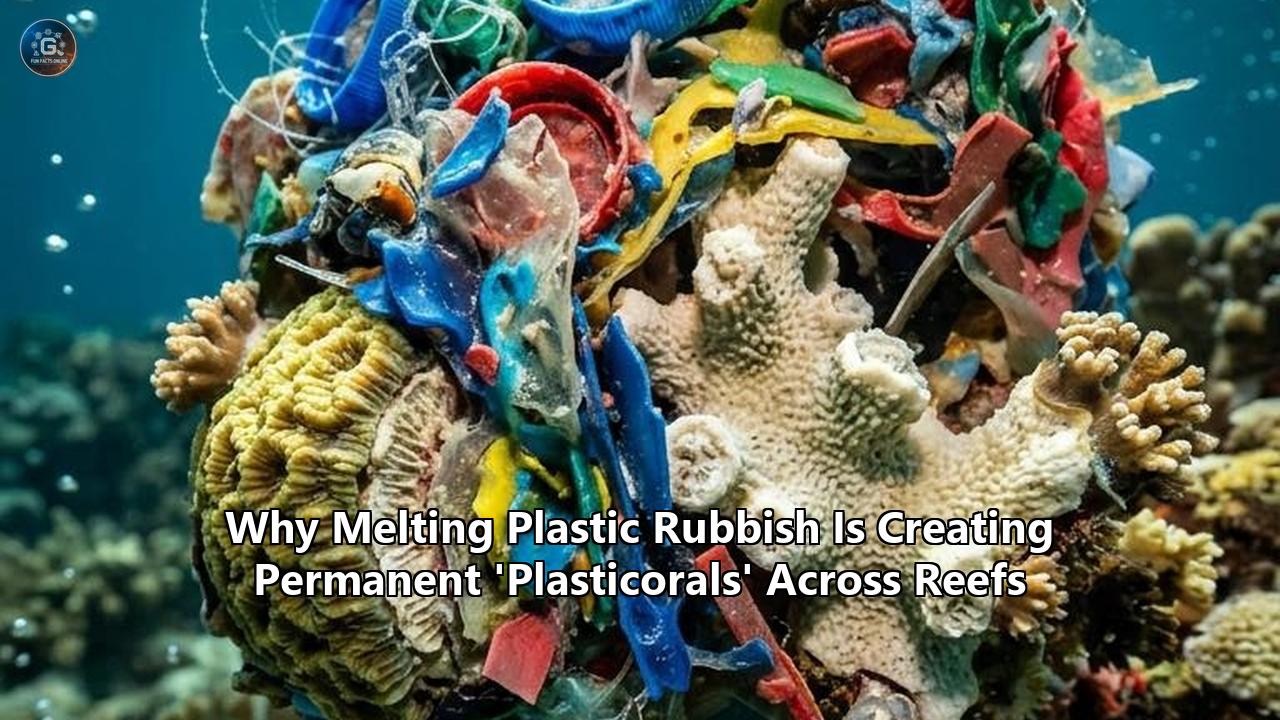
Spectroscopic scans of pale rubble collected along the shores of Yanbaru National Park in northern Okinawa, Japan, have confirmed the emergence of a new anthropogenic marine lithology: "plasticoral." In a study published in Marine Pollution Bulletin by researchers from the Okinawa Institute of Science and Technology (OIST) and the University of the Ryukyus, dead coral fragments measuring 20 to 30 millimeters in diameter were found inextricably fused with melted household polymers. Laboratory assays revealed that high-temperature open burning—specifically beach campfires and coastal refuse incineration reaching temperatures well beyond 600°C—has caused low-density polyethylene (LDPE) and polypropylene (PP) to liquefy and invade the microscopic pores of calcium carbonate skeletons.
The resulting hybrid material bridges biogenic aragonite and synthetic petrochemicals, locking non-biodegradable waste directly into the structural framework of coral reefs. This discovery comes at a precarious moment for global marine ecosystems. Scleractinian corals already face severe mortality: between 2023 and 2025, the National Oceanic and Atmospheric Administration (NOAA) documented that over 75% of global reef areas suffered bleaching-level heat stress, leaving vast tracts of fragile, dead skeletons behind.
Simultaneously, the input of plastic waste into marine environments continues its exponential climb. An estimated 11 to 14 million metric tons of synthetic polymers enter the marine environment each year, with cumulative plastic waste in marine ecosystems now surpassing 170 trillion particles floating in the water column alone. As thermal stress generates historic volumes of dead coral rubble and unmanaged coastal plastic disposal spikes, the open burning of beach debris is accelerating the formation of synthetic conglomerates. The infiltration of molten waste into the skeletal matrix alters the physical density of the rubble, leaches persistent toxic additives, blocks larval settlement, and permanently rewires the stratigraphy of fragile reef platforms.
+-----------------------------------------------------------------------------------------+
|                               PLASTICORAL FORMATION DYNAMICS                           |
+-----------------------------------------------------------------------------------------+
|                                                                                         |
|   Macroplastic Debris               Dead Coral Rubble                                   |
|   (LDPE, HDPE, PP Packaging)        (Pore throat diameters: 50–500 µm)                  |
|          │                                   │                                          |
|          ▼                                   ▼                                          |
|   Coastal Beach Fires / Incineration Pits (600°C – 900°C)                               |
|   * Exceeds polymer melting points (PE: 105–130°C; PP: 160–165°C)                       |
|   * Viscosity drops dramatically; surface tension triggers capillary action             |
|          │                                                                              |
|          ▼                                                                              |
|   Liquefied Polymer Penetration into Aragonite Pores                                    |
|   * Intrusive depth: 1.2 to 4.5 mm into skeletal framework                              |
|          │                                                                              |
|          ▼                                                                              |
|   Quenching via Tidal Inundation / Wave Action                                          |
|   * Rapid recrystallization locks polymer into pore throats                             |
|          │                                                                              |
|          ▼                                                                              |
|   Permanent Biogenic-Plastic Agglutinate: "PLASTICORAL"                                 |
|   * Physical Consequences: Decreased bulk density, altered hydrodynamics                |
|   * Chemical Consequences: PAHs (up to 18,400 ng/g), phthalates, bisphenols              |
|   * Ecological Consequences: 80% loss in CCA settlement, chronic larval mortality       |
+-----------------------------------------------------------------------------------------+
The Okinawa Discovery: Spectrometry and the Anatomy of Plasticoral
The field surveys led by Dr. Ifenna Ilechukwu and Professor James D. Reimer uncovered the specimens across multiple sites on Okinawa Island, most notably Ibu Beach and Sosu Beach. Both sites sit along the periphery of Yanbaru National Park, a protected UNESCO World Natural Heritage site renowned for subtropical biodiversity. The presence of synthetic deposits within a designated conservation reserve highlights the sheer reach of uncontained waste.
During macroscopic surveys of shoreline swash zones, researchers identified pale, wave-rounded coral rubble speckled with irregular blue, yellow, purple, and teal inclusions. Initial tactile and visual inspections indicated the colorations were not superficial paint transfers, macroalgal crusts, or epilithic biofilms. The foreign layers resisted manual detachment and scalpel scraping.
To identify the chemical composition and structural interface of the specimens, the OIST and University of the Ryukyus team subjected the fragments to non-destructive confocal Raman spectroscopy and high-resolution micro-computed tomography (micro-CT) scanning. The Raman spectral bands confirmed distinct chemical fingerprints:
- Polyethylene (PE): Characteristic sharp peaks observed at Raman shifts of 1,063 cm⁻¹ and 1,130 cm⁻¹ (representing C–C asymmetric and symmetric stretching), along with doublet peaks at 1,418 cm⁻¹ and 1,440 cm⁻¹ (representing CH₂ bending modes). PE accounts for roughly 36% of all global commodity plastic production.
- Polypropylene (PP): Strong spectral peaks detected at 809 cm⁻¹, 841 cm⁻¹, 973 cm⁻¹, and 1,152 cm⁻¹ (associated with CH₃ rocking and C–C skeletal backbone vibrations), and 1,458 cm⁻¹ (CH₃ asymmetric deformation). PP constitutes approximately 21% of worldwide synthetic polymer manufacturing.
Both polymers are the primary feedstocks for single-use packaging: polyethylene serves as the baseline resin for shopping bags, food wrappers, and squeeze bottles, while polypropylene dominates consumer bottle caps, woven strapping bands, and takeaway food containers.
Micro-CT reconstructions revealed that the interaction between the plastics and the coral was not a passive exterior film. Scleractinian coral skeletons consist of fibrous aragonite (calcium carbonate, CaCO₃) deposited by living polyps in highly intricate, porous patterns. High-resolution slice imaging demonstrated that molten plastic had flowed directly into the corallite calices and skeletal pore networks, achieving penetration depths between 1.2 and 4.5 millimeters beneath the exterior skeletal boundary.
"The melted polymers do not merely stick to the outside; they enter the small skeletal cavities and pores within the rubble, producing an integrated composite that cannot be separated by physical abrasion," said Dr. Ilechukwu. "This is an inseparable biogenic-plastic agglutinate. It is fundamentally different from a piece of line or a plastic bag snagged on a branch."
The OIST team mapped the pore throat diameters within the coral matrix, which typically range from 50 to 500 micrometers across branching species like Acropora and massive species such as Porites. At ambient tropical temperatures (25°C to 35°C), solid consumer plastics cannot deform to enter pores of this scale. Infiltration requires high heat to lower polymer viscosity to a fluid state, followed by capillary action that pulls the melted resin deep into the aragonite maze before cold seawater quenches the matrix into a permanent aggregate.
+-----------------------------------------------------------------------------------------+
|                  THERMAL AND VISCOUS PROPERTIES OF EMBEDDED RESINS                      |
+--------------------+-----------------------+-------------------+------------------------+
| Polymer Type       | Melting Point (°C)    | Degradation Temp  | Melt Flow Index (MFI)  |
|                    |                       | Range (°C)        | (g/10 min at 190°C)    |
+--------------------+-----------------------+-------------------+------------------------+
| LDPE (Low Density) | 105 – 115             | 380 – 450         | 0.3 – 20.0             |
| HDPE (High Density)| 125 – 135             | 390 – 460         | 0.1 – 10.0             |
| Polypropylene (PP) | 160 – 166             | 360 – 440         | 1.5 – 35.0             |
| Polystyrene (PS)   | 210 – 240 (glass 100) | 300 – 400         | 1.0 – 15.0             |
+--------------------+-----------------------+-------------------+------------------------+
Thermal Mechanics: The Physics of Beach Fire Agglutination
The thermodynamic conditions required to generate plasticorals point to human activity along the shoreline. Sunlight alone cannot trigger this process. Solar radiation on tropical shores can elevate dark sediment temperatures to 50°C to 65°C under direct midday exposure. While this thermal exposure accelerates photo-oxidative embrittlement and ultraviolet degradation, it falls well short of the melting threshold for high-density polyethylene (125°C–135°C) and polypropylene (160°C–166°C).
The primary driver is open combustion: shoreline bonfires, campsite firepits, and the open-air burning of uncollected municipal solid waste. Thermocouple measurements in open-air wood and driftwood beach fires reveal internal combustion cores that consistently hit 600°C to 900°C, with peripheral hot coal and sand zones maintaining temperatures between 250°C and 450°C for multiple hours.
When plastic waste is thrown into these fires or burned directly on beach sediment, the polymers pass through several thermal transitions:
- Glass Transition and Softening: As temperatures pass 100°C, crystalline domains within semi-crystalline polymers like LDPE and PP loosen, eliminating mechanical rigidity.
- Complete Viscous Melting: Between 160°C and 250°C, the resins fully liquefy into low-viscosity polymer melts.
- Pore Infiltration via Capillary Forces: The aragonite framework of dead coral rubble acts as a dense network of capillary tubes. The capillary driving pressure ($\Delta P$) operating on the fluid polymer is dictated by the Young-Laplace relation:
$$\Delta P = \frac{2\gamma \cos \theta}{r}$$
where $\gamma$ is the surface tension of the molten plastic (typically 20 to 30 mN/m for polyolefins at 200°C), $\theta$ is the contact angle between the liquefied polymer and the aragonite surface, and $r$ is the pore radius (25 to 250 $\mu$m). As the melt viscosity drops under sustained heat, capillary pressure drives the liquid polymer inward, displacing air from the skeletal pores.
- Thermal Quenching and Solidification: Once the fire burns down or high tides inundate the shoreline firepit, the molten matrix undergoes rapid cooling. Seawater at 20°C to 28°C quenches the infiltrated polymer within seconds, triggering recrystallization. The plastic shrinks slightly during phase change, creating a mechanical interlock that cements the plastic within the calcium carbonate structure.
At Sosu Beach, researchers discovered plasticoral samples resting directly within the charcoal residues of open beach firepits. This confirms that casual beach recreation, combined with unmanaged litter disposal, provides the thermal energy needed to turn short-lived consumer packaging into long-lasting geological artifacts.
+-----------------------------------------------------------------------------------------+
|                       PORE INTRUSION SPECTROMETRY & MECHANICS                           |
+-----------------------------+------------------------------------+----------------------+
| Coral Rubble Feature        | Value Range                        | Functional Impact    |
+-----------------------------+------------------------------------+----------------------+
| Skeleton Porosity           | 40% – 60% void volume              | High fluid capacity  |
| Pore Throat Diameter        | 50 – 500 µm                        | Rapid capillary draw |
| Infiltration Depth (CT-scan)| 1.2 – 4.5 mm                       | Structural bonding   |
| Bulk Density Shift          | -12% to -28% (vs. clean aragonite) | Increased mobility   |
+-----------------------------+------------------------------------+----------------------+
Field Evidence: From Indonesia to the Remote Atlantic
The Okinawa discovery adds to growing evidence that melted plastic is permanently altering coastal geology. In 2023, an expedition by a joint German-Indonesian research team led by Dr. Dwi Amanda Utami of Indonesia’s National Research and Innovation Agency (BRIN) and Dr. Lars Reuning of Kiel University documented similar hybrid formations on Panjang Island, located in the Java Sea off western Java.
The Panjang Island samples provided early evidence that unmanaged coastal waste disposal and coral fragments were forming composite rocks. On Panjang Island, where municipal refuse collection is non-existent, residents and transient visitors routinely burn piles of plastic rubbish along the high-tide line to clear space and eliminate trash.
The Kiel-BRIN researchers gathered 25 field samples of fused coral-plastic matrices and performed organic geochemical solvent extractions to examine their chemical makeup. The analyses showed that the samples were not chemically inert; the intense heat of open burning had caused partial thermal pyrolysis, saturating the samples with dangerous volatile pollutants.
+-----------------------------------------------------------------------------------------+
|                  CHEMICAL CONTAMINANTS EXTRACTED FROM FUSED SAMPLES                     |
+-------------------------------+--------------------------+------------------------------+
| Compound Class                | Concentration Range      | Ecotoxicological Threshold   |
|                               | (Panjang Island Study)   | Concern                      |
+-------------------------------+--------------------------+------------------------------+
| Low Molecular Weight PAHs     | 450 – 3,200 ng/g         | Acute cellular toxicity      |
| High Molecular Weight PAHs    | 1,200 – 18,400 ng/g      | Mutagenic / Carcinogenic     |
| Di-(2-ethylhexyl) phthalate   | 80 – 1,450 ng/g          | Endocrine disruption         |
| Di-n-butyl phthalate (DBP)    | 35 – 620 ng/g            | Larval motility suppression  |
| Triphenyl Phosphate (TPhP)    | 12 – 310 ng/g            | Neurotoxicity in teleosts    |
+-------------------------------+--------------------------+------------------------------+
"Our analyses demonstrate that plastiglomerates formed from coral debris and open burning are heavily enriched with organic pollutants," explained Dr. Reuning. "The combustion process generates polycyclic aromatic hydrocarbons (PAHs) and releases plasticizers such as phthalates directly into the matrix. These compounds are toxic, persistent, and classified as carcinogenic to marine organisms and humans."
The occurrence of heat-altered synthetic stones is now documented across multiple ocean basins:
- Kamilo Beach, Hawaii (2014): Dr. Patricia Corcoran, Charles Moore, and Kelly Jazvac identified the first classic "plastiglomerates," where melted plastic fused basalt pebbles, beach sand, and shell fragments within coastal bonfires.
- Madeira Island, Portugal (2016–2019): Dr. Ignacio Gestoso and colleagues reported "plasticrusts"—polyethylene coatings hardened directly onto rocky basalt intertidal shorelines via physical wave abrasion and sun-baking.
- Whitsand Bay, United Kingdom (2019): Dr. Andrew Turner identified "pyroplastics," rounded, pebble-like stones composed of burnt, weathered plastic debris that closely mimic natural geological gravel.
- Trindade Island, Brazil (2023): Fernanda Avelar Santos found plastic-sediment crusts on an isolated volcanic island located 1,140 kilometers offshore, a vital green sea turtle nesting sanctuary.
- Panjang Island, Indonesia (2023): Utami and Reuning identified the first coral rubble-dominated plastiglomerates caused by beachside waste incineration.
- Okinawa, Japan (2026): Ilechukwu and Reimer documented "plasticorals," demonstrating that melted polymers penetrate the internal pore systems of dead coral skeletons, creating a long-term biogenic-plastic hybrid.
+-----------------------------------------------------------------------------------------+
|                 GLOBAL TAXONOMY OF NOVEL ANTHROPOGENIC ROCK FORMS                       |
+------------------+-----------------------+-----------------------+----------------------+
| Classification   | Primary Mechanism     | Natural Substrate     | Key Geographic Sites |
+------------------+-----------------------+-----------------------+----------------------+
| Plastiglomerate  | Bonfire / Combustion  | Basalt, sand, shells  | Hawaii, Indonesia    |
| Plasticrust      | Wave shear / Friction | Intertidal bedrock    | Madeira, Giglio      |
| Pyroplastic      | Pyrolysis / Weathering| Synthetic mass only   | UK, Atlantic coasts  |
| Plastitar        | Tar adhesion          | Sand, gravel, rocks   | Canary Islands       |
| Anthropoquina    | Low-energy cementing  | Shelly beach sand     | Brazil               |
| Plasticoral      | Capillary melt draw   | Biogenic coral rubble | Okinawa, Indonesia   |
+------------------+-----------------------+-----------------------+----------------------+
These discoveries show that the global accumulation of plastic waste is no longer just littering the surface; it is altering coastal geology. Plastic is embedding itself within coastal geomorphology and marine substrate systems.
The Global Numbers: A Quantitative Breakdown of Reef Contamination
To understand why plasticorals are appearing with greater frequency, the phenomenon must be viewed against the larger issue of plastic pollution in oceans. Plastics represent the third most widely manufactured bulk material on Earth, trailing only concrete and steel. However, unlike concrete and steel, which weather into benign silicate, carbonate, and iron oxide minerals over decades or centuries, synthetic thermoplastic resins feature stable carbon-carbon backbones that resist natural chemical degradation for centuries.
+-----------------------------------------------------------------------------------------+
|                  GLOBAL PLASTIC INVENTORY AND FLUX METRICS (2026)                       |
+-------------------------------------------------------------+---------------------------+
| Metric Category                                             | Quantitative Value        |
+-------------------------------------------------------------+---------------------------+
| Cumulative Global Plastic Production (1950–Present)         | > 10.3 Billion Metric Tons|
| Annual Virgin Plastic Production (Global)                   | ~ 460 Million Metric Tons |
| Annual Aquatic Polymer Influx (Global Rivers and Coasts)    | 11 – 14 Million Metric Tons|
| Floating Pelagic Micro- and Macro-Debris Inventory          | > 170 Trillion Items      |
| Estimated Plastic Items Entangled in Asia-Pacific Reefs     | 15.7 Billion Items        |
| Share of Mismanaged Waste in Developing Coastal Nations     | 30% – 75%                 |
| Disease Risk Spike in Corals Contacting Entangled Plastic   | From 4% to 89% (22x rise) |
+-------------------------------------------------------------+---------------------------+
The scale of plastic waste on coral reefs was first systematically quantified in a study published in Science by Dr. Joleah Lamb and an international team of researchers. Surveying 159 coral reefs across four countries in the Asia-Pacific region—Australia, Indonesia, Myanmar, and Thailand—the researchers directly inspected 124,886 individual reef-building coral colonies for plastic entanglement and structural disease.
The study calculated that 11.1 billion macroplastic items were snagged on coral reefs throughout the Asia-Pacific region. Applying regional models of coastal population growth and waste management infrastructure, Lamb's team projected that this volume would expand by 40% to approximately 15.7 billion plastic items entangled on reefs by 2025.
The presence of macroplastics altered coral survival rates. The survey showed that when corals came into direct contact with plastic debris, the likelihood of developing lethal diseases jumped from 4% in uncontacted colonies to 89% in fouled colonies—a 22-fold increase in disease risk. The primary drivers of coral mortality identified were skeletal eroding band disease, white syndrome, and black band disease.
+-----------------------------------------------------------------------------------------+
|                      DISEASE PREVALENCE UNDER PLASTIC CONTACT                           |
+-----------------------------+----------------------------+------------------------------+
| Pathological State          | Pristine / No Contact      | In Direct Contact with Trash |
+-----------------------------+----------------------------+------------------------------+
| Overall Disease Likelihood  | 4.0%                       | 89.1%                        |
| White Syndromes             | 0.5%                       | 18.4%                        |
| Black Band Disease          | 0.2%                       | 6.1%                         |
| Skeletal Eroding Band       | 1.1%                       | 24.3%                        |
+-----------------------------+----------------------------+------------------------------+
Plastic debris functions as a floating transport hub for marine bacteria. Non-buoyant or snagged polymers cause micro-abrasions across sensitive polyp tissues, cutting through the protective mucus layer and introducing pathogenic bacteria, including Vibrio species and members of the Rhodobacteraceae family. The physical plastic also creates dark, anaerobic zones across the coral surface, starving the coral's symbiotic zooxanthellae (Symbiodiniaceae) of sunlight and oxygen.
Plasticorals present an even more permanent threat. While flexible plastic bags or fishing nets can slowly tear, drift away, or be removed by diver cleanups, plasticoral incorporates synthetic polymers directly into the reef's physical geology. Cleanups cannot remove this plastic without physically destroying the underlying reef framework.
The Rubble Engine: How Infiltrated Plastic Derails Reef Recovery
Coral reefs depend on dynamic cyclical processes. When storms, mechanical wave energy, bioerosion, or marine heatwaves kill branching corals (Acropora, Pocillopora, Montipora), their fragile branches shatter into loose skeletal rubble. These fragments wash ashore, forming gravel ramparts, or gather in shallow back-reefs and lagoons as expansive rubble fields.
In healthy marine ecosystems, this rubble is not waste; it is the essential raw substrate for reef regeneration:
- Pore and Cavity Shelters: The high porosity (40% to 60% void space) and complex shapes of coral rubble create critical habitat for cryptic fauna, including small crabs, stomatopods, polychaetes, echinoderms, and juvenile fish seeking refuge from wave energy and predators.
- Biogenic Cementation: Over three to ten years, uncompacted rubble stabilizes. Encrusting organisms—predominantly crustose coralline algae (CCA) such as Porolithon onkodes and Lithophyllum kotschyanum, alongside encrusting bryozoans and sponges—deposit high-magnesium calcite over the rubble. This biogenic cementation binds loose rubble into a solid, wave-resistant pavement.
- Larval Settlement: Floating planula larvae released during mass spawning locate these stabilized, CCA-crusted surfaces using precise chemical cues, settling down to build new, living coral colonies.
       HEALTHY REEF CYCLE                      PLASTICORAL DISRUPTION LOOP
     ┌───────────────────────┐                 ┌───────────────────────────┐
     │  Coral Mortality &    │                 │   Coral Mortality &       │
     │  Branch Breakage      │                 │   Branch Breakage         │
     └──────────┬────────────┘                 └─────────────┬─────────────┘
                ▼                                            ▼
     ┌───────────────────────┐                 ┌───────────────────────────┐
     │  Unconsolidated       │                 │ Coastal Inundation &      │
     │  Rubble Fields        │                 │ Beach Burning             │
     └──────────┬────────────┘                 └─────────────┬─────────────┘
                ▼                                            ▼
     ┌───────────────────────┐                 ┌───────────────────────────┐
     │  Cryptic Biodiversity │                 │ Capillary Melt Injection  │
     │  Colonizes Cavities   │                 │ ("Plasticoral" Forms)     │
     └──────────┬────────────┘                 └─────────────┬─────────────┘
                ▼                                            ▼
     ┌───────────────────────┐                 ┌───────────────────────────┐
     │  CCA Encrustation &   │                 │ Smothered Pores;          │
     │  Calcite Cementation  │                 │ Loss of Cryptofauna Space │
     └──────────┬────────────┘                 └─────────────┬─────────────┘
                ▼                                            ▼
     ┌───────────────────────┐                 ┌───────────────────────────┐
     │  Stable Hardground:   │                 │ CCA Cannot Encrust;       │
     │  New Coral Recruits   │                 │ Rubble Remains Unstable   │
     └───────────────────────┘                 └─────────────┬─────────────┘
                                                             ▼
                                               ┌───────────────────────────┐
                                               │ Chronic PAH/Leachate Flux;│
                                               │ Settlement Inhibition     │
                                               └───────────────────────────┘
Plasticoral breaks this regenerative cycle at every stage.
1. Loss of Cryptic Interstitial Space
When molten low-density polyethylene or polypropylene penetrates the surface cavities of rubble, it seals off internal pathways and micro-niches. Field density surveys in pristine rubble beds record between 1,200 and 4,500 cryptic invertebrates per kilogram of coral skeletal material.
When plastic melts into and coats these fragments, the reduction in available internal void volume ranges from 25% to over 70% in heavily penetrated fragments. This loss leaves small invertebrates exposed to predators and disrupts primary food sources for commercially valuable juvenile fish, including groupers (Serranidae) and snappers (Lutjanidae).
2. Disruption of Coralline Algal Cementation
Crustose coralline algae require bare, clean calcium carbonate or stable basalt substrates to deposit calcite. Polyolefin surfaces offer an incompatible foundation for biogenic calcification. Controlled settlement trials show that CCA coverage drops by more than 80% on surfaces coated with thin polyethylene or polypropylene films compared to bare aragonite controls.
Without CCA growth, loose coral rubble cannot knit into a solid foundation. Instead, the rubble continues to shift with every heavy swell and storm wave, grinding against surrounding corals and pulverizing new recruits in a persistent cycle of mechanical disturbance.
3. Suppression of Coral Larval Settlement
Coral planulae demonstrate acute chemical sensitivity during habitat selection. Free-swimming larvae of the major Indo-Pacific reef-builder Acropora tenuis rely on microbial and biochemical cues emitted by crustose coralline algae and associated bacterial biofilms to trigger downward settlement and metamorphosis.
When researchers expose settling larvae to water conditioned with plastic leachates—specifically phthalate plasticizers and burnt combustion byproducts—settlement rates decline sharply.
+-----------------------------------------------------------------------------------------+
|             ACROPORA TENUIS LARVAL RESPONSE TO PLASTICORAL LEACHATES                    |
+------------------------------------+-----------------------+----------------------------+
| Exposure Condition                 | Mean Settlement       | 96-Hour Larval             |
|                                    | Success (%)           | Mortality (%)              |
+------------------------------------+-----------------------+----------------------------+
| Clean Seawater Control             | 76.4 ± 4.2%           | 3.1 ± 0.8%                 |
| Unburned Coral Rubble Leachate     | 72.1 ± 5.1%           | 4.5 ± 1.2%                 |
| Unburned HDPE Leachate (10 g/L)    | 51.3 ± 6.8%           | 14.2 ± 2.6%                |
| Burnt Plasticoral Leachate (10 g/L)| 18.7 ± 3.9%           | 49.6 ± 5.4%                |
| Burnt Plasticoral Leachate (50 g/L)| 4.2 ± 1.1%            | 88.3 ± 6.2%                |
+------------------------------------+-----------------------+----------------------------+
Larvae exposed to leachates from thermally altered plasticorals exhibit erratic swimming behaviors, rapid ciliary degradation, and sharp drops in successful metamorphosis. At high leachate concentrations, mortality approaches 90% within 96 hours.
The combustion of plastic rubbish on shorelines transforms standard coral rubble—the essential nursery substrate of degraded reefs—into a chemically toxic deterrent that prevents the settlement of future coral generations.
Chemical Weathering and the Microplastic Pipeline
A primary danger of plasticorals is their role as long-term, distributed sources of secondary microplastics and chemical pollution in shallow waters.
When plastic waste floats in the open ocean, mechanical breakdown is buffered by water, which absorbs kinetic energy and keeps polymer temperatures close to the ambient sea surface temperature (20°C–30°C). Photo-oxidative degradation from solar UV rays still occurs, but rates remain slow because the surrounding water cools the material and biofouling algae block solar penetration.
On exposed beach faces, these dynamics change completely. In plasticorals formed by high-temperature fires, the polymers have already suffered extensive thermal degradation before ever reaching the sea. Thermal processing breaks the long polymer chains:
- High-temperature pyrolysis cleaves high-molecular-weight polyolefins into short, brittle hydrocarbon chains.
- Thermal oxidation incorporates oxygen-rich carbonyl groups ($C=O$), hydroxyl groups ($-OH$), and hydroperoxides into the synthetic backbone.
- Rapid cooling generates internal shear stresses throughout the polymer matrix.
+-----------------------------------------------------------------------------------------+
|                  POLYMER CHAIN DEGRADATION VIA THERMAL PYROLYSIS                        |
+-----------------------------------------------------------------------------------------+
|                                                                                         |
|   Virgin High-Molecular-Weight Polyethylene (Chain Length: > 10,000 units)              |
|   [ - CH₂ - CH₂ - CH₂ - CH₂ - CH₂ - CH₂ - CH₂ - CH₂ - CH₂ - CH₂ - ]n                   |
|                                                                                         |
|                                  │                                                      |
|                                  ▼  Thermal Pyrolysis (Beach Fires: 600°C – 800°C)      |
|                                                                                         |
|   Chain Scission & Oxygen Insertion (Chain Length: < 500 units)                         |
|   [ - CH₂ - CH₂ - C(=O) - CH₂ - ]  +  [ CH₂ = CH - CH₂ - CH₂ - ] (Oligomers)            |
|                                                                                         |
|                                  │                                                      |
|                                  ▼  Wave Action, Salt Abrasion, UV Exposure              |
|                                                                                         |
|   Rapid Fragmentation into Brittle Microplastics (< 5 mm) & Nanoplastics (< 1 µm)     |
|   * Up to 4.8x faster mechanical breakdown rate than virgin marine plastic pellets      |
+-----------------------------------------------------------------------------------------+
This chemically altered plastic is exceptionally fragile. When high tides and monsoon storm waves lift plasticorals from beach firepits and tumble them across the reef crest, the grinding action of wave-tossed sand and rubble acts as an abrasive mill.
Laboratory abrasion simulations conducted by environmental geochemists reveal that thermally degraded plastiglomerate and plasticoral fragments shed secondary microplastics (particles smaller than 5 millimeters) at rates 2.5 to 4.8 times faster than unburned virgin plastics exposed to the same hydrodynamic forces.
Rather than slowly releasing microplastics over decades, plasticorals shed high concentrations of irregular, micron- and nano-sized plastic fragments directly into the surrounding surf zone.
+-----------------------------------------------------------------------------------------+
|                     MICROPLASTIC GENERATION UNDER SHEAR FORCES                          |
+------------------------------------+----------------------+-----------------------------+
| Material Type                      | Microplastic Count   | Mean Particle Size          |
|                                    | (Particles/g/100 hrs)| Produced                    |
+------------------------------------+----------------------+-----------------------------+
| Pristine HDPE Pellet               | 14 ± 3               | 1,200 µm                    |
| Weathered Marine LDPE Film         | 48 ± 9               | 650 µm                      |
| Panjang Island Plastiglomerate     | 185 ± 28             | 180 µm                      |
| Burnt Okinawa Plasticoral Rubble   | 210 ± 34             | 145 µm                      |
+------------------------------------+----------------------+-----------------------------+
These generated microplastics fall within the 50 to 200 micrometer size range—the exact aperture size for suspension-feeding scleractinian polyps (Porites, Acropora, Montastrea). Corals rely on tactile contact and chemical chemoreceptors across their tentacles to catch planktonic prey. Microplastics that leach petroleum additives frequently trigger spurious feeding responses; polyps mistake synthetic particles for food and ingest them into their gastrovascular cavities.
Ingested particles cause physical gut impaction, mucosal ulceration, false satiation, and sharp declines in lipid energy reserves. In addition, microplastics accumulate within the coral's mesenterial filaments, causing tissue swelling and suppressing energy allocation toward egg and sperm production during seasonal mass spawning events.
+-----------------------------------------------------------------------------------------+
|                  CORAL ENERGY CONSUMPTION UNDER MICROPLASTIC FEEDING                    |
+------------------------------+---------------------------+------------------------------+
| Physiological Parameter      | Control Colony (Clean)    | Microplastic-Dosed Colony    |
+------------------------------+---------------------------+------------------------------+
| Daily Lipid Energy Reserves  | Baseline (100%)           | Depleted (-34.2%)            |
| Mucus Secretion Rate         | Normal                    | Elevated (+48.0% stress)     |
| Calcification Growth Rate    | 12.4 ± 1.1 mm/year        | 7.1 ± 0.9 mm/year            |
| Gamete Viability Post-Spawn  | 89.4%                     | 58.1%                        |
+------------------------------+---------------------------+------------------------------+
Stratigraphic Permanence: The Geological Horizon of the "Plasticene"
The emergence of plasticoral carries major implications that extend well beyond contemporary marine conservation. It confirms that human waste has crossed into the geological record, establishing unmistakable marker horizons for the Anthropocene epoch.
In formal stratigraphy, distinct epochs are defined by Global Boundary Stratotype Sections and Points (GSSPs)—physical markers in rock, sediment, or ice cores that denote planetary-scale shifts in Earth systems. Geologists studying sediment horizons from the mid-twentieth century onward have identified multiple synthetic markers:
- Radionuclide fallout signatures from atmospheric thermonuclear weapons testing (beginning in 1945, peaking in 1963).
- Fly ash and unburned spheroidal carbonaceous particles (SCPs) produced by high-temperature industrial coal combustion.
- Global isotopic shifts in atmospheric carbon dioxide ($\delta^{13}\text{C}$) triggered by massive fossil fuel consumption.
Plasticorals establish an enduring synthetic lithology within biogenic carbonate systems. Coral reefs are among the planet's most prolific natural limestone factories. Over millions of years, the accumulation, cementation, and burial of coral rubble and calcareous sand produces extensive reef limestone strata hundreds of meters thick.
When liquefied polyethylene and polypropylene penetrate the structural pores of dead coral skeletons, they create a chemically protected composite. While unbonded surface plastics exposed to sunlight and air eventually break down via photo-oxidation, plastics embedded deep inside aragonite matrices are shielded from ultraviolet rays.
As shifting tides, storms, and sand dunes bury these fragments beneath anaerobic marine sediment beds, the lack of molecular oxygen and sunlight halts photo-oxidative degradation entirely.
+-----------------------------------------------------------------------------------------+
|                  STRATIGRAPHIC PERSISTENCE OF COMMON REEF MATERIALS                     |
+--------------------------+------------------------------+-------------------------------+
| Material Composition     | Atmospheric Surface Lifespan | Deeply Buried Lifespan        |
+--------------------------+------------------------------+-------------------------------+
| Pure Cellulose / Wood    | 1 – 10 Years                 | Decades (forms lignite / coal)|
| Low-Carbon Steel         | 5 – 50 Years                 | Oxidizes into iron minerals   |
| Aragonite Coral Skeleton | Decades to centuries         | Millions of years (limestone) |
| Polyethylene in Aragonite| 100 – 500 Years              | Multi-Millennial Preservation |
+--------------------------+------------------------------+-------------------------------+
Because polyolefins possess high chemical stability in anoxic, alkaline carbonate environments, plasticorals can endure for tens of thousands to millions of years. Over geological time, diagenetic processes—where percolating groundwater dissolves calcium carbonate and reprecipitates it as dense calcite—will cement these plastic-infiltrated rubble beds into permanent limestone strata.
Future geologists drilling stratigraphic cores through ancient coastal basins will encounter distinct marker horizons dating from the mid-twentieth century onward: sedimentary strata marked by synthetic polymers, artificial colorants, and petrochemical residues directly embedded within natural coral frameworks.
"Plastic is the third most manufactured material globally, yet it persists far longer in sediment environments than steel or timber," noted Professor Reimer. "Future geologists will read this period, the Plasticene, directly through discrete plastic layers embedded in the Earth's crust. Plasticorals are concrete evidence that synthetic litter is writing itself into permanent geological history."
Spatial Modeling: Mapping Global Vulnerability Hotspots
Plasticorals are not isolated to Okinawa or the Java Sea. Their appearance is the predictable result of three converging environmental factors:
- High coastal coral rubble production, driven by recurring mass bleaching events and destructive tropical storms.
- High coastal plastic litter accumulation, driven by deficient terrestrial solid waste management infrastructure.
- Widespread unregulated open burning of waste directly along the high-water swash zone.
Overlaying global marine litter concentration models with coral reef mortality maps highlights extensive geographic zones where plasticoral formation is likely actively occurring unnoticed.
       GLOBAL VULNERABILITY CONVERGENCE MAP (HOTSPOTS)
  ┌──────────────────────────────────────────────────────────────────┐
  │                                                                  │
  │   [Tropical Storms / Thermal Bleaching: High Rubble Flux]        │
  │                              ▲                                   │
  │                              │                                   │
  │               ┌──────────────┴──────────────┐                    │
  │               │    PLASTICORAL HOTSPOTS     │                    │
  │               │ * Coral Triangle            │                    │
  │               │ * Bay of Bengal Coastlines  │                    │
  │               │ * Western Caribbean Arch.   │                    │
  │               │ * East African Swahili Coast│                    │
  │               └──────────────┬──────────────┘                    │
  │                              │                                   │
  │                              ▼                                   │
  │   [Inadequate Waste Infrastructure + Open Coastal Burning Pits]  │
  │                                                                  │
  └──────────────────────────────────────────────────────────────────┘
The primary global hotspot is the Coral Triangle, an expanse spanning Indonesia, Malaysia, the Philippines, Papua New Guinea, Timor-Leste, and the Solomon Islands. This region contains over 76% of all known coral species and nearly 30% of the world's coral reef surface area.
However, the Coral Triangle also experiences some of the world's highest rates of mismanaged plastic waste. In many coastal archipelagos, municipal solid waste collection covers less than 40% of households.
Without land-based waste infrastructure, coastal residents use the ocean as a disposal sink or pile household refuse onto beaches and set it on fire at low tide. Because the beaches of these tropical islands are composed almost entirely of dead coral sand and aragonite rubble, the conditions for plasticoral formation occur continuously.
+-----------------------------------------------------------------------------------------+
|                  REGIONAL PLASTICORAL FORMATION RISK INDEX (PFRI)                        |
+--------------------------+-----------------------+--------------------+-----------------+
| Region                   | Coral Rubble Supply   | Coastal Plastic    | Overall Risk    |
|                          | Index (0–10)          | Leakage (MT/yr)    | Classification  |
+--------------------------+-----------------------+--------------------+-----------------+
| Central/East Indonesia   | 9.2 (Severe bleaching)| 0.55 Million       | Extreme         |
| Western Philippines      | 8.8 (Typhoon damage)  | 0.38 Million       | Extreme         |
| Bay of Bengal / Andaman  | 7.4 (Monsoon dynamics)| 0.29 Million       | High            |
| Ryukyu Arc (Okinawa)     | 6.8 (Typhoon/Tourism) | 0.04 Million       | High (Observed) |
| East African Coastline   | 7.9 (Thermal stress)  | 0.18 Million       | High            |
| Red Sea Fringing Reefs   | 4.2 (High tolerance)  | 0.06 Million       | Moderate        |
| Great Barrier Reef       | 8.5 (Mass bleaching)  | <0.01 Million      | Low (Regulated) |
+--------------------------+-----------------------+--------------------+-----------------+
Regions like the Great Barrier Reef in Australia experience high volumes of coral rubble from mass bleaching events, but strict bans on coastal campfires and comprehensive land-based municipal waste collection keep the risk of plasticoral formation low.
Conversely, across the archipelagos of Southeast Asia, East Africa, and sections of the Caribbean, high coral mortality and unmanaged coastal waste combustion frequently overlap. In these areas, the transformation of coral rubble into persistent plasticorals is likely widespread, operating unmonitored across thousands of kilometers of remote shorelines.
Economic Costs and the Breakdown of Mitigation Infrastructure
The formation of plasticorals complicates marine remediation efforts and damages coastal blue economies. Traditional plastic pollution in oceans can be addressed through mechanical cleanups: beach cleanups, floating boom barriers at river mouths, trash interceptor vessels, and diver-led sweeps to remove snagged nets and debris.
These interventions rely on one fundamental operational reality: the plastic remains physically distinct from the natural environment.
Plasticoral invalidates that principle. Because the synthetic polymer is bound deep within the pore channels of the aragonite rubble, it cannot be gathered with rakes, sorted with sieves, or separated in mechanical floatation tanks. Physical removal requires either hand-picking individual stones from billions of pieces of natural rubble or using diamond-tipped masonry saws to cut the synthetic sections away.
Chemical extraction requires industrial solvents like hot xylene, toluene, or concentrated acids that dissolve the limestone skeleton, methods that cannot be deployed in natural marine environments. Once plastic transforms into plasticoral, it cannot be recovered through conventional cleanups.
+-----------------------------------------------------------------------------------------+
|                 REMEDIATION COST COMPARISON PER METRIC TON OF WASTE                     |
+------------------------------------+------------------------+---------------------------+
| Waste Remediation Class            | Cost Range (USD / Ton) | Technical Feasibility     |
+------------------------------------+------------------------+---------------------------+
| Municipal Terrestrial Collection   | $40 – $120             | Mature industrial standard|
| River Mouth Boom Interception      | $150 – $450            | High efficiency           |
| Mechanical Beach Sifting (Litter)  | $600 – $1,800          | Effective on loose macro  |
| Diver Removal (Snagged Reef Nets)  | $4,500 – $15,000       | Labor intensive, risky    |
| Plasticoral Extraction & Treatment | $85,000 – $250,000+    | Economically unviable     |
+------------------------------------+------------------------+---------------------------+
The financial impacts ripple across regional coastal economies:
- Reef Fishery Collapse: Coral rubble beds provide essential nursery habitats for juvenile reef fish. The loss of interstitial shelter space and the influx of endocrine-disrupting chemicals lower recruitment rates for coastal artisanal fisheries, an industry valued globally at more than $6.8 billion annually.
- Coastal Tourism Decline: Dive and snorkel tourism contributes over $36 billion annually to global gross domestic product. The degradation of white sand beaches and clear coral shores into graying gravel fields littered with burnt, plastic-fused composite stones undermines the aesthetic appeal of premier eco-tourism destinations.
- Loss of Natural Shoreline Protection: Healthy coral reefs and cemented rubble ramparts absorb up to 97% of incident wave energy, shielding coastal infrastructure from storm surges and erosion. Uncemented, plasticoral-dominated rubble fields fail to consolidate, leaving low-lying tropical islands and coastal settlements vulnerable to wave damage during severe typhoons.
Governance Horizons: Policy Interventions and Analytical Milestones
Addressing plasticoral formation requires moving beyond generic marine litter awareness campaigns. Halting this process requires interventions targeting the specific chemical, thermal, and regulatory drivers that create these synthetic rocks.
       TARGETED INTERVENTION POINTS ALONG THE CAUSAL CHAIN
  ┌─────────────────────────────────────────────────────────────┐
  │ 1. Production Phase:                                        │
  │    Mandate reduction caps on single-use polyolefins;        │
  │    Phase out toxic additives (phthalates, aryl phosphates)  │
  └──────────────────────────────┬──────────────────────────────┘
                                 │
                                 ▼
  ┌─────────────────────────────────────────────────────────────┐
  │ 2. Waste Disposal Phase:                                    │
  │    Ban open coastal burning pits and shorefront incinerators;│
  │    Deploy localized, enclosed pyrolysis/gasification plants │
  └──────────────────────────────┬──────────────────────────────┘
                                 │
                                 ▼
  ┌─────────────────────────────────────────────────────────────┐
  │ 3. Shoreline Recreation Phase:                              │
  │    Enforce campfire and open flame bans across MPAs;        │
  │    Establish designated elevated fire pits with ash catchers│
  └──────────────────────────────┬──────────────────────────────┘
                                 │
                                 ▼
  ┌─────────────────────────────────────────────────────────────┐
  │ 4. Monitoring & Geochemical Mapping:                        │
  │    Include biogenic agglutinates in national marine audits; │
  │    Deploy Raman spectrometry to track sediment contamination│
  └─────────────────────────────────────────────────────────────┘
Three immediate priorities emerge from the findings in Okinawa and Indonesia:
- Strict Fire Prohibitions within Marine Protected Areas: Coastal management authorities must recognize beach fires as chemical transformation sites rather than harmless recreational activities. Banning open ground fires along sandy and rubble-dominated beaches within Marine Protected Areas (MPAs)—such as Yanbaru National Park—is the most immediate step to prevent the thermal synthesis of new plasticorals. Fire regulations must be paired with designated, elevated fire braziers that prevent coals and molten slag from contacting natural sediment.
- Elimination of Open-Air Coastal Trash Burning: Unregulated waste burning on beaches stems directly from the failure of terrestrial solid waste infrastructure. Governments in tropical archipelagos must prioritize municipal waste collection along coastal zones, establishing clean waste-to-energy infrastructure or closed-vessel incineration systems that capture hazardous flue gases, eliminating the reliance on open-air beach firepits.
- Establishing Legally Binding Caps in Global Plastics Treaties: Ongoing negotiations under the United Nations Intergovernmental Negotiating Committee (INC) on Plastic Pollution must target upstream polymer production limits alongside downstream waste infrastructure. While downstream collection prevents litter from reaching shorelines, limiting total production of persistent single-use packaging resins—particularly low-density polyethylene and polypropylene—is the only systemic solution to slow the influx of plastic into ocean ecosystems.
The immediate research priorities are equally urgent. The team at OIST, alongside international geochemical research networks, has outlined key scientific milestones required over the next 24 to 36 months:
- Standardizing Field Survey Protocols: Establishing formal spectroscopic and imaging criteria to identify, catalog, and record plasticorals in ongoing national beach litter assessments and citizen science platforms like ReefLitter.com.
- Long-Term Leachate Kinetics: Conducting laboratory flow-through experiments to measure the multi-year leaching rates of polycyclic aromatic hydrocarbons, phthalate plasticizers, and bisphenols from weathered plasticorals into surrounding sediments and the water column.
- Ecotoxicological Assays on Calcifying Organisms: Quantifying the specific molecular and cellular impacts of plasticoral runoff on crustose coralline algae growth, microbial biofilm composition, and the settlement success of endangered scleractinian corals.
- Global Baseline Mapping: Conducting systematic core sampling across historic coastal firepit sites and remote island shores throughout the Indo-Pacific and Caribbean basins to determine how widely plasticorals have already formed.
The discovery in Okinawa demonstrates that the impacts of human consumer waste are fundamentally evolving. The crisis of plastic pollution in oceans is no longer just an aesthetic blight of bobbing bottles or drifting nets that can be gathered and carted away.
Through intense heat and coastal fires, synthetic packaging is merging with the skeletal remains of dead coral reefs, penetrating their internal channels and turning biological foundations into toxic, artificial stone. The boundaries between synthetic trash and natural geology are breaking down. Without decisive action to eliminate coastal burning and cap polymer production, these hybrid formations will continue spreading throughout tropical ecosystems, embedding the chemical signature of the Anthropocene permanently into the living architecture of the world's oceans.
Reference:
- https://www.eurekalert.org/news-releases/1144522?language=japanese
- https://www.oist.jp/news-center/news/2026/9/18/new-form-plastic-pollution-discovered-shores-vulnerable-coral-reefs
- https://reeflitter.com/plasticoral-when-plastic-becomes-embedded-in-coral-reef-environments/
- https://www.oist.jp/news-center/news/2026/9/18/new-form-plastic-pollution-discovered-shores-vulnerable-coral-reefs
- https://www.facebook.com/physorg/posts/1571161435039239/
- https://ecomagazine.com/news/coastal/okinawa-researchers-uncover-plasticorals-among-coral-rubble/
- https://www.forbesindia.com/article/lifes/plastiglomerate-rocks-made-up-of-plastic-waste-and-coral-rubble-identified-in-indonesia/87067/1
- https://www.forbesindia.com/article/lifes/plastiglomerate-rocks-made-up-of-plastic-waste-and-coral-rubble-identified-in-indonesia/87067/1
- https://news.mongabay.com/2023/08/plastics-waste-marine-ocean-beaches-pollution-plastiglomerate-pyroplastic-plasticrust/
- https://www.eurekalert.org/news-releases/996209
- https://cals.cornell.edu/news/2018/01/oceanic-plastic-puts-coral-reefs-peril
- https://particle.scitech.org.au/earth-water/plastic-trash-the-new-threat-for-coral-reefs-worldwide/
- https://www.researchgate.net/publication/385788245_Assessment_of_marine_litter_interactions_with_urban_coral_reefs_in_Okinawa_Japan
- https://rescueareef.earth.miami.edu/media/diving-deeper/its-a-plastic-world-the-emerging-threat-to-reef-building-corals/index.html
- https://www.facebook.com/physorg/posts/1571161568372559/
- https://reeflitter.com/plasticoral-when-plastic-becomes-embedded-in-coral-reef-environments/
- https://reeflitter.com/category/plastiglomerates/