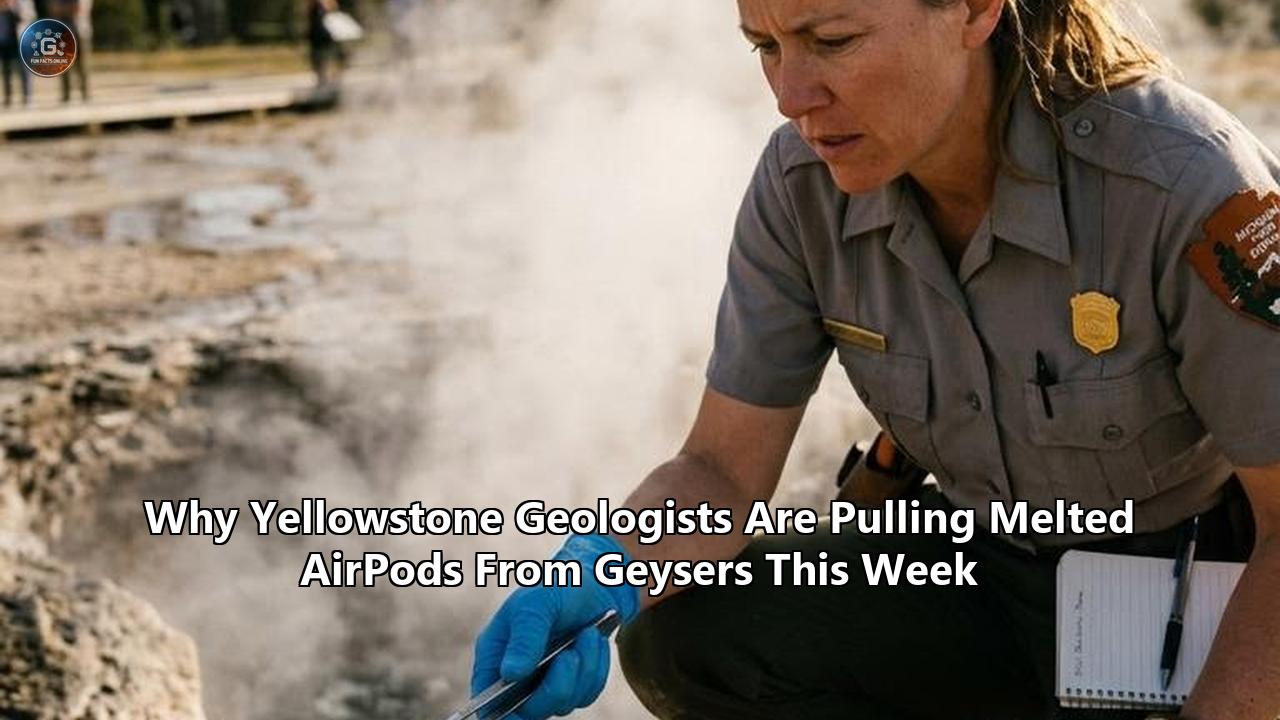
The telescoping pole extends twenty-two feet over the steaming cerulean water, its carbon-fiber rod bowing under its own weight. At the far end, affixed with industrial zip-ties and hose clamps, sits a custom stainless steel mesh strainer. A technician in a fire-retardant suit and a bright red National Park Service safety vest braces her boots against the grooved wooden planks of the Midway Geyser Basin boardwalk. Below her, the crust of siliceous sinter is little more than two inches thick—a brittle, chalky shell of precipitated silica rock suspended over a boiling aquifer registering 198 degrees Fahrenheit.
A sudden gust of wind sweeps across the lodgepole pine flats, whipping steam into the technician’s face. She maneuvers the basket beneath the water’s surface, scoops, and lifts.
What emerges from the depths of the hydrothermal feature is not a natural rock core or a bacterial mat sample. It is a tiny, warped mass of brilliant white polycarbonate, partially blistered and sealed with calcified mineral crusts. Upon closer inspection with stainless steel tweezers, the object reveals itself: an Apple AirPods Pro charging case, its magnetic hinge melted shut, with a single disfigured earbud fused to its internal cradle. Inside, a miniature lithium-ion cell sits entombed in boiling, mineralized geothermal brine.
This week, the Yellowstone Volcano Observatory (YVO) and the Yellowstone National Park Geology Program published their 2026 Hydrothermal Remediation Report, detailing the physical debris extracted by scientific crews across the park’s fragile thermal basins. The figures represent a historic high. Field crews retrieved more than 20,100 pieces of human-made garbage, 5,600 thrown rocks and sticks, and over 280 windblown hats from the park's thermal vents, springs, and runoff channels—a staggering 50 percent jump in litter removal compared to the previous year.
Among the recovery hauls from basins like Upper Geyser, Midway, and Norris were dozens of items that reflect modern consumer technology: five separate pairs of AirPods, camera drone fragments, high-end optical lens caps, vape pens, orthodontic aligners, and even instant Polaroid photographs depicting the very geothermal pools into which they fell.
What sounds like a comical catalog of tourist absentmindedness is, beneath the surface, an ecological and geological emergency. Yellowstone’s geysers are not bottomless pits or self-cleaning cauldrons. They are exquisitely balanced, pressurised plumbing networks that rely on ultra-specific conduits, temperatures, and convective fluid dynamics to survive. When modern consumer waste—loaded with synthetic polymers, microchips, and hazardous battery chemistry—enters these boiling labyrinths, it triggers a chain reaction of mineral crystallization, thermodynamic cooling, and conduit choking that can permanently silence a geyser.
Park geologists are now racing to uncover how modern synthetic garbage interacts with geothermal fluids, following an evidence trail that reveals how small consumer devices threaten to irreparably alter some of the planet’s oldest hydrothermal landscapes.
The Evidence Locker at Mammoth Hot Springs
Inside the Yellowstone Center for Resources in Mammoth Hot Springs, the laboratory air carries a faint trace of sulfur dioxide mingled with damp, drying textiles. Across four long stainless steel examination tables lie the forensic spoils of the summer season.
Margery Price, a physical science technician with the Yellowstone National Park Geology Program and lead author of the recent debris assessment, uses nitrile-gloved hands to organize the objects into taxonomic trays.
"People look at a thermal feature and see water, so their brain registers it as a pond or a drain," Price explains, holding up a specimen tray. "They don't realize they are looking at the delicate surface expression of a massive, superheated subterranean engine. Every single foreign object introduced to that system changes the physics."
The inventory laid out before her reads like an eccentric estate sale crossed with an e-waste processing facility:
- 54 camera lens caps, mostly 58mm and 67mm rings fumbled by amateur photographers leaning over thermal safety railings.
- 36 pairs of sunglasses, ranging from cheap plastic frames to designer metal aviators with polarized glass.
- 47 hair accessories, including claw clips and elastomeric bands.
- 17 pacifiers, commonly dropped from strollers along the boardwalk paths.
- Five Apple AirPods and wireless earbuds, their exterior casings deformed into bulbous, melted teardrops by continuous immersion in near-boiling water.
- 15 acrylic fake fingernails, swept off fingers by high thermal humidity and friction.
- $18.42 in domestic and international coins, along with paper currency from Mexico, Canada, and the European Union.
- Bizarre oddities, including a two-inch miniature copy of The Vampire Diaries, four Pokémon trading cards, plastic toy dinosaurs, an Uno card, and three vintage airline flight attendant pins.
In cataloging this surge of yellowstone geyser trash, Price’s team is tracking a clear shift in visitor demographics and technology. A generation ago, park caretakers mostly retrieved wooden walking sticks, wool caps, and glass soda bottles. Today, the debris consists predominantly of featherlight consumer plastics, non-biodegradable silicones, and high-density electronics.
"The AirPods are a distinctly modern phenomenon," Price observes. "Visitors walk along the boardwalks with active noise cancellation turned on to block the sound of the wind, leaning their heads over the thermal pools to take selfies. A gust catches their hat, they startle, their jaw moves, the earbud slips out of the concha of their ear, bounces once on the wooden curb, and rolls directly into a boiling vent. Within seconds, that device is sinking into an active hydrothermal conduit."
The physical condition of the recovered electronics offers an alarming window into geothermal geochemistry. The five AirPods retrieved this summer show varying stages of destruction. The white glossy exterior—manufactured from a specialized blend of acrylonitrile butadiene styrene (ABS) and polycarbonate—has a heat deflection temperature of roughly 185 to 210 degrees Fahrenheit. Yellowstone’s neutral-to-alkaline chloride springs sit persistently at 198 to 205 degrees Fahrenheit at park elevations, effectively softening the thermoplastic shells into putty.
Under a stereomicroscope, the laboratory team discovered that hydrothermal fluids had breached the sonic acoustic meshes of the earbuds within minutes of immersion. Inside the charging cases, the lithium-ion batteries showed signs of catastrophic structural degradation: electrolyte leakage, casing swelling, and chemical blistering driven by prolonged hydrothermal poaching.
The Subterranean Choke: Physics of a Hydrothermal Engine
To understand why a pair of plastic earbuds or a cluster of camera accessories matters to a thermal pool, one must follow the fluid underground.
Yellowstone’s geysers are rare geological phenomena. Of the roughly 1,000 geysers active on Earth, more than half are concentrated within the 3,472 square miles of Yellowstone National Park. Their operation requires three non-negotiable components: an intense subterranean heat source supplied by the Yellowstone hotspot’s rhyolitic magma chamber; an abundant, continuous supply of groundwater derived from snowmelt filtering through porous volcanic rock; and a pressure-tight, constricted subterranean plumbing system capable of withstanding immense hydraulic forces.
A geyser is not an open, smooth-walled pipe. It is a labyrinth of fractures, subterranean cavities, and narrow choke points carved through volcanic rhyolite. As cold meteoric water percolates miles into the Earth’s crust, it is superheated by underlying magma to temperatures well above 400 degrees Fahrenheit. Because this water is under immense hydrostatic pressure from the massive weight of the water column above it, it cannot boil. It remains liquid, supercharged with dissolved minerals—chiefly silicon dioxide ($SiO_2$) leached from the rhyolite rock.
As this superheated water becomes buoyant and ascends through the plumbing network, it encounters subterranean narrowings. In these narrow necks, convective mixing is restricted. Deep within the conduit, a portion of the water finally reaches its pressure-dependent flash point and explodes into steam bubbles. Steam occupies roughly 1,600 times the volume of liquid water. This sudden expansion lifts the overlying water column, causing water to spill over the vent rim at the surface.
That initial spill reduces the weight of the water column, instantly dropping the hydrostatic pressure throughout the entire subterranean pipe. Relieved of pressure, the superheated water below flashes into a chain reaction of explosive vaporization, hurtling thousands of gallons of boiling water and steam high into the air.
This system hinges upon narrow conduits. The moment foreign objects enter the vent, the mechanics falter.
"Geyser plumbing is analogous to the human cardiovascular system," explains Dr. Michael Poland, a research geophysicist and the Scientist-in-Charge of the Yellowstone Volcano Observatory. "A geyser requires precise flow dynamics and narrow constrictions to build explosive pressure. If you introduce debris—whether it is an accumulation of coins, cell phones, dropped garments, or modern plastic trash—you are effectively introducing arterial plaques. The hydraulic flow is restricted, the temperature distribution is disrupted, and the convective cycle can collapse completely."
When foreign items sink into a geyser’s throat, they do not remain passive. Because Yellowstone's thermal waters are saturated with dissolved silica, any solid object becomes an immediate nucleation site for mineral precipitation. The superheated water, cooling slightly as it nears the surface, sheds its dissolved mineral load, depositing amorphous opal-A silica, known as siliceous sinter or geyserite.
Within weeks, a foreign item dropped into a hydrothermal conduit does not just sit in the channel; it becomes cemented into the rock wall. The silica wraps around the object, fusing it with fallen river rocks, gravel, and natural sediment, transforming a flexible plastic casing or a metallic battery into an immovable, synthetic calcified dam.
Subterranean Geyser Throat
=====================================================
[ Superheated Water Ascent: >200°F (93°C)+ ]
                  │
                  ▼
[ Constriction Point / Vent Neck ]
   ├── Natural Silica Sinter Wall
   ├── Foreign Object: Melted Polycarbonate / Battery
   └── Silica Precipitation: Rapid Opal-A Cementation
                  │
                  ▼
[ Mechanical & Thermodynamic Consequences ]
   ├── Narrowed Hydraulic Cross-Section (Clogging)
   ├── Disrupted Convective Circulation (Temperature Plunge)
   └── Subterranean Overpressurization OR Vent Suffocation
=====================================================
The Cautionary Ghosts: Minute Geyser and Solitary’s Logs
Yellowstone’s history contains grim warnings of what happens when foreign material obstructs hydrothermal conduits. Park geologists frequently point visitors to two historical case studies: Minute Geyser and Solitary Geyser.
Minute Geyser, located along the trail in Norris Geyser Basin, was once one of the most reliable and dramatic displays in the park. In the late 19th and early 20th centuries, when the main stagecoach road passed within 70 feet of the feature, Minute erupted every sixty seconds, hurling plumes of boiling water 40 to 60 feet into the air. Travelers waiting for stagecoach connections regularly passed the time by throwing objects into its cavernous western vent.
They threw stones, horse shoes, coins, and silver dollars. Over several decades, this persistent vandalism took a toll. In 1947, a massive rock was jammed deep into the throat of Minute Geyser’s primary conduit.
The superheated waters were unable to dislodge the boulder. Instead, the silica-saturated fluid did what it always does: it precipitated millions of tiny layers of mineral sinter around the rock, cementing it permanently to the conduit walls. The main vent of Minute Geyser was choked.
The geyser never recovered. Today, Minute Geyser’s large western vent is silent, dry, and dead. The subterranean energy, unable to escape through its primary throat, forced its way into an adjacent, diminutive secondary fissure to the east, where it now spouts irregularly, reaching heights of only one to three feet. The original 60-foot column of water is gone forever, smothered by tourist debris. Park service records note that clearing the rock today would require heavy pneumatic machinery and diamond-tipped drilling rigs, an intervention that would pulverize the surrounding fragile thermal formation.
Decades later, the threat took a different form at Solitary Geyser, situated on a hillside above the Upper Geyser Basin. In the early 20th century, Solitary was tapped to supply hot water for a swimming pool at the Old Faithful Inn, lowering its water level and triggering regular eruptions. But visitors continuously used the thermal basin as a disposal pit.
By the time the Yellowstone Geology Program launched an extensive remediation of Solitary Geyser in 2021, the feature was dying. Technicians operating heavy-duty grappling hooks and telescoping poles pulled more than 15 waterlogged timber logs out of the throat—the largest weighing an astonishing 90 pounds—along with basketball-sized rocks and hundreds of smaller debris fragments. Like Minute Geyser, much of this debris had already begun to be cemented into place by silica sinter and required surgical extraction to prevent the complete destruction of the feature's conduit.
Now, the composition of that debris has shifted from heavy logs and limestone rocks to micro-components and consumer plastics. The mechanisms of destruction, however, remain identical.
The Chemical Arsenal: Batteries in the Boiling Cauldron
While a dropped pine branch or a field stone represents a mechanical obstruction, modern yellowstone geyser trash poses an entirely unprecedented geochemical threat. Consumer electronics introduce toxic reagents into an ecosystem that evolved in their absence.
The five AirPods pulled from Yellowstone’s basins this summer each contained two distinct lithium-ion battery cells: a button-style cell inside the earbud (typically a rechargeable lithium cobalt oxide coin cell, such as a CP1154 or A1664) and a larger pouch-style lithium-ion cell housed within the charging dock.
Chemical Anatomy of a Hydrothermal Battery Breach
┌────────────────────────────────────────────────────────┐
│  Polycarbonate / ABS Exterior Shell                    │
│  [Thermal Softening & Deformation: 185°F - 210°F]      │
│                         │                              │
│                         ▼                              │
│  Hydrothermal Fluid Ingress (pH 1.5 - 9.0 Brine)       │
│                         │                              │
│                         ▼                              │
│  Lithium-Ion Battery Internal Degradation:              │
│  ├── Lithium Hexafluorophosphate (LiPF6) Electrolyte   │
│  ├── Lithium Cobalt Oxide (LiCoO2) Cathode             │
│  ├── Graphitic Carbon Anode                            │
│  └── Copper & Aluminum Current Collectors              │
│                         │                              │
│                         ▼                              │
│  Leachate Plume: Dissolved Co, Ni, Li, Cu, and HF      │
│                         │                              │
│                         ▼                              │
│  Ecological Impact: Direct Toxicity to Hyperthermophiles│
└────────────────────────────────────────────────────────┘
When an electronic device drops into a hot spring or geyser vent, it enters an aggressive geochemical bath. Depending on the basin, Yellowstone waters range from highly alkaline, silica-saturated sodium-chloride solutions (such as those in Upper Geyser Basin, with a pH of 8 to 9) to fiercely acidic, sulfuric-acid-rich cauldrons (such as Norris Geyser Basin, where the pH can plummet to 1.5—acidic enough to dissolve cotton fabric in hours).
Under temperatures hovering near water's boiling point, standard consumer battery seals fail rapidly. As the polymer casing warps, water breaches the internal components.
The consequences are manifold:
- Electrolyte Hydrolysis: Most lithium-ion cells utilize an organic carbonate solvent containing dissolved lithium hexafluorophosphate ($LiPF_6$). When water breaches the battery core, $LiPF_6$ reacts vigorously with $H_2O$ in an exothermic hydrolysis reaction:
$$LiPF_6 + H_2O \rightarrow LiF + POF_3 + 2 HF$$
This reaction yields hydrofluoric acid ($HF$), one of the most corrosive acids known to chemistry, capable of attacking and dissolving silicates and biological structures alike.
- Heavy Metal Leaching: As the battery's protective casing disintegrates, the internal electrodes begin to break down. The cathode material—typically lithium cobalt oxide ($LiCoO_2$) or nickel-manganese-cobalt (NMC)—dissolves into the surrounding thermal pool. Heavy metals including cobalt, nickel, manganese, and copper are released directly into the water column. In neutral or acidic waters, these transition metals form soluble ionic complexes, contaminating pristine hydrothermal fluids that have circulated deep within the continental crust for centuries.
- Polymer Degradation and Microplastics: Polycarbonate and ABS shells immersed in alkaline, boiling hydrothermal environments undergo accelerated thermal and hydrolytic degradation. The polymer chains break down, shedding millions of sub-micron plastic particles. These synthetic particles integrate into the fragile colloidal silica suspensions that form geyserite sinter, contaminating the geological rock record with microplastics.
"People assume that a hot spring is like an industrial acid bath that just 'eats' things until they are gone," says Dr. Brent Peyton, director of the Thermal Biology Institute at Montana State University. "That is a fundamental chemical misunderstanding. Matter doesn't vanish. When you boil an electronic device, you are merely accelerating its decomposition into solution. You are transforming a solid electronic component into a dissolved chemical plume of lithium, cobalt, organic carbonates, and synthetic plasticizer compounds."
Murdering the Blue: Thermodynamic Suffocation and Color Death
The impact of human trash in Yellowstone's thermal features is not a theoretical model; it is permanently stamped across the park's visual geography. Its most tragic physical manifestation is the Morning Glory Pool.
Located near the northern terminus of the Upper Geyser Basin trail, Morning Glory was once widely regarded as the crown jewel of Yellowstone's thermal springs. In the late 19th century, early naturalists named it for its resemblance to the morning glory flower: a bottomless, pure, luminous cobalt-blue pool, free of surface algae and fringed with pure white mineral sinter.
Today, Morning Glory is almost unrecognizable. Its deep waters are a murky, sickly yellow-green, ringed with dense concentric halos of orange, rust-red, and muddy brown.
The reason for this biological transformation was investigated in a landmark study published by optical physicists and environmental engineers from Montana State University and the National Park Service. The researchers created a sophisticated mathematical model simulating the optical properties, water depth, and microbial biology of the pool to deduce why its color shifted so drastically.
The culprit was not an earthquake or a shift in the park's magma body. It was thousands of pounds of trash tossed into the vent by visitors.
The Morning Glory Optical Shift
┌────────────────────────────────────────────────────────┐
│  PRISTINE STATE (Pre-1950s)                            │
│  Conduit: Clear, Unobstructed Upwelling                │
│  Temperature: >165°F (74°C)                           │
│  Biological Life: Sterile in Center (Too Hot)          │
│  Optics: Pure Rayleigh Scattering & Red Absorption    │
│  Result: Brilliant Cobalt Blue                         │
└────────────────────────────────────────────────────────┘
                           │
                           ▼
 [ Thousands of Pounds of Coins, Stones, Debris Tossed ]
                           │
                           ▼
┌────────────────────────────────────────────────────────┐
│  DEGRADED STATE (Present Day)                          │
│  Conduit: Partially Blocked by Sintered Debris         │
│  Temperature: Drops below 150°F (65°C)                │
│  Biological Life: Thermophilic Cyanobacteria Invade    │
│  Pigments: Carotenoids & Chlorophyll Blanket Center    │
│  Result: Murky Yellow-Green & Rust-Brown Halos         │
└────────────────────────────────────────────────────────┘
For decades after the park was established, Morning Glory was adjacent to the main park road. Tourists routinely treated the pool as a wishing well or a trash receptacle. People tossed millions of pennies, nickels, handkerchiefs, glass bottles, and stones down its throat. By the 1950s, park rangers derisively nicknamed the feature the "garbage can".
All that foreign debris sank to the bottom of the funnel-shaped vent, lodging deep in the throat where the hot water upwelled from the bedrock. As silica sinter precipitated over the mass, the trash formed an artificial subterranean plug.
This plug partially choked off the upward convective circulation of superheated water from depth. The pool’s thermodynamic equilibrium collapsed. The surface temperature of Morning Glory plummeted from its original scalding, near-boiling baseline (greater than 165 degrees Fahrenheit) down to a cooler range between 120 and 150 degrees Fahrenheit.
That temperature drop had devastating biological consequences:
- The Physics of the Blue: In an undisturbed, scalding hot spring, water appears brilliant blue because of Rayleigh scattering and light absorption. Water molecules naturally absorb longer wavelengths of light (the red and infrared end of the spectrum) while scattering shorter, high-energy blue wavelengths back to the human eye. Because temperatures above 165 degrees Fahrenheit are too hot for photosynthetic organisms to survive, the deep center of the pool remains sterile, crystal clear, and blue.
- The Microbial Invasion: The moment the temperature dropped below critical thresholds, photosynthetic microorganisms colonized the crater. Thermophilic cyanobacteria—such as species from the genera Synechococcus and Phormidium—rapidly proliferated across the bottom and sides of the vent. To protect their photosynthetic apparatus from intense high-altitude ultraviolet light, these organisms produce vast quantities of accessory pigments: carotenoids, which reflect bright yellow and orange wavelengths.
When sunlight travels through the water, the yellow reflectance from the microbial mats combines with the natural optical absorption of the water, transforming the once-translucent blue water into an opaque, muddy green. The outer fringes of the pool, where the water has cooled even further, are now carpeted in thick, slimy mats of brown and orange bacteria.
Park rangers became so alarmed by this transformation that in the 1970s, they brought in high-volume pumps to drain Morning Glory, attempting to dredge out the trash. Crews managed to extract thousands of coins and historical artifacts, but the damage was already done. Much of the debris had been permanently incorporated into the subterranean silica rock matrix. The original circulation has never returned; Morning Glory remains permanently changed.
Now, as park crews recover hundreds of modern electronics and non-biodegradable synthetic objects each season, scientists fear that features like Grand Prismatic Spring, Abyss Pool, and Celestine Pool could face a similar fate if the influx of modern yellowstone geyser trash is not arrested.
When the Earth Spits Back: The Ear Spring Eruption of 2018
On September 15, 2018, Yellowstone received a violent reminder of what happens to the debris humans abandon in its vents.
Ear Spring, a quiet, ear-shaped hot pool situated on Geyser Hill just across the Firehole River from Old Faithful, was known for decades as a serene, gently steaming feature. Aside from a minor burp in 2004, it had not experienced a major eruption since 1957.
Without warning, the pool erupted into a furious, violent blast. A column of boiling water shot 30 feet into the air for several continuous minutes, showering the surrounding landscape with scalding spray, shattered sinter, and steam.
When the boiling deluge subsided and rangers gingerly approached the smoking perimeter, they found the ground strewn with items that looked like an archaeological excavation of mid-20th-century consumerism.
Artifacts Ejected During the 2018 Ear Spring Hydrothermal Blast:
─────────────────────────────────────────────────────────────────
• 100+ Historic US and international coins (many pre-1960)
• A complete 1930s molded rubber baby pacifier
• Mid-century aluminum beverage cans (steel pull-tab style)
• An 8-inch commercial plastic drinking straw
• A broken automotive rubber heel insert
• Crumpled commercial aluminum foil
• Dozens of cigarette butts preserved in anoxic mud
• Shards of historic park wooden signs (bear safety warnings)
• A solid cinder block section thrown into the crater decades prior
─────────────────────────────────────────────────────────────────
"The eruption washed trash out from underneath the boardwalk and hurled debris dozens of feet outward," recalls Rebecca Roland, a Yellowstone supervisory park ranger who surveyed the aftermath. "You might think that if you toss something in a hot spring or in a geyser that it disappears. It does not disappear. It stays inside, choking the feature, until the system builds enough unstable backpressure to spit it back at you."
The 2018 Ear Spring blast was more than just a historical disgorgement. The sudden clearing of the conduit caused radical shifts in the local hydrothermal plumbing of Geyser Hill. Within days of the eruption, new thermal fractures cracked open beneath the visitor boardwalks, scalding water began bubbling out of pristine turf, and adjacent features—such as Doublet Pool and North Goggles Geyser—experienced sudden, erratic shifts in their eruption cycles. The National Park Service was forced to shut down the pedestrian boardwalks on Geyser Hill for months to protect visitors from newly destabilized, boiling ground.
The event proved to geologists that the hydrothermal plumbing beneath Yellowstone has a long memory. Items dropped today—whether a set of wireless earbuds, an acrylic fingernail, or an aluminum keycard—can remain lodged in a thermal feature for nearly a century, slowly suffocating the conduit until seismic activity or sudden thermal overpressure triggers an explosive release.
The Human Impulse: Why Do People Throw Things?
Why do millions of rational visitors, standing on engineered wooden boardwalks surrounded by explicit warning signs, continue to drop, flick, and toss their personal possessions into boiling springs?
The answer involves a mix of physical accidents and ancient human psychology.
Yellowstone historian Alica Murphy has tracked visitor interactions with geothermal features back to the 1870s, when the park was first designated. The impulse to toss objects into hydrothermal water, she argues, taps into a deeply rooted behavioral archetype.
"There is something about a clear, deep pool of water that triggers an almost primal instinct in humans to throw something into it," Murphy notes. "The concept of the wishing well is thousands of years old. In European folklore, casting a coin, a shiny stone, or a personal talisman into a spring was an act of appeasing water spirits or asking for divine favor. People arrive at Yellowstone, encounter a natural pool of extraordinary color and depth, and that ancient cultural impulse kicks in. They want to leave a mark, make a wish, or see a physical reaction from the water."
In the park’s early years, this behavior was openly encouraged by commercial concessionaires and hotel operators. Handkerchief Pool, a famous feature in the Upper Geyser Basin, was marketed as a natural laundry. Visitors would drop soiled linen handkerchiefs into the circulating pool. Convection currents would pull the fabric deep into the subterranean funnel, swirl it through scalding, slightly alkaline waters, and spit it back to the surface clean twenty minutes later. By 1927, after tens of thousands of garments were run through the feature, Handkerchief Pool's plumbing collapsed under the weight of accumulated textiles, and it stopped functioning for two decades.
Yet in 2026, intentional vandalism represents only half the problem. The larger challenge is modern human clumsiness operating in a high-wind, high-distraction ecosystem.
Yellowstone attracts over 4.5 million visitors annually, with the vast majority arriving between June and September. At peak visitation, narrow boardwalks through basins like Midway and Upper Geyser are jammed shoulder-to-shoulder with thousands of people holding mobile phones, selfie sticks, cameras, insulated water bottles, and wearable gadgets.
Meanwhile, the geography of the geyser basins creates severe microclimatic hazards. The vast thermal plains are barren, timberless basins of white sinter, exposed to prevailing mountain winds sweeping down from the Continental Divide. Wind gusts across the basins routinely clock 40 to 50 miles per hour. When a sudden, cold mountain gust hits a crowded boardwalk, it acts like a giant vacuum cleaner.
"Midway Geyser Basin is our single biggest hat collector in the entire National Park System," says Price. "A gust catches a baseball cap or a visor, lifts it clean off a tourist’s head, and deposits it 30 feet out into the middle of the runoff mat of Grand Prismatic Spring. The visitor gasps, grabs their head with both hands, drops their camera lens cap, knocks their sunglasses off their nose, and dislodges an earbud. In three seconds, you have four distinct pieces of non-biodegradable debris settling into an ecosystem that took 10,000 years to form."
The legal ramifications of these actions are severe, though often difficult to enforce. Under Title 36 of the Code of Federal Regulations (36 CFR § 2.1), disposing of litter in a hydrothermal feature or leaving marked walkways in a national park carries penalties of up to six months in federal prison and fines up to $5,000.
Federal magistrate judges in Mammoth Hot Springs routinely sentence tourists to jail time for deliberate off-boardwalk excursions. But when an earbud or a camera lens falls by accident, prosecution is practically impossible. The consequence is left entirely to the geologists to clean up.
Operating on a Volcano: The 30-Foot Surgical Sweep
Cleaning an active, near-boiling hydrothermal basin is not like picking up litter along an interstate highway. It is a hazardous, technically demanding field operation where a single misstep can be fatal.
The ground in Yellowstone’s thermal areas is deceptively hazardous. The brilliant white, scalloped terraces that surround hot springs are composed of siliceous sinter and travertine—minerals precipitated out of thermal waters. In many places, this ground forms a brittle, paper-thin crust barely an inch thick, suspended over concealed caverns of boiling mud, scalding steam, and superheated water.
To the untrained eye, it looks like solid chalky limestone. If a human walks across it, the crust can give way without warning, plunging the victim into boiling water. Over the park’s history, more than twenty people have died from catastrophic hydrothermal burns, including several who were dissolved completely in acidic pools after stepping off designated boardwalks.
Because of these extreme hazards, the task of debris removal is entrusted solely to the specialized scientists of the Yellowstone Geology Program.
"Under no circumstances should any visitor ever attempt to retrieve an item that falls off a boardwalk," emphasizes Todd Henry, an operations coordinator with the program. "It doesn't matter if it’s a $1,000 phone, an heirloom diamond ring, or your favorite hat. If you step onto that thermal crust, you are risking fatal third-degree burns. The bacterial mats will slowly heal from minor disruptions, but a human body will not. You leave it, and you notify a ranger."
To execute cleanups, the Geology Program uses an arsenal of specialized tools designed to work at long distances without disturbing fragile geological structures:
- Extendable Carbon-Fiber Grabbers: Telescoping poles that extend from 12 to 30 feet, fitted with mechanical claw grips operated via internal cables.
- Titanium-Mesh Thermal Strainers: Custom long-reach nets forged from heat-resistant metals that can withstand continuous immersion in 200-degree, highly acidic or alkaline water without structural degradation.
- Long-Reach Slotted Ladles: Custom-welded stainless steel scoops used to gently retrieve heavy, dense items like coins, AirPods, and small electronic devices resting on deep spring shelves.
- Low-Impact Hand Rakes: Flexible plastic and rubber rakes designed to skim windblown debris off delicate cyanobacterial mats without tearing the living biological fabric.
During a typical sweep, two technicians work in tandem. One technician maneuvers the long-reach pole, keeping their center of gravity balanced entirely over the sturdy wooden timbers of the boardwalk. The second technician acts as a spotter, monitoring the physical stability of the feature, watching for sudden surges in thermal steam or water spouting, and ensuring the retrieval pole does not scrape against the delicate, living micro-rims of the pool.
The work is tedious and demanding. In the 2026 summer season alone, the geology crew covered more than 1,300 miles of trails and boardwalks on foot, carrying heavy telescoping gear across Upper Geyser Basin, Norris, West Thumb, and Mammoth. They logged more than 11,000 miles of vehicle travel between thermal areas, systematically sweeping hundreds of distinct hot springs and geysers to extract personal items before they could be cemented into the earth by precipitated silica.
Any recovered hats that remain in wearable condition are laundered, sanitized, and donated to local community charities in Wyoming and Montana. Foreign currency is logged and turned over to the park's treasury. But the technological refuse—the melted AirPods, broken lenses, lithium batteries, and twisted selfie sticks—is preserved for scientific analysis, cataloged as an alarming index of the Anthropocene’s intrusion into geothermal nature.
The Looming Horizon: Can Yellowstone Survive Modern Mass Tourism?
The record-breaking haul of 20,100 pieces of trash pulled from Yellowstone’s hydrothermal features this season arrives at an inflection point for the world’s first national park.
Park infrastructure is buckling under the weight of contemporary visitation. When Yellowstone was created in 1872, visitors arrived by train and horse-drawn carriage, numbering in the low thousands. Today, highways funnel millions of automobiles directly to the rim of active volcanic basins.
The park is studying several forward-looking interventions to mitigate the crisis:
- Boardwalk Engineering: Park engineers are testing new railing profiles in high-wind zones like Midway Geyser Basin. Prototype designs incorporate angled wind baffles and inward-curved secondary lips to prevent dropped items from sliding off the wood surface and into the thermal pools below.
- Hydrothermal Sensor Arrays: YVO is deploying real-time thermal and acoustic sensors near high-risk features like Grand Prismatic and Old Faithful to detect changes in upwelling temperatures and acoustic resonance, helping scientists pinpoint internal flow restrictions before features experience permanent thermodynamic cooling.
- Aggressive Educational Campaigns: Park officials are revamping safety signage at trailheads, replacing abstract warnings with direct visual representations of damaged features like Morning Glory and Minute Geyser.
The challenge of yellowstone geyser trash is not merely an aesthetic nuisance for park rangers. It is a struggle to preserve the physical integrity of one of the planet's rarest natural ecosystems.
A geyser basin is not a static museum exhibit. It is an evolving, living thermodynamic system—an intricate interplay of tectonic heat, pressurized groundwater, delicate silica architecture, and unique thermophilic life that exists nowhere else in the universe. Its mechanics are finely tuned: an expansion of a fissure by a millimeter, or a blockage in a conduit by a single inch, can mean the difference between a thundering, 100-foot column of boiling water and a dormant, stagnant pool.
As Margery Price wraps up another forensic audit in the Mammoth laboratory, placing a melted earbud back into its specimen drawer, she offers a final perspective on the fragile wonders outside.
"When an earbud or a camera lens falls into a geyser, people think the tragedy is that they lost a $200 gadget," Price says. "The actual tragedy is that they have introduced an unnatural, indestructible foreign object into a geological system that took millennia to balance. A geyser can survive earthquakes. It can survive severe droughts. It can survive volcanic shifts. But it might not survive our carelessness."
Reference:
- https://accounts.outsideonline.com/oidc/o/authorize/?prompt=none&response_type=code%20id_token&response_mode=query&state=%7B%22token%22%3A%22db94a6e14ba826b09f497500b9192bfb889029e651ff42657b4ebf6893c3523041656ecf68317917cd80fef6d00dd0f6fbd3b0da0ac82c3b6100975526caa91face6de74a50e730de8e3b47851d7d5cf9bb1de8a66202b3a679d15e4e3d247244261b8cc3f0b2b7963dbeebf6a26c191733fc01ab45021653d54484ee4ef0dc0febc8c92cfef711ee3b40fca17570bef9f40a73c481a199ca160091e5521a4169d1c8e4125d53c498baa42c76d448e2b48482bb25a43b3471d53c730bec9ec192ee9ecb8e6a89901d1469f%22%2C%22iv%22%3A%22fc0375fd1e4175e35f62224d%22%7D&nonce=0ffe350d-3953-4595-8dce-a6d87f0ac370&client_id=zW6ji0kF1tAJjnFx9Ey9xtRlS7AHK6dpgbkmtNrf&redirect_uri=https%3A%2F%2Fwww.outsideonline.com%2Fauthorize
- https://cowboystatedaily.com/2025/09/13/pizza-boxes-trash-and-hundreds-of-hats-removed-from-yellowstone-thermal-areas/
- https://www.facebook.com/Montanarightnow/posts/yellowstone-national-park-geologists-collected-over-20000-pieces-of-trash-from-h/1734725985325601/
- https://www.usgs.gov/observatories/yvo/news/caps-trash-and-other-hydrothermal-funky-finds-2026-edition
- https://www.usgs.gov/observatories/yvo/news/hydrothermal-hats-and-visitor-safety-walking-boots-yellowstone-national-park
- https://cowboystatedaily.com/2026/09/14/20-000-pieces-of-trash-recovered-from-yellowstone-geothermal-areas-this-summer/
- https://www.nps.gov/yell/learn/nature/hydrothermal-systems.htm
- https://malaysia.news.yahoo.com/yellowstone-cleaned-geysers-chuckling-over-162735355.html
- https://www.smithsonianmag.com/smart-news/decades-trash-spurt-out-yellowstone-geyser-180970488/
- https://www.usgs.gov/observatories/yvo/news/complicated-plumbing-hot-springs-and-steam-vents-yellowstone-national-park
- https://www.nps.gov/places/000/minute-geyser.htm
- https://rcn.montana.edu/Features/Detail.aspx?id=6311
- https://www.hmdb.org/m.asp?m=88414
- https://www.facebook.com/xplorationstation/videos/did-you-know-yellowstones-famous-morning-glory-pool-was-once-a-brilliant-deep-bl/2237347637121749/
- https://cowboystatedaily.com/2026/09/07/morning-glory-pool-used-to-be-brilliant-blue-until-tourists-started-throwing-stuff-in-it/
- https://www.facebook.com/LocalNews8/posts/yellowstones-geology-team-removed-over-20000-pieces-of-trash-from-hydrothermal-a/1562385882598896/
- https://www.upworthy.com/yellowstone-cleaned-out-its-geysers-and-theyre-chuckling-over-some-of-the-20000-funky-finds/
- https://www.usgs.gov/observatories/yvo/news/hot-spring-cleaning
- https://www.sciencefriday.com/articles/whats-causing-the-color-change-in-yellowstones-morning-glory-spring/
- https://www.smithsonianmag.com/smart-news/tourist-trash-has-changed-color-yellowstones-morning-glory-pool-180954239/
- https://www.usgs.gov/observatories/yvo/news/whats-story-morning-glory
- https://www.9news.com/article/news/nation-world/trash-treasures-lost-found-debris-yellowstone-national-park-hydrothermal-pools/507-e2bd98d9-9d76-48bf-bc98-da93f4e1edf0
- https://www.sciencealert.com/yellowstone-ear-spring-geyser-erupted-30-feet-rained-down-trash
- https://en.wikipedia.org/wiki/Ear_Spring
- https://oilcity.news/community/outdoors-community/2026/09/18/record-setting-amount-of-trash-pulled-from-yellowstone-hydrothermal-features-this-season/
- https://www.upworthy.com/yellowstone-cleaned-out-its-geysers-and-theyre-chuckling-over-some-of-the-20000-funky-finds/
- https://www.sfgate.com/national-parks/article/yellowstone-geologists-find-hydrothermal-feature-20234304.php