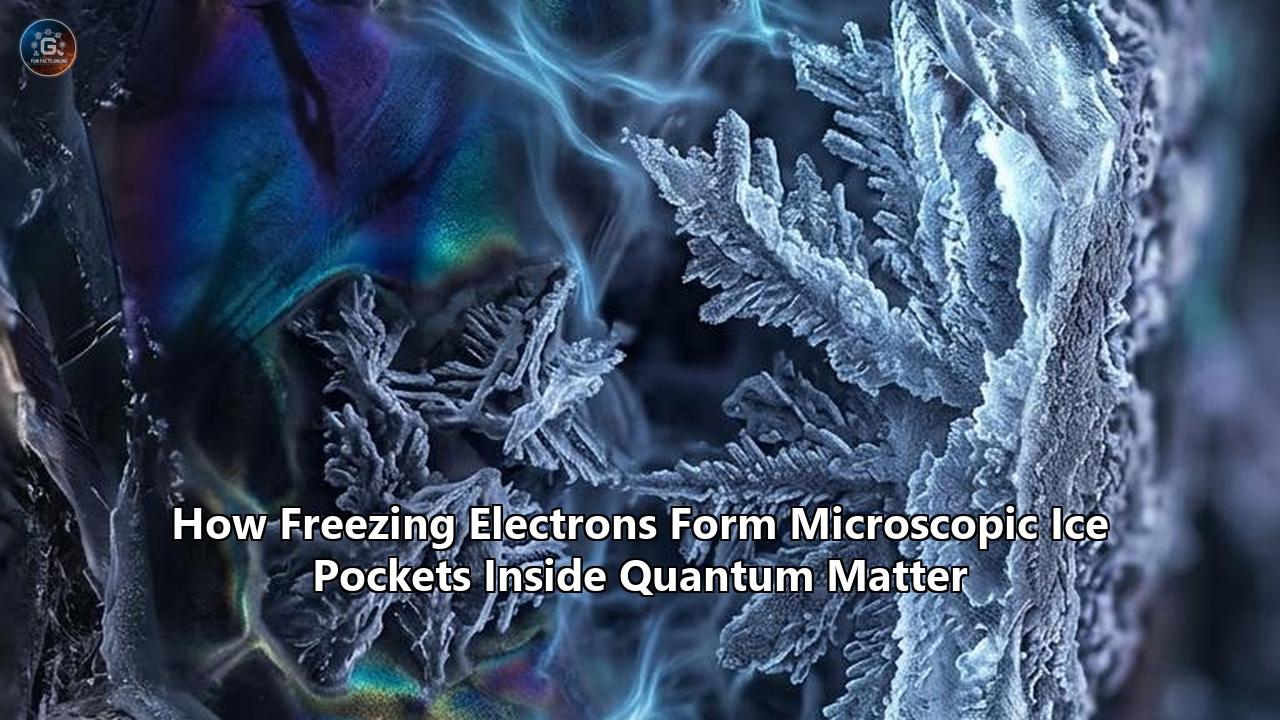
Physicists at the Massachusetts Institute of Technology have identified a long-sought mechanism governing how electron networks freeze inside correlated electronic systems, capturing the exact process by which competing electronic phases nucleate into microscopic islands. The study, published in Nature Physics, resolves a persistent mystery in solid-state physics: when multiple quantum phases inhabit the exact same material, they do not emerge through identical thermodynamic pathways. Instead, while one electronic phase materializes smoothly and continuously across the crystal lattice, a second, subdominant phase crystallizes into abrupt, isolated domains—forming microscopic islands of immobilized charge that mirror the growth of ice crystals in freezing water.
Led by Nuh Gedik, the Donner Professor of Physics at MIT, alongside lead author Yifan Su and co-author Alfred Zong, now an assistant professor of physics at Stanford University, the research team probed the rare-earth quantum compound erbium tritelluride ($ErTe_3$) using ultrafast laser pump-probe spectroscopy. The findings expose a fundamental design bottleneck for next-generation quantum computing architectures, high-temperature superconductors, and post-silicon microelectronics.
When electrons freeze into localized, rigid configurations rather than flowing smoothly, they create spatial heterogeneity, electronic hysteresis, and severe energy loss. By mapping how these quantum matter ice pockets emerge and expand, the MIT experiment provides solid-state engineers and condensed matter theorists with the physical blueprint needed to either suppress or strategically manipulate phase separation in advanced quantum devices.
       HOMOGENEOUS PHASE TRANSITION (Dominant Wave)
       [ ·  ·  ·  ·  ·  ·  ·  ·  ·  ·  ·  ·  ·  ·  · ]
       Continuous, uniform emergence across the entire crystal
       (Second-Order Thermodynamic Transition)

                              VS.

       NUCLEATION & EXPANSION (Subdominant Wave)
       [ · · (❄️ ICE POCKET ❄️) · · · (❄️ ICE POCKET ❄️) · · ]
       Discontinuous nucleation into isolated crystalline islands
       (First-Order Thermodynamic Transition)
The Coexistence Dilemma in Correlated Quantum Matter
For more than three decades, condensed matter physicists operating at the frontier of materials science have pursued a single primary objective: harnessing materials where electrons do not act as isolated, independent particles, but instead interact collectively. In ordinary copper or silicon, electrons glide past one another with negligible direct coordination. In strongly correlated quantum matter, however, electrostatic repulsion forces electrons into intricate collective dances. These collective behaviors give rise to high-temperature superconductivity, colossal magnetoresistance, and topologically protected edge currents.
Yet, translating these exotic electronic behaviors into functional computing hardware has encountered a persistent obstacle. Quantum materials frequently host multiple competing ground states simultaneously. Superconductivity, magnetic order, and charge density waves (CDWs)—periodic modulations of electron density that alter a material’s structural and electronic profile—routinely fight for control over the same underlying electron fluid.
Engineers attempting to use these materials as ultra-fast, low-power electronic switches have repeatedly observed unpredicted switching delays, localized heat build-ups, and sudden state collapses. When pushed toward a target operational state, the electrons inside these materials often settle into a fractured, phase-separated landscape: patches of conducting fluid interrupted by static, insulating domains.
"People believe the cornerstone of replacing silicon lies in quantum materials that have multiple coexisting phases," explained Alfred Zong. "Our experiment provides a very neat way to study these multiple phases".
The core issue has been an inability to observe the nucleation process in real time. Standard equilibrium measurements average electronic responses across macroscopic sample areas, blurring out the initial moments when a secondary phase begins to crystallize. As a result, theorists could not settle whether subdominant phases formed through a continuous, uniform structural modulation (a second-order transition) or through discontinuous nucleation and island growth (a first-order transition). Without knowing the thermodynamic order of these phase transitions, engineers lacked the mathematical and experimental models required to stabilize multi-phase quantum devices.
Inside Erbium Tritelluride: The Mechanics of Electronic Freezing
To resolve how multi-phase competition unfolds at the femtosecond scale, the MIT team turned to erbium tritelluride, a quasi-two-dimensional layered material that serves as a pristine model system for collective electron behavior.
Under elevated temperatures, electrons within $ErTe_3$ move throughout the crystal lattice in an essentially uniform distribution. When cooled below a critical threshold of approximately 265 Kelvin (-8 degrees Celsius), the kinetic energy of the electrons drops below their mutual Coulomb repulsion energy. At this point, the electron sea spontaneously organizes into a unidirectional, periodic wave of electric charge—a dominant charge density wave running along a single crystal axis.
UNIFORM METALLIC STATE (High Temperature)
   e⁻      e⁻      e⁻      e⁻      e⁻      e⁻      e⁻
  ·····················································
  (Electrons move freely with high kinetic energy)

DOMINANT CHARGE DENSITY WAVE (Cooled below ~265 K)
   ---  e⁻ e⁻ e⁻  ---  e⁻ e⁻ e⁻  ---  e⁻ e⁻ e⁻  ---
  ·····················································
  (Periodic wave-like density modulation along the X-axis)

ORTHOGONAL SUBDOMINANT WAVE (Cooled below ~160 K)
   | e⁻ e⁻ |       | e⁻ e⁻ |       | e⁻ e⁻ |
  -+- - - -+- - - -+- - - -+- - - -+- - - -+- - - - -+-
   | e⁻ e⁻ |       | e⁻ e⁻ |       | e⁻ e⁻ |
  ·····················································
  (Perpendicular wave forms, creating an electronic checkerboard)
As the material is cooled further, dropping below roughly 160 Kelvin, a secondary, subdominant charge density wave develops perpendicular to the first. The superposition of these two orthogonal electronic ripples turns the initial metallic sea into a two-dimensional electronic checkerboard.
Physicists have long debated how this orthogonal wave takes hold. The primary wave already locks up a significant portion of the material's available electronic states at the Fermi surface, fundamentally altering the energy landscape for any subsequent phase.
The question confronting the MIT researchers was straightforward: Does the second wave gently overlay itself across the existing wave pattern like a ripple spreading across a calm pond, or does it claw its way into existence by forcibly nucleating isolated, high-density domains?
Catching the Nucleation: The Laser Pump-Probe Protocol
Resolving this question required a technique that could selectively disrupt the electronic system without completely destroying the underlying crystal lattice. Gedik's laboratory deployed a dual-pulse ultrafast optical pump-probe arrangement.
The experiment proceeded through three sequential stages:
- The Pump Pulse: An initial ultrashort infrared laser pulse (lasting tens of femtoseconds) struck the $ErTe_3$ crystal. The intense electromagnetic field dumped energy directly into the electronic system, instantaneously vaporizing the fragile charge density waves and melting the electronic checkerboard back into a uniform liquid state.
- The Controlled Quench: Within hundreds of femtoseconds, the injected electronic energy dispersed into the surrounding lattice vibrations (phonons), causing the local electron temperature to plummet back toward the cryogenic baseline.
- The Time-Delayed Probe Pulse: A secondary, weaker laser pulse probed the sample at precisely calibrated picosecond intervals. By measuring the polarization and reflectivity of this reflected probe pulse, the researchers tracked the microstructural recovery of both the dominant and subdominant charge density waves with femtosecond temporal resolution.
                      ULTRAFAST PUMP-PROBE CYCLE

  1. INFRARED PUMP          2. THERMAL QUENCH           3. POLARIZED PROBE
   (Femtosecond Burst)      (Energy to Phonons)         (Picosecond Delays)
         │                         │                           │
         ▼                         ▼                           ▼
  [ Melt Order ] ───────► [ Rapid Cooling ] ────────► [ Readout Recovery ]
  Checkerboard melts       Electrons cool down,       Maps continuous vs.
  into uniform liquid.     freezing forces ignite.    nucleated dynamics.
The resulting optical signatures revealed an unmistakable divergence in how the two waves reformed.
The dominant charge density wave recovered systematically and smoothly across the entire illuminated volume. Its amplitude grew uniformly over time, behaving as a textbook second-order phase transition.
The subdominant wave displayed the exact mathematical signatures of a first-order nucleation process. Rather than rising evenly everywhere, it remained undetectable until isolated, localized seeds formed at distinct spatial coordinates. These quantum matter ice pockets then expanded outward at finite velocities, gradually fusing together to establish long-range checkerboard order.
"The mechanism responsible for the emergence of this second phase has long been debated, and our approach provides a powerful new way to uncover the hidden physics behind phase transitions in quantum materials," stated Gedik.
"Just like superconductivity, charge density waves are a collective phenomena where electrons move together in certain ways," added lead author Yifan Su.
The Broader Landscape of Electron Crystallization
The findings from MIT fit into a rapidly developing field focused on electron freezing in two-dimensional and correlated systems. In 1934, Hungarian-American theoretical physicist Eugene Wigner calculated that if an electron gas is cooled to near absolute zero at sufficiently low densities, the kinetic energy of the particles drops to negligible values. Under these conditions, the mutual Coulomb repulsion between identical negative charges should compel the electrons to lock into an ordered, stationary geometric lattice—an "electron ice" now known as a Wigner crystal.
                      CLASSICAL VS. QUANTUM ICE

  Molecular Water Ice (H₂O)            Quantum Matter Ice Pockets
  -------------------------            --------------------------
  • Driven by hydrogen bonding.        • Driven by Coulomb repulsion vs. kinetic energy.
  • Rigid atomic framework.            • Pure electronic lattice suspended in a host crystal.
  • Macroscopic phase boundary.        • Retains significant quantum zero-point fluctuations.
  • First-order nucleation.            • First-order nucleation within an existing electronic fluid.
For nearly a century, directly verifying and manipulating these frozen electronic states proved elusive. Traditional electron microscopy techniques blast samples with high-energy beams that melt delicate electronic arrays instantly.
Over the past four years, however, a cascade of experimental breakthroughs has illuminated this physics:
- Direct Scanning Tunneling Microscopy (UC Berkeley / Berkeley Lab): Teams led by Feng Wang and Michael Crommie placed graphene sheets directly over transition metal dichalcogenide semiconductor sandwiches, using the graphene as a non-invasive sensing blanket. This allowed a scanning tunneling microscope (STM) to image a static honeycomb Wigner crystal without disturbing the underlying frozen charge. Subsequent work in late 2024 verified the existence of Wigner molecular crystals, where multiple electrons bind into localized artificial "molecules" across twisted tungsten disulfide ($\text{tWS}_2$) moiré superlattices.
- Visualizing Quantum Zero-Point Motion (Princeton University): Physicists led by Ali Yazdani successfully resolved the spatial structure of electron ice in ultra-pure graphene. Crucially, Yazdani’s team confirmed that even when frozen solid, quantum electrons continue to undergo zero-point motion covering roughly a third of the distance between lattice sites, creating an inherently dynamic quantum solid.
- The "Pinball" Phase (Florida State University / MagLab): Theorists Aman Kumar, Hitesh Changlani, and Cyprian Lewandowski demonstrated that in moiré heterostructures, generalized Wigner crystals do not always melt uniformly. Instead, they can enter a hybrid state where a subset of electrons remains frozen into an insulating grid while remaining electrons delocalize into a conductive liquid, navigating the frozen lattice like steel balls ricocheting through a pinball machine.
The MIT discovery on erbium tritelluride demonstrates that this freeze-thaw dynamic is not restricted to artificially stacked 2D moiré superlattices. It is an intrinsic feature of bulk correlated quantum materials. The abrupt, localized formation of quantum matter ice pockets represents a universal mechanism by which electronic systems resolve structural and Coulombic frustration.
Why Electronic Ice Pockets Break Classical and Quantum Devices
The realization that competing electronic states nucleate via first-order island formation directly exposes why correlated materials misbehave when integrated into microelectronic or quantum devices. When a phase transition progresses via first-order nucleation rather than uniform transformation, several destructive physical processes occur:
               HOW PHASE SEPARATION CAUSES DEVICE FAILURE

  [ Active Conductive Channel ]
        ├── (❄️ Ice Pocket ❄️) ──► Carrier Pinning & Charge Trapping
        ├── (⚡ Domain Wall ⚡) ──► High-Resistance Scattering Interface
        └── (⏳ Nucleation Lag ⏳) ──► Severe Switching Hysteresis & Decoherence
1. Domain Wall Scattering and Kinetic Bottlenecks
When subdominant electronic phases nucleate at distinct, random sites throughout a crystal, the expanding islands eventually collide. Because these individual pockets form with mismatched spatial phases, their boundaries generate structural domain walls.
These electronic interfaces act as intense scattering centers for charge carriers. In a microelectronic switch designed for zero-resistance conduction, domain walls introduce sudden jumps in electrical resistance, converting computational energy into localized parasitic heat.
2. Operational Hysteresis and State Retention Errors
First-order phase transitions inherently carry free-energy activation barriers. While a second-order transition turns on and off instantaneously at a critical control parameter, a nucleating phase requires supercooling or superheating to overcome its nucleation barrier.
In a transistor or memory cell, this creates large hysteresis loops: the electrical bias required to switch a device on differs significantly from the bias required to switch it off. In high-density logic architectures, this hysteresis leads to timing jitter, variable switching latencies, and state-retention failures.
3. Decoherence in Quantum Information Processors
In solid-state qubits—such as superconducting transmon qubits or topological Majorana-based devices—quantum coherence depends on a strictly homogeneous dielectric and magnetic background.
If fluctuating quantum matter ice pockets nucleate and dissolve stochastically at the device boundary due to minor thermal or optical perturbations, they produce localized two-level systems (TLS defects) and low-frequency charge noise ($1/f$ noise). This charge jitter dephases the qubit wavefunctions, sharply driving down coherence times ($T_1$ and $T_2$).
The Engineering Response: How Researchers Are Overcoming Phase Separation
Now that the precise mechanism driving electronic phase separation has been visualized, laboratories, materials foundries, and quantum hardware developers are implementing four primary strategies to suppress or harness these localized phase transformations.
                             FOUR-TIER STRATEGIC RESPONSE

  1. Moiré Superlattice Tuning    ──► Pins electronic density via interlayer twist angles.
  2. Ultrafast Floquet Laser Control ──► Bypasses nucleation barriers using resonant THz light.
  3. Nanoscale Strain Engineering ──► Pre-determines island nucleation sites via local strain.
  4. Quantum Ab Initio Modeling   ──► Predicts free-energy landscapes to filter candidates.
Strategy 1: Moiré Superlattice Pinning and Potential Engineering
Rather than leaving electrons to nucleate at random sites, materials scientists are utilizing van der Waals heterostructures—such as twisted bilayer graphene or transition metal dichalcogenide superlattices—to impose artificial periodic potentials.
By altering the relative rotational "twist angle" between adjacent atomic layers with sub-tenth-of-a-degree precision, researchers can dictate the potential wells in which electrons sit.
Work led by Feng Wang at UC Berkeley and kinetic modeling teams at the National High Magnetic Field Laboratory demonstrates that when the moiré potential depth exceeds the free energy of nucleation, electrons freeze uniformly onto the superlattice sites. This prevents uncontrolled island growth and eliminates disordered domain wall boundaries.
    UNCONTROLLED SYSTEM                      MOIRÉ PINNED SYSTEM
    (Disordered Freezing)                    (Engineered Uniform Grid)

     ·  · ( ❄️ ) ·  ·  ·                      [❄️]  [❄️]  [❄️]  [❄️]  [❄️]
     ·  ·  ·  ·  ( ❄️ ) ·                      [❄️]  [❄️]  [❄️]  [❄️]  [❄️]
     ( ❄️ ) ·  ·  ·  ·  ·                      [❄️]  [❄️]  [❄️]  [❄️]  [❄️]
    Random nucleation leads                   Superlattice potential fixes
    to domain scattering.                     every pocket symmetrically.
Strategy 2: Floquet Engineering and Resonant Ultrafast Switching
Because thermal cooling inevitably triggers first-order nucleation when crossing thermodynamic coexistence curves, optical physicists are bypassing thermal equilibrium entirely.
Using mid-infrared and terahertz optical pulses tailored to the vibrational frequencies of the host lattice, researchers are implementing "Floquet engineering"—using time-periodic light fields to reshape the material’s electronic band structure on demand.
Experiments derived from Gedik’s laser architecture demonstrate that resonant light pulses can selectively melt a subdominant charge density wave in less than 200 femtoseconds without heating the surrounding lattice. By toggling the material optically between checkerboard and unidirectional states, devices can switch at terahertz rates, completely avoiding the sluggish nucleation-and-growth dynamics of thermal transitions.
Strategy 3: Nanoscale Strain Engineering
To prevent random island nucleation, experimentalists at Stanford, MIT, and Harvard are developing micro-machined silicon-nitride strain membranes to apply localized uniaxial and biaxial tension to quantum thin films.
In compounds like $ErTe_3$, applying modest tensile strain along one crystalline axis breaks the symmetry between orthogonal directions.
This shifts the energetic balance, driving down the free energy of one charge density wave while suppressing the subdominant mode. By tuning the strain, engineers can eliminate the formation of quantum matter ice pockets altogether, forcing the material into a pure, single-phase conducting or insulating ground state across its entire surface area.
                     SYMMETRY BREAKING VIA STRAIN

    No Strain (Orthogonal Coexistence)        Uniaxial Tensile Strain

        │                                         ▲  Strain Axis
        ▼                                         │
     ┌─────┐                                ┌───────────┐
     │ ❄️ ❄️│  <-- Subdominant islands      │  ═══════  │ <-- Pure, uniform
     │ ❄️ ❄️│      form checkerboard.       │  ═══════  │     single-mode wave;
     └─────┘                                └───────────┘     islands suppressed.
Strategy 4: High-Performance Quantum Materials Simulation
To accelerate the discovery of materials immune to uncontrolled phase segregation, computational materials scientists are employing advanced non-equilibrium quantum simulations.
Using supercomputing resources at Florida State University's Research Computing Center and the University of Chicago’s Pritzker School of Molecular Engineering (PME), researchers like Giulia Galli and Marco Monti are running density functional theory and quantum Monte Carlo models that account for electron-electron correlations and lattice defect cavities.
These simulations accurately map out whether a candidate quantum compound will undergo a clean second-order phase shift or devolve into fractured first-order phase separation, filtering out problematic material candidates before physical synthesis begins in the laboratory.
Structural Comparison: Homogeneous Transition vs. Ice Pocket Nucleation
To highlight how electronic phase transitions function across different parameters, the table below contrasts the classic continuous transition observed in dominant electronic phases against the nucleated growth observed in subdominant frozen pockets:
| Physical Parameter | Continuous Electronic Transition (Dominant Phase) | Nucleated Freezing Transition (Subdominant Phase / Ice Pockets) |
|---|---|---|
| Thermodynamic Classification | Second-order transition (Ehrenfest classification). | First-order transition with an energy barrier. |
| Spatial Progression | Uniform amplitude growth across the entire crystal volume simultaneously. | Discontinuous; forms isolated nanoscale seeds that expand outward. |
| Nucleation Barrier ($\Delta G^$) | Zero; transition begins as soon as temperature drops below $T_c$. | Non-zero; requires supercooling or localized fluctuations to seed. |
| Switching Latency | Governed strictly by intrinsic electron-phonon scattering times (femtoseconds). | Governed by island boundary propagation velocity across the crystal (picoseconds to nanoseconds). |
| Domain Wall Formation | Minimal; single, continuous long-range order parameter. | Heavy; distinct expanding islands collide with spatial phase mismatches. |
| Hysteresis & Dissipation | Low hysteresis; reversible, minimal thermodynamic loss. | Pronounced hysteresis loops; distinct activation and deactivation thresholds. |
| Microelectronic Impact | Ideal for high-speed linear switching and uniform conductivity modulation. | Generates electrical noise, localized heat, and variable switching thresholds. |
Turning the Defect into a Feature: The Future of Quantum Domain Memory
While phase separation and localized electron freezing present formidable challenges to conventional transistor scaling, researchers are exploring whether these phenomena can be harnessed as functional technological components.
In classical computing, magnetic domain-wall memory and memristors store information by using electric fields to nucleate and slide microscopic domain walls through solid materials. Because quantum matter ice pockets represent distinct, self-contained thermodynamic zones with different optical and electrical properties from their surroundings, they could serve as non-volatile binary states.
                 NON-VOLATILE ELECTRONIC DOMAIN MEMORY

      LOGICAL "0" (Fluid Phase)             LOGICAL "1" (Frozen Pocket)

      [ ·  ·  ·  ·  ·  ·  ·  · ]             [ ·  (❄️ ICE POCKET ❄️)  · ]
      • Uniform low resistance.             • Localized high resistance.
      • Rapid carrier flow.                 • Trapped charge / pinned spin.
      • High-frequency transmission.        • Non-volatile data retention.
An isolated electronic ice pocket trapped within a moiré cell could represent a logical "1", while a cleared, fluid phase represents a logical "0". Because writing and erasing these states requires shifting only electron coordinates rather than physically moving heavy atomic nuclei (as in conventional flash memory or phase-change chalcogenide memory), an electronic ice memory could theoretically achieve:
- Write Speeds: Under 1 picosecond using resonant optical or terahertz clock pulses.
- Energy Consumption: Less than a few attojoules ($10^{-18}\text{ J}$) per bit switch, limited only by the Coulomb interaction energy of a few hundred localized electrons.
- Endurance: Near-infinite write-erase cycle endurance, as the host crystal lattice experiences virtually no mechanical degradation during electronic-only phase switching.
"In systems that are much more complex, like high-temperature superconductors, you see there are multiple phases—magnetism, superconductivity, charge density waves, and they all exist together," emphasized Gedik. "One of the theories is that the way they interact with each other is key for their exotic properties".
What to Watch Next
The MIT team's direct observation of nucleated electronic freezing initiates a critical phase of experimental and applied research across quantum condensed matter physics. Key milestones and experimental objectives over the next 24 to 36 months include:
- Real-Space Nanoscale Imaging: Combining the ultrafast pump-probe optical protocols developed by Gedik’s lab with localized scanning tunneling microscopy (STM) or scanning near-field optical microscopy (SNOM) to produce real-space movies of individual expanding ice domains at sub-nanometer resolutions.
- Cuprate Superconductor Probing: Applying identical non-equilibrium quench techniques to high-$T_c$ copper-oxide and iron-based superconductors to determine whether competing "pseudogap" and charge stripe phases emerge via first-order nucleation, clarifying how these phases help or hinder Cooper pair formation.
- Room-Temperature Charge Density Wave Discovery: Identifying 2D materials and layered compounds where charge density wave transitions and electronic ice states persist above 300 Kelvin, opening pathways to develop ambient-temperature collective-state microelectronics.
- Integrated Optoelectronic Gate Arrays*: Demonstrating prototype solid-state switches on optical waveguides where localized infrared laser pulses toggle an electronic channel between fluid and frozen states at frequencies exceeding 100 gigahertz.
The realization that electrons do not merely slow down, but freeze into isolated crystalline islands inside correlated materials, clarifies how collective states of matter assemble from the bottom up. Whether by eliminating these phase boundaries through precision strain and moiré engineering, or by exploiting them as ultra-fast memory elements, mastering the dynamics of electronic ice pockets is set to transform the design of future quantum technologies.
Reference:
- https://www.sciencedaily.com/releases/2026/08/260819041231.htm
- https://news.mit.edu/2026/physicists-watch-materials-electrons-assemble-reassemble-coexisting-phases-0807
- https://soz6.com/news/mit-physicists-discover-electrons-rebuilding-like-ice-inside-a-quantum-material
- https://quantumzeitgeist.com/quantum-electrons-phases-mit-physicists/
- https://news.fsu.edu/news/science-technology/2025/11/06/fsu-physicists-discover-new-state-of-matter-in-electrons-platform-to-study-quantum-phenomena/
- https://www.quantamagazine.org/physicists-create-a-bizarre-wigner-crystal-made-purely-of-electrons-20210812/
- https://research.princeton.edu/news/quantum-crystal-frozen-electrons%E2%80%94-wigner-crystal%E2%80%94-visualized-first-time
- https://vcresearch.berkeley.edu/news/physicists-snap-first-image-electron-ice
- https://scitechdaily.com/frozen-electrons-come-to-life-in-groundbreaking-princeton-study/
- https://www.youtube.com/watch?v=kTl3cznjrnw
- https://www.youtube.com/shorts/MuzI0UYWclQ
- https://physics.berkeley.edu/news/scientists-capture-images-electron-molecular-crystals
- https://physics.berkeley.edu/news-events/news/physicists-snap-first-image-of-electron-ice
- https://newscenter.lbl.gov/2024/11/07/scientists-capture-images-of-electron-molecular-crystals/
- https://news.uchicago.edu/story/using-quantum-mechanics-researchers-crack-hidden-chemistry-ice
- https://www.youtube.com/watch?v=0D69Rg0Cnh4