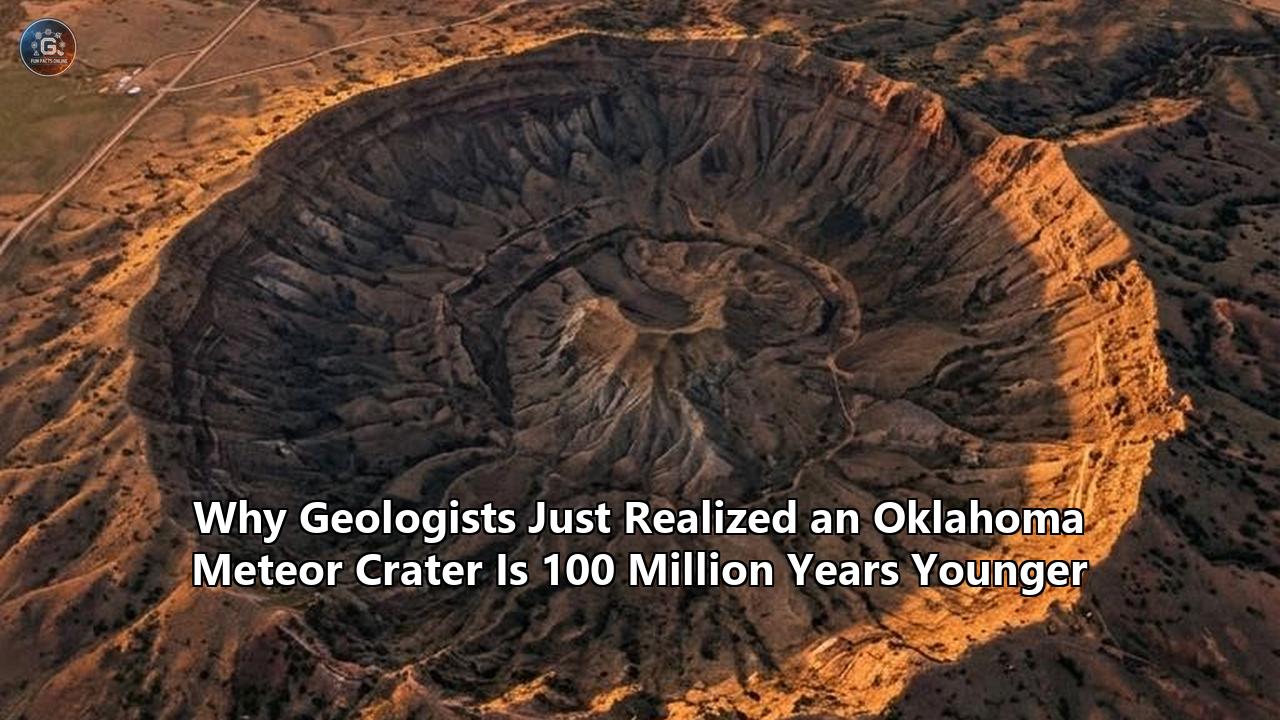
A newly published radioisotopic analysis has subtracted nearly 100 million years from the accepted formation date of the Ames impact structure in Major County, Oklahoma. By isolating and dating shock-metamorphosed zircon crystals trapped in crater basement granite, geochemists have determined that the 15-kilometer-wide depression formed approximately 369.7 ± 5.9 million years ago during the Late Devonian epoch—not 467.5 million years ago during the Middle Ordovician, as textbook records have maintained since the site's commercial discovery in 1991.
The 97.8-million-year chronological adjustment, detailed in Meteoritics & Planetary Science by a research team led by the University of Texas at Austin, instantly removes the continent's largest oil-producing astrobleme from the famous Ordovician Meteor Event. Simultaneously, it deposits this massive planetary scar directly into the temporal boundary of the Frasnian–Famennian mass extinction, an environmental catastrophe that eliminated 70% to 80% of all marine species on Earth.
The quantitative divergence between the old and new age models rests on a stark methodological division: 30 years of reliance on four fragments of fossiliferous drill core versus high-precision secondary ion mass spectrometry (SIMS) and laser ablation inductively coupled plasma mass spectrometry (LA-ICP-MS) across 37 isotopic target spots.
================================================================================
                    AMES IMPACT CHRONOLOGY: AT A GLANCE
================================================================================
Metric                      Traditional Classification   Revised Determination
--------------------------------------------------------------------------------
Geological System           Middle Ordovician (Darriwilian) Late Devonian (Famennian)
Numerical Age Model         ~467.5 to 470.0 Ma           369.7 ± 5.9 Ma (2σ)
Chronological Discrepancy   +97.8 Million Years          [Baseline Reference]
Analytical Method           Conodont Biostratigraphy     U-Pb Zircon (SIMS & LA-ICP-MS)
Underlying Data Points      4 core shale chips           37 spot analyses (16 grains)
Associated Global Event     Ordovician Meteor Spike      Frasnian-Famennian Extinction
Target Crust Crystallization 1401.2 ± 8.1 Ma (Basement)   1401.2 ± 8.1 Ma (Granodiorite)
Subsurface Burial Depth     8,990 to 9,990 ft (2.7-3 km) 8,990 to 9,990 ft (2.7-3 km)
Diameter Across Rim Crest   14.0 to 16.0 km (9-10 miles) 14.0 to 16.0 km (9-10 miles)
Estimated Oil Trapped       25 to 145 Million Barrels    25 to 145 Million Barrels
================================================================================
By recalculating the Oklahoma meteor crater age, researchers have removed one of the primary anchors supporting the hypothesis that Earth was once girdled by a Saturn-like debris ring, forcing planetary scientists and geologists to reconstruct impact rates across the Paleozoic era.
The Metrics of the 100-Million-Year Recalibration
The Ames impact crater sits buried beneath 8,990 to 10,000 feet of sedimentary overburden on the northern shelf of the Anadarko Basin, approximately two miles north of Ames, Oklahoma. Unlike subaerially exposed impact sites such as Arizona's Barringer Crater, the Ames structure possesses zero surface expression. Its structural parameters are known exclusively through 120 square miles of reflection seismic imaging and deep exploratory boreholes.
Subsurface Cross-Section of the Ames Structure:
0 ft    ======================= Surface (Major County Farmland) =======================
        |
        |  Permian red beds, Pennsylvanian & Mississippian marine limestones
        |  (~8,900 vertical feet of post-impact sedimentary fill)
        |
-8,990' ----------------------- Post-Impact Caprock ---------------------------------
        |  Late Devonian / Mississippian Black Shales (Stratigraphic Sealing Horizon)
-9,200' ----------------------- Rim Crest & Central Ring Floor ----------------------
        |  Excavated Structural Rim: 15 km (9.3 miles) diameter
        |  Altered Breccias, Impact-Melt Rock, Granodiorite & Carbonate Clasts
-9,990' ----------------------- Central Rebound Uplift & Target Floor ---------------
        |  Granitic Basement Core (Mesoproterozoic: 1401.2 ± 8.1 Ma)
        |  Deep Fault-Fracture Traps Holding 25M-145M Barrels of Hydrocarbons
        ==============================================================================
The crater is a complex structural basin characterized by:
- An outer rim crest diameter spanning 14.0 to 16.0 kilometers (8.7 to 9.9 miles).
- A structural depression dropping 600 feet below regional target datums.
- An annular low measuring 1.5 to 2.0 kilometers wide wrapping around a pronounced central uplift.
- A rebound peak composed of shattered, shocked Mesoproterozoic granodiorite uplifted more than 1,600 feet above its native basement position.
For three decades, this morphology was thought to have formed 467.5 million years ago. The new geochronological series, directed by lead author Dr. Elizabeth Catlos alongside late graduate researcher Andrew Parisi and late geologist Michael Brookfield, evaluated impact-melt lithologies sampled directly from drilling cores held at the Oklahoma Geological Survey's Core and Sample Library in Norman.
The primary dataset deployed secondary ion mass spectrometry (SIMS) on an initial cohort of extracted zircon grains, followed by high-spatial-resolution laser ablation inductively coupled plasma mass spectrometry (LA-ICP-MS). Out of 37 discrete radioisotopic target spots evaluated across 16 zircon mineral grains, 10 concordant analyses clustered around a tight, common Late Devonian date. The calculated weighted mean 206Pb/238U age resolved to 369.7 ± 5.9 million years, supported by a mean square weighted deviation ($MSWD$) of 0.71 and a probability of fit $p(\chi^2)$ equal to 0.70.
In geochronological statistics, an $MSWD$ value near 1.0 indicates that the observed scatter is entirely explained by analytical uncertainty alone. The value of 0.71 indicates a coherent single-generation thermal event. A non-impact magmatic origin for this 369.7 Ma population is structurally ruled out; northern Oklahoma was a tectonically stable craton throughout the Paleozoic, with no recorded volcanic arcs, plutonic intrusions, or orogenic activity between the Cambrian Southern Oklahoma Aulacogen formation and the Pennsylvanian Ancestral Rocky Mountain orogeny.
Zircon Isotopic Frequency Distribution:
  Number of
  Analyses
     |
  12 |                                              --- [Younger Shock Resetting]
  10 |                                              ---  369.7 ± 5.9 Ma
   8 |                                              ---  n = 10 spots, MSWD = 0.71
   6 |                                              ---
   4 |
   2 |
   0 +-----+-----+-----+-----+-----+-----+-----+-----+-----+-----+-----+-----+-----+
    300   350   400   450   500   550   600   700   900  1100  1300  1400  1500  (Ma)
           ^           ^                                               ^
           |           |-- Traditional Ordovician Window               |-- Target Basement
      New Impact Age       (467.5 Ma - Zero Shock Hits)                    Granodiorite
      (369.7 Ma)                                                           (1401.2 Ma)
The remaining 26 analyses retained the deep inheritance of the pristine target basement, yielding an upper Concordia intercept age of 1401.2 ± 8.1 million years ($2\sigma$), reflecting the Mesoproterozoic igneous crystallization of the Southern Granite-Rhyolite Province. Crucially, not a single zircon domain yielded a date within the 460-to-480-million-year window that defines the Middle Ordovician.
Shock Metamorphism: Nanoscale Calibration with NASA
To confirm that the 369.7 Ma radiometric signal marked the moment of extraterrestrial impact rather than a low-temperature diagenetic alteration or regional fluid migration, the Texas team collaborated with microbeam specialists at NASA.
Zircon ($\text{ZrSiO}_4$) is an exceptionally robust mineral chronometer. It features an ultra-high closure temperature for lead diffusion exceeding 900°C and resistance to mechanical breakdown. To reset a zircon's uranium-lead radiometric clock without completely melting the crystal lattice requires hypervelocity impact pressures and flash thermal spikes.
Researchers mounted the grains and subjected them to two non-destructive structural imaging techniques prior to isotopic ablation:
Cathodoluminescence (CL) Petrography
Cathodoluminescence mapping evaluated inner zoning geometries. Magmatic zircons naturally crystallize with concentric, oscillatory trace-element bands. The analyses revealed that while basement cores preserved unperturbed 1.4-billion-year concentric growth zoning, the outer rims and distinct fracture networks showed complete cathodoluminescence quenching. This textural disruption was produced by shock-induced plastic deformation and partial volatilization of trace lattices.
Electron Backscatter Diffraction (EBSD)
Using high-resolution EBSD at the sub-micrometer scale, structural crystallographers measured mechanical lattice distortions. The tests identified two impact signatures:
- Micro-twinned crystal domains: Localized deformation twins inclined at specific crystallographic angles, forming only under transient peak shock pressures between 20 and 40 gigapascals (GPa). For scale, ambient lithostatic pressure at the crater's 10,000-foot depth is approximately 0.08 GPa; peak impact pressures exceeded standard overburden pressures by a factor of 250 to 500.
- Granular Neoblasts: Distinct arrays of microscopic, polycrystalline granular zircon crystals crosscutting older oscillatory magmatic boundaries. These recrystallized domains represent transformed "shock-melt" patches where impact kinetic energy instantly converted zirconium silicate grains into high-pressure planar transformation products, subsequently recrystallizing back to zircon as temperatures dropped from post-impact peaks exceeding 1,200°C.
================================================================================
          METALLURGICAL & CRYSTALLOGRAPHIC SHOCK DEFORMATION STAGES
================================================================================
Shock Pressure Shock Effect on Zircon             Ames Crater Core Observation
--------------------------------------------------------------------------------
< 10 GPa       Elastic strain, fracturing         Widespread macro-fracturing
10 to 20 GPa   Planar micro-fracturing, planar    Observed across 100% of tested
               deformation features (PDFs)        granitic target lithologies
20 to 40 GPa   Deformation twinning, formation    Documented via NASA EBSD maps
               of {112} micro-twin lamellae       within the 369.7 Ma crystal rims
40 to 60 GPa   Phase transition to Reidite        Localized relict domains within
               (high-density ZrSiO4 polymorph)    recrystallized micro-pockets
> 60 GPa       Dissociation into ZrO2 + SiO2,     Granular neo-formed zircon arrays
               followed by thermal neo-zircon     dating to 369.7 ± 5.9 Ma
================================================================================
When mass spectrometry laser beams sampled these shock-damaged structural zones, the isotope ratios repeatedly revealed the Late Devonian date.
"No matter what technique we used, it was coming back to this younger signal," said Dr. Catlos, associate professor in the Jackson School's Department of Earth and Planetary Sciences. "With this research, we're basically taking a major pawn out of the Ordovician Meteor Event and dumping it into the Frasnian-Famennian event, and saying, 'This is where this impact belongs.'"
The Conodont Trap: Deconstructing a 30-Year-Old Error
How could geology accept an erroneous date for more than three decades? The answer lies in the limitations of 20th-century stratigraphy and a false assumption about four rock chips.
Old Sedimentary Model (1991–2025):
   [Space Projectile hits Ordovician Ocean floor at 467.5 Ma]
            |
            v
   Crater fills with Ordovician marine water & sediment
            |
            v
   Shales contain *Conodonts A, B, C* (Middle Ordovician)
            |
            +---> CONCLUSION: The impact date MUST match the conodonts (467.5 Ma).

New Tsunami Resurge Model (2026):
   [Ordovician platform strata rests dormant for ~100 Million Years]
            |
            v
   [Space Projectile strikes Late Devonian Sea at 369.7 Ma]
            |
            v
   Explosion excavates 10,000 vertical feet of strata, pulverizing
   Middle Ordovician shales and conodont fossils into airborne/waterborne ejecta
            |
            v
   Giant Tsunami Resurge washes back into the crater depression,
   redepositing ancient Ordovician conodonts into Devonian collapse breccia
            |
            +---> CONCLUSION: Fossils date their native layer, NOT the impact.
In 1991, Continental Resources and DLB Oil & Gas drilled the Cecil Gregory No. 1-20 well in Section 20-21N-9W, intending to tap traditional Arbuckle dolomite gas reservoirs. Instead of standard regional carbonate layering, the drill bit punched through the Oil Creek shale and entered a 1,600-foot-thick vertical interval of impact breccia, chaotic granitic melt rocks, and dolomite debris.
When the Gregory No. 1-20 well began pumping 200 barrels of oil per day, it transformed the Ames depression into an exploration play. Geologists needed to determine the target's chronostratigraphic envelope to map surrounding prospects.
At the time, radioisotopic U-Pb micro-dating was not readily available for microcrystalline zircons. Geologists relied on biochronology—dating strata by identifying index fossils. Stratigraphers recovered fossils of conodonts, extinct jawless marine vertebrates related to modern hagfish, from core chips taken out of the crater floor and the immediately overlying black shale caprock.
The conodont elements exhibited biozones characteristic of the Middle Ordovician (Darriwilian stage, roughly 460 to 475 Ma). The logic of the era appeared sound: if fossilized conodont teeth were interbedded within the crater's initial fall-back layers and basinal sedimentary fill, the impact had to have struck during that Ordovician window. That single finding locked the Oklahoma meteor crater age into geological catalogs for over thirty years.
However, the conodont diagnosis rested on only four small shale samples extracted from high-value production cores.
The 2026 Jackson School re-examination documented how explosive excavation mechanics misled the biochronologists. When a hypervelocity bolide measuring approximately 800 to 1,000 meters in diameter impacts continental crust at 15 to 25 kilometers per second, it unloads millions of megatons of kinetic energy. The resulting transient cavity excavates deeper basement rocks along with every overlying stratigraphic package.
In northern Oklahoma during the Late Devonian, target stratigraphy consisted of:
- Mesoproterozoic crystalline basement (~1.4 Ga) at depth.
- Cambro-Ordovician Arbuckle Group dolomites (thickness: 1,500 to 2,000 feet).
- Middle Ordovician Simpson Group sandstones and Oil Creek shales, which held the fossil conodont populations.
- Overlying Silurian-Devonian platform carbonates.
================================================================================
                 AMES CRATER STRATIGRAPHIC SUCCESSION & CORRELATION
================================================================================
Depth (ft)    Stratigraphic Unit         Lithology              Original Age Assignment (1990s) Revised System (2026)
----------------------------------------------------------------------------------------------------------------------
Surface-8990  Penn./Miss. strata         Shale, Limestone       Late Paleozoic (Undisputed)      Late Paleozoic
8990 - 9050   Caprock Marine Shale       Black Pyritic Shale    Middle Ordovician (Fossil trap)  Late Devonian (~370 Ma)
9050 - 9200   Crater Fallback Breccia    Shattered Dolomite/Melt Middle Ordovician               Late Devonian Impact Ejecta
9200 - 9800   Ring Complex & Megabreccia Jumbled Clastic Chunks  Middle Ordovician Target        Reworked Paleozoic Clasts
9800 - 10000+ Rebound Central Peak       Shocked Granodiorite   Mesoproterozoic (Displaced)      1401.2 Ma Basement / 369.7 Ma Impact
================================================================================
When the asteroid struck, it vaporized the shallow layers and pulverized the Simpson Group shales. Because the Devonian target site was covered by a shallow epeiric marine system, the initial atmospheric ejecta curtain was followed by a massive marine resurge. A wall of seawater rushed back inward across the devastated platform to fill the crater void.
This resurge acted as a geological vacuum cleaner. It swept millions of tons of disaggregated Ordovician muds, sand, and resistant conodont microfossils into the structural depression. These older conodont teeth sank into the crater-filling sediment, settling alongside genuine Devonian material.
"The teeth were likely already millions of years old when the asteroid struck Ames, and likely just got jumbled around in the mix of the impact, remaining preserved," said Dr. Catlos.
The conodont fossils recorded the lifespan of an Ordovician marine organism, not the moment when an asteroid detonated within the Oklahoma crust.
40Ar/39Ar Thermochronology and the Hydrocarbon System
Ames is not just an academic case study; it is an economic asset. The crater has produced tens of millions of barrels of crude oil and trillions of cubic feet of natural gas. The structure hosts over 100 commercial wells drilled into its central rim, outer bounding faults, and elevated granitic core. Cumulative production estimates project an ultimate recovery of 25 million to 145 million barrels of high-grade oil.
================================================================================
              AMES IMPACT STRUCTURE HYDROCARBON SYSTEM DATA
================================================================================
Parameter                                Quantitative Value / Metric
--------------------------------------------------------------------------------
Primary Reservoir Rock                   Brecciated & fractured granodiorite / dolomite
Reservoir Porosity Range                 5% to 22% (Average: 12.5%)
Permeability Range                       0.5 to 300 millidarcies (mD)
Crater Hydrocarbon Column Thickness      Over 1,600 vertical feet (500+ meters)
Estimated Recoverable Reserves           25 to 145 Million Barrels (Crude)
Primary Source Kitchen Strata            Overlying organic-rich marine black shales
Peak Generation & Thermal Window         310.5 Ma (Carboniferous) to 250.5 Ma (Permian)
Reservoir Sealing Mechanism              Devonian/Mississippian impermeable black shales
Total Producing Well Count               100+ commercial completions since 1991
--------------------------------------------------------------------------------
To resolve the thermal timeline of this energy reservoir, the researchers combined their U-Pb zircon investigations with high-precision 40Ar/39Ar step-heating geochronology on plagioclase feldspar grains extracted from the deep reservoir core.
Plagioclase possesses a lower thermal closure temperature than zircon, functioning as an isotopic thermometer that captures low-grade thermal pulses and fluid alteration between 200°C and 350°C.
The argon analysis yielded two dates that were younger than both the conodont ages and the 369.7 Ma impact event:
- Late Carboniferous (Pennsylvanian): Fusion dates clustered at ~310.5 Ma.
- Permian: Complementary low-temperature degassing steps recorded a reset at ~250.5 Ma.
Post-Impact Thermal and Hydrocarbon Chronology:
370 Ma ---- Late Devonian Impact Event (369.7 ± 5.9 Ma)
            * Asteroid strikes, producing 15 km crater.
            * Deep brecciation establishes 1,600 ft fractured reservoir zone.
            * Crater is submerged and capped with anoxic organic-rich black muds.
            |
            | Deep burial under 8,000+ feet of Pennsylvanian sediments
            v
310 Ma ---- Pennsylvanian Thermal Pulse (~310.5 Ma: 40Ar/39Ar Plagioclase Age)
            * Orogenic pulse causes deep basinal fluid migration.
            * Source shales enter peak oil generation window (~120°C - 150°C).
            * Hydrocarbons migrate downward and laterally into fractured basement granite.
            |
            | Sustained tectonic loading
            v
250 Ma ---- Permian Thermal Overprinting (~250.5 Ma: 40Ar/39Ar Secondary Reset)
            * Final regional heating event preserves oil/gas containment in structural traps.
            * Hydrothermal fluid flow seals faults, cementing the traps.
            |
            v
1991 AD --- Gregory 1-20 well discovers the petroleum-saturated central crater core.
These dates trace the multi-stage fluid history of the Ames petroleum system.
The ~369.7 Ma Late Devonian impact created the reservoir architecture. The cosmic detonation fractured the Mesoproterozoic granodiorite down to multiple kilometers, generating secondary porosity ranging from 5% to 22% and creating permeabilities of up to 300 millidarcies.
The crater depression trapped thick, organic-rich marine muds. As millions of years passed and the Anadarko Basin subsided, these organic beds were buried beneath 8,000 feet of Pennsylvanian sedimentary overburden.
The 40Ar/39Ar age of 310.5 Ma marks when deep burial and regional tectonics heated the source shales past 120°C. This maturation expelled hydrocarbons directly downward and laterally into the porous, fractured crater rim.
The secondary 250.5 Ma Permian thermal signature records hydrothermal fluid migrations that precipitated secondary carbonate and quartz cements along the crater's bounding fault blocks, sealing millions of barrels of oil inside the fractured astrobleme.
Dismantling the Ordovician Saturn-Ring Theory
The revision of the Oklahoma meteor crater age extends far beyond regional petrology. It pulls a linchpin from one of the most prominent planetary physics hypotheses introduced in the mid-2020s: the theory that Earth once hosted an asteroid debris ring.
In 2024, a team of planetary scientists published an analysis in Earth and Planetary Science Letters that evaluated the paleogeographic coordinates of 21 confirmed Middle Ordovician impact structures. Their models revealed that all 21 craters were clustered within 30 degrees of Earth’s paleo-equator during the Darriwilian stage (~466–468 Ma), despite more than 70% of continental crust being positioned outside that tropical belt.
================================================================================
   NORTH AMERICAN IMPACT CATALOG: REVISED ORDOVICIAN VS. DEVONIAN AUDIT
================================================================================
Impact Structure   Location         Diameter  Original Age Assigned  Status / Evidence (2026)
--------------------------------------------------------------------------------
Ames Structure     Oklahoma, USA    15 km     467.5 Ma (Ordovician)  RE-DATED: 369.7 ± 5.9 Ma (Devonian)
Slate Islands      Ontario, Canada  30 km     ~450 Ma (Ordovician)   Confirmed Impact / Under Review
Brent Crater       Ontario, Canada  3.8 km    ~453 Ma (Ordovician)   Confirmed Ordovician (40Ar/39Ar)
Rock Elm           Wisconsin, USA   6.5 km    ~470 Ma (Ordovician)   Stratigraphic bracket
Decorah            Iowa, USA        5.6 km    ~465 Ma (Ordovician)   Coincident with OME layer
Alamo Breccia      Nevada, USA      >50 km    ~382 Ma (Devonian)     Confirmed Devonian (Conodonts/Iridium)
Siljan Ring        Sweden           52 km     ~377 Ma (Devonian)     Confirmed Late Devonian (40Ar/39Ar)
Woodleigh          Australia        ~40 km    ~364 Ma (Devonian)     Confirmed Late Devonian (Zircon U-Pb)
Charlevoix         Quebec, Canada   54 km     ~400-340 Ma (Devonian) Broad Devonian stratigraphic span
================================================================================
The mathematical probability that 21 randomly distributed impacts from the asteroid belt would land within this narrow equatorial zone is estimated at 1 in 2.5 million.
To explain this anomaly, researchers proposed that approximately 466 million years ago, a massive chondritic asteroid made a close encounter with Earth, passed inside the planet's Roche limit (approximately 18,400 kilometers altitude), and was torn apart by tidal gravitational forces.
Over the next 10 to 40 million years, this debris cloud organized into a temporary, Saturn-like debris ring around Earth’s equator. As material gradually decayed from the ring's inner margin, space rocks rained down onto the tropical latitudes below, forming an equatorial bombardment pattern termed the Ordovician Meteor Event (OME).
The Ordovician Ring Model vs. Impact Attrition:

           [Tidally Disrupted Chondritic Progenitor]
                             |
                             v
           +-------------------------------------+
           | Transient Equatorial Debris Ring   |
           +-------------------------------------+
                             |
         +-------------------+-------------------+
         |                                       |
         v                                       v
   [Tropical Impact Flux]             [Global Shading / Cooling]
         |                                       |
         v                                       v
   21 Identified Craters               Middle Ordovician Icehouse
   (Ames was the 15 km poster child)   (Hirnantian Glaciation)
         |
         |---> [2026 REVISION: Ames removed via Zircon Dating]
         |
         v
   Dataset reduced; Equatorial clustering significance drops;
   Statistical models require recalibration of total ring mass.
The Ames crater was a key continental example within this dataset. Spanning roughly 15 kilometers, it represented one of the largest craters cited to prove the high-volume terrestrial downpour of this equatorial debris ring.
By pulling Ames out of the Ordovician, the study by Dr. Catlos and colleagues removes over 1,700 cubic kilometers of displaced crust from the Ordovician impact balance sheet. The removal forces orbital physicists to recalculate the estimated mass, lifetime, and cross-sectional density of the proposed debris ring.
If one of the largest North American structures in the Ordovician cluster is not Ordovician at all, how many of the remaining 20 craters rely on similar biochronological assumptions?
Aligning Ames with the Late Devonian Mass Extinction
While removing the Ames structure weakens the Ordovician debris ring dataset, its relocation to 369.7 ± 5.9 Ma places the crater squarely into one of paleontology's most lethal crises: the Frasnian-Famennian (F-F) mass extinction.
================================================================================
                THE BIG FIVE TERRESTRIAL MASS EXTINCTIONS
================================================================================
Extinction Event          Age (Ma)    Species Loss Primary Hypothesized Mechanism
--------------------------------------------------------------------------------
End-Ordovician            ~443 Ma     85%          Gondwanan glaciation & oceanic cooling
Late Devonian (F-F)       ~372 Ma     75-80%       Volcanism / Oceanic Anoxia / *IMPACTS*
End-Permian (P-Tr)        ~252 Ma     96%          Siberian Traps large igneous province
End-Triassic (Tr-J)       ~201 Ma     80%          CAMP flood basalt volcanism
End-Cretaceous (K-Pg)     ~66 Ma      76%          Chicxulub Impact + Deccan volcanism
--------------------------------------------------------------------------------
*AMES RE-DATING: Chronological convergence moves Ames (369.7 Ma) into the F-F crisis window.*
================================================================================
The Frasnian-Famennian boundary event, which peaked at approximately 372 million years ago, was not a single sudden wipeout like the Cretaceous-Paleogene (K-Pg) boundary. Instead, it comprised two intense pulses of marine mortality spaced roughly 800,000 years apart: the Lower and Upper Kellwasser events.
During these episodes:
- Reef ecosystems built by stromatoporoids and tabulate corals collapsed entirely.
- 99% of trilobite genera vanished, never regaining their early Paleozoic diversity.
- Conodonts—the very creatures whose teeth skewed the dating of Ames—suffered catastrophic extinction, with more than 80% of species disappearing.
- Deep oceans turned anoxic, preserving massive black shale sequences worldwide (such as the Bakken Formation in North Dakota and the Woodford Shale in Oklahoma).
For decades, the Late Devonian crisis has been viewed as a protracted catastrophe caused primarily by volcanic eruptions from the Viluy Large Igneous Province in modern-day Siberia, compounded by early forests sucking atmospheric carbon dioxide down to dangerous levels.
However, an impact camp within geology has long argued that a cluster of asteroid impacts either triggered or exacerbated this environmental collapse.
Global Temporal Convergence of Late Devonian Craters:

  400 Ma =======================================================================
         |
         |  * Charlevoix Impact, Canada (54 km): Broad Devonian bracket
         |
  382 Ma |  * ALAMO BRECCIA IMPACT, Nevada, USA (>50 km)
         |    [Devonian Reef Tsunami Deposit / Ejecta]
         |
  377 Ma |  * SILJAN RING IMPACT, Sweden (52 km)
         |    [Ar-Ar calibrated impact melt: ~377 Ma]
         |
  372 Ma |==== [THE FRASNIAN-FAMENNIAN EXTINCTION PEAK (Kellwasser Event)] ====
         |    * Reef collapses, 75-80% marine species eliminated
         |
  370 Ma |  * AMES IMPACT STRUCTURE, Oklahoma, USA (15 km)
         |    [NEW ZIRCON U-Pb AGE: 369.7 ± 5.9 Ma]
         |
  364 Ma |  * WOODLEIGH IMPACT, Australia (~40 km)
         |    [Zircon U-Pb calibrated impact date]
         |
  359 Ma |==== [HANGENBERG EXTINCTION EVENT] =================================
  350 Ma =======================================================================
The redated Ames structure joins an emerging cluster of large astroblemes precisely straddling this critical Devonian window:
- The Alamo Impact in Nevada (ejecta volume > 1,000 cubic kilometers, crater > 50 kilometers across), occurring at ~382 Ma.
- The Siljan Ring in Sweden (52 kilometers wide), radioisotopically dated to 377 ± 2 Ma.
- The Woodleigh structure in Western Australia (40 to 60 kilometers wide), dated via zircon U-Pb to approximately 364 Ma.
- The Ames structure in Oklahoma (15 kilometers wide), now anchored at 369.7 ± 5.9 Ma.
The discovery does not prove that the Ames asteroid single-handedly caused the Frasnian-Famennian extinction. A 15-kilometer crater is a fraction of the size of the 180-kilometer Chicxulub crater that wiped out the non-avian dinosaurs 66 million years ago.
However, its presence establishes that the Earth was struck by multiple medium-to-large extraterrestrial bodies during the Late Devonian crisis.
The energy yielded by the Ames bolide alone released roughly 100,000 to 200,000 megatons of TNT equivalent, driving regional atmospheric shockwaves, megatsunamis across the Laurentian epeiric seaways, and throwing hundreds of cubic kilometers of vaporized dust and sulfur into the upper atmosphere.
If an asteroid impact struck an already stressed biosphere suffering from oceanic anoxia and volcanic warming, it may have delivered the final blow that tipped vulnerable marine ecosystems into total collapse.
"It matters whether these extinctions were driven by an extraterrestrial force such as this one, or an interior force such as a series of massive volcanic eruptions," Dr. Catlos explained, emphasizing why pinpoint numerical precision is necessary to model prehistoric life crises.
The Broader Audit: How Many Other Impact Ages Are Wrong?
The fundamental finding from Oklahoma is not merely that one crater changed its age; it exposed systematic weaknesses in terrestrial impact catalogs.
Of the roughly 200 confirmed meteorite impact structures identified across Earth, nearly 40% are dated purely by biostratigraphic constraints—fossil teeth, pollen grains, or shell fragments in overlying sedimentary strata—rather than direct radiometric analysis of impact-melt rocks.
================================================================================
     GLOBAL AUDIT: VULNERABILITY MATRIX FOR TERRESTRIAL IMPACT AGES
================================================================================
Crater Category     Count   Dating Mechanism             Inherent Risk Level
--------------------------------------------------------------------------------
Class I: Absolute   ~60     U-Pb Zircon, 40Ar/39Ar       LOW RISK
                            (High-precision mass spec)   (< 1-2% Age Error)

Class II: Isotopic  ~60     Fission Track, Rb-Sr,        MODERATE RISK
                            K-Ar on whole rock           (Thermal resetting gaps)

Class III: Relative ~80     Biostratigraphy, Conodonts,  HIGH RISK
                            Regional Stratigraphic Brackets (> 50-100 Myr errors possible)
--------------------------------------------------------------------------------
Ames Crater Journey: Moved from Class III (High Risk) directly to Class I (Absolute).
================================================================================
When an impact strikes soft sedimentary layers, the resulting chaotic breccia routinely mixes older rock units into younger craters.
If geologists only date the fossils trapped within that chaos, they fall into the same trap that distorted the Oklahoma meteor crater age for three decades:
- The fossils establish the maximum potential age of the shattered substrate (terminus post quem).
- They do not date the asteroid strike itself.
Dr. Danny Stockli, dean of the Jackson School of Geosciences and a co-author on the study, noted that the success at Ames proves why researchers must systematically audit historical drill cores using micro-beam zircon geochronology.
"Zircon U-Pb dating is not only the most accurate way to tell when events like this occurred in Earth's history, but microstructures in zircon can record the shock pressures of impacts," Stockli stated.
Standardized Framework for Re-Evaluating Subsurface Impact Structures:

  [Legacy Drill Core Identified in State/National Core Repositories]
                             |
                             v
  Step 1: Petrographic Shock Screen
          - Identify planar deformation features (PDFs) in quartz.
          - Screen for shocked zircon via thin-section scanning.
                             |
                             v
  Step 2: Non-Destructive Nanoscale Mapping (NASA EBSD / CL)
          - Differentiate magmatic oscillatory zoning from shock recrystallization.
          - Locate {112} micro-twins and granular neoblasts.
                             |
                             v
  Step 3: In-Situ High-Spatial-Resolution Mass Spectrometry
          - Laser ablation or SIMS targeting strictly the shock-melt domains.
          - Isolate and filter inherited target rock ages (e.g., 1.4 Ga basement).
                             |
                             v
  Step 4: Regional Recalibration
          - Re-evaluate global extinction links and astronomical bombardment rates.
The research team outlined three priority targets that require direct geochronological auditing:
- The Rock Elm Structure (Wisconsin): Currently dated via stratigraphy to the Ordovician (~470 Ma), but suspected of containing reworked Cambrian and early Ordovician fossils that may obscure a younger event.
- The Decorah Structure (Iowa): A 5.6-kilometer subsurface depression currently placed at 465 Ma based on fossilized algal deposits within the crater fill.
- The Crooked Creek Structure (Missouri): A 7-kilometer disturbed zone pinned broadly between the Cambrian and Mississippian solely through regional unconformity mapping.
Unresolved Questions and What Comes Next
While the re-dating of the Ames structure settles a thirty-year stratigraphic paradox, it introduces a series of new, quantitatively demanding challenges for Earth scientists:
- Resolving the Mass Extinction Chronology: The new weighted mean date of 369.7 ± 5.9 Ma places the Ames strike near the Frasnian-Famennian boundary (~372 Ma), but its analytical margin of error also crosses into the early Famennian stage. To establish whether Ames struck simultaneously with the Kellwasser oceanic extinction pulse, geochronologists need to reduce the measurement uncertainty to under ± 1.0 million years. Achieving that precision requires Chemical Abrasion Isotope Dilution Thermal Ionization Mass Spectrometry (CA-ID-TIMS) on un-fractured shock-melt crystals, a process requiring fresh, deep-core samples.
- Confirming the Impactor Composition: Because the traditional model grouped Ames with the Ordovician Meteor Event, planetary scientists assumed the bolide was an L-chondrite space rock, broken off during the breakup of the L-chondrite asteroid parent body. Now that the crater is Devonian, that compositional assumption is void. Geochemists are preparing platinum group element (PGE) and osmium isotope analyses ($^{187}\text{Os}/^{188}\text{Os}$) across the melt breccias to determine whether the Late Devonian impactor was an iron asteroid, a carbonaceous chondrite, or a comet core.
- Auditing the Subsurface Repositories: The Ames study demonstrated that revolutionary discoveries do not always require multimillion-dollar expeditions; they can emerge from dust-covered drill core boxes stored in public geology archives. Research institutions are expanding extraction projects at the Oklahoma Geological Survey and comparable state archives, searching for forgotten cores through deep impact zones across the continental interior.
As state surveys pull additional historical core boxes from storage, the Oklahoma meteor crater age stands as a clear quantitative warning: the fossil record documents what lived before an asteroid hit, but only the physics of the atom can tell us when the sky actually fell.
Reference:
- https://gizmodo.com/a-buried-oklahoma-crater-was-dated-to-the-wrong-era-and-it-actually-lines-up-with-a-mass-extinction-2000818870
- https://www.thebrighterside.news/post/oklahoma-crater-may-be-100-million-years-younger-than-thought-shifting-it-toward-a-mass-extinction-event/
- https://www.researchgate.net/scientific-contributions/Axel-K-Schmitt-72266475
- https://www.ou.edu/ogs/generalinterest/meteorites
- https://www.eurekalert.org/news-releases/1145770
- https://studyfinds.com/oklahomas-crater-100-million-years-younger/
- https://studyfinds.com/oklahomas-crater-100-million-years-younger/
- https://www.sciencedaily.com/releases/2026/10/261002080012.htm
- https://news.ssbcrack.com/ut-austin-researchers-redefine-timeline-of-oklahomas-ames-meteor-impact-structure/
- https://www.senseaboutscience.org.uk/ames-impact-structure-dating-revised-by-100-million-years-pointing-to-mass-extinction/
- https://www.jsg.utexas.edu/news/2026/09/meteor-hit-oklahoma-100-million-years-later-than-previously-thought/
- https://www.researchgate.net/publication/342619507_Interpreting_and_reporting_40Ar39Ar_geochronologic_data
- https://scienmag.com/oklahoma-meteor-crater-is-100-million-years-younger-than-scientists-believed/
- https://www.earth.com/science/oklahoma-meteor-crater-formed-nearly-100-million-years-later-than-scientists-thought/
- https://astrobiology.com/2026/09/29/meteor-hit-oklahoma-100-million-years-later-than-previously-thought/
- https://knowridge.com/2026/09/oklahomas-buried-meteor-crater-is-100-million-years-younger-than-we-thought/
- https://ua.news/en/technologies/krater-eims-v-oklakhomi-viiavivsia-maizhe-na-100-mln-rokiv-molodshim-sciencedaily
- https://craterexplorer.ca/chicxulub-impact-structure/