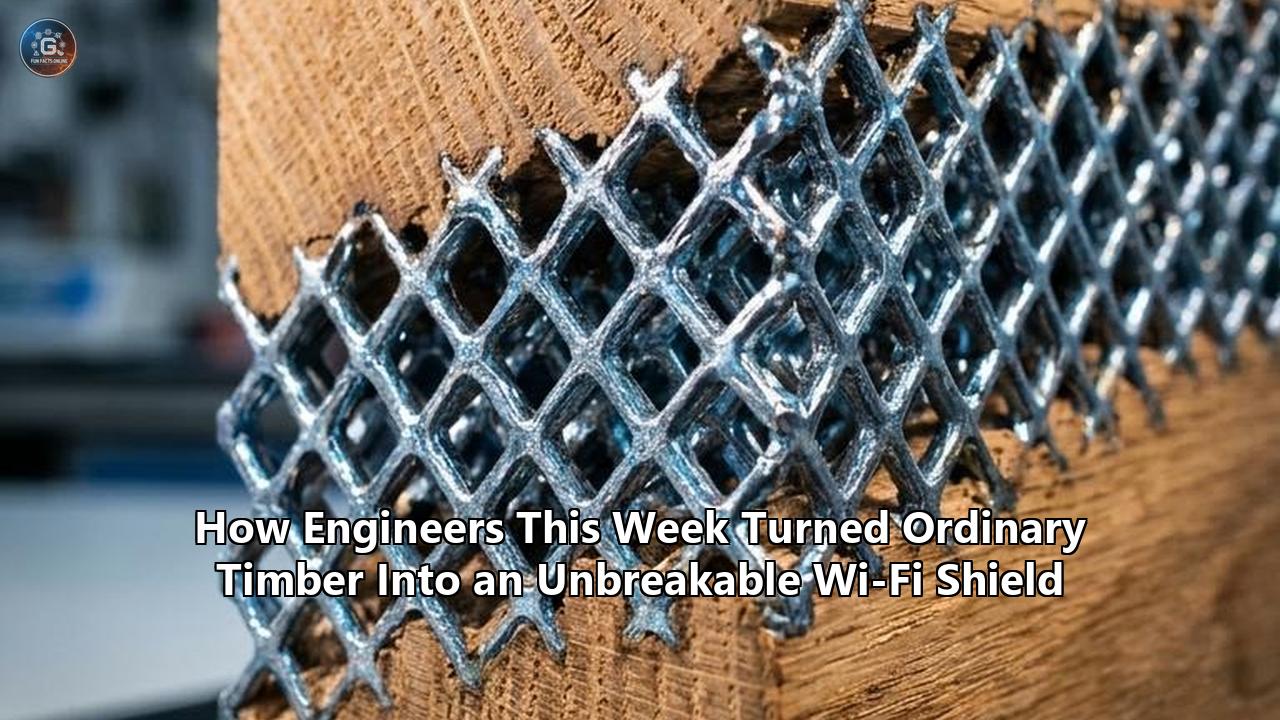
This week, materials scientists and chemical engineers unveiled a commercial-scale method to turn raw, untreated wood into an impenetrable barrier against wireless data transmission. Publishing synchronized research across Polymer Composites and Advanced Composites and Hybrid Materials in mid-May 2026, international engineering teams demonstrated a solvent-free chemical impregnation and pyrolysis technique that transforms standard forestry products into highly conductive, magnetic metamaterials.
Dubbed "Magwood" in one study and Ni3Fe-decorated carbonized wood in another, the resulting material effectively functions as a structurally rigid, architectural-grade timber wifi shield. Testing in the X-band frequency range (8 to 12.4 gigahertz)—the exact spectrum housing high-speed wireless networks, satellite communications, and military radar—revealed that these engineered wood panels achieve a shielding effectiveness ranging from 59.88 to an astonishing 94.1 decibels (dB), depending on the specific metal nanoparticle concentration.
In the physics of signal attenuation, a 40 dB rating means 99.99% of a signal is blocked. Pushing past 60 dB means the modified wood absorbs and destroys more than 99.9999% of incident electromagnetic waves. The panels dramatically outperform solid copper and aluminum meshes of the same weight, establishing a new baseline for architectural signal security.
The Invisible Threat of Electromagnetic Pollution
To understand why engineers are turning trees into signal blockers, one must look at the rapidly densifying state of global wireless infrastructure. Ambient electromagnetic interference (EMI) has become a measurable environmental pollutant. Every active Wi-Fi router, 5G cellular antenna, Bluetooth array, and Internet of Things (IoT) sensor emits electromagnetic fields. When deployed in extreme densities—such as in commercial office buildings, hospitals, or dense urban centers—these overlapping frequencies create signal crosstalk. This invisible static degrades the performance of sensitive microelectronics, disrupts medical imaging equipment, and creates severe vulnerabilities in corporate data security.
For decades, the standard solution to EMI pollution has been the Faraday cage: a continuous enclosure of highly conductive metal, usually copper, aluminum, or steel mesh. While effective, metal shielding presents distinct engineering flaws. Metals are exceptionally heavy, difficult to integrate into standard building materials, prone to galvanic corrosion, and highly reflective.
When a Wi-Fi signal hits a standard copper shield, the metal does not absorb the energy; it violently reflects it back into the environment. In a confined space, this secondary reflection creates an echo chamber of electromagnetic noise, compounding interference for devices outside the shielded zone.
The engineering mandate for the 2020s became the search for an absorption-dominant shielding material—something that could pull the Wi-Fi signal inward and dissipate its energy, rather than bouncing it away. Researchers found the answer in the natural, anisotropic cellular structure of wood.
The Anatomy of Wood as a Metamaterial Scaffold
Under an electron microscope, a cross-section of ordinary timber—such as balsa, ash (Fraxinus mandshurica), or pine—reveals a highly ordered, geometric honeycomb of micro-channels. These tubular structures, known as tracheids and vessels, evolved over millions of years to transport water and minerals from a tree's roots to its leaves.
In its natural state, this cellular scaffold is essentially transparent to radio frequencies. Wi-Fi signals pass seamlessly through the porous gaps, which is why a wireless router can transmit data through the wooden framing of a residential home. However, materials scientists recognized that this precise, vertically aligned cellular matrix is a physical geometry that would cost billions of dollars to replicate synthetically using polymers or aerogels. Wood provides a ready-made, lightweight, 3D template. If engineers could line the interior walls of these microscopic cellular tubes with conductive and magnetic materials, they could turn the timber into an electromagnetic black hole.
Previous attempts to achieve this in the early 2020s relied on harsh chemical delignification. Engineers would boil wood blocks in sodium hydroxide and hydrogen peroxide for days to strip away the lignin—nature's binding glue—leaving a spongy white cellulose scaffold. They would then backfill this delicate sponge with expensive silver nanowires, MXenes (two-dimensional transition metal carbides), or synthetic epoxies. The process was toxic, generated massive volumes of chemical waste, and severely compromised the structural integrity of the wood.
The May 2026 Breakthrough: Solvent-Free Synthesis
The breakthroughs published this week abandon the destructive delignification process entirely, opting for a highly efficient, solvent-free approach that scales easily to industrial manufacturing. The researchers utilized a method characterized as a "three birds with one stone" strategy, integrating vacuum-assisted impregnation with direct nitrogen pyrolysis.
Step 1: Vacuum-Assisted Impregnation
Rather than stripping the wood of its natural chemistry, the engineers place raw, unmodified timber blocks into a vacuum chamber submerged in an aqueous solution of metal salts. Depending on the desired magnetic properties, the solution contains either iron chloride (FeCl2) or a mixture of nickel and iron precursors. When the vacuum is engaged, the air trapped inside the wood's microscopic tracheids is forcefully evacuated. When the pressure is normalized, the vacuum aggressively pulls the metallic salt solution deep into the core of the wood, coating the interior walls of every cellular channel without requiring toxic solvents.
Step 2: Direct Pyrolysis
The saturated wood is removed from the chamber, dried, and transferred to a high-temperature furnace filled with inert nitrogen gas. The temperature is steadily ramped up to between 400°C and 1000°C. Because there is no oxygen in the furnace, the wood does not burn. Instead, it undergoes thermochemical decomposition.
As the temperature crosses 300°C, the hemicellulose and cellulose break down. By 800°C, the lignin degrades, leaving behind a rigid, highly graphitized carbon matrix. Simultaneously, the extreme heat forces the metallic salts to undergo in-situ crystallization. The nickel and iron molecules bond, precipitating into uniform Ni3Fe (nickel-iron) or iron oxide magnetic nanoparticles that anchor themselves permanently to the carbonized cellular walls.
The resulting material is no longer ordinary wood, nor is it a simple piece of charcoal. It is a hierarchically porous, magnetically decorated, electrically conductive carbon composite.
The Physics of Wave Annihilation
The reason this carbonized timber wifi shield is so exceptionally effective lies in how it manipulates the physical behavior of electromagnetic waves. When a Wi-Fi signal—which consists of oscillating electric and magnetic fields—strikes the Magwood panel, it is subjected to three distinct loss mechanisms that systematically drain its energy.
Impedance Matching and Multiple Internal Reflections
If a material has a vastly different electrical impedance than the surrounding air (like a sheet of solid copper), an incoming wave will instantly bounce off the surface. Because the engineered wood retains its high porosity (mostly empty air within the carbonized channels), its surface impedance closely matches that of the ambient environment. The Wi-Fi wave does not perceive a hard barrier; it enters the wood seamlessly.
Once inside, the wave is trapped in a microscopic house of mirrors. The signal bounces back and forth against the walls of the carbonized tracheids. With every microscopic reflection, the wave travels deeper into the material's labyrinth, unable to escape back into the room.
Conduction Loss and Joule Heating
As the wave ricochets through the internal channels, its electrical component interacts with the graphitized carbon matrix. The carbon walls possess high electrical conductivity—measured in recent tests at up to 1858 Siemens per meter (S/m) or 1659.59 S/cm depending on the specific carbonization parameters. The wave's electric field forces the free electrons in the carbon to oscillate. This movement of electrons creates a micro-current, effectively converting the high-frequency radio wave into trace amounts of physical heat, a process known as Joule heating.
Magnetic Loss and Interfacial Polarization
Simultaneously, the wave's magnetic component interacts with the Ni3Fe or iron oxide nanoparticles lining the cell walls. These nanoparticles possess highly specific magnetic domain structures. As the Wi-Fi signal oscillates billions of times per second (gigahertz), it forces the magnetic poles of the nanoparticles to rapidly flip back and forth. This mechanical-magnetic friction drains the remaining energy from the wave (magnetic hysteresis loss).
Furthermore, the boundaries between the graphitized carbon, the air voids, and the metal nanoparticles create millions of microscopic capacitors. When the wave hits these boundaries, positive and negative charges accumulate in a phenomenon called interfacial polarization, or the Maxwell-Wagner-Sillars effect. The electromagnetic energy gets bogged down in these localized charge traps, dissipating completely.
The sum of these mechanisms results in a material where the total shielding effectiveness ($SE_{total}$) is almost entirely driven by absorption ($SE_{absorption}$) rather than reflection ($SE_{reflection}$). The signal enters the timber, converts into a fraction of a degree of passive heat, and ceases to exist.
Economics and Manufacturing Viability
The transition from theoretical materials science to commercial viability hinges entirely on manufacturing economics. Prior ultra-high-performance EMI shields relied on exotic materials like silver nanowires, carbon nanotubes, or graphene aerogels. A single square meter of graphene-based shielding foam can cost thousands of dollars to synthesize in a laboratory, requiring highly pressurized chemical vapor deposition (CVD) chambers and highly purified precursor gases.
The engineered wood flips this economic model. The primary raw material is industrial timber waste or rapidly renewable forestry species like balsa, pine, and ash. These species are harvested globally at scale and cost pennies per linear foot.
By eliminating the hydrogen peroxide and sodium hydroxide delignification steps, the May 2026 process averts the most expensive and environmentally damaging aspect of biomass modification: chemical waste disposal. The vacuum impregnation process utilizes cheap, abundant iron and nickel salts, which are byproducts of traditional metal refining. Nitrogen pyrolysis is already a standardized industrial process used in biochar and activated carbon production.
Scaling this process requires larger vacuum vessels and continuous-feed nitrogen kilns, both of which are standard equipment in modern metallurgy and composite manufacturing. Consequently, the cost of manufacturing a timber wifi shield at an architectural scale is projected to be remarkably competitive with high-end commercial acoustic paneling, and significantly cheaper than outfitting a room with architectural copper shielding.
Super-Wood: Mechanical and Thermal Properties
While the primary objective of the research was electromagnetic shielding, the pyrolysis and metal-doping process fundamentally altered the physical properties of the wood, yielding a suite of secondary benefits that make it highly attractive for commercial construction.
Extreme Lightweight Density: Despite its metallic content, the material remains incredibly light. The carbonized Ni3Fe wood composite exhibits a density of merely 0.193 grams per cubic centimeter (g/cm³). For comparison, solid aluminum has a density of 2.7 g/cm³, and copper sits at 8.96 g/cm³. This allows architects to install thick layers of shielding in ceilings and partition walls without requiring reinforced structural framing to carry the dead load. Hydrophobicity and Moisture Resistance: Natural wood swells and rots when exposed to moisture, and raw porous carbon degrades in electrical performance when ambient humidity fills its pores. The newly synthesized composites exhibit intrinsic hydrophobicity. Testing revealed static water contact angles reaching up to 118 degrees. Water droplets physically cannot flatten out to penetrate the surface; they bead up and roll off. This ensures the electromagnetic shielding effectiveness remains stable over decades, regardless of seasonal humidity fluctuations or HVAC condensation. Fire Retardancy and Thermal Stability: Traditional wood is highly combustible, presenting a liability in server rooms or data centers. The pyrolysis process removes the volatile organic compounds that fuel a standard timber fire. The remaining graphitized carbon, coated in metallic nanoparticles, exhibits self-extinguishing behavior. It resists ambient oxygen combustion, acting more like a ceramic than a forestry product under direct flame exposure. Photothermal Conversion: In a specialized application of the Joule heating effect, the dark, highly absorptive surface of the carbonized wood proved exceptionally efficient at harvesting ambient light. Under low solar irradiance (100 mW cm⁻²), the Ni3Fe-EP-carbonized wood composite demonstrated stable heat conduction, converting light into thermal energy and reaching surface temperatures of up to 55°C. In colder climates, building envelopes clad in this material could theoretically shield interiors from EMI while passively contributing to the structure's heating load.Real-World Applications: From Data Centers to Smart Homes
The commercialization of this technology directly targets several high-value sectors struggling with the proliferation of wireless signals.
Secure Compartmented Information Facilities (SCIFs)
Military contractors, intelligence agencies, and corporate research divisions operate in SCIFs—rooms designed to prevent any electronic data from entering or leaving. Currently, building a SCIF involves wrapping a room in welded metal seams, which is incredibly labor-intensive. Deploying a timber wifi shield in a commercial setting allows contractors to build secure rooms using standard carpentry techniques. The engineered wood can be cut with standard saws, fastened with standard hardware, and seamlessly hidden behind decorative drywall or aesthetic wood veneers.
Healthcare and Diagnostic Imaging
Magnetic Resonance Imaging (MRI) machines require environments free of external radio frequency interference to generate clear internal scans of patients. Hospitals currently spend millions constructing specialized copper-lined rooms for these machines. The lightweight nature of the magnetic wood panels offers a rapidly deployable alternative, reducing the structural load on hospital floors and drastically cutting installation timelines.
Aerospace and Aviation
Modern aircraft are flying data centers, packed with sensitive avionics, navigation equipment, and passenger Wi-Fi routers. Shielding the flight control computers from the passenger cabin's electromagnetic noise is a critical safety requirement. Because aerospace engineering is governed by the strict limitation of weight, replacing heavy aluminum EMI casings with carbonized wood composites weighing 0.193 g/cm³ allows for significant fuel savings over the lifespan of an aircraft.
Residential Privacy Architecture
As the density of connected devices increases in residential neighborhoods, homeowners are experiencing unprecedented network congestion. Furthermore, the rise of advanced wireless scanning tools has made it easier for malicious actors to "sniff" Wi-Fi packets from the street, identifying when occupants are home or compromising network credentials. High-end residential architects are already exploring the integration of EMI-blocking materials into exterior wall assemblies. By lining a home's perimeter with these panels, homeowners can create a definitive wireless boundary, ensuring their local network remains strictly contained within the physical footprint of their property.
Looking Ahead: Milestones and Unresolved Questions
The May 2026 publications mark the definitive transition of wood-based EMI shielding from theoretical chemistry to practical engineering. However, several critical milestones remain before the material appears in wholesale lumber yards.
The immediate engineering challenge lies in scaling the vacuum-impregnation chambers to accommodate standard architectural dimensions. While treating a 10-centimeter sample block in a university lab is straightforward, achieving uniform iron-salt saturation across a 4-by-8-foot structural panel requires industrial-scale vacuum vessels and massive, highly controlled nitrogen kilns to prevent warping during the 800°C pyrolysis phase. Materials science start-ups focused on bio-composites are currently racing to design the continuous-feed manufacturing lines necessary to achieve this scale.
Another area of active research is the development of Frequency Selective Surfaces (FSS). Currently, the Magwood panels are broadband absorbers; they annihilate almost all radio frequencies across the X-band and L-band indiscriminately. While this is ideal for a military SCIF, a commercial office building might want to block external 2.4 GHz and 5 GHz Wi-Fi signals to prevent data theft, while simultaneously allowing lower-frequency 4G or 5G emergency cellular signals to pass through so employees can still receive phone calls. Researchers are investigating whether they can precisely tune the diameter of the wood's microscopic pores—potentially by selecting specific tree species with exact biological tracheid dimensions—to create structural filters that block specific wavelengths while remaining transparent to others.
Finally, long-term environmental durability testing is currently underway. While the intrinsic hydrophobicity prevents immediate water ingress, engineers must verify that the Ni3Fe nanoparticles do not slowly oxidize over a 50-year commercial building lifespan. If the magnetic nanoparticles rust or degrade, the magnetic loss mechanism of the shield will fail, drastically reducing the material's ability to absorb high-frequency radar and Wi-Fi.
By leveraging the microscopic brilliance of nature's design and enhancing it with precisely calibrated green chemistry, engineers have fundamentally rewritten the rules of electromagnetic shielding. Wood, humanity's oldest building material, has been successfully reprogrammed to solve one of the most invisible and pervasive problems of the modern digital age.
Reference:
- https://www.researchgate.net/publication/341955048_Lightweight_and_Construable_Magnetic_Wood_for_Electromagnetic_Interference_Shielding
- https://www.quora.com/Can-you-make-a-list-of-the-top-wifi-blocking-materials-like-wood-iron-glass-etc
- https://www.youtube.com/watch?v=h0HImmGm24w
- https://www.researchgate.net/publication/404801756_A_three_birds_with_one_stone_strategy_Ni3Fe-decorated_carbonized_wood_composites_for_high-performance_and_multifunctional_electromagnetic_interference_shielding
- https://www.researchgate.net/publication/357835387_Nickel-coated_wood-derived_porous_carbon_NiWPC_for_efficient_electromagnetic_interference_shielding