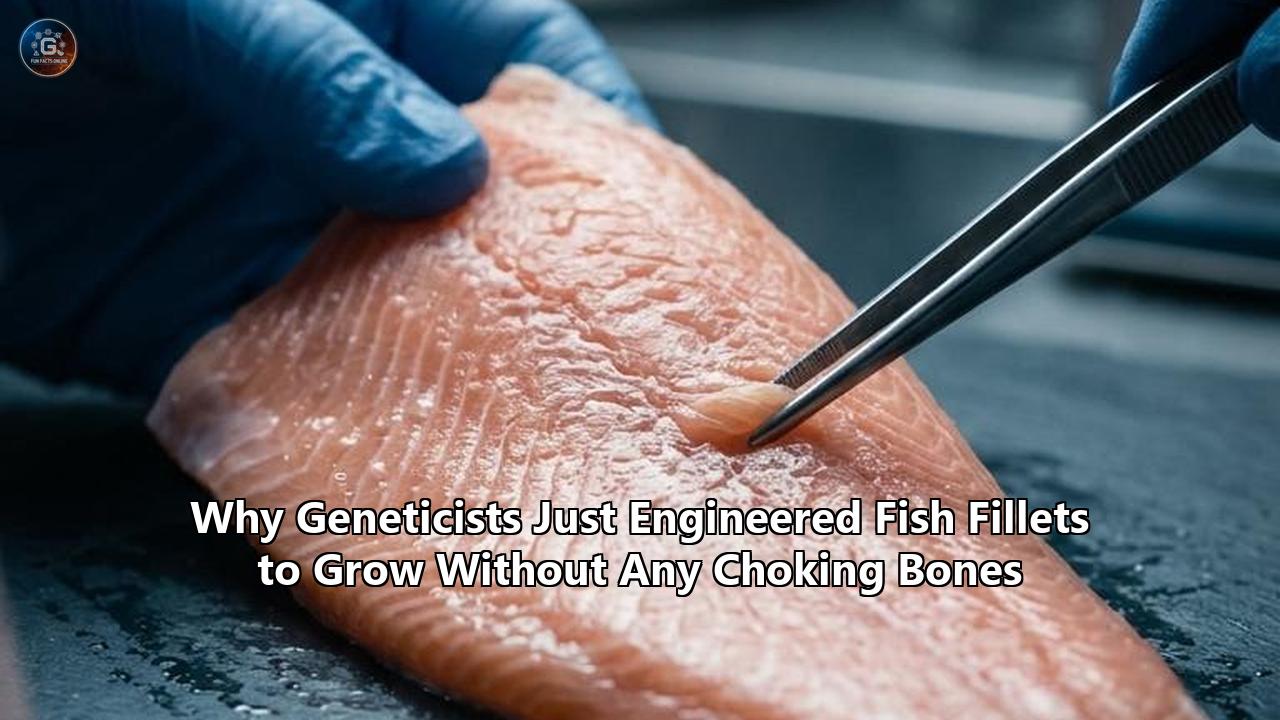
Inside an aquatic genomics facility in Wuhan, an automated micro-computed tomography scanner rotates slowly around a submerged specimen of grass carp (Ctenopharyngodon idella). On the adjacent monitor, a three-dimensional skeletal reconstruction resolves in high-resolution monochrome. The heavy cranial plate appears intact, flanked by a pristine vertebral column and curved thoracic ribs. But in the translucent bands of lateral muscle where over one hundred razor-sharp, Y-shaped intermuscular bones should branch, the screen shows nothing but solid, uninterrupted soft tissue.
The specimen is part of an ongoing project that has moved from basic genetics laboratories into multi-generational aquaculture trials. Teams of molecular biologists across major Chinese research institutes have used CRISPR-Cas9 genome editing to permanently delete the needle-like pin bones that have haunted diners, seafood processors, and hospital emergency wards for centuries.
The achievement represents the culmination of a systematic genetic hunt. By knocking out precise osteogenic master switches—specifically the runx2b and bmp6 genes—without modifying the rest of the organism's structural skeleton, researchers have cultivated viable, fast-growing strains of crucian carp, grass carp, and Wuchang bream that develop zero intermuscular bones.
The emergence of boneless genetically engineered fish is shifting from theoretical laboratory curiosity to industrial reality. The commercial stakes are vast: carp species account for tens of millions of metric tons of global aquaculture production each year. Yet their widespread adoption in global value-added processing lines, school lunch programs, and Western supermarkets has remained historically stalled by the constant threat of esophageal choking. Eliminating this single anatomical trait unlocks new supply chains, but it also raises pressing questions about evolutionary biomechanics, aquatic biosafety, and consumer acceptance.
+-----------------------------------------------------------------------------+
|                      ANATOMICAL COMPARISON: SKELETAL PROFILES               |
+-----------------------------------------------------------------------------+
| WILD-TYPE CYPRINID                      | GENE-EDITED MUTANT (e.g., WUCI)   |
|                                         |                                   |
|   [Cranial Vault]                       |   [Cranial Vault]                 |
|          |                              |          |                        |
|   [Vertebral Column]                    |   [Vertebral Column]              |
|      /   |   \                          |      /       \                    |
|  [Ribs]  |  [Ribs]                      |  [Ribs]     [Ribs]                |
|    |     |     |                        |    |           |                  |
|  * * * * * * * *  <-- ~100+ Pin Bones   |  (No Intermuscular Spines)        |
|  (Intermuscular Ossified Tendons)       |                                   |
|                                         |                                   |
| - High choking risk                     | - Zero choking risk               |
| - Requires manual pick/maceration       | - Direct mechanical filleting     |
| - Low industrial fillet yield           | - Intact muscle architecture      |
+-----------------------------------------------------------------------------+
The Clinical and Industrial Toll of the Pin Bone
To understand why molecular geneticists spent over a decade targeting a seemingly minor anatomical feature, one must look at otolaryngology records and food manufacturing ledgers.
In hospital emergency rooms across China, Japan, and Southeast Asia, fish bone impactions represent one of the most frequent acute endoscopic emergencies. Unlike the axial ribs or the sturdy dorsal spines, intermuscular bones—known scientifically as ossified myoseptal tendons—are hair-thin, semi-transparent, and structurally elastic. When a diner swallows a bite of traditional carp fillet, these tiny needles easily slip past oral mastication. They lodge in the palatine tonsils, the base of the tongue, the piriform fossa, or the upper esophagus, occasionally piercing arterial walls or causing severe deep neck infections if left untreated.
"For decades, the presence of these myoseptal spines has been an intractable bottleneck," says Dr. Liang Chen, a food processing engineer who has consultatively tracked aquaculture mechanization in Hubei province. "You can run salmon, pollock, or cod through automated industrial deboners with high efficiency because their pin bones are clustered in predictable rows along specific fascia planes. In carps, the bones branch laterally throughout the entire edible muscle matrix. If you attempt mechanical extraction, you shred the fillet into mush. If you do not extract them, you cannot sell the product to institutional cafeterias, fast-food conglomerates, or international markets where zero-bone tolerance is mandatory."
This bottleneck has kept carps—despite being among the most resource-efficient, low-trophic-level farmed animals on the planet—locked into regional, whole-fish traditional culinary preparations. Grass carp alone yielded over 5.9 million metric tons in 2022, representing roughly a fifth of China's freshwater aquaculture yield. Yet almost none of that tonnage enters the international frozen fillet trade.
The economic mandate was clear: eliminate the pin bones, and you open up a multi-billion-dollar global commodity market. Accomplishing that without breeding a crippled or morphologically dysfunctional animal, however, required uncovering a genetic blueprint that standard evolutionary biology had not yet deciphered.
Sifting Through 1,600 Candidates: The Decade-Long Hunt
The journey toward developing a viable boneless genetically engineered fish began not in carp ponds, but within thousands of micro-tanks containing model zebrafish (Danio rerio).
+-----------------------------------------------------------------------------+
|             THE GENETIC SCREENING AND DISCOVERY TIMELINE                    |
+-----------------------------------------------------------------------------+
| 2009-2012 | Initial bioinformatics screening catalogs >1,600 candidate      |
|           | osteogenic genes linked to fish skeletal development.           |
|           |                                                                 |
| 2018      | Disruption of *scxa* (scleraxis) reduces pin bones by 70%,      |
|           | but causes severe collateral rib and spinal deformations.       |
|           |                                                                 |
| 2019-2021 | Identification of *runx2b* and *bmp6* as distinct master        |
|           | regulators for intermuscular tendon ossification.               |
|           |                                                                 |
| 2022-2024 | CRISPR-Cas9 deployment in diploid and polyploid carps creates   |
|           | stable, fertile lines displaying complete bone elimination.     |
|           |                                                                 |
| 2025-2026 | Comprehensive multi-generational physiological, nutritional,    |
|           | and swimming biomechanics evaluations (e.g., *Zhongke 6*).     |
+-----------------------------------------------------------------------------+
In 2012, Professor Gao Zexia of Huazhong Agricultural University's Fisheries College set out to find the specific genetic regulatory switch governing intermuscular bone formation. The challenge was biological specificity. Vertebrate skeletons rely on deeply conserved signaling networks: perturb the wrong osteogenic pathways, and the embryo will fail to form a skull, its vertebrae will fuse, or its ribs will collapse, resulting in embryonic lethality.
Working in parallel, researchers at the Chinese Academy of Fishery Sciences’ Heilongjiang River Fisheries Research Institute and the Institute of Hydrobiology at the Chinese Academy of Sciences (CAS) cataloged more than 1,600 candidate genes tied to bone development, mineral homeostasis, and collagen deposition.
The investigative trail was strewn with false starts. Early work focused heavily on scxa (scleraxis), a basic helix-loop-helix transcription factor critical for tendon development. In 2018, tests revealed that knocking out scxa in zebrafish successfully eliminated roughly 70 percent of intermuscular bones. However, the collateral damage was severe: the fish developed warped spines, deformed ribs, and compromised motility, rendering the mutation commercially and ethically unviable.
The breakthrough arrived when teams decoupled primary endochondral bone formation from intramembranous and tendinous ossification. They discovered that intermuscular bones are not standard skeletal bones formed from cartilaginous templates; they are membranous ossifications that develop late within the connective tissue sheets (myosepta) separating adjacent muscle segments.
Two distinct genetic targets emerged from high-throughput CRISPR mutagenesis:
- ---runx2b (Runt-related transcription factor 2b): A duplicated teleost-specific paralog that acts as a downstream selector switch, directly directing myoseptal tendon progenitor cells to differentiate into mature osteoblasts.
- ---bmp6 (bmp6a and bmp6b - Bone Morphogenetic Protein 6):* Signaling ligands that transmit the localized biochemical cues necessary to initiate mineralization within the lateral myosepta during juvenile development.
When Gao’s laboratory and the CAS teams led by Academician Gui Jianfang knocked out both functional copies of these target pathways, juvenile fish grew through their developmental cycle without initiating ossification in their connective tissues. Their ribs, neural arches, spines, and fin rays calcified normally, but their muscle tissue remained devoid of bony needles.
Cracking the Polyploid Code
Moving from diploid model zebrafish to commercially farmed carps introduced an obstacle: polyploid genetics.
+-----------------------------------------------------------------------------+
|                     THE POLYPLOID TARGETING CHALLENGE                       |
+-----------------------------------------------------------------------------+
| Diploid Species (Zebrafish)           Amphitriploid Species (Gibel Carp)    |
|                                                                             |
| Chromosome Set: [2n]                  Chromosome Set: [AAABBB / 6n]         |
| Target Copies:  2 Alleles             Target Copies:  6 Alleles             |
|                                       (3 *runx2b-A* + 3 *runx2b-B*)         |
|                                                                             |
| Simple Dual-Cut Target                Multiplexed High-Fidelity sgRNAs      |
|          |                                           |                      |
| [ Complete Gene Deletion ]             [ Simultaneous Multi-Locus Cleavage ]|
|          |                                           |                      |
| Zero Intermuscular Bones              Zero Intermuscular Bones              |
+-----------------------------------------------------------------------------+
While zebrafish possess straightforward diploid genomes (two sets of chromosomes), many prized food carp are genetic briar patches. The Gibel carp (Carassius gibelio), for instance, is an amphitriploid species (AAABBB) carrying two distinct triploid sets of chromosomes.
"If you have an organism with six distinct alleles for a single functional gene, a partial mutation achieves nothing," explains Dr. Haoran Song, a developmental geneticist studying teleost genomics. "If even one or two functional copies of runx2b remain unedited, the cell produces enough transcription factor to trigger the complete cascade. You end up with an animal that still grows 60, 70, or 80 percent of its pin bones. To achieve total elimination, you must engineer molecular scissors capable of cleaving every homeologous allele simultaneously without causing off-target damage across millions of adjacent base pairs."
Gui Jianfang’s group at the CAS Institute of Hydrobiology, collaborating with Gao Zexia, mapped out the full amphitriploid genome of the Gibel carp, identifying two homeologs: Cgrunx2b-A and Cgrunx2b-B, each carrying three nearly identical sub-alleles. Using dual-target single guide RNAs (sgRNAs) paired with high-fidelity Cas9 enzymes, they achieved simultaneous biallelic and multi-locus cleavage.
To confirm the developmental timeline, the researchers used Alizarin Red S—a dye that binds specifically to calcified matrix—to trace bone emergence from the embryonic stage onward. In unedited wild-type carp, intermuscular bones begin mineralizing at approximately 14 to 20 days post-hatching, starting near the caudal tail fin and advancing systematically forward toward the head. In the multi-allele edited strains, the 14-day window arrived, passed, and the lateral muscle beds remained clear. The resulting strain, designated Zhongke 6, established a viable line of boneless genetically engineered fish engineered to lack intermuscular spines throughout its life cycle.
The Biomechanical Mystery: Why Did Pin Bones Evolve?
When news of the successful genetic knockouts emerged, evolutionary biologists raised a fundamental question: if intermuscular bones can be removed with a clean genetic deletion, why did teleost fish evolve and maintain them across 200 million years of evolutionary history?
+-----------------------------------------------------------------------------+
|                      TELEOST EVOLUTIONARY SPECTRUM                          |
+-----------------------------------------------------------------------------+
| BASAL TELEOSTS                                    ADVANCED TELEOSTS         |
| (Cyprinids, Clupeids, Characins)                  (Perciformes, Pleuronect.)|
| e.g., Carp, Herring, Piranha                      e.g., Perch, Bass, Flatfish|
|                                                                             |
| - High number of intermuscular bones (80-120+)    - Zero intermuscular bones|
| - Softer muscle architecture                      - Denser connective sheets|
| - High undulatory body movement                   - Stiffened axial drive   |
|                                                                             |
|        ---------------- EVOLUTIONARY LOSS ---------------->                 |
|                                                                             |
| CRISPR EDIT: Recapitulates advanced teleost loss directly in basal species.  |
+-----------------------------------------------------------------------------+
In basal teleosts—the ancestral lineages that include Cypriniformes (carps, minnows) and Clupeiformes (herrings, sardines)—intermuscular bones sit within the fibrous intersections of the myomeres, the W-shaped muscle blocks that line a fish’s flanks. Biomechanists hypothesized that these calcified struts act as biological cantilevers. When a fish undulates through water, muscular contraction generates shear stresses across adjacent tissue layers. Pin bones were thought to stiffen the soft tissue, ensuring that force generated by muscle contraction was efficiently transferred to the caudal tail rather than dissipated as heat or lateral bulging.
In higher, more modern teleosts—such as percomorphs (tilapia, sea bass, tuna)—intermuscular bones were lost naturally over millions of years of evolutionary diversification. These advanced fish evolved stiffer, more complex horizontal and vertical collagen sheets that transmit mechanical force without requiring internal calcified rods.
To determine whether removing pin bones impaired the carp's ability to swim, evade predators, or feed, research teams subjected the gene-edited fish to rigorous hydro-mechanical testing:
- Critical Swimming Speed ($U_{crit}$): Edited carp were placed in recirculating flume tanks with incremental increases in water velocity. Their sustained swimming capacity matched that of unedited wild-type siblings with no statistically significant decline in fatigue thresholds.
- Fast-Start Escape Response: High-speed video analysis (1,000 frames per second) recorded the "C-start" escape reflex triggered by acoustic pressure stimuli. The edited fish exhibited normal angular velocity and acceleration escape metrics.
- Locomotor Mechanics: Kinematic tracking showed minor adaptations in tail-beat amplitude, but swimming efficiency in standard pond and tank environments remained fully preserved.
The investigation revealed that in modern aquaculture conditions—where fish are not required to navigate torrential river currents or outrun apex predators for survival—the biological cost of losing intermuscular bones is functionally negligible.
Texture, Nutrients, and the Consumer Palate
Eliminating pin bones solves the safety and processing issue, but it raises another concern: does altering muscle-associated bone signaling change the quality, taste, or texture of the meat?
A multi-institutional team analyzed the F3 generation of wholly boneless crucian carp (designated WUCI) against multiple commercial wild-type strains, including wild-type Carassius auratus, Songpu silver crucian carp, and Fangzheng silver crucian carp. The findings, published in detailed nutritional and textural evaluations, delivered unexpected insights into post-harvest flesh quality.
+-----------------------------------------------------------------------------+
|                TEXTURAL & BIOCHEMICAL ASSAY: WT VS. WUCI (F3)               |
+-----------------------------------------------------------------------------+
| PARAMETER             | WILD-TYPE (WT)         | BONELESS MUTANT (WUCI)     |
+-----------------------+------------------------+----------------------------+
| Intermuscular Bones   | ~80 to 120 per fish    | 0                          |
| Moisture Content      | 78.4% ± 0.6            | 78.9% ± 0.5 (No change)    |
| Crude Protein         | 17.8% ± 0.4            | 17.6% ± 0.3 (No change)    |
| Amino Acid Profile    | Baseline               | Unaltered (Identical)      |
| EPA + DHA (Omega-3)   | Standard levels        | Preserved                  |
| Flesh Shear Force     | Baseline (Moderate)    | Significantly Higher (+8%) |
| Muscle Hardness       | Baseline               | Slightly Lower (-5%)       |
| Tissue Calcium        | Standard matrix level  | Moderately Reduced         |
| Tissue Potassium      | Standard matrix level  | Moderately Elevated        |
+-----------------------+------------------------+----------------------------+
Texture Profile Analysis (TPA) and mechanical shear tests revealed that the flesh of the boneless mutant exhibited slightly lower overall hardness but a measurable increase in shear force resistance compared to control groups. In practical sensory terms, diners and food scientists described the meat as noticeably more tender while retaining cohesive elasticity.
Because the osteogenic signaling pathways were turned off specifically in the myosepta, the overall muscle fiber diameter and density remained unaffected. Chemical assays showed that critical fatty acids—including docosahexaenoic acid (DHA) and eicosapentaenoic acid (EPA)—along with essential amino acid profiles matched standard fish. The only marked biochemical shift occurred in trace mineral partitioning: boneless fish tissue showed slightly decreased calcium concentrations and elevated potassium levels, a direct physiological consequence of halting localized calcium-phosphate crystallization within the flesh.
The Economics of Automated Processing
The industrial argument for the boneless genetically engineered fish lies in the mechanics of commercial seafood processing plants.
In modern fish processing facilities, speed and yield determine viability. Processing a wild-type grass carp or bream into clean, boneless products requires intensive manual labor. Workers must use V-shaped knives to excise large swaths of flesh surrounding the lateral bone clusters, discarding up to 35 to 45 percent of edible muscle in the process. Alternatively, processors resort to heavy mechanical deboning machines that grind the entire fish into a minced slurry, destroying muscle integrity to produce low-value fish paste or surimi.
+-----------------------------------------------------------------------------+
|                     VALUE-CHAIN PROCESSING PIPELINE                         |
+-----------------------------------------------------------------------------+
| CONVENTIONAL CARP PROCESSING:                                               |
| [Whole Harvest] --> [Evisceration] --> [Manual Splitting]                   |
|       |                                                                     |
|       +--> [Heavy Meat Grinder / Deboner] --> [Low-Value Surimi/Paste]      |
|       |    (Yield loss ~40%, Structural loss 100%)                          |
|       |                                                                     |
|       +--> [Whole/Bone-in Retailing] --> (Confined to Local Asian Wet Mkts) |
|                                                                             |
| BONELESS GENE-EDITED PIPELINE:                                              |
| [Whole Harvest] --> [High-Speed Mechanical Filleting]                       |
|       |                                                                     |
|       +--> [Uniform Intact Boneless Fillets]                                |
|       |    (Yield >65%, Intact Muscle Texture)                              |
|       |                                                                     |
|       +--> [Global Cold-Chain: Ready Meals, Institutional Menus, Export]    |
+-----------------------------------------------------------------------------+
By removing intermuscular bones at the genetic level, high-speed automated filleting lines—similar to those used for Atlantic salmon and whitefish—can process carp with high recovery rates. Intact, high-protein white fillets can be sliced, frozen, battered, or portioned directly for ready-to-eat meals, fast-food sandwiches, and consumer retail packs.
"From an industrial engineering standpoint, this alters the commodity balance," notes Chen. "Freshwater cyprinids possess some of the most favorable feed conversion ratios in agriculture, converting plant-based, low-cost feed into protein far more sustainably than carnivorous marine species like salmon or sea bass. If you eliminate the bone penalty, you have a protein source capable of competing directly with pollock, tilapia, and pangasius on the global market."
Ecological Containment and the Regulatory Maze
Despite the clear commercial and culinary benefits, the path from research tanks to supermarket shelves faces regulatory scrutiny and ecological considerations.
+-----------------------------------------------------------------------------+
|                     REGULATORY & BIOSAFETY MATRIX                           |
+-----------------------------------------------------------------------------+
| DOMAIN              | REGULATORY STATUS / RISK MITIGATION STRATEGY          |
+---------------------+-------------------------------------------------------+
| Genetic Mod. Type   | SDN-1 (Site-Directed Nuclease-1): Targeted knockout   |
|                     | with no foreign transgenic DNA inserted.              |
|                     |                                                       |
| Ecological Risk     | Accidental escape into open river basins and          |
|                     | competition with wild native populations.             |
|                     |                                                       |
| Containment Mech.   | Induced Triploidy & Gynogenesis: Engineering physical |
|                     | reproductive sterility in all commercial stock.       |
|                     |                                                       |
| Jurisdictional View | - China: Expedited pathway for non-transgenic edits.  |
|                     | - US (USDA/FDA): Exemption pathways for SDN-1 edits.  |
|                     | - EU: Stricter GMO classification frameworks remain.  |
+---------------------+-------------------------------------------------------+
The most pressing ecological concern is accidental escape. Carps are notoriously hardy, adaptable, and prolific breeders. In waterways where non-native carps have previously been introduced—such as the Mississippi River basin in the United States—they have rapidly outcompeted native species, disrupted aquatic vegetation, and dominated river ecosystems. If fertile gene-edited fish were to escape into natural river systems, could their modified genetics spread across wild populations?
To address this, researchers have integrated reproductive containment directly into the development pipeline:
- Induced Sterility (Triploidy): Using hydrostatic pressure or temperature shock on fertilized eggs to produce triploid fish carrying three sets of chromosomes, rendering them functionally sterile and incapable of reproducing if they escape into open waterways.
- Gynogenetic Reproduction: Utilizing specialized all-female lineages that require specific laboratory-controlled hormonal or physical triggers to produce viable offspring, eliminating the possibility of self-sustaining wild feral colonies.
The regulatory landscape is simultaneously evolving around the distinction between transgenic modifications and targeted gene editing. Unlike older genetically modified organisms (such as AquaBounty's AquAdvantage salmon, which incorporated growth hormone genes from Chinook salmon and promoter sequences from ocean pout), these boneless carps are created via SDN-1 (Site-Directed Nuclease-1) gene editing. No foreign DNA or foreign species genes are introduced into the fish’s genome. The CRISPR enzyme simply makes a targeted cut, and the fish's natural DNA repair mechanism deactivates the gene—a process that mimics naturally occurring loss-of-function mutations.
In agricultural jurisdictions including China, the United States, Japan, and Brazil, non-transgenic SDN-1 gene-edited organisms face substantially streamlined regulatory assessment pathways compared to traditional transgenic GMOs. Japan has already commercialized CRISPR-edited red seabream (engineered with a knocked-out myostatin gene for increased muscle mass) without requiring transgenic warning labels. China’s revised gene-editing guidelines have similarly established clear evaluation standards for safety-validated, non-transgenic aquatic crops, accelerating the transition from closed experimental ponds to commercial authorization.
Global Ripple Effects: Beyond the Asian Carp Basin
While Chinese laboratories have driven the primary research on cyprinids, the elimination of intermuscular bones is sparking parallel efforts across global aquaculture research centers:
- South America (Tambaqui): In Brazil, geneticists at EMBRAPA (Brazilian Agricultural Research Corporation) are applying homologous CRISPR knockouts to Colossoma macropomum (tambaqui), an economically vital Amazonian freshwater species whose delicious, high-yield rib fillets are compromised by intramuscular Y-bones.
- South Asia (Major Indian Carps): Research consortia in India and Bangladesh have initiated functional genomic screening targeting runx2b orthologs in rohu (Labeo rohita) and catla (Gibelion catla), aiming to modernize domestic processing of South Asia's core aquaculture staples.
- North America & Europe (Salmonids & Catfish): While Atlantic salmon lack branching myoseptal Y-bones, they do possess single pin bones along the anterior lateral line that require costly mechanical extraction during filleting. Researchers are investigating whether localized upstream signaling disruption can eliminate these pin bones entirely without affecting the axial skeleton.
The Next Milestones on the Horizon
The development of the boneless genetically engineered fish marks a definitive turning point in agricultural biotechnology: the intentional reconfiguration of vertebrate skeletal anatomy to serve human consumption and industrial processing.
Over the coming seasons, the field faces three critical milestones:
+-----------------------------------------------------------------------------+
|                      FUTURE MILESTONES & WATCHLIST                          |
+-----------------------------------------------------------------------------+
| [2026-2027]                                                                 |
| Scale-up of closed-containment pilot commercial hatcheries; formal biosafety|
| certificates filed for large-scale pond farming of *Zhongke 6* carp.        |
|                                                                             |
| [2027-2028]                                                                 |
| Consumer market trials in municipal restaurant chains and institutional     |
| cafeterias across primary test cities in Hubei and Heilongjiang provinces.  |
|                                                                             |
| [2028-2030]                                                                 |
| Entry of automated, ready-to-cook boneless whitefish carp fillets into      |
| international frozen export supply chains and school meal infrastructure.   |
+-----------------------------------------------------------------------------+
As large-scale commercial pond trials expand, biologists will continue tracking long-term multi-generational stability across thousands of consecutive breeding cycles, verifying that the deletion of runx2b and bmp6* does not introduce subtle vulnerabilities to emerging pathogens, changes in mineral absorption, or structural fatigue under varying environmental conditions.
The evidence gathered across laboratories in Wuhan, Harbin, and beyond demonstrates that the ancient problem of the choking fish bone has found a molecular solution. By turning off a single cellular switch, geneticists have reshaped an age-old culinary landscape, transforming one of the world's most frustrating freshwater delicacies into a clean, uniform, and entirely bone-free protein source.
Reference:
- http://www.ecns.cn/news/2024-03-20/detail-ihcytyps2802201.shtml
- https://nautil.us/editing-the-pesky-bones-out-of-a-popular-farmed-fish-1281553
- https://global.chinadaily.com.cn/a/202201/21/WS61ea0fa5a310cdd39bc826ca.html
- https://english.news.cn/20220118/22e4ee09bff841e29de08d45e25cdb83/c.html
- https://www.mdpi.com/2410-3888/10/12/606
- https://www.frontiersin.org/journals/cell-and-developmental-biology/articles/10.3389/fcell.2022.821471/full
- http://english.ihb.cas.cn/newsroom/research/202302/t20230208_326763.html
- https://english.cas.cn/print/index.shtml?docurl=https://english.cas.cn/newsroom/news--archives/2023/research-news/202302/t20230208_1126711.shtml
- https://pmc.ncbi.nlm.nih.gov/articles/PMC12729833/
- https://hakaimagazine.com/features/supersize-my-seabream/