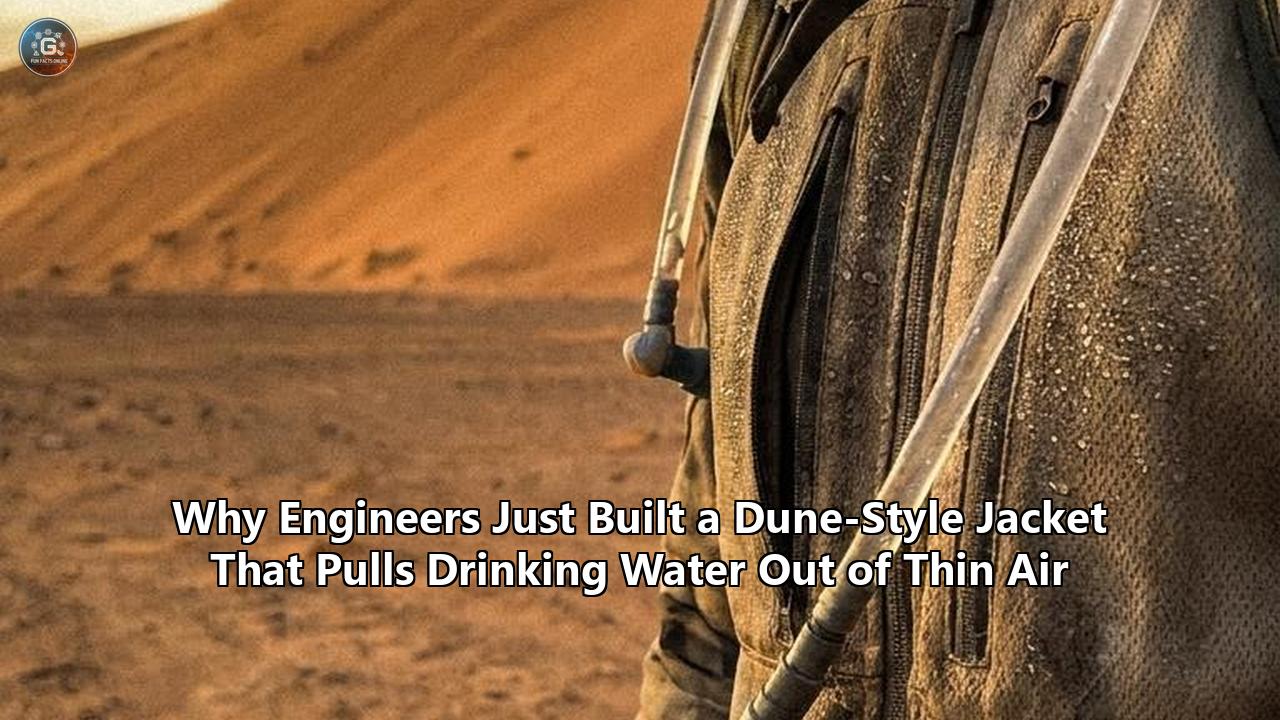
In June 2026, engineers at the University of Texas at Austin unveiled a wearable, highly flexible outdoor jacket that pulls clean drinking water directly from ambient humidity. The research, published in Science Advances, details how these scientists engineered hierarchical textile fibers to harvest moisture from the surrounding air and condense it into drinkable water.
The jacket is inspired by the legendary "stillsuits" of Frank Herbert’s science-fiction masterpiece Dune. In the fictional universe of Arrakis, stillsuits are full-body garments designed to recycle every drop of a wearer's bodily moisture—from sweat to urine—to keep them alive in hyper-arid wastes. The real-world jacket developed in Texas does not recycle sweat. Instead, it acts as a personal, wearable "windtrap," capturing water vapor suspended in the air and converting it into potable liquid on the go.
With the Earth’s atmosphere containing an estimated 12,900 cubic kilometers of water vapor at any given moment—enough to fill millions of massive municipal reservoirs—the potential for this technology is staggering. Led by Dr. Guihua Yu, a chair professor in the Cockrell School of Engineering’s Walker Department of Mechanical Engineering and the Texas Materials Institute, and lead graduate student researchers Chuxin Lei and Weixin Guan, this milestone marks a massive departure from traditional atmospheric water harvesting.
The jacket generates between 400 and 900 milliliters (roughly 14 to 30 ounces) of clean water per day, depending on the relative humidity of the environment. Simultaneously, a companion solar-powered system developed by the same research group has broken water-collection records in both the scorching, arid Chihuahuan Desert of New Mexico and the humid environment of Austin, Texas.
This breakthrough represents a structural pivot in resource generation. By transforming passive apparel into an active extraction tool, the research team is laying the groundwork for a future where clean water is not something people have to carry, buy, or pump from a grid, but something they simply harvest by walking outside.
The Molecular Chemistry of the Wearable Hydrogel
To understand how a soft, lightweight jacket can extract drinking water from the air, one must look at the textile's fiber structure. Traditional atmospheric water harvesting systems are heavy, boxy, and energy-intensive. They typically rely on active refrigeration coils to cool air below its dew point, or they use dense beds of desiccant materials—like silica gel or metal-organic frameworks (MOFs)—that require extreme heat to release the water they absorb.
The UT Austin team bypassed these limitations by developing a specialized fabric under their "AirGel" platform, which is constructed from biomass-derived hydrogel fibers. The primary material challenge in atmospheric water harvesting is a kinetic bottleneck: materials that are highly effective at absorbing water vapor (hydrophilic sorbents) are usually terrible at releasing it, requiring high temperatures to break the chemical bonds between the water molecules and the sorbent material. Conversely, materials that release water easily (hydrophobic sorbents) cannot absorb enough moisture from dry air to be useful.
Traditional Sorbents (e.g., Silica Gel, MOFs):
Vapor Absorption ---> Trapped in Bulk Sorbent ---> Requires High Heat (>100°C) to Release

UT Austin Hierarchical Hydrogel Fiber (AirGel):
Vapor Absorption ---> Quick Phase Change ---> Capillary Transport ---> Low-Heat Desorption (<45°C)
(Porouse Outer Layer)    (Liquid Surface)       (Fiber Core Channel)     (Thermoresponsive Release)
To resolve this conflict, the researchers engineered a thermoresponsive hydrogel network. They utilized a copolymer structure that alters its physical state based on temperature. At lower, ambient temperatures, the hydrogel is highly hydrophilic, actively pulling water molecules from the air. When the temperature of the material is raised slightly—to a threshold easily achieved by body heat or mild solar exposure—the hydrogel undergoes a phase transition, becoming hydrophobic. This transition forces the material to squeeze out its captured water like a microscopic sponge, without requiring the boiling temperatures needed by industrial desiccants.
The critical innovation lies in the physical architecture of the fibers. As Keith P. Johnston, a co-author and professor in the McKetta Department of Chemical Engineering, explains:
“The important advance here is that the team did not simply make another material that absorbs water. They designed a pathway for water to move quickly, from vapor in the air, to liquid on the fiber surface, and then into the textile.”
This pathway is achieved through a hierarchical pore structure within each individual fiber. The outer layer of the fiber features open, highly porous channels that facilitate the rapid phase change of water from gas (vapor) to liquid. Once condensed on the surface, the liquid is moved via capillary pressure through the fiber's interior channels toward the collection zones. This passive fluid transport mechanism prevents the water from remaining trapped inside the bulk polymer matrix, accelerating the absorption-desorption cycle.
When woven into standard fabrics, these biomass fibers maintain their flexibility, durability, and breathability, turning the jacket into a highly functional water from air device. This is a massive departure from standard water-harvesting machinery. By manipulating the polymer chemistry at the molecular scale, the team achieved a three- to ten-fold improvement in water-transport efficiency over conventional sorbent materials at scale.
The Mechanical Loop: From Ambient Vapor to the Canteen
The transition from a laboratory-synthesized hydrogel fiber to a functional, wearable garment requires a highly coordinated mechanical system. The UT Austin prototype jacket is constructed with integrated panels of the AirGel textile strategically positioned across the outer shell, where air exposure is maximized.
   [ Ambient Air / Humidity ]
               │
               ▼  (Passive Absorption via porous outer fibers)
      [ AirGel Textile ]
               │
               ▼  (Capillary transport along interior channels)
   [ Detachable Cartridges ]  <--- Integrated at collection points
               │
      (User detaches filled cartridge)
               │
               ▼
     [ Foldable Collector ]   <--- Placed inside portable chamber
               │
               ▼  (Mild Solar or Thermal Heating, <45°C)
     [ Condensation Phase ]
               │
               ▼  (Passive Gravity Drip)
   [ Distilled Drinking Water ]
The operation of the jacket occurs in a multi-stage passive and active loop:
- Passive Vapor Absorption: As the wearer moves through their environment, ambient wind and body movement force air across the hydrogel-infused panels. The textile absorbs moisture directly from the atmosphere, capturing water molecules regardless of whether the wearer is running, walking, or resting.
- Capillary Shuttling: Instead of keeping the water distributed evenly throughout the coat, the capillary architecture of the fibers coaxes the liquid to travel toward designated collection nodes. Here, the moisture is funneled into small, detachable harvesting units integrated directly into the garment's structure.
- Cartridge Extraction: Once the collection units are saturated, the wearer detaches them from the jacket. The jacket's design makes this process as simple as replacing a lens or unscrewing a cap.
- Thermal Desorption and Condensation: The saturated cartridges are placed inside a compact, foldable solar collector unit carried in a backpack or pocket. When exposed to sunlight or mild heat, the thermoresponsive hydrogel releases the liquid. The evaporated water condenses on the cool walls of the collector and drips down into a canteen as pure, distilled drinking water.
During field testing, this cycle produced between 400 and 900 milliliters of drinking water per day. To put this in perspective, 900 milliliters is nearly a full liter of water—equal to almost two standard plastic bottles. In dry climates with relative humidity as low as 20%, the system still gathered roughly 400 milliliters of water, proving that the technology functions in arid zones where water is most desperately needed.
In a parallel development, the team utilized the same gel-fabric architecture to build a solar-driven, field-portable atmospheric water harvester. In rigorous trials conducted in the Chihuahuan Desert of New Mexico, this unit extracted 1.3 liters of clean drinking water per day from the dry desert air. This yield translates to roughly 4.3 liters of water per kilogram of moisture-capturing material per day, a new performance standard for sorption-based atmospheric water harvesting.
Because the water undergoes an evaporation and condensation loop within the collector, the resulting liquid is distilled and immediately potable. It is entirely free of soil-borne pathogens, heavy metals, and particulate matter, bypassing the need for secondary filtration tablets or pump systems.
Shaking Up the Global Outdoor Gear Industry
The introduction of water-harvesting apparel is poised to disrupt the multi-billion-dollar global outdoor gear and performance apparel industries. For decades, the primary design objectives of companies like Patagonia, Arc'teryx, ThruDark, and The North Face have been thermal regulation, moisture-wicking (moving sweat away from the body), and wind and water resistance. The concept of "water harvesting" introduces an entirely new functional category to the consumer market: active resource generation.
┌────────────────────────────────────────────────────────────────────────┐
│                      OUTDOOR APPAREL PARADIGM SHIFT                   │
├───────────────────────────────────┬────────────────────────────────────┤
│         Traditional Gear          │    Next-Gen Water-Harvesting Gear  │
├───────────────────────────────────┼────────────────────────────────────┤
│ • Passive protection (barrier)    │ • Active resource extraction       │
│ • Hydrophobic treatments (DWR)    │ • Dynamic hydrophilic /            │
│                                   │   hydrophobic phase-change fibers │
│ • Heavy load carrying (canteens)  │ • On-demand water generation       │
│ • High reliance on base camps     │ • Extended off-grid range         │
└───────────────────────────────────┴────────────────────────────────────┘
The primary consumer benefit of a water-harvesting jacket is weight reduction. Water is a heavy, dense cargo, weighing exactly one kilogram (2.2 pounds) per liter. For thru-hikers on long-distance trails like the Appalachian Trail or the Pacific Crest Trail, mountaineers, and off-grid backpackers, water dictates every logistics decision. Carrying enough water for a multi-day journey requires massive, heavy packs that stress the joints and drain the wearer's energy.
By utilizing a jacket that can generate up to a liter of water a day, an outdoor enthusiast can dramatically reduce their baseline pack weight. Instead of carrying three to four liters of water for a day’s trek, they can carry a minimal reserve, knowing their jacket and gear will generate fresh water passively as they hike.
This technology can be integrated into far more than just jackets. The research team at UT Austin has pointed out that the same AirGel biomass fibers can be woven into:
- Backpacks: Large surface-area packs can act as passive moisture collectors while exposed to the sun and air currents during a hike.
- Tents and Rainflies: Overnight, when relative humidity levels naturally spike as temperatures drop, a tent fly woven with hydrogel fibers could absorb liters of water from the night air, which can be harvested in the morning to prepare breakfast and refill canteens.
- Sleeping Bags and Bivy Sacks: Utilizing the moisture-wicking properties of hydrogels, sleeping bags could absorb body humidity and ambient vapor, storing it in localized collector nodes.
- Emergency Shelters: Lightweight, deployable tarps used by search-and-rescue teams could double as water-generating hubs, saving lives during wilderness extractions.
This material-level integration changes outdoor gear from a passive shield against the elements into a system that actively leverages the environment to sustain the wearer. Outdoor apparel brands are likely to jump at the chance to license these patents to gain a competitive edge. The first brands to bring a functional, wearable, water-generating jacket to market will secure a major foothold in the high-end adventure and survivalist sectors.
Tactical Logistics: Transforming Military and Field Operations
In tactical environments, water is not just a biological necessity; it is a primary logistical vulnerability. Modern military operations in arid, landlocked, or infrastructure-poor regions require massive water resupply networks. The United States Department of Defense, which has previously engaged with Dr. Guihua Yu’s lab on alternative water solutions, spent billions of dollars during operations in Iraq and Afghanistan transporting bottled water to forward operating bases (FOBs).
                                  MILITARY SUPPLY CHAIN

Traditional Logistics:
[ Central Water Depots ] ───► [ Fuel-Hungry Convoys ] ───► [ High-Risk FOBs ] ───► [ Heavy Soldier Loads ]
                             (Hostile Target Risk)                                 (5-10 kg water weight)

Decentralized AWH Wearables:
[ Ambient Air ] ────────────► [ Wearable Jacket/Pack ] ───► [ On-Demand Hydration ]
                             (Zero Logistical Footprint)   (Ultra-Light Combat Load)
The financial cost of this transport is dwarfed by the human cost. Fuel and water supply convoys are slow, heavy, and predictable, making them prime targets for improvised explosive devices (IEDs) and ambushes. Reducing the frequency of these supply runs directly correlates to saving soldiers' lives.
Additionally, individual infantry soldiers carry heavy combat loads, often exceeding 100 pounds. A significant portion of this weight is water. A soldier operating in a hot environment needs to consume between 4 and 8 liters of water per day to maintain combat readiness. Carrying this volume of liquid severely degrades physical performance, limits operational range, and slows down movement in hostile territory.
The integration of an advanced water from air device directly into military uniforms, plate carriers, and rucksacks alters this tactical equation:
- Extended Mission Autonomy: Reconnaissance teams, special forces, and deep-penetration patrols can operate behind enemy lines for days or weeks longer than previously possible, freed from the tether of scheduled water drops.
- Radical Load Reduction: By converting their uniforms into active water collectors, soldiers can reduce their starting pack weight by 10 to 15 pounds, boosting their agility, speed, and endurance.
- Minimized Thermal Footprint: Unlike motorized or generator-powered water filtration units, which emit significant thermal signatures that can be picked up by enemy infrared sensors, the biomass-hydrogel jacket operates passively and silently, maintaining a soldier's stealth.
- Tactical Redundancy: If a soldier is separated from their unit or pinned down in an isolated position, a water-generating uniform serves as a vital survival backup, preventing dehydration-induced cognitive decline and physical collapse.
Beyond infantry operations, military medics and search-and-rescue teams can use these materials to treat casualties in water-scarce zones, ensuring that sterile water is always available for cleaning wounds and administering IV fluids.
Humanitarian Lifeline: Disaster Relief and Infrastructural Collapse
When natural disasters like hurricanes, earthquakes, floods, or tsunamis strike, municipal infrastructure is often the first thing to collapse. Water treatment plants lose power, water mains rupture, and floodwaters contaminate local aquifers with sewage, chemicals, and debris. In the immediate aftermath of a crisis, supplying clean drinking water to survivors and emergency responders becomes a race against time.
┌────────────────────────────────────────────────────────────────────────┐
│                    DISASTER RESPONSE LOGISTIC COMPARISON               │
├───────────────────────────────────┬────────────────────────────────────┤
│      Standard Humanitarian Aid    │    AWH-Enabled Wearable Aid        │
├───────────────────────────────────┼────────────────────────────────────┤
│ • Transporting heavy bottled water│ • Distributing dry, lightweight    │
│ • Bulky, fuel-dependent pumps     │   smart apparel and shelters       │
│ • Vulnerable supply bottlenecks   │ • Decoupled from road access       │
│ • Secondary pathogen risks        │ • Decentralized, passive water     │
│                                   │   generation at the family level   │
└───────────────────────────────────┴────────────────────────────────────┘
The current humanitarian playbook relies on trucking in millions of plastic water bottles or deploying bulky, stationary water-filtration units. Both methods suffer from significant logistical bottlenecks. Damaged roads, collapsed bridges, and debris can isolate hard-hit communities for days. Furthermore, stationary water-filtration systems are useless if local water sources are dried up or contaminated with non-filterable chemical toxins.
A wearable, decentralized water-harvesting system changes how we approach disaster relief. Rather than waiting for aid convoys to clear physical blockages, emergency agencies can drop lightweight, hydrogel-infused jackets, blankets, and temporary shelters directly into disaster zones via drone or helicopter.
These items provide immediate relief in several ways:
Decentralized Water Production
Displaced families can produce their own clean water right where they are, without having to gather at crowded, high-risk centralized distribution centers.
Absolute Purity
Because the AWH textile works through an evaporation-condensation (distillation) cycle, the extracted water is completely separated from ground-level contaminants. Even if a survivor is surrounded by toxic floodwaters or chemical spills, the jacket pulls pure water vapor directly from the air, avoiding the pollutants altogether.
Reduced Resource Strain
By enabling survivors to generate their own water, relief agencies can focus their limited transport capacity on delivering medicine, food, and heavy search-and-rescue equipment.
This decentralized approach is particularly vital for the Global South and water-stressed nations. Across parts of North Africa, the Middle East, South Asia, and sub-Saharan Africa, clean drinking water is a daily struggle even without a natural disaster. The United Nations estimates that by 2030, nearly half of the world's population will live in areas of high water stress.
A low-cost, low-maintenance, wearable water from air device offers these communities a level of daily resource independence that traditional infrastructure projects—which require billions of dollars and decades of political stability to construct—simply cannot provide.
Short-Term Consequences: Patents, Partnerships, and Production Lines
With the research published and validated, the transition from lab-bench science to a viable consumer product is already underway. Discovery to Impact, the University of Texas at Austin's specialized technology commercialization and patenting division, has filed a comprehensive patent application covering the biomass-derived hydrogel fibers and the hierarchical textile weave.
                                COMMERCIALIZATION TIMELINE

[ UT Austin Patent Filed ] ───► [ Industrial Fabric Licensing ] ───► [ Med-Military Pilots ] ───► [ Consumer Outdoor Market ]
(June 2026 Milestone)           (Partnership with Mills)             (Defense/Relief Contracts)  (Patagonia / Arc'teryx)
In the short term, the first consequence of this development will be a race among defense contractors, medical suppliers, and high-end outdoor brands to secure licensing agreements. The initial commercial deployment will not be a mass-market retail product. Instead, the path to market will follow a multi-stage trajectory:
Phase 1: Specialized Military and Search-and-Rescue Contracts
The first entities capable of absorbing the high initial costs of producing these specialized hydrogel textiles will be government agencies. The US Department of Defense, along with international humanitarian organizations like the Red Cross and USAID, are likely to fund early pilot programs. These programs will field-test the jacket in extreme, real-world environments to determine its ruggedness and establish training protocols for using the detachable collector cartridges.
Phase 2: Industrial Fabric Scaling
To make the jackets affordable, the biomass-hydrogel synthesis must be scaled up. Currently, the fibers are manufactured in specialized academic and industrial laboratories. To achieve commercial viability, the team’s "AirGel" material must be integrated into standard high-speed textile spinning and weaving machinery.
Fortunately, the use of biomass-derived materials—such as cellulose from wood pulp, chitin from discarded crab shells, and various plant-based polymers—makes the raw materials incredibly inexpensive and environmentally sustainable. This sustainability profile will make the technology highly attractive to fabric mills looking to lower their carbon footprint.
Phase 3: The Early Adopter Consumer Market
Once industrial production lines are running, the technology will enter the high-end consumer market. Outdoor enthusiasts can expect to see early-generation water-harvesting jackets and backpacks hitting the shelves at premium price points, likely starting at $500 to $800.
These products will target thru-hikers, adventure racers, and off-grid survivalists who are willing to pay a premium to shave pounds off their gear loads. The marketing surrounding these garments will leverage the Dune stillsuit connection, leaning heavily into the sci-fi appeal of carrying an active, life-sustaining system on your back.
Long-Term Implications: Redefining Our Relationship with Water Infrastructure
Looking further down the road, the widespread adoption of wearable atmospheric water harvesting will fundamentally reshape how human society interacts with natural resources and public infrastructure. For the entirety of human history, population centers have been tethered to geographic water sources: rivers, lakes, springs, and aquifers. The rise of modern cities required the construction of massive, centralized water grids, canals, reservoirs, and chemical treatment plants.
Centralized water grids are expensive to build, difficult to maintain, and highly vulnerable to natural disasters, cyberattacks, and political instability. In many parts of the world, municipal water systems are plagued by chronic contamination, lead pipes, and chemical runoff.
Centralized Water Paradigm:
[ Natural Source ] ───► [ Treatment Facility ] ───► [ Massive Pipe Network ] ───► [ End User (Tethered) ]

Wearable AWH Paradigm:
[ Ubiquitous Air Vapor ] ───► [ Wearable Sorbent Garment ] ───► [ End User (Autonomous & Mobile) ]
A mature wearable water-harvesting market offers a pathway toward complete personal resource autonomy. If a person's clothing, backpack, shelter, and vehicle can passively generate their daily drinking water requirements, the necessity of being tethered to a municipal grid is greatly reduced.
This decoupling could have profound societal effects:
Re-imagining Off-Grid Living and Nomadic Lifestyles
With water and solar energy both harvestable on the move, remote regions that were previously uninhabitable due to a lack of local water sources will become viable places to live, work, and travel. This shift could accelerate the decentralization of work, allowing remote workers to live truly nomadic lifestyles in arid, wilderness, or desert landscapes.
A New Class of Self-Sustaining Architecture
If biomass-hydrogel fibers can be scaled up to clothing, they can also be integrated into building materials. We may see the development of "smart" architectural skins—hydrogel-infused roofing membranes, siding, and awnings—that passively harvest water for households, drastically reducing a home's reliance on municipal water networks or well water.
A Buffer Against Climate-Induced Migration
As climate change drives desertification and dries up freshwater sources across equatorial regions, millions of people face displacement. Wearable and localized atmospheric water-harvesting systems could provide a crucial survival buffer, allowing vulnerable populations to remain in their ancestral homelands by securing a reliable, decentralized source of pure drinking water.
Radical Reduction in Plastic Waste
By generating clean water on demand directly into reusable canteens, the global reliance on single-use plastic water bottles could plummet, removing a major source of microplastic pollution from our oceans and landfills.
Wearable vs. Stationary AWH Technologies
To appreciate the design leap of the UT Austin jacket, it is helpful to compare it to existing stationary atmospheric water harvesting systems. Sorbent-based atmospheric water harvesting (SAWH) has enjoyed a surge of academic and commercial interest over the last decade, but the vast majority of these systems have been rigid, bulky machines.
Below is a comparative breakdown of how the wearable hydrogel textile matches up against traditional stationary systems:
| Feature | Wearable Hydrogel Jacket (UT Austin) | Stationary AWH Unit (e.g., Watergen / WaterCube) |
|---|---|---|
| Form Factor | Flexible, breathable, lightweight textile | Bulky, rigid, metal-and-plastic box |
| Power Source | Passive solar or body heat (low-energy desorption) | Active electrical grid, heavy battery, or large solar array |
| Water Output | 400 – 900 mL / day (personal scale) | 10 – 1,000+ Liters / day (community scale) |
| Transport Kinetics | Passive capillary action through fiber pores (3x to 10x improvement) | Active fan blowers and gravity-drip beds (energy-intensive) |
| Raw Materials | Sustainable, biomass-derived hydrogels (cellulose, chitin, etc.) | Synthetic polymers, heavy metals, or complex MOF crystals |
| Mobility | Absolute (moves with the wearer's body) | Limited (requires vehicles to transport and set up) |
Stationary units are designed for high-yield, high-throughput applications, making them excellent for hospitals, military bases, or remote villages. However, their reliance on mechanical compressors, fans, and high-temperature heating cycles makes them vulnerable to mechanical failure and dependent on a steady supply of electricity.
The wearable water from air device sacrifices total volume yield for ultimate portability, mechanical simplicity, and energy efficiency. By leveraging the natural movement of the wearer's body to circulate air and utilizing the ambient temperature change to drive desorption, the jacket operates as an elegant, zero-emission survival tool.
The Engineering Hurdles: What Still Needs to Be Solved?
While the prototype jacket has proven its capabilities in controlled trials and limited field tests, several significant engineering hurdles must be overcome before the garment is ready for mass production and daily wear.
┌────────────────────────────────────────────────────────────────────────┐
│                   KEY ENGINEERING CHALLENGES TO RESOLVE                │
├───────────────────────────────────┬────────────────────────────────────┤
│           Technical Obstacle      │         Proposed Solution          │
├───────────────────────────────────┼────────────────────────────────────┤
│ • Laundering & Durability         │ • Cross-linked polymer shielding & │
│   (Hydrogels degrading in wash)   │   protective outer mesh coatings   │
│ • Bodily Contamination            │ • Separation layers & placement on │
│   (Sweat, salts clogging pores)   │   non-sweat areas of outer shell   │
│ • Air Pollution & Smog            │ • Integrated micro-porous carbon   │
│   (Heavy metals, PM2.5 in water)  │   filters within collector units   │
│ • Desorption Convenience          │ • Passive, body-heat driven        │
│   (Needing foldable heaters)      │   continuous-evaporation systems   │
└───────────────────────────────────┴────────────────────────────────────┘
The team must address several key areas of concern:
Laundering and Durability
Hydrogels are, by definition, water-swollen polymer networks. When placed in a standard washing machine with hot water, harsh surfactants, and aggressive physical agitation, these delicate networks can easily degrade, tear, or lose their active properties.
If a water-harvesting jacket cannot be washed, its practical lifespan in the field will be incredibly short. Engineers must develop protective coatings or robust cross-linking chemistry that can shield the hydrogel fibers from chemical and physical damage during laundering, or design the water-harvesting panels to be easily zipped off and hand-rinsed.
Contamination from Sweat and Body Oils
Humans sweat, and sweat is loaded with sodium, potassium, urea, and proteins. If these biological compounds migrate into the hydrogel fabric, they will quickly clog the open pore pathways, feed bacterial growth, and ruin the water’s taste and safety.
The jacket's design must incorporate an impermeable barrier layer on the interior of the garment, preventing sweat from reaching the outer water-harvesting layers. The panels must also be restricted to the upper back, shoulders, and outer arms—areas that are highly exposed to the wind but generate less direct sweat contact than the underarms or chest.
Environmental Pollution and Air Quality
The jacket extracts water vapor from whatever air is surrounding it. If a user wears the jacket in a smog-choked urban center, a wildfire zone, or near an industrial site, the atmospheric moisture may contain dissolved volatile organic compounds (VOCs), microplastics, heavy metals, or toxic gases.
While the distillation process inside the foldable collector helps separate the water from solid particulate matter, some volatile chemicals can evaporate and condense alongside the water. Incorporating a secondary, low-resistance activated carbon filter inside the collection unit will be necessary to ensure the water remains safe to drink regardless of local air quality.
The Desorption Convenience Factor
Currently, harvesting the water requires detaching the units and placing them inside a separate foldable heater. While this process is simple, it is still an active step that requires the wearer to stop, set up the collector, and wait for the water to distill.
The holy grail of this research is a fully closed-loop, continuous-desorption system that uses direct, passive body heat to evaporate and condense water while the user is actively walking, delivering water directly to a drinking tube without any manual intervention—much closer to the fictional stillsuit.
Looking Ahead: The Future of Wearable Environmental Engineering
The development of the water-harvesting jacket by Dr. Guihua Yu’s team at UT Austin is more than just a clever proof-of-concept; it is a preview of a broader transition in material science. We are moving away from an era of static materials that merely protect us from our surroundings, and entering an era of active, environmental materials that interact with and extract resources from our environment.
Evolution of Human Apparel:
[ Primitive Shrouds ] ───► [ Synthetic Barriers ] ───► [ Smart Performance ] ───► [ Active Generators ]
(Furs, Cotton)             (Gore-Tex, Polyester)      (Biometric Sensors)       (Water-Harvesting Textiles)
In the coming years, we can expect to see this platform expand in several exciting directions. Researchers will likely focus on improving the yield of these materials in sub-15% relative humidity environments, unlocking the ability to harvest water in the driest deserts on Earth. We may also see the integration of thin-film organic solar cells directly into the outer layer of the jacket, providing the mild electrical current needed to drive continuous water desorption without relying on solar heat.
Furthermore, this technology opens up intriguing possibilities for planetary exploration. If human explorers ever walk the surface of Mars, they will face hyper-arid conditions where liquid water is non-existent but atmospheric water vapor is present. Adapting this biomimetic hydrogel technology for space suits could provide an extra layer of life-support redundancy for astronauts operating in extreme space environments.
Back on Earth, the immediate focus remains on addressing the global freshwater crisis. By converting our everyday clothing into highly efficient water from air device networks, we can democratize water access, giving hikers, soldiers, disaster victims, and water-stressed communities around the globe the ultimate tool for self-reliance: the ability to pull clean, life-sustaining drinking water directly out of thin air.
References
- --- Notebookcheck: Detailed breakdown of the wearable jacket's daily yield (400 to 900 mL) and the UT Austin team's record-setting 1.3-liter desert harvesting trials.
- --- T3: Focus on the biomass-derived hydrogel fibers, the capillary water transport mechanism, and potential integrations into tents, backpacks, and shelters.
- --- TechSpot: Discussion of the Science Advances publication, comparing the jacket's function to Dune's stillsuits, and detailing the companion solar-powered system.
- --- University of Texas at Austin: Press release quoting lead researchers Guihua Yu, Weixin Guan, and Keith P. Johnston on rethinking the form of AWH technology.
- --- Good News Network: Highlights on the "AirGel" trademark, the role of lead author Weixin Guan, and UT Austin's commercialization unit filing patent applications.
- --- ResearchGate (Science Advances, June 2026): Original study citation ("Scalable hierarchical textile fibers toward personalized wearable atmospheric water harvesting") detailing the molecular dynamics of thermoresponsive hydrogels.
- --- ResearchGate / Chemical Society Reviews: Review of sorption-based AWH kinetic limitations and the UT Austin team's scale-up strategies.
- --- SciTechDaily: Overview of the dual publication milestones in Science Advances and Nature Water by Guihua Yu’s Cockrell School of Engineering lab.
- --- CultureMap Austin: Explains the distillation loop inside the foldable collector, the purity of the resulting water, and the history of Yu's lab working with the Department of Defense.
- --- Galaxus: Explores the structural design of the jacket, the capillary pathways within the open-pore fibers, and potential applications in remote field operations.
Reference:
- https://www.notebookcheck.net/Wearable-jacket-turns-air-into-900-mL-of-drinking-water-daily.1325949.0.html
- https://www.techspot.com/news/112745-jacket-can-harvest-drinking-water-air-like-real.html
- https://www.t3.com/active/outdoors/did-the-water-from-air-clothes-of-dune-just-become-a-reality
- https://scitechdaily.com/new-water-harvesting-jacket-pulls-up-to-30-ounces-of-drinking-water-from-the-air-daily/
- https://www.businesstoday.in/latest/trends/story/from-dune-to-reality-scientists-create-jacket-that-pulls-drinking-water-straight-from-air-539351-2026-06-26
- https://www.reddit.com/r/tech/comments/1u4q60k/this_jacket_can_harvest_drinking_water_from_the/
- https://stuff.co.za/2026/06/22/jacket-condenses-almost-a-litre-of-water-air-day/
- https://news.utexas.edu/2026/06/11/this-jacket-pulls-drinking-water-from-thin-air/
- https://austin.culturemap.com/news/innovation/ut-austin-inventions-water-jacket/
- https://www.goodnewsnetwork.org/prototype-high-tech-jacket-pulls-drinking-water-from-thin-air/
- https://news.utexas.edu/2026/06/11/this-jacket-pulls-drinking-water-from-thin-air/
- https://pubs.acs.org/doi/10.1021/accountsmr.5c00216
- https://www.researchgate.net/publication/406952819_Scalable_hierarchical_textile_fibers_toward_personalized_wearable_atmospheric_water_harvesting
- https://www.youtube.com/shorts/RxBm0GhYFT4
- https://www.researchgate.net/scientific-contributions/Weixin-Guan-2196036355
- https://www.galaxus.at/captcha
- https://techmymoney.com/2026/06/12/ut-austin-water-harvesting-jacket/
- https://www.ctvnews.ca/sci-tech/article/this-jacket-can-produce-nearly-900-ml-of-water-per-day/
- https://www.engadget.com/2192755/researchers-are-developing-textiles-that-can-produce-drinking-water-from-the-air/
- https://pubmed.ncbi.nlm.nih.gov/42234751/
- https://stacker.news/items/1511158