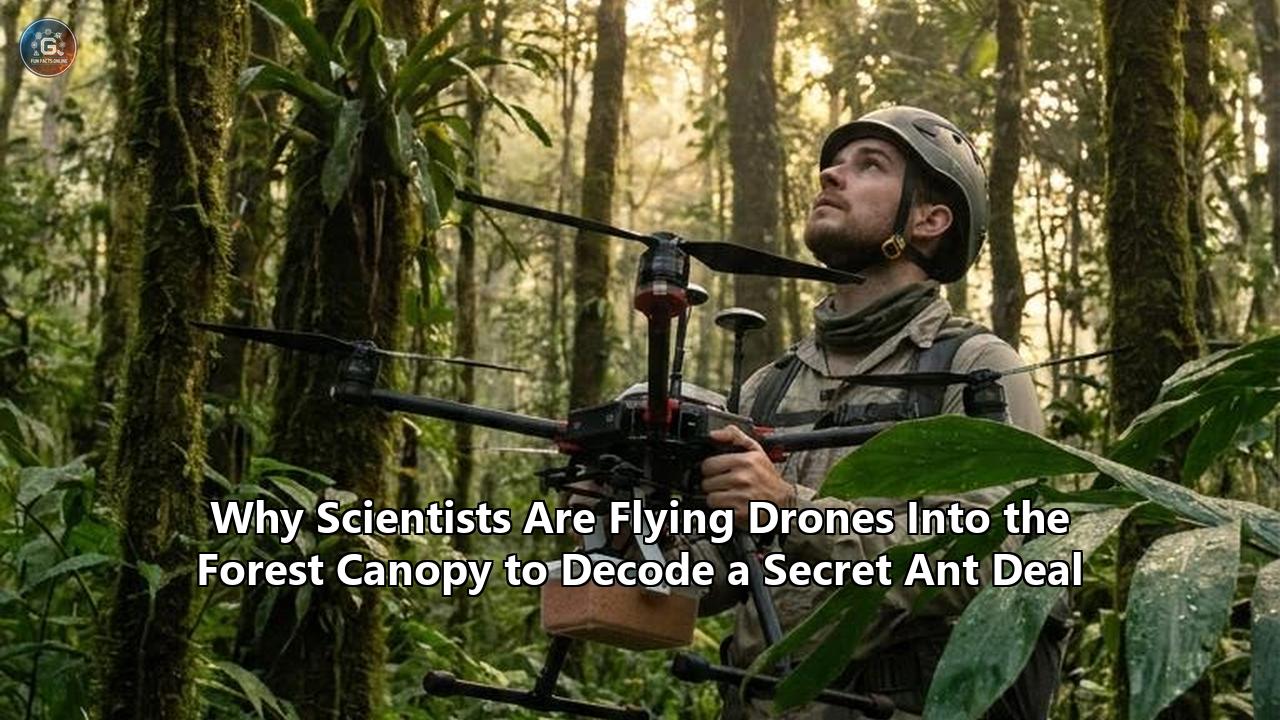
Treetop Espionage: The £500,000 Mission to Spy on a Forest Trade
On June 16, 2026, the UK’s Advanced Research + Invention Agency (ARIA) announced a major funding initiative aimed at halting biodiversity loss and repairing failing woodlands. At the center of this announcement was the launch of the ARISE project (Accelerating ReIntroduction of EcoSystem-Engineering Ant Colonies with Embodied AI). Led by Professor Elva Robinson from the Department of Biology and Professor Radu Calinescu from the Institute for Safe Autonomy (ISA) and the Department of Computer Science at the University of York, this interdisciplinary project secured £500,000 to solve one of the most persistent failures in modern forest restoration.
The core of their mission is an aerial surveillance operation taking place up to 40 meters above the forest floor. Scientists are flying autonomous drones directly into the dense, turbulent forest canopy to decode a highly complex, invisible ecological negotiation: the symbiotic "secret deal" struck between wood ants and canopy-dwelling aphids.
For decades, conservationists seeking to revive degraded or newly planted woodlands have faced a frustrating bottleneck. Wood ants are widely recognized as "ecosystem engineers"—nature’s architects whose presence is vital for establishing the soil quality, nutrient cycles, and pest control required for a forest to truly come alive. Yet, because these ants struggle to spread to new forests on their own, conservationists must manually relocate entire colonies.
Historically, these translocation efforts have suffered from staggeringly high failure rates, with relocated colonies frequently collapsing within two years for reasons scientists could only guess at from the ground.
Now, the ARISE team believes the key to a colony’s survival lies entirely in the treetops. Wood ants do not merely forage; they operate a high-altitude "farming" network, acting as armed bodyguards for colonies of aphids in exchange for a massive, sugar-rich liquid fuel known as honeydew.
If a relocated colony fails to quickly establish this delicate commercial agreement in the canopy, it starves. Because this transaction plays out in the inaccessible heights of the tree canopy, researchers have had no way of knowing whether their translocated ants have successfully struck a deal.
By deploying state-of-the-art drones to collect samples, analyze the chemical composition of treetop honeydew, and map insect populations using hyperspectral cameras, the ARISE project is shining a light into this long-standing ecological blind spot.
The Canopy Transaction: Inside the Tense World of Ant-Aphid Trophobiosis
To understand why scientists are risking expensive drone hardware in the chaotic branches of the forest canopy, one must first look at the biological mechanics of the partnership itself. This relationship is known as trophobiosis—a food-for-protection mutualism that represents one of the most highly organized interspecies agreements in the animal kingdom.
The primary actors in this relationship are wood ants, specifically species from the Formica rufa group (such as the hairy wood ant, Formica lugubris), and various species of large, bark-feeding aphids belonging to the genus Cinara (such as Cinara piceae or Cinara pini), as well as oak-dwelling aphids like Lachnus roboris.
[ Tree Phloem Sap ] ──(Ingested)──> [ Canopy-Dwelling Aphids ]
                                              │
                                       (Excretes Honeydew)
                                              │
                                              ▼
[ Wood Ants (Formica spp.) ] <───────── [ Sugary Honeydew Fuel ]
            │
    (Acts as Bodyguards)
            │
            ▼
[ Defensive Action: Sprays Formic Acid / Attacks Canopy Predators ]
These aphids are essentially living straws. They insert their needle-like mouthparts, or stylets, directly into the phloem vessels of trees—such as Scots pine, Norway spruce, or birch—to tap into the pressurized stream of sugar- and amino-acid-rich sap.
Because the phloem sap is highly pressurized, the aphids must process vast volumes of it continuously to extract the nitrogen and amino acids they need for growth. The excess water and highly concentrated sugars are then excreted from the aphid's rear end as a clear, viscous droplet of honeydew.
Left alone, this sticky residue would accumulate, attracting lethal fungal pathogens that would suffocate the aphid colony. But the wood ants ensure this never happens.
A foraging wood ant will approach an aphid and gently stroke its posterior with its antennae. This behavioral signal, known as "solicitation," prompts the aphid to hold back the droplet until the ant is ready, then excrete it directly into the ant's open mandibles.
The ant swallows the honeydew, storing it temporarily in an expandable, muscular organ called the crop, or "social stomach". The crop is entirely separate from the ant's digestive tract; its contents are intended not for the individual worker, but for transport back down the trunk to be distributed to queens, larvae, and nestbound workers via the process of regurgitation, known as trophallaxis.
This is no minor dietary supplement. Honeydew is the metabolic engine of the wood ant colony. It provides the sheer carbohydrate volume required to fuel the frantic, highly active lifestyles of millions of workers.
In a healthy boreal or temperate forest, a single large wood ant nest can collect several hundred kilograms of honeydew in a single season. This continuous supply of liquid energy keeps the workers from becoming energy-limited, enabling them to construct their towering, dome-shaped mounds and defend their massive territories.
In return for this sugary payload, the wood ants provide the aphids with an elite security detail. Armed with powerful, crushing mandibles and the ability to spray defensive formic acid from their abdomens over considerable distances, wood ants are formidable defenders.
They patrol the aphid-infested branches relentlessly, attacking and driving off major aphid predators such as ladybird beetles, lacewing larvae, hoverfly larvae, spiders, and parasitic wasps. They have even been observed physically picking up ladybirds and tossing them off the branches to the forest floor.
Yet, this apparent harmony hides an undercurrent of tension. In ecological terms, mutualisms are rarely altruistic; they are balanced on a razor's edge of mutual exploitation.
If the honeydew supply drops or if the ants face a severe protein shortage back at the nest to feed their developing larvae, they will occasionally turn on their partners and consume the aphids as prey.
Furthermore, some plants attempt to manipulate this interaction. Certain trees produce extrafloral nectar designed to attract ants directly, bypassing the aphids entirely, while some aphids have evolved chemical signals that mimic the ants' own alarm pheromones to keep their bodyguards on high alert.
Understanding the precise chemical and behavioral variables of this high-altitude "deal" is the puzzle the ARISE team is attempting to solve.
The High-Altitude Blindspot in Modern Restoration
The urgent need to decode this relationship is driven by a crisis in forest conservation. Global reforestation initiatives have historically focused heavily on the simple act of planting trees.
However, ecologists have realized that a collection of trees does not automatically make a functioning forest ecosystem. For a restored woodland to be self-sustaining and resilient, it must possess the complex trophic food webs and wildlife networks that drive natural ecological processes.
This is where wood ants (Formica species) come in as crucial components of forest architecture. They are massive ecosystem engineers.
By moving soil, organic debris, and resin to construct their giant nests—which can stand over a meter tall and contain up to a million ants—they dramatically alter the physical and chemical properties of the forest floor. They aerate the soil, increase its water-holding capacity, and accumulate localized hotspots of essential nutrients like nitrogen, phosphorus, and potassium, which directly boost the growth and health of surrounding trees.
┌─────────────────────────────────────────────────────────┐
│               WOOD ANTS: ECOSYSTEM ENGINEERS            │
├────────────────────────────┬────────────────────────────┤
│ Physical Impacts           │ Biological Impacts         │
├────────────────────────────┼────────────────────────────┤
│ • Aerate forest soil       │ • Suppress tree defoliators│
│ • Accumulate soil nitrogen │ • Support guest beetles    │
│ • Boost phosphorus levels  │ • Disperse woodland seeds  │
│ • Build warm microclimates │ • Source of food for birds │
└────────────────────────────┴────────────────────────────┘
Furthermore, wood ants act as highly effective, natural pest control agents. As generalist predators, they hunt millions of herbivorous insects every year, keeping populations of defoliating caterpillars and sawflies in check and preventing devastating insect outbreaks that can strip entire forest stands bare.
They also support hundreds of other species, including specialized "myrmecophilous" beetles, spiders, and silverfish that live exclusively inside ant nests, while providing a vital food source for larger woodland animals like woodpeckers and badgers.
However, wood ants have a major vulnerability: they are terrible at dispersing to new habitats.
Many wood ant species form "polydomous" colonies, which consist of multiple interconnected nests spread across a wide area. Instead of relying on high-flying, long-distance mating flights where young queens can fly miles to start a new nest, these colonies often expand through a process called "budding".
A queen will simply walk out of the maternal nest, accompanied by a small army of workers, to establish a new daughter nest a few dozen meters away. While this strategy makes the colony highly secure and locally dominant, it limits their speed of geographic expansion.
If a new forest is planted miles away from an existing woodland, or if a forest has been fragmented by agriculture or urban development, the wood ants will likely never reach it on their own.
To overcome this, conservationists have increasingly resorted to translocation: physically digging up a healthy donor nest—including a significant portion of its internal pine-needle structure, thousands of workers, and as many queens as possible—and transporting them in sealed containers to be released at a carefully selected receptor site in a failing or newly planted woodland.
On paper, translocation is a straightforward solution. In practice, it has been an ecological nightmare.
Long-term monitoring of translocated wood ant nests has revealed devastatingly high failure rates. In many documented cases, up to 80% or more of relocated nests dwindle and vanish within two to three years of their introduction.
"Current ant translocation projects typically disregard the complex ant-aphid mutualisms occurring in the forest canopy, despite their key role in providing the energy to fuel wood ant colony success," explains the team behind the ARISE project.
                        [ CONSERVATION CHOKEPOINT ]
                                     │
                 [ Conservationists Relocate Wood Ant Colony ]
                                     │
                                     ▼
                [ Ants Climb Into 40m Forest Canopy ]
                                     │
                  ┌──────────────────┴──────────────────┐
                  ▼                                     ▼
      [ Aphid Partnership Fails ]             [ Aphid Partnership Succeeds ]
                  │                                     │
                  ▼                                     ▼
      [ Colony Starves & Collapses ]          [ Colony Thrives & Restores Forest ]
                (80% of cases)                          (20% of cases)
When a colony is dumped into a new forest, the worker ants must immediately establish paths up the nearest trees to secure food. If those trees do not host the specific species of bark-feeding aphids they require, or if those aphid populations are too sparse, or if the chemical composition of the tree's sap makes the honeydew unappealing or nutritionally deficient, the ants cannot secure the massive caloric surplus they need to survive the coming winter.
Because these interactions occur 40 meters above ground, conservationists on the forest floor have been completely blind to them. They can only watch as the nest slowly falls silent, unable to diagnose whether the failure was due to bad weather, soil issues, competition, or a catastrophic failure of the treetop sugar trade.
Until now, accessing the forest canopy to study these interactions has been slow, dangerous, and highly destructive. Traditional arboreal sampling methods rely on sending human climbers up using ropes, which is expensive and physically limits the number of trees that can be sampled.
Other methods include building massive, semi-permanent canopy walkways or scaffolding, or using "line launchers"—essentially giant air guns that shoot ropes over the upper branches of a tree to pull down a small branch for analysis. These air guns are highly imprecise; they frequently damage the very treetops they are targeting, shaking loose the fragile insect communities and destroying the micro-habitats scientists want to study.
The deep canopy has remained what ecologists call the "eighth continent"—a biologically rich, high-altitude ocean of life that remains almost entirely unmapped and poorly understood.
Airborne Lab Equipment: The Science of Drones in Forest Research
To shatter this vertical barrier, the ARISE project is spearheading the integration of drones in forest research, transitioning these aerial devices from simple cameras into highly sophisticated, autonomous flying laboratories.
Designing drones capable of operating within a dense forest canopy, however, is an immense engineering challenge that has pushed the limits of robotics and "embodied AI".
In a typical open-air environment, agricultural or surveying drones rely on clear line-of-sight communication, stable wind conditions, and precise Global Navigation Satellite System (GNSS) coordinates. None of these conditions exist beneath or inside a mature forest canopy.
  [ OPEN AIR FLIGHT ]                        [ CANOPY FLIGHT (ARISE) ]
  • Strong GPS/GNSS signals                  • GPS-denied environments
  • Clear line-of-sight                      • Extreme signal multipath interference
  • Predictable wind vectors                 • Micro-turbulences & localized gusts
  • Zero physical obstacles                  • Cluttered twigs, branches, & leaves
First, the physical structure of the trees creates a "GPS-denied" environment. The dense layer of leaves and wet wood blocks and scatters satellite signals, leading to extreme multipath interference and sudden, catastrophic drops in positioning accuracy.
Second, the wind inside and just above a forest canopy is incredibly chaotic. Large gusts are broken up by the uneven tree surface, creating unpredictable micro-turbulences, localized shear winds, and sudden updrafts that can instantly throw a standard quadcopter off course and slam it into a branch.
Finally, the environment is intensely cluttered. A forest canopy is a three-dimensional maze of thick limbs, springy twigs, pine needles, dangling mosses, and spiderwebs.
For a drone, a collision with even a minor branch can chip a propeller blade, destabilize the flight controller, and result in a devastating 40-meter fall, potentially destroying the drone and sparking a forest fire.
To overcome these obstacles, Professor Radu Calinescu’s team at the Institute for Safe Autonomy has equipped their research drones with a custom-built suite of safe autonomous navigation systems.
Instead of relying on GPS, these drones utilize Simultaneous Localization and Mapping (SLAM) algorithms driven by lightweight, solid-state LiDAR sensors and stereo-depth cameras.
As the drone approaches a target tree, its onboard computers generate a highly detailed, real-time 3D point-cloud map of the immediate branch structure, calculating safe flight paths through the gaps in the foliage down to the millimeter.
       [ LiDAR & Stereo Cameras ] ──(Generates)──> [ Real-Time 3D Point-Cloud Map ]
                                                              │
                                                        (Processes via SLAM)
                                                              │
                                                              ▼
[ Onboard Computer ] <──(Path Correction)── [ Pathfinding & Collision-Avoidance AI ]
        │
        ▼
[ Adjusts Rotor Thrust & Hover Position ]
This pathfinding AI is paired with advanced collision-avoidance algorithms that are tuned specifically for organic structures.
Unlike a concrete wall, a tree branch is flexible and can swing in the wind. The drone's control loops are capable of predicting this motion, adjusting the speed of individual rotors in milliseconds to counteract sudden shifts in the branches or unexpected wind shear.
By leveraging these advanced capabilities, the use of drones in forest research has transitioned from passive remote sensing to active, physical interaction with the canopy.
The ARISE drones are equipped with specialized, lightweight manipulator arms and microsampling tools designed at York. When the drone identifies an aphid-hosting branch, it does not just take a photo; it hovers stably alongside the branch and extends a precise, custom-engineered micro-clipper or swabbing probe.
The physical mechanism must be incredibly gentle. The team uses specialized fabric-covered probes—similar to those developed by researchers like Steffen Kirchgeorg and Stefano Mintchev for collecting environmental DNA (eDNA) from rainforest canopies—to softly brush against leaves and twigs to gather secretions, aphids, and ant specimens without breaking the branch or disturbing the rest of the insect colony.
The probe is suspended from the drone via a high-speed winch and pulley system, allowing the main drone body to hover at a safe distance above the turbulent treetop zone while the probe is lowered deep into the foliage. Sensors on the winch detect any physical resistance or snagging, allowing the flight computer to immediately adjust its hover position to prevent entanglement.
By bridging the gap between robotic engineering and molecular ecology, the ARISE project demonstrates how drones in forest research can go beyond simple photography, allowing scientists to physically "reach" into previously unreachable ecosystems and extract vital biological data.
Deciphering the Chemistry of the Deal
Once the drones have completed their high-altitude sampling missions and returned to the forest floor, the second phase of the ARISE project begins in the molecular biology laboratory. Here, researchers are using advanced chemical analysis to literally translate the nutritional terms of the contract between the ants and the aphids.
                     [ FIELD EXTRACTION VIA DRONE ]
                                   │
       ┌───────────────────────────┼───────────────────────────┐
       ▼                           ▼                           ▼
[ Phloem Sap Samples ]    [ Aphid Secretions ]      [ Ant Crop Contents ]
       │                           │                           │
       └───────────────────────────┼───────────────────────────┘
                                   │
                                   ▼
                   [ NUTRITIONAL METABOLOMIC ANALYSES ]
                    (Using mass spectrometry: GC-MS)
                                   │
                                   ▼
             [ Identifies Sugars, Amino Acids, & Toxins ]
                                   │
                                   ▼
            [ Decodes the Nutritional "Value" of the Deal ]
This molecular translation relies on nutritional metabolomics.
Metabolomics is the comprehensive study of the unique chemical fingerprints—specifically small-molecule metabolites—left behind by specific cellular processes.
The ARISE molecular ecology team, supervised by Professor Robinson, collects three distinct types of chemical samples from the treetop pipeline:
- Phloem Sap: Extracted directly from the sunlit canopy branches targeted by the drones.
- Aphid Secretions (Honeydew): Collected directly from the canopy-dwelling aphid colonies.
- Ant Crop Contents: Gathered by intercepting returning wood ant workers on the tree trunks and carefully extracting the contents of their social stomachs before they can feed their nestmates.
Using gas chromatography-mass spectrometry (GC-MS) and liquid chromatography-mass spectrometry (LC-MS), the researchers analyze these samples to identify and quantify every individual sugar, amino acid, organic acid, and plant defense compound present in the food chain.
This chemical profiling is critical because not all honeydew is created equal.
The exact nutritional profile of honeydew varies dramatically depending on the host tree species, the specific species of aphid, and even the health of the individual tree.
While honeydew is primarily composed of simple sugars like sucrose, glucose, and fructose, it also contains more complex, insect-synthesized trisaccharides like melezitose and erlose, which are highly attractive to wood ants.
Furthermore, honeydew contains essential amino acids—such as glutamic acid, aspartic acid, and phenylalanine—which are critical for ant larval development but are often highly limited in the forest environment.
By comparing the chemical profile of the phloem sap, the aphid secretions, and the ant crop contents, the team can determine exactly what the ants are selecting.
Previous research has shown that wood ant colonies do not invest their foraging labor equally across all trees. Instead, they treat different trees and their associated aphid populations as higher- or lower-value food sources.
The metabolomic data generated by the ARISE project will, for the first time, define what constitutes "high quality" fuel for a wood ant colony. It will reveal whether the ants are searching for specific rare sugars, looking for balanced amino acid profiles, or actively avoiding trees that are loaded with toxic plant defense chemicals like terpenes and phenols.
This laboratory analysis is paired with a remote sensing technique: hyperspectral imaging.
While a standard camera only captures light across three visible bands—red, green, and blue—hyperspectral cameras capture hundreds of continuous, narrow bands of light across the electromagnetic spectrum, extending far into the near-infrared and shortwave infrared regions.
  [ STANDARD IMAGING ]                      [ HYPERSPECTRAL IMAGING ]
  • Captures Red, Green, Blue               • Captures 100+ continuous spectral bands
  • Shows physical colors                   • Shows chemical & physiological states
  • Misses microscopic stressors            • Detects chlorophyll loss & water stress
Different chemical states in leaves, bark, and insects reflect and absorb these invisible wavelengths of light in highly distinct ways.
For example, when aphids feed heavily on a tree's phloem, they cause localized chlorophyll depletion, water stress, and structural changes in the leaf canopy. This stress can be instantly detected in the 750–1250 nm near-infrared range and the 1950–2450 nm shortwave infrared range long before any physical damage or color change is visible to the naked human eye.
Furthermore, the physical accumulation of sticky honeydew on the surface of leaves creates a highly characteristic "oily" light reflectance pattern that hyperspectral sensors can identify.
By flying drones equipped with compact hyperspectral cameras over the canopy, the ARISE project can feed this spectral data into custom machine-learning models.
These models are trained to cross-reference the spectral signatures with the physical insect samples collected by the drones, allowing researchers to remotely map the exact density, location, and physiological health of aphid populations across an entire forest from the air, without ever having to set foot off the ground.
The Dawn of "Ecosystem Engineering"
The ARISE project represents far more than a local study on ants and aphids in Yorkshire; it is a major milestone in a larger, global shift toward high-tech, proactive conservation.
For generations, conservation philosophy has been largely passive, defined by the idea of "leaving nature alone" or simply protecting a physical area from human encroachment.
But in a rapidly changing world dominated by habitat fragmentation, shifting climate zones, invasive species, and accelerating biodiversity collapse, passive conservation is no longer enough.
Under the guidance of the UK’s Advanced Research + Invention Agency (ARIA), projects like ARISE are exploring the feasibility of what is being called "Engineering Ecosystem Resilience".
This framework acknowledges that ecosystems are highly complex, adaptive networks where small, targeted interventions can have massive, cascading positive effects.
Rather than spending millions of pounds on slow, manual habitat maintenance, scientists can use advanced technology to identify and restore the crucial "keystone" species and trophic relationships that naturally drive self-sustaining forest recovery.
┌─────────────────────────────────────────────────────────────────┐
│              THE SPECTRUM OF CONSERVATION STRATEGIES            │
├────────────────────────────────┬────────────────────────────────┤
│ Passive Conservation           │ Resilience Engineering (ARISE) │
├────────────────────────────────┼────────────────────────────────┤
│ • "Leave nature alone"         │ • Active biological management │
│ • Simple tree-planting         │ • Reintroducing keystone fauna │
│ • Fencing off areas            │ • Autonomous drone monitoring  │
│ • Blind to treetop dynamics    │ • Real-time chemical analysis  │
└────────────────────────────────┴────────────────────────────────┘
The tools being forged in the ARISE project will provide a highly scalable, repeatable blueprint for forest managers worldwide.
Once the machine learning models and drone-sampling protocols are fully validated in the wood ant translocation projects of the UK, the technology can be adapted to monitor and protect other vital, high-altitude mutualisms across the globe.
In the tropical rainforests of Southeast Asia and South America, for example, complex multipartite symbioses between canopy-dwelling ants, plants, epiphytes, and specialized fungal networks are the primary drivers of carbon cycling and biodiversity.
Historically, studying these systems at scale has been impossible.
As the deployment of drones in forest research continues to mature, the tools developed by Calinescu and Robinson could soon be adapted to other ecological crises:
- Canopy Disease Detection: Remotely mapping the spread of devastating pathogens, such as ash dieback or oak wilt, before they can kill entire forest stands.
- Invasive Species Eradication: Identifying and precisely targeting invasive canopy-dwelling pests, like the little fire ant (Wasmannia auropunctata), with minimal pesticide use.
- Carbon Biomass Estimation: Utilizing 3D laser-scanning and hyperspectral imagery to calculate the exact amount of carbon stored in the upper canopy layer, providing accurate data for global carbon markets.
- Pollinator Habitat Management: Assessing the health and density of wild bee and pollinator communities nested high in the forest crown to guide agricultural and forestry policies.
As the ARISE project progresses toward its first major field trials, the scientific community will be watching closely.
By sending autonomous drones into the treetops to eavesdrop on the ancient, quiet transaction between wood ants and aphids, these researchers are not just decoding a secret ant deal. They are unlocking the secrets of the forest canopy itself, showing how we can use the power of advanced robotics and molecular biology to rebuild the wild, resilient ecosystems of tomorrow.
Reference List
- --- ResearchGate. Above-canopy drone insect trapping studies and relationship of wing surface area to altitude of capture.
- --- Wikipedia. Fungus-growing ants (tribe Attini) and leafcutter ant canopy foraging habits.
- --- National Institutes of Health (NIH). Multipartite symbiotic communities: Ant-plant-fungal mutualisms in tropical forest canopies.
- --- Atmos. The tense, self-interested reality of ant-plant protection mutualisms and ecological manipulation.
- --- National Ecological Observatory Network (NEON). A Drone-Based Approach to Collecting Sunlit Canopy Samples (Video/Report on forestry sampling limitations).
- --- Discover Wildlife. DNA-collecting drones equipped with specialized swabbing probes to survey rainforest canopies.
- --- University of York. Autonomous canopy-exploring drones and advanced genetics utilized in ARISE project for wood ant translocation monitoring (Published Tuesday, June 16, 2026).
- --- MDPI. Red Wood Ant nest distribution and its correlation with forest canopy openness and edges.
- --- Earth. Drones equipped with non-invasive eDNA swabbing probes used to decode treetop biodiversity.
- --- Springer Nature. Autonomous drone swarms utilizing synthetic aperture sensing to see through dense forest foliage.
- --- Guam.gov. Drone Management Project utilizing aerial drone technology for canopy-dwelling little fire ant eradication.
- --- ACS (Environmental Science & Technology). UAV-based surface swabbing of environmental DNA (eDNA) within tree canopies during the XPRIZE Rainforest.
- --- ResearchGate. The Druid Drone (DD): A portable unmanned aerial vehicle with a multifunctional manipulator for forest canopy research.
- --- White Rose. Nutritional metabolomics of the tree-aphid-ant processing pipeline in Formica lugubris wood ant networks.
- --- DiVA Portal. Ant-aphid mutualisms (trophobiosis) and their ecological cascading impacts on forest health.
- --- ResearchGate. UAV high-resolution imaging and deep learning models for detecting wood ant nests and evaluating spatial impact on forests.
- --- MDPI. Review of Red Wood Ants (Formica rufa group) as keystone ecosystem engineers in forest protection.
- --- ARIA (Advanced Research + Invention Agency). The Engineering Ecosystem Resilience Opportunity Space: Concept and Beliefs.
- --- ARIA. Engineering Ecosystem Resilience: Opportunity Seed Projects, including the ARISE project announcement.
- --- White Rose. Metabolomic investigation of wood ant crop contents and phloem sap to determine resource quality selection.
- --- Swedish University of Agricultural Sciences (SLU). Organized systems of honeydew harvesting from aphid colonies by wood ants (Formica spp.).
- --- Theses.cz. Review of wood ant biology, polydomous colonies, and foraging behaviors in coniferous and deciduous forests.
- --- HUN-REN Centre for Ecological Research. Transportation networks and the restructuring of wood ant (Formica lugubris) colony networks under perturbations.
- --- Jobs.ac.uk. ARISE Post-doctoral Research Associate Role Description: molecular ecology, drone-enabled microsampling, and hyperspectral imaging.
- --- National Institutes of Health (NIH). Decentralized self-organization and quality-distance trade-offs in wood ant transportation networks.
- --- National Parks and Wildlife Service (NPWS). Hairy Wood Ant (Formica lugubris) species dossier: biology, distribution, and reliance on Cinara aphids.
- --- National Institutes of Health (NIH). Community-level cascading effects of food-for-protection trophobiosis in forest canopies.
- --- National Institutes of Health (NIH). Individual worker behavior and mechanisms of honeydew resource redistribution in polydomous wood ant colonies.
- --- ResearchGate. The historical failure rates and ecological challenges of wood ant translocations.
- --- Nature Back from the Brink. Translocation monitoring data and failure rates of wood ant and narrow-headed ant colonies.
- --- Cairngorms National Park Authority. Guidance on the Translocation of Wood Ants: ecological restoration and post-translocation monitoring.
- --- MDPI. Hyperspectral remote sensing and machine learning for the detection of aphid stress in canopies.
- --- ResearchGate. Spectral characterization of plant canopies under aphid infestation stress.
- --- National Institutes of Health (NIH). Hyperspectral imaging at the canopy scale: mapping aphid infestation grade via honeydew oily leaf reflectance.
Reference:
- https://www.york.ac.uk/news-and-events/news/2026/research/drones-targeted-genetics/
- https://www.researchgate.net/profile/Chris-Cathrine/publication/281630976_Wood_Ant_Nest_Translocations/links/55f1410208ae0af8ee1d509c/Wood-Ant-Nest-Translocations.pdf
- https://naturebftb.co.uk/wp-content/uploads/2022/01/SP09-Narrow-headed-Ant-Final-Report-BftB-Website.pdf
- https://etheses.whiterose.ac.uk/id/eprint/37934/1/Bruce_301071433_Thesis_final.pdf
- https://www.jobs.ac.uk/job/DRH762/post-doctoral-research-associate
- https://www.diva-portal.org/smash/get/diva2:1439455/FULLTEXT01.pdf
- https://pmc.ncbi.nlm.nih.gov/articles/PMC1685857/
- https://www.mdpi.com/2075-4450/16/5/518
- https://theses.cz/id/ratyos/master_thesis_Veronika_Jlkov_2011.pdf
- https://www.npws.ie/sites/default/files/publications/pdf/IWM68.pdf
- https://etheses.whiterose.ac.uk/id/eprint/37934/1/Bruce_301071433_Thesis_final.pdf
- https://stud.epsilon.slu.se/8633/7/larsson_r_151123.pdf
- https://www.reddit.com/r/dji/comments/1lsrrbg/ant_infested_drone/
- https://pmc.ncbi.nlm.nih.gov/articles/PMC4797383/
- https://atmos.earth/science-and-nature/symbiotic-ant-plants-and-the-changing-math-of-mutualism/
- https://pmc.ncbi.nlm.nih.gov/articles/PMC2688311/
- https://aria.org.uk/opportunity-spaces/engineering-ecosystem-resilience
- https://cairngorms.co.uk/uploads/documents/CNPA2022Wood-Ant-Translocation-Guidance.pdf
- https://www.totaljobs.com/jobs/assistant-scientist/in-york
- https://www.researchgate.net/publication/281630863_Caledonian_Conservation_Ltd_Technical_Note_1_Wood_Ant_Translocation_Protocol
- https://www.youtube.com/watch?v=Zp9Mqz0WibU
- https://www.researchgate.net/publication/367465255_Druid_Drone_-_A_portable_unmanned_aerial_vehicle_with_a_multifunctional_manipulator_for_forest_canopy_and_mistletoe_research_and_management
- https://www.mdpi.com/2072-4292/13/3/520
- https://stoplfa.guam.gov/resources/
- https://www.mdpi.com/1999-4907/13/11/1893
- https://communities.springernature.com/posts/the-forest-is-no-longer-a-hiding-place-how-an-intelligent-drone-swarm-sees-through-the-canopy
- https://pubs.acs.org/doi/10.1021/acs.est.4c05595
- https://www.discoverwildlife.com/environment/asia-rainforest-dna-drone
- https://scispace.com/pdf/hyperspectral-imaging-a-potential-tool-for-monitoring-crop-4uvgxszw6h.pdf
- https://www.researchgate.net/figure/Spectral-reflectance-of-aphid-infested-canopy-in-field-laboratory-and-pot-at-different_fig3_236154812
- https://www.mdpi.com/2072-4292/17/5/929
- https://pmc.ncbi.nlm.nih.gov/articles/PMC9745077/
- https://aria.org.uk/opportunity-spaces/engineering-ecosystem-resilience/opportunity-seeds
- https://aria.org.uk/opportunity-spaces/engineering-ecosystem-resilience/accelerated-adaptation
- https://en.wikipedia.org/wiki/Fungus-growing_ants
- https://mitppc.umn.edu/news/5-ways-researchers-are-using-drones-stop-invasive-species
- https://www.researchgate.net/publication/387995751_An_adhesive_drone_trap_to_study_the_flight_altitude_preferences_of_winged_ants
- https://www.earth.com/news/drones-reveal-hidden-biodiversity-in-rainforest-canopies/
- https://www.researchgate.net/publication/380165750_UAV_data_and_deep_learning_efficient_tools_to_map_ant_mounds_and_their_ecological_impact
- https://pubmed.ncbi.nlm.nih.gov/33878925/