The Knock at the Door: How a DJI Mavic Pro Became a Federal Felony
On Friday, February 27, 2026, a 27-year-old college student named Junwei Guo stood before U.S. Magistrate Judge Susan Van Keulen in a San Jose federal court. He wore sweatpants, spoke through a Mandarin translator, and listened as the charges against him were read aloud in the quiet, wood-paneled room.
The charge was not a local misdemeanor or a municipal citation. Guo was being prosecuted for violating National Defense Airspace under 49 U.S.C. § 46307—a Class A misdemeanor carrying a maximum penalty of one year in a federal penitentiary, a year of supervised release, and a criminal fine of up to $100,000.
The chain of events that brought him to this point began three months prior, on November 9, 2025. Under a clear California sky, the San Francisco 49ers were hosting the Los Angeles Rams at Levi’s Stadium in Santa Clara. Inside the venue, tens of thousands of fans filled the stands. Outside, in a residential neighborhood just under three miles away, Guo unpacked a DJI Mavic 3 Pro—a consumer drone weighing just under two pounds, equipped with a high-definition camera.
Guo was not a saboteur, a spy, or a political activist. He was an aerial photography enthusiast, a self-described hobbyist who wanted to capture the stadium’s glowing canopy against the twilight sky. According to federal court documents, he powered on the device, initiated takeoff, and pushed the control sticks forward.
The drone climbed. It bypassed the standard 400-foot ceiling established for recreational flyers, ascending into the flight paths of regional commercial aviation. It reached an altitude of approximately 2,300 feet above the ground. At that height, the drone was invisible to the naked eye from the stadium below, but it was glowing like a beacon on military-grade airspace monitoring systems.
Within minutes of reaching peak altitude, the drone’s radio frequency signature was intercepted by federal authorities. Using specialized detection hardware deployed around the stadium, a combined task force of the FBI, the Federal Air Marshal Service, and local Santa Clara police mapped the drone's telemetry. They did not just track where the drone was; they mapped its return-to-home GPS coordinates—the exact spot where Guo stood holding the remote controller.
When the drone drifted back down and landed, Guo was met by federal agents. During his initial questioning, Guo tried to downplay the flight, claiming he had only flown between 1,500 and 2,000 feet. When agents pressed him, pointing out that any flight above 400 feet in the area was heavily restricted, his estimate shrank to 500 or 600 feet.
It was too late. His flight path had already been recorded by federal sensors, and his lack of a Remote Pilot Certificate, failure to register the aircraft, and lack of authorization to operate within restricted national defense airspace were documented.
"The public often views these small aircraft as harmless toys," says Jonathan Ridley, a veteran aviation attorney specializing in uncrewed systems. "But the federal government views them as unregulated aircraft operating in the same national airspace system as Boeing 737s. When you fly one near a stadium during a major event, you aren't just breaking a park rule. You are breaching a military-grade security perimeter. Junwei Guo's case is the blueprint for how the federal government plans to handle stadium incursions going forward."
The timing of Guo's prosecution was not accidental. It was a shot across the bow, designed to send a clear message before the single largest sporting event on earth arrived on North American soil.
The Invisible Dome: Inside the World Cup Airspace Lockdowns
The FIFA World Cup begins its month-long tournament across the United States, Canada, and Mexico. Millions of international visitors are pouring into host cities, and local infrastructure is strained to its limits. But while security guards, metal detectors, and concrete barricades form the visible ring of protection on the ground, the Federal Aviation Administration (FAA), the Department of Homeland Security (DHS), and the Department of Justice (DOJ) have constructed an unprecedented, invisible defensive dome in the sky.
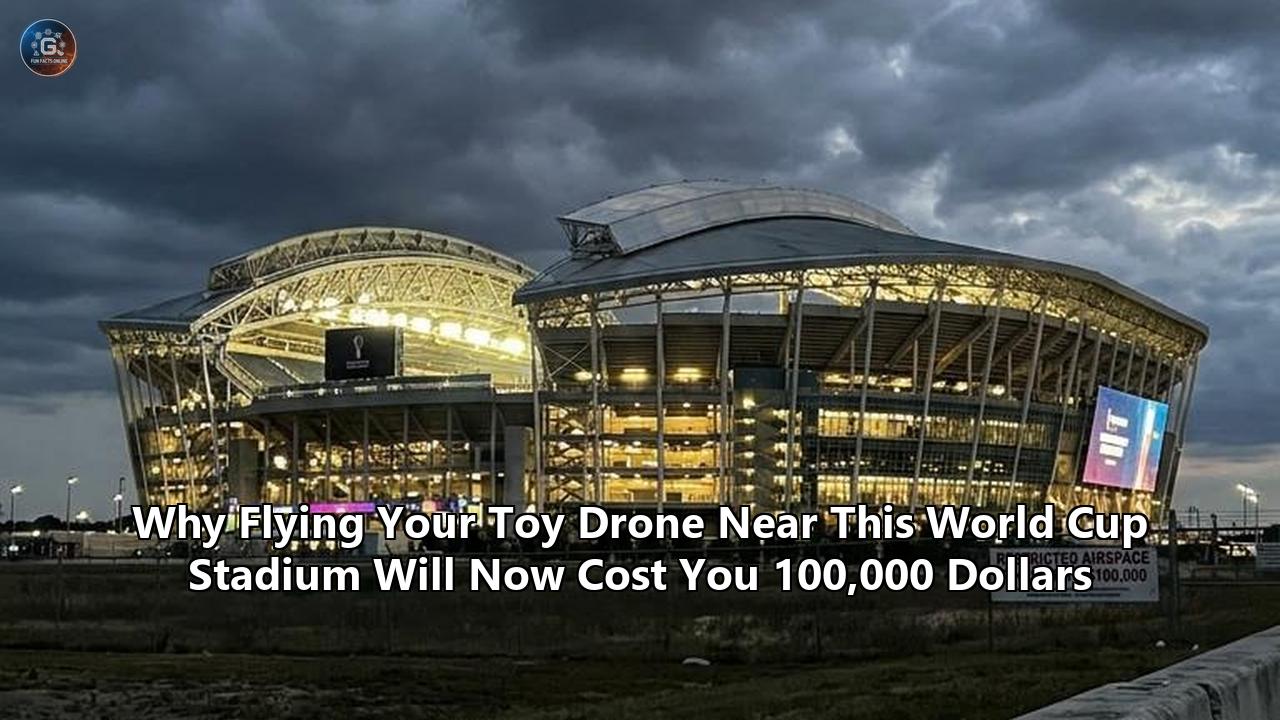
Under a coordinated safety plan, the FAA has designated every U.S. World Cup tournament venue a strict, zero-tolerance "No Drone Zone." This designation turns the airspace surrounding 11 major metropolitan stadiums into temporary military-grade no-fly zones.
               [ 3,000 Feet AGL ]
             _____________________
            /                     \
           /                       \
          /                         \
         /       NO DRONE ZONE       \  <- 3-Nautical-Mile Radius
        /     (Restricted Airspace)   \
       /                               \
      /                                 \
     |               STADIUM             |
_____|___________________________________|_____
                    [ GROUND ]
The primary mechanism for this lockdown is the Temporary Flight Restriction (TFR). On match days, the FAA implements these TFRs around each of the following host stadiums:
- Atlanta: Mercedes-Benz Stadium
- Boston: Gillette Stadium (Foxborough)
- Dallas: AT&T Stadium (Arlington)
- Houston: NRG Stadium
- Kansas City: GEHA Field at Arrowhead Stadium
- Los Angeles: SoFi Stadium
- Miami: Hard Rock Stadium
- New York / New Jersey: MetLife Stadium (Host of the Final)
- Philadelphia: Lincoln Financial Field
- San Francisco Bay Area: Levi's Stadium
- Seattle: Lumen Field
On match days, all uncrewed aircraft operations are strictly prohibited within a three-nautical-mile radius (roughly 3.5 standard miles) of these stadiums, extending from the ground up to 3,000 feet above ground level.
For the average citizen, a three-nautical-mile radius is difficult to conceptualize until it is mapped onto a local environment. A 3.5-mile circle centered on MetLife Stadium in East Rutherford, New Jersey, does not just cover the field and the immediate parking lots. It swallows entire residential neighborhoods in Carlstadt, Secaucus, Rutherford, and Wood-Ridge. It blankets major commercial retail parks, shipping corridors along the Hackensack River, and multiple state highways.
In Los Angeles, a similar bubble around SoFi Stadium blankets almost the entirety of Inglewood, reaches into portions of Hawthorne, and pushes right against the approach corridors for Los Angeles International Airport (LAX).
"A lot of casual pilots think, 'Well, I'm not over the stadium itself, I'm just in a park down the street taking pictures of the crowds,'" says Marcus Vance, a security consultant who spent twelve years managing stadium operations for a Major League Baseball franchise. "They don't realize that the moment they lift off from their driveway three miles away, they have violated a national defense TFR. Under the current framework, there is no distinction between a drone hovering directly over the pitch and one hovering over a strip mall parking lot three miles away. Both are treated as national security violations."
The lockdown is not limited to the stadiums. The FAA has also designated smaller "No Drone Zones" around fan festivals, team hotels, training base camps, and other official tournament locations. At these secondary locations, drone flights are prohibited within a one-nautical-mile radius and up to 1,000 feet above ground level.
The legal framework supporting these restrictions is absolute. Even commercial operators holding Part 107 remote pilot certificates are not exempt. Standard airspace waivers and automated LAANC (Low Altitude Authorization and Notification Capability) approvals are suspended within these zones. Unless an operator has secured a highly specific, individually vetted emergency waiver from the FAA's System Operations Support Center (SOSC) weeks in advance—a privilege reserved almost exclusively for broadcast networks and public safety agencies—any flight within these coordinates is illegal.
The Weaponization of the Sky: Why Stadium Security Is Terrified of Plastic Helicopters
To understand why the federal government is willing to lock down massive swaths of metropolitan airspace and threaten citizens with six-figure fines, one must look at how the threat profile of uncrewed aircraft has evolved over the last decade.
For years, sports franchises and local police departments viewed consumer drones as a minor nuisance—the aerial equivalent of a streaker running onto the field. They were seen as a distraction that might cause a brief delay of game or, at worst, crash into an upper deck and cause minor property damage.
That perspective has vanished. Today, law enforcement and national security agencies view the consumer drone not as a camera, but as a potential vector for asymmetric warfare.
"The war in Ukraine has become a real-world testing ground for drone technology, and if there is one threat that keeps me up at night, it is from drones," New York Police Department Commissioner Jessica Tisch remarked during a security briefing.
In modern conflict zones, off-the-shelf consumer drones costing less than $1,000 are routinely modified to carry explosive payloads, drop ordnance with pinpoint accuracy, or act as kinetic strike weapons. The technology required to convert a hobbyist drone into a weapon is public, cheap, and easily accessible. When applied to an open-air stadium containing 80,000 highly concentrated spectators, the mathematical potential for catastrophe is what keeps security planners awake at night.
"You have to look at the physics of a stadium," says Marcus Vance. "An open-air bowl is a highly vulnerable acoustic and structural environment. If an unauthorized drone appears over the crowd, we have no way of knowing in the first five seconds whether it is a teenager taking a selfie, a commercial pilot ignoring the rules, or someone carrying a chemical agent or an explosive device. If we assume it's harmless and we're wrong, thousands of lives are at risk. If we panic and evacuate, the resulting crowd stampede in the concourses can cause hundreds of crush injuries and fatalities."
The threat of crowd panic is not theoretical. On November 16, 2023, during a Monday Night Football matchup between the Baltimore Ravens and the Cincinnati Bengals at M&T Bank Stadium, a small consumer drone with flashing green and red lights suddenly descended over the playing field. The game was halted, players were pulled off the turf, and security teams scrambled to identify the threat.
The drone was eventually traced to a local resident who was simply trying to get a unique view of the game, but the incident caused massive disruption and highlighted how easily a single uncrewed aircraft could shut down a multi-million-dollar live broadcast.
According to security data compiled by Dedrone, a market leader in airspace security, stadium incursions have risen at an exponential rate. In 2017, the NFL recorded only a dozen unauthorized drone sightings near its stadiums. By 2023, that number had jumped to more than 2,800 annual incursions.
"The public simply does not realize how crowded the skies have become," says Vance. "And because these devices are silent from a distance and can move at 40 miles per hour, they can breach a stadium's physical footprint in a matter of seconds. By the time a ground security guard spots it with their eyes, it's already too late to react."
Radio Silence and RF Sniffers: The Secret Counter-UAS Tech Guarding the World Cup
The enforcement of these "No Drone Zones" does not rely on local police officers squinting at the clouds with binoculars. The defense of World Cup stadiums involves a highly sophisticated, multi-layered electronic warfare network operated by the FBI, the DHS, and specialized military contractors.
When a drone pilot powers up their aircraft, the remote controller and the drone establish an active radio frequency (RF) link. This link typically operates on public Wi-Fi or proprietary industrial protocols across the 2.4 GHz, 5.8 GHz, or 1.2 GHz spectrums. To the human eye, this connection is invisible. To the counter-UAS (unmanned aircraft system) sensors deployed around the stadiums, it is a loud, distinct radio signal.
       [ UNAUTHORIZED DRONE ]
              /       \
             /         \
  (Radio Link)         (GPS / Telemetry)
           /             \
          v               v
 [ PILOT'S CONTROLLER ]  [ COVERT C-UAS SENSOR ]
                                  |
                                  v
                       [ FBI MONITORING CENTER ]
                       (Instant GPS Location)
"We deploy passive radio-frequency sensors around the entire three-mile perimeter," explains an aerospace defense engineer who consulted on the World Cup security architecture. "These sensors are tuned to listen for the specific control protocols used by DJI, Autel, Skydio, and other major manufacturers. The moment an uncrewed aircraft is switched on, our system intercepts the handshake packet between the controller and the drone."
Because the drone must constantly communicate its telemetry—including its GPS coordinates, speed, altitude, and serial number—the counter-UAS network can immediately read this data. Under modern federal regulations, most drones operating in U.S. airspace are also required to broadcast "Remote ID" data. Remote ID acts as an electronic license plate, transmitting the drone's position and the pilot's control station location to anyone with a receiver.
Even if a pilot attempts to disable Remote ID or uses a custom-built drone that does not broadcast standard telemetry, the security network is not blind. "We use passive radar and high-resolution optical cameras equipped with artificial intelligence," the engineer says. "The radar detects the physical presence of a small moving object in the sky, and the optical tracker automatically slews to the target, zooming in to confirm if it's a bird or a drone. Once we have a track, we can use radio direction-finding to triangulate the exact location of the operator's handheld transmitter."
Once an unauthorized drone is detected inside the TFR, federal agencies are authorized to deploy active mitigation measures. In December 2025, Congress updated national security statutes to give state and local law enforcement broader authorities to electronically disable or physically intercept threatening drones.
The methods used to neutralize a drone fall into two categories: "soft-kill" and "hard-kill" systems.
Soft-Kill Mitigation (Electronic Takeover)
This is the primary method used in urban stadium environments. Rather than shooting the drone out of the sky, which could cause a heavy piece of plastic and metal to fall onto a crowd, federal operators use targeted RF jamming or protocol manipulation.
Using high-gain directional antennas, authorities can flood the drone's receiving antenna with a localized signal that mimics its controller. This severs the pilot's control link.
Once the control link is broken, the drone is programmed to execute its safety protocols—either hovering in place, returning to its launch point, or performing a controlled vertical descent. In more advanced scenarios, federal agencies can use proprietary protocol override systems to hijack the drone's flight computer mid-air, taking direct control of the aircraft and guiding it to a secure landing zone controlled by law enforcement.
Hard-Kill Mitigation (Physical Interception)
In rare scenarios where electronic countermeasures fail—such as when a drone is flying autonomously on a pre-programmed GPS path with no active radio link—authorities can use physical interception. This can involve nets launched from specialized counter-drone aircraft, trained birds of prey, or kinetic interceptors.
However, because physical interception runs the risk of dropping debris onto spectators, it is treated as a measure of last resort.
The most surprising finding for many apprehended pilots is how quickly the trap springs. "Pilots assume they have time to pack up their gear and run," says Ridley, the aviation attorney. "They don't realize that the FBI tactical teams are sitting in unmarked vehicles parked throughout the neighborhood. When the system identifies the pilot's GPS coordinates, the closest ground unit is dispatched immediately. Often, the pilot is handcuffed before their drone has even finished its automated landing sequence."
The End of the "Educate First" Era: How the FAA Rewrote Its Rules for 2026
The severity of the current World Cup enforcement campaign is the result of a systematic, multi-year transformation within the FAA. For the first two decades of consumer drone flight, the agency operated under a philosophy known as "voluntary compliance" or "educate first."
Under this older model, the FAA recognized that the vast majority of drone buyers were recreational users who did not read federal aviation regulations before opening a box. If a hobbyist was caught flying in a restricted area, the agency's primary response was to send a letter of warning or offer safety counseling. It was an approach built for an era when drones were rare, low-powered, and relatively limited in range.
That era is over. The exponential growth of the drone market, coupled with rising national security concerns, forced a complete overhaul of federal drone flight regulations.
The turning point arrived in January 2026, when the FAA issued UAS Compliance and Enforcement (C&E) Bulletin 2026-1. This internal directive fundamentally altered how safety inspectors and law enforcement handle uncrewed aviation violations. Under the new policy, the "educate first" safety-first approach was officially restricted. The bulletin mandated that any drone operation that endangers the public, violates established airspace restrictions, or is used in furtherance of any criminal activity must trigger immediate, formal legal enforcement action.
"The FAA effectively took away the discretion of its field inspectors," explains Adam Gittins, an uncrewed aviation compliance expert. "Before 2026, if you made an honest mistake, you could talk your way out of a fine by proving you learned your lesson. Now, if you fly in restricted airspace, the inspector is legally required to open a formal enforcement case. There is no slap on the wrist anymore."
To streamline this newly aggressive enforcement posture, the FAA launched a program on April 15, 2026, called the Drone Expedited and Targeted Enforcement Response (DETER).
| Program Feature | Traditional FAA Enforcement | DETER Program (Launched April 2026) |
|---|---|---|
| Target Audience | All operators, complex cases | First-time, minor civil offenders |
| Average Resolution Time | Months to years | Days (10-day response window) |
| Admission of Liability | Can be contested through appeals | Mandatory admission of guilt |
| Penalty Structure | Full civil penalties, certificate revocation | Significantly reduced fines or suspension |
| Right to Appeal | Preserved through NTSB and federal courts | Waived entirely by participant |
| Exclusions | None | TFR violations, criminal activity, drugs/alcohol |
At first glance, some pilot communities read the DETER announcement as a sign that the FAA was softening its stance. But a close reading of the program's fine print reveals a far more calculated strategy. DETER is designed to quickly clear the massive backlog of minor, first-time offenses so that the agency can focus its heavy litigation resources on high-visibility violations—like those occurring around World Cup venues.
"DETER is basically an administrative plea bargain," says Ridley. "The FAA is saying, 'If you made a minor error, such as forgetting to update your address on your registration, we will let you settle quickly for a small fine, provided you sign a confession and waive your right to a trial.' But they explicitly carved out stadium TFR violations. If you fly near a stadium during the World Cup, you are barred from participating in the DETER program. You are immediately routed to the standard, high-impact prosecution pipeline."
This shift in drone flight regulations is supported by a quiet expansion of the FAA’s investigative partnerships. Under the DETER framework, local police departments can upload telemetry data directly to the FAA’s legal division in real time. What used to take months of paperwork between federal offices can now be processed, verified, and issued as a formal Notice of Violation within 72 hours.
The Shadow of the Law: What Happens to the Casual Creator Who Flies Anyway?
If a pilot decides to ignore the warnings, bypass the geofencing built into their drone's software, and launch their aircraft into an active World Cup TFR, they enter a legal system designed to impose maximum consequence.
The prosecution of a stadium airspace violation moves along two separate tracks: the civil penalty track managed by the FAA, and the criminal prosecution track managed by the Department of Justice.
                     [ RESTRICTED FLIGHT INTRUSION ]
                                  /  \
                                 /    \
                                v      v
            [ CIVIL TRACK (FAA) ]      [ CRIMINAL TRACK (DOJ) ]
                     |                             |
         - Up to $75,000 fine     - Up to $100,000 fine
         - License Revocation     - Up to 1 Year Prison
         - Permanent Asset Seizure - Class A Misdemeanor
The Civil Track: Financial Ruin and Equipment Seizure
Under the FAA's statutory authority, the agency can assess massive civil penalties for each individual regulatory violation committed during a single flight.
A single unauthorized flight near a World Cup venue is rarely treated as a single violation. Instead, the FAA's legal counsel stacks charges. For example, if a hobbyist flies their drone within the MetLife Stadium TFR, the FAA can charge them with:
- Operating an aircraft in restricted airspace without authorization (up to $75,000)
- Operating an uncrewed aircraft in a careless or reckless manner so as to endanger life or property (up to $11,000)
- Operating an uncrewed aircraft without broadcasting required Remote ID telemetry (up to $27,500)
- Operating an aircraft without a valid registration or remote pilot certificate (up to $10,000)
The total civil liabilities for a single five-minute flight can easily exceed $100,000. Under federal law, the FAA is also authorized to permanently seize the uncrewed aircraft system, including the drone, all associated controllers, memory cards, and auxiliary equipment. There is no compensation for this seizure; the equipment is cataloged as evidence and eventually destroyed or repurposed for government use.
The Criminal Track: Prison and a Permanent Record
While civil fines are financially devastating, the criminal track carries the weight of a federal criminal record. Because stadium TFRs are designated as "National Defense Airspace," violating them is a federal misdemeanor under 49 U.S.C. § 46307.
"Once the DOJ gets involved, the tone of the investigation changes completely," says Ridley. "You are no longer dealing with aviation inspectors in polo shirts. You are dealing with federal prosecutors and FBI special agents who treat you with the same seriousness as someone trying to smuggle contraband onto a military base. They do not care if your intention was only to post a video to YouTube. The statute does not require 'intent to harm.' It only requires 'intent to operate the aircraft' within the restricted boundary."
If convicted of violating National Defense Airspace, an operator faces a maximum penalty of one year in a federal prison, one year of supervised release, and a criminal fine of up to $100,000.
A conviction also results in a permanent federal misdemeanor record. This can lead to the immediate loss of professional licensing, the inability to pass standard background checks for employment, housing restrictions, and the permanent revocation of the individual's passport or international travel privileges.
"The math is incredibly simple," says Ridley. "The average consumer drone costs $800. The footage you capture might get you a few hundred views on social media. The penalty for acquiring that footage is a six-figure debt, the loss of your physical freedom, and a criminal record that will follow you for the rest of your natural life. It is the worst risk-to-reward ratio in modern photography."
Case Study: The Cost of a "Money Shot"
To illustrate how these laws are applied in practice, it is useful to look at the financial and personal ruin of past violators. While Junwei Guo's case remains pending in federal court, prior enforcement actions highlight the merciless nature of the FAA’s stack-and-track penalty system.
In a documented enforcement sweep, the FAA finalized a series of civil penalty assessments against 27 individual drone operators, totaling more than $341,000 in combined fines. The case files reveal the mundane, often careless nature of the violations:
- The Florida Wedding Incident: An operator in Wesley Chapel, Florida, was hired to capture aerial footage of an outdoor wedding venue. Unbeknownst to the pilot, the venue sat within a highly active airspace corridor used by local emergency medical helicopters. The drone drifted into the flight path of an incoming medical transport, forcing the helicopter pilot to execute an evasive maneuver. The FAA assessed a personal civil penalty of $32,700 against the drone operator, cited him for reckless endangerment, and permanently revoked his pilot certificate.
- The Boston Harbor Flyover: A tourist visiting Boston decided to launch a small drone from a public pier to capture the sunset over the harbor. The pier was located within the Class B airspace of Logan International Airport, which was active with commercial airliner arrivals. The pilot did not have airspace authorization and was not broadcasting Remote ID data. The drone was intercepted by airport radar, and the pilot was met at the pier by State Police. The FAA issued a civil penalty of $22,000, while the local municipality filed separate misdemeanor charges for operating in a public park without a permit.
- The Baltimore Playoff Incident: During the 2024 AFC Championship Game at M&T Bank Stadium, a drone flew directly over the upper bowl during the third quarter, prompting officials to halt play. The operator, a local resident, was tracked to a school parking lot half a mile away. He was arrested by state troopers, and the FBI took over the case. In addition to a $75,000 civil fine from the FAA, the operator was federally charged under Section 46307, eventually pleading guilty to a misdemeanor and receiving three years of supervised probation, 200 hours of community service, and a permanent ban from owning or operating uncrewed aircraft.
"The consistent thread in all of these cases is a lack of situational awareness," says drone compliance expert Adam Gittins. "None of these people set out to disrupt a game or endanger a helicopter. They bought a device from an electronics store, assumed it was a toy, and ignored the warnings on their phone screens. But in aviation, ignorance is not a defense. The sky is a highly regulated, shared public resource, and the federal government is no longer willing to tolerate amateur mistakes."
The Future of Airspace Sovereignty: Navigating the New Skies
As the FIFA World Cup progresses toward its final match at MetLife Stadium on July 19, 2026, the ongoing airspace lockdown is serving as a grand experiment for the future of urban security. The systems, technologies, and legal frameworks refined during this tournament will not disappear when the teams go home. Instead, they represent the new normal for urban aviation.
The rapid development of counter-drone technology, combined with increasingly rigid drone flight regulations, points to a future where uncrewed aviation will be highly restricted, heavily monitored, and strictly segregated.
                 [ THE FUTURE URBAN AIRSPACE ]
               _________________________________
              /                                 \
             /     AUTHORIZED COMMERCIAL ZONE    \  <- Air Taxis, Delivery Drones
            /     (Fully Managed / Remote ID)    \     (Strict Geo-Tracking)
           /                                     \
          /_______________________________________\
         /                                         \
        /           RESTRICTED CIVIC ZONE           \ <- Casual/Hobbyist Flights
       /        (Parks, Stadiums, Major Roads)       \   (Effectively Prohibited)
______/_______________________________________________\______
                              [ GROUND ]
Several key trends are emerging from the current World Cup enforcement actions that will shape the next decade of uncrewed flight:
The Proliferation of Local Airspace Geofencing
Major drone manufacturers, including DJI, are facing intense pressure from Western governments to implement mandatory, un-bypassable geofencing.
In the future, drone flight software may automatically link to real-time FAA TFR registries. If a pilot attempts to take off inside a restricted zone, the drone's flight computer will refuse to spin its motors.
While some custom-built, open-source drones can bypass these software locks, those homebuilt devices will stand out even more on passive RF detection systems, making their operators immediate targets for law enforcement.
The Rise of Local Airspace Sovereignty
The transition of counter-UAS authorities from federal agencies to state and local police marks a major shift in law enforcement power.
Historically, only the federal government had the authority to regulate or intercept aircraft in flight. Now, with state and local police departments acquiring specialized training and electronic warfare tools, local municipalities are beginning to establish their own low-altitude airspace rules.
This could lead to a fragmented patchwork of municipal drone bans, where flying a drone over a suburban downtown or a local high school football game is treated with the same severity as flying near a professional stadium.
The Threat of Commercial Displacement
For professional, law-abiding drone pilots who use uncrewed aircraft for utility inspections, real estate marketing, agriculture, and filmmaking, the rising tide of restrictions is creating an existential crisis.
"We are reaching a point where it is almost impossible to operate a legitimate drone business in a major metropolitan area," says Ridley. "The administrative burden of securing airspace clearances, maintaining compliance with shifting Remote ID rules, and constantly checking for active TFRs is exhausting. Many small operators are simply shutting down their businesses because the liability of an accidental violation is too high."
For those who wish to continue flying, the path forward requires an absolute commitment to regulatory compliance and professional standard operating procedures.
A Checklist for Staying Legal
To help drone pilots navigate this increasingly hostile regulatory landscape and avoid six-figure liability, compliance experts recommend a strict pre-flight workflow:
- Verify Registration and Certification: Never operate a drone that is not properly registered with the FAA, regardless of its weight. If you are flying for any commercial purpose—including posting monetized videos to social media—you must hold a current Part 107 Remote Pilot Certificate.
- Confirm Remote ID Compliance: Ensure your drone is broadcasting a valid, active Remote ID signal before every flight. Operating a drone with a disabled or malfunctioning Remote ID transmitter is a standalone federal violation that can result in immediate fines and equipment confiscation.
- Check the Airspace Map Daily: Before powering on your controller, consult an FAA-approved airspace awareness application, such as B4UFLY or Aloft, to check for active Temporary Flight Restrictions. Do not rely on old maps; TFRs can be issued with only a few hours of notice.
- Observe the 400-Foot Limit: Keep your aircraft below 400 feet above ground level at all times, unless you are flying within 400 feet of a tall structure and have secured the appropriate waivers.
- Maintain Visual Line of Sight: Never fly your drone beyond your physical, unassisted ability to see the aircraft. Flying using only your screen or FPV (First Person View) goggles without a dedicated visual observer is a high-priority violation frequently targeted by FAA inspectors.
- Avoid Crowds and Public Venues: As a general rule, never fly over or near any mass gathering, including sports stadiums, music festivals, protests, or busy transportation corridors. If you hear the hum of a crowd or see a sea of parked cars, your drone belongs on the ground.
The message of the FIFA World Cup airspace lockdown is clear: the sky is no longer a lawless frontier where anyone with a plastic controller can carve out their own piece of the air. The federal government has made it known that the airspace above our cities is national defense territory, and they are backing that claim with the full, crushing weight of six-figure fines, asset seizures, and prison sentences.
Before you launch your drone to get that "money shot" of a stadium light show, ask yourself a simple question: is that video worth $100,000 and a year in a federal prison cell?
For anyone who values their financial security and their physical freedom, the answer is obvious. Leave the drone in its case, keep your eyes on the pitch, and let the professionals handle the view from above.
Reference:
- https://www.courthousenews.com/drone-operator-who-flew-near-california-football-game-charged-with-criminal-flight-violations/
- https://www.justice.gov/usao-ndca/pr/drone-operator-charged-violating-temporary-flight-restrictions-area-surrounding-levis
- https://localnewsmatters.org/2026/02/05/san-francisco-man-accused-of-illegally-flying-drone-over-levis-stadium-during-nfl-game/
- https://www.sanjoseinside.com/news/drone-operator-charged-with-violating-flight-restrictions-over-levis-stadium-during-nfl-game/
- https://petapixel.com/2026/05/04/faa-warns-of-criminal-fines-up-to-100000-for-drones-near-world-cup-stadiums/
- https://coptrz.com/blog/faa-warns-world-cup-drone-flyers-of-fines-up-to-100000/
- https://www.gtlaw.com/en/insights/2026/6/faa-declares-no-drone-zones-for-2026-fifa-world-cup
- https://www.photoworkout.com/world-cup-drone-no-fly-zones/
- https://www.photographytalk.com/world-cup-no-drone-zone-faa-rules-2026/
- https://www.niemanlab.org/2015/09/the-journalists-guide-to-drones-over-or-crashing-into-stadiums/
- https://www.faa.gov/newsroom/faa-establishes-no-drone-zones-fifa-world-cup-2026-stadiums-fan-events-and-base-camps
- https://dronedj.com/2026/05/29/faa-world-cup-drone-fine/
- https://www.faa.gov/fifaworldcup2026
- https://dronelife.com/2025/02/05/super-bowl-security-the-growing-challenge-of-unauthorized-drones-over-stadiums/
- https://www.telegraphindia.com/sports/football/us-bans-use-of-drones-during-world-cup-violators-can-face-up-to-100000-dollar-fines-criminal-charges/cid/2164848
- https://www.cshlaw.com/resources/flying-foul-play-legal-issues-take-flight-in-monday-night-footballs-drone-incident/
- https://www.commercialuavnews.com/faa-deter-drone-enforcement-program
- https://www.faa.gov/newsroom/authorities-crack-down-illegal-drone-use-around-coors-field-during-games
- https://www.commercialuavnews.com/u-s-government-seeks-to-protect-world-cup-stadiums-from-rogue-drones
- https://dronelife.com/2026/04/16/faa-deter-drone-enforcement-program/
- https://www.uraniumwaves.com/soundscope/world-cup-2026-drone-ban-us-stadium-security-explained
- https://www.agaviation.org/enews-article/faas-new-deter-program-targets-uas-operators-violating-regulations/
- https://www.youtube.com/watch?v=_WCU4FE5j-w
- https://www.farmprogress.com/max-armstrong/faa-launches-fast-track-drone-enforcement-program-for-farms
- https://www.striptillfarmer.com/blogs/1-covering-strip-till/post/6625-what-you-need-to-know-about-the-faas-new-deter-program-for-drones
- https://www.faa.gov/newsroom/faa-launches-new-program-accelerate-enforcement-drone-violations
- https://thehdpost.com/2026/02/02/california-man-faces-jail-100000-fine-for-flying-drone-over-levis-stadium-during-nfl-game/
- https://texashomeandhangar.com/2026/05/faa-warns-of-fines-for-drones-near-world-cup-stadiums/