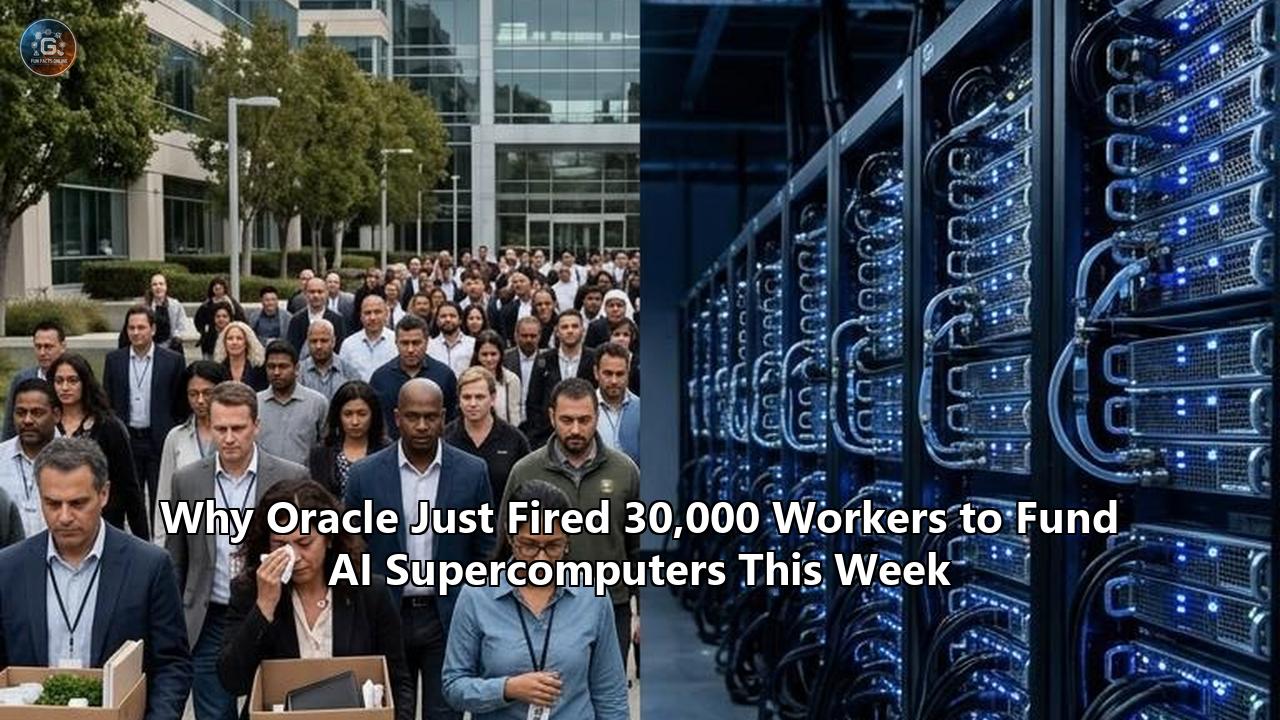
At 6:00 a.m. on March 31, 2026, thousands of Oracle employees across the United States, India, Canada, Mexico, and Europe opened their inboxes to a standardized, non-reply message sent from "Oracle Leadership".
"After careful consideration of Oracle's current business needs," the email read, "we have made the decision to eliminate your role as part of a broader organizational change. As a result, today is your last working day".
Within minutes, internal Slack access was severed, corporate VPN credentials were invalidated, and thousands of software engineers, cloud architects, database administrators, and enterprise account executives were locked out of the systems they had helped build.
The purge was sweeping. Initial estimates from financial analysts at TD Cowen and internal employee trackers indicated that between 20,000 and 30,000 positions—roughly 18% of Oracle’s global 162,000-person workforce—were eliminated in a single day. In India alone, home to major enterprise engineering and support centers, an estimated 12,000 workers were terminated before breakfast.
Yet, this was not a company in distress.
Just three weeks prior to the mass termination, Oracle reported its strongest organic growth quarter in 15 years. Third-quarter revenue spiked 22% to $17.2 billion, net income exploded 95% to $6.13 billion, and Oracle Cloud Infrastructure (OCI) revenue surged 84% year-over-year. The software giant was sitting on an unprecedented $553 billion backlog of contracted future orders.
Oracle did not fire tens of thousands of workers to survive an economic slump or offset falling enterprise sales. It eliminated them to free up $8 billion to $10 billion in annual labor costs to finance the most expensive hardware shopping spree in tech history: the construction of multi-gigawatt artificial intelligence supercomputers.
Subsequent regulatory disclosures in June 2026 confirmed the staggering scope of this workforce reallocation. In its Form 10-K filing with the U.S. Securities and Exchange Commission (SEC), Oracle revealed a net annual headcount loss of 21,000 employees, accompanied by a $1.84 billion severance bill—a nearly 400% surge over the previous year's restructuring costs.
The story of the Oracle layoffs AI investment strategy represents a stark escalation in the tech sector's resource reallocation. It marks a major turning point where profitable enterprise software companies choose to trade human capital directly for silicon, liquid cooling, and gigawatt power grid hookups.
Phase 1: The Escalation Begins (Late 2024–Late 2025)
The path toward Oracle’s massive 2026 workforce restructuring began quietly two years earlier, driven by a fundamental shift in how the cloud market operates.
For decades, Oracle built its fortune on relational database software, enterprise resource planning (ERP) systems, and high-margin corporate software licenses. When cloud computing took off, Oracle initially trailed Amazon Web Services (AWS), Microsoft Azure, and Google Cloud Platform (GCP). However, under the direct technical leadership of Chairman and Chief Technology Officer Larry Ellison, Oracle Cloud Infrastructure (OCI) executed a targeted pivot.
Rather than competing purely for general-purpose web server hosting, Ellison shifted OCI’s engineering focus toward ultra-high-speed, bare-metal compute networks. OCI designed custom RDMA (Remote Direct Memory Access) networking over converged Ethernet, enabling tens of thousands of Graphics Processing Units (GPUs) to communicate with ultra-low latency.
When generative AI models emerged as the dominant compute workload in 2023 and 2024, AI labs discovered that Oracle’s bare-metal architecture could train frontier models faster and significantly cheaper per hour than competing public clouds.
The Inking of Mega-Contracts
The transformation accelerated exponentially through a series of unprecedented cloud infrastructure deals:
- The OpenAI Multi-Year Contract: Oracle signed a landmark $300 billion, multi-year agreement to supply OpenAI with massive compute capacity to train and serve next-generation Large Language Models (LLMs).
- The Stargate Consortium: Oracle partnered with OpenAI and SoftBank on the ambitious $500 billion Stargate infrastructure initiative, designed to build multi-gigawatt AI supercomputing hubs across North America.
- Meta Infrastructure Agreements: Meta expanded its reliance on OCI, reserving tens of thousands of NVIDIA H100, H200, and Blackwell GB200 GPUs for Llama model training.
Oracle Cloud CapEx Escalation vs. Restructuring Severance (FY2024 - FY2026)

  $60B -------------------------------------------------------- $55.7B CapEx
                                                                [Data Centers & GPUs]
  $40B --------------------------------------------------

  $20B --------------------------------------------------
        $6.8B CapEx
  $0B  +--------------------+---------------------------+
       FY2024               FY2025                      FY2026
       (Severance: $374M)   (Severance: $374M)          (Severance: $1.84B)
By late 2025, Oracle’s remaining performance obligations (RPO)—contracted future revenue awaiting compute delivery—had ballooned past $500 billion.
However, this massive order book exposed a severe financial problem.
The Cash Flow Paradox
Unlike competitors Microsoft and Alphabet, which generate tens of billions of dollars in free cash flow from established enterprise software suites and search advertising to fund their data center builds internally, Oracle’s organic cash generation was insufficient to cover its capital expenditure (CapEx) commitments.
Building a single modern AI supercomputer center equipped with 100,000 NVIDIA GB200 NVL72 systems costs between $4 billion and $6 billion. Oracle was planning dozens of these facilities globally.
During the Q3 2025 earnings call, Ellison foreshadowed the massive scaling efforts required:
"We are bringing on enormous amounts of capacity over the next 24 months. Demand for OCI accelerated compute is essentially bottomless, and our primary challenge is simply bringing data centers online fast enough."
To fund this expansion, Oracle's management faced a choice: raise massive debt at elevated interest rates, heavily dilute equity, or reallocate operating capital internally by cutting headcount. They chose all three.
Phase 2: The March 31 Execution — Turning Point in Corporate Restructuring
By early March 2026, rumors began circulating within Oracle’s Redwood Shores headquarters and Austin technology hubs that a major organizational shift was imminent. Bloomberg reported on March 5 that Oracle was planning cuts in the "thousands," targeting divisions where management believed AI tools could assume operational workloads or where revenue growth lagged behind cloud infrastructure.
The full scale of the plan hit on March 31, 2026.
The 6:00 AM Notification Wave
The execution was notable for its automated nature and speed:
- No Manager Involvement: Direct supervisors were largely bypassed. Termination notices arrived directly from a central email account, "Oracle Leadership," delivered at 6:00 a.m. local time across multiple global time zones.
- Immediate Access Revocation: Affected workers found their corporate laptops restarted and locked within 15 to 30 minutes of receiving the message, preventing internal handoffs or team communications.
- Overnight Disappearance: Over 10,000 user profiles disappeared from Oracle’s internal Slack channels and directory within 24 hours.
Departmental Impact of Oracle's FY2026 Headcount Reductions
┌──────────────────────────────────┬──────────────────┬─────────────────────┐
│ Business Division                │ Estimated Cuts   │ % Division Reduced  │
├──────────────────────────────────┼──────────────────┼─────────────────────┤
│ Hardware & Legacy Systems        │ ~1,000           │ 33.3%               │
│ Sales, Marketing & Account Execs │ ~6,000           │ 19.4%               │
│ Research & Development (R&D)     │ ~7,000           │ 14.0%               │
│ Cloud & Managed Services         │ ~3,000           │ 10.3%               │
│ Consulting & Professional Svcs   │ ~3,000           │ 8.1%                │
│ Administrative & HR Operations   │ ~1,000           │ 8.3%                │
└──────────────────────────────────┴──────────────────┴─────────────────────┘
The human cost was heavily concentrated in specific units and geographic hubs:
- Oracle Health (Cerner): Following Oracle’s $28.3 billion acquisition of electronic health records giant Cerner in 2022, thousands of health IT consultants, integration managers, and support engineers were let go as Oracle shifted health data operations onto automated OCI cloud platforms.
- India Development Centers: India bore the heaviest absolute loss, with approximately 12,000 positions eliminated across Bengaluru, Hyderabad, and Pune.
- Enterprise Software Sales: Traditional database sales account teams faced deep cuts as Oracle pivoted sales incentives entirely toward long-term cloud compute commitments.
An account manager based in Austin, Texas, described the surreal experience:
"I closed a $4 million database renewal on Friday. On Tuesday morning at 6:05 a.m., I received an automated email telling me my role was eliminated due to changing business needs. By 6:20 a.m., my laptop display went black. There was no exit interview, no handoff, no conversation with my VP. The money saved on my salary was going directly into buying GPUs."
Phase 3: The June SEC Filings — The Reality of Capital Reallocation
While news leaks and employee posts in April painted a picture of widespread job losses, the true financial picture was officially confirmed on Monday, June 22, 2026, when Oracle filed its annual Form 10-K regulatory filing with the SEC.
The regulatory filing confirmed what Wall Street analysts had suspected: Oracle had executed one of the largest workforce-to-capital transformations in tech history.
Key Metrics Disclosed in Oracle's June 2026 Form 10-K Filing
─────────┬─────────────────────────────────────────────────────────────
Headcount│ Total workforce fell from 162,000 (May 2025) to 141,000 (May 2026),
         │ reflecting a net drop of 21,000 employees (~13%).
─────────┼─────────────────────────────────────────────────────────────
Severance│ $1.84 billion spent on severance and employee exit costs in
         │ FY2026, up from $374 million in FY2025.
─────────┼─────────────────────────────────────────────────────────────
CapEx    │ Annual capital expenditures reached $55.7 billion, blowing past
         │ the company's initial guidance of $50 billion.
─────────┼─────────────────────────────────────────────────────────────
Cash Flow│ Free cash flow turned sharply negative to negative $24 billion,
         │ with projections reaching negative $42 billion if spending continues.
─────────┴─────────────────────────────────────────────────────────────
Most notable was the language Oracle used in the regulatory document. In a stark admission of how artificial intelligence was affecting internal operations, the filing stated:
"The adoption and deployment of AI technologies across our operations have resulted, and may continue to result, in reductions to our workforce."
The report signaled that the wave of Oracle layoffs AI investment decisions was not a one-off event, but a structural strategy designed to continuously trim operational overhead as internal AI coding, automated network management, and self-healing database technologies mature.
Oracle's Free Cash Flow Swing (FY2024 - FY2026)

  +$10B ─── +$8.2B Free Cash Flow (FY2024)
            │
     $0B ───┼─────────────────────────────────────────────────────────
            │
  -$20B ───┼─────────────────────────── -$24.0B Free Cash Flow (FY2026)
            │                            [Driven by $55.7B CapEx]
  -$40B ───┴───────────────────────────────────────────────────────── -$42.0B (Projected Peak)
Credit Rating Downgrade and Debt Escalation
The financial markets reacted to Oracle’s high-stakes strategy with mounting concern over the speed of its capital allocation.
On July 9, 2026, credit rating agency S&P Global Ratings downgraded Oracle’s long-term credit rating to BBB-—placing the tech giant just one single notch above speculative, high-yield, or "junk" status.
S&P cited three primary risk factors:
- Severe Negative Free Cash Flow: Spending $55.7 billion on physical infrastructure caused free cash flow to collapse to negative $24 billion.
- Customer Concentration Risk: S&P estimated that nearly 50% of Oracle’s remaining performance backlog was tied directly to a small handful of AI startups and labs, primarily OpenAI.
- Escalating Debt Loads: Oracle announced plans to raise an additional $40 billion through fresh debt issuances and secondary equity offerings, including selling $20 billion in common stock to finance data center construction.
To bridge this massive cash burn gap, Oracle pioneered a novel cloud financing model: prepaid customer infrastructure.
Oracle required key clients, including OpenAI and venture-backed AI labs, to pay upfront for compute capacity. By mid-2026, customer-funded hardware prepayments and advanced multi-year cash deposits on Oracle's balance sheet had surged to $75 billion.
Phase 4: Inside the Machine — Where the Saved Capital is Going
To understand why Oracle was willing to accept a credit downgrade, fire 30,000 workers, and spend $1.84 billion on severance, one must examine the physical infrastructure Oracle is building.
Anatomy of Oracle's New Class of AI Supercomputer Centers
┌─────────────────────────┬─────────────────────────────────────────────────┐
│ Infrastructure Component│ Technical Specification & Scale                 │
├─────────────────────────┼─────────────────────────────────────────────────┤
│ Facility Power Capacity │ 1.0 to 2.2 Gigawatts per campus site            │
│ Dedicated Compute Chips │ 100,000+ NVIDIA Blackwell GB200 NVL72 NVLink    │
│ Thermal Management      │ Direct-to-chip liquid cooling with closed loops │
│ Network Architecture    │ 800Gbps RDMA over Converged Ethernet (RoCEv2)   │
│ Energy Sourcing         │ Dedicated Small Modular Nuclear Reactors (SMRs) │
└─────────────────────────┴─────────────────────────────────────────────────┘
The economics of modern AI compute are vastly different from traditional enterprise software hosting. Operating a world-class AI cloud requires unprecedented capital intensity:
1. Gigawatt-Scale Compute Campuses
Standard enterprise cloud data centers historically operated on 20 to 50 megawatts of power. The AI supercomputers Oracle is breaking ground on in Utah, Texas, and international sites are rated between 1.0 and 2.2 gigawatts—enough electricity to power over 1.5 million residential homes.
2. High-Density Silicon Clusters
Oracle is purchasing NVIDIA’s top-tier GB200 NVL72 architectures by the cluster. A single NVL72 rack—housing 36 Grace CPUs and 72 Blackwell GPUs linked over a unified 130 TB/s NVLink domain—costs over $3 million per rack. Populating a single 100,000-GPU cluster represents an initial capital outlay of over $4 billion for the compute chips alone.
3. Advanced Liquid Cooling Infrastructure
Air cooling is physically incapable of dissipating the thermal load generated by modern AI silicon running at 1200 watts per chip. Oracle's new buildouts feature full direct-to-chip liquid cooling loops, industrial cooling towers, and liquid-to-liquid heat exchangers, adding hundreds of millions of dollars in mechanical engineering costs per site.
4. Direct Power Sourcing
In late 2025, Larry Ellison revealed that Oracle had secured building permits for three Small Modular Nuclear Reactors (SMRs) to directly power a new gigawatt-scale data center campus. The capital required to design, permit, and construct off-grid energy generation facilities has forced Oracle to function as much as an energy utility as a software vendor.
How $1 Billion in Operational Capital Shifts inside Oracle

TRADITIONAL ENTERPRISE MODEL (Pre-2026)
┌───────────────────────────────────────────────────────────┐
│ Enterprise Engineering & Dev Staff ($450M)                 │
│ Global Sales, Account Executives & Marketing ($350M)      │
│ Legacy IT Operations & Support ($120M)                    │
│ Facility & Corporate Overhead ($80M)                      │
└───────────────────────────────────────────────────────────┘

REALLOCATED AI INFRASTRUCTURE MODEL (Post-2026)
┌───────────────────────────────────────────────────────────┐
│ GPU Silicon & Accelerated Server Racks ($620M)            │
│ Power Substation, Grid & SMR Energy Hookups ($180M)       │
│ Liquid Cooling & Mechanical Engineering ($120M)          │
│ Automated Cloud Operations & Core Kernel Engineers ($80M) │
└───────────────────────────────────────────────────────────┘
By reducing its human payroll by tens of thousands of workers, Oracle permanently removes billions of dollars in annual recurring operating expenses—salaries, healthcare benefits, stock-based compensation, real estate leases, and administrative overhead.
That money is converted directly into debt service coverage for the massive bonds issued to buy GPUs and construct data centers.
Phase 5: The Strategic Calculations Behind the Trade-Off
The Oracle layoffs AI investment narrative highlights a calculated business strategy. Oracle’s board of directors and executive suite operated on three core economic premises when executing this shift:
Premise 1: The OCI Price-Cut Strategy
In the cloud market, infrastructure usage is highly price-sensitive. By radically reducing labor costs, Oracle can run OCI at significantly lower operating expense margins than AWS or Microsoft Azure.
This lean operating model allows Oracle to offer OCI GPU instances at 20% to 40% lower prices per compute hour than rival clouds. For AI labs spending $500 million a month on training runs, that price gap is decisive.
Premise 2: Internal Automation Replacing Personnel
Oracle is using advanced AI agents internally to run its own operations.
- Automated Code Generation: Oracle’s software engineering teams have heavily deployed internal AI coding tools to write, debug, and translate legacy database code, allowing smaller engineering units to maintain core software lines.
- Autonomous Database Systems: Oracle’s Autonomous Database handles patching, tuning, security updates, and database provisioning automatically, rendering thousands of traditional database administration and support roles redundant.
- AI Agent Customer Service: Enterprise customer support queries are increasingly routed through conversational AI agents, dramatically reducing the need for level-1 and level-2 support engineers.
Premise 3: High Margin vs. High Volume Capital Efficiency
Traditional enterprise software offers high gross margins (often 80%+) but requires large human teams—sales reps, solutions architects, consultants, and customer success managers—to close and maintain multi-million-dollar deals.
Cloud compute infrastructure operates on lower gross margins (30% to 50%), but it scales with minimal human intervention. Once a gigawatt data center is built and connected to an AI lab via long-term contracts, a small team of physical site technicians and automated network tools can manage billions of dollars in annual compute capacity.
Oracle chose to trade high-margin, high-labor enterprise software for lower-margin, capital-intensive, low-labor compute scale.
Phase 6: The Industry-Wide Escalation Pattern
Oracle’s drastic actions are not occurring in isolation. Across the tech ecosystem, a major wave of capital reallocation is underway, with companies systematically cutting staff to fund physical AI infrastructure:
- Meta: Cut approximately 8,000 positions (10% of its workforce) in May 2026, reallocating the saved operational budget directly into its multi-billion-dollar synthetic data and GPU cluster buildouts.
- Cloudflare: Cut 20% of its global workforce in May 2026, with CEO Matthew Prince explicitly stating that internal AI tool adoption eliminated the need for middle management and back-office operations.
- Salesforce: Trimmed its customer service and support teams from 9,000 employees down to 5,000 after deploying internal AI agent frameworks.
- Tech Sector Totals: Data from outplacement firm Challenger, Gray & Christmas revealed that tech companies cut over 123,000 jobs in the first five months of 2026, with AI adoption and compute capital reallocation cited as the leading cause of job losses.
Major Tech Reallocations: Headcount Reductions tied to AI Infrastructure (2026)
┌─────────────┬──────────────────────────┬──────────────────────────────────────────┐
│ Company     │ Confirmed Headcount Cut  │ Primary Infrastructure Destination       │
├─────────────┼──────────────────────────┼──────────────────────────────────────────┤
│ Oracle      │ 21,000 to 30,000 (13-18%)│ $55.7B Data Center & GB200 Cluster Build │
│ Meta        │ ~8,000 (10%)             │ Llama 4/5 Compute & Custom Silicon       │
│ Cloudflare  │ ~1,000 (20%)             │ Edge AI Inference Infrastructure         │
│ Salesforce  │ ~4,000 (Service Unit)    │ Autonomous Agent Network Development     │
└─────────────┴──────────────────────────┴──────────────────────────────────────────┘
This trend has ignited intense debate among economists, industry leaders, and governance experts.
Speaking at an industry summit in May 2026, Nvidia CEO Jensen Huang openly criticized corporate leadership teams that blame AI for workforce reductions:
"Using AI as an excuse to lay off thousands of productive employees is a misunderstanding of what this technology is meant to accomplish. AI should empower human workers to expand their output, not serve as a convenient cover for aggressive balance sheet engineering."
Despite such pushback, the market reality remains clear: executive suites are being judged by Wall Street on their ability to secure silicon, build data centers, and secure mega-scale compute contracts—even if it comes at the expense of thousands of jobs.
The Road Ahead: What to Watch in H2 2026 and Beyond
As Oracle navigates the aftermath of its massive organizational shift, several crucial tests will determine whether this aggressive shift pays off or backfires.
1. Conversion of the $553 Billion Backlog
The core financial rationale behind the Oracle layoffs AI investment strategy rests on converting its $553 billion backlog into recognized, cash-generative revenue. If data center construction faces supply chain delays, grid interconnect bottlenecks, or delays in receiving NVIDIA Blackwell processors, Oracle will carry the elevated interest burdens of its debt load without the immediate cash flow to service it.
2. Credit Rating Pressure at BBB-
With S&P downgrading Oracle to BBB-, any further financial deterioration, unexpected drop in enterprise software margins, or delay in customer prepayments could trigger a secondary downgrade into junk status. Falling into high-yield territory would sharply increase borrowing costs for Oracle’s planned $40 billion debt offerings, directly undercutting the profitability of its cloud strategy.
3. Customer Concentration Vulnerability
With nearly half of Oracle’s contracted future performance obligations tied directly to OpenAI, Oracle’s long-term corporate health is heavily dependent on the commercial success and financial stability of a single client. If OpenAI pivots compute loads to alternative providers or renegotiates terms, Oracle’s massive capital investments could become underutilized assets.
4. Operational Friction from Headcount Reductions
Trimming 14% to 19% of engineering, sales, and customer service teams carries real operational risks. If automated AI systems fail to deliver seamless database maintenance, or if enterprise clients experience degraded customer service, traditional software customers may migrate to competitors like Microsoft, IBM, or Snowflake.
5. Upcoming Milestones to Track
- Late 2026 Q2 Earnings: Wall Street will closely monitor whether CapEx growth begins to stabilize or continues rising past $60 billion annually.
- Stargate Phase 1 Groundbreaking: The physical rollout of the first multi-gigawatt Stargate compute campuses will demonstrate whether Oracle can bring mega-scale power capacity online on schedule.
- Further Workforce Adjustments: As stated in Oracle’s SEC filings, additional workforce reductions remain possible as internal AI deployments expand throughout late 2026 and early 2027.
The events at Oracle mark a pivotal moment in corporate history. The company has crossed a major threshold—trading thousands of human jobs to fund artificial intelligence supercomputers. Whether this bold transformation becomes the defining model for Big Tech efficiency or a cautionary tale of overleveraged capital allocation will depend on how quickly those supercomputers turn silicon into sustainable profit.
Reference:
- https://thenextweb.com/news/oracle-layoffs-march-2026
- https://www.forbes.com/sites/jonmarkman/2026/04/06/oracles-massive-30000-layoff-as-ai-spending-surges/
- https://www.wsws.org/en/articles/2026/04/02/clmg-a02.html
- https://aitoolsrecap.com/Blog/oracle-layoffs-ai-infrastructure-stargate-2026
- https://www.youtube.com/watch?v=sb5glj61LsA
- https://www.youtube.com/watch?v=cbMP6G0EE7c
- https://www.tomshardware.com/tech-industry/artificial-intelligence/oracle-lays-off-21-000-employees-in-just-12-months-due-to-ai-adoption-and-costly-ai-infrastructure-ambitions-says-layoffs-will-continue-as-internal-ai-deployment-grows
- https://www.calcalistech.com/ctechnews/article/skqmajvzzl
- https://www.youtube.com/watch?v=SFKa2fpZvn0
- https://datacentremagazine.com/news/oracle-lays-off-thousands-of-employees-amid-ai-investments
- https://www.computing.co.uk/news/2026/ai/oracle-under-pressure-after-ratings-downgrade-over-ai-expansion
- https://aimagazine.com/news/oracle-lays-off-thousands-of-employees-amid-ai-investments
- https://www.forbes.com/sites/maryroeloffs/2026/06/23/ai-cost-21000-jobs-at-oracle-this-year-and-more-layoffs-could-be-coming/
- https://indianexpress.com/article/technology/artificial-intelligence/oracle-sheds-21000-employees-while-ramping-up-ai-investments-10752739/
- https://www.reddit.com/r/BetterOffline/comments/1u2g14j/oracles_rising_data_center_costs_overshadow_ai/
- https://www.informationweek.com/it-leadership/oracle-s-ai-based-layoffs-may-not-be-over