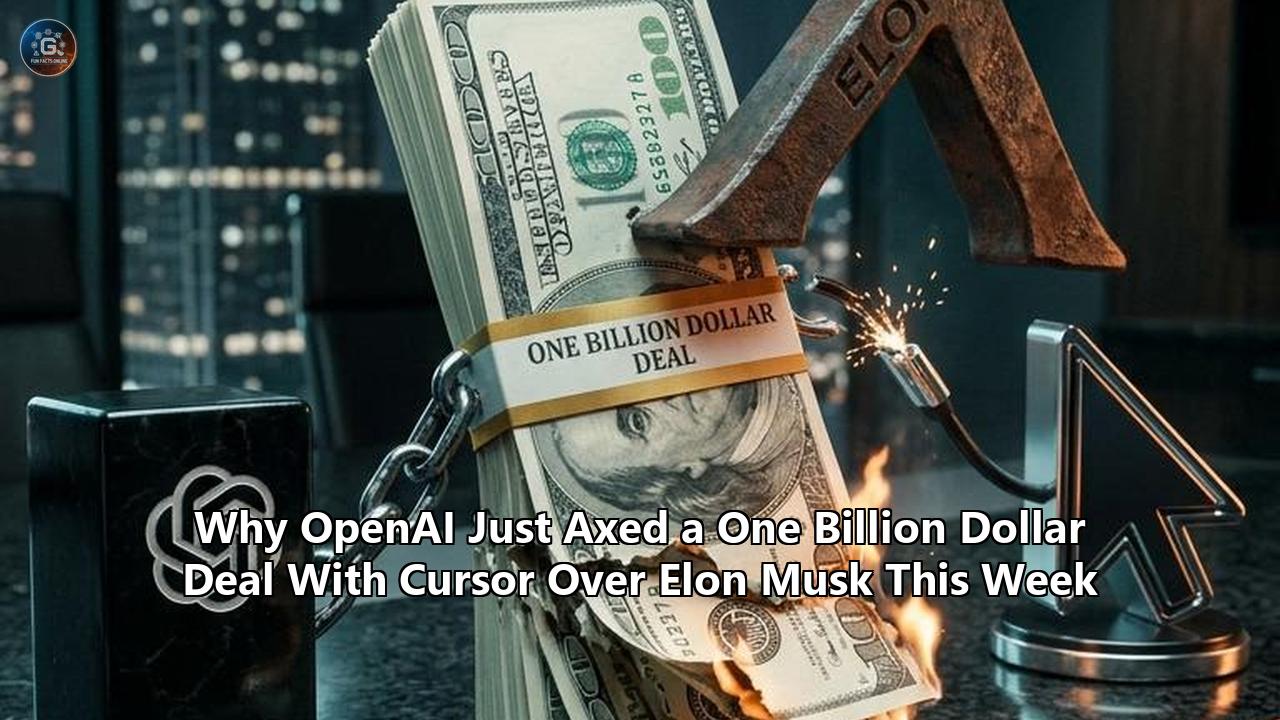
OpenAI has officially terminated its commercial model-access agreement with Cursor, the world’s most widely adopted artificial intelligence coding editor. The decision walks away from what internal projections estimated would become a $1 billion annual revenue stream. The abrupt severance, announced in an executive statement on August 28, sets a firm cutoff date of November 12, 2026, after which Cursor’s millions of software engineering users will be permanently blocked from querying OpenAI’s proprietary frontier models through the native interface.
The catalyst for the rupture was Elon Musk. Two weeks prior, Musk’s aerospace giant, SpaceX, finalized a staggering $60 billion all-stock acquisition of Cursor’s parent company, Anysphere, absorbing the software startup into a newly minted commercial division known as SpaceXAI.
OpenAI moved quickly to invoke a standard "change of control" clause in its enterprise licensing contract. In doing so, the company stated directly that it could no longer trust that its intellectual property and proprietary model architectures would be respected under Musk’s operational umbrella. OpenAI specifically pointed to Musk's past conduct with Twitter’s data pipelines and his sworn courtroom admissions that his AI venture, xAI, distilled OpenAI’s reasoning outputs to accelerate the training of its own competing model, Grok.
┌──────────────────────────────────────────────────────────────────┐
│                      THE AI CRACKUP: AT A GLANCE                 │
├───────────────────┬──────────────────────────────────────────────┤
│ The Action        │ OpenAI terminates model supply to Cursor     │
│ Deadline Date     │ November 12, 2026                            │
│ The Catalyst      │ SpaceX buys Cursor (Anysphere) for $60B      │
│ Financial Stake   │ >$1 Billion in projected annual API revenue  │
│ Stated Reason     │ Change-of-control clause; ToS violations     │
│ Direct Precedents │ Twitter data cutoff; xAI model distillation  │
│ Primary Beneficiary Anthropic (Claude 3.5/Opus/Sonnet) & xAI     │
└───────────────────┴──────────────────────────────────────────────┘
The collapse of the OpenAI Cursor deal represents a historic moment in the artificial intelligence sector. It marks the first instance where a leading foundational model vendor deliberately abandoned a ten-figure enterprise customer purely over corporate distrust, rival acquisition risks, and competitive self-defense.
Understanding why OpenAI walked away from this mountain of cash requires looking past Silicon Valley’s executive theater. The breakup exposes the intricate mechanics of generative code synthesis, the economics of API token consumption, the legal machinery of high-stakes software mergers, and the technical vulnerability known as model distillation.
Anatomy of a $1 Billion Enterprise Contract
To understand how a single application could generate more than $1 billion in annual revenue for an infrastructure provider, one must examine the specific mechanics of modern software development workflows.
Cursor does not operate like a conventional web browser interface where a user types a brief question and receives a paragraph of text. Cursor is a deep, full-featured fork of Microsoft’s open-source Visual Studio Code (VS Code). It operates inside the developer’s local machine, continuously reading, parsing, indexing, and modifying entire multi-gigabyte codebases.
                          ┌────────────────────────┐
                          │   Developer Keyboard   │
                          └───────────┬────────────┘
                                      │
                                      ▼
                          ┌────────────────────────┐
                          │  Cursor Client Engine  │
                          └─────┬────────────┬─────┘
                                │            │
           Local Context Window │            │ Background AST & Diffing
                                ▼            ▼
┌──────────────────────────────────────┐  ┌─────────────────────────────────┐
│ Dynamic Context Assembler            │  │ Local Embedding Index           │
│ • Open files & tab history           │  │ • Merkle-tree codebase cache    │
│ • Terminal outputs & build logs      │  │ • Multi-file dependency graph   │
│ • Git commit diffs & branch history  │  │ • Language Server Protocol data │
└──────────────────┬───────────────────┘  └────────────────┬────────────────┘
                   │                                       │
                   └───────────────────┬───────────────────┘
                                       │
                                       ▼
                   ┌───────────────────────────────────────┐
                   │ Massive Token Payload (100k - 200k)   │
                   └───────────────────┬───────────────────┘
                                       │
                 ┌─────────────────────┴─────────────────────┐
                 │                                           │
                 ▼                                           ▼
  ┌─────────────────────────────┐             ┌─────────────────────────────┐
  │   OpenAI Enterprise API     │             │  Anthropic / xAI Pipelines  │
  │  (Provisioned Throughput)   │             │   (Multi-Model Fallbacks)   │
  │ • Chain-of-Thought Compute  │             │ • Claude 3.5 Sonnet         │
  │ • Speculative Decoding      │             │ • Grok 4.5 Synthesis Engine │
  │ • Model Weights: O3 / GPT-4o│             └─────────────────────────────┘
  └─────────────────────────────┘
When an engineer uses an AI-powered coding editor, the computational workload scales exponentially compared to ordinary consumer chat applications. A single keystroke or inline request triggers what engineers refer to as a contextual payload:
- Context Window Assembly: The editor gathers the file currently being edited, snippets of dozens of related files, API interface declarations, language-server diagnostics (linter errors, type definitions), recent git commit histories, and terminal compiler outputs.
- Context Compression and Retrieval: Using vectorized codebase embeddings stored locally, the client identifies relevant function signatures across thousands of project files and bundles them into the prompt.
- Multi-Turn Chain-of-Thought Reasoning: When the user commands the editor to rewrite an architecture, build a feature, or resolve an obscure bug, the AI model executes recursive planning steps. It produces hidden "reasoning tokens" before outputting actual functional syntax.
- Agentic Loops and Multi-File Diffing: The model generates automated file modifications, runs the code against local terminal tests, reads the error logs, and automatically issues iterative corrections in a continuous computational cycle.
The Math Behind the Token Run Rate
In artificial intelligence architectures, billing is calculated through tokens—the basic building blocks of text and code, where 1,000 tokens equal roughly 750 English words or 150 lines of formatted code.
┌────────────────────────────────────────────────────────────────────────┐
│              ENTERPRISE AI DEVELOPER TOKEN USAGE PROFILE               │
├──────────────────────────────────────────┬─────────────────────────────┤
│ Average Context Window per Request       │ 85,000 Tokens               │
│ Output + Reasoning Tokens per Task       │ 4,500 Tokens                │
│ Average Automated Interactions per Day   │ 120 Agentic Loops           │
│ Total Daily Ingestion/Output per Dev     │ ~10.74 Million Tokens       │
├──────────────────────────────────────────┼─────────────────────────────┤
│ Blended API Rate (Input/Output Average)  │ $0.0035 per 1,000 Tokens    │
│ Daily Computational Cost per Heavy Dev   │ ~$37.59 per Day             │
│ Annualized API Run Rate per Seat         │ ~$9,400 to $13,500 per Year │
└──────────────────────────────────────────┴─────────────────────────────┘
When an enterprise engineering team of 5,000 developers operates on an agentic coding substrate, that single corporate account can burn millions of dollars in underlying model compute every quarter.
Cursor had expanded across top-tier Silicon Valley engineering departments, Fortune 500 financial institutions, enterprise software conglomerates, and fast-growing startups. By early 2026, Cursor had emerged as one of OpenAI’s top five single largest API customers globally.
OpenAI did not simply offer Cursor generic off-the-shelf API access. Under their customized enterprise partnership, OpenAI supplied Cursor with dedicated compute clusters, customized low-latency endpoints, provisioned throughput units (PTUs), and alpha access to unreleased experimental reasoning models.
Internal financial models at OpenAI projected that Cursor’s explosive developer adoption would generate well over $1 billion in annual recurring software consumption by early 2027.
Terminating such an agreement is financially counterintuitive on the surface. Companies preparing for prospective public offerings do not willingly surrender nine-figure, high-margin software revenues. The decision was driven by existential strategic and legal priorities that outweighed the immediate revenue.
The $60 Billion SpaceX Acquisition and the Creation of SpaceXAI
To trace the breakdown of the OpenAI Cursor deal, one must examine the corporate maneuvers orchestrated by Elon Musk during the summer of 2026.
On August 14, 2026, SpaceX shocked Wall Street and Silicon Valley by announcing the completed acquisition of Anysphere, Cursor’s creator, for $60 billion in equity. The acquisition eclipsed nearly all previous venture-backed software transactions in modern technology history.
                                  ┌───────────────────────────┐
                                  │      ELON MUSK EMPIRE     │
                                  └─────────────┬─────────────┘
                                                │
                 ┌──────────────────────────────┼──────────────────────────────┐
                 │                              │                              │
                 ▼                              ▼                              ▼
      ┌────────────────────┐         ┌────────────────────┐         ┌────────────────────┐
      │     X (Twitter)    │         │      SpaceX        │         │        xAI         │
      │ Real-time Text,    │         │ Aerospace, Starlink│         │ Colossus Cluster   │
      │ Video, Public Data │         │ Hardware & Launch  │         │ 100k+ H100/H200s   │
      └──────────┬─────────┘         └──────────┬─────────┘         └──────────┬─────────┘
                 │                              │                              │
                 └──────────────────────┐       │       ┌──────────────────────┘
                                        ▼       ▼       ▼
                                  ┌───────────────────────────┐
                                  │   SpaceXAI Super-Entity   │
                                  │ (Consolidated AI Division)│
                                  └─────────────┬─────────────┘
                                                │
                                                ▼
                                  ┌───────────────────────────┐
                                  │    Cursor (Anysphere)     │
                                  │  The $60B Control Node    │
                                  │  for Software Engineering │
                                  └───────────────────────────┘
The rationale behind SpaceX absorbing an AI code editor involves Musk’s broader vertical integration strategy. SpaceX manages the world’s most extensive satellite internet constellation (Starlink), designs orbital launch vehicles, constructs high-cadence manufacturing systems, and operates complex autonomous software platforms. Musk consolidated his technological properties—linking the data exhaust of X (formerly Twitter), the raw computing power of xAI’s superclusters, and the physical manufacturing footprint of SpaceX.
Musk realized that the most valuable bottleneck in modern computing is the software creation layer itself. By owning the IDE where world-class engineers spend their working hours, an organization captures three strategic assets:
- Telemetry on Human Problem Solving: Millions of hours of real-time software debugging, error correction, architectural planning, and algorithmic refactoring.
- Direct Application Distribution: An interface that bypasses traditional platform gatekeepers like Apple, Google, and Microsoft.
- The Premier Training Ground for Synthetic Intelligence: The ability to let autonomous models write code, run it on supercomputers, observe the execution result, and autonomously self-improve.
To power this ambition, Musk integrated Cursor directly into xAI’s computing operations. xAI operates "Colossus," a computing complex in Memphis, Tennessee, powered by more than 100,000 liquid-cooled Nvidia graphics processing units. By acquiring Cursor, SpaceX positioned itself to redirect all of Cursor’s underlying intelligence requirements into its own proprietary silicon and foundational models, primarily the Grok family.
For OpenAI, the prospect of its most advanced proprietary systems running inside an ecosystem owned, governed, and audited by Elon Musk created an immediate corporate crisis.
The Legal Mechanism: Deconstructing the "Change of Control" Clause
The legal lever OpenAI used to dissolve the relationship is one of the most consequential mechanisms in commercial contract law: the Change of Control (CoC) provision.
┌────────────────────────────────────────────────────────────────────────┐
│               CHANGE OF CONTROL (CoC) CLAUSE MECHANICS                 │
├────────────────────────────────────────────────────────────────────────┤
│ 1. Execution of Original Partnership (2023)                            │
│    • OpenAI provides preferential API pricing, early weights & PTUs.   │
│    • Standard protective covenants inserted regarding IP governance.   │
│                                                                        │
│ 2. The Trigger Event (August 14, 2026)                                 │
│    • SpaceX executes all-stock buyout of Anysphere (>50% voting stock).│
│    • Legal ownership of Anysphere transfers to SpaceX.                 │
│                                                                        │
│ 3. The Invocation Window (August 14 - August 28, 2026)                 │
│    • Contractual 30-day "Limited Opt-Out Window" becomes active.       │
│    • OpenAI legal evaluates competitive risk and Terms of Service.     │
│                                                                        │
│ 4. Formal Termination Notice (August 28, 2026)                         │
│    • OpenAI serves notice of termination under Change of Control.      │
│    • Maximum allowable wind-down timeline activated (Ends Nov 12, 2026)│
└────────────────────────────────────────────────────────────────────────┘
In enterprise software and strategic API licensing, foundational vendors include Change of Control provisions to prevent hostile competitor infiltration.
When a startup signs a high-tier enterprise model agreement, it receives proprietary Software Development Kits (SDKs), custom routing pipelines, Service Level Agreements (SLAs), and access to model weights and fine-tuning endpoints. These agreements include strict clauses establishing that if the customer is acquired by, merged with, or cedes more than 50% of its voting power to a direct competitor or third party, the supplier holds the unilateral right to cancel the agreement within a designated window (typically 30 to 90 days).
Without Change of Control protections, an adversarial company could execute a corporate buyout of a smaller vendor simply to inherit its underlying supplier relationships, bypass supplier vetting, and access the competitor's intellectual property and dedicated capacity.
When SpaceX finalized its purchase of Anysphere, it changed Cursor's corporate control. OpenAI's corporate counsel exercised this contractual protection.
OpenAI declined to negotiate revised enterprise terms with SpaceX. It triggered the maximum notice period permitted under the original contract—a ten-week transition window terminating on November 12, 2026—and barred Cursor from integrating any future frontier models, such as OpenAI's forthcoming Astra reasoning architecture.
Model Distillation: The Deep Tech Threat Behind the Breakup
The public statement released by OpenAI centered on a specific grievance: Elon Musk's companies could not be trusted to abide by OpenAI's Terms of Service. The technological core of that accusation centers on Model Distillation.
                      ┌─────────────────────────────────┐
                      │    Teacher Model (OpenAI O3)    │
                      │  Cost to train: $500M - $1B     │
                      └────────────────┬────────────────┘
                                       │
                                       ▼ (Outputs Complex Reasoning Traces)
                 ┌───────────────────────────────────────────┐
                 │ 1. "Let's break down this memory leak..." │
                 │ 2. "Step A: Check pointer arithmetic..."  │
                 │ 3. "Step B: Verify heap allocations..."   │
                 │ 4. "Step C: Refactor thread mutex lock..."│
                 └─────────────────────┬─────────────────────┘
                                       │
                                       ▼ (Synthetic Dataset Extraction)
                 ┌───────────────────────────────────────────┐
                 │ Filtered, Formatted Training Tokens       │
                 │ Cost to capture: Peanuts vs. Base Compute │
                 └─────────────────────┬─────────────────────┘
                                       │
                                       ▼ (Supervised Fine-Tuning)
                      ┌─────────────────────────────────┐
                      │    Student Model (Grok-Code)    │
                      │   Trained on Rival's Logic      │
                      │   Fractional Training Cost      │
                      └─────────────────────────────────┘
How Model Distillation Works
Training a world-class foundational model from scratch requires hundreds of millions of dollars in compute, vast electricity infrastructure, specialized network topologies, and years of human research. The model ingests trillions of tokens of text and code, slowly adjusting billions of parameters through gradient descent to learn the underlying statistical and logical structure of programming languages.
Model distillation is an algorithmic shortcut:
- The Teacher-Student Paradigm: Instead of training a model on unstructured, messy raw data, engineers use a superior, highly advanced model (the "Teacher") to solve complex programming challenges.
- Harvesting Chain-of-Thought Data: The Teacher model does not merely spit out the correct code; it generates detailed, multi-step chain-of-thought traces, self-corrections, architectural justifications, and verification steps.
- Synthetic Supervised Fine-Tuning: The smaller, cheaper model (the "Student") is trained directly on these synthetic reasoning paths.
- Knowledge Absorption at Scale: By mimicking the Teacher's exact intermediate logic steps, the Student model achieves performance comparable to the larger model while expending only 1% to 5% of the original training compute.
Every major AI lab’s Terms of Service explicitly forbids this practice. OpenAI’s Developer Policy states:
"You may not use the output of our Services to develop models that compete with OpenAI."
Sworn Testimony and the Shadow of xAI
The technological risk for OpenAI was not hypothetical. During ongoing federal court litigation between Elon Musk and OpenAI in early 2026, Musk was asked directly under cross-examination whether his AI startup, xAI, had used outputs from OpenAI's models to train and refine Grok. Musk admitted under oath that this was "partly true".
                     DISTILLATION ECONOMICS COMPARISON
┌───────────────────────────────────────┬──────────────────────────────────┐
│ Conventional Frontier Base Training   │ Synthetic Model Distillation     │
├───────────────────────────────────────┼──────────────────────────────────┤
│ Compute Required: 50,000+ H100 Months │ Compute: 1,500 H100 Months       │
│ Financial Outlay: $300M - $1B+        │ Financial Outlay: $5M - $15M     │
│ Data Requirements: Trillions of Tokens│ Data: Curated Reasoning Chains   │
│ Optimization: Trial-and-error loss    │ Optimization: Direct mimicry     │
└───────────────────────────────────────┴──────────────────────────────────┘
The data flow within Cursor presented a profound structural risk:
- Cursor processes hundreds of millions of proprietary programming queries daily.
- Developers use the tool to debug production environments, build microservices, and refactor code.
- If Cursor remained plugged into OpenAI’s API while being wholly owned by SpaceX and xAI, Musk’s engineers would have full control of the servers routing those API calls.
OpenAI determined it was impossible to verify whether prompt-completion pairs, internal reasoning traces, and token-level evaluations passing through Cursor’s backend were being saved, structured, and routed into xAI's data pipelines to train Grok 5.
OpenAI was also shaped by historical precedent. After Musk purchased Twitter in 2022, he abruptly terminated OpenAI’s access to the Twitter data firehose, which OpenAI had previously licensed to train conversational models. Having seen Musk pull data access on short notice, OpenAI’s executive leadership chose not to leave their own API pipeline exposed within Musk’s software portfolio.
The Altman-Musk Rivalry: How Personal Feuds Shape Industrial Realities
The collapse of the OpenAI Cursor deal cannot be separated from the personal and corporate rivalry between Sam Altman and Elon Musk.
                                  A DECADE OF FRICTION
  2015 ─── Musk and Altman co-found OpenAI as an open-source non-profit research lab.
           Musk commits up to $1B in initial funding to counter Google DeepMind.
            │
  2018 ─── Musk attempts to take direct operational control of OpenAI and fold it into Tesla.
           Altman and the board refuse. Musk leaves OpenAI and cuts off funding.
            │
  2019 ─── OpenAI creates a "capped-profit" subsidiary; secures $1B initial Microsoft backing.
            │
  2022 ─── OpenAI launches ChatGPT; Musk buys Twitter and cuts OpenAI's data access.
            │
  2023 ─── Musk launches rival venture xAI; builds the massive "Colossus" GPU cluster.
            │
  2024-25─ Musk files a $150B lawsuit alleging OpenAI abandoned its non-profit charter.
           Altman rejects Musk's unsolicited hostile offers to buy out OpenAI.
            │
  2026 ─── SpaceX acquires Cursor (Anysphere) for $60B.
           OpenAI terminates its $1B Cursor contract, citing lack of trust and ToS breaches.
The two men founded OpenAI in December 2015 alongside Greg Brockman, Ilya Sutskever, and others. The original premise was an open-source, non-profit counterweight to Google's consolidation of AI talent. Musk pledged significant early funding, but by early 2018, as OpenAI lagged behind rivals in compute capacity, Musk pushed to take operational control of the lab and merge it into Tesla.
Altman and the other co-founders rejected the proposal. Musk walked away, resigned his board seat, and ceased ongoing financial contributions.
Left without Musk’s capital, Altman restructured OpenAI in 2019, creating a capped-profit entity to raise external equity. That restructuring enabled a $1 billion investment from Microsoft, which later expanded into a multi-billion-dollar compute and equity alliance.
As OpenAI surged to global prominence following the launch of ChatGPT, Musk grew increasingly vocal in his criticism. He launched xAI in 2023 with a mission to build competing frontier models and filed multiple expansive federal lawsuits against OpenAI and Altman personally. The lawsuits alleged breaches of fiduciary duty, fraud, and antitrust violations, demanding billions in damages and seeking to invalidate OpenAI’s corporate restructuring.
Altman publicly rejected multiple hostile acquisition bids and consortium offers led by Musk.
When Musk acquired Cursor through SpaceX, the friction shifted from courtrooms and social media into core commercial infrastructure. Maintaining an enterprise supplier arrangement with an entity owned by an executive suing you for tens of billions of dollars became untenable for OpenAI’s board and legal counsel.
Musk responded characteristically on X after the announcement, calling OpenAI’s leadership untrustworthy, while Altman and OpenAI held firmly to their contractual termination rights.
Inside Cursor's Multi-Model Engine: Will the Editor Survive?
Following OpenAI's announcement, industry observers questioned whether the loss of the world's most recognizable AI model provider would undermine Cursor’s core value proposition.
Cursor CEO Michael Truell moved quickly to calm developer anxiety, revealing a data point that caught the software industry off guard: OpenAI models accounted for only about 5% of Cursor’s active user traffic.
                     CURSOR MODEL USAGE TRAFFIC SHARE
┌───────────────────────────────────────────────────┬──────────────┐
│ Model Provider / Architecture                     │ Traffic %    │
├───────────────────────────────────────────────────┼──────────────┤
│ Anthropic (Claude 3.5 Sonnet, Claude Opus)        │ ~62%         │
│ Cursor Native / Fine-Tuned (Composer 2.5 / Shadow)│ ~21%         │
│ Google (Gemini 1.5 Pro, Gemini 2.0 Flash)         │ ~8%          │
│ OpenAI (GPT-4o, O-series models) [BEING CUT OFF]  │ ~5%          │
│ xAI / Other Open-Source Weights (Grok 4.5, Llama) │ ~4%          │
└───────────────────────────────────────────────────┴──────────────┘
The reality is that Cursor had already engineered its technical stack to prevent single-vendor dependency.
The Multi-Model Routing Layer
Cursor does not hard-code its user interface to an isolated model endpoint. The platform uses a dynamic, client-side and server-side model orchestration layer that lets developers toggle seamlessly between frontier providers:
- Anthropic Dominance: Anthropic’s Claude 3.5 Sonnet and Claude Opus families had already established themselves as the preferred models among professional software engineers due to their superior handling of code diffs, architectural mapping, and complex logic trees. Anthropic capitalized on the OpenAI severance by granting Cursor higher rate limits, dedicated enterprise pipelines, and prioritized inference capacity.
- Composer 2.5 and Speculative Decoding: Anysphere built proprietary, highly specialized small models (such as Composer 2.5) running on open-weight checkpoints. These smaller, fine-tuned models execute real-time code predictions, multi-cursor inline edits, and token-diff completions locally or on low-cost edge instances, reducing the need to ping large frontier models for routine edits.
- The Colossus Migration: Backed by SpaceX’s compute resources, Cursor is transitioning its backend inference into xAI’s dedicated GPU clusters. The upcoming Grok 4.5 and Grok-Code models were co-optimized alongside Cursor’s engineering team to handle complex repo-level operations directly.
                    CURSOR MODEL ARBITRATION ARCHITECTURE
                                ┌───────────────┐
                                │ Developer IDE │
                                └───────┬───────┘
                                        │
                                        ▼
                         ┌─────────────────────────────┐
                         │ Cursor Smart Model Router   │
                         └──────┬───────┬───────┬──────┘
                                │       │       │
            Fast Edits (<50ms)  │       │       │ Complex Reasoning
     ┌──────────────────────────┘       │       └──────────────────────────┐
     ▼                                  ▼                                  ▼
┌──────────────────────────┐  ┌──────────────────────────┐  ┌──────────────────────────┐
│ Cursor Composer 2.5      │  │ Anthropic Claude Engine  │  │ xAI Grok Computing Mesh  │
│ (Custom Open Checkpoint) │  │ (Claude 3.5 Sonnet/Opus) │  │ (Colossus Supercluster)  │
│ • Real-time Tab Complete │  │ • Full Repo Refactoring  │  │ • 100k+ Dedicated GPUs   │
│ • Local File AST Diffs   │  │ • Logic Bug Synthesis    │  │ • Deep Context Reasoning │
└──────────────────────────┘  └──────────────────────────┘  └──────────────────────────┘
Because Cursor built a defensible workflow layer rather than a shallow API wrapper, the platform treats foundation models as interchangeable utility components. If an enterprise developer demands OpenAI models specifically, they will soon be forced to use alternative extensions or provide their own custom enterprise Azure OpenAI API keys. For the vast majority of Cursor’s user base, however, everyday development workflows will continue uninterrupted on Anthropic, Google, and xAI backends.
Strategic Fallout: The End of AI Infrastructure Neutrality
The dissolution of the OpenAI Cursor deal sends shockwaves across the software industry that extend far beyond these two companies. It dismantles the assumption that major AI model providers will operate as neutral, utility-style infrastructure for downstream developers.
For the past several years, venture capital firms funded thousands of startups on the thesis that foundational model developers (OpenAI, Anthropic, Google) would serve as the "power grid" or the "AWS" of the intelligence economy. Startups were told to focus entirely on user experience, workflow integration, and distribution, while relying on API calls to supply the core reasoning intelligence.
                      THE AI STACK BALKANIZATION
┌────────────────────────────────────────────────────────────────────────┐
│ THE HISTORICAL VIEW: Neutral Utility Layer                             │
│                                                                        │
│   [Applications: Cursor, Harvey, Jasper, Windsurf, Devin]              │
│                           ▲                                            │
│                           │ (Uniform, Neutral REST APIs)               │
│   [Foundational Models: OpenAI, Anthropic, Google]                     │
│                           ▲                                            │
│   [Hyperscalers: Microsoft Azure, AWS, Google Cloud]                   │
└────────────────────────────────────────────────────────────────────────┘
                                   VS
┌────────────────────────────────────────────────────────────────────────┐
│ THE REALITY: Vertically Integrated Walled Ecosystems                   │
│                                                                        │
│   WARING BLOC A            WARING BLOC B            WARING BLOC C      │
│   ┌──────────────────┐     ┌──────────────────┐     ┌────────────────┐ │
│   │ OpenAI / MSFT    │     │ SpaceX / xAI     │     │ Anthropic/AWS  │ │
│   │ • Canvas / Codex │     │ • Cursor ($60B)  │     │ • Claude Code  │ │
│   │ • Copilot Suite  │     │ • Grok Models    │     │ • Bedrock Hub  │ │
│   │ • Closed Tier    │     │ • Colossus Mesh  │     │ • Open Claude  │ │
│   └──────────────────┘     └──────────────────┘     └────────────────┘ │
└────────────────────────────────────────────────────────────────────────┘
The OpenAI-Cursor split proves that downstream startups remain acutely vulnerable to platform risk. Foundational model creators are building their own first-party application layers:
- OpenAI is expanding its first-party coding interfaces, integrating canvas environments, and developing autonomous desktop developer agents directly inside ChatGPT to compete head-to-head with standalone IDEs.
- Microsoft is embedding deeper native agentic capabilities into GitHub Copilot and Visual Studio, challenging independent third-party software extensions.
- Anthropic is launching specialized command-line agents and native software engineering environments designed to capture developer loyalty directly.
When an application layer startup grows large enough to represent significant revenue—and then aligns itself with a direct competitor—the infrastructure provider can and will pull the plug.
Enterprise Chief Information Officers (CIOs) and software engineering leaders are adjusting their procurement criteria accordingly. Corporate development teams are no longer willing to standardize their internal engineering workflows on tools dependent on a single proprietary model provider. The demand for multi-model interoperability, local open-source fallback models, and sovereign on-premise deployments has become a baseline security requirement.
What Happens on November 12: The Road Ahead
As the November 12 cutoff deadline approaches, the artificial intelligence landscape is drawing new battle lines.
                     CRITICAL DATES & MILESTONES
┌────────────────────┬─────────────────────────────────────────────────┐
│ Date               │ Milestone / Industry Event                      │
├────────────────────┼─────────────────────────────────────────────────┤
│ August 14, 2026    │ SpaceX closes $60B buyout of Anysphere      │
│ August 28, 2026    │ OpenAI formally issues contract termination   │
│ September 2026     │ Anthropic expands dedicated capacity to Cursor  │
│ October 2026       │ xAI begins public rollout of Grok 4.5 coding model│
│ November 12, 2026  │ Final shutoff of direct OpenAI API endpoints    │
│ Q1 2027            │ OpenAI expected launch of Astra reasoning model│
└────────────────────┴─────────────────────────────────────────────────┘
The dissolution of the OpenAI Cursor deal illustrates the maturing reality of the artificial intelligence economy. Pure financial incentives are no longer enough to guarantee corporate cooperation. When intellectual property security, model distillation risks, and fierce executive rivalries intersect, even ten-figure commercial agreements can collapse overnight.
                             KEY TAKEAWAYS
┌────────────────────────────────────────────────────────────────────────┐
│ 1. Structural Vulnerability of AI Startups                              │
│    Relying exclusively on third-party foundational models introduces   │
│    lethal platform risk during mergers, acquisitions, or pivots.        │
│                                                                        │
│ 2. Distillation is the Ultimate IP Redline                             │
│    Foundational labs view output harvesting by rivals as an            │
│    existential threat and will forfeit massive revenue to stop it.   │
│                                                                        │
│ 3. Enterprise Value Lies in the Workflow Interface                     │
│    Cursor's multi-model architecture insulated it from destruction,    │
│    proving that user distribution and workflow integration outlast     │
│    individual model vendor contracts.                                  │
└────────────────────────────────────────────────────────────────────────┘
Software engineering teams should prepare their internal infrastructure for a more fragmented ecosystem. The market has fractured into competing, vertically integrated technology blocs: OpenAI and Microsoft in one corner, SpaceX, xAI, and Cursor in another, with Anthropic, Google, and open-weight models competing across the remaining terrain.
The developer desktop has become the most valuable strategic battleground in tech. The loss of a $1 billion customer proves that OpenAI is ready to play hardball to protect its perimeter.
Reference:
- https://www.infoworld.com/article/4216503/cursor-customers-will-lose-access-to-openai-coding-models-in-november.html
- https://www.channelinsider.com/ai/news-openai-cursor-model-access-spacex-acquisition/
- https://www.aichatdaily.com/ai-business/openai-walks-away-1b-cursor-deal-after-spacex
- https://www.reddit.com/r/OpenAI/comments/1w6cqrr/openai_cut_off_a_billiondollar_customer_to_avoid/
- https://www.forbes.com/sites/the-prompt/2026/09/01/cursor-pays-the-price-for-the-spacex-acquisition-no-more-openai-models/
- https://www.forbes.com/sites/jonmarkman/2026/08/31/openai-cuts-off-cursor-after-spacexs-60-billion-takeover/
- https://bravenewcoin.com/insights/openai-to-cut-spacex-acquired-cursor-deal-as-musk-slams-altman
- https://www.kucoin.com/news/flash/openai-terminates-1-billion-cursor-partnership-after-spacex-acquisition
- https://www.businessinsider.com/openai-ends-cursor-contract-elon-musk-spacex-sam-altman-feud-2026-8
- https://www.facebook.com/wired/posts/openai-recently-estimated-its-cursor-partnership-would-make-more-than-1-billion-/1440052921323629/
- https://www.livemint.com/companies/news/openai-ends-cursor-deal-is-elon-musk-responsible-for-sam-altmans-company-cutting-off-ai-models-what-we-know-11787999816381.html
- https://devops.com/openai-cuts-off-cursors-model-access-after-spacex-acquisition/
- https://www.reddit.com/r/cursor/comments/1w19lrl/openai_is_ending_its_cursor_partnership_after/