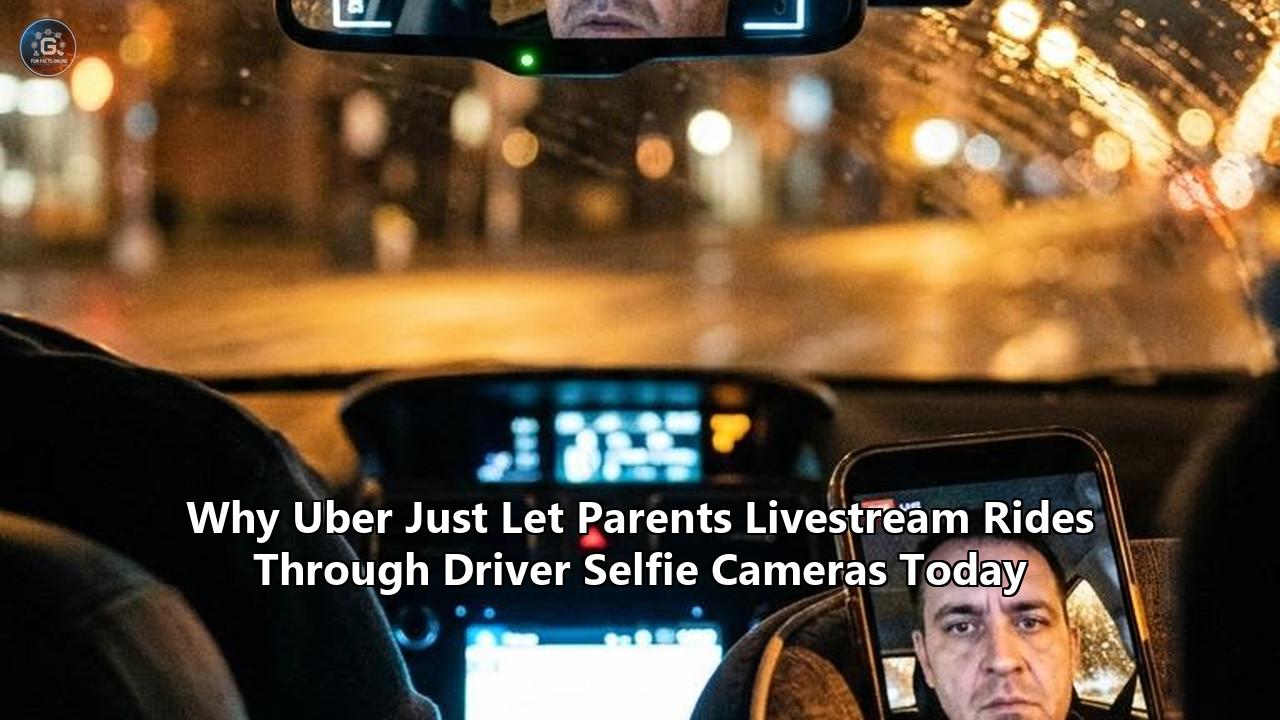
On a quiet Tuesday morning in Atlanta, a smartphone mounted to the dashboard of an aging Toyota Camry clicked to life. A blue banner flashed across the screen of the driver, Marcus Vance, alerting him that a passenger had entered the vehicle. Seconds later, a secondary notification popped up: Parent has connected to the live cabin stream.
Miles away, sitting at a kitchen table, a mother watched a crystal-clear, high-definition feed of the inside of Vance’s car on her smartphone. Through the ultra-wide lens of Vance’s own phone camera, she could see her 15-year-old daughter sitting in the back right seat, backpack resting on her lap, while Vance navigated the morning traffic.
The capability represents the newest, most radical iteration of Uber’s parental surveillance toolkit. Under a major product rollout launched in nine initial metropolitan markets—Atlanta, Phoenix, Orlando, Portland, Cleveland, El Paso, Raleigh-Durham, Rhode Island, and San Antonio—Uber has introduced live video streaming for its Teen Accounts. The tool allows parents to tap into real-time audio and video feeds generated directly from the driver’s personal smartphone camera for the entire duration of a ride.
+-------------------------------------------------------------------------+
|                  UBER TEEN RIDE LIVE STREAM ARCHITECTURE                |
+-------------------------------------------------------------------------+
|                                                                         |
|  [ Driver Dashboard ]                                                   |
|         |                                                               |
|  Driver Smartphone (Front-Facing Selfie Camera & Mic)                   |
|         |                                                               |
|         +---> [ Low-Latency WebRTC Video Uplink ]                       |
|                     |                                                   |
|                     v                                                   |
|         [ Uber Secure Relay & 14-Day Encrypted Storage ]                |
|                     |                                                   |
|                     v                                                   |
|         [ Encrypted Video Downlink ]                                    |
|                     |                                                   |
|                     v                                                   |
|  [ Parent / Guardian Uber App (Active Monitoring Interface) ]           |
|                                                                         |
+-------------------------------------------------------------------------+
The feature, timed deliberately to capture the lucrative back-to-school transit market, is expanding nationwide over the coming weeks. But beneath the marketing pitch of parental peace of mind lies an unprecedented structural shift: turning millions of independent gig workers’ personal smartphones into remote, broadcast-capable closed-circuit surveillance devices for consumers.
An investigation into internal product mechanics, public safety filings, and pending multidistrict litigation reveals that the decision to let parents view Uber livestream rides is not just an incremental safety update. Instead, it is the culmination of years of mounting legal exposure, shifting regulatory liability, and a high-stakes corporate push to monetize the teenage transit demographic without inheriting catastrophic legal risk.
The Anatomy of the In-Cabin Broadcast
To understand how Uber achieved live visual access into private vehicles, one must look at the evolution of the company’s internal hardware and software framework known as "Record My Ride".
Launched experimentally in select Latin American and US cities in late 2022, Record My Ride was originally built as a localized, on-device dashcam alternative. It utilized the driver's front-facing phone camera to record cabin activity, storing the encrypted footage directly on the phone's flash memory. The files were designed to sit dormant, unreadable even by the driver, until an explicit safety incident report prompted an upload to Uber’s safety response center.
The new parental live streaming protocol completely dismantles that local-storage quarantine.
+-------------------------------------------------------------------------+
|                     STREAM PIPELINE & DATA FLOW                         |
+-------------------------------------------------------------------------+
|                                                                         |
|  1. Driver Opt-in   ---> Accepts Teen Dispatch Protocol                 |
|  2. Ride Triggers   ---> Phone Front Camera & Mic Initialize            |
|  3. Guardian Alerts ---> Push Notification: "Live Video Available"      |
|  4. Active Session  ---> Bi-directional Notification to Driver & Teen   |
|  5. Buffer Pipeline ---> 1080p/720p Variable Bitrate Video Stream       |
|  6. Storage Engine  ---> AES-256 Cloud Ingestion (14-Day Purge Timer)   |
|                                                                         |
+-------------------------------------------------------------------------+
When an eligible teen ride begins, the Uber driver application accesses the mobile device's camera hardware through operating system level permissions (Camera and Microphone runtime access). If the driver has opted into the video program, a background capture service initiates.
The application encodes the video stream—typically scaled dynamically between 720p and 1080p resolution at 30 frames per second depending on cellular bandwidth—and routes the packets through a real-time WebRTC media pipeline directly to Uber's distributed streaming infrastructure.
From there, the media stream is split:
- The Downlink Feed: Transmitted with sub-second latency to the authorized guardian’s smartphone, where it renders within a dedicated video viewport inside the passenger app.
- The Ingestion Archive: Simultaneously piped into a secure cloud storage bucket, where the raw footage is held under AES-256 encryption for a mandatory 14-day retention cycle.
"The jump from local, post-incident forensic storage to active, multi-point streaming telemetry is massive," says Dr. Aris Thorne, a distributed systems architect and former municipal surveillance consultant. "You are moving from a passive digital witness to an active remote monitor. That requires significant cellular uplink bandwidth, constant camera-sensor thermal overhead on the driver’s personal hardware, and an architectural trust model that places total faith in server-side access controls."
| Feature Attribute | Legacy "Record My Ride" (2022) | Live Teen Ride Video (Current) |
|---|---|---|
| Capture Medium | Driver Phone Front Camera | Driver Phone Front Camera |
| Transmission Type | Stored locally on-device | Live WebRTC cloud streaming |
| Viewing Access | Post-incident safety teams only | Parents in real-time + Safety teams |
| Latency | N/A (Offline encoding) | 300ms – 1.2s live stream |
| Data Retention | 7 days (auto-purged if unshared) | 14 days encrypted on Uber servers |
| Consent Trigger | Driver toggle / Passenger placard | Account link + Trip initiation alert |
Inside the vehicle, the physical configuration must adhere to strict guidelines. Uber’s internal driver training materials advise gig workers to mount their smartphones on the center console or windshield at a specific angle—aimed directly between the driver's right shoulder and the center rear seat. The intent is clear: the camera must capture both the back half of the driver’s head and profile, as well as the teen passenger seated across the rear bench.
When a parent taps the push notification to begin watching the Uber livestream rides, an audible chime plays through the driver's phone, accompanied by a permanent visual indicator: a persistent blue eye icon with the label Guardian Viewing.
Yet, for drivers on the road, that small icon represents something far larger than a notification—it marks the total erosion of the boundary between personal property and corporate monitoring.
The Legal Shadow: Multidistrict Litigation and the $8.5 Million Bellwether
Why did Uber deploy such an invasive, technically demanding tool now? The answer is not found in marketing surveys, but in the federal court dockets of San Francisco.
For nearly three years, Uber Technologies Inc. has been fighting a massive legal war consolidated under Northern District of California Multidistrict Litigation (MDL No. 3084: In re: Uber Technologies, Inc., Passenger Sexual Assault Litigation). The litigation, overseen by U.S. District Judge Charles Breyer, consolidates thousands of claims brought by passengers alleging sexual harassment, assault, and physical violence by drivers operating on the network.
+-------------------------------------------------------------------------+
|                  THE CORPORATE LIABILITY ESCALATION                     |
+-------------------------------------------------------------------------+
|                                                                         |
|  2017–2022 Safety Disclosures:                                          |
|  • >400,000 internal incident classifications                           |
|  • Thousands of formal sexual assault complaints                        |
|                                                                         |
|  Federal MDL No. 3084 Consolidation:                                    |
|  • >3,000 federal & state claims centralized in California             |
|                                                                         |
|  The Arizona Bellwether Precedent:                                      |
|  • $8,500,000 Jury Verdict on "Apparent Agency"                         |
|  • Internal risk scores exposed in open court                           |
|                                                                         |
|  Strategic Defense Response:                                            |
|  • Aggressive implementation of active, auditable cabin surveillance     |
|                                                                         |
+-------------------------------------------------------------------------+
A turning point arrived when a federal jury in Phoenix returned an $8.5 million compensatory verdict in a bellwether trial involving an alleged sexual assault by an Uber driver. Uber had long defended such lawsuits by asserting that drivers are independent contractors, insulating the technology platform from vicarious liability.
The jury in Arizona rejected that shield, finding that Uber created the conditions of "apparent authority"—leading the consumer to believe the platform maintained direct operational oversight of the trip.
During that trial, internal documents unsealed by the court revealed that Uber’s own proprietary Safety Risk algorithms had evaluated specific trips and drivers with elevated hazard indices, yet dispatched vehicles without additional preventative controls.
Plaintiffs' lawyers demonstrated that Uber’s historical resistance to continuous in-vehicle monitoring, biometric screening, and hardware dashcams stemmed from a desire to minimize driver onboarding friction and avoid the legal designation of an employer.
"The Arizona verdict demolished the legal firewall Uber had spent fifteen years building," says Rachel Vance-Boren, a tort liability specialist and civil litigator who represents victims in rideshare safety cases. "Once a federal court holds that Uber can be liable under apparent agency, the calculus shifts completely. The company can no longer claim it is just a passive matching engine. It must prove to insurance underwriters, institutional investors, and juries that it exercises aggressive, state-of-the-art oversight over the physical space of the ride."
Enter the Teen Accounts program.
Launched in 2023 across the United States and now operating in more than 50 countries, Uber Teen accounts allow adolescents between the ages of 13 and 17 to hail rides independently. For Uber, the demographic represents one of the fastest-growing customer cohorts—filling the mid-afternoon operational lull between school dismissals and after-school sports practices.
Teen Market Revenue Potential  <--->  Catastrophic Liability Exposure
(High-frequency school trips)        (Underage passenger harm claims)
                         \            /
                          \          /
                       [ Compromise Solution ]
                                 |
                    Continuous Remote Livestreaming
Transporting unaccompanied minors, however, carries immense financial and legal liability. A single catastrophic assault involving an unaccompanied teen could expose Uber to punitive damages capable of compromising entire business lines.
By allowing parents to Uber livestream rides, the platform constructs an immediate liability defense: the company provides parents with continuous, real-time visual oversight, effectively deputizing the guardian as a co-monitor while maintaining an immutable, encrypted cloud record to defeat contradictory allegations in court.
Inside the Driver’s Seat: The Illusion of "Voluntary" Surveillance
Uber’s official statements present the video feature as an entirely voluntary choice for drivers.
"Live video is an opt-in safety feature designed to support both drivers and families," an Uber spokesperson stated during the regional launch. "Drivers are in complete control of their participation and can choose whether or not to enable video recording or accept teen rides at any time."
Interviews with drivers across several launch markets tell a vastly different story.
+-------------------------------------------------------------------------+
|                  ALGORITHMIC DISPATCH & INCENTIVE CASCADE               |
+-------------------------------------------------------------------------+
|                                                                         |
|  [ Driver Account Profile ]                                             |
|         |                                                               |
|         +---> Tier 1: Record My Ride + Teen Opt-In Active               |
|         |     • Direct access to high-volume 2:00 PM – 5:00 PM dispatches|
|         |     • Unrestricted access to surge-priced school zones        |
|         |     • Elevated dispatch ranking in core suburban nodes        |
|         |                                                               |
|         +---> Tier 2: Video Feature Disabled                            |
|               • Automatic disqualification from Teen dispatches         |
|               • Suppressed trip allocation during afternoon peaks       |
|               • Documented income drop of 20% to 35%                    |
|                                                                         |
+-------------------------------------------------------------------------+
In suburban Phoenix, one of the primary test corridors, 48-year-old rideshare veteran Carlos Mendez explained how the algorithmic dispatch system enforces compliance.
"They tell the press it’s an option," Mendez said. "Here is how that 'option' actually works. Between 2:30 PM and 5:00 PM, nearly 40% of the trip requests coming out of the East Valley are Teen Accounts coming from high schools and athletic complexes. If you don't turn on 'Record My Ride' and agree to let parents stream through your camera, the algorithm stops routing those trips to you. You sit in a parking lot with zero income while drivers who consented to having a camera pointed at their face get ride after ride."
Mendez's testimony highlights the structural tension of the gig economy: algorithmic coercion masquerading as voluntary choice.
Drivers who enable the stream face severe operational and privacy burdens:
- Thermal and Battery Degradation: Continuous front-camera video encoding paired with GPS navigation and screen illumination causes standard smartphones to overheat rapidly, frequently triggering thermal throttling or device shutdowns on hot dashboard mounts.
- Cellular Data Costs: The upstream transmission of continuous video consumes significant high-speed mobile data, an uncompensated expense absorbed entirely by the driver.
- Constant Psychological Surveillance: Drivers report extreme cognitive fatigue caused by having an active lens pointed inches from their faces, knowing that at any moment an unknown third party may be watching and evaluating their driving habits, body language, facial expressions, or verbal comments.
"It creates a digital panopticon in the vehicle," says Dr. Veena Dubal, a professor of law at the University of California, Irvine, whose research focuses on algorithmic management and gig worker rights. "The driver’s car is their personal workplace, and their phone is their personal property. Uber is requiring workers to turn their own tools into live corporate surveillance hardware, not to protect the driver, but to insulate the corporation from tort liability while shifting the operational costs onto the labor force."
The Bystander Dilemma and State Wiretapping Conflicts
Beyond labor rights, Uber’s video streaming tool enters a legal minefield regarding two-party consent, constitutional wiretapping statutes, and bystander privacy.
In the United States, privacy during audio and video recording is governed by a fragmented patchwork of state and federal laws. Twelve states—including California, Florida, Illinois, Pennsylvania, and Massachusetts—require all parties in a private conversation to consent to an audio recording (commonly called "two-party" or "all-party" consent laws).
+-------------------------------------------------------------------------+
|                     STATE RECORDING STATUTE SPECTRUM                    |
+-------------------------------------------------------------------------+
|                                                                         |
|  [ One-Party Consent Jurisdictions ]                                    |
|  • Federal Standard (18 U.S.C. § 2511)                                  |
|  • Georgia, Texas, Arizona, New York, Ohio                              |
|  • Rule: Single party aware of recording satisfies legality             |
|                                                                         |
|  [ All-Party / Two-Party Consent Jurisdictions ]                        |
|  • California (Pen. Code § 632)                                         |
|  • Florida (Fla. Stat. § 934.03)                                        |
|  • Pennsylvania (18 Pa.C.S. § 5703)                                     |
|  • Illinois (720 ILCS 5/14-2)                                           |
|  • Rule: Every individual in acoustic range must explicitly consent     |
|                                                                         |
+-------------------------------------------------------------------------+
Uber’s legal team contends that because the driver explicitly toggles the feature on and the account holder (the parent/teen) initiates the ride through the terms of service, adequate legal consent is established across the transaction.
This legal logic collapses, however, when applied to third-party bystanders.
Consider a scenario that occurs thousands of times daily: a 16-year-old student books an Uber ride home from school and brings along two 15-year-old classmates. The classmates have not registered for an Uber Teen account, have never signed the platform's terms of service, and their parents have no contractual relationship with Uber.
Yet, when the car departs, the front-facing camera records and transmits the video and audio of those non-contracting minors directly to the booking student's parents, while streaming their identifiable biometric likenesses to Uber's cloud servers.
                   +---------------------------+
                   |  Booking Teen (Consented) |
                   +-------------+-------------+
                                 |
  +------------------------------+------------------------------+
  |                              |                              |
  v                              v                              v
[ Guest Passenger A ]   [ Guest Passenger B ]         [ Driver's Personal Space ]
  • Unregistered Minor    • Unregistered Minor          • Independent Contractor
  • Zero App Affiliation  • Zero App Affiliation        • Constant Audio/Video Feed
  • No Parental Consent   • No Parental Consent         • Uncompensated Transmission
          \                      /                               /
           \                    /                               /
            +------------------+-------------------------------+
                               |
                               v
               [ UNCONSENTED THIRD-PARTY DATA CAPTURE ]
"From an evidentiary and privacy standpoint, this is a massive blind spot," says Mark H. Kelly, a constitutional privacy attorney and former state prosecutor. "If you are in a two-party consent state like California or Florida, recording the audio of a non-consenting third-party minor in a vehicle where they possess a reasonable expectation of conversational privacy can be an outright statutory violation. Uber’s in-app terms cannot waive the fundamental civil rights of a bystander who never downloaded the app."
Uber addresses this in its privacy disclosures by stating that passengers are notified via an on-screen prompt on the booking phone that the ride is subject to recording.
However, if a passenger does not own the phone ordering the ride, no visual or auditory disclosure is provided to them upon opening the car door.
The Architecture of Escrow: Who Holds the Keys?
Uber has sought to reassure privacy advocates by emphasizing the cryptographic protections surrounding its video pipeline.
The company states publicly that:
- The live video stream is encrypted in transit.
- The video cannot be saved, recorded, or replayed by the parent, the teen, or the driver after the trip terminates.
- The cloud recording is deleted automatically after 14 days unless an active safety report is filed by one of the parties.
+-------------------------------------------------------------------------+
|                  UBER VIDEO KEY ESCROW & RETENTION MODEL                |
+-------------------------------------------------------------------------+
|                                                                         |
|  [ Cloud Stream Ingestion ]                                              |
|         |                                                               |
|         v                                                               |
|  [ Encrypted at Rest (AES-256) ]                                        |
|         |                                                               |
|         +---> Default Lifecycle: 14-Day Automated Deletion Timer        |
|         |                                                               |
|         +---> Safety Incident Triggered?                                |
|                     |                                                   |
|                     +---> YES: Master Escrow Decryption Key Loaded      |
|                     |     • Uber Corporate Safety Investigators         |
|                     |     • Law Enforcement / Subpoena Compliance       |
|                     |     • Indefinite File Retention Flag Set          |
|                     |                                                   |
|                     +---> NO: Permanent Deletion at Day 14              |
|                                                                         |
+-------------------------------------------------------------------------+
When asked whether the system employs end-to-end encryption (E2EE)—which would render the media feed unreadable to Uber itself—company representatives declined to confirm.
The distinction is critical.
In an end-to-end encrypted architecture, only the driver's phone (the sender) and the parent's phone (the receiver) would hold the mathematical keys to decrypt the media stream. Uber would function merely as a blind conduit, incapable of inspecting the content.
Uber does not use end-to-end encryption for its video architecture. Instead, the company utilizes a Key Escrow Model.
The video packets are encrypted using Uber's public key infrastructure during transit and storage, but Uber maintains the corresponding private decryption keys within its corporate key management system.
End-to-End Encryption (E2EE):
[Driver Phone] ======= Encrypted Tunnel =======> [Parent Phone]
                   (Uber CANNOT decrypt)

Uber Key Escrow Model (Actual):
[Driver Phone] ---> [Uber Servers (Holds Master Key)] ---> [Parent Phone]
                                 |
                                 v
                 Internal Investigators / Law Enforcement
This structural reality unlocks major forensic and law enforcement capabilities:
- Internal Safety Triage: Uber’s proprietary Safety Operations teams can unilaterally decrypt and review archived cabin footage whenever an incident report is generated.
- Subpoena and Law Enforcement Access: Because Uber holds the decryption keys, any footage within the 14-day window is subject to state and federal subpoenas, grand jury demands, search warrants, and civil discovery orders without requiring the driver’s or the rider’s consent.
- Automated Vision Analysis Potential: With raw video files accessible on server-side clusters, the infrastructure exists to run algorithmic post-processing—including facial expression analysis, seatbelt verification, driver distraction tracking, or movement classification—even if Uber asserts such models are not currently deployed in production.
"When a corporation says a feed is 'encrypted,' the consumer hears 'private,'" says Julian Hendershot, a senior security researcher at the Electronic Frontier Foundation (EFF). "In corporate parlance, encryption often just means 'encrypted to everyone except us.' Uber is accumulating millions of hours of high-definition, interior vehicle footage of workers and minors. That database is an irresistible target for law enforcement requests, civil litigators, and threat actors."
From Rideshare to Robotaxi: The Long-Term Surveillance Map
The launch of parent-controlled livestreaming cannot be viewed in isolation from Uber’s overarching corporate roadmap.
The rideshare industry is navigating a structural transition toward autonomous vehicles (AVs). Uber has already inked operational partnerships with autonomous technology developers, integrating driverless vehicles from Waymo and other robotics providers into its commercial hailing network.
+-------------------------------------------------------------------------+
|                  THE CABIN MONITORING EVOLUTION MATRIX                  |
+-------------------------------------------------------------------------+
|                                                                         |
|  Phase 1 (2014–2020): Telemetric Oversight                              |
|  • GPS Geofencing, Speed Tracking, Telephonic Audio Records             |
|                                                                         |
|  Phase 2 (2021–2025): Asynchronous Forensic Media                       |
|  • Localized Audio Recording, Device Dashcam Plugins                    |
|                                                                         |
|  Phase 3 (Current): Real-Time Interactive Streaming                     |
|  • Parent Live-Monitoring, Cloud Key Escrow, Algorithmic Validation     |
|                                                                         |
|  Phase 4 (Autonomous Horizon): Teleoperational Fleet Monitoring        |
|  • Driverless Cabin Oversight, Real-Time Edge Video Diagnostics         |
|                                                                         |
+-------------------------------------------------------------------------+
In a driverless vehicle, physical security requires ubiquitous, uninterrupted optical and acoustic cabin monitoring. Remote operators must possess the ability to look inside any vehicle at any second to verify passenger safety, assess mechanical failure, manage medical crises, or prevent property destruction.
By engineering, testing, and normalizing real-time passenger livestreaming within its legacy human-driven fleet, Uber is solving the cultural, legal, and technological challenges of remote vehicle surveillance.
Human Gig Fleet (Current)              Autonomous Robotaxi Fleet (Future)
------------------------              ----------------------------------
Driver Phone Selfie Camera   ----->   Integrated Ceiling Sensor Suites
Parent Livestream Tool       ----->   Fleet Command Teleoperation Centers
Manual Safety Opt-In         ----->   Continuous Mandatory Stream Pipelines
The human workforce is effectively functioning as the testbed for the sensor deployment of the autonomous future.
"This is about acclimatization," says labor sociologist Dr. Elena Rostova. "Ten years ago, a passenger or driver would have been appalled by the idea of an unblinking, corporate-connected video camera streaming their every breath during a ride. Today, by framing it through the sympathetic lens of child safety and parental peace of mind, Uber makes total physical surveillance feel not only normal, but necessary. Once the social contract accepts the camera, it never goes away."
Critical Questions Looming Over the Rollout
As the live video feature transitions from its initial nine-city pilot to an unrestricted nationwide deployment, the system faces mounting operational friction and regulatory questions.
+-------------------------------------------------------------------------+
|                     KEY UNRESOLVED REGULATORY PRESSURES                 |
+-------------------------------------------------------------------------+
|                                                                         |
|  [ Regulatory / Legal Challenge ]     [ Potential Impact ]              |
|                                                                         |
|  FTC COPPA Compliance Audit        -> Scrutiny over non-contracting     |
|                                       minor biometric capture           |
|                                                                         |
|  NHTSA Driver Distraction Inquiry  -> Review of active dash notifications|
|                                       and screen UI interference        |
|                                                                         |
|  Class-Action Wiretap Lawsuits     -> Multi-state litigation over       |
|                                       all-party consent violations      |
|                                                                         |
|  Driver Union Labor Filings        -> National Labor Relations Board    |
|                                       challenges to mandatory hardware  |
|                                                                         |
+-------------------------------------------------------------------------+
Key developments will determine whether this surveillance model becomes a permanent standard across urban mobility or collapses under legal and regulatory scrutiny:
- State Wiretapping Enforcement: Attorneys general in strict two-party consent jurisdictions (such as California and Massachusetts) are facing calls from digital privacy groups to review whether rideshare livestreaming violates statutory eavesdropping provisions when guest minors are present.
- Federal Trade Commission (FTC) Scrutiny: The FTC has recently intensified scrutiny around commercial surveillance and children’s data privacy. Federal regulators may examine whether the continuous capture and cloud retention of teen facial biometric streams complies with COPPA (Children's Online Privacy Protection Act) mandates.
- Driver Safety and Distraction Impact: While Uber product managers assert that parent viewing notifications do not interrupt turn-by-turn navigation, traffic safety experts are evaluating whether the cognitive load of frequent monitoring alerts contributes to driver distraction.
- The Labor Status Pushback: Gig worker advocacy groups, including the App-Based Workers in Action and Rideshare Drivers United, are preparing formal filings with the National Labor Relations Board (NLRB), arguing that requiring drivers to provide visual camera feeds constitutes an exercise of operational control indicative of an employer-employee relationship.
The Monitored Road Ahead
Inside Marcus Vance's Camry on the Atlanta perimeter highway, the blue indicator light on his phone finally turns off as the ride concludes. The 15-year-old passenger steps onto the curb outside her high school, and the live media channel closes.
Vance takes a deep breath, reaches up, and adjusts his phone mount. He looks down at his app interface. A new trip request pings on the screen—another morning run, another Teen Account, another notification that a camera will be watching.
He hesitates for a second, then taps Accept.
The transformation of the rideshare vehicle is complete. The car is no longer just a mode of transit; it has become an interactive, auditable, and constantly monitored glass box—a physical space defined by the conflicting demands of parental terror, driver economic vulnerability, and corporate risk mitigation. For millions of commuters and workers, the lens is open, the feed is live, and the road ahead will be recorded from every conceivable angle.
Reference:
- https://www.ksat.com/news/local/2026/08/26/uber-launches-livestream-feature-for-parents-to-monitor-teen-rides-in-real-time/
- https://www.facebook.com/ABCNews/videos/uber-launches-live-video-streaming-for-teen-rides-letting-parents-watch-trips-in/1036501232321624/
- https://gizmodo.com/uber-is-letting-parents-keep-an-eye-on-their-teens-through-a-drivers-phone-camera-2000803032
- https://www.techrepublic.com/article/news-uber-teen-rides-live-video-privacy/
- https://sea.mashable.com/transportation/54150/uber-launches-new-live-video-feature-to-monitor-teen-riders
- https://uk.pcmag.com/mobile-apps/166926/uber-now-lets-parents-monitor-their-teen-through-the-drivers-phone-camera
- https://law.justia.com/cases/federal/appellate-courts/ca9/23-3445/23-3445-2025-03-10.html
- https://www.jurist.org/news/2026/02/uber-ordered-to-pay-8-5-million-in-bellwether-sexual-assault-case/
- https://www.lawsuit-information-center.com/uber-sex-assault-lawsuit.html
- https://www.uber.com/us/en/drive/safety/recording/
- https://help.uber.com/en/driving-and-delivering/article/record-my-ride---frequently-asked-questions?nodeId=7f86cc51-2c3e-4888-8dc1-0ac2b6337b92
- https://www.facebook.com/mashable/posts/the-feature-uses-uber-drivers-phone-cameras-to-film-the-trip/1432791742048724/
- https://www.facebook.com/groups/335103792746637/posts/1052912187632457/
- https://petapixel.com/2026/08/31/uber-will-let-parents-watch-teens-through-drivers-selfie-cameras/
- https://www.youtube.com/watch?v=dYBQtWSS-kE
- https://www.lawsuitlegalnews.com/news/uber-rolls-out-teen-accounts-in-california-as-sex-assault-lawsuits-rise/
- https://verusllc.com/articles/case-management/updates-from-the-consolidated-mdl-the-uber-sexual-assault-litigation/
- https://www.facebook.com/techcrunch/posts/uber-said-no-one-will-be-able-to-access-the-video-once-the-ride-ends/1411947317465798/