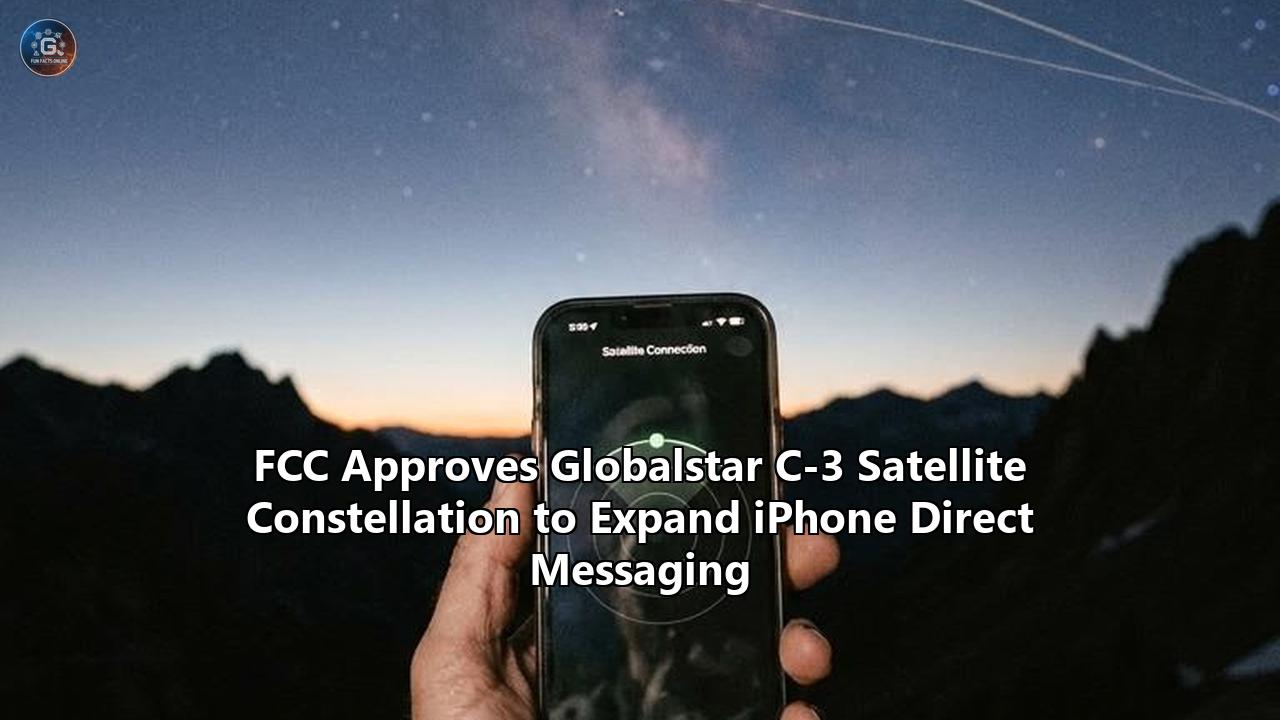
The Federal Communications Commission has granted nationwide operating authority to Globalstar for its third-generation C-3 Mobile Satellite Service system. The regulatory order clears the Covington, Louisiana-based satellite operator to communicate directly with hundreds of millions of mobile devices across the United States, cementing the orbital infrastructure that underpins Apple’s long-term iPhone satellite roadmap.
The decision, issued by the FCC's Space Bureau following an extensive review process, approves the deployment and domestic operations of a low Earth orbit fleet designed explicitly for direct-to-device (D2D) messaging, emergency signaling, and remote telecommunications. Beyond giving space-to-ground transmission rights over Globalstar’s licensed Mobile Satellite Service (MSS) spectrum, the authorization specifically licenses an expanded network of six-meter ground station antennas situated across key domestic gateways in Alaska, Hawaii, Nevada, Texas, Florida, and Puerto Rico.
"Receiving this FCC authorization is a critical step forward for continuing to enhance the capabilities of our low Earth orbit satellite constellations," said Dr. Paul E. Jacobs, Chief Executive Officer of Globalstar. Jacobs added that the regulatory green light will ensure the operator's ability "to deliver next-generation satellite services that combine increased capacity, improved performance, and greater flexibility to users for years to come."
The ruling arrives at a pivotal juncture in mobile communications. As smartphone makers and terrestrial mobile network operators race to eliminate dead zones through orbital links, the FCC’s action provides Apple and Globalstar with clear domestic regulatory certainty ahead of commercial constellation launches. Globalstar, which entered the public consciousness when Apple introduced Emergency SOS via satellite on the iPhone 14 lineup in late 2022, is now moving beyond emergency text dispatches toward sustained, passive off-grid messaging, higher-bandwidth satellite telemetry, and multi-device consumer connectivity.
================================================================================
                    GLOBALSTAR C-3 SYSTEM ARCHITECTURE
================================================================================

 [Space Segment]
  - 48 Operational LEO Satellites + 6 In-Orbit Spares (54 Total Spacecraft)
  - Orbital Altitude: 1,414 km (Initial insertion ~680 km)
  - Manufacturer: MDA Space (Payloads) / Rocket Lab (Platforms)
  - Primary Spectrum: Big LEO MSS (1.6 GHz Uplink / 2.4 GHz Downlink) & Band 53/n53
                            │
                            │ Radio Frequency Link (Direct-to-Device & Telemetry)
                            ▼
 [User Segment]                                [Ground Infrastructure]
  - Consumer Smartphones (iPhone, Pixel/Skylo)  - ~90 Six-Meter Tracking Dishes
  - Wearables & Emergency Handhelds             - Domestic Hubs: AK, HI, NV, TX, FL, PR
  - Embedded Automotive & IoT Terminals         - Dual Control: Covington & Toulouse
================================================================================
Constellation Blueprint: The Technical Anatomy of the C-3 System
The authorized C-3 architecture departs markedly from the legacy spacecraft Globalstar has operated for more than a decade. Notified to the International Telecommunication Union through French regulatory filings under the designation AST-NG-C-3, the system encompasses an operational constellation of 48 satellites positioned in low Earth orbit at an altitude of approximately 1,414 kilometers (879 miles), supported by six dedicated in-orbit spares.
Primary manufacturing of the space segment is contracted to Canada’s MDA Space, which serves as the prime contractor under a $1.1 billion procurement framework funded primarily through commercial advance commitments from Apple. MDA Space in turn subcontracted Rocket Lab USA to construct 17 composite spacecraft platforms under an initial $143 million procurement to jump-start constellation deployment, pairing Rocket Lab’s commercial satellite buses with MDA's digital beamforming and software-defined radio payloads.
Globalstar's regulatory filings outline a phased orbital insertion profile. Under its deployment plan filed with the FCC, Globalstar will begin launching initial batches of spacecraft to an intermediate altitude of roughly 680 kilometers. Once systems undergo health checks and payload commissioning in this staging orbit, onboard electric propulsion systems will steadily raise the spacecraft to their operational 1,414-kilometer orbital planes. Launches are slated to begin in 2027, carried aboard commercial medium-lift launch vehicles, primarily SpaceX Falcon 9 boosters.
Constellation Profile: Globalstar Third-Generation (C-3)
--------------------------------------------------------------------------------
Operational Orbit:            1,414 km circular LEO
Staging Orbit:                ~680 km insertion orbit
Active Spacecraft:            48 operational satellites
Spares:                       6 in-orbit flight spares (54 total authorized)
Orbital Planes:               8 planes with 6 operational spacecraft each
Prime Payload Contractor:     MDA Space (Canada)
Platform Subcontractor:       Rocket Lab USA
Ground Gateways:              ~90 six-meter steerable dishes worldwide
Control Infrastructure:       Covington, Louisiana, USA & Toulouse, France
RF Allocations:               L-band (Uplink), S-band (Downlink), Band 53/n53
--------------------------------------------------------------------------------
To support these spacecraft, Globalstar is executing an aggressive terrestrial infrastructure campaign. The company’s global ground network will incorporate roughly 90 six-meter tracking dish antennas across more than 20 countries. Within U.S. borders, the FCC order authorizes operations across crucial regional stations:
- Wasilla, Alaska: Provides high-latitude geometric look-angles covering sub-Arctic air and sea corridors.
- Kapolei, Hawaii: Secures Pacific maritime and mid-ocean air transit coverage.
- Beatty and High Rock, Nevada: Offers desert-basin terrestrial look-angles serving the Western intermountain region.
- Clifton, Texas: Anchors central continental routing and telemetry operations.
- Sebring, Florida: Covers the Southeastern seaboard and Gulf of Mexico shipping routes.
- Puerto Rico: Provides link margin coverage across the Caribbean basin.
Mission operations will execute out of redundant, carrier-grade control centers located at Globalstar’s corporate headquarters in Covington, Louisiana, and its international satellite operations center in Toulouse, France. Together, these hubs handle high-rate telemetry, tracking, and control (TT&C) duties while orchestrating packet handoffs between satellites crossing local orbital horizons every 10 to 15 minutes.
The Apple Alliance: Capital Allocation and Strategic Mechanics
The commercial engine driving the deployment of the Globalstar C-3 satellite network is Apple Inc., which has structured an asset-light aerospace deployment model. Rather than absorbing the operational burdens, regulatory liabilities, and orbital manufacturing overhead of running a space agency internally, Apple has deployed targeted capital infusions into Globalstar to secure dedicated, wholesale satellite capacity.
Under expanded commercial and capital agreements, Apple executed an infrastructure financing framework committing up to $1.5 billion. This arrangement combines $1.1 billion in direct upfront cash prepayments for network infrastructure with a $400 million purchase of a 20 percent equity stake in Globalstar’s operational satellite subsidiary. In exchange for underwriting the capital expenditure of the new constellation and ground stations, Apple retains wholesale access to 85 percent of the network's overall operational capacity.
================================================================================
                     CAPITAL & CAPACITY FLOW DIAGRAM
================================================================================

   ┌─────────────────────────────────────────────────────────────┐
   │                         APPLE INC.                          │
   └───────────────┬─────────────────────────────▲───────────────┘
                   │                             │
       $1.1 Billion Infrastructure Prepayments   │ 85% Constellation
       $400 Million (20% Equity Stake)           │ Capacity Reserved
                   │                             │
                   ▼                             │
   ┌─────────────────────────────────────────────┴───────────────┐
   │                      GLOBALSTAR, INC.                       │
   │  (Retains 15% Capacity for Commercial MSS, Band 53, IoT)    │
   └───────────────┬─────────────────────────────┬───────────────┘
                   │                             │
       $1.1 Billion Prime Contract    $143 Million Subcontract
                   │                             │
                   ▼                             ▼
   ┌───────────────────────────────┐ ┌───────────────────────────┐
   │           MDA SPACE           │ │      ROCKET LAB USA       │
   │    (Digital Transponders,     │ │    (Spacecraft Buses,     │
   │     Beamforming Payloads)     │ │   Attitude Control, Power)│
   └───────────────────────────────┘ └───────────────────────────┘
The capital injection solved an existential challenge for Globalstar: funding the multi-billion-dollar replacement cycle of its second-generation constellation, which was launched between 2010 and 2013 and has been approaching the end of its design life. By leveraging Apple's balance sheet, Globalstar retired high-yield debt while procuring advanced hardware without diluting common equity into penny-stock terrain.
For Apple, the relationship grants direct architectural influence over orbital hardware design. Apple engineers have collaborated closely with Globalstar’s space operations team to tailor antenna beam patterns, modulation schemes, and link-budget priorities directly to the radio frequency front-ends and baseband silicon integrated into iPhones and Apple Watches. The arrangement allows Apple to expand features from basic emergency messaging to seamless background texting, off-grid iMessage conversations, and location telemetry in the Find My network without needing to coordinate with terrestrial wireless carriers.
Who Is Affected: A Systematic Breakdown Across Sectors
The FCC’s approval triggers structural adjustments across consumer technology, public safety, enterprise operations, and mobile carrier ecosystems.
+-----------------------------------+-------------------------------------------------------------+
| Stakeholder Group                 | Primary Operational and Economic Impact                     |
+-----------------------------------+-------------------------------------------------------------+
| iPhone & Wearable Users           | Omnidirectional connectivity indoors, in-vehicle; background|
|                                   | off-grid iMessage, SMS, and emergency services.             |
+-----------------------------------+-------------------------------------------------------------+
| Android Hardware Ecosystem        | Parity via Skylo partnership; expands non-Apple access to  |
|                                   | Globalstar MSS spectrum across certified devices.           |
+-----------------------------------+-------------------------------------------------------------+
| Public Safety Answering Points    | High-reliability real-time medical, crash, and telemetry   |
| (PSAPs) & First Responders        | dispatches during catastrophic terrestrial infrastructure loss.|
+-----------------------------------+-------------------------------------------------------------+
| Terrestrial Mobile Carriers       | Sidelined on basic messaging; pressure to partner with SCS  |
| (AT&T, Verizon, T-Mobile)         | providers (Starlink, AST SpaceMobile) for broadband parity. |
+-----------------------------------+-------------------------------------------------------------+
Smartphone Consumers and Off-Grid Travelers
Until now, satellite connectivity on standard consumer handsets has required deliberate user cooperation. Users on the iPhone 14 through iPhone 16 running iOS 18 must hold the device upright, consult an on-screen graphical radar display, and keep the handset pointed at a passing satellite across an unobstructed horizon. A ridge of granite, a stand of pine trees, or placing the phone inside a vehicle can disrupt the radio link.
The higher effective isotropic radiated power (EIRP) and sensitive digital beamforming payloads aboard each Globalstar C-3 satellite alter this dynamic. The improved link budget allows devices to communicate with satellites without requiring rigid directional pointing. Transceivers will reliably push packets through vehicle windshields, light architectural materials, and canopy cover. This capability shifts satellite usage from a conscious, stressful survival activity into an ambient background service that operates automatically whenever terrestrial cellular networks are absent.
Public Safety Answering Points (PSAPs) and Search-and-Rescue Teams
Terrestrial cellular networks remain vulnerable to regional power grid collapses, severed fiber backhauls, and physical tower destruction during natural disasters. Hurricane Helene and Hurricane Milton demonstrated how quickly conventional wireless networks can fail, leaving entire counties in communications blackouts.
================================================================================
                   EMERGENCY DATA PATHWAY COMPARISON
================================================================================

 Legacy Cellular Route:
 [Handset] ──(Cellular Band)──► [Tower] ──(Fiber Backhaul)──► [Central Office] ──► [911 PSAP]
                                   ▲                ▲
                                   └─── Single Points of Failure (Storms, Fires, Blackouts)

 C-3 Satellite Direct Route:
 [Handset] ──(MSS L-Band)──► [C-3 Satellite] ──(MSS S-Band/Feeder)──► [Six-Meter Gateway]
                                                                              │
                                                                       (Dedicated IP)
                                                                              ▼
                                                                       [Emergency Relay]
                                                                              │
                                                                              ▼
                                                                         [911 PSAP]
================================================================================
The C-3 system provides a hardened, alternative route for distress dispatches. Because ground stations are equipped with redundant industrial power generation and dedicated high-speed fiber backbones, the data pipeline avoids local last-mile terrestrial failures. First responders gain continuous location telemetry, crash-detection telemetry, and medical ID packets from stranded citizens, bypassing severed regional telephone switches to connect straight into emergency call centers.
The Android Ecosystem and Skylo's Multi-Carrier Play
While Apple is Globalstar’s dominant commercial patron, it is not the sole beneficiary of the C-3 infrastructure. In late 2026, Globalstar and non-terrestrial network (NTN) service provider Skylo finalized a commercial operating agreement that was submitted to the FCC. Under this pact, Skylo will act as a network service provider over the C-3 constellation, utilizing Globalstar’s licensed Big LEO spectrum to support direct-to-device connectivity across non-Apple devices.
Skylo has already partnered with Google to deploy satellite SOS services on the Pixel 9 and subsequent Android handsets using 3GPP Release 17 NTN protocols. Skylo’s formal application to the FCC requested authorization to serve up to 250 million mobile devices with emergency, safety, and short-messaging data services. Globalstar formally endorsed Skylo’s petition.
The regulatory clearance of C-3 resolves a critical spectrum constraint for Skylo, giving the broader Android hardware community—including Samsung, Motorola, and Google—a stable path to match Apple's satellite capabilities over dedicated mobile satellite spectrum.
Terrestrial Mobile Network Operators
The commercial posture of mobile network operators (MNOs) like AT&T, Verizon, and T-Mobile is deeply complicated by the FCC order. Historically, wireless carriers acted as the undisputed gatekeepers of wide-area voice and data communications. By integrating satellite modems directly into phone hardware and negotiating wholesale satellite agreements at the original equipment manufacturer (OEM) level, Apple and Globalstar have bypassed carrier billing entirely.
================================================================================
                    DIRECT-TO-DEVICE ARCHITECTURAL MODELS
================================================================================

 Model A: OEM Direct MSS Integration (Globalstar / Apple)
 Handset Baseband ──► Dedicated MSS Frequencies ──► LEO Constellation ──► Gateway
 (Carrier agnostic; controlled by the device manufacturer; transparent to MNO)

 Model B: Supplemental Coverage from Space (Starlink / T-Mobile / AST SpaceMobile)
 Handset Baseband ──► Terrestrial Cellular Bands ──► LEO Constellation ──► Core EPC
 (Carrier dependent; utilizes leased mobile spectrum; anchored to subscriber SIM)
================================================================================
This arrangement limits carriers' ability to charge standalone fees for basic emergency and satellite SMS features. Carriers cannot easily monetize standard text messaging over satellite when Apple includes it directly within iOS. In response, terrestrial carriers have accelerated their own partnerships with Supplemental Coverage from Space (SCS) providers, such as T-Mobile's alliance with SpaceX’s Starlink and AT&T/Verizon’s deals with AST SpaceMobile, seeking to offer higher-bandwidth voice and data that Globalstar’s messaging-focused pipeline does not prioritize.
Technical Shift: What Changes Over Prior Generations
Understanding the significance of the C-3 constellation requires evaluating how direct-to-device radio physics differ from standard terrestrial wireless networks. Connecting a low-power, pocket-sized smartphone to a satellite orbiting hundreds of kilometers overhead requires overcoming severe signal attenuation and path loss.
       PATH LOSS COMPARISON: TERRESTRIAL VS. SPACE

 Terrestrial Cell Tower (Distance: ~3 km)
 [Phone] ════════════════════════════════════► [Tower]
  Free Space Path Loss at 2.4 GHz: ~110 dB

 LEO Orbit (Distance: 1,414 km)
 [Phone] ---------------------------------------------------------> [C-3 Satellite]
  Free Space Path Loss at 2.4 GHz: ~163 dB

 *Deficit to overcome: ~53 dB of additional signal attenuation*
To bridge this 53 dB path-loss deficit without burning through phone battery reserves or requiring unwieldy external helical antennas, the satellite itself must carry the burden of the link budget. The Globalstar C-3 satellite constellation achieves this through four technical improvements:
+---------------------------+---------------------------+---------------------------+
| Metric / Feature          | Second-Generation Fleet   | Third-Generation (C-3)    |
+---------------------------+---------------------------+---------------------------+
| Active Constellation Size | 24-25 Spacecraft          | 48 Spacecraft + 6 Spares  |
+---------------------------+---------------------------+---------------------------+
| In-View Satellite Passes  | Often 1 (intermittent)    | Multiple simultaneous     |
+---------------------------+---------------------------+---------------------------+
| Antenna Architecture      | Passive planar arrays     | Dynamic active phased     |
|                           |                           | array digital beamforming |
+---------------------------+---------------------------+---------------------------+
| Link Margin Threshold     | Requires direct sky view  | 6 to 10 dB higher link    |
|                           |                           | margin; penetrates glass  |
+---------------------------+---------------------------+---------------------------+
| Spatial Diversity         | Single-path reception     | Multi-satellite diversity |
|                           |                           | and seamless handover     |
+---------------------------+---------------------------+---------------------------+
Digital Beamforming and Phased Array Payloads
The second-generation Globalstar satellites relied on broad, relatively static antenna beam footprints. When a user initiated an SOS message, the satellite had to process the signal over a sprawling geographic cell, diluting signal power and exposing the link to noise.
The MDA Space payloads on C-3 incorporate advanced digital beamforming networks. By dynamically adjusting the phase and amplitude of radio signals across multi-element phased arrays, each satellite can generate dozens of narrow, high-gain spot beams. These spot beams can be focused on specific geographic regions experiencing high demand—such as national parks or disaster zones—concentrating RF energy directly toward ground devices.
Link Margins and Non-Line-of-Sight Reception
The primary practical constraint of the original Emergency SOS service was signal attenuation caused by physical obstructions. Standard foliage can introduce 3 to 8 dB of signal loss; a vehicle roof can introduce 5 to 12 dB; and architectural glass or building structures routinely absorb 10 to 20 dB of RF energy.
By running substantially higher downlink transmission power and deploying more sensitive digital receivers in orbit, the C-3 system improves the overall link margin. While it cannot penetrate deep subterranean structures or high-rise urban concrete cores, this added margin allows the system to establish links through automobile windshields, heavy forestry, and thin residential roof structures, eliminating the need to search for an unobstructed horizon.
Doubling Constellation Density
By deploying 48 operational satellites instead of 24, Globalstar cuts average orbital spacing in half. For a user on the ground, this means that instead of waiting for a single satellite to crest the horizon, handsets will routinely have two or three satellites simultaneously visible above a 15-degree elevation angle.
This orbital redundancy enables spatial diversity: if a user is standing next to a cliff face that blocks the southern sky, an alternate satellite passing overhead to the northwest can maintain the connection. Furthermore, overlapping coverage simplifies beam-to-beam handover, preventing dropped data packets during multi-sentence text message exchanges.
Spectrum Architecture: Dedicated Big LEO Bands vs. Terrestrial Overlays
Globalstar operates within globally coordinated Mobile Satellite Service spectrum:
- Uplink (Device to Space): L-band allocation spanning 1610 to 1626.5 MHz.
- Downlink (Space to Device): S-band allocation spanning 2483.5 to 2500 MHz (often leveraged in conjunction with Globalstar's terrestrial Band 53 and n53 spectrum).
Because these frequencies are allocated internationally specifically for space-to-ground mobile communications, they carry dedicated regulatory protection against terrestrial cross-talk. This eliminates the severe out-of-band emissions limits and co-channel interference disputes that complicate systems attempting to reuse terrestrial cellular spectrum from orbit.
The Orbital Arena: Direct-to-Device Competitive Landscape
The direct-to-device telecommunications space has become one of the most fiercely contested sectors in commercial aerospace. Globalstar’s approval with C-3 highlights two fundamentally divergent regulatory, operational, and architectural philosophies.
================================================================================
              DIRECT-TO-DEVICE ARCHITECTURAL APPROACHES
================================================================================

 Dedicated Mobile Satellite Service (MSS)
 ├── Operators: Globalstar (Apple), Skylo, Omnispace
 ├── Spectrum: Dedicated L-Band / S-Band allocations
 ├── Handset Integration: Dedicated baseband code & RF paths (OEM driven)
 └── Advantages: Global frequency harmonization; no interference with cell towers

 Supplemental Coverage from Space (SCS)
 ├── Operators: Starlink Direct to Cell (T-Mobile), AST SpaceMobile (AT&T/Verizon)
 ├── Spectrum: Terrestrial cellular spectrum (Mid-band PCS, AWS, 700/800 MHz)
 ├── Handset Integration: Zero modifications; uses standard LTE/5G terrestrial radios
 └── Advantages: Immediate software compatibility; higher theoretical bandwidth
 └── Challenges: Complex regulatory hurdles; strict out-of-band emission limits
================================================================================
Globalstar and Apple vs. AST SpaceMobile
AST SpaceMobile has pursued a radically different design: deploying colossal satellites with phased-array antenna apertures spanning up to 64 square meters (and planned arrays expanding to over 220 square meters on future BlueBird satellites). AST’s objective is to act as a "cell tower in space," radiating terrestrial cellular spectrum directly to unmodified LTE and 5G smartphones.
While AST SpaceMobile aims to offer broadband data speeds capable of supporting direct video calling and voice streaming, its architecture introduces complex operational challenges:
- Orbital Drag and Debris Risks: Spacecraft carrying hundreds of square meters of flat planar arrays experience high aerodynamic drag in low Earth orbit, requiring frequent station-keeping maneuvers.
- Launch Volume Constraints: Falcon 9 fairings can accommodate only a limited number of folded AST arrays per launch, raising deployment costs.
- Regulatory Complexity: AST must secure spectrum-leasing approvals, national authorizations, and interference coordination agreements with neighboring carriers in every country it touches.
In contrast, each Globalstar C-3 satellite uses a compact, 500-kilogram bus designed for dense stacking inside launch fairings, allowing 8 to 12 satellites to deploy per launch run. By operating on dedicated MSS frequencies, Globalstar avoids the local regulatory friction tied to leasing terrestrial mobile spectrum.
+-------------------------+-------------------------+-------------------------+
| Architecture Feature    | Globalstar C-3          | AST SpaceMobile         |
+-------------------------+-------------------------+-------------------------+
| Spacecraft Wet Mass     | ~500 kg                 | ~1,500 - 3,000 kg       |
+-------------------------+-------------------------+-------------------------+
| Antenna Deployment Form | Compact digital arrays  | Massive unfolding array |
| Factor                  | integrated on rigid bus | (64 to 220+ sq meters)  |
+-------------------------+-------------------------+-------------------------+
| Target Throughput       | Low-bitrate messaging,  | Multi-megabit broadband,|
| Profile                 | telemetry, voice/data   | cellular data, voice    |
+-------------------------+-------------------------+-------------------------+
| Spectrum Framework      | Licensed Big LEO MSS    | Leased Terrestrial      |
|                         | (L/S bands)             | Cellular (SCS framework)|
+-------------------------+-------------------------+-------------------------+
| Target Ecosystem        | Apple iOS, Skylo-linked | Carrier subscribers     |
|                         | Android OEM devices     | (AT&T, Verizon, MNOs)   |
+-------------------------+-------------------------+-------------------------+
Starlink Direct to Cell and T-Mobile
SpaceX has entered direct-to-device communications by launching Starlink V2 Mini satellites outfitted with direct-to-cell eNodeB payloads. Partnering with T-Mobile in the United States, alongside international carriers like Optus (Australia), Rogers (Canada), and Salt (Switzerland), SpaceX aims to provide text, voice, and data coverage using carriers' terrestrial mid-band spectrum (primarily 1.9 GHz PCS).
SpaceX brings unmatched vertical integration, launching its own satellites on its own rockets. However, Starlink Direct to Cell has faced intense pushback before the FCC from competing operators, including EchoStar (Dish Network), AT&T, and Globalstar itself. Competitors have argued that Starlink’s direct-to-cell transmissions risk exceeding aggregate out-of-band emission limits, potentially causing harmful interference to adjacent terrestrial cellular operations and radio astronomy.
While SpaceX has had to navigate experimental testing permits and negotiate waiver thresholds under the FCC’s newly adopted Supplemental Coverage from Space regulatory framework, Globalstar’s C-3 petition proceeded under established, mature Mobile Satellite Service licensing rules. Globalstar secured full nationwide operating clearance while SCS operators continue navigating multi-carrier disputes.
Short-Term Consequences: 12 to 24 Months
The immediate impact of the FCC authorization unfolds across three main areas: capital construction, hardware testing, and ecosystem positioning.
================================================================================
                      12 TO 24 MONTH EXECUTION ROADMAP
================================================================================

 [H1 2027]  Ground Station Expansion
            ├── Civil works & installation of ~90 six-meter tracking dishes
            └── Integration into Covington & Toulouse TT&C networks

 [H2 2027]  Initial Orbital Launches
            ├── First wave of C-3 spacecraft aboard SpaceX Falcon 9
            ├── Insertion into 680 km staging orbit
            └── Electric propulsion orbit raising to 1,414 km

 [Ongoing]  Software & Baseband Preparation
            ├── Firmware rollouts via iOS updates (laying C-3 handoff code)
            └── Skylo enterprise & Android device qualification
================================================================================
Accelerated Ground Infrastructure Buildout
With formal domestic operating authority secured, Globalstar is expediting civil works and antenna commissioning at its gateway facilities. Deploying roughly 90 six-meter tracking antennas worldwide requires complex multi-axis motor assemblies, cryo-cooled or low-noise amplifier front ends, and high-capacity backhaul interconnections to handle hundreds of gigabits of aggregated user data. Facilities in Alaska, Hawaii, Nevada, Texas, Florida, and Puerto Rico will install these dishes to support telemetry tracking and mission control well before the first production C-3 satellites separate from launch adapters.
Flight Hardware Production and Orbital Commissioning
At MDA Space’s manufacturing cleanrooms in Montreal and Rocket Lab’s production facilities, structural qualification of the C-3 flight articles will transition into full production. Flight integration must adhere to strict schedule baselines to support the planned launch manifests starting in 2027.
Once launched aboard commercial boosters, mission operations teams in Covington and Toulouse will oversee early operations and orbit-raising maneuvers. Spacecraft will maneuver from their initial 680-kilometer insertion orbits up to 1,414 kilometers, circularizing their flight paths and deploying their phased array panels. Handset baseband software inside iOS will quietly receive low-level modem firmware updates preparing the devices to acquire the new C-3 beacon patterns as the spacecraft enter service.
       ORBITAL COMMISSIONING PROFILE

 Altitude
   ▲
   │                              Operational Constellation (1,414 km)
   │                       ┌──────────────────────────────────────────
   │                      ╱  - Payloads fully active
   │                     ╱   - Dynamic digital beamforming online
   │                    ╱    - In-orbit spares parked in plane
   │                   ╱
   │                  ╱  Electric Propulsion Raising Phase
   │                 ╱   - Solar array deployment
   │                ╱    - Platform health checks & subsystem testing
   │               ╱
   │  Launch Insertion (~680 km)
   │  ────────────┘
   └────────────────────────────────────────────────────────────────► Time
Skylo Network Scaling
The FCC order provides regulatory stability that allows Skylo to finalize device certification programs with non-Apple OEMs. Semiconductor designers including Qualcomm and MediaTek have already integrated 3GPP NTN profiles into their commercial mobile modem platforms. With Globalstar and Skylo aligning their spectrum and network layers, Android device manufacturers can begin offering satellite emergency messaging and off-grid tracking as standard features, eliminating what has been a distinct software and safety advantage for Apple’s iPhone ecosystem.
Long-Term Consequences: 3 to 7 Years
Looking further ahead, the operational life of the C-3 fleet—expected to span through the late 2030s—will drive structural transformations across consumer hardware, carrier economics, and satellite communications.
================================================================================
                    LONG-TERM TRANSFORMATION MATRIX
================================================================================

 ┌─────────────────────────┐     ┌─────────────────────────┐
 │   COMMUNICATIONS CORE   │     │   CONSUMER HARDWARE     │
 ├─────────────────────────┤     ├─────────────────────────┤
 │ Total elimination of    │     │ Ubiquitous off-grid     │
 │ off-grid coverage voids │────►│ connectivity becomes a   │
 │ across North America    │     │ standard baseline spec  │
 └─────────────────────────┘     └─────────────────────────┘
              │                               │
              ▼                               ▼
 ┌─────────────────────────┐     ┌─────────────────────────┐
 │   COMMERCIAL PRESSURE   │     │   LEGACY MARKET SHIFT   │
 ├─────────────────────────┤     ├─────────────────────────┤
 │ Disruption of dedicated │     │ Carrier monetization    │
 │ handheld satphone units │────►│ margins compressed for  │
 │ (Garmin, Iridium)       │     │ low-bandwidth messaging │
 └─────────────────────────┘     └─────────────────────────┘
================================================================================
Normalization of Ubiquitous Handset Connectivity
Within five years, the concept of a total mobile "dead zone" will largely disappear from consumer expectations in North America and other supported regions. Just as Wi-Fi and Bluetooth evolved from premium add-ons into expected baseline technologies, direct-to-device orbital connectivity will become standard across all consumer handsets.
With the Globalstar C-3 satellite infrastructure delivering sufficient link margins to communicate through everyday obstacles like vehicle roofs and light structural walls, consumers will remain connected to basic messaging networks regardless of their distance from cellular towers. Apple and other device makers will likely expand background sync services, enabling short-burst location telemetry, health check-ins, automated road-hazard warnings, and intermittent micro-data transfers for mapping services completely outside cellular coverage.
Disruption of Dedicated Handheld Satellite Hardware
For decades, outdoor recreationists, maritime operators, field biologists, and remote workers relied on dedicated satellite communicators from brands like Garmin (inReach), SPOT (a Globalstar subsidiary), and standalone Iridium handheld transceivers. These devices required dedicated subscriptions often ranging from $12 to $60 per month, alongside specialized hardware costing between $300 and $1,500.
As standard smartphones gain high-reliability satellite messaging supported by the C-3 constellation, consumer demand for basic standalone satellite messengers will drop sharply. While extreme high-latitude polar expeditions and military teams will continue relying on ruggedized, dedicated devices, the broad commercial outdoor market will rely on their primary smartphones, consolidating the consumer satellite tracking market into the phone ecosystem.
Market Transition: Handheld Remote Communicators
--------------------------------------------------------------------------------
1990s - 2010s:   Heavy, dedicated satellite phones (Iridium, Inmarsat, Globalstar)
2015 - 2023:     Miniature personal satellite trackers (Garmin inReach, SPOT)
2024 - 2026:     Hybrid era: Early smartphone SOS (requires manual pointing)
2027 & Beyond:   Embedded omnidirectional background satellite links via C-3
--------------------------------------------------------------------------------
The Monetization Puzzle: Subscriptions vs. Ecosystem Lock-In
When Apple unveiled Emergency SOS via satellite in 2022, it announced the service would be free for two years, later extending that complimentary period repeatedly. The massive capital commitments Apple has poured into Globalstar—totaling more than $1.5 billion—raise questions about how these space services will be monetized over the long run.
================================================================================
                    FUTURE MONETIZATION STRATEGIES
================================================================================

 Option 1: Hardware Differentiation Loss-Leader
 ├── Keep satellite features free for current-generation devices
 └── Drive high-margin device upgrade cycles and brand retention

 Option 2: Apple One Services Integration
 ├── Maintain Emergency SOS as an open, free safety utility
 └── Bundle unlimited non-emergency satellite iMessage and off-grid Find My
     into Apple One Premier or iCloud+ storage subscriptions

 Option 3: Wholesale Roaming Partnerships
 ├── Partner directly with terrestrial carriers (AT&T, Verizon, T-Mobile)
 └── Offload carrier off-grid roaming onto C-3 for a negotiated per-packet fee
================================================================================
Apple has consistently demonstrated a willingness to absorb substantial infrastructure operating costs if they drive hardware sales and reinforce ecosystem retention. By providing reliable off-grid text and emergency messaging directly within iOS, Apple creates a compelling retention hook. Even if Apple eventually introduces charges for high-volume consumer satellite data, Emergency SOS will almost certainly remain permanently free to avoid the public-relations backlash of charging users in life-or-death crises.
Critical Milestones and Unresolved Questions
While the FCC’s nationwide operating order removes Globalstar's primary domestic regulatory hurdle, several technical, operational, and financial milestones will determine how smoothly the C-3 network rolls out.
================================================================================
                       CRITICAL MILESTONES TO WATCH
================================================================================

 2027 Launch Campaign:
 [ ] First batch of C-3 satellites launches to 680 km staging orbit
 [ ] In-orbit systems checkout and deployable antenna array verification
 [ ] Electric propulsion orbit-raising maneuvers to 1,414 km operating slot

 Ground & Spectrum Execution:
 [ ] Completion and RF calibration of ~90 six-meter ground tracking stations
 [ ] International landing rights approvals from non-U.S. telecommunications bodies
 [ ] Integration of Skylo NTN core with Android ecosystem partners

 Commercial Rollout:
 [ ] iOS release unlocking continuous background satellite messaging
 [ ] Publication of Apple's long-term commercial pricing model for off-grid data
================================================================================
Launch Schedules and Deployment Execution
The aerospace sector frequently faces launch vehicle bottlenecks and component delays. The C-3 constellation depends on steady production runs from MDA Space and Rocket Lab, as well as timely launch pad access. Any supply chain disruptions affecting digital signal processor chips, structural composites, or rocket availability could shift constellation operational dates deeper into the late 2020s.
Observing how smoothly the initial batch of satellites transitions from its staging orbit at 680 kilometers to the operational 1,414-kilometer plane will provide the first real test of the spacecraft's electric propulsion systems and autonomous station-keeping capabilities.
International Landing Rights and Geopolitical Coordination
The FCC’s authorization covers the United States and its territories, but low Earth orbit satellites circle the globe continuously. To operate as a truly global network, Globalstar must secure landing rights and spectrum clearances from equivalent regulatory bodies worldwide, including the European Conference of Postal and Telecommunications Administrations (CEPT), the UK’s Ofcom, and regulators throughout Latin America and Asia-Pacific.
While the ITU filing submitted by France under AST-NG-C-3 establishes primary global frequency coordination, individual nation-states retain sovereign authority over transmissions within their borders. Navigating these varied regulatory frameworks will dictate how quickly Apple and Skylo can market frictionless off-grid messaging to international travelers.
The Throughput Ceiling
The C-3 system is purpose-built to deliver reliable, robust, low-bitrate direct-to-device connectivity. It is engineered to transmit text messages, coordinate safety operations, broadcast sensor telemetry, and handle compressed emergency voice packets. It is not designed to stream high-definition video or support general high-speed web browsing.
As competing networks like AST SpaceMobile and Starlink Direct to Cell continue working to deploy cellular broadband directly to standard phones, the industry will see whether consumer demand prioritizes lightweight, high-reliability messaging with low battery impact (the Globalstar/Apple model) or higher-bandwidth, battery-intensive mobile broadband (the AST/Starlink model).
By securing clear regulatory approval for its C-3 constellation, Globalstar has positioned its space architecture to anchor consumer smartphone direct-to-device connectivity for the decade ahead. The focus now turns from regulatory hearings in Washington to cleanrooms, launch sites, and the challenging orbital physics of low Earth orbit.
Reference:
- https://www.reddit.com/r/SpaceInvestorsDaily/comments/1xa5zk0/fcc_authorizes_globalstars_thirdgeneration_c3/
- https://www.streetinsider.com/Corporate+News/FCC+authorizes+Globalstars+C-3+satellite+system+for+U.S.+operations/27201801.html
- https://www.stocktitan.net/news/GSAT/fcc-authorizes-globalstar-s-third-generation-c-3-system-for-lmxx5hhwtoal.html
- https://www.tokenpost.com/news/regulation/35028
- https://www.pcmag.com/news/globalstar-to-start-launching-c-3-satellites-for-iphones-next-year
- https://www.pcmag.com/news/iphone-satellite-provider-globalstar-gets-fcc-approval-for-c-3-constellation
- https://evertiq.com/design/56708
- https://satnews.com/2026/08/18/rocket-lab-delivers-initial-mda-space-satellites-to-support-globalstar-replenishment-fleet/
- https://www.kratosspace.com/constellations/articles/globalstar-outlines-its-planned-48-satellite-constellation-part-of-a-1-billion-investment
- https://dig.watch/updates/globalstar-to-strengthen-iphone-satellite-connectivity-with-apple-investment
- https://www.reddit.com/r/apple/comments/1gh5704/apple_expands_iphone_satellite_services_deal/
- https://www.apple.com/newsroom/2022/11/emergency-sos-via-satellite-made-possible-by-450m-apple-investment/
- https://investors.globalstar.com/news-releases/news-release-details/globalstar-enter-next-era-mobile-satellite-connectivity-expanded
- https://www.pcmag.com/news/iphone-satellite-provider-confirms-deal-with-android-focused-skylo
- https://www.cnet.com/tech/mobile/apple-will-invest-1-5-billion-in-globalstar-to-expand-satellite-services/
- https://ca.investing.com/news/stock-market-news/globalstar-receives-fcc-approval-for-c3-satellite-system-93CH-4888570
- https://raoglobal.org/insights/apples-15-billion-investment-in-globalstar