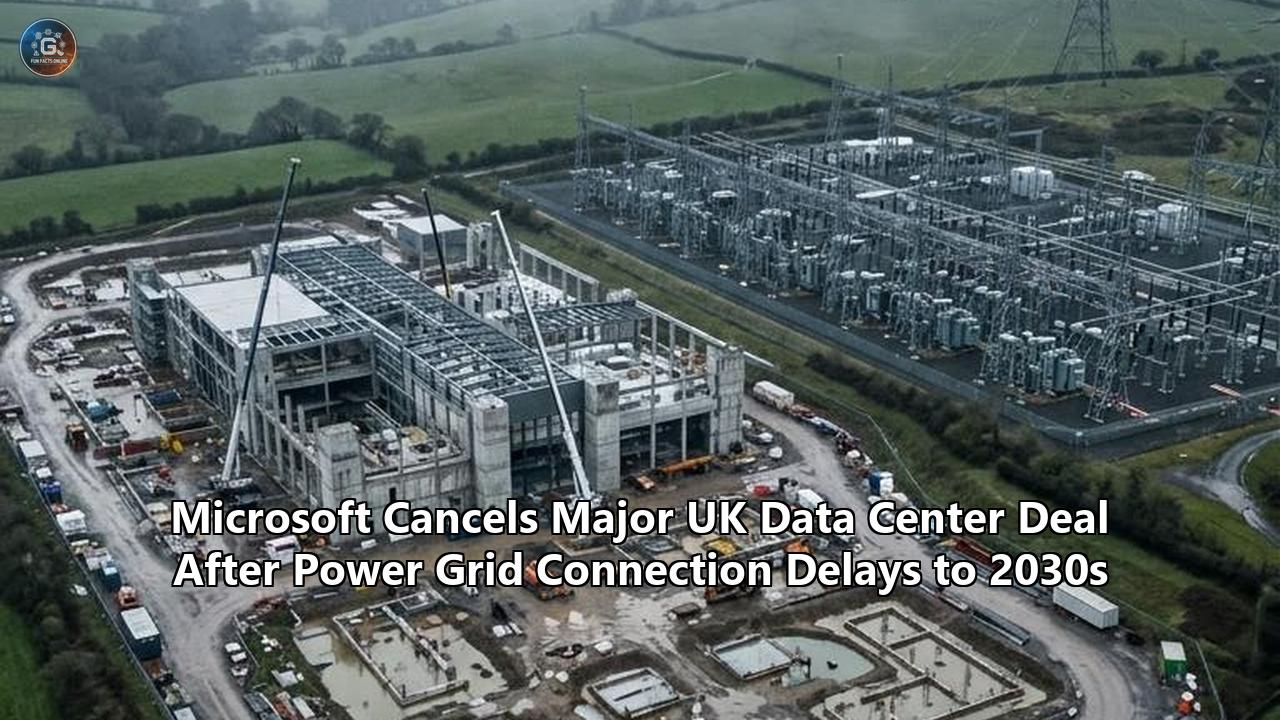
Microsoft has officially pulled out of its agreement to anchor what was slated to become Britain’s largest artificial intelligence supercomputing data center, dealing a severe blow to the United Kingdom’s technology ambitions and underscoring the severe electrical capacity shortages stalling advanced computing projects worldwide.
The site, situated in Loughton, Essex, was being developed by British specialized cloud provider Nscale. Under the bilateral partnership announced in September 2025, Microsoft had agreed to lease the entirety of the campus’s initial 50-megawatt computing capacity, which was engineered to house 23,040 liquid-cooled Nvidia GB300 accelerators dedicated to Microsoft’s Azure cloud services. The facility was scheduled to receive its first batch of silicon and begin commercial operations in early 2027.
That timeline disintegrated when regional distribution network operator UK Power Networks (UKPN) and transmission authorities informed the developers that the local electricity grid could not supply the necessary 50 to 90 megawatts of energized capacity until the early-to-mid 2030s—with firm connection dates drifting as far out as 2034. Confronted with an eight-to-ten-year wait merely to plug its servers into the high-voltage grid, Microsoft executed an exit clause to terminate the contract.
"This decision relates to a single site," a Microsoft spokesperson confirmed, maintaining that the Redmond-based software and cloud company continues to collaborate with Nscale across alternative developments in Norway, Portugal, and the United States.
For its part, Nscale affirmed that its underlying relationship with Microsoft remains intact. "Our relationship with Microsoft remains strong and long-term, and this unfortunate London-wide grid issue has no impact on our other contracts," an Nscale spokesperson said. "We remain committed to both the Loughton project and the UK, and we are exploring alternative power sources for the site, as well as other expansion sites in the UK."
Despite the diplomatic public statements, the collapse of the Loughton deal exposes a deepening structural chasm between digital ambitions and physical infrastructure. While hyperscalers plan capital deployments in three-month sprints, national power grids operate on decadal upgrade cycles. The Essex cancellation is not an isolated planning misfire; it is a symptom of a systemic grid lockup across advanced economies. Understanding how the UK reached this impasse—and how regulators, utilities, and hyperscalers are attempting to dismantle the bottleneck—reveals the scale of the challenge confronting the next wave of compute infrastructure.
The Core Challenge: Silicon Velocity Meets Transmission Inertia
The primary catalyst behind the collapse of the Loughton project is an irreconcilable temporal mismatch between modern semiconductor lifecycles and utility-scale grid construction.
Modern AI computing accelerators experience an aggressive rate of economic and architectural obsolescence. A cluster based on Nvidia's Blackwell architecture, such as the GB300 systems earmarked for Essex, possesses an optimal operational lifespan of three to five years before newer microarchitectures deliver four-to-eight-fold gains in floating-point operations per watt. To justify capital expenditures that now surpass $35 billion per quarter for companies like Microsoft, hyperscalers must procure land, construct the shell, install high-density liquid cooling, secure power, and energize the compute clusters within an eighteen-to-twenty-four-month window.
When electricity network operators issue connection dates stretching into the 2030s, the fundamental financial logic of the lease evaporates. By 2033, an Nvidia GB300 GPU will be four semiconductor generations removed from current production, rendering the infrastructure economically unviable before its transformers are even energized. Hyperscalers cannot amortize contemporary silicon across an eight-year holding pattern while servers sit idle in unpowered halls.
AI Hardware Generation vs. Grid Connection Timeline
┌──────────────────────────────────────────────────────────────┐
│ GPU Usable Lifecycle (3-5 Years)                              │
│ [ GB300 Deployed ] ──► [ Peak Value ] ──► [ Depreciated ]    │
└──────────────────────────────────────────────────────────────┘
 vs.
┌──────────────────────────────────────────────────────────────┐
│ UK Grid Queue Interconnection Timeline (7-10+ Years)         │
│ [ Application ] ──► [ Queue Hold ] ──► [ Line Upgrades ] ──► [ First Power: 2034 ]
└──────────────────────────────────────────────────────────────┘
This structural timing mismatch is driving Microsoft data center delays across several key European and North American tier-one markets, forcing cloud operators to re-evaluate where and how they procure capacity. For enterprise cloud providers, waiting for utility transmission reinforcement is no longer a viable schedule risk; it represents capital stranding.
The issue is amplified by the financial dynamics of the AI buildout. In the June quarter of 2026, Microsoft reported cash capital expenditures of $35.8 billion, representing an 80% year-over-year surge driven almost entirely by cloud and AI infrastructure demands. Chief Financial Officer Amy Hood has reiterated to analysts that customer demand for compute consistently outstrips available capacity. Microsoft possess the cash reserves, the client base, and the silicon allocations; the single binding constraint on its global revenue growth has become access to high-voltage alternating current.
When a regional network operator informs a tenant that power delivery must slide by seven years, the anchor tenant has no mathematical alternative but to reallocate capital to regions with immediate energization pathways. The Essex facility was originally structured to serve as the computing backbone for Microsoft’s sovereign UK public sector workloads and enterprise Azure customers. Its abandonment sends those workloads elsewhere.
What Went Wrong: The 73-Gigawatt Speculative Phantom Queue
The immediate reason UK Power Networks could not offer Nscale a near-term connection date in Essex stems from an administrative and physical crisis engulfing Great Britain’s electrical grid: the saturation of the transmission and distribution queues with speculative capacity requests.
Data published by Great Britain’s energy regulator, the Office of Gas and Electricity Markets (Ofgem), reveals that the volume of contracted demand in the nation's connection queue escalated from 41 gigawatts in November 2024 to an unprecedented 125 gigawatts by mid-2025. Of this queue, 315 proposed data center projects account for approximately 73 gigawatts of requested electricity capacity.
To put this figure into technical context:
- The entire peak winter electricity demand for the whole of Great Britain—spanning every home, factory, hospital, train line, and commercial business combined—hovers at approximately 45 gigawatts.
- Data center developers have requested connection agreements equal to 162% of Great Britain's total national peak power demand.
- Meeting that 73 GW pipeline would imply an aggregate data center capital expenditure of approximately £693 billion ($937 billion)—a sum that exceeds the combined global infrastructure spending of Microsoft, Alphabet, Amazon, and Meta combined.
Great Britain Grid Context: Peak Demand vs. Connection Requests
┌──────────────────────────────────────────────────────────────┐
│ Peak National Electricity Demand: 45 GW                      │
│ ████████████████████                                         │
├──────────────────────────────────────────────────────────────┤
│ Data Center Queue Capacity Requests: 73 GW                   │
│ ████████████████████████████████                               │
├──────────────────────────────────────────────────────────────┤
│ Total Connections Queue (All Sectors): 125 GW                 │
│ ████████████████████████████████████████████████████         │
└──────────────────────────────────────────────────────────────┘
The underlying driver of this queue inflation is an outdated regulatory structure. Historically, under the regulations overseen by Ofgem and operated by National Grid ESO—now reorganized as the National Energy System Operator (NESO)—connections were allocated on a rigid "first come, first served" basis.
Under this legacy framework, it cost developers virtually nothing to file an initial connection application and hold a place in the transmission queue. Securing a paper connection offer required minimal proof of financial liquidity, zero engineering site control, and no verified planning permission from local authorities.
This regulatory loophole spawned a class of speculative land developers and intermediaries who hoarded grid reservations across the Greater London area and the Home Counties. Because land with an associated grid offer commands a premium valuation on secondary markets compared to unpowered agricultural or commercial land, speculators applied for dozens of high-voltage connections across Essex, Hertfordshire, Buckinghamshire, and Berkshire without the intention or capital to build an operating data center.
The result was the creation of a massive "phantom queue" of zombie projects. When a legitimate operator like Nscale submitted an application to expand capacity to 90 megawatts at its Loughton facility, utility engineers were legally required to model the network under the theoretical assumption that every speculative megawatt ahead of Nscale in the queue would eventually be built and energized.
On paper, the local substations and 132kV/400kV transmission lines appeared severely overloaded, triggering massive, multi-year infrastructure reinforcement requirements before Nscale could be accommodated. In reality, the upstream capacity was held by paper entities that would never pour concrete. The administrative structure blocked real capital from accessing existing capacity.
Regional Gridlock: The Southeast England Bottleneck
The geography of the Loughton cancellation highlights the severe concentration of network constraints in Southeast England. For three decades, the European data center market has clustered around the "FLAP-D" markets: Frankfurt, London, Amsterdam, Paris, and Dublin. London remains Europe’s largest digital interchange, hosting dense fiber paths, major financial exchanges, and undersea cable connections landing along the English coast.
Within the UK, data center capacity has historically concentrated around the M4 corridor in Slough and West London. Yet West London’s electricity grid has been running at or near capacity since 2022. In July 2022, the Greater London Authority issued planning alerts warning developers that the distribution substations operated by Scottish and Southern Electricity Networks (SSEN) and UK Power Networks across the London boroughs of Hillingdon, Ealing, and Hounslow had exhausted their capacity reserves. In those boroughs, grid operators warned that new housing developments of ten units or more might face construction pauses lasting up to a decade because high-voltage substations were saturated by existing data center baseloads.
The West-to-East London Data Center Spillover
┌──────────────────────────┐         ┌──────────────────────────┐
│  West London (M4/Slough) │ ──────► │ East London & Essex      │
│  • Substation saturation │         │ • Scaffolding/ind. yards │
│  • Housing development   │         │ • High fiber proximity   │
│    caps enforced (2022)  │         │ • Rapid queue exhaustion │
│  • Grid: Full            │         │ • Grid: Saturated (2026) │
└──────────────────────────┘         └──────────────────────────┘
Blocked from West London, developers turned eastward around the M25 orbital motorway, targeting commercial plots, logistics yards, and brownfield sites across East London and Essex. Loughton was chosen precisely for this geographic shift: close enough to central London to deliver sub-millisecond round-trip latency to the City's financial sector, yet situated outside the saturated West London substation zones.
However, the regional 132kV and 33kV distribution networks managed by UK Power Networks across Essex were never engineered to support multi-hundred-megawatt industrial loads. Unlike traditional heavy manufacturing facilities, which gradually ramp power consumption over a decade and cycle their load across working shifts, an AI compute cluster acts as an immediate, flat, non-variable power sink.
A 50-megawatt IT load operates at near-100% capacity factor around the clock. When ancillary systems—such as industrial chillers, variable-speed pumps, and computer room air handler (CRAH) units—are accounted for, a 50 MW compute facility with a Power Usage Effectiveness (PUE) rating of 1.25 demands a continuous grid draw of 62.5 megawatts. Expanding that facility to 90 MW requires roughly 112.5 megawatts of peak firm power.
That single installation consumes the equivalent power of more than 110,000 average British households. Connecting a load of that magnitude requires direct tie-ins to 400kV/132kV bulk supply points and dedicated grid transformers.
Because the transmission corridors bringing offshore wind energy down from the North Sea across East Anglia were already operating at transmission thermal limits, UK Power Networks could not accommodate Nscale’s demand without comprehensive transmission reconductoring and substation reconstruction. The estimated completion date for those network reinforcements landed squarely in the early-to-mid 2030s.
Supply Chain Paralysis: The Global Transformer Squeeze
Grid operators cannot accelerate these reinforcement timelines simply by allocating more capital. Even when utilities identify necessary grid reinforcements, they encounter an international supply chain backlog for electrical transmission hardware.
The primary physical bottleneck is the manufacturing lead time for high-voltage (HV) and extra-high-voltage (EHV) autotransformers and gas-insulated switchgear (GIS). Before 2021, the procurement lead time for a custom 400kV substation transformer from major global suppliers—such as Hitachi Energy, GE Vernova, and Siemens Energy—ranged between 18 and 24 months. By late 2026, those procurement lead times stretched to between 48 and 64 months.
HV/EHV Transformer Lead Times (Hitachi Energy, GE Vernova, Siemens)
Pre-2021: [ 18 to 24 Months ]
2026:     [ 48 to 64 Months ] (Up to 5+ Years)
Several compounding industrial factors drive this four-to-five-year lead time:
- Shortages of Grain-Oriented Electrical Steel (GOES): High-efficiency transformer cores rely on specialized, cold-rolled grain-oriented electrical steel to minimize core losses and eddy currents. Global manufacturing of top-grade GOES is concentrated among a small group of specialized mills in Japan, South Korea, Germany, and the United States. Demand for GOES from the concurrent expansion of renewable generation, electric vehicle charging networks, and industrial electrification has exhausted supply.
- Limited Factory Winding Capacity: Winding large transformer coils remains an exacting, semi-manual manufacturing process requiring specialized technicians and cleanroom-grade assembly conditions. Expanding manufacturing capacity requires years of capital investment and workforce training.
- Competing Clean Energy Demands: Utilities are replacing aging mid-century transmission gear while simultaneously connecting gigawatts of offshore wind, utility-scale solar, and high-voltage direct current (HVDC) interconnectors. The data center sector must compete for transformer production slots against federally mandated renewable power projects worldwide.
When UK Power Networks and NESO evaluated the transmission upgrades required to deliver 90 MW into Loughton, they were constrained by these manufacturing realities. Even if emergency regulatory approval were granted, procuring the step-down transformers, switchgear line-ups, and protective relays required half a decade of advance manufacturing. The grid delays were locked in by industrial supply realities, not just regulatory bureaucracy.
Neoclouds and the Shifting Economics of Dedicated Infrastructure
The cancellation in Essex highlights vulnerabilities within the financial architecture supporting the global AI infrastructure surge. Over the past three years, specialized GPU cloud providers—known across the technology industry as "neoclouds"—have emerged as pivotal intermediaries between chip suppliers like Nvidia and enterprise users.
Companies like Nscale, CoreWeave, Nebius, Crusoe, and Lambda Labs established business models centered on securing scarce Nvidia GPU allocations, raising significant private debt secured against that silicon, and entering into long-term compute lease contracts with hyperscalers and frontier AI research labs.
Nscale, founded by Josh Payne as a spin-out from Bitcoin mining operations firm Arkon Energy, followed this infrastructure roadmap. By acquiring brownfield industrial sites and applying its experience in securing utility power allocations, Nscale scaled rapidly, growing from an initial valuation under $100 million to reporting more than $100 billion in total contracted client value across multiple jurisdictions.
The Neocloud Capital Structure
┌──────────────────────────────────────────────────────────────┐
│ 1. Secure GPU Allocations (Nvidia GB200/GB300)               │
│                            ▼                                 │
│ 2. Raise Debt Backed by Silicon Assets                       │
│                            ▼                                 │
│ 3. Sign Anchor Tenant Leases (Microsoft, Anthropic)          │
│                            ▼                                 │
│ 4. Acquire Real Estate & Interconnection Rights              │
│                            ▼                                 │
│ 5. Execute Public Market Listing (IPO)                       │
└──────────────────────────────────────────────────────────────┘
*Vulnerability: Failure at Step 4 halts cash flow while debt obligations continue.
The company filed registration documents for an initial public offering (IPO) on the New York Stock Exchange, targeting a market valuation of up to $35 billion. Central to Nscale’s IPO prospectus were its anchor customer relationships: Microsoft and frontier AI lab Anthropic, which together represented approximately 85% of Nscale’s long-term contracted pipeline. That included a six-year, $45 billion compute agreement signed with Anthropic, alongside substantial commitments with Microsoft spanning facilities in Loughton, Norway, Portugal, and the United States.
However, the loss of Microsoft as the sole anchor tenant for the Loughton site introduces operational headwinds ahead of the planned public listing. The Essex facility was promoted as the company’s UK flagship—a $3 billion development designed to house more than 23,000 high-end accelerators.
Without Microsoft committing to pay for the 50 MW capacity starting in 2027, Nscale faces the challenge of identifying alternative tenants willing to sign leases for a site that currently has no viable pathway to grid energization for nearly a decade.
The withdrawal has caused investor sentiment surrounding the IPO to cool. Financial institutions advising on the transaction have encouraged Nscale to adjust its valuation expectations down to between $16 billion and $19 billion, citing market wariness toward capital-intensive neocloud business models. That shift reflects wider market pressure across the sector. Shares in competing neocloud CoreWeave declined 25% amid investor scrutiny regarding high corporate leverage, while Australian data center developer Firmus Technologies withdrew its planned IPO due to weak institutional demand.
The project has also faced scrutiny on the ground. When journalists visited the planned development location in early 2026, the site was still operating as an active commercial scaffolding storage yard, highlighting the distance between early press announcements and operational data halls.
This is not the first time UK power constraints have altered compute commitments. In April 2026, OpenAI quietly stepped back from its proposed "Stargate UK" supercomputer partnership with Nscale, with company sources citing the UK’s comparatively high commercial electricity tariffs and regulatory friction regarding energy off-take agreements.
The recurring pattern of Microsoft data center delays and withdrawn cloud partnerships illustrates that in high-performance computing, holding hardware reservations is irrelevant if developers cannot deliver energized megawatts.
Geopolitical Stakes: The UK’s AI Superpower Ambitions
The cancellation in Essex represents a significant policy challenge for the British government. For successive administrations, developing sovereign AI compute infrastructure has been a central economic objective.
In September 2025, ministers hailed the Loughton campus as a prime example of the UK's ability to attract international technology investment, positioning the site as the engine of a sovereign compute strategy. The project was presented as part of a £22 billion infrastructure package that Microsoft had committed to deploy across the UK between 2025 and 2028.
British industrial policy has positioned artificial intelligence as a cornerstone for reviving domestic economic productivity, updating healthcare operations within the National Health Service, and strengthening sovereign defense intelligence capabilities.
Ministers have argued that relying entirely on foreign-hosted cloud infrastructure across Ireland, the Netherlands, and North America introduces data sovereignty vulnerabilities, leaving the UK exposed to shifting international regulatory frameworks and cross-border trade friction.
Yet industrial policy is ultimately bounded by the physics of the utility network. While the Department for Science, Innovation and Technology (DSIT) and the Treasury developed strategic AI frameworks, the regulatory regime overseeing the power grid remained tethered to legacy mechanisms that prioritized queue tenure over project viability.
A November 2025 government policy paper identified grid connection queues as the single greatest threat to national digital competitiveness. The loss of the Loughton anchor tenant demonstrates the real-world economic consequences of that finding.
If global technology enterprises cannot secure grid interconnections within their capital planning windows, they will redirect capital elsewhere. Regions with alternative energy infrastructures—such as the Nordics, with abundant baseload hydro and wind resources, or Gulf states leveraging sovereign power allocations—stand to capture the compute workloads originally slated for Britain.
Regulatory and Structural Solutions: Reforming the Queue
To address the backlog stalling the digital economy, UK energy authorities, grid operators, and market participants have begun deploying operational, regulatory, and engineering reforms.
Queue Management Transition: Ofgem & NESO Framework
Legacy System (Pre-2025)             Curate Reform Package (2025-2026)
┌──────────────────────────────┐     ┌──────────────────────────────┐
│ • First come, first served   │     │ • First ready, first served  │
│ • Minimal application fees   │ ──► │ • Data Centre Commitment Fee │
│ • No planning proof required │     │   (£237k–£712k per MW)       │
│ • Zombie capacity protected  │     │ • Mandatory Gate 2 milestones│
└──────────────────────────────┘     └──────────────────────────────┘
The Transition to "First Ready, First Served"
The primary regulatory reform involves replacing the traditional connection queue framework. The newly formed National Energy System Operator (NESO) and Ofgem have dismantled the legacy "first come, first served" system, replacing it with a gated "first ready, first served" model.
Under this framework, queue priority is determined by project development milestones rather than the date the initial application was submitted. To maintain a viable queue position, developers must pass strict technical and legal validation gates, including:
- Clear legal control of the underlying real estate.
- Formal submission and acceptance of local planning applications.
- Demonstration of direct commercial interest from an identified off-taker.
Projects that stall or fail to meet agreed construction timetables are systematically removed from the queue, allowing ready-to-build projects behind them to advance into available connection windows. In its initial pilot phases across 2025 and 2026, NESO successfully removed more than 153 gigawatts of inactive, speculative battery and generation capacity from the national transmission queue. Regulatory focus has now shifted to applying the same approach to high-voltage demand queues.
Ofgem’s "Curate" Package and Commitment Fees
To deter purely speculative applications from entering the queue, Ofgem published a regulatory reform initiative titled the "Curate" package.
The central mechanism within this framework is the Data Centre Commitment Fee (DCCF). Under the proposed rules, any data center developer requesting a connection capacity exceeding 40 megawatts must post a returnable financial guarantee ranging between £237,500 and £712,500 per megawatt upon accepting a formal connection offer:
- For an enterprise-scale 100-megawatt development, the developer must deposit or secure bank letters of credit worth between £23.8 million and £71.3 million.
- For an expansive 500-megawatt hyperscale campus, the required financial commitment ranges between £118.8 million and £356.3 million.
These funds are held until the facility is fully built and energized. If the developer fails to achieve construction milestones or attempts to trade the connection offer on secondary markets without executing the build, the deposit is forfeited to the state.
By imposing substantial financial capital requirements on applicants, Ofgem is working to clear speculative intermediaries from the queue, ensuring grid capacity is reserved for well-capitalized, actionable projects.
Data Centre Commitment Fee (DCCF) Deposit Structure
┌───────────────────┬───────────────────────────────┐
│ Project Size (MW) │ Required Security Deposit     │
├───────────────────┼───────────────────────────────┤
│ 40 MW (Minimum)   │ £9.5M – £28.5M                │
│ 100 MW            │ £23.8M – £71.3M               │
│ 500 MW (Campus)   │ £118.8M – £356.3M             │
└───────────────────┴───────────────────────────────┘
*Calculated at £237,500 to £712,500 per MW (Ofgem benchmark).
Transmission Buildouts: The North West London Upgrade
Alongside regulatory reforms, National Grid Electricity Transmission has launched major physical reinforcement projects across Greater London.
In August 2026, National Grid unveiled the North West London Upgrade, a nationally significant infrastructure initiative engineered to unlock more than 1 gigawatt of dedicated grid headroom specifically targeting the high-density computing sector. Key technical components of the upgrade include:
- Constructing a new 132kV Gas-Insulated Switchgear (GIS) substation at Letchmore Heath, adjacent to the critical 400kV Elstree transmission junction.
- Reconductoring more than 200 kilometers of high-voltage overhead lines spanning the 35-kilometer route between Sundon substation in Bedfordshire and Elstree in Hertfordshire.
- Installing 60 kilometers of new 400kV underground high-voltage transmission cables within the existing Elstree-to-St John’s Wood utility tunnel under north-central London.
- Upgrading and expanding urban substations at Sundon and St John’s Wood to handle higher continuous currents and manage fault energy levels.
While these transmission initiatives will unlock significant capacity, they are major engineering endeavors. Upgrading high-voltage overhead lines and subterranean urban utility tunnels requires complex outages, precise engineering coordination, and multi-year construction timelines. Consequently, this new capacity will become operational gradually toward 2028 and 2029—too late to resolve the immediate scheduling pressures that forced the cancellation in Essex.
Technical and Operational Alternatives: How Developers Are Adapting
Confronted with persistent transmission backlogs, hyperscalers, neoclouds, and campus operators are pivoting to alternative engineering architectures to deploy computing power without waiting on traditional utility connections.
1. Behind-the-Meter (BTM) Generation and Private Island Microgrids
Rather than applying for conventional utility grid tie-ins and waiting in multi-year connection queues, developers are building independent, on-site power plants—known in the energy sector as "behind-the-meter" (BTM) or "islanded" microgrids.
Industry forecasts from Bloom Energy indicate that by 2030, approximately 38% of new data center facilities globally will employ behind-the-meter generation for primary, continuous base power, with 27% designed to operate completely isolated from local utility distribution networks.
Data Center Power Architecture: Utility Grid vs. Behind-the-Meter
A. Traditional Utility Path:
┌──────────────┐     ┌──────────────┐     ┌──────────────┐     ┌──────────────┐
│ Centralized  │ ──► │ Transmission │ ──► │ Distribution │ ──► │ Data Center  │
│ Generation   │     │ (400kV Queue)│     │ Substation   │     │ (Delayed)    │
└──────────────┘     └──────────────┘     └──────────────┘     └──────────────┘

B. Behind-the-Meter (BTM) Island Path:
┌────────────────────────────────────────────────────────┐
│ On-Site Private Microgrid                              │
│ • Modular Aeroderivative Gas Turbines (H2-ready)       │ ──► ┌──────────────┐
│ • Solid Oxide Fuel Cells (SOFC)                        │     │ Data Center  │
│ • Battery Energy Storage Systems (BESS)                │     │ (Energized)  │
└────────────────────────────────────────────────────────┘
These islanded facilities utilize several generation technologies:
- Modular Aeroderivative Gas Turbines: High-efficiency, fast-start turbines (such as GE Vernova LM2500 and LM6000 systems) capable of running on natural gas blends, with eventual pathways toward hydrogen. These units can be deployed on-site within 18 to 24 months, providing bridge power until a transmission interconnection is finalized.
- Solid Oxide Fuel Cells (SOFC): Stationary fuel cell installations that generate clean, low-emission electricity electrochemically without atmospheric combustion, delivering consistent baseload power with high availability.
- Battery Energy Storage Systems (BESS): Multi-megawatt lithium-iron-phosphate (LFP) utility batteries designed to manage peak compute demands, shave transients caused by synchronized AI model training runs, and ensure electrical stability across the private microgrid.
However, behind-the-meter generation brings its own supply chain constraints. Procurement lead times for industrial gas turbines have expanded to between four and six years, while secure natural gas pipeline access has become increasingly difficult to permit across European urban centers.
2. Siting Migration: Abandoning the M25 for Industrial Peripheries
The systemic bottlenecks in Southeast England are accelerating an industry-wide geographical migration. Hyperscale data center developers are moving away from traditional metropolitan hubs and relocating to the industrial peripheries of Great Britain—including Northeast England, Scotland, and South Wales.
This geographic repositioning offers clear infrastructure advantages:
- Proximity to Clean Energy Generation: By locating campuses near offshore wind landing zones along the North Sea coast (such as Dogger Bank landing points in Teesside and Yorkshire) or near major Scottish hydroelectric schemes, developers can access low-cost renewable generation before it encounters southern transmission choke points.
- Access to Industrial Brownfield Grid Capacity: Former industrial sites—including decommissioned coal-fired power stations, former steel works, and chemical complexes—frequently retain high-voltage substation connections with existing rights-of-way and capacity for 100 to 500 megawatts of demand.
- Reduced Land and Planning Friction: Peripheral industrial zones often have clearer pathways to local planning approval and less competition from residential developers, avoiding the urban land-use conflicts seen in West London.
While moving to peripheral regions increases latency back to London by five to fifteen milliseconds, this operational trade-off is manageable for large-scale AI training workloads, which are far less latency-sensitive than consumer cloud services or algorithmic financial trading.
3. Advanced Nuclear and Small Modular Reactors (SMRs)
For long-term, multi-gigawatt power requirements, the global technology sector is forming direct commercial partnerships with the nuclear energy industry.
Hyperscalers are pursuing dedicated power purchase agreements (PPAs) and co-location arrangements with commercial nuclear facilities to secure carbon-free, 24/7/365 baseload electricity:
- In the United States, Microsoft closed a historic 20-year energy off-take agreement with Constellation Energy to re-commission the 835-megawatt Unit 1 reactor at the Three Mile Island nuclear station in Pennsylvania.
- Amazon Web Services (AWS) acquired Talen Energy’s 960-megawatt Cumulus data center campus, which connects directly behind the meter to the adjacent 2.5-gigawatt Susquehanna nuclear power plant.
- In the United Kingdom, developers are collaborating with Great British Nuclear and commercial reactor manufacturers, including Rolls-Royce SMR, to site future computing campuses next to designated small modular reactor sites in North Wales (Wylfa) and Cumbria (Moorside).
Small Modular Reactors, which can produce roughly 300 to 470 megawatts of continuous electrical power per unit from a compact footprint, represent a viable long-term solution for powering 100,000+ chip supercomputing installations without overburdening the public distribution grid. However, SMR deployments remain capital-intensive and face comprehensive licensing processes, meaning commercial operation for these installations will primarily materialize in the early-to-mid 2030s.
Mitigating Microsoft Data Center Delays: The Operational Path Forward
The Essex cancellation marks a strategic turning point in how cloud operators and developers approach computing infrastructure. The collapse of the Nscale agreement demonstrated that ambitious private contracts cannot override physical power grid constraints.
To insulate future deployments from Microsoft data center delays, hyperscalers and specialized cloud providers are re-engineering their procurement models. The emerging strategy prioritizes utility execution over real estate acquisition. Rather than acquiring land and pursuing power later, operators increasingly refuse to sign binding tenant leases until network operators provide binding, financially guaranteed interconnection agreements.
Infrastructure Development: The New Paradigm
Legacy Playbook (Pre-2026):
[ Secure Land / Speculative Site ] ──► [ Announce AI Partnership ] ──► [ Apply for Grid Power ]
Result: Stalled projects and contract terminations.

New Operational Playbook:
[ Verify Substation Headroom ] ──► [ Secure Binding Interconnection ] ──► [ Deploy Capital & Silicon ]
Result: Predictable energization and reduced schedule risk.
The era of speculative, unanchored data center development is ending. As Ofgem and NESO enforce connection commitment fees and readiness gates, the massive 73-gigawatt UK pipeline will inevitably contract.
Industry analysts expect that up to two-thirds of the 315 data center applications currently clogging the British queue will be withdrawn, abandoned, or forfeited over the next twenty-four months. While that contraction will register in the headlines as a sharp reduction in proposed investments, it will clear administrative space for viable, capitalized projects to connect to the network without waiting a decade.
For the United Kingdom, the cancellation of its flagship AI compute campus provides a clear lesson in industrial delivery. Having a clear national AI strategy is meaningless without the electrical infrastructure to power it. To remain competitive with other digital economies, national energy policy must treat transmission pylons, high-voltage substations, and electrical switchgear as the foundation of modern technology policy.
The transition from digital models to physical deployment has met the hard realities of electrical infrastructure. How quickly regulators, utilities, and hyperscalers resolve this challenge will determine where the next generation of artificial intelligence is built.
Reference:
- https://www.techradar.com/pro/microsoft-ditches-residency-plans-at-uks-largest-data-center-over-power-supply-concerns
- https://the-european.eu/story-67894/microsoft-pulls-out-of-major-uk-ai-data-centre-project-amid-power-grid-delays.html
- https://coinpaper.com/37554/microsoft-exits-major-uk-ai-data-center-plan-threatening-nscale-s-35-b-ipo-ambitions
- https://live.euronext.com/en/financial-news/microsoft-pulls-out-uk-nscale-data-centre-deal-over-power-delay
- https://www.benzinga.com/markets/tech/26/10/62433053/ai-boom-hits-a-power-wall-microsoft-walks-away-from-nscales-uk-data-center-deal
- https://www.datacenterdynamics.com/en/news/microsoft-pulls-out-of-delayed-nscale-data-center-in-loughton-essex/
- https://www.techtimes.com/articles/329207/20261019/microsoft-exits-nscales-uk-flagship-grid-cant-supply-power-until-2030s-ipo-risk.htm
- https://news.slashdot.org/story/26/10/18/226212/planned-uk-data-center-delayed-until-2030s-over-power-grid-delays-microsoft-pulls-out
- https://thenextweb.com/news/microsoft-pulls-out-nscale-loughton-data-centre-ipo
- https://www.tikr.com/blog/microsoft-walks-away-from-nscales-uk-data-center-as-the-grid-runs-out-of-power
- https://www.cityam.com/ofgem-targets-speculative-ai-data-centres-to-free-up-britains-energy-grid/
- https://www.infrastructureinvestor.com/ofgems-data-centre-queue-cull-and-what-it-means-for-capital/
- https://rmt.fr/en/news/energy-constraints-and-regulatory-challenges-in-the-data-center-sector
- https://aidatacenterguide.com/part-3-site-selection-power-procurement-and-permitting/3-2-grid-interconnection-queues-and-speed-to-power
- https://www.itpro.com/infrastructure/data-centres/national-grid-plans-major-works-to-accommodate-london-data-centers
- https://www.datum.co.uk/insights/news/construction-bottlenecks/
- https://aiweekly.co/alerts/londons-99-data-centres-collide-with-housing-and-water-limits
- https://internationalbanker.com/technology/everything-to-grid-can-flexible-power-ease-the-data-centre-bottleneck/
- https://gridreadiness.com/grid-data-center
- https://www.livemint.com/companies/news/microsoft-pulls-out-of-nscale-s-uk-ai-data-centre-project-here-is-what-happened-11792378600733.html
- https://cio.economictimes.indiatimes.com/news/data-center/microsoft-pulls-out-of-uk-data-center-deal-with-nscale/135037865
- https://www.kucoin.com/news/flash/microsoft-abandons-nscale-ai-data-center-in-uk-due-to-power-delays-until-2030s
- https://www.businesskorea.co.kr/news/articleView.html?idxno=279057
- https://www.businesskorea.co.kr/news/articleView.html?idxno=279057
- https://www.pv-magazine.com/2026/09/08/uk-grid-connections-reform-mishandled-regulator-finds/
- https://www.forbes.com/sites/jeffsteele/2026/10/16/grid-no-longer-among-data-center-builders-biggest-problems/