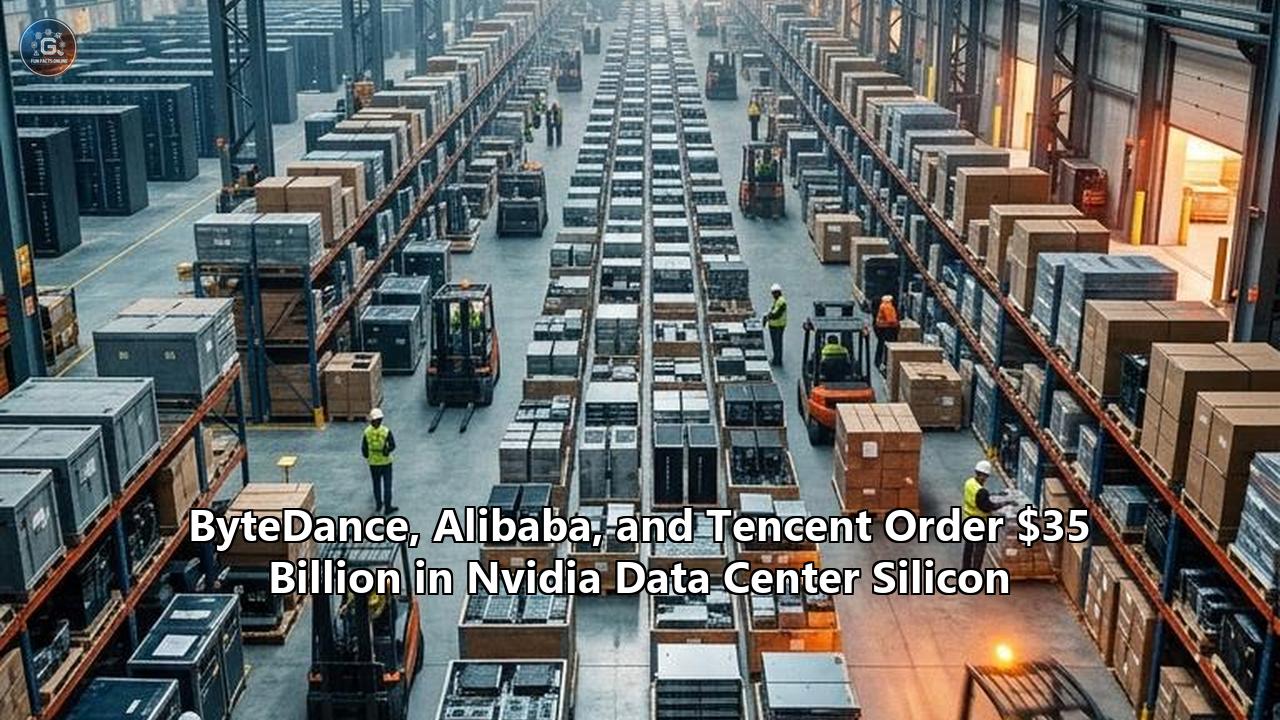
A discreet commercial procurement paper trail snaking through server distributors in Shenzhen, Beijing, and Hong Kong has revealed the largest collective hardware transaction in the history of Chinese artificial intelligence. ByteDance, Alibaba Group Holding, and Tencent Holdings have placed combined purchase orders for more than 3 million units of an unreleased, export-compliant graphics processor from Nvidia, running up an aggregate sticker price that clears $35 billion.
The processor at the center of the massive booking is the RTX PRO 5500, a high-end workstation card priced at approximately $11,400 per unit. The sheer scale of the transaction has sent shockwaves through the global semiconductor supply chain. Rather than standard enterprise equipment, Chinese hyperscalers are acquiring workstation silicon en masse, intending to dismantle, repackage, and cluster the cards inside high-density server racks to keep their consumer-facing AI operations functional.
The buying spree has forced Santa Clara into an uncomfortable corner. Internal communications delivered to enterprise partners in mid-October revealed that Nvidia cannot guarantee fulfillment of the orders. While ByteDance, Alibaba, and Tencent alone have contracted for 3 million cards, aggregate Chinese enterprise demand for the specific model has surged past 6 million units. Nvidia has told regional distributors that its total worldwide production run for the RTX PRO 5500 will top out at no more than 3 million units through 2027, warning clients that final hardware allocations may cover as little as 5% to 10% of what buyers originally requested.
The order book illustrates an extraordinary computational bottleneck. Confronted with successive waves of U.S. export controls that severed access to premier computing engines like the Blackwell B300 and placed the Hopper H200 under strict licensing scrutiny, China's tech conglomerates have abandoned hope of a diplomatic thaw. Instead, they are spending tens of billions of dollars to construct warehouse-scale inference engines out of workstation-grade silicon.
                     THE ALLOCATION CHASM (2026-2027)

Total Chinese Enterprise Demand:
[████████████████████████████████████████████████████████████] 6,000,000+ Units
ByteDance, Alibaba, Tencent Orders:
[██████████████████████████████                              ] 3,000,000+ Units ($35B)
Global Nvidia Production Cap (All Markets):
[██████████████████████████████                              ] 3,000,000 Units
Projected Chinese Allocation Fulfillment:
[███                                                         ] 5% – 10% of requested volume
The Paper Trail Behind the $35 Billion Booking
The procurement effort did not emerge through standard, publicly disclosed enterprise tenders. Instead, it surfaced across multiple procurement schedules coordinated through authorized tier-one system integrators and secondary enterprise channels throughout East Asia.
The figures reflect an urgent capital deployment:
- Combined Order Volume: Exceeds 3.07 million units contracted across ByteDance, Alibaba, and Tencent.
- Average Selling Price: Approximately $11,400 per unit card.
- Gross Order Commitment: In excess of $35 billion.
- Total Chinese Market Backlog: Upwards of 6 million units across all domestic commercial buyers.
- Sampling and Delivery Timetable: Engineering samples scheduled for December; commercial volume rollouts set for the first quarter of 2027.
ByteDance accounts for the largest individual share of the order, according to people familiar with the transaction details. The parent company of TikTok and the domestic Chinese short-video platform Douyin has built an insatiable appetite for compute cycles. Its consumer chatbot, Doubao, processes billions of daily inference tokens, while its core algorithmic recommendation engines consume millions of FLOPS every second to serve personalized video feeds to more than a billion active users worldwide.
Alibaba Cloud and Tencent Cloud represent the remainder of the bulk orders. For Alibaba, compute capacity is the lifeblood of its proprietary foundation model family, Tongyi Qianwen, and its enterprise infrastructure platform, Model Studio. Tencent has focused its capital expenditure on expanding its Hunyuan foundational model stack, which powers automated advertising generation, enterprise productivity tools, and WeChat's embedded conversational assistants.
"This is not a long-term capital efficiency plan; it is an emergency supply run," says Arthur Wei, a senior semiconductor supply chain analyst at Horizon Tech Advisory in Singapore. "Chinese hyperscalers observed the steady erosion of export thresholds over the past three years. They have determined that buying compliant workstation chips today, even at high prices, is preferable to waiting for another policy shift from Washington that could shut the door completely."
When contacted regarding the multi-billion-dollar backlog, an Nvidia representative reiterated that global product distributions must strictly conform to dynamic export control frameworks, noting that customer demand across Asia remains structurally elevated above existing production ceilings. Representatives for ByteDance, Alibaba, and Tencent declined to provide on-the-record comments regarding specific hardware procurement numbers.
Deconstructing the Silicon: How the RTX PRO 5500 Evades Export Caps
The RTX PRO 5500 was not conceived as a high-density compute engine. The card was engineered as a workstation component aimed at CAD modeling, high-end visual effects rendering, and localized software development. Yet, its internal technical profile makes it an attractive alternative for artificial intelligence operators starved of enterprise accelerators.
The hardware architecture reflects a delicate dance around U.S. Department of Commerce rules. Under updated regulations enforced by the Bureau of Industry and Security (BIS), processors bound for China cannot exceed specific Total Processing Performance (TPP) metrics or cross rigid performance density thresholds designed to curb high-performance computing clusters.
       COMPARATIVE ARCHITECTURE: ENTERPRISE SILICON VS. WORKSTATION PIVOT

+-------------------------+--------------------+--------------------+--------------------+
| Metric / Feature        | Blackwell B300     | Hopper H200        | RTX PRO 5500       |
|                         | (Data Center)      | (Data Center)      | (Workstation)      |
+-------------------------+--------------------+--------------------+--------------------+
| U.S. Export Status      | Outright Ban       | Case-by-Case / Lic.| Export Compliant   |
| Memory Architecture     | 288GB HBM3e        | 141GB HBM3e        | 84GB GDDR7         |
| Memory Bandwidth        | Up to 8.0 TB/s     | 4.8 TB/s           | ~1.2 TB/s          |
| Interconnect            | NVLink 5 (1.8TB/s) | NVLink 4 (900GB/s) | PCIe Gen 5 (x16)   |
| Primary Application     | Frontier Training  | Large-Scale Train. | Inference / Render |
| Unit List Price         | $35,000 - $40,000+ | $25,000 - $30,000  | ~$11,400           |
+-------------------------+--------------------+--------------------+--------------------+
The RTX PRO 5500 circumvents these restrictions by abandoning High Bandwidth Memory (HBM) modules altogether. Enterprise accelerators like the Hopper H100, H200, and Blackwell B200 rely on stacked HBM dies positioned on an advanced silicon interposer, which generates the massive memory bandwidth required to train frontier models.
Instead, the RTX PRO 5500 relies on 84 gigabytes of high-density GDDR7 memory. This design choice is critical:
- Compliance by Bandwidth Limiting: GDDR7 modules provide memory bandwidth hovering near 1.2 terabytes per second—sufficient for running trained models, but low enough to remain under the performance density limits that trigger export licensing requirements.
- Raw VRAM Capacity: Providing 84GB of addressable video memory allows operators to load large language model weights directly into the frame buffer without splitting parameters across dozens of discrete chips.
- Core Density Parity: The GPU core layout uses the same transistor structure and streaming multiprocessor count as the RTX 5090 class. For matrix multiplication tasks that do not depend on massive inter-chip communication, its localized throughput is substantial.
"The metric that matters most for inference is memory capacity per dollar, followed closely by memory bandwidth," says Dr. Julian Chen, a distributed computing systems architect previously with Baidu's infrastructure division. "The previous workarounds, like the RTX 6000D released in mid-2025, failed because their memory envelopes were too constrained. By giving this card 84GB of GDDR7, Nvidia provided enough memory capacity to run quantized 70-billion-parameter models on a handful of cards. Chinese engineers immediately recognized that they could build production clusters out of it."
The mechanical trade-offs, however, are severe. The RTX PRO 5500 lacks Nvidia’s proprietary NVLink high-speed interconnect. While dedicated enterprise accelerators communicate across server backplanes at bidirectional speeds of up to 1.8 terabytes per second, the RTX PRO 5500 is restricted to the PCIe Gen 5 bus, which tops out at 64 gigabytes per second in each direction.
This interconnect bottleneck renders the hardware inefficient for pre-training massive models, where thousands of processors must synchronize parameter gradients every millisecond. But for inference—where queries are evaluated independently—that communication penalty is manageable.
Modifying Workstation Hardware for the Server Room
Transforming millions of desktop workstation cards into a continuous enterprise server deployment presents immense physical and electrical challenges. Over the past six months, contract hardware manufacturers in Guangdong have been re-engineering server chassis to host workstation cards at cloud scale.
Standard cloud facilities are designed to house 19-inch or 21-inch rack-mounted nodes sliding into vertical bays cooled by unidirectional front-to-back airflow. Workstation cards, built with commercial axial fans, blow heat outward across the sides of the chassis, creating thermal turbulence that can trigger emergency shutdowns inside dense rack arrays.
"You cannot drop three thousand workstation cards into a standard tier-four facility and walk away," explains a senior systems engineer at a Beijing-based infrastructure integration firm who spoke on condition of anonymity. "The cards have the wrong mechanical footprint, the power connectors point toward the side panels instead of the rear, and the thermal exhausts create hot-air recirculation pockets inside high-density enclosures."
To deploy the hardware, systems integrators have engineered customized 4U and 8U server enclosures that feature:
- Custom Riser Configurations: PCIe Gen 5 flexible riser assemblies that rotate the workstation cards 90 degrees, aligning the heatsink fins with the server’s primary front-to-back chassis airflow.
- Active-to-Passive Thermal Conversions: Complete removal of standard commercial plastic fan shrouds, replacing them with custom aluminum ducts connected to high-RPM counter-rotating chassis fan walls.
- Bespoke Power Harnessing: Proprietary 12V-2x6 power cables engineered to route along the bottom metal of the tray, preventing the physical bend fatigue that has plagued consumer-grade high-wattage connectors.
- Node-Level Software Optimization: Custom Linux kernel patches designed to bypass standard desktop display drivers and initialize the cards as headless compute engines directly inside Kubernetes clusters.
By retrofitting these systems, Chinese cloud providers have figured out how to fit eight RTX PRO 5500 cards into a single 4U chassis, creating dense compute nodes with 672 gigabytes of aggregate GDDR7 memory. While the setup consumes more power and occupies more floor space than an integrated Hopper or Blackwell system, it offers a functional path forward for tech giants running low on compute.
The Compute Shortage: Why Inference Demands Cannot Wait
The timing of this $35 billion expenditure highlights an inflection point in the Chinese technology landscape: the shift from the training phase of AI models to high-volume commercial inference.
Throughout 2023 and 2024, Chinese companies engaged in an aggressive race to train domestic foundational models, prioritizing compute clusters for pre-training runs. By late 2026, that landscape changed. Foundational model training has plateaued into incremental iterations, while the demand for daily inference cycles has grown exponentially.
           THE AI WORKLOAD TRANSITION: COMPUTE ALLOCATION SHIFT

     Training Workloads (Pre-training & Post-training Fine-Tuning)
     2024: [████████████████████████████████████████] 72% of total compute
     2026: [████████████████                        ] 31% of total compute

     Inference Workloads (Production APIs, Chatbots, Agents, Recommendation)
     2024: [███████████████                         ] 28% of total compute
     2026: [████████████████████████████████████████] 69% of total compute
The scale of modern AI services has placed unprecedented strain on existing infrastructure:
- Doubao’s Query Volume: ByteDance’s consumer assistant has grown to process more than 120 million active queries every day, requiring tens of thousands of dedicated GPUs running continuously just to return responses without latency spikes.
- Enterprise Workloads: Alibaba Cloud hosts thousands of corporate clients using its Model Studio APIs to build customer service bots, automated code assistants, and translation tools. Every API call requires real-time compute resources.
- Multimodal Processing: The launch of video generation and image understanding models across Douyin, Taobao, and WeChat has multiplied inference requirements by an order of magnitude compared to plain text models.
This dynamic explains why Chinese hyperscalers are scouring the market for alternatives to traditional Nvidia data center chips. Building infrastructure around high-end data center silicon like the H100 or H200 was viable when hardware needs were measured in thousands of accelerators. But supporting millions of live consumer inference queries requires tens of thousands of deployed GPUs—a scale that domestic alternatives and smuggled hardware cannot satisfy.
"If an inference engine experiences an operational blackout because you ran out of capacity, users migrate to a competitor in minutes," notes Kevin Shen, an AI infrastructure consultant based in Shanghai. "ByteDance and Alibaba are burning through their hardware reserves just to support their everyday traffic. They are not buying the RTX PRO 5500 to pursue theoretical benchmarks; they are buying it to prevent their services from crashing under real-world demand."
Inference workloads are naturally suited to distributed architectures. While training a massive language model requires tightly coupled GPUs that share data continuously, inference tasks can be easily split across independent servers. A query sent to an AI assistant can be processed on an isolated node containing eight RTX PRO 5500 cards without requiring access to an expensive, multi-chassis NVLink network. This architectural reality has turned workstation silicon into a practical substitute for Nvidia data center chips in consumer-facing environments.
The Software Moat: Why Domestic Chinese Silicon Stalled
The decision to commit $35 billion to workstation-grade hardware highlights an uncomfortable reality for China's domestic semiconductor industry: local alternatives are still struggling to replace Nvidia's software ecosystem.
Over the past four years, Beijing has invested heavily in domestic chipmakers, championing hardware like Huawei’s Ascend 910B and 910C, the Biren BR100 series, and Moore Threads' MTT S-series accelerators. On paper, several of these domestic processors offer impressive performance metrics. Huawei’s Ascend 910C, for instance, features raw computing specs and high-bandwidth memory allocations that closely rival Nvidia’s Hopper line.
Yet, enterprise buyers like ByteDance, Alibaba, and Tencent continue to prioritize compliant Nvidia hardware. The reason lies in the software ecosystem.
                  THE ENTERPRISE SOFTWARE STACK DILEMMA

   Nvidia Compute Stack                       Domestic Alternative (Huawei CANN)
+----------------------------+             +----------------------------+
| vLLM / TensorRT-LLM / SGLang|             | MindSpore / ModelLink      |
+----------------------------+             +----------------------------+
| CUDA 13.x Runtime & Tooling|             | CANN 8.x Compute Platform  |
+----------------------------+             +----------------------------+
| Automated Kernel Profiling |             | Custom C++ Operator Dev.   |
+----------------------------+             +----------------------------+
| Zero-Friction Production   |             | High Developer Overhead    |
| Cluster Deployment         |             | & Compiler Instability     |
+----------------------------+             +----------------------------+
Interviews with software engineers across China’s leading cloud providers point to persistent friction in migrating to domestic platforms:
- Compiler Instability: Engineers report that Huawei's CANN (Compute Architecture for Neural Networks) software layer has improved, but still struggles with high-performance distributed inference frameworks like vLLM and TensorRT-LLM. Custom CUDA kernels written over the last decade often fail to compile cleanly on alternative architectures, requiring time-consuming manual rewrites.
- The Developer Tax: "When we build an inference pipeline on CUDA, an engineer can pull an optimized open-source model from the community and put it into production in two hours," says a lead software architect at a Hangzhou-based tech firm. "When we deploy the same model on domestic hardware, it often requires three software engineers two full weeks just to write, profile, and debug the custom operators. That developer overhead becomes unsustainable at our deployment scale."
- Yield and Packaging Shortages: Domestic chipmakers face significant manufacturing headwinds. Fabrication partners like Semiconductor Manufacturing International Corporation (SMIC) remain cut off from extreme ultraviolet (EUV) lithography systems. Using older deep ultraviolet (DUV) multi-patterning techniques to produce chips like the Ascend 910C yields lower chip output per wafer and higher defect rates, driving up production costs and limiting total supply.
Enterprises reliant on Nvidia data center chips face high costs and complex operational challenges when attempting to switch platforms. For corporate executives managing public services, spending billions to acquire less powerful, fully compliant Nvidia cards is considered safer than attempting a rushed, wholesale migration of their core infrastructure to unproven domestic software platforms.
The TSMC Bottleneck and the Rubin Conflict
While the scale of China’s hardware orders has made headlines, Nvidia's real challenge is manufacturing the chips.
The 3-million-unit order from ByteDance, Alibaba, and Tencent faces a severe production bottleneck at Taiwan Semiconductor Manufacturing Company (TSMC). Semiconductor fabrication plants in Hsinchu, Tainan, and Taichung are already running at full capacity, with fab schedules locked down well into 2027.
       TSMC ADVANCED CAPACITY ALLOCATION MAP (PROJECTED 2026-2027)

[██████████████████████████████] 45% Nvidia Blackwell (B200/B300) & Rubin Enterprise
[██████████████                ] 25% Apple A-Series & M-Series Silicon
[██████████                    ] 15% AMD Instinct (MI350/MI400) & EPYC Processors
[██████                        ] 10% Qualcomm / MediaTek Mobile Platforms
[███                           ]  5% Workstation Silicon (RTX PRO 5500 & Equivalents)
Nvidia is managing a delicate internal prioritization challenge across its product lines:
- The Rubin Architecture Transition: Starting in late 2026 and accelerating through 2027, Nvidia is transitioning its primary foundry lines to support the Rubin architecture—its next-generation platform for high-end computing. These chips deliver operating margins well above 75%, far out-earning workstation-class cards.
- Wafer and Packaging Trade-Offs: Although the RTX PRO 5500 uses traditional GDDR7 packaging rather than advanced Chip-on-Wafer-on-Substrate (CoWoS) technology, it still consumes 4-nanometer wafer starts at TSMC. Every wafer dedicated to a compliant workstation chip is a wafer that cannot be used to produce premium chips for Western hyperscalers like Microsoft, Amazon Web Services, and Google.
- The Global Supply Ceiling: Nvidia’s internal projections cap total worldwide output of the RTX PRO 5500 at 3 million units through 2027. Because this allocation must serve creative professionals, design studios, and enterprise buyers in North America, Europe, and non-sanctioned parts of Asia, only a fraction of those wafers can be sent to mainland China.
This dynamic explains why Nvidia warned partners that allocation fulfillment for Chinese clients could drop to the single digits.
"Nvidia’s production lines are stretched thin across every modern node," explains Dan Niles, founder and portfolio manager at Niles Investment Management. "Jensen Huang must satisfy demands from the largest cloud platforms in the West while simultaneously handling these massive requests from Asia. From an economic perspective, Nvidia will prioritize products that offer the highest margins and face the fewest regulatory risks. Workstation chips destined for China rank much lower on that list."
Washington’s Policy Dilemma: The Bureau of Industry and Security
The $35 billion order book highlights the persistent regulatory challenges facing the U.S. Commerce Department's Bureau of Industry and Security (BIS).
Since October 2022, U.S. export controls have sought to prevent China from acquiring cutting-edge American silicon capable of accelerating military capabilities and training state-of-the-art artificial intelligence models. Every time the BIS introduces new regulatory limits, the semiconductor industry adapts:
- October 2022: The initial export restrictions ban the A100 and H100. In response, Nvidia designs the A800 and H800, which reduce interconnect speeds while keeping compute cores intact.
- October 2023: Regulators update the rules to close the interconnect loophole by introducing performance density caps. Nvidia responds by releasing the H20, L20, and RTX 6000D, precisely engineered to sit just beneath the new legal ceiling.
- 2025–2026: Washington tightens licensing requirements for enterprise Hopper variants like the H200 and explicitly restricts the Blackwell B300. Chinese hyperscalers then pivot their capital to high-end workstation cards like the RTX PRO 5500.
                     THE REGULATORY ESCALATION CYCLE

[2022 Sanctions] ──> Bans A100/H100 ───────> Nvidia launches A800/H800
       │
[2023 Revision]  ──> Restricts A800/H800 ──> Nvidia launches H20 / RTX 6000D
       │
[2025-26 Curbs]  ──> Restricts H20/B300 ───> Chinese Hyperscalers Order
                                            $35B in RTX PRO 5500 Silicon
       │
[Next Step?]     ──> Potential BIS Rule Changes on Workstation VRAM & GDDR7
This cycle has sparked debate in Washington. National security policymakers view the multi-billion-dollar workstation orders as a clear circumvention of export control intent, arguing that deploying millions of interconnected commercial cards effectively blurs the line between consumer hardware and enterprise computing.
"The spirit of export controls was to cap the total computing power accessible to Chinese hyperscalers," says Emily Kilcrease, senior fellow and director of the Energy, Economics, and Security Program at the Center for a New American Security (CNAS). "When Chinese companies bypass those limits by ordering millions of workstation cards, they expose a structural blind spot in the regulations. The policy was designed around enterprise hardware, not commercial workstation GPUs being adapted for server use."
Closing this loophole, however, presents political and economic challenges. If the BIS lowers export thresholds to capture the RTX PRO 5500, it would place standard workstation and consumer electronics under export control regimes. That would affect international PC makers, enterprise design firms, and consumer tech brands, adding friction to global electronics supply chains.
At the same time, authorities in Beijing face their own balancing act. While the Chinese government continues to push state-owned enterprises toward domestic alternatives like the Ascend 910C, it has allowed commercial internet giants like ByteDance, Alibaba, and Tencent to buy Western hardware through international channels to maintain their competitive edge.
The Splintered Architecture of Computing
The massive volume of orders moving through Nvidia’s supply chain points to an increasingly divided computing landscape.
As early hardware samples head out to partners ahead of full commercial shipments, the global technology sector is bifurcating into two distinct computing paradigms:
- The Western Model: Hyperscalers in North America and Europe continue to build massive, centralized superclusters centered around liquid-cooled Blackwell and upcoming Rubin deployments. These systems rely on ultra-wide NVLink switches and high-bandwidth memory to train multi-trillion-parameter models across single compute fabrics.
- The Chinese Workaround: Constrained by trade limits, Chinese developers are pivoting toward pragmatic, distributed architectures. They are clustering export-compliant workstation hardware and running quantized inference software to maximize performance per watt, optimizing their networks around the hardware they can still legally acquire.
                THE BIFURCATED INFRASTRUCTURE PARADIGM

      Western Hyperscalers                    Chinese Hyperscalers
   (Microsoft, AWS, Meta, CoreWeave)        (ByteDance, Alibaba, Tencent)
+-----------------------------------+   +-----------------------------------+
| Architecture: Unified Superfabrics|   | Architecture: Distributed Fabrics |
| Primary Silicon: Blackwell / Rubin|   | Primary Silicon: Repurposed WS/H20|
| Memory: HBM3e / HBM4 (Terabytes/s)|   | Memory: GDDR7 / Constrained HBM   |
| Interconnect: NVLink 5 (1.8 TB/s) |   | Interconnect: Standard PCIe Gen 5 |
| Primary Objective: Frontier AGI   |   | Primary Objective: Industrial     |
| Training & Ultra-Scale Reasoning  |   | Inference & App Monetization      |
+-----------------------------------+   +-----------------------------------+
This structural split between Western hyperscale platforms and export-constrained Nvidia data center chips will shape the economics of artificial intelligence over the coming decade. ByteDance, Alibaba, and Tencent are betting that the future of the industry belongs to whoever delivers fast, reliable, low-cost inference to consumers, rather than whoever spends the most money training frontier models.
Over the coming quarters, several milestones will show whether this multibillion-dollar bet pays off:
- Initial Hardware Shipments: The arrival of the first engineering samples will reveal how effectively Chinese systems integrators have addressed the thermal and power challenges of running workstation cards in server racks.
- Allocation Decisions: Nvidia’s regional distribution reports will show how many cards actually clear export review and make their way into Chinese data centers.
- Regulatory Responses: The Bureau of Industry and Security is expected to review the transaction, leaving open the question of whether Washington will adjust its performance density rules once again.
If Nvidia fulfills only 10% of the requested orders, Chinese hyperscalers will still inject more than 300,000 high-performance GPUs into their inference networks. If the companies secure the full 3 million cards, they will build an inference engine capable of processing trillions of daily queries—proving that computing demand can route around geopolitical trade barriers, provided buyers are willing to sign the check.
Reference:
- https://www.kucoin.com/news/flash/bytedance-alibaba-tencent-order-over-35-billion-in-nvidia-gpus
- https://live.euronext.com/en/financial-news/exclusive-bytedance-alibaba-tencent-place-over-35-billion-worth-nvidia-chip-orders
- https://www.marketscreener.com/news/chinese-tech-giants-are-buying-nvidia-gaming-chips-for-ai-here-s-why-ce785cd8da8ff527
- https://www.investing.com/news/stock-market-news/bytedance-alibaba-and-tencent-order-35-billion-of-nvidia-chips-reuters-4959256
- https://www.tikr.com/blog/chinese-tech-giants-order-nvidia-rtx-pro-5500
- https://qz.com/bytedance-alibaba-tencent-nvidia-chip-orders-102026
- https://www.tomshardware.com/pc-components/gpus/chinas-tech-giants-drop-usd35-billion-on-export-compliant-nvidia-rtx-pro-5500-workstation-gpu-orders-to-power-ai-ambitions-according-to-reports-bytedance-alibaba-and-tencent-order-3-million-cards-despite-warnings-that-only-10-percent-of-orders-are-fulfillable