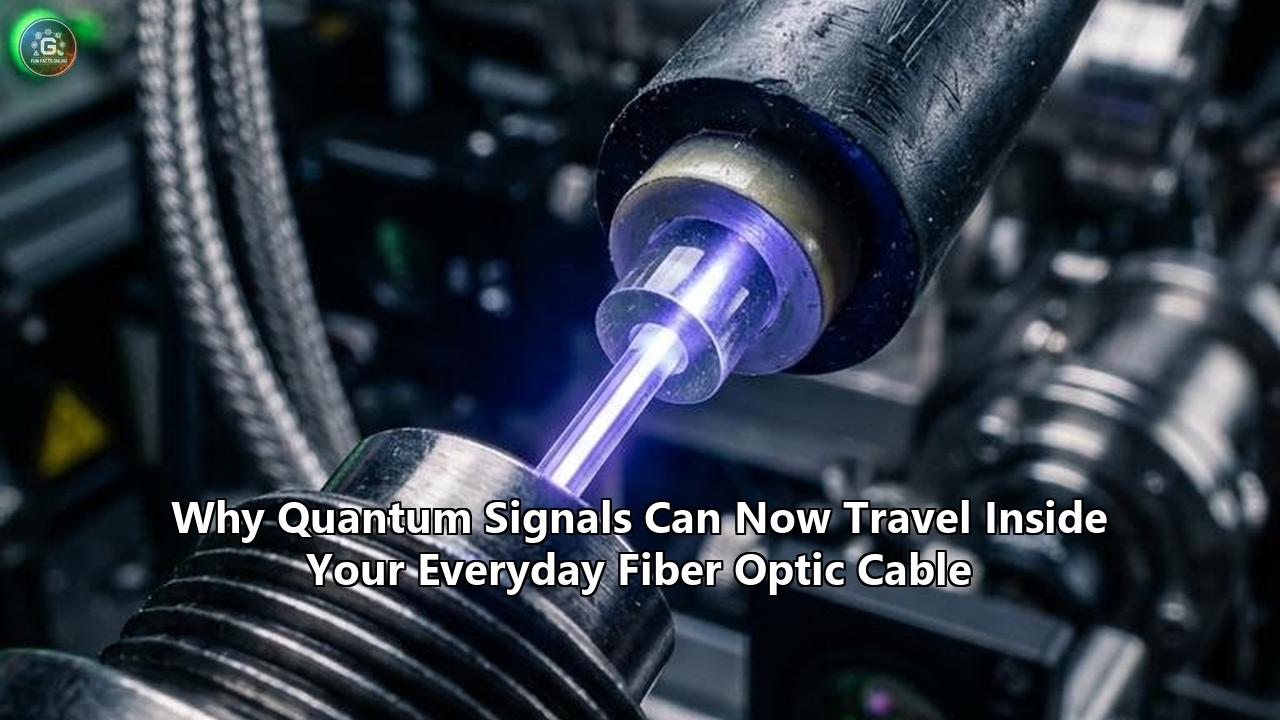
In a 24.4-kilometer stretch of standard optical fiber running beneath the streets between Evanston and downtown Chicago, single photons carrying delicate quantum entanglement have successfully coexisted alongside 1.6 terabits per second of commercial internet traffic.
The experiment, led by researchers at Northwestern University and published in Optica Quantum, marks a decisive moment in telecommunications history. Quantum information—famously so fragile that a single stray photon can destroy it—no longer requires its own isolated, multi-million-dollar "dark fiber" pipelines. Instead, quantum states can now travel inside the exact same everyday optical cables that deliver streaming video, corporate data, and standard web traffic.
Senior author Prem Kumar described the sheer physical scale of the achievement by comparing the single-photon quantum state to an ant attempting to walk down a highway crowded with speeding elephants. Classical internet traffic pumps trillions of photons per second through a glass thread no thicker than a human hair, creating a blinding tempest of light. Yet, by applying precise spectral placement and sub-nanosecond temporal filtering, Kumar’s team achieved an entanglement fidelity exceeding 94 percent across active commercial fiber.
This milestone comes on the heels of rapid, escalating breakthroughs across 2024, 2025, and early 2026. Teams from Toshiba, the University of Pennsylvania, and Fermilab have systematically dismantled the physical barriers that once isolated quantum networking from everyday communications infrastructure. The realization that quantum communication fiber optics can share existing optical networks removes the single largest financial and logistical barrier to building a global quantum internet.
Understanding how physics and optical engineering resolved this long-standing collision requires tracing a decades-long trajectory of escalating technical hurdles, unexpected optical phenomena, and pivotal turning points.
The Fundamental Conflict: Millions of Watts Versus Single Photons
To understand why sending quantum signals down standard fiber optic cables was long deemed impossible, one must examine the physics of optical fiber transmission.
Classical fiber optic networks rely on intensity modulation or phase keying of laser pulses. A standard 800-Gigabit-per-second (800G) optical channel launches light into standard single-mode fiber (SMF-28) at power levels around 1 to 10 milliwatts (0 to +10 dBm). That power corresponds to roughly $10^{16}$ photons passing through the fiber core every single second.
By contrast, quantum signals—whether used for Quantum Key Distribution (QKD) or quantum teleportation—are encoded into individual photons or entangled photon pairs. A quantum transmitter might output just one photon every few nanoseconds, translating to an optical power level of less than $-100$ dBm (a fraction of a picowatt).
When high-power classical light and fragile single photons travel down the same strand of silica glass, two distinct nonlinear optical phenomena occur that threaten to obliterate the quantum signal:
[ Classical Laser Pulse ] ---> ( High Power: ~10^16 photons/sec )
                                      │
                                      ▼
                      Silica Fiber Lattice Vibrations
                                      │
           ┌──────────────────────────┴──────────────────────────┐
           ▼                                                     ▼
Spontaneous Raman Scattering (SpRS)                     Four-Wave Mixing (FWM)
(Wavelength-shifted noise across 100+ nm)             (Intermodulation at specific frequencies)
           │                                                     │
           └──────────────────────────┬──────────────────────────┘
                                      ▼
                     [ Inundates Quantum Channel ]
(Single-photon detectors blinded)- Spontaneous Raman Scattering (SpRS): As intense classical laser light passes through the amorphous silicon dioxide ($\text{SiO}_2$) matrix of an optical fiber, light particles inelastic-scatter off the thermal vibrations (phonons) of the glass lattice. This process shifts a portion of the high-power classical photons to lower frequencies (Stokes scattering) and higher frequencies (anti-Stokes scattering). The resulting Raman noise spreads across a wide spectrum spanning more than 100 nanometers. To a single-photon detector, this background optical noise looks like a blinding continuous glare.
- Four-Wave Mixing (FWM): When multiple classical wavelengths travel together, nonlinear Kerr interactions in the glass cause photons from different channels to mix, generating new photon frequencies that can fall directly into the spectral window reserved for the quantum signal.
For decades, these scattering mechanisms meant that any attempt to send single photons down a cable carrying live internet traffic resulted in the single-photon detectors being completely swamped by noise. The quantum bit error rate (QBER) would spike beyond 50%, destroying any quantum state coherence or secret key generation.
As a result, early experimenters were forced to isolate quantum channels inside dedicated "dark fibers"—expensive, unlit optical lines completely physically separated from classical telecommunications traffic.
Phase 1 (1997–2015): The Dark Fiber Monopoly and Early Coexistence Whispers
The earliest attempts to challenge the dark-fiber requirement date back to the late 1990s. In 1997, researcher P. D. Townsend published a proof-of-concept experiment showing that low-speed classical data (1.2 Mbps) could share a 28-kilometer fiber spool with a primitive single-photon QKD signal.
However, as classical internet backbones rapidly scaled from megabits to gigabits—and eventually terabits—the optical power inside commercial fiber exploded. The low-power conditions of Townsend's 1997 test were quickly eclipsed by the realities of modern Dense Wavelength Division Multiplexing (DWDM).
1997                       2010                       2018                       2024                       2026
 Townsend Test             Dark Fiber Era             O-Band / C-Band Split      Toshiba 250 km / UPenn     Northwestern
 1.2 Mbps + QKD            Dedicated physical lines   Spectral separation        Coexistence & Q-Chip       1.6 Tbps + Entanglement
 (Lab spool)               High cost, low scale       O-band (1310) / C (1550)   Live standard IP traffic   Deployed SMF-28
Throughout the 2000s and early 2010s, the quantum networking community remained locked in the dark fiber paradigm:
- High Deployment Costs: Leasing a dedicated strand of dark fiber in a major metropolitan center like New York or London costs thousands of dollars per kilometer annually.
- Geographic Limits: Many commercial fiber routes had zero spare dark fiber available, making quantum security inaccessible for most enterprise data centers.
- Attenuated Experiments: Academic labs attempting coexistence were forced to dial classical laser power down to near-zero levels, rendering the classical channels useless for realistic telecom operations.
By 2015, a consensus had formed across telecom equipment manufacturers: unless quantum photons could survive inside fully populated, high-power optical fiber lines, quantum networks would remain confined to niche government and laboratory applications.
Phase 2 (2016–2023): The Spectral Separation Pivot
The first major architectural breakthrough emerged when researchers realized that Spontaneous Raman Scattering is fundamentally asymmetric.
Because thermal vibrations in optical fiber create far more Stokes noise (shifted to longer wavelengths) than anti-Stokes noise (shifted to shorter wavelengths), engineers began looking for spectral "sweet spots" where quantum photons could hide.
This led to the separation of optical bands:
- The C-Band (1530–1565 nm): The standard band for high-capacity classical internet traffic, owing to its ultra-low attenuation (~0.19 dB/km) in silica fiber.
- The O-Band (1260–1360 nm): A shorter wavelength band with higher fiber attenuation (~0.32 dB/km), but located roughly 200 nanometers away from the C-band.
Standard Fiber Transmission Bands:

   O-Band (1260 - 1360 nm)             C-Band (1530 - 1565 nm)             L-Band (1565 - 1625 nm)
┌──────────────────────────┐         ┌──────────────────────────┐         ┌──────────────────────────┐
│  Quantum Channel Space   │         │ High-Power Internet      │         │ Real-Time Network Sync   │
│  (Minimized Raman Noise) │ <------ │ Classical DWDM Traffic   │ ------> │ Timing & Control Signals │
└──────────────────────────┘  200nm  └──────────────────────────┘  30nm   └──────────────────────────┘
                              Guard
                              Band
Between 2018 and 2023, research groups worldwide systematically mapped the Raman noise spectra generated when high-power C-band lasers were launched into standard single-mode fiber. By placing the quantum channel in the Original-band (O-band) at 1310 nm while keeping classical data in the Conventional-band (C-band) at 1550 nm, they created a 200-nanometer spectral guard band.
In 2021, a milestone field test in China demonstrated a 1310 nm QKD channel coexisting over 66 kilometers of commercial backbone fiber carrying 3.2 Tbps of C-band classical traffic.
Yet, this band-separation approach carried severe trade-offs:
- Higher Signal Loss: Because glass fiber absorbs more light at 1310 nm than at 1550 nm, O-band quantum photons lost their energy nearly twice as fast per kilometer, limiting maximum transmission range.
- Residual Anti-Stokes Tail: Even with a 200 nm spectral gap, high-power classical channels operating at multi-terabit capacities still produced enough anti-Stokes Raman photons to corrupt sensitive quantum entanglement protocols.
- Coexistence Limitations: The system worked for weak coherent pulse QKD (which can tolerate moderate error rates), but failed when applied to true entangled photon pairs or multi-qubit quantum memory states.
A fundamentally new set of filtering, modulation, and routing tools was needed to achieve true hybrid operation.
Phase 3 (Late 2024–Early 2025): Cryo-Free Transmission and Long-Distance Coherence
Between late 2024 and early 2025, the research narrative accelerated dramatically from simple laboratory spools to real-world infrastructure tests.
In December 2024, a joint team operating across U.S. national lab infrastructure accomplished the first quantum teleportation demonstration over an optical link populated with high-power 400 Gbps classical traffic. By using optimal O-band quantum channels paired with narrow spectro-temporal filtering, the researchers achieved quantum state transfer across 30.2 kilometers of fiber with a Bell state measurement at the fiber's midpoint.
Then came an April 2025 announcement that altered long-distance scaling projections. A research team at Toshiba Europe, led by senior scientist Mirko Pittaluga, published a study in Nature demonstrating coherent transmission of quantum data across 250 kilometers (155 miles) of standard fiber optic cable connecting Frankfurt and Kehl in Germany.
Frankfurt <=======================================================> Kehl
                       250 km (155 miles) Standard Fiber
          * Live Underground Commercial Telecom Infrastructure
          * Zero Cryogenic Cooling Required at Transmission Nodes
          * Full Phase Coherence Maintained across Environmental Drifts
Crucially, the Toshiba experiment solved two major engineering hurdles that had plagued field deployments:
- Elimination of Cryogenic Dependency: Previously, ultra-precise quantum receivers required bulk superconducting nanowire single-photon detectors (SNSPDs) liquid-cooled to near absolute zero (1.5 Kelvin). Toshiba’s phase-stabilized architecture demonstrated coherent transmission using standard room-temperature or thermo-electrically cooled optical receivers.
- Phase Coherence Under Environmental Stress: Underground telecom fiber is subjected to continuous physical disturbances—vibrations from highway traffic, soil temperature shifts, and physical cable bending. Toshiba’s dual-wavelength phase-compensation technique actively canceled optical path phase drifts in real time, maintaining quantum coherence over 250 km of live fiber.
"It is fundamental to the phase-based architecture of the quantum internet," noted Pittaluga, emphasizing that the test was conducted not on laboratory spools, but through active, buried commercial cables subject to real-world thermal and mechanical stress.
Phase 4 (August–September 2025): The Silicon Q-Chip and Standard IP Protocol Integration
While Toshiba proved long-distance phase coherence, a fundamental network architectural question remained: How do you route quantum signals through real-world internet routers and switches without destroying the delicate quantum states?
In standard classical networks, data packets are inspected, measured, buffered, and re-routed at every router using Internet Protocol (IP). But in quantum mechanics, the No-Cloning Theorem and wavefunction collapse mean that if a router measures a quantum photon to read its destination address, the quantum information is destroyed.
In late August 2025, researchers at the University of Pennsylvania published a solution in Science: the Q-Chip (Quantum-Classical Hybrid Internet by Photonics).
UPenn Q-Chip Hybrid Packet Architecture:

  ┌─────────────────────────────────────────────────────────────┐
  │ Classical "Pilot Light" Escort (Header / IP Routing Data)   │
  ├─────────────────────────────────────────────────────────────┤
  │ Entangled Quantum Payload (Single Photons - Unmeasured)     │
  └─────────────────────────────────────────────────────────────┘
                                │
                                ▼
  * Classical Light is Measured & Routed via Standard IP Switches
  * Quantum Payload "Piggybacks" UnTouched Through Silicon Channels
  * Active Disturbance Compensation Updates Every 100 Milliseconds
The UPenn team built a monolithic silicon-photonic integrated circuit that packages fragile quantum photons alongside a classical "pilot light" escort.
How the Q-Chip Works:
- Piggyback Payload Design: The classical optical signal acts as a locomotive, carrying standard IP headers, routing metadata, and timing markers. The quantum single photons travel right alongside it inside the same photonic waveguides.
- Non-Destructive Routing: When the hybrid packet arrives at a commercial network router, standard optical splitters route the high-intensity classical header to conventional electronic processing units. The router reads the IP destination, sets its internal optical switches, and directs the optical path—allowing the untouched quantum payload to pass through without ever being measured or collapsed.
- Inferred Error Correction: Environmental noise (vibrations, temperature drifts) alters both the classical escort light and the quantum photons equally. By continuously measuring phase shifts in the classical escort light every 100 milliseconds, the Q-Chip infers the exact distortion experienced by the adjacent quantum signal and applies real-time phase-shifts to reconstruct the quantum state—without ever touching the quantum qubit directly.
In real-world campus tests across Philadelphia, underground Verizon commercial optical lines were used to route quantum signals across complex multi-destination topology with routing accuracy between 91.6% and 97.1%.
The UPenn breakthrough proved that quantum communication fiber optics could speak the same structural language as the traditional internet.
Phase 5 (July 2026 Milestone): Real-World Metropolitan Entanglement Under Terabit Load
Despite these advances, one final challenge remained: Could true quantum entanglement—the most sensitive and demanding quantum resource—be distributed over standard fiber carrying full-power, multi-terabit commercial telecommunications traffic?
Weak laser QKD pulses can tolerate moderate background noise, but entangled photon pairs rely on precise two-photon quantum correlation states. If Raman noise photons contaminate the timing window of an entangled pair, the entanglement fidelity drops below the classical limit (70.7%), rendering the link useless for quantum teleportation or distributed quantum computing.
In July 2026, a research team led by Professor Prem Kumar and graduate student Gina Talcott at Northwestern University published their results in Optica Quantum, demonstrating real-world metropolitan entanglement distribution under heavy commercial optical traffic.
Northwestern University Deployed Link Topology (July 2026):

 Evanston Node (Alice)                                    Chicago Downtown Node (Bob)
┌──────────────────────┐                                 ┌──────────────────────────┐
│ Entangled Photon     │     24.4 km Deployed SMF-28     │ Receiver Array           │
│ Pair Generator       │ ═══════════════════════════════>│ Superconducting Detectors│
└──────────────────────┘                                 └──────────────────────────┘
           │                                                          ▲
           │          ┌──────────────────────────────────┐            │
           └─────────>│ Co-Propagating Optical Signals   │────────────┘
                      ├──────────────────────────────────┤
                      │ O-Band: Quantum Entangled Pairs  │
                      │ C-Band: 1.6 Tbps Classical Data  │
                      │ L-Band: Picosecond Sync Signal   │
                      └──────────────────────────────────┘
The Experimental Setup:
- Location: Installed, underground commercial fiber optic cable stretching 24.4 kilometers between Evanston, Illinois, and downtown Chicago.
- Fiber Type: Standard Single-Mode Fiber (SMF-28).
- Classical Traffic Load: The C-band was populated with two active 800-Gbps data channels (totaling 1.6 Tbps throughput) combined with Amplified Spontaneous Emission (ASE) noise, generating a total classical launch power of +21.4 dBm (138 milliwatts).
- Synchronization Channel: An independent L-band classical timing signal running alongside to provide picosecond-level synchronization between remote nodes.
- Quantum Channel: Polarization-entangled photon pairs operating in the O-band.
The Results:
Despite the tremendous difference in signal power—where classical photons outnumbered quantum photons by trillions to one—the team maintained an entanglement fidelity of over 94 percent.
"Quantum signals are very, very tiny compared to classical signals," explained Kumar. "It's like an ant traveling through a path filled with elephants. Our results show that photons can survive the journey and remain entangled."
This Chicago-Evanston trial represented the first successful distribution of quantum entanglement across installed metropolitan fiber while coexisting with full-capacity, high-power classical communications.
Technical Mechanics: How Quantum Signals Survive the Fiber
To understand how single photons can endure a journey down an active fiber optic line without being overwhelmed by classical light, it helps to analyze the technical architecture used in modern coexistence setups.
                             [ COEXISTENCE FILTERING ARCHITECTURE ]

    Combined Input Light
    (Quantum + Classical)
             │
             ▼
┌─────────────────────────┐
│ Band-Splitter (WDM)     │ ─── C-Band (1550nm) ──> Classical Receiver (1.6 Tbps Data)
└─────────────────────────┘
             │
             │ O-Band (1310nm)
             ▼
┌─────────────────────────┐
│ Ultra-Narrowband Filter │ ─── Suppresses out-of-band Raman photons (linewidth <0.1 nm)
└─────────────────────────┘
             │
             ▼
┌─────────────────────────┐
│ Time-Gating Circuit     │ ─── Opens detection window ONLY during precise photon arrival (<100 ps)
└─────────────────────────┘
             │
             ▼
┌─────────────────────────┐
│ SNSPD Array             │ ─── High efficiency (>85%), low dark-count single photon detection
└─────────────────────────┘
The modern coexistence architecture relies on a four-stage defense system that suppresses noise photons before they reach the quantum detector:
1. Optimal Band Allocation (WDM Filtering)
By engineering quantum photon sources to emit precise wavelengths in the O-band (e.g., 1270–1310 nm), optical systems maximize the spectral separation from classical C-band lasers (1530–1565 nm). Wavelength Division Multiplexers (WDMs) at the receiver end route more than 99.9999% of C-band light away from the quantum detection port.
2. Ultra-Narrowband Optical Filtering
Even after band separation, residual Raman noise photons spill into the O-band. To block this scattered light, researchers place ultra-narrowband spectral filters—such as Fiber Bragg Gratings (FBG) or Fabry-Perot etalons—directly in front of the quantum detectors. These filters feature optical passbands narrower than 0.1 nanometers (tens of gigahertz), carving out an extremely narrow frequency slice that admits the quantum photon while blocking 99.9% of ambient Raman noise.
3. Sub-Nanosecond Temporal Gating
Raman noise is emitted as a continuous background stream, whereas quantum photons arrive at precise, predictable time intervals. By transmitting an L-band classical timing pulse alongside the quantum payload, the receiving system synchronizes its clocks to picosecond precision.
The single-photon detector is switched on only during an extremely narrow time window—often less than 100 picoseconds wide—exactly when the quantum photon is scheduled to arrive. By shutting out noise during the remaining 99% of the clock cycle, the effective noise power drops by several orders of magnitude.
4. Advanced Detector Sensitivity and Coincidence Logic
Using Superconducting Nanowire Single-Photon Detectors (SNSPDs) with system efficiencies exceeding 85% and dark count rates below 500 counts per second, receiving nodes can identify coincident photon pairs even when embedded in residual background noise. Multi-photon coincidence logic algorithms cross-correlate detection events at remote nodes (Alice and Bob), filtering out uncorrelated noise photons that happen to pass through the optical filters.
| Architectural Parameter | Early Coexistence (2018) | Advanced Coexistence (2026) |
|---|---|---|
| Classical Band Allocation | Low-power C-Band (<0 dBm) | High-power multi-channel C-Band (+21.4 dBm) |
| Classical Throughput | 1.2 Gbps – 10 Gbps | 1.6 Terabits per second (1.6 Tbps) |
| Quantum Protocol | Weak Coherent Pulse QKD | Polarization-Entangled Photon Pairs |
| Filtering Linewidth | Standard Thin Film Filters (~1-2 nm) | Ultra-Narrow FBG / Fabry-Perot (<0.1 nm) |
| Temporal Precision | Nanosecond gating | Picosecond-level synchronization |
| Entanglement Fidelity | < 75% (unusable under high load) | > 94% on active commercial fiber |
Commercial, Security, and Infrastructure Implications
The ability to send quantum signals through standard fiber optic cables changes the economics of quantum network deployment.
               [ DEPLOYMENT COST & ARCHITECTURE COMPARISON ]

   OLD PARADIGM: Dedicated Dark Fiber          NEW PARADIGM: Integrated Coexistence
 ┌──────────────────────────────────┐        ┌──────────────────────────────────┐
 │ • $10,000+ / km annual lease     │        │ • $0 new physical fiber leases   │
 │ • Custom optical switching gear  │        │ • Piggybacks on existing SMF-28  │
 │ • Physically isolated infrastructure│      │ • Compatible with standard WDM   │
 │ • Slow, rigid scaling            │        │ • Dynamic software provisioning  │
 └──────────────────────────────────┘        └──────────────────────────────────┘
1. Massive Capital Expenditure Reduction
Telecommunications carriers and enterprise data center operators are no longer faced with a multi-billion-dollar infrastructure bill to lay dark fiber for quantum security. By integrating quantum transmitters directly into standard WDM chassis, service providers can activate quantum key distribution on demand across existing fiber paths.
2. Accelerated Defense Against "Harvest-Now, Decrypt-Later" Attacks
With quantum computers progressing toward the threshold where they can break classical public-key encryption (RSA and ECC), bad actors are actively intercepting and storing encrypted corporate and military data traffic today.
Integrating QKD directly into active telecommunications links allows immediate deployment of quantum-secured keys to protect high-capacity optical backbones against future decryption.
3. Foundation for Distributed Quantum Computing Clusters
Scaling quantum computers past thousands of physical qubits requires linking individual quantum processing units (QPUs) together via quantum interconnects. The Northwestern and UPenn breakthroughs demonstrate that quantum computing clusters located across a city or university campus can exchange entangled qubits directly over commercial fiber networks, effectively creating a distributed quantum supercomputer.
What to Watch Next
As field demonstrations move from pilot tests to commercial adoption, several key developments will define the next phase of quantum-classical optical integration:
[ NEXT MILESTONES ]

 2026–2027: Multi-Node Metropolitan Field Deployments
 ├── Integration into commercial DWDM transponder blades
 └── Field tests across complex ring-and-mesh telecom topologies

 2027–2028: Multi-Core and Space-Division Multiplexing (SDM)
 ├── Transmitting quantum light down dedicated spatial cores in multicore fiber
 └── Eliminating cross-core Raman leakage entirely

 2028+: Standardized Quantum IP Routing Protocols
 ├── ITU-T & IETF standardizations for hybrid quantum-classical headers
└── Commercial gigahertz-rate quantum repeaters deployed on active links- Integration into Commercial DWDM Transponder Gear: Network hardware manufacturers like Ciena, Nokia, and Cisco are working to integrate narrow-line quantum lasers and co-propagation optical filters directly into standard 19-inch rackmount transponder units.
- Space-Division Multiplexing (SDM) and Multi-Core Fiber: Research is shifting toward multi-core fiber optics, where individual glass strands contain multiple isolated cores. Allocating quantum light to one spatial core while classical traffic occupies adjacent cores could eliminate cross-talk and Raman scattering altogether, pushing single-fiber capacities beyond tens of terabits per second.
- Gigahertz Quantum Repeater Integration: While coexistence over 25–50 kilometer metropolitan spans is now proven, extending these hybrid links over continental distances requires quantum repeaters capable of storing and swapping entanglement without converting signals back to classical bits. Field trials pairing cryo-free quantum memories with co-propagating optical channels represent the next major technical hurdle.
The physics that once made single-photon transmission seem incompatible with standard telecommunications has been systematically tamed. Quantum signals are no longer confined to isolated lab setups or dedicated dark fibers. They are traveling quietly through the glass threads beneath our cities, riding alongside the flood of classical internet traffic.
Reference:
- https://news.northwestern.edu/stories/2026/07/quantum-internet-leaves-the-lab
- https://www.eurekalert.org/news-releases/1137154
- https://www.livescience.com/technology/computing/quantum-internet-inches-closer-thanks-to-new-chip-it-helps-beam-quantum-signals-over-real-world-fiber-optic-cables
- https://validate.perfdrive.com/?ssa=bb4d86d2-8d69-7251-3478-047c87ccaf15&ssb=71822217357&ssc=https%3A%2F%2Fopg.optica.org%2Foe%2Fviewmedia.cfm%3Furi%3Doe-34-5-7566%26html%3Dtrue&ssi=baf03597-d3hy-bf42-0d9a-afb60311c3a4&ssk=botmanager_support@radware.com&ssm=71765134212307817130117027269994&ssn=9e983832ba6b5d6706200d5d60413f794145a8a5194c-265b-c68c-a54b69&sso=6571b8c-a9ed-9fe0c64c47effa33ec1755619e0fa08cf7c6d9a34407637e&ssp=49942245931784776877178478789488563&ssq=32989526285905939308962859067947846235010&ssr=MTgwLjE4OC4xNzIuMTc5&sst=python-requests%2F2.32.3&ssv=&ssw=
- https://www.tomshardware.com/tech-industry/quantum-computing/quantum-internet-is-possible-using-standard-internet-protocol-university-engineers-send-quantum-signals-over-fiber-lines-without-losing-entanglement
- https://english.elpais.com/technology/2025-04-23/scientists-achieve-quantum-communication-across-155-miles-of-conventional-fiber-optics.html
- https://validate.perfdrive.com/?ssa=f34428b7-69cd-5d2d-cb1a-2ac4d1cb7665&ssb=19569297291&ssc=https%3A%2F%2Fopg.optica.org%2Fopticaq%2Fabstract.cfm%3Furi%3Dopticaq-4-4-342&ssi=5ad0208e-d3hy-fd65-6e54-50910aef1d95&ssk=botmanager_support@radware.com&ssm=12150401793982801101868974673513&ssn=e6fcc968ad98179ee5b7bed2f6a848bfbe5bf7cf4458-b59c-0414-1c6cc0&sso=7a49214-1701-08575bf3db023230916824b312970a74f3aae62ed214a6c6&ssp=15810216401784718628178473751613386&ssq=82044886287516910207262875350663334960456&ssr=MTgwLjE4OC4xNzIuMTc5&sst=python-requests%2F2.32.3&ssv=&ssw=
- https://www.advancedsciencenews.com/quantum-communication-could-be-integrated-into-existing-fiber-optic-networks-new-study-shows/
- https://tsapps.nist.gov/publication/get_pdf.cfm?pub_id=957266
- https://arxiv.org/abs/2510.02807
- https://www.optica-opn.org/home/articles/volume_37/june_2026/features/building_quantum_networks_on_classical_fiber_infrastructure/
- https://www.researchgate.net/publication/330487734_Multiplexing_C-band_quantum_key_distribution_with_O-band_classical_optical_communication_over_common_optical_fiber_at_metro_access_distance
- https://validate.perfdrive.com/?ssa=858aa546-d4b8-253b-38ba-854b533f0309&ssb=16704244470&ssc=https%3A%2F%2Fopg.optica.org%2Foe%2Fabstract.cfm%3Furi%3Doe-32-16-28356&ssi=1c45b869-d3hy-d6dd-b48a-2ce913e44df8&ssk=botmanager_support@radware.com&ssm=40284063157458306104889967213672&ssn=2fc2bf3f25f16fc15098bc4857692005cb9f1d310df1-8f38-9940-59bedf&sso=5b1a740-53e7-293b82872a03457bd9aa50721bfedce6685fc954c59f4bf4&ssp=23535923011784703678178473618017638&ssq=34721346288649910342462886760465286215043&ssr=MTgwLjE4OC4xNzIuMTc5&sst=python-requests%2F2.32.3&ssv=&ssw=
- https://studyfinds.com/quantum-internet-breakthrough-practical-network-using-existing-fiber-cables/
- https://www.engineeringserviceprovider.com/quantum-internet-breakthrough-sending-tomorrows-data-on-todays-fiber/
- https://arxiv.org/html/2602.00253v2