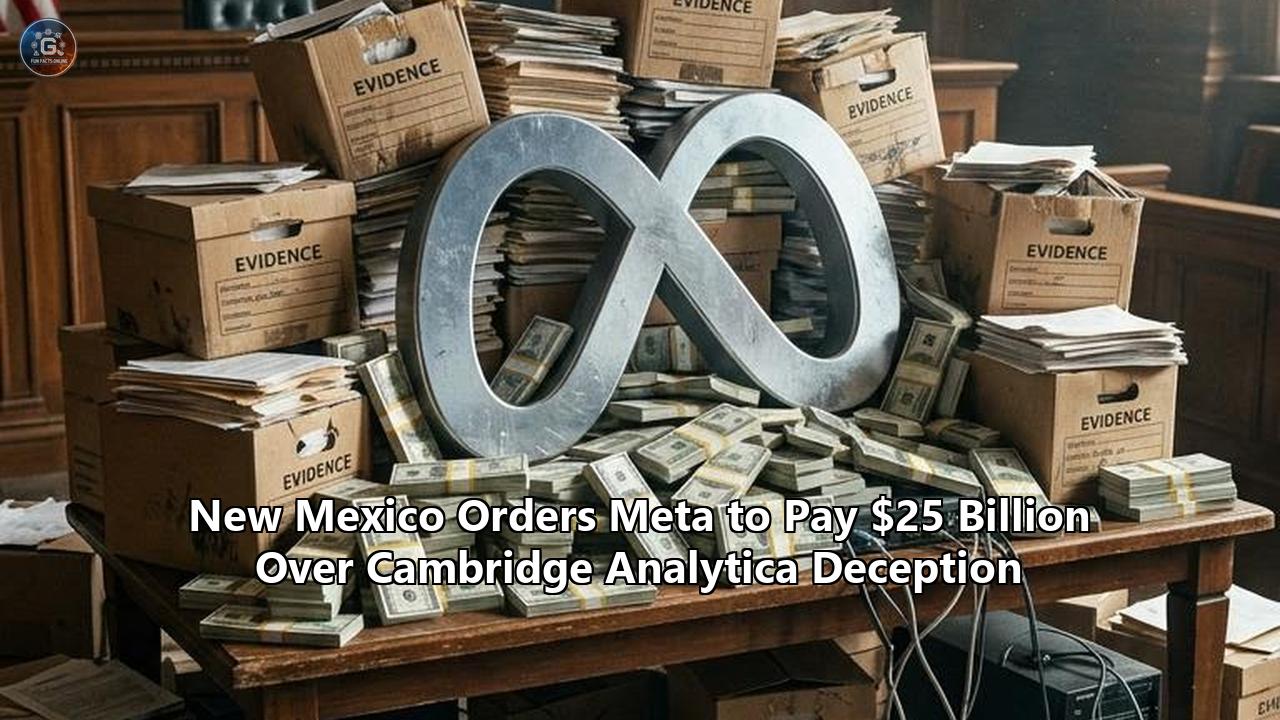
State District Court Judge Francis J. Mathew has ordered Meta Platforms Inc. to pay $25 billion in civil penalties to the state of New Mexico, concluding a five-year legal battle over the company’s data harvesting and consumer deception practices tied to the Cambridge Analytica scandal. The penalty, handed down in Santa Fe, stands as the largest single-state judicial award ever assessed against an American technology corporation.
The judgment follows a late-September jury verdict finding that Meta willfully and unconscionably violated New Mexico’s Unfair Practices Act (UPA) more than 43 million times. Jurors determined that Meta’s senior executive leadership—including Chief Executive Officer Mark Zuckerberg and former Chief Operating Officer Sheryl Sandberg—orchestrated a systematic, decade-long public campaign that misled users about who could access their personal information, the true efficacy of user privacy settings, and the company's internal investigations into rogue third-party data brokers.
"Facebook’s wrongdoing—over the course of years and systematically broadcast to the public—goes to the heart of Facebook’s core business practices," Judge Mathew wrote in his memorandum opinion. "It relates to the way in which Facebook induces people onto the platform and ultimately keeps them there. These communications were part of a coherent strategy designed to mislead the public."
The state’s attorney general, Raúl Torrez, framed the ruling as an institutional reckoning for Silicon Valley, asserting that the judgment proves states can successfully challenge monopolistic platforms outside the confines of negotiated regulatory settlements.
"This judgment should be a signal, an unambiguous message, to Silicon Valley," Torrez said during a news conference following the decision. "This case has always been about more than one company or one scandal. It is about whether corporations can mislead consumers about what happens to their personal information without facing meaningful consequences. When you deploy deceptive trade practices to extract personal wealth from our citizens, New Mexico will hold you to account."
Meta immediately vowed to challenge the ruling, signaling an aggressive appellate trajectory that will test the constitutional limits of state-level statutory penalties.
"This ruling, and the Attorney General's approach to this enforcement, makes it all but impossible to do business in the state of New Mexico," said C.J. Mahoney, Meta’s Chief Legal Officer. "At its core, this lawsuit seeks to impose a tax on speech to enforce new rules for what people can say online. We are confident we will prevail on appeal."
The $25 billion judgment represents a major stress test of the legal frameworks governing platform accountability in the United States. By examining the diverging paths of state litigation, contrasting enforcement philosophies, technical realities of corporate data architecture, and looming constitutional clashes, the ruling highlights fundamental differences between traditional regulatory compromises and aggressive courtroom adjudication.
                                LITIGATION COMPARISON MATRIX
┌───────────────────────────┬───────────────────────────────┬───────────────────────────────┐
│ Metric / Dimension        │ Multi-State Settlement Bloc   │ New Mexico Lone Litigation    │
├───────────────────────────┼───────────────────────────────┼───────────────────────────────┤
│ Ultimate Recovery         │ $18 Billion aggregate         │ $25 Billion single judgment   │
│                           │ (across 48 states)            │ (sole state beneficiary)      │
├───────────────────────────┼───────────────────────────────┼───────────────────────────────┤
│ Legal Mechanism           │ Negotiated consent decree     │ Jury verdict + Judicial order │
│                           │ & broad liability release     │ under state Unfair Practices  │
├───────────────────────────┼───────────────────────────────┼───────────────────────────────┤
│ Internal Discovery Public │ Heavily restricted or         │ Unredacted internal executive │
│ Disclosure                │ sealed via settlement terms   │ memos admitted into evidence  │
├───────────────────────────┼───────────────────────────────┼───────────────────────────────┤
│ Corporate Defense         │ Structured compliance pledges │ Constitutional challenges:    │
│ Response                  │ and administrative monitoring │ Due Process, Eighth Amendment │
├───────────────────────────┼───────────────────────────────┼───────────────────────────────┤
│ Precedential Risk Profile │ Predictable, contained cost   │ Uncapped per-violation risk,  │
│                           │ of doing business             │ asymmetric fiscal exposure    │
└───────────────────────────┴───────────────────────────────┴───────────────────────────────┘
The Strategic Split: Lone Trial Versus Coalition Settlement
The road to the $25 billion penalty illuminates two sharply opposing strategies within state and federal law enforcement: collaborative multi-state settlement diplomacy versus independent, high-risk litigation taken through verdict.
In August 2026, a coalition of 48 state attorneys general finalized an $18 billion multi-state settlement with Meta. That pact resolved sweeping allegations spanning adolescent mental health harms, algorithmic design vulnerabilities, and deceptive privacy representations. Buried within the 130-page master settlement agreement was a standard, non-negotiable clause demanded by Meta’s defense counsel: a comprehensive global release of all future claims arising from historical privacy breaches, explicitly including residual fallout from the Cambridge Analytica data harvesting incident.
Forty-eight states signed. The trade-offs driving their decision were familiar:
- Guaranteed immediate revenue distributions to state treasuries without the risk of an adverse trial verdict.
- Avoidance of multi-year appellate challenges against an adversary with virtually unlimited legal budgets.
- The imposition of behavioral remedies—such as mandated platform safety audits, independent compliance monitors, and technical roadmaps—intended to alter Meta’s operational habits.
Only New Mexico and Florida refused to join the master settlement. While Florida pursued parallel administrative proceedings, New Mexico’s Department of Justice chose complete isolation, opting to push its standalone 2021 complaint into a Santa Fe courtroom.
                     STRATEGIC FORK IN STATE TECH ENFORCEMENT

                                [State AG Coalitions]
                                          │
                   ┌──────────────────────┴──────────────────────┐
                   ▼                                             ▼
       [The 48-State Settlement]                     [New Mexico Standalone Trial]
       • Aggregate $18 Billion pool                  • $25 Billion awarded to single state
       • Broad corporate liability release           • Zero release of claims; total liability
       • Modest per-capita payout ($~55/res)         • Extraordinary per-capita value ($11,800/res)
       • Behavioral reforms & oversight              • Pure punitive & statutory economic focus
       • High certainty, low immediate risk          • High risk of appellate reduction or reversal
The mathematical divergence between these approaches is striking. Under the 48-state settlement, the average per-capita recovery for participating states amounts to roughly $55 per resident. In contrast, New Mexico’s $25 billion judgment translates to approximately $11,800 for every one of the state's 2.11 million residents.
By breaking away from the multi-state bloc, New Mexico accepted enormous downside exposure. Had Meta secured a complete defense verdict at trial, the state would have walked away with zero compensation, having expended millions of dollars in expert witness fees and contracted litigation costs. By shouldering that risk, trial counsel DiCello Levitt and local litigator Randi McGinn gained complete procedural autonomy.
Rather than bargaining behind closed executive doors, the state forced Meta to hand over troves of internal correspondence, submit its highest-ranking corporate officers to videotaped depositions, and justify its past public statements before a local jury. The resulting evidentiary record directly fueled the jury’s finding of deliberate misconduct, enabling the court to apply statutory per-violation penalties at scale.
Statutory Multipliers versus Administrative Oversight
The judicial order in Santa Fe exposes the gap between statutory deceptive-trade enforcement and traditional administrative consent decrees. For nearly a decade, the primary American regulatory response to platform privacy infractions rested on administrative settlements negotiated by the Federal Trade Commission (FTC).
In 2019, the FTC concluded its signature investigation into Facebook’s Cambridge Analytica disclosures with a then-historic $5 billion civil penalty and an expanded 20-year privacy oversight order. While celebrated at the time as a record-shattering administrative penalty, the settlement encountered intense criticism from privacy scholars, civil rights advocates, and dissenting FTC commissioners Rohit Chopra and Rebecca Kelly Slaughter.
Critics pointed out that:
- The $5 billion fine accounted for less than 9% of Facebook’s 2018 gross revenue ($55.8 billion) and was absorbed without jeopardizing capital expenditure plans or corporate earnings growth.
- The agreement shielded corporate executives from personal liability for past conduct.
- The structural operating requirements failed to fundamentally dismantle the underlying ad-targeting mechanisms that monetized personal behavioral data.
Private civil litigation similarly fell short of transforming corporate behavior. The consolidated multi-district Meta Cambridge Analytica lawsuit in the U.S. District Court for the Northern District of California culminated in late 2022 in a $725 million class settlement. While the largest recovery ever achieved in a U.S. data privacy class action, the class represented roughly 250 to 280 million domestic users. After court-approved attorney fees and administrative expenses were deducted, individual claimants received modest payments averaging around thirty dollars. The financial consequence for Meta was largely symbolic—a balance-sheet line item handled as routine operational friction.
                  EVOLUTION OF CAMBRIDGE ANALYTICA PENALTIES

  Year   Enforcement Action               Entity             Penalty Amount
 ────────────────────────────────────────────────────────────────────────────
  2019   FTC Consent Decree               Federal Agency     $5.0 Billion
  2022   MDL Private Class Action         Federal Court      $725 Million
  2026   Multi-State Omnibus Settlement   48 State AGs       $18.0 Billion (All claims)
  2026   New Mexico District Court Ruling Single State Court $25.0 Billion
New Mexico’s statutory enforcement was built on an entirely different legal architecture. Rather than pursuing common-law negligence, breach of contract, or class-action restitution, Attorney General Torrez anchored the state’s claims directly to the New Mexico Unfair Practices Act (NMSA 1978, § 57-12-1 et seq.).
The state's legal framework offers distinct strategic levers:
The Multiplier Framework
Under the UPA, a plaintiff need not prove that an individual consumer suffered specific, quantifiable out-of-pocket financial losses. Instead, liability attaches whenever a commercial actor makes a false or misleading oral or written statement, visual description, or other representation that has the capacity or tendency to deceive.
Crucially, the statute authorizes civil penalties of up to $5,000 for each violation when the conduct is determined to be willful and unconscionable.
Impression-Level Attribution
State prosecutors presented an innovative attribution theory at trial. Instead of treating the Cambridge Analytica breach as a single corporate failure, the prosecution parsed 29 distinct public assertions made by Meta between 2015 and 2021. These included:
- Claims that users maintained absolute control over their personal data.
- Pledges that Facebook did not share or sell individual identifying data to external third parties without express affirmative consent.
- Assertions that third-party applications accessing the platform’s Open Graph API were systematically vetted and held to rigorous contractual safeguards.
- Public statements insisting that an extensive internal audit had confirmed no other apps had improperly harvested bulk friend-network data after Cambridge Analytica was exposed.
The jury determined that 26 of those 29 statements were willfully false or misleading.
Trial prosecutors then introduced media distribution figures, platform delivery analytics, and consumer interaction logs proving how frequently these misrepresentations were delivered to New Mexico IP addresses, user feeds, and local news markets.
By multiplying the individual misleading statements across the recipient audience, the jury reached an astronomical tally: 43 million discrete statutory violations of state law.
               NEW MEXICO UPA PENALTY CALCULATION MODEL

    26 Deceptive Statements Proven at Trial
       × Multiplied by Media / Platform Delivery Across New Mexico
       ──────────────────────────────────────────────────────────
    = 43+ Million Total Willful Violations
       × Maximum Statutory Exposure: $5,000 per violation
       ──────────────────────────────────────────────────────────
    = $219 Billion Maximum Theoretical Exposure
       │
       ▼
    Judge Mathew's Adjusted Proportional Award: $25 Billion
Had Judge Mathew imposed the maximum allowable statutory penalty of $5,000 for each of the 43 million violations, the aggregate judgment would have exceeded $219 billion—a sum surpassing Meta's total annual operating revenue. In calibrating the award down to $25 billion, the court balanced the sheer scale of the jury’s findings with a figure meant to be economically felt without causing insolvency.
This per-impression statutory multiplier fundamentally upends corporate risk assessment. For decades, tech platforms have treated federal regulatory enforcement as a predictable, manageable overhead expense. The New Mexico verdict breaks that predictability by establishing that a single state with barely two million residents can extract tens of billions of dollars using state consumer protection statutes.
Frontend Privacy Interfaces versus Backend Graph Systems
At the core of the trial was a technical dispute between user-facing software interfaces and backend distributed data systems. The state’s technical witnesses deconstructed the architecture of Facebook’s platform, demonstrating how user controls were built to give the appearance of data security while underlying data-sharing pipelines continued serving the company's advertising model.
The controversy dates back to Facebook’s launch of the Open Graph API v1.0 in 2010. During this architectural era, the social network operated on a relational schema that treated a user’s social connections—their "Friends"—as an accessible property of the user object itself.
When a single individual authorized an external third-party application, such as Aleksandr Kogan’s "This Is Your Digital Life" personality quiz, the application did not merely scrape the consenting user’s demographic details. Through the API’s default permissions, the application obtained deep behavioral, demographic, and ideological data from every individual within that user’s friend network—even though those friends had never installed the application, visited the developer’s domain, or received explicit notice of the transfer.
                 OPEN GRAPH API v1.0 DATA HARVESTING PIPELINE

  [Target User] ──(Installs App)──> ["This Is Your Digital Life" Quiz]
        │                                        │
        ├─ Grants Permission                     ├─ Requests Expanded Permissions:
        │  for Own Profile                       │  `friends_about_me`, `friends_likes`,
        │                                        │  `friends_hometown`, `friends_location`
        ▼                                        ▼
  [Friend Network] ───────────────────────> [Aleksandr Kogan / GSR]
  (87 Million Users)                             │
  (Never visited app,                            │ Unauthorized Transfer
   never granted direct consent)                 ▼
                                            [Cambridge Analytica]
                                            (Targeted Political Profiling)
During the trial, the state contrasted Meta's public-facing statements regarding user control with unredacted internal engineering discussions. The state entered into evidence internal emails and deposition testimony showing that company leadership understood the fundamental incompatibility between advertising monetization and genuine user control.
Among the most damaging exhibits was an internal executive memo authored by Mark Zuckerberg during the height of the platform’s interface redesigns. Zuckerberg wrote: "Give them a chance to change their privacy settings but obviously don't encourage it".
Trial testimony revealed that Meta’s engineering teams deployed deceptive design patterns—commonly termed dark patterns—specifically calibrated to minimize user friction when onboarding, maximize data extraction, and bury opt-out menus behind labyrinthine multi-screen menus.
                     CONTRASTING SYSTEM ARCHITECTURES

┌─────────────────────────────────┬─────────────────────────────────┐
│ Meta Frontend Consumer Facade   │ Meta Backend Data Reality       │
├─────────────────────────────────┼─────────────────────────────────┤
│ "You own and control your data" │ Complex relational graph models │
│ toggles displayed to users      │ that commodified user data      │
├─────────────────────────────────┼─────────────────────────────────┤
│ Clear "Off-Facebook Activity"   │ Shadow profiling engines via    │
│ management controls advertised  │ Meta Pixel across third-party   │
│ in public marketing campaigns   │ internet web ecosystems         │
├─────────────────────────────────┼─────────────────────────────────┤
│ Deprecation of Open Graph v1.0  │ Selective "whitelisting" of     │
│ framed as total cessation of    │ enterprise corporate partners   │
│ third-party unauthorized data   │ granted persistent, privileged  │
│ harvesting                      │ backend API data pipes          │
├─────────────────────────────────┼─────────────────────────────────┤
│ Public assurances of systematic │ Incomplete, discontinued audits │
│ internal audits hunting rogue   │ of external app developers due  │
│ third-party app developers      │ to engineering resource costs   │
└─────────────────────────────────┴─────────────────────────────────┘
The state demonstrated through technical forensics that Meta's public assertions of rigorous enforcement were inaccurate. When Facebook publicly announced in March 2018 that it was investigating thousands of apps that had access to large amounts of data prior to the 2014 API rule changes, the internal reality looked far different.
Documents revealed that Meta quietly wound down its App Developer Investigation (ADI) program long before thoroughly checking the thousands of applications flagged as high risk. The company determined that conducting deep, forensic, on-site server inspections was technically difficult, legally fraught, and operationally expensive.
Yet, public statements from corporate leadership assured users that the platform had cleaned up its ecosystem and neutralized unauthorized data harvesting. Judge Mathew specifically focused on this disconnect, characterizing the promised post-scandal investigation as "willfully ineffective" and finding that it formed a key part of the 43 million deceptive representations delivered across New Mexico.
Due Process Proportionality and the Eighth Amendment
The core legal dispute in the Meta Cambridge Analytica lawsuit now shifts from liability to constitutional proportionality under the Fourteenth Amendment’s Due Process Clause and the Eighth Amendment’s Excessive Fines Clause. Meta's appellate challenge, which will initially proceed to the New Mexico Court of Appeals before heading to the state Supreme Court and potentially the U.S. Supreme Court, argues that the $25 billion award is legally indefensible.
                  APPELLATE CONSTITUTIONAL CONFRONTATION

   State of New Mexico's Defense             Meta Platforms Inc.'s Appeal
 ────────────────────────────────────────────────────────────────────────────
 • Pure statutory civil penalty under     • Violation of Substantive Due
   state police powers, not standard        Process under *BMW* and *State Farm*
   common-law punitive damages.             proportionality standards.

 • Each violation represents a distinct,  • $25 billion penalty is grossly
   verifiable act of consumer deception     disproportionate to economic harm
   broadcast to real residents.             in a state of 2.1 million people.

 • Aggregation reflects corporate scale   • Excessive Fines Clause (*Timbs v.
   and the willful, systematic nature       Indiana*) restricts punitive state
   of senior executive misconduct.          statutory penalties.
Meta’s appellate defense relies on established U.S. Supreme Court jurisprudence limiting excessive civil penalties, most notably BMW of North America, Inc. v. Gore (1996) and State Farm Mutual Automobile Insurance Co. v. Campbell (2003). In these foundational cases, the Supreme Court established that punitive awards violating certain guideposts—specifically the degree of reprehensibility, the disparity between actual harm and the punitive award, and the difference between the remedy and civil penalties imposed in comparable cases—cross the line into arbitrary deprivations of property under the Fourteenth Amendment.
Under typical State Farm analysis, punitive-to-compensatory damage ratios rarely exceed single digits without triggering constitutional concerns. Meta’s appellate attorneys argue that:
- The state presented zero direct evidence showing that New Mexico citizens suffered tens of billions of dollars in tangible economic harm.
- The civil penalty of $25 billion dwarfs the state's total economic output from the technology sector and is detached from any measurable compensatory baseline.
- The penalty violates the Eighth Amendment’s Excessive Fines Clause, which was incorporated against the states by the U.S. Supreme Court in Timbs v. Indiana (2019). Meta contends that a $25 billion penalty for consumer deception is inherently excessive and punitive.
Conversely, the New Mexico Attorney General’s Office maintains that Meta is conflating common-law punitive damages with statutory civil penalties.
The state's legal counter-arguments rest on distinct principles:
- Statutory Integrity: The civil penalties were not generated by a runaway jury applying open-ended punitive discretion. The jury simply answered questions of fact regarding whether violations occurred, and Judge Mathew applied a statutory scheme established by the New Mexico Legislature.
- Per-Violation Legality: Under long-standing statutory penalty jurisprudence—including St. Louis, I.M. & S. Ry. Co. v. Williams (1919)—legislatures retain wide discretion to establish per-violation fines for offenses against public welfare. Such penalties only violate due process if they are so severe and oppressive as to be wholly disproportionate to the offense.
- Corporate Scale as a Factor in Deterrence: As trial counsel Randi McGinn argued before Judge Mathew, applying nominal penalties to a company with a market capitalization exceeding $1.5 trillion would transform state law enforcement into a minor cost of business. To achieve the legislative purpose of deterrence, statutory penalties must be large enough to impact the violator's financial balance sheet.
This constitutional confrontation will test how statutory accumulation interacts with modern digital platforms. When a platform's algorithms can broadcast an identical deceptive statement millions of times directly to consumers' screens, does the aggregation of thousands of modest statutory violations unconstitutionally violate due process? Or does insulating Big Tech from these cumulative penalties give high-volume digital platforms an unfair legal advantage over traditional brick-and-mortar businesses?
Commercial Deception versus Free Expression
The clash between Meta and New Mexico extends beyond basic statutory interpretation, setting up a fundamental showdown over the boundaries of commercial speech and platform governance. In responding to Judge Mathew's $25 billion order, Meta Chief Legal Officer C.J. Mahoney framed the ruling not as a routine privacy penalty, but as an unconstitutional regulatory overreach targeting platform speech.
"At its core, this lawsuit seeks to impose a tax on speech to enforce new rules for what people can say online," Mahoney said.
This framing draws directly from Meta’s broader legal strategy across the country, where the company has increasingly relied on the First Amendment to challenge state regulations. In major constitutional disputes—such as Moody v. NetChoice and NetChoice v. Paxton—the tech industry successfully argued that platforms exercise protected editorial discretion when organizing, curating, and moderating online content.
By categorizing New Mexico’s consumer protection lawsuit as an attempt to penalize platform speech, Meta is trying to bring consumer privacy litigation under this same First Amendment umbrella.
               SPEECH DOCTRINE vs. CONSUMER PROTECTION

       Meta's First Amendment Shield         State's Commercial Speech Doctrine
 ┌─────────────────────────────────────────┬─────────────────────────────────────────┐
 │ Theory: Content Moderation & Editorial  │ Theory: Pure Commercial Consumer Fraud  │
 │ Discretion                              │ Under *Central Hudson* Standards        │
 ├─────────────────────────────────────────┼─────────────────────────────────────────┤
 │ Public statements regarding platform    │ Public statements about data privacy    │
 │ safety, integrity, and policies are     │ are commercial representations designed │
 │ expressive commentary on matters of     │ to induce consumers to join and remain  │
 │ public concern and debate.              │ on the monetized service.               │
 ├─────────────────────────────────────────┼─────────────────────────────────────────┤
 │ Penalties targeting how platforms       │ False or misleading commercial speech   │
 │ moderate content or describe speech     │ receives zero protection under the      │
 │ policies operate as an unconstitutional │ First Amendment and is subject to state │
 │ regulatory tax on platform operations.  │ trade practices penalties.              │
 └─────────────────────────────────────────┴─────────────────────────────────────────┘
The State of New Mexico rejects this First Amendment defense as an attempt to obscure basic corporate fraud.
In briefs submitted during the trial, state prosecutors made the distinction clear:
- The lawsuit did not target third-party political discourse, editorial choices, or user posts on Facebook.
- The violations stemmed from Meta’s own commercial misrepresentations regarding the functionality, privacy controls, and data protection practices of its products.
Under the long-standing commercial speech doctrine established in Central Hudson Gas & Electric Corp. v. Public Service Commission (1980), the First Amendment offers no protection to commercial speech that is false, deceptive, or misleading. When a corporate entity makes material misstatements about how it protects customer data to preserve user engagement and advertising revenues, those statements fall squarely under state consumer protection statutes.
Meta’s counter-argument suggests that state attorneys general are repurposing consumer protection laws to penalize platforms for subjective statements about safety, civic integrity, and content moderation. If a state court can penalize a tech company billions of dollars because it decides the platform failed to live up to its public statements regarding content moderation, Meta argues that state officials will effectively control online public discourse.
This friction between consumer protection enforcement and corporate speech defenses represents one of the most consequential battlegrounds in technology law. If the appellate courts uphold Judge Mathew’s ruling, it will set a clear precedent: tech platforms cannot shield deceptive marketing and consumer privacy statements behind the First Amendment.
State Budgets versus Big Tech Balance Sheets
The financial impact of a $25 billion judgment creates a striking contrast between the fiscal balance sheet of an American state and the capital structure of a global technology monopoly.
                 FISCAL SCALE COMPARISON (FY 2026)

    Meta Platforms Annual Free Cash Flow ─────── ~$40-50 Billion

    Judge Mathew's Penalty Order ────────────── $25 Billion

    State of New Mexico Total Annual Budget ─── $10.2 Billion

    New Mexico Public School Reform Fund ────── $4.1 Billion
For New Mexico, an influx of $25 billion represents a massive fiscal development. The entire annual general fund budget for the state hovers around $10.2 billion. The judgment is roughly two and a half times the state's entire annual operating budget.
Under the New Mexico Unfair Practices Act and state fiscal statutes, civil penalties recovered by the Attorney General must be directed into the state treasury, with substantial portions legally dedicated to the state’s public education system and permanent endowment funds.
If upheld on appeal, the funds could:
- Double the size of New Mexico’s Land Grant Permanent Fund, securing permanent, inflation-proof funding for public early childhood education and higher education tuition assistance.
- Overhaul state infrastructure, modernizing public broadband networks, rural healthcare clinics, and community water management systems.
- Earn New Mexico an additional 15 percent post-judgment interest per year under state law until the obligation is settled in full, adding roughly $3.75 billion annually while appeals run their course.
For Meta, the penalty represents a major operational and financial disruption. Meta generated more than $134 billion in revenue in 2023, with current annual operational revenues climbing past $160 billion and annual free cash flows stabilizing between $40 billion and $50 billion. A sudden, non-tax-deductible $25 billion cash outflow would consume roughly half of the company’s entire annual free cash flow.
                      META CAPITAL ALLOCATION IMPACT

            [Annual Free Cash Flow: ~$45 Billion]
                              │
             ┌────────────────┴────────────────┐
             ▼                                 ▼
   [Normal Capital Allocation]        [With $25B NM Penalty]
   • Infrastructure & AI: ~$35B       • Infrastructure & AI: ~$20B (Squeezed)
   • Share Repurchases: ~$10B         • Share Repurchases: Paused/Eliminated
                                      • New Mexico Judgment Outflow: $25B
Such an expense would likely force Meta to reduce its share repurchase programs, scale back multi-billion-dollar investments in artificial intelligence infrastructure, and explain to Wall Street why historical liability from a 2014-era breach remains capable of impacting current earnings.
This dynamic explains the aggressive response from Meta’s legal leadership, including the public assertion that the ruling makes it "all but impossible to do business in the state of New Mexico".
This language hints at a potential corporate weapon: jurisdictional geofencing.
               JURISDICTIONAL RISK & RETALIATION SPECTRUM

   Low Impact                                                   High Impact
 ┌───────────────────────┬───────────────────────┬─────────────────────────┐
 │ Geofenced Features    │ Commercial Boycott    │ Complete Market Exit    │
 ├───────────────────────┼───────────────────────┼─────────────────────────┤
 │ Disabling specific    │ Halting regional data │ Shutting down access    │
 │ beta capabilities, AI │ center investments &  │ to Facebook, Instagram, │
 │ tools, or specialized │ civic sponsorship     │ and WhatsApp for IP     │
 │ services for state    │ programs across the   │ ranges registered in    │
 │ residents.            │ state.                │ New Mexico.             │
 └───────────────────────┴───────────────────────┴─────────────────────────┘
While completely pulling core services like Facebook, Instagram, and WhatsApp out of New Mexico would spark severe public blowback and advertiser unrest, Meta could deploy targeted measures:
- Suspending future capital commitments for hyperscale data centers in the state, diverting infrastructure spending toward more compliant jurisdictions like Arizona, Utah, or Texas.
- Geofencing and withholding newly released features—such as next-generation AI assistants, experimental commerce integrations, or developer platforms—citing the state's aggressive legal environment.
- Lobbying state business groups and chambers of commerce to pressure the Legislature into amending the Unfair Practices Act, attempting to cap statutory penalties or weaken the Attorney General's enforcement authority.
This dynamic exposes the real-world trade-offs of localized regulatory enforcement. By using its legal system to hit a global tech giant with a record fine, New Mexico has secured a landmark legal victory while directly inviting capital flight and corporate resistance.
American Decentralization versus Global Structural Regulation
The Santa Fe judgment highlights the decentralized nature of digital platform regulation in the United States, particularly when contrasted with the statutory frameworks governing the European Union and other international jurisdictions.
The European Union has spent the last decade building a unified, top-down regulatory system:
- The General Data Protection Regulation (GDPR) establishes comprehensive, continent-wide rules governing data processing, consent, and user portability, enforced by designated Data Protection Authorities and the European Data Protection Board.
- The Digital Markets Act (DMA) identifies major platforms as "gatekeepers," outlawing self-preferencing and requiring backend interoperability under threat of structural remedies.
- The Digital Services Act (DSA) mandates algorithmic audits, transparent advertising repositories, and coordinated systemic-risk assessments.
European financial penalties are tethered directly to a platform's total corporate scale. Under the GDPR, maximum fines are capped at 4% of a company’s global annual turnover, while the DMA permits fines reaching 10%—or up to 20% for repeated violations. Enforcement operates predictably through centralized regulatory channels, giving multinational corporations a clear view of their potential legal exposure.
                  REGULATORY PHILOSOPHY COMPARISON

 ┌───────────────────────────┬───────────────────────────┬───────────────────────────┐
 │ Dimension                 │ European Union Framework  │ U.S. State-Led Framework  │
 │                           │ (GDPR / DMA / DSA)        │ (New Mexico / UPA Model)  │
 ├───────────────────────────┼───────────────────────────┼───────────────────────────┤
 │ Legislative Architecture  │ Comprehensive, omnibus,   │ Fragmented, sector-based, │
 │                           │ unified data framework    │ decentralized across states│
 ├───────────────────────────┼───────────────────────────┼───────────────────────────┤
 │ Enforcement Agency        │ Centralized Data          │ Elected State AGs, local  │
 │                           │ Protection Authorities    │ juries, state court judges │
 ├───────────────────────────┼───────────────────────────┼───────────────────────────┤
 │ Penalty Metrics           │ Fixed percentage of total │ Uncapped statutory fines  │
 │                           │ global annual turnover    │ per violation/impression  │
 ├───────────────────────────┼───────────────────────────┼───────────────────────────┤
 │ Primary Focus             │ Ex-ante structural rules  │ Ex-post consumer fraud    │
 │                           │ and process compliance    │ penalties and restitution │
 └───────────────────────────┴───────────────────────────┴───────────────────────────┘
The United States has taken the opposite path. A unified federal consumer data privacy law remains stalled in Congress, held back by disputes over whether federal legislation should preempt stronger state regulations and whether ordinary citizens should have a private right of action.
This federal vacuum has allowed individual states to step in:
- States like California, Virginia, Colorado, and Connecticut have enacted standalone comprehensive privacy frameworks that grant consumers data deletion and opt-out privileges.
- Enforcement across the country remains decentralized. Without a dedicated national data protection authority, enforcement power falls to 50 state attorneys general, each operating under their own state consumer protection statutes.
- Rather than imposing percentage-based administrative caps on global revenues, state statutes like New Mexico’s UPA rely on per-violation penalties. In an era where platforms interact with users millions of times a day, this model introduces unprecedented financial volatility for tech companies.
This fragmented enforcement landscape presents clear trade-offs. The decentralized American model allows a motivated attorney general in an economically smaller state to break through corporate defenses that stalled federal regulators. At the same time, this fractured system leaves multinational platforms subject to wildly unpredictable legal standards, where a single state court can impose a penalty that threatens a company's global earnings.
The Road Ahead for State-Level Enforcement
The immediate ramifications of the New Mexico ruling will test whether the Meta Cambridge Analytica lawsuit marks the peak of state-level data privacy enforcement or the opening salvo of a protracted period of jurisdictional fragmentation.
                 UPCOMING PROCEDURAL & LEGAL MILESTONES

  Q4 2026 ──► [Appellate Supersedeas Bond Hearing]
              State District Court in Santa Fe determines whether Meta
              must post a full or partial cash bond (up to $25B) to
              stay enforcement during appeal.

  2027    ──► [New Mexico Court of Appeals Review]
              Direct review of jury instructions, statutory definitions of
              "willful violations," and application of per-impression multipliers.

  2027-28 ──► [New Mexico Supreme Court Adjudication]
              State high court addresses whether the $25B penalty violates
              state constitutional guarantees or exceeds statutory authority.

  2028+   ──► [U.S. Supreme Court Petition]
              Potential petition for writ of certiorari regarding Fourteenth
              Amendment Due Process limits and the Eighth Amendment's
              Excessive Fines Clause (*Timbs*).
The most pressing procedural hurdle is the appellate supersedeas bond requirement. Under New Mexico Rule of Appellate Procedure 12-207, an appellant seeking to stay the execution of a civil money judgment pending appeal must generally post an adequate supersedeas bond.
If Judge Mathew demands that Meta post a full or substantial cash bond covering the $25 billion judgment, Meta would be forced to tie up immense capital reserves or secure unprecedented third-party surety backing simply to exercise its right to appeal. Meta’s legal team is expected to seek an emergency stay, arguing that requiring an appellate bond of this magnitude would cause immediate corporate injury and violate state due process.
Beyond the immediate bond skirmish, the New Mexico ruling provides a viable legal playbook for pending litigation across the country. Attorneys general pursuing cases against Big Tech platforms—such as lawsuits targeting TikTok’s algorithmic design, Google’s location-tracking systems, and Amazon’s pricing algorithms—will be studying the Santa Fe verdict.
State prosecutors will examine how New Mexico’s trial team:
- Successfully convinced a jury to treat platform design choices and recurring public statements as millions of individual consumer protection violations.
- Secured internal executive communications, including Mark Zuckerberg's memos, to establish willful and unconscionable misconduct.
- Transformed statutory per-violation penalties into multi-billion-dollar liabilities without relying on complex class-action certifications.
At the same time, this $25 billion judgment increases the pressure on federal lawmakers. Multinational technology companies that once lobbied against federal privacy legislation may soon reverse course, aggressively pushing for a federal privacy bill that includes total preemption of state consumer protection remedies. For Silicon Valley, complying with a strict federal data standard has become far more appealing than facing unpredictable, multi-billion-dollar trials in individual state courtrooms.
The Santa Fe judgment firmly ends the era of modest, predictable corporate settlements. By taking the Cambridge Analytica scandal all the way through a state jury trial and securing a $25 billion award, New Mexico has proven that localized sovereign litigation can impose historic financial consequences on the world's most powerful platforms. The legal, constitutional, and economic shockwaves will reverberate through courtrooms and corporate boardrooms for years to come.
Reference:
- https://www.pbs.org/newshour/nation/meta-must-pay-new-mexico-25-billion-its-biggest-fine-ever-for-deceiving-users-about-facebook-privacy
- https://www.courthousenews.com/new-mexico-jury-finds-facebook-liable-of-deceiving-users-about-privacy-protections/
- https://www.businessinsider.com/meta-25-billion-penalty-cambridge-analytica-case-new-mexico-2026-10
- https://seekingalpha.com/news/4655424-meta-to-pay-25b-to-new-mexico-in-cambridge-analytica-case
- https://gizmodo.com/judge-orders-meta-to-pay-25-billion-over-decade-old-facebook-scandal-2000828968
- https://www.foxbusiness.com/technology/meta-ordered-pay-25b-jury-finds-misled-facebook-users
- https://dicellolevitt.com/new-mexico-secures-resounding-jury-victory-against-meta-in-cambridge-analytica-privacy-trial/
- https://www.cbsnews.com/news/meta-new-mexico-25-billion-privacy-ruling/
- https://edition.cnn.com/2026/10/21/tech/meta-25-billion-new-mexico-judgment
- https://www.engadget.com/2293597/new-mexico-court-order-meta-pay-25-billion-privacy-case/