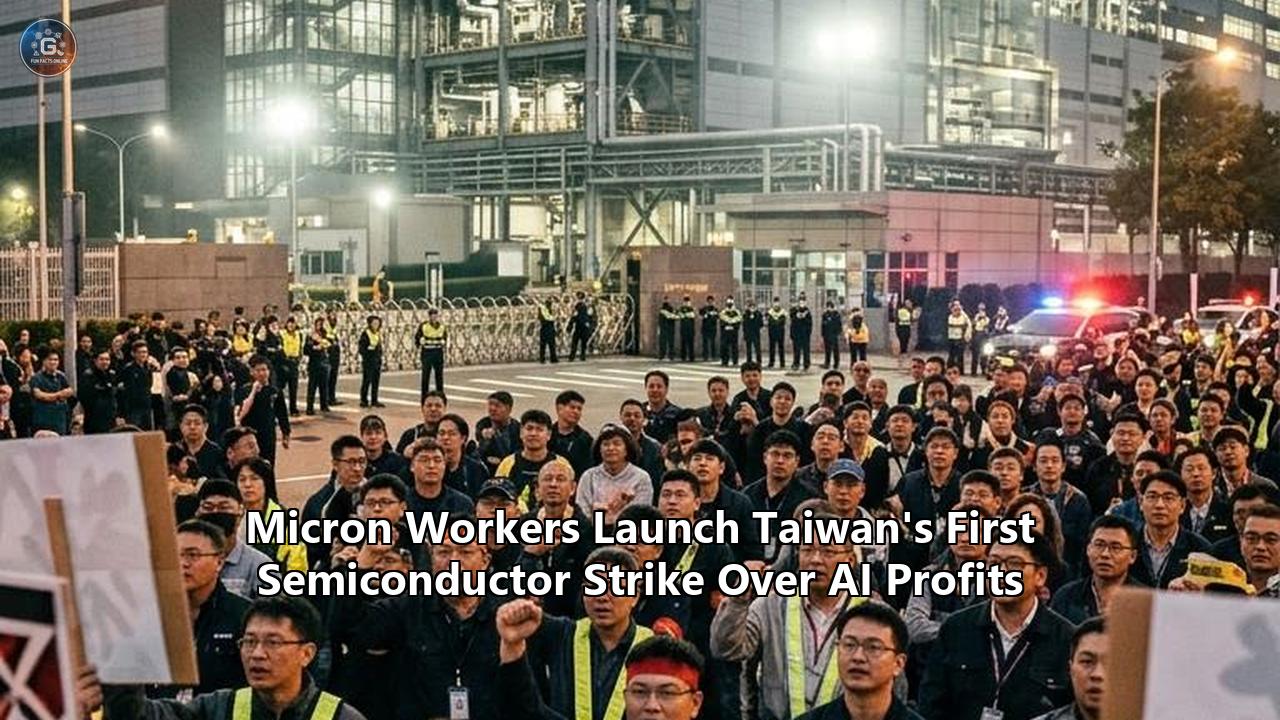
TAOYUAN, Taiwan — At 9:00 a.m. on Thursday, October 22, 2026, a crowd of semiconductor workers dressed in union vests assembled outside the gates of Micron Technology’s fabrication complex in Taoyuan. Above the security barriers, union leaders unfurled a white-and-red banner carrying an uncompromising message: “Micron failed to propose a profit-sharing scheme. The Taoyuan union will immediately begin strike action”.
With those words, decades of industrial docility across Taiwan’s high-tech manufacturing sector came to an end. The 24-hour warning walkout staged by the Taoyuan union marks the first formal strike in the history of Taiwan’s semiconductor industry, shattering the island’s longstanding reputation for unyielding labor harmony inside the cleanrooms that anchor the global tech economy.
The walkout followed an eleventh-hour collapse of government-mediated labor talks on Wednesday evening. While Micron managed to avert an island-wide shutdown by striking a quiet, confidential pact with a separate union at its larger Taichung site late Wednesday afternoon, workers in Taoyuan refused to back down without an explicit, mathematically defined profit-sharing formula. Demanding a permanent system that channels 15% of annual operating profit into quarterly employee bonuses, the union took industrial action against the world’s third-largest memory chipmaker at the absolute peak of an artificial intelligence spending wave.
The immediate ripple effects of the Micron Taiwan strike extend far beyond the perimeter of Fab 11 in Taoyuan. The facility produces approximately 22% of Micron’s global dynamic random-access memory (DRAM) wafer capacity and acts as an indispensable link in the packaging and verification pipeline for High-Bandwidth Memory (HBM)—the specialized silicon stacks required by AI accelerators from Nvidia, AMD, and custom hyperscaler server platforms. With more than 75% of Micron’s fiscal 2027 advanced memory capacity already contracted to enterprise clients, the standoff exposes a structural fault line running through the AI boom: the technicians, cleanroom operators, and process engineers who run round-the-clock wafer fabrication facilities are no longer willing to accept discretionary executive bonuses while corporate margins surge into historic territory.
THE ESCALATION ARC: HOW TAIWAN'S FIRST CHIP STRIKE UNFOLDED

[Late 2024 - Mid 2026]
AI boom accelerates; Micron operating profits surge. Cleanroom workloads multiply.
          │
          ▼
[July - August 2026]
Korean memory unions win 10-10.5% profit-sharing deals at Samsung and SK Hynix.
          │
          ▼
[Sept 16, 2026]
Micron offers NT$1M (~$31.6K) one-off bonuses; Taiwan unions reject discretionary payouts.
          │
          ▼
[Oct 7, 2026]
Taoyuan union votes 99.1% to authorize industrial action.
          │
          ▼
[Oct 21, 2026 (Midday)]
Micron splits labor front: signs quiet deal with Taichung union.
          │
          ▼
[Oct 21, 2026 (8:45 PM)]
Taoyuan mediation collapses over lack of explicit formula.
          │
          ▼
[Oct 22, 2026 (9:00 AM)]
Workers walk off the line; Taiwan's first semiconductor strike officially begins.
1. The Supercycle Divide: How the AI Windfall Sparked Fab Floor Friction
The road to the picket line began two years prior, when generative artificial intelligence transitioned from software experiments into physical infrastructure deployments. Modern AI clusters demand vast quantities of HBM, an architecture that stacks multiple DRAM dies vertically using through-silicon vias (TSVs) to achieve multi-terabyte-per-second memory bandwidth. For memory producers, the impact on corporate balance sheets was immediate and transformative.
For Micron, which maintains roughly 50% to 60% of its total manufacturing footprint and 15,000 employees in Taiwan, the AI memory cycle overturned years of post-pandemic cyclical downturns. In fiscal 2023, the memory sector suffered one of its deepest contractions in history, marked by billions of dollars in write-downs, capital expenditure cuts, and global headcount reductions. In Taiwan, workers accepted hiring freezes, scaled-back variable compensation, and mandatory cost-control programs.
By early 2026, the picture had inverted completely. Enterprise demand for 8-high and 12-high HBM3E modules outstripped supply across the entire industry. Micron's DRAM lines ran at capacity, driving operating income toward historic levels.
Inside the fabs at Taichung and Taoyuan, however, the day-to-day conditions tell a very different story. Manufacturing high-bandwidth memory is vastly more labor-intensive and yield-sensitive than turning out standard commodity DDR4 or DDR5 components. Fabrication operators and equipment maintenance engineers faced grueling 12-hour rotating shifts. The transition to advanced 1-beta (1b) and 1-gamma (1γ) nanometer process nodes required engineers to spend extended hours in cleanrooms wearing positive-pressure bunny suits, managing ultra-pure chemical distribution systems, tuning extreme ultraviolet (EUV) lithography scanners, and handling wafer warpage problems inherent to microscopic 3D stacking.
Fab technicians observed corporate executives presenting quarterly earnings calls that celebrated record cash flows and sold-out manufacturing lines through 2027. Yet internal compensation schemes remained chained to an older framework: base salaries with modest annual performance bonuses determined entirely at management’s discretion.
The tension crystallized around a basic principle of equity. Workers pointed out that while equipment depreciates and corporate executives collect equity packages indexed to stock valuations, the front-line engineering teams absorbed the physical and psychological toll of keeping continuous-flow production lines operational 24 hours a day, 365 days a year. The feeling that corporate headquarters in Boise, Idaho, viewed Taiwan as a low-cost production outpost began to spread through internal messaging boards and union halls across northern and central Taiwan.
2. The South Korean Precedent: Suwon and Icheon Rewrite the Rules
The discontent in Taiwan might have simmered without boiling over had it not been for a labor realignment across the East China Sea. In South Korea, home to Micron’s chief competitors Samsung Electronics and SK Hynix, semiconductor labor had spent the preceding two years breaking through historical taboos against collective industrial resistance.
In early 2026, the National Samsung Electronics Union (NSEU)—representing tens of thousands of semiconductor workers—staged strategic work stoppages, threatening to disrupt Samsung's critical chip fabrication operations. The dispute ended when Samsung management conceded to an agreement allocating 10.5% of its semiconductor division’s operating profit into an institutionalized, transparent bonus pool. Soon after, SK Hynix cemented an accord with its own labor union, establishing an uncapped bonus framework guaranteeing 10% of overall annual operating profit directly to employees.
These settlements reverberated through Taiwan’s tech sector. For years, international chip executives had cited South Korea’s structured compensation and high bonus levels as unique to chaebol governance. But Taiwanese chip workers saw things differently: they operated the same ASML lithography tools, applied the same atomic-layer deposition recipes, and achieved equal or superior wafer yields compared to their Korean counterparts.
HOW THE REGIONAL PROFIT-SHARING FORMULAS COMPARE

┌────────────────────────┬───────────────────────────────────────────┬──────────────────────────┐
│ Company / Facility     │ Mechanism                                 │ Profit Pool Allocation   │
├────────────────────────┼───────────────────────────────────────────┼──────────────────────────┤
│ Samsung Electronics    │ Institutionalized Division Bonus Fund     │ 10.5% of operating profit│
│ SK Hynix               │ Uncapped Collective Bargaining Pool       │ 10.0% of operating profit│
│ Micron Taoyuan (Demand)│ Legally Binding Quarterly Profit Sharing  │ 15.0% of operating profit│
│ Micron Taiwan (Offer)  │ Discretionary One-Time Bonus (FY26)       │ ~4.4% equivalent         │
└────────────────────────┴───────────────────────────────────────────┴──────────────────────────┘
The South Korean deals provided the Taiwan unions with an empirical benchmark. At union meetings in Taoyuan and Taichung throughout July and August 2026, labor organizers passed around translated copies of the Samsung and SK Hynix agreements. The lesson was direct: transparent, formulaic profit-sharing was achievable if the workforce maintained collective solidarity.
The Taiwanese unions decided not merely to match the Korean benchmark, but to exceed it. They formulated a core demand: starting in fiscal 2027, Micron must legally bind itself to distributing 15% of its Taiwan operations' annual operating profit directly to workers, disbursed on a predictable, quarterly basis. In addition, to settle the accounts for the blistering production pace of the preceding 12 months, the unions demanded a one-off fiscal 2026 windfall payout equivalent to up to 83 months of base salary.
3. The September Gambit: Cash Bonuses and the Reject Payout
Faced with a brewing labor challenge in Taiwan, Micron’s executive leadership attempted to resolve the dispute with capital rather than institutional reform.
On September 16, 2026, Micron rolled out an aggressive compensation proposal for its Taiwan employees. The package was designed to stun the workforce with headline numbers: eligible staff were offered an immediate one-time cash bonus of NT$1 million (approximately $31,650), combined with special equity retention grants and variable performance awards. Depending on tenure and engineering rank, the total package ranged between 35 and 68 months of base salary.
In corporate boardrooms, an offer equivalent to several years of base pay was viewed as overwhelmingly generous. But the unions saw the offer as a tactical maneuver to avoid signing a binding collective bargaining contract.
Union analysts calculated that when measured against Micron’s surging operating profits, the total monetary value of the one-off cash bonus pool represented roughly 4.4% of operating earnings—less than half the percentage secured by their South Korean counterparts. More critically, the payout was structured as an extraordinary, non-precedent-setting bonus. It contained no contractual guarantees for fiscal 2027 and offered no transparent audit mechanism that would allow workers to verify how future bonuses were calculated.
The Taoyuan union leadership held an emergency general assembly. The decision was unanimous: reject the offer.
"A one-time bonus is a gift that management can revoke the moment the market cools," union representatives argued during internal consultations. "Without a fixed, statutory profit-sharing formula written into a collective bargaining agreement, workers will be right back where they started the moment the AI cycle softens."
When Micron management declined to amend the proposal during formal mediation sessions held by the Taoyuan City Department of Labor in late September, the mediation concluded in statutory failure. Under Taiwan’s Labor Union Act, that failure unlocked the legal pathway for union members to hold a binding strike authorization vote.
4. The 99% Mandate: The October Turning Point
The labor dispute reached the point of no return during the first week of October 2026.
On October 7, the Taoyuan union—which represents approximately 2,335 workers, or roughly 70% of the Taoyuan facility’s direct production and engineering workforce—closed its strike ballot boxes. The results delivered a clear message to management in Boise and Taipei.
Out of 2,258 eligible voting union members, 2,012 cast ballots. A total of 1,994 members voted in favor of strike action. That represented an approval rate of 99.1% among those voting, and 88.3% of the total eligible union membership.
TAOYUAN UNION STRIKE AUTHORIZATION VOTE (OCTOBER 7, 2026)

Total Eligible Union Membership: 2,258
Ballots Cast:                     2,012 (89.1% Turnout)
──────────────────────────────────────────────────────────
Votes IN FAVOR of Strike:         1,994 (99.1% of votes cast)
Votes AGAINST Strike:                18 ( 0.9% of votes cast)
──────────────────────────────────────────────────────────
Absolute Membership Endorsement:  88.3% of total roster
The outcome eliminated any executive assumption that the dispute was driven by a radical union minority. It proved that the rank-and-file cleanroom workforce, down to individual line technicians, was prepared to bring production lines to a halt.
The strike vote sent ripples through the Taiwanese government. The semiconductor industry is Taiwan’s economic backbone, an industrial cluster that generated more than 15% of the island’s GDP and provided the geopolitical foundation often referred to as the "Silicon Shield." A high-profile strike inside a Tier-1 semiconductor fab carried deep reputational risks for an administration working to preserve international confidence in Taiwan's manufacturing reliability.
Taiwanese President Lai Ching-te intervened publicly, calling on both Micron management and worker representatives to negotiate "sincerely" and seek consensus before factory floors were affected. Taiwan’s Ministry of Labor issued a parallel statement, acknowledging the constitutional validity of the strike vote while dispatching senior mediators to broker informal compromise sessions.
Micron responded by playing a bifurcated corporate strategy. The company operates two primary manufacturing bases in Taiwan: Fab 11 in Taoyuan (formerly Inotera Memories) and Fab 16 in Taichung (formerly Rexchip). The workers at these two sites were organized under separate enterprise labor unions with distinct leadership structures and legal registrations.
While the Taoyuan union had moved swiftly toward a strike mandate, the Taichung union—representing Micron’s largest single manufacturing presence on the island—had opted to continue bilateral mediation without scheduling a formal strike authorization vote. Micron management focused its highest-level diplomatic efforts on Taichung, calculating that if it could settle with the larger site, it could isolate the militant leadership in Taoyuan.
5. The 48-Hour Brinkmanship: October 20 to 21
On Tuesday, October 20, the Taoyuan union escalated the situation. Union chairman Jerry Lin announced that the Taoyuan workforce would stage a one-day solidarity strike on Thursday, October 22. The date was chosen with tactical intent: October 22 was the exact day Micron was scheduled to sit down for a critical, second-round government mediation session with the Taichung union.
"Through our actions, we will make our dissatisfaction with the current system heard and demonstrate our determination to establish a fair profit-sharing system," the Taoyuan union said in an official dispatch. The union framed the upcoming walkout as a "warning strike" rather than an indefinite shutdown, signaling that it remained prepared to sign an agreement immediately if Micron presented a concrete, transparent profit-sharing mechanism.
The announcement initiated an intense 48-hour negotiating window across three cities: Taipei, Taoyuan, and Taichung.
On Wednesday morning, October 21, Micron executives made their move to divide the labor front. Behind closed doors in Taichung, company negotiators presented the Taichung union leadership with a revamped compensation framework that included quarterly profit-linked bonuses for the first time.
By early Wednesday afternoon, Micron and the Taichung union issued a joint statement: both sides had officially signed an agreement and had jointly withdrawn from their scheduled October 22 mediation session. The financial terms were kept strictly confidential, with both parties stating that specific formulas would be communicated directly to eligible Taichung employees.
With Taichung secured, Micron executives entered a mediation session at the Taoyuan City Department of Labor on Wednesday afternoon, hoping to present the Taichung settlement as a fait accompli.
The strategy miscalculated the mood in Taoyuan. The Taoyuan negotiating team, led by Jerry Lin, demanded to review the precise contractual language and mathematical calculations governing the Taichung accord. When Micron management declined to provide explicit percentages or establish a fixed 15% profit floor for Taoyuan, the talks degraded rapidly. Management reiterated that global corporate policy could not tie discretionary capital expenditure to rigid local profit-sharing floors dictated by individual plant unions.
At 8:45 p.m. on Wednesday night, Jerry Lin walked out of the Taoyuan government building and addressed the waiting press.
"We held negotiations at the Taoyuan City government on October 21, but no consensus was reached," Lin told reporters. "Micron failed to present a concrete profit-sharing scheme that protects the long-term rights of our workers. The strike proceeds tomorrow morning at 9:00 a.m."
Late Wednesday night, Micron issued a counter-statement: "Micron remains eager to maintain continuous communication and dialogue with the Taoyuan Union". But the operational machinery of Taiwan’s first semiconductor strike was already in motion.
6. The Day of Action: Walkout at Fab 11
Dawn in Guishan District, Taoyuan, brought gray skies and a heavy police presence outside the sprawling perimeter of Micron Fab 11. By 8:30 a.m., off-shift cleanroom workers, maintenance technicians, facilities crew members, and union officers began congregating near the main entrance.
Promptly at 9:00 a.m., the strike was formally declared.
A core picket line of striking workers, accompanied by union leaders waving labor federation flags, took up positions outside the main corporate gate. Inside the complex, management initiated emergency contingency protocols. High-level plant supervisors took over essential operations, while executive leadership initiated an all-hands internal audio-video conference call with hundreds of engineers and technicians working the day shift inside the facility.
Jerry Lin addressed the workers through a megaphone on the street:
"If you give up, that's when the game is over. The Taoyuan union has not given up. Modern chipmaking is built on our labor, our health, and our precision. When the company makes unprecedented billions from the AI boom, it cannot expect the people who operate the tools to survive on discretionary scraps. We are striking today to make sure that a real, permanent profit-sharing formula is signed into law for every worker at this facility."
Production at the plant was not immediately reduced to zero, but the strike produced operational friction. Cleanroom shift rotations were disrupted, requiring plant leadership to reassign non-union technical staff, process integration managers, and expatriate engineering personnel to monitor active tool chambers.
The visual of a picket line standing directly outside an advanced semiconductor fab sent an immediate shockwave through Asian equity markets. Investors accustomed to viewing Taiwanese foundries as frictionless manufacturing operations suddenly had to confront the reality of labor risk in the most critical node of global technology infrastructure.
The Micron Taiwan strike was no longer a theoretical threat; it was an established historical fact.
7. The Physics of the Fab: Why 24 Hours Matters in Semiconductor Manufacturing
To outside observers, a 24-hour warning strike might seem like a manageable operational pause. In ordinary manufacturing environments—such as automotive assembly lines or textile plants—a one-day stoppage translates to a predictable 24-hour delay in output that can be resolved through weekend overtime.
In advanced semiconductor fabrication, that logic breaks down completely.
A modern DRAM wafer fab is a continuous chemical and physical reaction chamber designed to run uninterrupted for years at a time. The process of converting a raw 300-millimeter monocrystalline silicon ingot into a finished wafer containing hundreds of functioning DRAM dies involves between 600 and 1,000 discrete processing steps, spanning a manufacturing cycle time of two to three months per wafer.
THE CONTINUOUS FLOW CYCLE OF 300MM WAFER FABRICATION

[Raw Silicon Wafer Entry]
           │
           ▼
[Chemical Vapor Deposition (CVD)] ──► Atomic-layer precision; sensitive to temperature drift
           │
           ▼
[Photolithography (EUV / ArFi)]  ──► Nanometer-scale alignment; requires continuous calibration
           │
           ▼
[Plasma Etch & Ion Implantation] ──► Highly corrosive gas lines; automated safety sweeps
           │
           ▼
[Through-Silicon Via (TSV)]      ──► Microscopic hole etching for vertical HBM stacking
           │
           ▼
[Chemical Mechanical Polish]     ──► Continuous slurry replenishment; tool clogging risks
           │
           ▼
[Automated Wafer Handling (AMHS)]──► Overhead monorail system; requires instant human clearance
A fab depends on strict thermodynamic, chemical, and atmospheric equilibria:
- Chamber Environmental Integrity: Tools operating deposition and etch processes utilize toxic, pyrophoric, and corrosive gases (such as silane, phosphine, and sulfur hexafluoride) held at ultra-high vacuum and exact temperatures. If preventive maintenance schedules lapse by even several hours because senior maintenance technicians are picketing outside, process chambers can suffer thermal drift, particle contamination, or mechanical deposition buildup.
- Automated Material Handling Systems (AMHS): In an advanced fab, thousands of FOUPs (Front Opening Unified Pods)—sealed plastic containers carrying 25 wafers each—are transported across ceiling-mounted monorail systems. When track jams, sensor misalignments, or load-port handoff errors occur, certified cleanroom engineers must clear them within minutes. If personnel shortages slow response times, entire sectors of the automated overhead track gridlock, halting wafer lots at critical processing gates.
- Chemical Mechanical Planarization (CMP): CMP tools use chemical slurries to polish wafer surfaces flat to nanometer tolerances. CMP tools cannot simply be left idle with slurry in their delivery lines; dried abrasive particles cause micro-scratches on subsequent wafer batches, destroying entire wafer runs.
- Through-Silicon Via (TSV) Reliability: The Taoyuan site plays an essential role in processing DRAM wafers slated for HBM stacking. TSV etching and micro-bump formation require uninterrupted cleanroom processing. A queue time violation—where a wafer sits exposed to cleanroom ambient air for longer than its designated process window between etching and barrier-seed deposition—can oxidize contact surfaces, ruining yield across an entire manufacturing lot.
A single day of understaffed operations forces fab managers to initiate tool-holds, suspend test-wafer runs, and reroute production lots to avoid bottleneck equipment. It can take weeks of metrology recalibration and scrap qualification to restore a fab to steady-state yield efficiency following even an abbreviated operational disruption.
8. Global Tech Supply Chains in the Crosshairs
The timing of the walkout could hardly be more precarious for the broader artificial intelligence hardware ecosystem. The global market for high-performance computing memory has consolidated around three primary suppliers: SK Hynix, Samsung Electronics, and Micron.
Micron’s Taoyuan and Taichung operations form a tightly coupled manufacturing axis. Taoyuan produces standard and specialized DRAM silicon, which is then coordinated with advanced packaging operations to build multi-layer HBM3E stacks for enterprise customers. Micron had already pre-sold more than 75% of its total fiscal 2027 advanced memory capacity, meaning that every planned wafer start is tied directly to legal delivery schedules for major technology clients.
THE AI HARDWARE MEMORY BOTTLENECK

┌────────────────────────┐      ┌────────────────────────┐      ┌────────────────────────┐
│ Micron Taiwan Fabs     │ ──►  │ Advanced Packaging     │ ──►  │ AI Accelerator Output  │
│ (Taoyuan & Taichung)   │      │ (TSV Stacking & CoWoS) │      │ (Server Infrastructure)│
│                        │      │                        │      │                        │
│ DRAM Wafer Fab         │      │ TSV Bonding & Test     │      │ Tier-1 GPU Assemblies  │
│ Produces 22% of Micron │      │ Substrate Assembly     │      │ Hyperscaler Cloud Racks│
│ total global capacity  │      │ Integrated with Logic  │      │ Sold Out Through 2027  │
└────────────────────────┘      └────────────────────────┘      └────────────────────────┘
The enterprise risks unfold across several fronts:
Tight Supply Chains Leave Zero Margin for Error
Unlike commodity memory cycles of the past, where global warehouses held 12 to 16 weeks of inventory, high-performance HBM is manufactured under lean, just-in-time logistics. Data center operators and AI system builders maintain minimal buffer inventory due to the rapid obsolescence of memory architectures and the extreme capital cost of modern accelerator boards. Any sustained disruption originating from the Micron Taiwan strike cascades directly into server assembly backlogs in North America and East Asia.
Breach of Delivery Commitments
Because Micron's production capacity for 2026 and 2027 is locked into long-term supply contracts, any output reduction shifts the company from operational delay into contractual vulnerability. Industrial agreements with enterprise clients carry strict performance clauses and volume guarantees. If wafer starts in Taoyuan are lost, Micron cannot easily shift production to its facilities in Hiroshima, Japan, or Manassas, Virginia, which operate under different tool configurations, node allocations, and packaging workflows.
Memory Pricing Pressures
The spot and contract markets for enterprise memory are hyper-sensitive to supply signals. Following reports of the Taoyuan strike vote in early October, memory market brokers reported an immediate tightening in DDR5 and server DRAM pricing. A prolonged confrontation or a renewal of rolling strikes would increase memory acquisition costs across the entire server supply chain, squeezing margins for hardware OEMs and driving up the capital expenditure requirements of major cloud service providers.
9. Breaking the Silence: The Cultural Shift in Taiwan's High-Tech Labor
Beyond immediate quarterly wafer yields and memory contract pricing, the labor action in Taoyuan marks a watershed moment in the socio-economic evolution of Taiwan’s tech sector.
For more than four decades, Taiwan’s semiconductor miracle was constructed on a foundation of implicit social consensus:
- Engineers and fab operators worked intense, round-the-clock rotations under demanding conditions.
- In exchange, companies provided job security, annual cash bonuses, and prestigious social standing within the island’s technocratic hierarchy.
- Strikes were functionally nonexistent; disputes were managed through internal corporate welfare committees or paternalistic executive mediation.
The strike at Micron demonstrates that this historic model is breaking down under the financial dynamics of the AI boom.
Several structural changes explain why the semiconductor workforce in Taiwan is abandoning its traditional docility:
Generational Changes in the Cleanroom
The newer cohort of Taiwanese engineers and technicians entering the industry holds different attitudes toward work-life balance and corporate loyalty than the generation that built the initial foundry ecosystem in the 1980s and 1990s. With Taiwan facing acute demographic contractions and an aging labor pool, skilled process engineers are in short supply. Workers understand their scarcity value and are far more willing to use collective bargaining power to secure enforceable, long-term contracts.
The Loss of Stock Dividend Allotments
In the early 2000s, Taiwanese tech workers regularly became wealthy through the "employee stock dividend" system, which allowed companies to distribute new shares of stock to workers at par value (NT$10 per share) regardless of market price. When regulatory changes ended that practice in 2008 to align Taiwan with international accounting standards, employee compensation shifted to cash bonuses. Without equity windfalls, workers became dependent on executive discretion—a vulnerability that has grown increasingly frustrating as corporate revenues hit all-time highs.
International Exposure and Cross-Border Union Networks
Modern tech workers in Taiwan are closely connected to global labor developments. Through online forums, engineering channels, and cross-border union affiliations, Taiwanese workers closely followed the recent strikes at Boeing, the auto plants of Detroit, and their direct counterparts at Samsung Electronics in South Korea. The realization that chipworkers in neighboring democracies could strike without destroying their companies or their national economies stripped the idea of a walkout of its historic taboo.
This shift sends a warning signal to executive suites across Taiwan’s semiconductor corridor. Companies like Taiwan Semiconductor Manufacturing Company (TSMC), United Microelectronics Corporation (UMC), Advanced Semiconductor Engineering (ASE), and MediaTek have watched the events at Micron with intense concern. If the Taoyuan union succeeds in forcing Micron to adopt an institutionalized 15% profit-sharing floor, that formula will become the standard collective bargaining benchmark when labor contracts come up for renewal across the entire island.
10. The Road Ahead: Friday Negotiations and Escalation Scenarios
As the 24-hour warning walkout in Taoyuan concluded, the labor dispute moved from the street back to the negotiating table.
Both sides confirmed that formal negotiations between Micron management and the Taoyuan union will resume on Friday, October 23. The atmosphere will be defined by an entirely new dynamic: the union has demonstrated that its members will walk off the job, while management has established that it can secure agreements with at least part of its workforce, as shown in Taichung.
THE PATH AHEAD: THREE FORKS AT THE NEGOTIATING TABLE

                    [Friday, October 23: Talks Resume]
                                     │
         ┌───────────────────────────┼───────────────────────────┐
         │                           │                           │
         ▼                           ▼                           ▼
[The Compromise Path]      [The Escalation Path]       [The Fragmented Fab]
Micron mirrors Taichung    Mediation breaks down       Taoyuan signs parity deal,
terms; union accepts       again; union launches       but secret clauses create
profit-linked tier (10%)   rolling 48-hour strikes     wildcat actions later
without rigid 15% floor.   and wafer-start bans.       in Fab 11 cleanrooms.
Three primary scenarios now frame the path forward:
Scenario A: The Taichung Mirror Compromise
The most probable off-ramp involves Micron offering the Taoyuan union the same profit-linked bonus framework signed by the Taichung workforce 48 hours earlier. Under this approach, Micron would introduce formal quarterly profit-linked bonuses—breaking its historical insistence on purely discretionary payouts—while resisting the union's rigid 15% operating profit floor. If the package includes a transparent calculation audit and settles near the regional 10% to 10.5% precedent set by Samsung and SK Hynix, the Taoyuan union leadership may declare victory and end industrial action.
Scenario B: Hardline Deadlock and Rolling Stoppages
If Micron’s corporate headquarters directs local negotiators to maintain an absolute refusal to formalize future profit-sharing percentages, the conflict could escalate. Having completed the 24-hour warning strike, the Taoyuan union retains the legal right to launch rolling walkouts, targeted shift boycotts, or bans on overtime work. In a continuous-flow fab, an overtime ban is almost as disruptive as a full strike, as it prevents tool maintenance handoffs between shifts. Such an escalation would force international customers to reconsider delivery timelines and could prompt broader interventions from Taiwan’s Ministry of Economic Affairs.
Scenario C: Labor Backlash and Wildcat Risk
A more volatile risk stems from the secrecy surrounding the Taichung agreement. If Taoyuan workers feel that Taichung was given concessions that are withheld from Fab 11, or conversely, if Taichung workers discover that Taoyuan’s strike yields a superior profit-sharing formula, labor unrest could reignite at Micron’s largest site. The Taichung union chose not to strike this week, but its membership was watching the picket line in Taoyuan closely. Any perceived inequity between the two sites could spark wildcat actions or unseat incumbent union leadership in favor of more militant organizers.
11. Key Milestones to Watch
As the tech sector tracks the fallout of the Micron Taiwan strike, several forward-looking indicators will reveal whether the labor conflict will subside or expand:
- The October 23 Post-Strike Mediation Outcome: The joint statement or lack thereof emerging from Friday’s scheduled talks will clarify whether Micron has agreed to put numerical formulas into the Taoyuan collective agreement.
- Customer Wafer Audits: Over the coming weeks, major enterprise customers will conduct quality and yield audits on DRAM wafer lots processed during the disruption window. Any spike in scrap rates or queue-time yield loss will provide the first hard data on the physical impact of the walkout.
- The Taichung Disclosure: The specific terms of the Taichung agreement cannot remain secret indefinitely. As details filter through internal employee networks, the reaction of Taichung’s workforce will dictate whether labor stability has truly returned to Micron’s primary Taiwan production hub.
- Precedent Effects Across the Hsinchu Corridor: Observers should monitor upcoming contract negotiations and union formation drives at other Taiwanese foundries and packaging houses. The taboo against striking has been broken; whether other engineering workforces follow Taoyuan’s blueprint will define the next decade of semiconductor manufacturing in Taiwan.
The warning strike outside Fab 11 has transformed the dynamics of high-tech production. As artificial intelligence continues to reshape corporate balance sheets, the people inside the cleanrooms have demonstrated that they are prepared to halt the world's most critical manufacturing lines to claim their share of the windfall.
Reference:
- https://aiweekly.co/alerts/micron-taoyuan-union-begins-taiwans-first-semiconductor-strike
- https://macaubusiness.com/handful-of-micron-workers-strike-in-taiwan/
- https://www.investing.com/news/economy-news/micron-taiwan-union-sign-deal-withdraw-from-mediation-4961824
- https://www.tradingkey.com/analysis/stocks/us-stocks/262224903-micron-taiwan-employees-strike-oct-22-15-percent-profit-sharing-dispute-tradingkey
- https://www.businesskorea.co.kr/news/articleView.html?idxno=279296
- https://247wallst.com/investing/2026/10/21/micron-is-making-record-profits-its-taiwan-workers-are-walking-out/
- https://www.tomshardware.com/pc-components/dram/microns-taiwan-union-will-launch-a-one-day-strike-this-week-threatening-round-the-clock-fab-operations-workers-demand-concrete-terms-for-2026-bonus-and-clearer-profit-sharing-arrangements
- https://www.livemint.com/companies/news/micron-reaches-deal-with-taiwan-union-amid-bonus-dispute-october-22-strike-still-looms-11792564002427.html
- https://www.reddit.com/r/technology/comments/1whyf0a/micron_offers_taiwan_employees_31650_cash_bonus/
- https://electronics.economictimes.indiatimes.com/news/semiconductors/micron-union-in-taiwan-to-launch-one-day-strike-as-bonus-dispute-escalates/135079529
- https://www.caixinglobal.com/2026-10-22/micron-taiwan-workers-stage-strike-seeking-bigger-share-of-ai-profits-102496116.html
- https://www.thestar.com.my/tech/tech-news/2026/10/20/micron-union-in-taiwan-to-launch-strike-as-bonus-dispute-escalates