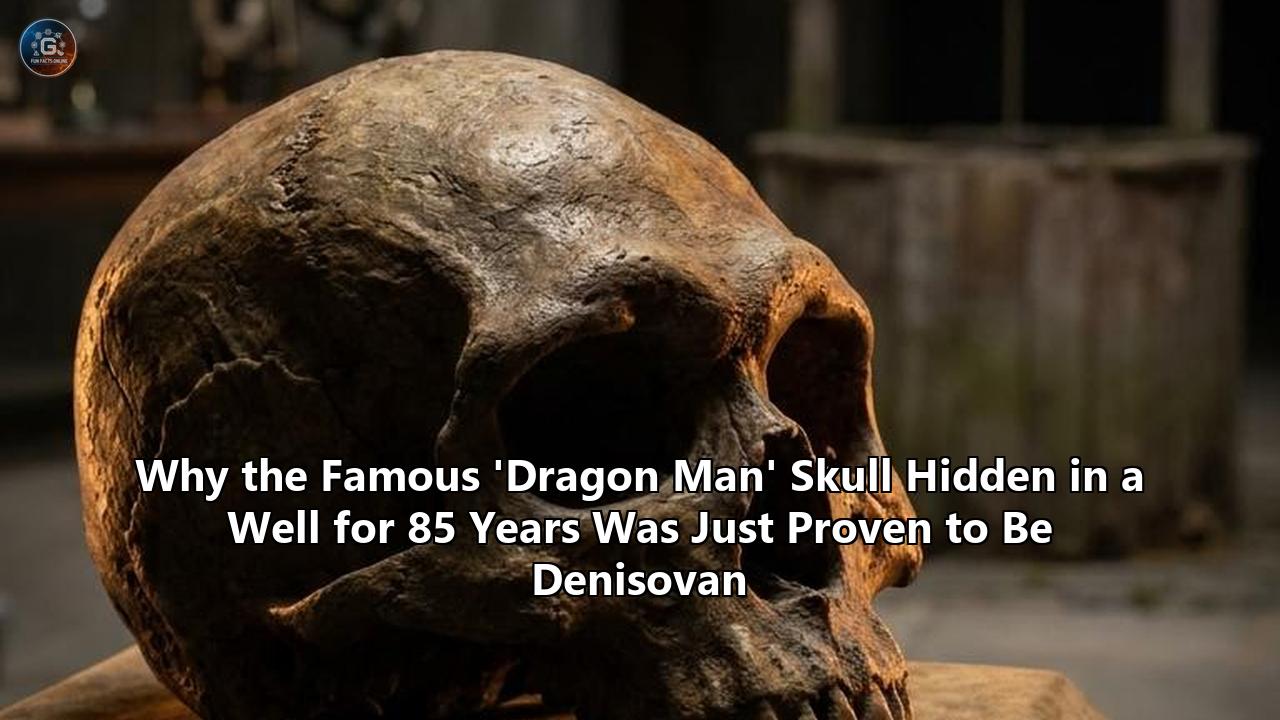
In June 2025, two landmark papers published in Science and Cell delivered a definitive resolution to one of the most polarizing debates in modern paleoanthropology. By combining innovative DNA extraction from fossilized tooth plaque with advanced proteomic profiling, an international research team led by the Chinese Academy of Sciences proved that the famous 146,000-year-old Dragon Man skull (Homo longi) belongs to the mysterious Denisovan lineage.
This revelation has effectively solved an 85-year-old mystery that began at a construction site in occupied China and survived decades of burial in an abandoned well. More importantly, it finally provides a highly anticipated physical identity for the Denisovans.
First identified in 2010 from a microscopic fragment of a child’s pinkie bone found in Siberia, the Denisovans have long been the "ghosts" of the human family tree. We possessed their complete genome and knew they interbred with our direct ancestors, yet we had no clear idea of what they looked like.
The identification of the Dragon Man skull changes everything. It provides a near-complete cranium that shows these ancient cousins were robust, large-brained giants with physical traits highly adapted to the extreme climates of Ice Age Asia.
The molecular breakthrough occurred alongside a parallel study published in Science in April 2025, which confirmed that the "Penghu 1" mandible—a fossilized jawbone dredged from the seafloor off Taiwan—was also Denisovan. Together, these studies confirm that the Denisovans were not a small, isolated group huddled in Siberian caves, but a highly successful, continent-spanning population of ancient humans.
The Harbin Heist: How a Laborer Hid History in a Well
The extraordinary journey of the Harbin cranium reads more like an international espionage thriller than a standard paleontological discovery.
In 1933, the city of Harbin, located in China's northernmost province of Heilongjiang, was under the control of the Japanese puppet state of Manchukuo. During the construction of the Dongjiang Bridge over the Songhua River, a Chinese laborer chanced upon a bizarrely large, heavy, and remarkably complete human-like skull buried in the river sediment.
The laborer immediately recognized that the find was highly unusual. Fearing that the occupying Japanese military forces would seize the fossil as a valuable artifact, he made a split-second decision to smuggle it away from the construction site. He wrapped the skull in traditional cloth and slipped it down into an old, abandoned well, covering it with dirt.
For 85 years, the skull remained undisturbed in the dark, cold depths of the well. The laborer returned to his normal life, keeping the secret safe through the Second World War, the Chinese Civil War, the Cultural Revolution, and decades of subsequent modernization. He kept the secret even from his closest family members, possibly out of lingering fear of political repercussions or the loss of the relic.
It was only in 2018, as he lay on his deathbed, that the elderly man finally told his grandchildren about the treasure hidden at the bottom of the well. Following his directions, the family retrieved the skull, which was still in remarkably pristine condition. Recognizing its monumental value, they donated it to Hebei GEO University in Shijiazhuang, where scientists began the arduous task of studying it.
Ironically, the laborer’s decision to hide the skull in a cold, damp well is likely the sole reason the fossil survived with its organic molecules intact. Had it been turned over to authorities in 1933, it would likely have been treated with early 20th-century chemical preservatives that destroy ancient DNA, or worse, it might have met the same tragic fate as the famous Peking Man fossils, which vanished without a trace during the chaos of World War II.
1933: Discovered during bridge construction in Harbin -> Hidden in a well to avoid Japanese seizure
  │
  v
2018: Secret revealed on laborer's deathbed -> Family retrieves cranium -> Donated to Hebei GEO University
  │
  v
2021: Described as a new species: Homo longi ("Dragon Man") -> Triggers intense scientific debate
  │
  v
2025: Qiaomei Fu's team extracts ancient DNA/proteins -> Confirmed as Denisovan -> We finally have a Denisovan "face"
The Denisovan Ghosts: Paleoanthropology’s Greatest Frustration
To appreciate why proving the Dragon Man skull is Denisovan is such a monumental milestone, it is necessary to understand the unique "ghost" status that the Denisovans held in the study of human evolution.
For more than a century, hominin species were defined exclusively by their bones. Neanderthals, Homo erectus, and Homo heidelbergensis were all established as distinct evolutionary lineages based on cranial shapes, jaw thicknesses, and dental patterns discovered in the field.
But in 2010, the field of paleogenomics completely bypassed traditional anatomy. A team of geneticists at the Max Planck Institute for Evolutionary Anthropology, led by Nobel laureate Svante Pääbo, successfully sequenced high-quality ancient DNA from the tip of a juvenile female’s pinkie bone found in Denisova Cave, located in the Altai Mountains of southern Siberia.
The results were astonishing: the DNA did not belong to a Neanderthal, nor did it belong to a modern human. Instead, it belonged to a previously completely unknown lineage of archaic humans that split from a common ancestor shared with Neanderthals roughly 400,000 years ago. They were named "Denisovans" after the cave where the fragment was found.
Subsequent genetic surveys of modern humans revealed that Denisovans had left a massive genetic imprint. Indigenous populations of Papua New Guinea, Melanesians, and Australian Aborigines carry up to 4 to 6 percent Denisovan DNA in their genomes, the result of ancient interbreeding events. Tibetans possess a unique gene variant (EPAS1) inherited from Denisovans that allows them to thrive at high altitudes where oxygen levels are dangerously thin.
Yet, despite this vast genetic legacy, the physical fossil record for Denisovans remained practically non-existent. For fifteen years, all scientists had to represent this entire human group was:
- A tiny pinkie bone fragment.
- Three exceptionally large molars from Denisova Cave.
- A small piece of a parietal bone.
- The "Xiahe mandible," a partial lower jawbone discovered by a Buddhist monk in Baishiya Karst Cave on the Tibetan Plateau, which was linked to Denisovans in 2019 using ancient protein analysis.
For paleontologists, this was deeply unsatisfying. They had a comprehensive blueprint of the Denisovan genome, but they had absolutely no idea what they looked like. Did they have massive, projecting faces like Neanderthals? Or were they flatter-faced like us? How large were their brains? Without a skull, these questions were impossible to answer.
The Controversy of Homo longi: Why "Dragon Man" Stood Apart
When Hebei GEO University researchers formally described the Harbin skull in the summer of 2021, they chose not to link it to the Denisovans. Instead, they argued that the fossil represented a brand-new species of ancient human, which they named Homo longi—derived from the geographic name Heilongjiang, which translates to "Black Dragon River."
The skull was spectacular in its preservation. It was completely intact except for its lower jaw, featuring a combination of primitive and modern physical traits that didn't fit into any existing evolutionary category:
- Enormous Size: It is one of the largest hominin skulls ever found, featuring a brain capacity of approximately 1,420 cubic centimeters—firmly within the range of modern humans and slightly exceeding the Neanderthal average.
- Archaic Braincase: Despite its modern brain volume, the skull is long and low rather than round, with thick bone walls and heavily built features.
- The Massive Brow Ridge: It features a thick, continuous, gently curved brow ridge (supraorbital torus) running across its forehead, reminiscent of more ancient species like Homo erectus.
- Anatomical Mosaic: While it has large, almost square eye sockets and a broad nose, its cheekbones are flat and low, giving it a remarkably modern, flat lower face that does not project forward like a Neanderthal’s.
- A Single Giant Tooth: The cranium has only one tooth left in its socket: an exceptionally large upper second molar.
                     ┌─── Homo sapiens (Modern Humans)
                     │
             ┌───────┤
             │       └─── Homo longi ("Dragon Man" / Denisovans) *Genetically Confirmed*
=============┤
             │       ┌─── Neanderthals (Siberian & European)
             └───────┤
                     └─── Homo heidelbergensis (Archaic ancestor)
The original research team, led by paleontologists Ji Qiang and Xijun Ni, ran a massive cladistic (evolutionary tree) analysis based on physical bone measurements. They concluded that Homo longi was actually a "sister lineage" to Homo sapiens, meaning it was more closely related to modern humans than Neanderthals were.
This claim immediately triggered a fierce paleontological debate. Many researchers, most notably Chris Stringer of the Natural History Museum in London, pointed out that the massive size of the skull's molar and its general physical shape bore a striking resemblance to the Xiahe mandible from Tibet and other enigmatic fossils found across China.
Stringer and others argued that Homo longi was highly likely to be a Denisovan. The problem, however, was that this hypothesis could not be verified.
Because Denisovans were defined solely by their DNA, morphological comparisons were not enough. To prove that the Dragon Man skull was Denisovan, scientists had to extract genetic or molecular evidence directly from the bone itself.
When molecular paleogeneticists first attempted to drill into the Harbin skull's bones and teeth to extract ancient DNA, they hit a dead end. The skull was heavily fossilized, and its environmental history in the temperate, fluctuating climates of northern China had caused its endogenous DNA to degrade to a degree that made conventional extraction impossible. Without DNA, the debate was frozen in a classic paleontological deadlock: the morphologists argued for a new species, while the geneticists could only speculate from afar.
Breaking the Molecular Seal: The Revolutionary Science Behind the Plaque and the Proteins
The scientific breakthrough that finally broke this deadlock arrived in June 2025, through a pair of studies led by Dr. Qiaomei Fu, a world-renowned paleogeneticist at the Institute of Vertebrate Paleontology and Paleoanthropology (IVPP) in Beijing.
Fu had spent years studying the Harbin fossil. Knowing that traditional methods of drilling into the skull’s dense bone (such as the petrous bone in the inner ear) or tooth pulp had failed to yield viable human DNA, she decided to try two entirely different, highly advanced molecular strategies: targeting fossilized tooth plaque and mapping ancient proteins.
Decoding the Dental Calculus (Hardened Plaque)
The first strategy, detailed in the journal Cell, focused on the single remaining molar in the Dragon Man skull.
While the tooth's interior pulp cavity was devoid of preserved DNA, its exterior surface was covered in a layer of fossilized dental plaque, known scientifically as dental calculus. Dental calculus is essentially calcified oral biofilm. Over a person's life, plaque mineralizes into a rock-hard layer of calcium phosphate, trapping anything present in the mouth—including food debris, bacteria, and epithelial cells shed from the individual’s own gums and cheeks.
In archaeological and paleontological contexts, dental calculus acts as an incredibly robust molecular time capsule. Unlike bone, which is highly porous and subject to the leaching of water and soil microbes, calculus is dense, non-porous, and crystalline. It seals host genetic material inside an airtight, inorganic matrix that protects it from environmental degradation.
Fu’s team extracted tiny samples of dental calculus—weighing less than 25 milligrams—from the Harbin molar. They then optimized chemical extraction protocols and deployed custom bioinformatic algorithms specifically designed to separate highly degraded ancient human DNA from the massive amounts of microbial and environmental DNA that dominate plaque.
Against extraordinary odds, they succeeded. They successfully isolated fragments of ancient human host mitochondrial DNA (mtDNA)—representing the first time that genomic material has been retrieved directly from the dental calculus of a Paleolithic human fossil.
[Molar with Dental Calculus] ──(Micro-sampling <25mg)──> [Crystalline Matrix]
                                                               │
                                                               v (Chemical Dissolution)
[Degraded ancient mtDNA] <──(Bioinformatic Filtering)── [Bulk DNA Mixture]
          │
          └─── Matches Denisovan Altai Reference (99.9% confidence)
The genetic results were unequivocal. The mitochondrial DNA retrieved from the calculus fell directly within the known range of Denisovan mtDNA variation.
Phylogenetic analysis placed the Harbin individual on an evolutionary branch closely related to the earliest Denisovans found in southern Siberia (the Denisova 3 and Denisova 4 individuals), who lived between 217,000 and 106,000 years ago. The genetic sequence showed no affinity to Neanderthals or modern humans, proving beyond a doubt that the individual was part of the Denisovan maternal lineage.
Paleoproteomics: Reading History in Amino Acids
While mitochondrial DNA is exceptionally useful for establishing maternal lineage, it is inherited solely from the mother and does not provide a complete picture of an individual's nuclear genome. To double-check their findings, Fu’s team deployed a second molecular method: paleoproteomics, the results of which were published in Science.
Proteins are composed of chains of amino acids, which are dictated by an organism's nuclear DNA. Because the chemical bonds in proteins are significantly more stable than the phosphodiester bonds in DNA, proteins can survive in fossilized tissues for hundreds of thousands—and in some cases, millions—of years longer than DNA, even in warm and damp environments.
Using a newly developed, highly automated paleoproteomic system paired with liquid chromatography-tandem mass spectrometry (LC-MS/MS), the researchers analyzed organic material extracted from the petrous bone of the skull.
The results set a world record in ancient biomolecular studies:
- The team successfully identified over 308,000 peptide-spectrum matches.
- They recovered more than 20,000 individual peptides.
- They confirmed the presence of 95 endogenous proteins preserved within the bone matrix.
This represents the most extensive and informative ancient human proteome ever recovered from a single fossil.
                                  PALEOPROTEOMIC ANALYSIS

  [Petrous Bone Sample] ──(Extraction)──> [Ancient Protein Extract]
                                                   │
                                                   v (Trypsin Digestion)
                                          [Peptide Library]
                                                   │
                                                   v (LC-MS/MS Mass Spectrometry)
                                          [308,000+ Peptide Spectra]
                                                   │
                                                   v (Computational Alignment)
                                          [95 Endogenous Proteins]
                                                   │
                                                   v (Phylogenetic Mapping)
                                          [Verified 3 Denisovan-Specific SAPs]
By mapping the exact sequences of these 95 proteins, the researchers identified 122 single amino acid polymorphisms (SAPs)—variations in the protein chain that act as evolutionary signatures.
Crucially, the Harbin individual's proteome contained three highly specific protein variants that are unique to Denisovans. When these amino acid variations were subjected to phylogenetic clustering, the Harbin individual clustered directly with Denisova 3.
The independent alignment of both mitochondrial DNA from the dental plaque and protein sequences from the bone left no room for skepticism. The mysterious "Dragon Man" was, in fact, a Denisovan.
Reconstruction of a Giant: What the Denisovans Actually Looked Like
Now that the Dragon Man skull has been definitively linked to the Denisovans, we can finally construct a complete physical profile of this extinct human relative.
Previously, artists and scientists could only make wild guesses about Denisovan features based on the single Xiahe jawbone and DNA-based methylation reconstructions. The Harbin skull provides a near-perfect, 146,000-year-old physical template.
Based on the morphological measurements of the cranium, paleontologists have painted a striking portrait of a robust, powerful hominin built to withstand some of the harshest environments of the Middle Pleistocene.
| Anatomical Feature | Description in Harbin Cranium (Homo longi) | Evolutionary Adaptation & Significance |
|---|---|---|
| Cranial Capacity | ~1,420 cc to 1,500 cc | Comparable to or larger than modern humans; indicates highly developed cognitive and sensory processing. |
| Brow Ridge | Massively developed, continuous, and gently curved | Structural reinforcement of the face; typical archaic hominin defense against biting stresses. |
| Eye Orbits | Exceptionally large, deep, and almost perfectly square | Suggests excellent low-light vision, helpful during long, dark winters in high-latitude northeastern China. |
| Cheekbones | Low, flat, and recessed with a shallow canine fossa | Strikingly modern appearance; contrasts with the projecting, hafted midfaces of Neanderthals. |
| Nasal Cavity | Extremely wide, round, and broad | Optimized for warming and humidifying dry, freezing Arctic air before it reached the lungs. |
| Dentition | Massive alveolar bone supporting giant, robust molars | Adapted for chewing tough, highly abrasive, or fibrous foods, possibly including raw meats and tubers. |
                       DENISOVAN CRANIAL ANATOMY (HARBIN SPECIMEN)

                             Long, low cranial vault (1,420-1,500 cc)
                                     /
             _______________________/_______
            /                               \
           |   _..---''''''''---.._          |
          /.-''                    ''-._     \
         //                             '-._  |
       _//   Massive, curved             '._\ |
      (/)    supraorbital torus             \|
      (|     (brow ridge)                    |
      (|      \__  / \                       |
       |         \/   \                      |
       |        /      \____                 |___ Flat cheekbones
       |       |  [ ]   [ ] |                    (recessed midface)
       |       |    \   /   |
        \       \    \_/   /
         \       '-._____.-'  <─── Broad, wide nose
          '._             /
             '--._____..-'  <───── Massive palate with giant molars
Body Mass and Bergmann's Rule
While we do not have postcranial bones (such as a femur or pelvis) belonging to the Harbin individual, researchers can estimate his physical size based on the robusticity and dimensions of his skull.
The thickness of the cranial walls, the sheer width of the zygomatic arches, and the massive palate indicate a powerfully built male individual who likely stood around 1.8 meters (nearly 6 feet) tall and weighed approximately 100 kilograms (220 pounds).
This massive body size aligns perfectly with a fundamental biological principle known as Bergmann’s Rule. Bergmann's Rule states that within a broadly distributed taxonomic clade, populations living in colder environments tend to evolve larger body masses than those in warmer regions.
A larger body has a lower surface-area-to-volume ratio, which dramatically reduces the rate of heat loss. With winters in Middle Pleistocene Harbin routinely dropping far below freezing, the Denisovans of northeastern China evolved into physical giants to conserve body heat in a brutal, glaciated landscape.
Rewriting the Pleistocene Map: A Continent-Spanning Empire
The identification of the Dragon Man skull as Denisovan does more than settle a taxonomic argument; it completely redraws the map of human geography during the Middle-to-Late Pleistocene.
Historically, many anthropologists subscribed to a highly localized view of human evolution in East Asia, sometimes championing the "Multiregional Evolution" hypothesis. This theory suggested that modern Chinese populations evolved directly from local Chinese Homo erectus ancestors, independent of the "Out of Africa" migration that characterized Homo sapiens.
The molecular identification of Denisovans has shattered this simplistic view. Instead of isolated regional lineages, we now see a highly dynamic, incredibly complex landscape of overlapping, interbreeding human populations.
The geographical distribution of molecularly confirmed Denisovan fossils now spans thousands of kilometers:
- Siberia (Denisova Cave): The northernmost outpost, situated in the dry, cold Altai Mountains. This is where the Denisovans were first identified from DNA.
- The Tibetan Plateau (Baishiya Karst Cave, Xiahe): Located at an elevation of over 3,000 meters (10,000 feet). This freezing, oxygen-depleted highland was inhabited by Denisovans who developed unique genetic adaptations to survive hypoxia—adaptations they eventually passed on to modern Tibetans.
- Northeastern China (Harbin): A cold, forested region located in the northeast, where the Dragon Man skull was found.
- The Taiwan Strait (Penghu Channel): A subtropical, coastal environment. The Penghu 1 mandible, recovered from seafloor sediments, demonstrates that Denisovans migrated as far south as Taiwan, which during glacial periods of low sea levels was fully connected to the Asian mainland.
                                  THE DENISOVAN RANGE

 [Siberia: Denisova Cave] ───────(4,000 km)───────> [Northeastern China: Harbin]
           │                                                  │
       (3,000 km)                                         (2,000 km)
           │                                                  │
           v                                                  v
 [Tibetan Plateau: Xiahe] ───────(2,500 km)───────> [Taiwan Strait: Penghu 1]
This map reveals that the Denisovans were one of the most ecologically adaptable human species to have ever lived.
They were not specialized cave dwellers; they were master survivalists. They thrived in the hyper-arid Altai mountains, the oxygen-depleted alpine plateaus of Tibet, the sub-arctic forests of northeastern China, and the humid, wet subtropical coastlines of Taiwan.
This immense geographic reach explains why their DNA is so prevalent in modern populations across Southeast Asia, Melanesia, and Oceania.
As modern Homo sapiens migrated out of Africa and traversed Southern and Eastern Asia, they did not find an empty continent. They encountered a massive, deeply entrenched, and physically formidable empire of Denisovans.
The genetic exchanges that occurred were not brief, isolated encounters. Recent genomic studies published in 2026 indicate that the ancestors of modern Oceanian populations interbred with at least three distinct Denisovan-like groups at different times and in different places, inheriting key immune, metabolic, and developmental genes that continue to protect modern humans today.
The Taxonomic Dilemma: Does Homo longi Exist?
The molecular confirmation that the Harbin cranium is Denisovan has triggered a fascinating taxonomic puzzle for the International Commission on Zoological Nomenclature (ICZN).
If the Dragon Man skull is a Denisovan, and the species was officially named Homo longi in 2021, what do we call this branch of humanity going forward?
    DNA DISCOVERY (2010)                       ANATOMICAL DISCOVERY (2021)
  "Denisovans" (Siberian Cave)                 "Homo longi" (Harbin Cranium)
            │                                               │
            └───────────────► BOTH ARE THE SAME ◄───────────┘
                               (Confirmed 2025)
                                       │
                              WHAT IS THE NAME?
                                       │
            ┌──────────────────────────┴──────────────────────────┐
            ▼                                                     v
   "HOMO LONGI" wins Priority                            "HOMO SAPIENS" wins Lumping
  (Under formal ICZN rules,                             (Under evolutionary gene-flow models,
   molecular "Denisovan" is                              all archaic human sister-clades
   not a valid taxonomic species)                        are variations of a single species)
In biological taxonomy, the rules of priority are incredibly strict. The informal term "Denisovan" is a molecular label; it was never formally published as a zoological species under the ICZN code.
On the other hand, Homo longi was published in 2021 with a comprehensive morphological description and a designated holotype (the Harbin skull itself).
Therefore, under taxonomic law, the name _Homo longi_ has priority.
This leads to a highly counterintuitive scientific reality: *the Denisovans are actually Homo longi---.
"Assuming the author's claim is true, then Denisovans are a population of Homo longi, just as New Yorkers and Beijingers are both Homo sapiens," explained paleontologist Xijun Ni, one of the original describers of the Harbin skull.
Chris Stringer agrees with this taxonomic reality, stating that even though "it is increasingly likely that Harbin is the most complete fossil of a Denisovan found so far, Homo longi is the appropriate species name for this group."
The Case for "Lumping"
However, not all scientists agree that naming a separate species is helpful.
Paleogeneticist Svante Pääbo, whose laboratory pioneered the recovery of Denisovan DNA, argues that carving up Middle-to-Late Pleistocene hominins into distinct species fails to reflect the biological reality of the era.
"We ourselves do not use species names for Neanderthals or Denisovans," Pääbo noted following the 2025 announcement. "We do not find it helpful as these are closely related groups that have been shown to mix and have fertile offspring, with each other and with our own direct ancestors. But if a species name is needed, we would simply call them all Homo sapiens."
This taxonomic tension highlights a fundamental transition in how we define what it means to be human.
For over a century, biology relied on the Biological Species Concept, which defines a species as a group of organisms that can interbreed and produce fertile offspring. Because we now know that modern humans, Neanderthals, and Denisovans regularly interbred and produced fertile offspring—leaving their genes in our DNA today—the strict boundaries between these "species" have begun to dissolve.
Whether we call them Homo longi, Denisovans, or archaic Homo sapiens, they were a vital, highly sophisticated branch of our own evolutionary family.
The Future of Molecular Paleoanthropology
The scientific triumph of proving the Dragon Man skull is Denisovan marks the beginning of an entirely new era in the study of human evolution.
For decades, paleontologists were limited to analyzing the shapes of bones—a highly subjective process that often led to endless debates over whether a bump on a skull or the thickness of a tooth represented a new species or simply natural variation within a population.
The ability of Qiaomei Fu’s team to bypass degraded bones and target dental calculus has completely bypassed these limitations.
Dental plaque is practically universal in fossil hominins; they did not possess toothbrushes, and their highly abrasive diets meant that plaque mineralized rapidly on their teeth during life. Because calculus is exceptionally resilient and protects host DNA from degradation, it can now be targeted on hundreds of other ambiguous fossils found in museums around the world.
This molecular revolution will soon be applied to several other famous "mystery skulls" found across East Asia:
- The Dali Skull: A remarkably complete cranium discovered in Shaanxi Province in 1978, dated to around 260,000 years ago. It shares many morphological features with the Harbin skull but its evolutionary identity remains unconfirmed.
- The Jinniushan Skull: An archaic cranium found in Liaoning Province, dated to roughly 200,000 years ago, displaying a similar mixture of primitive and advanced traits.
- The Maba Skull: A partial skull cap from southern China featuring prominent, rounded brow ridges.
- The Yunxian Crania: A set of million-year-old skulls recently reconstructed using virtual 3D modeling, which may represent the direct ancestors of the Denisovan/Homo longi lineage in Asia.
                     POTENTIAL EAST ASIAN DENISOVAN FOSSILS

                  ┌─── Harbin Skull ("Dragon Man") *CONFIRMED*
                  ├─── Penghu 1 Mandible (Taiwan) *CONFIRMED*
                  ├─── Xiahe Mandible (Tibet) *CONFIRMED*
  [DENISOVANS] ───┼
                  ├─── Dali Skull (Shaanxi) — *High Candidate*
                  ├─── Jinniushan Skull (Liaoning) — *High Candidate*
                  └─── Maba Skull (Guangdong) — *Potential Candidate*
By extracting ancient plaque DNA and protein maps from these specimens, scientists will finally be able to determine which ones belong to the Denisovan lineage.
We are quickly moving toward a future where we will no longer map human evolution through fragmented bones, but through a comprehensive, continent-wide grid of ancient biomolecules.
Eighty-five years ago, a Chinese laborer lowered a giant skull into a dark well to protect it from the ravages of war. He could never have imagined that his simple act of defiance would eventually allow 21st-century scientists to decode the very molecules of life, giving a face to a long-lost branch of the human family and forever changing how we understand our origin story.
Reference:
- https://economictimes.indiatimes.com/news/international/global-trends/chinese-laborer-hid-mysterious-skull-for-85-years-now-scientists-know-who-is-this-ancient-dragon-man/articleshow/121946863.cms?from=mdr
- https://www.livescience.com/archaeology/human-evolution/ancient-dragon-man-skull-from-china-isnt-what-we-thought
- https://www.eurekalert.org/news-releases/1087905
- https://pure.mpg.de/view/item_3655822
- https://www.smithsonianmag.com/smart-news/iconic-dragon-man-skull-offers-first-glimpse-of-what-a-denisovans-face-looked-like-new-genetic-studies-suggest-180986861/
- https://www.reddit.com/r/Anthropology/comments/1lesbu6/new_analyses_indicate_that_the_harbin_skull/
- https://www.theguardian.com/science/2024/mar/30/scientists-link-elusive-human-group-to-150000-year-old-chinese-dragon-man
- https://www.nationalgeographic.com/history/article/controversial-dragon-man-skull-confirmed-to-be-a-denisovan
- https://english.elpais.com/science-tech/2025-06-18/enigmatic-dragon-man-was-not-a-new-human-species-but-a-denisovan.html
- https://www.youtube.com/watch?v=U1JEtuctleI
- https://www.researchgate.net/publication/392863654_First_ever_skull_from_'Denisovan'_reveals_what_ancient_people_looked_like
- https://worldofpaleoanthropology.org/2025/06/21/unveiling-the-denisovan-enigma-proteomics-morphology-genetic-legacy/
- https://www.sci.news/archaeology/denisovan-fossil-taiwan-13819.html
- https://www.sciencenews.org/article/skull-first-denisovan-human-cousin
- https://globe.ku.dk/newslist/2025/a-male-denisovan-jawbone-from-taiwan-expands-the-known-geographic-range-of-this-extinct-human-group/
- https://www.reddit.com/r/bigfoot/comments/1lhbtig/denisovan_skull_ancient_dna_reveals_dragon_man/
- https://en.wikipedia.org/wiki/Harbin_cranium
- https://earthlogs.org/2025/06/19/chinese-skull-confirmed-as-denisovan/
- https://www.youtube.com/watch?v=XLyCfap0cCw
- https://www.nationalgeographic.com/history/article/controversial-dragon-man-skull-confirmed-to-be-a-denisovan
- https://medium.com/fossils-et-al/homo-longi-does-not-exist-a-new-look-at-denisovan-humans-4d514d2dab16
- https://michaelbalter.substack.com/p/human-evolution-a-new-face-for-the
- https://popular-archaeology.com/article/a-new-denisovan-mandible-from-taiwan/
- https://www.sciencedaily.com/releases/2016/03/160329113314.htm
- https://www.eurekalert.org/news-releases/1087905
- https://www.researchgate.net/lab/Qiaomei-Fu-Lab
- https://www.zmescience.com/science/anthropology/people-on-these-pacific-islands-have-the-most-ancient-genome-of-all-humans-and-a-lot-of-denisovan-genes/
- https://en.wikipedia.org/wiki/Penghu_1