The Smoke Over Cartagena: June 8, 1708
The heat on the Caribbean Sea was suffocating, thick with salt, humidity, and the impending dread of battle. Off the coast of the fortified port city of Cartagena de Indias, in the Viceroyalty of New Granada, the Spanish treasure galleon San José labored under the weight of its own staggering wealth.
The vessel, a 62-gun, three-masted giant of the Spanish Navy, was the flagship of the Flota de Tierra Firme. Commanded by the 71-year-old General José Fernández de Santillán, the Count of Casa Alegre, the ship’s holds were stuffed to the deck beams with treasure accumulated from the mines of Peru and Bolivia: chests of raw emeralds, millions of silver coins, and roughly eight tons of gold bullion.
This fortune was destined for Europe. King Philip V of Spain desperately needed the bullion to fund the War of the Spanish Succession, a bloody dynastic conflict pitting the Bourbon alliance against a grand coalition led by the British Empire and the Holy Roman Empire.
But the British knew the treasure fleet was coming. Commodore Charles Wager, commanding a squadron of Royal Navy warships from the deck of the 70-gun Expedition, had been waiting in the shadows of the Rosario Islands.
As the sun began to sink on June 8, 1708, Wager’s squadron intercepted the Spanish fleet. The battle of Barú was fierce, loud, and chaotic. Wooden hulls splintered under broadsides; smoke choked the horizon.
Wager’s strategy was simple: disable the San José, board her, and seize the richest prize in the Americas. But the Spanish flagship resisted. For hours, the two massive warships exchanged devastating cannon fire at close range.
Then, around 7:30 PM, the sea was illuminated by a blinding flash.
According to British logs, the San José suffered a catastrophic internal explosion. The gunpowder magazine, located near the mainmast, had ignited.
Spanish accounts from the few survivors suggested a different tragedy—that the ship’s hull broke apart under the relentless vibrations of her own defensive cannon fire.
Whichever version was true, the result was instantaneous and horrifying. The great galleon split in two and plunged into the abyss, taking nearly 600 souls and the fortunes of an empire with her.
For over three centuries, the San José lay in pitch-black silence, 600 meters (nearly 2,000 feet) beneath the surface of the Caribbean. It became the ultimate maritime myth: the "Holy Grail of shipwrecks," valued in modern terms at anywhere from $17 billion to $31 billion.
                THE VOYAGE OF THE SAN JOSÉ (1708)

   [Portobelo, Panama] ---> [Cartagena, Colombia] ---> [Sunk in Battle]
      (Loaded gold,           (Ambushed by British        (Resting at 600m
     silver & emeralds)         Navy off Peninsula)        depth for 300+ yrs)
Now, that silence has been permanently broken.
The Recovery: A Tense First Glimpse of the Deep
The physical retrieval of the world’s most sought-after sunken treasure is no longer a theoretical debate. After years of diplomatic standoffs, legal blockades, and whispers of state-sanctioned secrecy, a highly specialized, state-led expedition has officially commenced the San Jose shipwreck recovery.
Using a remotely operated vehicle (ROV) capable of withstanding the immense pressures of the deep sea, the Colombian Navy, in coordination with the Ministry of Culture and the Colombian Institute of Anthropology and History (ICANH), quietly lowered its robotic equipment into the dark, cold waters off Cartagena.
  [Research Vessel: ARC Malpelo / ARC Gloria]
         |
         |  ~600 Meters (approx. 2,000 feet)
         v
  [ROV: Saab Seaeye Lynx / REMUS 6000] ----> [Seabed Debris Field]
                                             - Sevilla Cannon
                                             - Chinese Cups
                                             - Gold Macuquinas
Operating from a high-tech control room on a Colombian naval vessel, scientists and engineers watched as the ROV's robotic arms carefully selected the first physical pieces of the fabled galleon.
The items raised to the surface during this delicate operation represent a historic moment in maritime archaeology:
- The Sevilla Cannon: A massive bronze cannon bearing the unmistakable inscription "Sevilla". The weapon's decorative dolphin-shaped cascabels—hallmarks of 17th-century Spanish foundry work—were what originally allowed researchers to positively identify the ship.
- The Chinese Porcelain Cup: A delicate, intact porcelain cup dating back to the Kangxi period of the Qing Dynasty (1661–1722), highlighting the surprisingly global reach of early 18th-century trade networks.
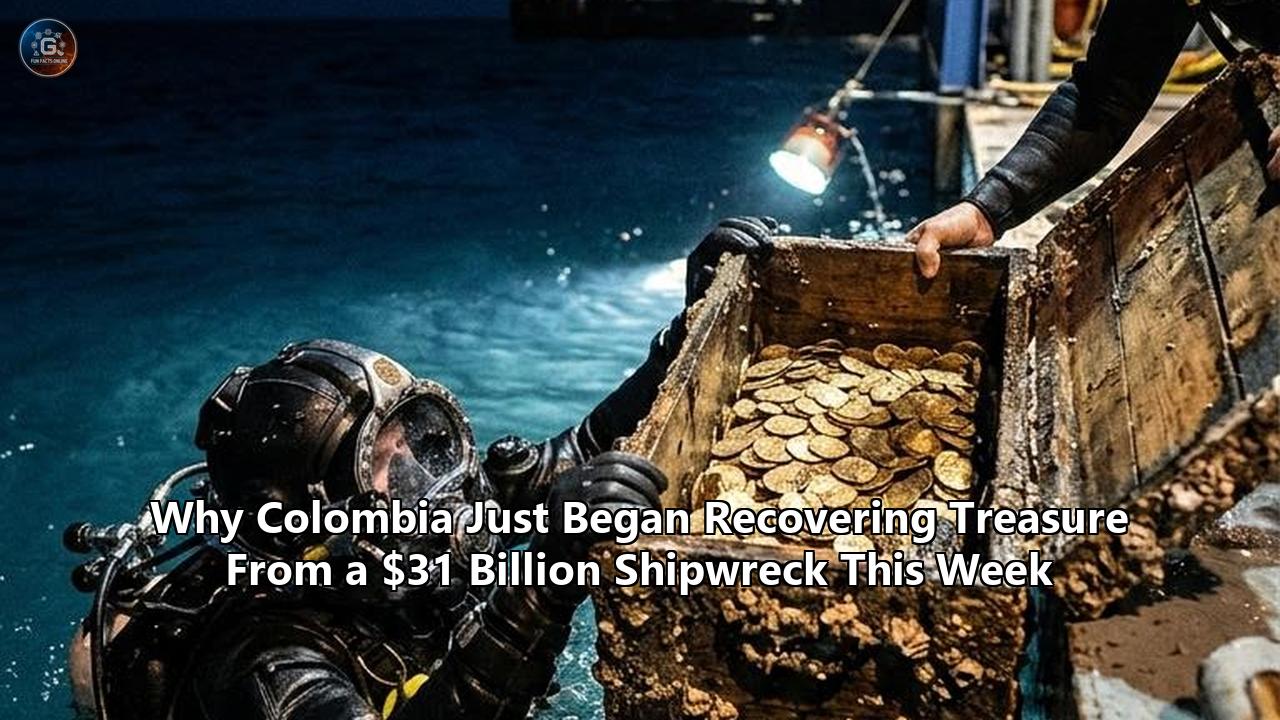
- The Macuquinas: Three gold and bronze coins, hand-struck and hammered at the mint in Lima, Peru, in 1707.
- Porcelain Fragments & Deep-Sea Sediment: Crucial physical samples that scientists plan to analyze to reconstruct the ship's final moments and the exact conditions of its burial.
"This historic event demonstrates the strengthening of the Colombian State's technical, professional, and technological capabilities to protect and promote Underwater Cultural Heritage," declared Yannai Kadamani Fonrodona, Colombia's Minister of Cultures, Arts, and Knowledge.
According to Colombian authorities, the purpose of this initial phase is strictly scientific. The recovered objects were immediately transferred under armed guard to a specialized, highly climate-controlled laboratory in Cartagena for desalination and chemical stabilization.
Yet, behind the sterile language of archaeological preservation lies a fierce political ticking clock.
The administration of Colombian President Gustavo Petro is rapidly approaching its end in August 2026. Petro, the country's first leftist leader, made the recovery of the San José a signature, legacy-defining promise of his presidency, ordering his ministers to "pick up the pace" to bring the treasure home before he leaves office.
This sudden rush has ignited a geopolitical storm. It is a high-stakes chess match involving a frustrated billionaire English hedge fund manager, a former employee of Fidel Castro, the government of Spain, a litigious American salvage company, and indigenous nations in the high Andes who claim the gold belongs to the ancestors who died mining it.
The Obsession of Roger Dooley: From Castro’s Cuba to Colombia’s Coast
To understand how the San Jose shipwreck recovery finally began, one must follow the trail of a single, obsessive figure: a Cuban-American maritime archaeologist named Roger Dooley.
Dooley’s journey into the deep-sea treasure hunt did not begin in a corporate boardroom, but in the dusty, humid archives of Seville, Spain, in July 1984. At the time, Dooley was working as the chief archaeologist for Carisub, a state-owned Cuban marine salvage organization.
His ultimate boss was Cuban President Fidel Castro. Castro, an avid diver in his youth, was fascinated by the prospect of recovering historic Spanish galleons wrecked off Cuba’s northern reefs to fill the cash-strapped island's coffers.
While digging through the General Archive of the Indies, Dooley stumbled upon a series of colonial-era documents that shifted his focus entirely. He discovered the detailed manifests of the San José and, crucially, a handwritten derrotero—a pilot's book of maritime directions.
The archives revealed that the San José had gone down in an area that historical sailors noted was "not possible to dive in any way" due to the extreme depth. While shallow-water wrecks had been systematically looted over the centuries, deep-sea wrecks remained perfectly preserved, acts of history frozen in amber.
Dooley became consumed by a lifelong obsession to find the ship. For nearly three decades, he shopped his archival research to wealthy Latin Americans and various governments, trying to secure the millions of dollars required to mount a deep-sea search.
In 2013, Dooley finally found his patron: Anthony Clake, a high-ranking English hedge fund executive at the prominent London firm Marshall Wace. Clake, who possessed an amateur passion for maritime history, agreed to bankroll the operation. Together, they formed a Swiss-registered company called Maritime Archaeology Consultants (MAC).
               THE SEED OF AN OBSESSION

 [July 1984: Roger Dooley digs in Seville's Archives under Fidel Castro]
                               |
                               v
 [Discovers pilot's handwritten "derrotero" for the San José]
                               |
                               v
 [2013: Partners with English Hedge Fund Exec Anthony Clake (MAC)]
                               |
                               v
 [2014: Secret pitch to Colombian President Juan Manuel Santos]
Armed with Clake’s capital and Dooley’s archival maps, MAC approached the Colombian government under President Juan Manuel Santos in 2014.
Dooley's confidence was absolute. During a tense meeting with Colombia's Minister of Culture, he famously declared, "If I don't find it, I'll cut my own head off".
Thanksgiving Day, 2015: The Secret Discovery
The expedition to find the San José was mounted in late 2015 aboard the Colombian Navy research ship ARC Malpelo. To execute the deep-water search, MAC hired the world’s preeminent oceanographic research body: the Woods Hole Oceanographic Institution (WHOI) of Massachusetts.
WHOI brought with them a specialized piece of equipment—the REMUS 6000, a torpedo-shaped autonomous underwater vehicle (AUV) owned by the personal foundation of hedge fund billionaire Ray Dalio. Capable of diving to depths of 6,000 meters, the REMUS 6000 was programmed to sweep the ocean floor off Colombia’s Barú Peninsula, using side-scan sonar to look for anomalies in the flat, muddy seabed.
For weeks, the AUV scanned the darkness, returning to the ship with vast amounts of digital data that Dooley and the scientific team spent hours analyzing.
Then, on Thanksgiving Day in November 2015, the screen flashed with a series of tiny anomalies. In his book Neptune's Fortune, journalist Julian Sancton described them as "a few light specks on the screen that looked like breadcrumbs on a smooth, rust-colored yellow place mat".
The team re-programmed the REMUS 6000 to descend to a lower altitude of just 30 feet above the target site, this time with its high-resolution cameras rolling.
When the AUV returned to the ship and the digital images were uploaded, the room fell dead silent.
Staring back at them from the bottom of the sea was a sprawling, pristine debris field. There were copper cooking cauldrons, hundreds of blue-and-white Chinese porcelain cups, clay jars, and, most importantly, several massive bronze cannons.
When Dooley zoomed in on the cannons, he saw the ornate dolphin motifs cast into the bronze. It was the definitive proof he had spent his life searching for: they had found the San José.
               THE ANATOMY OF A DEEP-SEA DISCOVERY

 +-------------------------------------------------------------------+
 | [REMUS 6000 AUV]                                                  |
 | - Sweeps bottom at 600 meters using side-scan sonar               |
 | - Detects "breadcrumb" anomalies on Thanksgiving Day 2015         |
 +-------------------------------------------------------------------+
                                  |
                                  v
 +-------------------------------------------------------------------+
 | [Low-Altitude Camera Pass]                                        |
 | - Captures thousands of high-resolution images                    |
 | - Reveals copper cauldrons, clay jars, Chinese pottery            |
 | - Confirms bronze cannons decorated with dolphin motifs           |
 +-------------------------------------------------------------------+
But the joy of discovery was quickly overtaken by political maneuvering.
In December 2015, President Juan Manuel Santos went on national television to announce the discovery of the "Holy Grail of shipwrecks" to the Colombian public.
But in his address, Roger Dooley’s name was never mentioned. Neither was MAC, nor Woods Hole.
Santos framed the discovery as an entirely Colombian achievement, executed by the country’s navy and national scientists. The exact coordinates of the shipwreck were immediately classified as a "state secret," and the site was placed under strict military monitoring.
Dooley and his team, who had spent decades of research and millions of dollars to locate the wreck, found themselves completely sidelined by the very government that had hired them.
The $10 Billion Coordinates War
The Colombian government’s insistence on classifying the location of the San José was not just a matter of national pride; it was a desperate defensive maneuver against a massive, decades-long legal assault.
The primary legal combatant is Sea Search Armada (SSA), a consortium of American investors formerly known as Glocca Morra.
SSA claims that it actually found the wreck of the San José back in 1981. Under a contract signed with the Colombian government at the time, the salvors were promised a 50% split of any treasure recovered from the site.
                          THE LEGAL LABYRINTH

  [1981: Glocca Morra (SSA) claims to find wreck; signs 50% deal]
                                 |
                                 v
  [1984: Colombia passes laws reducing salvor shares to 5%]
                                 |
                                 v
  [2007: Colombian Supreme Court rules SSA owns 50% of whatever is
         specifically found at their original 1981 coordinates]
                                 |
                                 v
  [2015: Navy/MAC find the San José miles away from SSA's coordinates]
                                 |
                                 v
  [2026: SSA sues Colombia for $10 billion in Arbitration Court]
However, as the immense potential value of the shipwreck became clear, the Colombian government began changing the rules.
In 1984, Colombia passed a law retroactively slashing the share of any private salvage company from 50% to a mere 5% finder's fee, which would also be subject to heavy taxation.
SSA sued. The legal battle dragged through Colombian courts for over twenty years, culminating in a landmark 2007 ruling by the Colombian Supreme Court.
The court ruled that Sea Search Armada was indeed entitled to 50% of the treasure—but only of the treasure located at the exact coordinates that SSA had registered in their original 1981 filing.
When the Colombian Navy and MAC located the San José in 2015, they claimed it was found in an entirely different location, several miles away from SSA's registered coordinates and at a different depth.
"Their coordinates were wrong," Dooley later pointed out, arguing that SSA had likely registered the site of a different ship altogether.
SSA’s leadership, led by CEO Jack Harbeston, furiously disputed this. They accused Dooley—who had briefly worked with a contractor associated with SSA in the 1990s—of stealing their proprietary data and using their own research to guide the Colombian Navy to the true site.
SSA has since taken the Colombian government to the UN's Permanent Court of Arbitration in London, demanding a staggering $10 billion—equivalent to half the estimated value of the galleon's cargo.
The coordinates controversy took a bizarre, almost comical turn in late 2023. The Oversight Committee for Submerged Cultural Heritage, a Colombian public watchdog group, raised a red alert, claiming that the "top-secret sealed envelope" containing the exact, classified coordinates of the San José had been mysteriously misplaced by state agencies.
The announcement caused temporary panic in Bogotá, with allegations that the coordinates had been leaked or sold to international treasure hunters.
While the government eventually quieted the scandal—claiming the envelope was never lost—the incident highlighted the extreme paranoia and lack of transparency surrounding the site.
Who Owns the Spoils of an Empire?
The legal battle with Sea Search Armada is only one front in a multi-sided geopolitical war over the San Jose shipwreck recovery. If the treasure is fully brought to the surface, Colombia faces massive ownership claims from other sovereign nations and indigenous communities:
| Claimant | Legal & Historical Basis of Claim | Current Status |
|---|---|---|
| Colombia | The wreck lies within its territorial waters and contiguous zone, designated as national cultural patrimony under domestic Law 1675. | Currently executing physical recovery operations; refuses to share the cargo. |
| Spain | The San José was a commissioned warship of the Spanish Navy (Armada Española); under international law, it enjoys "sovereign immunity" and remains Spanish property. | Demands the wreck be treated as a sovereign state vessel and a protected war grave for its 600 dead sailors. |
| Qhara Qhara Nation (Bolivia) | The gold and silver were extracted from the mines of Potosí using the forced, brutal labor of their indigenous ancestors. | Filed formal petitions demanding repatriation of the metals mined from their ancestral lands. |
| Sea Search Armada (USA) | Claims to have originally discovered the wreck site in 1981 under a valid commercial salvage contract. | Suing Colombia for $10 billion in the Permanent Court of Arbitration. |
| MAC / Anthony Clake | Financed the actual 2015 discovery under a public-private partnership agreement that was later canceled by Colombia. | Seeking financial compensation after Colombia declared the wreck "cultural interest" assets, blocking private payout. |
Colombia has managed to keep these international claimants at bay by exploiting a series of legal loopholes.
Crucially, Colombia is one of the few maritime nations that has refused to ratify the United Nations Convention on the Law of the Sea (UNCLOS). It has also refused to sign the 2001 UNESCO Convention on the Protection of the Underwater Cultural Heritage.
Both of these international treaties explicitly state that sunken military vessels—regardless of how long they have been underwater—remain the property of their flag state (in this case, Spain) unless the flag state formally abandons them.
Because Colombia is not a party to these treaties, it argues that its own domestic laws take precedence.
In 2013, Colombia passed Law 1675, which established that any shipwrecks found in Colombian waters are part of the nation’s "submerged cultural heritage".
Under President Iván Duque in 2020, the government went a step further, formally declaring the entire contents of the San José to be "assets of cultural interest".
This designation legally prohibited any portion of the cargo from being used to pay private salvagers or international partners.
While this move effectively blocked MAC and Roger Dooley from receiving a percentage of the gold, it also meant that Colombia had to shoulder the massive, multi-million-dollar cost of the recovery entirely on its own.
Science or State-Sanctioned Plunder? The Archaeological Backlash
As the Colombian Navy boasts of its successful retrieval of the Sevilla cannon and gold coins, a growing chorus of underwater archaeologists and international preservationists is sounding a loud, urgent alarm.
The central point of contention is whether the current operation is a genuine, meticulous scientific excavation—or merely a rushed, politically motivated treasure grab disguised as archaeology.
                 THE EXPEDITION'S TWO PHASES

 [Phase 1: Non-Intrusive Survey (2024 - mid-2025)]
   - 3D photogrammetry & mapping of debris field
   - Strict observation; zero physical contact
                       |
                       |  Abrupt shift in Nov 2025
                       v
 [Phase 2: Active Retrieval (Late 2025 - 2026)]
   - Use of subsea robotic arms (Saab Seaeye Lynx)
   - Physical extraction of cannons, porcelain, coins
   - Backlash: No scientific peer review before extraction
The transition from Phase 1 (non-intrusive survey) to Phase 2 (physical extraction) occurred with surprising speed in November 2025.
Prior to the extraction, researchers had published a highly detailed study in the Cambridge University journal Antiquity, using high-resolution photogrammetry to build three-dimensional digital reconstructions of the gold coins where they lay on the seabed.
Many archaeologists argued that the project should have remained non-intrusive, utilizing digital mapping to study the site without disturbing its delicate equilibrium.
"No scientific reasons were given for this extraction, and the equipment used was far from optimal," criticized maritime archaeologist Dr. Ricardo Martín in an interview regarding the late-2025 retrieval. "What destroys deep-sea archaeological contexts that are not at risk, like this one, is human intervention".
Deep-sea environments at 600 meters are incredibly stable. The water is near-freezing, pitch black, and has very low oxygen levels, which slows the decay of organic materials like wood, leather, and paper.
The moment objects are lifted from this environment and exposed to oxygen, light, and changing temperatures, they begin a rapid, irreversible process of deterioration.
A single mistake in the conservation laboratory can turn a 300-year-old wooden artifact or delicate metal coin into dust.
       DEEP-SEA STABILITY VS. SURFACE PERIL

 [Seabed Environment: 600m Depth]        [Surface Environment]
 - Near-freezing temperatures            - High heat & humidity
 - Pitch black (no UV light)              - Direct sunlight / UV exposure
 - Extreme low oxygen levels             - Highly oxygenated air
 - Perfect physical equilibrium          - Rapid chemical oxidation
               |                                       |
               +------------------> [ROV] <------------+
                             (Critical Risk
                            during transport)
There are also serious questions about the transparency of the current state-led expedition.
The oversight group Veeduría Nacional para el Control Social del Patrimonio Cultural Sumergido de Colombia (VNPCS) recently filed an open letter to the country’s attorney general, alleging a complete lack of public transparency regarding the ongoing operations.
The group raised concerns about potential damage to the site, claiming that unauthorized interventions may have already altered the pristine context of the debris field.
The tension between pure science and national political pressure is palpable.
While ICANH director Alhena Caicedo Fernández has repeatedly insisted that the project is designed "to study, not salvage, a trove valued in the billions," the reality of President Petro's hard August 2026 deadline has forced scientists to work under a grueling schedule.
"They are trying to do in months what should take a decade of careful planning," warned an international salvage expert who spoke on the condition of anonymity. "When you rush deep-sea recovery, you don't get archaeology. You get expensive, wet salvage."
The Ghost of Wager’s Action: What the Sediments Say
Despite the political and legal storm, the scientific potential of the San Jose shipwreck recovery remains genuinely unprecedented.
The small haul of objects retrieved so far has already begun to challenge long-held historical narratives about the ship’s final hours.
For centuries, the dominant historical consensus—based largely on British naval logs—was that the San José blew up in a spectacular explosion after its powder magazine was pierced by British cannon fire.
However, as the Colombian ROV began mapping the site in high-resolution, researchers noticed a striking anomaly: the ship’s wooden hull, while broken, did not show the extensive, black charring or widespread fragmentation that would be expected from a massive gunpowder explosion.
Furthermore, when researchers digitally stitched thousands of high-altitude photographs together to create a comprehensive aerial view of the debris field, they discovered that the galleon’s entire bow was completely missing.
The break through the ship near the mainmast was remarkably clean.
This physical evidence has led to a compelling new hypothesis: the San José may not have exploded in a ball of fire, but rather suffered a catastrophic structural failure.
Under the weight of its massive cargo and the violent recoil of its own heavy bronze cannons firing in rapid succession, the wooden timbers of the aging ship may have simply snapped under the strain of the battle, causing the vessel to flood and plunge to the seabed in seconds.
The sediment samples recovered alongside the coins and porcelain are now being analyzed in specialized laboratories to test for trace amounts of sulfur, charcoal, and other chemical markers of gunpowder.
"The sediment is our time machine," said Alhena Caicedo Fernández. "It will tell us if there was fire, how fast the ship sank, and what the final moments were like for the 600 people trapped on board".
The Countdown to August 2026
As the Colombian research vessel continues to hover over the secret coordinates of the San José, the clock is ticking down.
With President Gustavo Petro’s administration entering its final weeks, the pressure to show dramatic, physical results to the Colombian public is reaching a fever pitch.
                 THE ROAD TO AUGUST 2026

  [Present: July 2026] ------------------------> [August 2026]
  - Intense deep-sea ROV operations              - End of Petro's Presidential Term
  - Looming Arbitration Court rulings            - Goal: Solidify Colombian control
  - Academic pushback over site damage             over the $31B physical assets
Plans are already underway to construct a world-class, heavily fortified maritime museum in Cartagena to house the recovered artifacts.
The Colombian government envisions a cultural sanctuary where citizens and tourists can view the gold, emeralds, and porcelain, keeping the wealth of the Spanish Empire within the soil of the nation from which it was once extracted.
Yet, the unresolved legal battles loom like a dark cloud over these grand ambitions.
If the Permanent Court of Arbitration rules in favor of Sea Search Armada, Colombia could be hit with a devastating $10 billion penalty—a financial blow that would cripple the country's economy.
If Spain successfully asserts its sovereign rights through international diplomatic channels, Colombia could find itself an outcast in the global scientific community, accused of state-sponsored looting of a sovereign war grave.
For now, the gold macuquinas, the Sevilla cannon, and the delicate Kangxi teacups sit in their salt-water baths in a secure lab, slowly giving up the salt of three centuries.
They are tangible, beautiful, and deeply complicated symbols of a global empire's rise and fall.
As the deep-sea robots continue to reach into the mud of the Caribbean, the ultimate question remains unanswered: is the true treasure of the San José the billions of dollars in gold waiting to be spent, or the unbroken, tragic history waiting to be told?
The world will be watching closely to see what Colombia pulls from the darkness next.
Reference:
- https://dailygalaxy.com/2026/07/san-jose-shipwreck-first-treasures-recovered-colombia/
- https://timesofindia.indiatimes.com/etimes/trending/after-300-years-colombia-retrieves-its-first-pieces-of-the-san-jos-the-17-billion-holy-grail-of-shipwrecks/articleshow/125893872.cms
- https://www.smithsonianmag.com/history/archaeologists-discovered-the-holy-grail-of-shipwrecks-a-decade-ago-now-theyre-finally-beginning-to-unravel-the-secrets-of-the-san-jose-180988050/
- https://en.wikipedia.org/wiki/Spanish_galleon_San_Jos%C3%A9
- https://www.ksl.com/article/51408513/colombia-recovers-first-treasures-from-300-year-old-holy-grail-of-shipwrecks
- https://dailygalaxy.com/2026/07/san-jose-shipwreck-first-treasures-recovered-colombia/
- https://www.theguardian.com/world/2025/nov/21/san-jose-shipwreck-billions-treasure-artifacts-colombia
- https://www.smithsonianmag.com/history/archaeologists-discovered-the-holy-grail-of-shipwrecks-a-decade-ago-now-theyre-finally-beginning-to-unravel-the-secrets-of-the-san-jose-180988050/
- https://thebogotapost.com/galleon-san-jose/50162/
- https://divernet.com/scuba-news/wrecks/items-lifted-from-san-jose-shipwreck-its-not-about-treasure/
- https://www.theguardian.com/world/2015/dec/06/holy-grail-of-shipwrecks-in-three-way-court-battle
- https://www.mensjournal.com/news/san-jose-spanish-galleon
- https://www.digitaljournal.com/article/colombia-shows-first-treasures-recovered-from-300-year-old-shipwreck/
- https://www.theartnewspaper.com/2026/05/25/colombia-shipwreck-san-jose-controversy-looting
- https://www.mentalfloss.com/science/archaeology/take-closer-look-cargo-billion-dollar-san-jose-shipwreck
- https://www.cbsnews.com/news/san-jose-shipwreck-treasure-recovered-1708-colombia/
- https://divemagazine.com/scuba-diving-news/new-survey-confirms-wreck-of-san-jose-sunken-treasure-galleon
- https://divernet.com/scuba-news/wrecks/colombia-to-step-up-treasure-ship-recovery/
- https://nnp.wustl.edu/library/periodical/635970
- http://www.oceantreasures.org/pages/content/famous-wrecks/old-treasures-and-shipwrecks-news-galleon-santissima-trinidad.html
- https://www.goodreads.com/book/show/232207670
- https://www.whoi.edu/press-room/news-release/new-details-on-discovery-of-the-san-jose-shipwreck/
- https://qz.com/1289639/underwater-pictures-of-san-jose-the-holy-grail-of-shipwrecks
- https://www.kongsberg.com/news/stories/2018/6/discovery-san-jose-shipwreck-0/
- https://xray-mag.com/content/first-artefacts-recovered-san-jose
- https://www.ksl.com/article/51408513/colombia-recovers-first-treasures-from-300-year-old-holy-grail-of-shipwrecks
- https://www.ancient-origins.net/news-history-archaeology/san-jos-shipwreck-cannon-00102328
- https://divemagazine.com/scuba-diving-news/first-report-from-2024-expedition-to-wreck-of-san-jose
- https://seahistory.org/colombian-government-reports-identification-of-san-jose-shipwreck/
- https://www.miamiherald.com/news/nation-world/world/americas/colombia/article215084800.html
- https://thecitypaperbogota.com/culture/colombia-to-recover-artifacts-from-san-jose-galleon-in-2024/
- https://www.theartnewspaper.com/2026/05/25/colombia-shipwreck-san-jose-controversy-looting
- https://www.livescience.com/archaeology/scientists-pull-up-first-riches-from-holy-grail-of-shipwrecks-that-sank-off-colombia-in-1708
- https://southstreetseaportmuseum.org/neptunes-fortune/