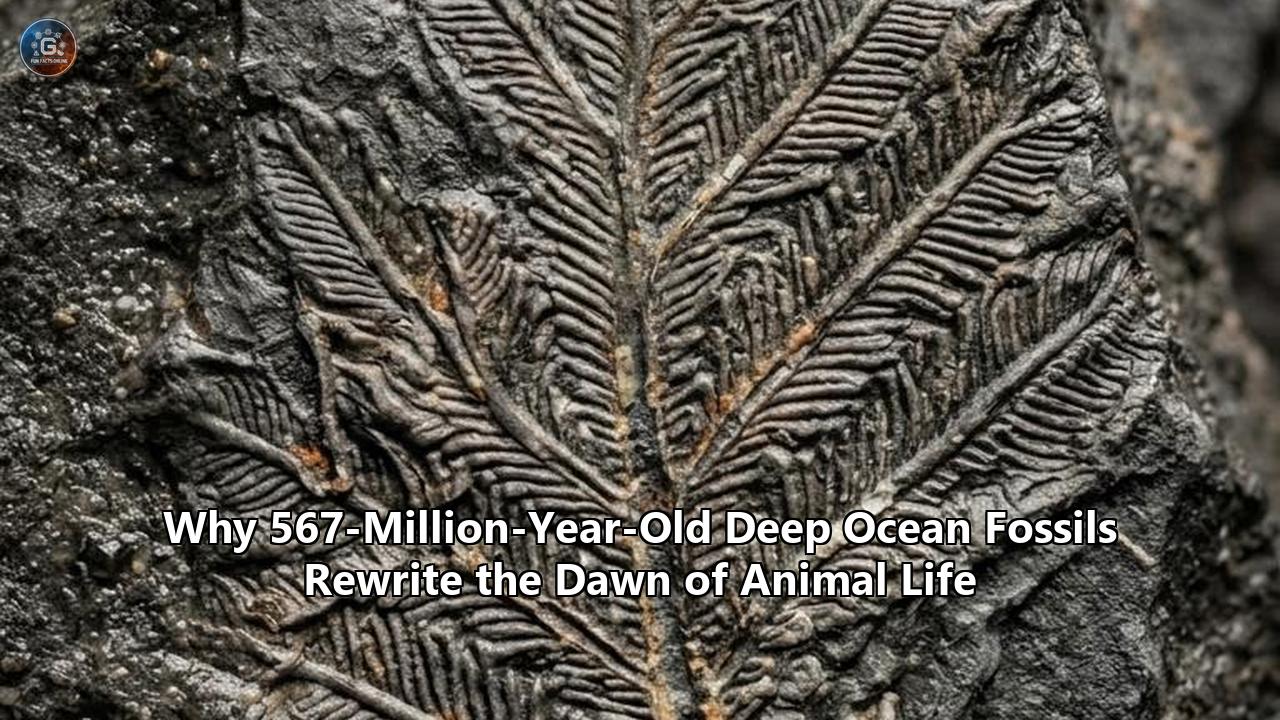
In May 2026, an international research team published the discovery of an extensive fossil assemblage from the remote Mackenzie Mountains in Canada’s Northwest Territories. Preserved in the lower Blueflower Formation near Sekwi Brook, these impressions date to approximately 567 to 566 million years ago. The findings document more than 100 individual fossil specimens, identifying six distinct organism groups previously missing from the ancient rock record of Laurentia, the ancestral continental core of North America.
The discovery directly challenges several foundational tenets of historical geology and evolutionary biology. For decades, the canonical timeline of early multicellular evolution placed the emergence of complex, motile, and sexually reproducing organisms between 559 and 550 million years ago, confined largely to shallow, wave-swept shelf environments. The Blueflower fossils push the fossilized record of these milestones back by 5 to 10 million years. More critically, sedimentary and geochemical analysis confirms that these organisms lived on an ancient continental slope hundreds of meters below the photic zone.
By pushing back the timeline and identifying deep marine settings as active cradles of innovation, these specimens alter scientific models detailing the environmental constraints and biological tempo governing the dawn of animal life.
PREVAILING CHRONOLOGICAL MODEL (Three-Stage Ediacaran)
├── Avalon Assemblage (575–559 Ma): Deep-water, static, frondose osmotrophs (e.g., Rangeomorphs)
├── White Sea Assemblage (559–550 Ma): Shallow-water, active motility, bilaterians, sexual reproduction
└── Nama Assemblage (550–538 Ma): Shallow-water, calcifiers, complex ecosystem engineering

THE BLUEFLOWER FORMATION DISCOVERY (567–566 Ma)
└── Coexistence: Complex "White Sea" taxa (Dickinsonia, Kimberella, Funisia) thrive in deep continental
    slope waters simultaneously with Avalon communities, invalidating the strict linear sequence.
The Collapse of the Tripartite Evolutionary Ladder
Before this discovery, paleontologists organized the macroscopic ecosystems of the Ediacaran Period (635 to 538 million years ago) into a tidy, three-stage evolutionary succession:
- The Avalon Assemblage (575–559 Ma): Documented at sites such as Mistaken Point in Newfoundland and Charnwood Forest in England, this phase was characterized by morphologically strange, non-motile, frond-like organisms termed rangeomorphs. These creatures lived primarily in deep, quiet water, relying on osmotic nutrient uptake (osmotrophy) rather than active predation or muscular grazing.
- The White Sea Assemblage (559–550 Ma): Best known from coastal cliffs along Russia’s White Sea and the Flinders Ranges in South Australia, this assemblage represented a marked leap in complexity. It introduced bilateral body symmetry, muscular motility, and directed feeding traces on seafloor microbial mats.
- The Nama Assemblage (550–538 Ma): Preserved prominently in Namibia, this closing act showed early biomineralization (such as the shell-building Cloudina) and signs of ecosystem stress directly preceding the Cambrian Radiation.
Paleobiologists interpreted this sequence as a linear chronological ladder. The assumption was that morphological innovation happened step-by-step: first came simple, static ocean fronds in deep water, followed millions of years later by complex, motile organisms exploiting sunlit, oxygen-rich coastal shallows.
The Blueflower Formation discovery shatters that neat compartmentalization. In layers dated to roughly 567 million years ago, the research team—led by Scott D. Evans of the American Museum of Natural History and Justin V. Strauss of Dartmouth College—uncovered hallmark White Sea taxa embedded firmly within the Avalon time window. Organisms previously assumed to belong exclusively to younger stages were actively coexisting alongside older evolutionary lineages.
+---------------------------+------------------------------------------------------+------------------------------------------------------+
| Metric / Feature          | Previous Consensus Model                             | Blueflower Formation Evidence                        |
+---------------------------+------------------------------------------------------+------------------------------------------------------+
| Age of White Sea Taxa     | 559 – 550 Ma                                         | ~567 – 566 Ma                                        |
| Primary Habitat Setting   | Shallow, sunlit shelf platforms                      | Deep-water continental slope / basin                 |
| Evolutionary Trajectory   | Onshore origin -> Offshore diversification           | Offshore origin -> Onshore expansion                 |
| Community Structure       | Strictly chronological stages (Avalon -> White Sea)  | Spatially and temporally overlapping ecosystems      |
| Geographic Scope          | Taxa absent from Laurentia (North America)           | Rich, diverse White Sea communities in Laurentia     |
+---------------------------+------------------------------------------------------+------------------------------------------------------+
The problem uncovered by these fossils is twofold. First, historical paleontology misread local taphonomic windows—geological preservation environments—as strict global extinction and origination events. Second, the geographic absence of these organisms across North America was mistaken for biological absence. For decades, models of evolutionary rates were built on incomplete sampling, creating a synthetic evolutionary delay that skewed timelines across every major phylogenetic tree.
The Offshore Paradox and the Inversion of Evolutionary Direction
Beyond upending geological dates, the Mackenzie Mountains discovery inverts a long-standing principle of marine ecology: the onshore-offshore evolutionary dynamic.
In later geological periods, such as the Paleozoic and Mesozoic, major evolutionary breakthroughs routinely appeared in shallow nearshore environments before spreading into deep basinal waters. Shallow coastal waters provided higher primary productivity fueled by abundant sunlight and wave mixing, creating intense competitive arenas that drove rapid morphological adaptation.
The 567-million-year-old Canadian specimens reverse this dynamic. Sedimentological analysis led by Strauss confirms that the lower Blueflower Formation preserves turbiditic siltstones and mudstones deposited below the reaches of storm wave base on a steep continental slope. Yet this deep-water setting was populated by organisms carrying out intricate biological functions:
DEEP CONTINENTAL SLOPE ECOSYSTEM (~567 Ma)
│
├── Kimberella
│   ├── Biology: Bilateral symmetry, distinct dorsal-ventral axes, muscular foot
│   └── Behavior: Directed grazing via radular/proboscis scratching (Kimberichnus traces)
│
├── Dickinsonia
│   ├── Biology: Segmented quilt-like construction, apical growth zone
│   └── Behavior: Coordinated crawling and episodic bottom-surface digestion
│
└── Funisia dorothea
    ├── Biology: Clustered tubular colonies
└── Behavior: Synchronized gamete broadcast spawning (sexual reproduction)- *Targeted Grazing and Motility (Kimberella): Kimberella, an organism exhibiting clear bilateral symmetry, a muscular ventral foot, and a tough dorsal covering, moved methodically across ancient sediments. Associated scratch-like trace fossils known as Kimberichnus demonstrate that it raked and fed on underlying microbial mats, proving that complex grazing mechanics operated in deep-water systems far earlier than anticipated.
- Integrated Locomotion (Dickinsonia): Dickinsonia, an iconic oval organism featuring ribbed modules organized across a central glide axis, moved along the seafloor. Trace fossils demonstrate that Dickinsonia repositioned itself to absorb nutrients directly through its sole, requiring tissue integration and coordinated muscular or hydrostatic contraction.
- Synchronized Sexual Reproduction (Funisia dorothea): Tubular fossils identified as Funisia dorothea appear in dense, mono-specific size clusters. This population architecture mirrors modern marine invertebrates that reproduce through broadcast spawning—the simultaneous release of eggs and sperm into the water column.
These findings indicate that complex body architectures, coordinated locomotion, and sexual reproduction did not emerge exclusively in high-energy coastal shallows. Instead, the deep ocean functioned as an evolutionary incubator.
"We think of the deep ocean as a dark, inhospitable place, but it is also relatively stable, with few fluctuations in things like temperature and oxygen essential to most animal life," Evans explained upon releasing the study. "This stability may have provided key opportunities to support early animal life."
The Biogeochemical Conflict: Deep-Sea Oxygenation Under Scrutiny
The discovery of active, breathing organisms on a 567-million-year-old continental slope creates an acute biogeochemical dilemma.
For half a century, the dominant geochemical paradigm asserted that Earth’s deep oceans remained persistently anoxic (oxygen-depleted) and ferruginous (dissolved iron-rich) or euxinic (sulfidic) throughout the Neoproterozoic Era, only oxygenating during the Phanerozoic transition around 538 million years ago. Aerobic respiration, bulk collagen synthesis, and the high metabolic demands of muscular locomotion require dissolved oxygen ($O_2$). If the deep ocean was anoxic at 567 Ma, complex motile metazoans should have suffocated.
+--------------------------------------------------------------------------------------------------+
|                                    THE GEOCHEMICAL DILEMMA                                       |
|                                                                                                  |
|   PREVAILING GEOCHEMICAL PROXIES                  PALEOBIOLOGICAL EVIDENCE                       |
|   (Iron speciation, Chromium isotopes)            (Lower Blueflower Formation)                   |
|                                                                                                  |
|   ┌────────────────────────────────┐              ┌────────────────────────────────┐             |
|   │ Deep ocean remained anoxic,    │    VERSUS    │ Motile, muscular bilaterians   │             |
|   │ ferruginous, and toxic until   │              │ (*Kimberella*, *Dickinsonia*)  │             |
|   │ the Cambrian transition.       │              │ actively breathing at 567 Ma.  │             |
|   └────────────────────────────────┘              └────────────────────────────────┘             |
|                                            │                                                     |
|                                            ▼                                                     |
|                           RESOLVING THE APPARENT PARADOX                                         |
|                                                                                                  |
|   1. Dynamic Oxygen Oases: Localized, transient ventilation plumes along continental slopes.    |
|   2. Ultralow Metabolic Thresholds: Early metazoans adapted to function at 0.5–2.0% modern PAL.   |
|   3. Internal Solitary Waves: Physical tidal pumps delivering oxic shallow water into basins.     |
+--------------------------------------------------------------------------------------------------+
To address this conflict, co-authors Erik Sperling of Stanford University and Kimberly Lau of Pennsylvania State University applied trace metal and stable isotope paleo-redox proxies directly to the fossil-bearing strata. Their work reveals a far more dynamic marine chemical environment than uniform models suggested:
- Transient Oxygen Oases: Instead of an ocean-wide oxygenation event, continental slopes experienced episodic ventilation events. Density-driven currents and cascading shelf waters transported oxygen down into deep basins, creating localized marine refugia where metazoan communities flourished.
- Lowered Physiological Oxygen Floors: Experimental studies on modern non-bilaterians and simple invertebrates (such as placozoans, sea anemones, and demosponges) indicate that basic tissue maintenance, ciliary crawling, and even primitive muscular contraction can operate at dissolved oxygen concentrations as low as 0.5% to 2.0% of present atmospheric levels (PAL). Early macroscopic organisms did not require fully oxygenated oceans; they required chemophysical stability.
- Internal Solitary Waves (ISWs): Physical oceanographic models suggest that deep-marine slopes in the late Neoproterozoic were subject to internal tidal waves. These waves pulsed across the sea floor, clearing stagnant toxic boundary layers, resuspending food particles, and delivering pulses of oxygenated water directly to benthic communities.
The problem was not that the animals lacked oxygen, but that geochemical models had averaged millions of years of rock chemistry, smoothing away the dynamic, localized habitats that facilitated the dawn of animal life.
Methodological Overhaul: Correcting Paleontology’s Sampling Biases
The mischaracterization of early animal evolution stems directly from systemic collection biases and limitations in sedimentary dating. For over a century, Ediacaran paleontology concentrated on accessible outcrops in South Australia, the English Midlands, and the White Sea region of northwestern Russia. Entire continents—most notably North America—were largely left out of the diversification narrative.
SAMPLING BIASES & SYSTEMIC CORRECTIONS

Historical Obstacles:
├── Geographical Concentration: Over-reliance on accessible sites (Flinders Ranges, White Sea)
├── Chronostratigraphic Rigidity: Assuming rock unit presence equals absolute biological appearance
└── Radiometric Imprecision: Low resolution across soft-sediment siliciclastic successions

Modern Multi-Disciplinary Corrections:
├── High-Precision Re-Os Dating: Direct radiometric dating of organic shales in sequence
├── Taphonomic Decoupling: Separating biological innovation from preservation conditions
└── Broadened Field Grids: Decadal mapping programs across remote northern cordilleras
To resolve these biases, the research consortium implemented a rigorous multi-proxy framework across northwestern Canada:
High-Precision Radiometric Calibration
Siliciclastic marine rocks rarely contain volcanic ash beds suitable for uranium-lead (U-Pb) zircon dating. To circumvent this, the team deployed rhenium-osmium (Re-Os) geochronology on organic-rich marine mudstones flanking the fossil horizons. Because rhenium and osmium are scavenged directly from seawater by sinking organic matter, the isotopic ratio records the precise depositional age of the sedimentary rock. This technique established the lower Blueflower Formation's minimum age of ~567 Ma with high confidence.
Taphonomic Decoupling
Paleobiologists have separated biological extinction from the closure of taphonomic preservation windows. The soft-bodied Ediacara biota required unique taphonomic conditions to fossilize—often termed "Death Masks." Silt and clay laden with iron, silica, or volcanic dust had to rapidly blanket the creatures, followed by immediate pyrite mineral crusting driven by anaerobic microbial activity.
By analyzing the microscopic thin sections of the Blueflower beds, researchers proved that the apparent absence of White Sea organisms in older rocks worldwide was not an evolutionary absence, but a failure of fossilization.
Geographic and Stratigraphic Expansion
The Canadian Cordillera represents one of the thickest, most continuous Neoproterozoic-to-Cambrian sedimentary successions on the planet. By methodically logging thousands of meters of vertical stratigraphy across the Wernecke, Ogilvie, and Mackenzie Mountains, Justin Strauss and his team discovered that the stratigraphic column preserves an unbroken environmental transect spanning multiple millions of years.
STRATIGRAPHIC SUCCESSION IN THE MACKENZIE MOUNTAINS (NWT)

Top
 │  Cambrian Strata (Trilobites, biomineralized shells, extensive bioturbation)
 │  ─────────────────────────────────────────────────────────────────────────────
 │  Upper Blueflower Formation (Nama-type components, biomineralization)
 │  ─────────────────────────────────────────────────────────────────────────────
 │  Lower Blueflower Formation (~567–566 Ma)
 │  [★ The Sekwi Brook Fossil Assemblage: Dickinsonia, Kimberella, Funisia, Aulozoon]
 │  ─────────────────────────────────────────────────────────────────────────────
 │  Nadaleen Formation (Avalon-type rangeomorphs and simple disks)
 │  ─────────────────────────────────────────────────────────────────────────────
 │  Sheepbed Formation (Post-glacial post-Marinoan mudstones and early macro-algae)
 ▼
Base
This integrated strategy resolves the structural bias that long hindered Neoproterozoic evolutionary studies, providing clear empirical evidence that active animal communities were functioning long before the classic White Sea exposures were deposited.
Collaborative Fieldwork and Northern Scientific Sovereignty
Uncovering these 567-million-year-old fossils demanded logistical endurance and collaborative governance. The Mackenzie Mountains of the Northwest Territories are among the most remote environments in North America, accessible only via specialized helicopter drop-offs, with scientists working along steep scree slopes in unpredictable sub-Arctic weather.
FIELDWORK LOGISTICS & INSTITUTIONAL GOVERNANCE

Field Operations:
├── Helicopter deployments into roadless Mackenzie Mountain scree basins
├── Decadal mapping supported by Canadian and Yukon Geological Surveys
└── Extensive stratigraphic logging across the Sekwi Brook drainage basin

Collaborative Governance:
├── Formal research licensing with Sahtú Dene and Métis leadership
├── Integration of local geographic and environmental knowledge
└── Permanent regional accessioning at the Prince of Wales Northern Heritage Centre
The expedition operated under a modern research paradigm emphasizing Indigenous scientific sovereignty and ethical land use. The fossil localities sit on the ancestral lands of the Sahtú Dene and Métis peoples.
Before fieldwork began, the research team worked closely with Sahtú leadership and communities, securing formal permissions, incorporating traditional geographical knowledge, and establishing strict site-stewardship protocols.
Rather than exporting northern geological heritage permanently to southern or international institutions, the discovered fossils will be permanently accessioned and preserved at the Prince of Wales Northern Heritage Centre in Yellowknife, Northwest Territories. This institutional framework guarantees that indigenous communities retain custody of critical natural history specimens while keeping them available for ongoing global research.
The logistical success in the Mackenzie Mountains proves that remote, high-risk paleontological field campaigns can align with community-led scientific conservation and indigenous ownership.
Reconciling the Molecular Clock with the Physical Fossil Record
For decades, paleobiology has struggled with an unresolved contradiction between molecular clock models and macro-paleontology.
Molecular clock analyses—which estimate when biological lineages split by comparing mutation rates across modern animal genomes—consistently suggest that the common ancestors of all bilaterian animals (sponges, cnidarians, mollusks, and arthropods) originated between 650 and 600 million years ago, during or immediately following the Cryogenian "Snowball Earth" glaciations.
THE EVOLUTIONARY TIMELINE RECONCILIATION

650 Ma ─────────────────────────────────────────────────────────────► 530 Ma
(Cryogenian)                       (Ediacaran)                        (Cambrian)

Molecular Clock Estimates for Crown Metazoa:
[======================= 650–600 Ma =======================]

Old Fossil Record (Mistaken Point / White Sea):
                                   [Avalon: 575 Ma]  [White Sea: 559 Ma]  [Cambrian: 538 Ma]
                                          ▲                  ▲                   ▲
                                    (Static fronds)    (First Bilaterians) (Shells/Burrows)

New Blueflower Formation Calibration:
                                   [Avalon: 575 Ma]
                                   [Blueflower: 567 Ma] ◄── Pushed back by 5–10 million years
                                   (Kimberella, Dickinsonia in deep-water basins)
Until this discovery, physical fossils failed to back up those computational dates. The sudden emergence of complex animals around 559 million years ago in the White Sea and Flinders Ranges left an unexplained 40-to-90-million-year "ghost lineage" across evolutionary trees. Critics argued that molecular clocks were systematically flawed, overestimating evolutionary rates and generating phantom timelines.
The 567-million-year-old Canadian fossils begin to bridge this gap. By showing that derived, specialized bilaterian forms such as Kimberella and integrated organisms like Dickinsonia were fully formed and functionally active nearly 570 million years ago, the physical fossil record is stepping closer to molecular timelines.
Furthermore, locating these organisms in deep offshore marine strata resolves where the ancestors of modern animals were hiding during the early Ediacaran. Shallow-water coastal deposits from 600 to 570 million years ago were frequently scoured by fluctuating sea levels and geochemical swings. The deep continental slopes, by contrast, provided long-term ecological refugia where early metazoans quietly radiated, developed complex muscular and reproductive systems, and accumulated morphological novelties away from high-energy coastlines.
These fossils confirm that the emergence of complex animals was not a frantic, instantaneous burst, but an extended, ecologically diverse radiation that took place across the dawn of animal life.
Upcoming Milestones and the Unresolved Frontiers of Early Life
The Blueflower Formation discovery has sparked a renewed international research campaign, with multiple scientific teams preparing new investigations across the circumpolar north.
+--------------------------------------------------------------------------------------------------+
|                                    UPCOMING RESEARCH FRONTIERS                                   |
+--------------------------------------------------------------------------------------------------+
| 1. High-Density Micro-CT and Synchrotron Geochemical Mapping (2026–2027)                         |
|    - Non-destructive 3D imaging of internal soft-tissue architectures and gut tracts.             |
|    - Synchrotron X-ray fluorescence to isolate organic carbon vs. microbial mineral envelopes.  |
|                                                                                                  |
| 2. Stratigraphic Transects across the Nadaleen and Sheepbed Formations (2027 Field Season)       |
|    - Targeted sampling of sub-570 Ma deeper slope sections in Yukon and NWT.                     |
|    - Searching for pre-Avalon bilaterian trace fossils and microscopic body plans.              |
|                                                                                                  |
| 3. High-Resolution Carbonate Clumped Isotope Paleothermometry                                    |
|    - Reconstructing bottom-water temperatures on the 567 Ma Laurentian continental slope.       |
|    - Assessing thermal stability as an ecological buffer for early multicellularity.             |
|                                                                                                  |
| 4. Global Deep-Slope Coring Projects (Namibia, South China, and Siberia)                         |
|    - Testing if deep-to-shallow evolutionary radiation was a universal macroevolutionary rule.   |
+--------------------------------------------------------------------------------------------------+
High-Resolution Micro-CT and Synchrotron Mapping
Specimens collected during the Mackenzie Mountains expeditions are undergoing advanced synchrotron X-ray fluorescence (XRF) and high-density micro-computed tomography ($\mu\text{CT}$) at central research laboratories. These non-destructive, sub-micron imaging methods will map out trace-element distributions within the fossils, helping scientists reconstruct internal organ anatomy, primitive digestive systems, and verify the muscular attachment points of enigmatic taxa such as Eoandromeda and Aulozoon*.
Targeting Older Basinal Sediments
The research team has identified hundreds of vertical meters of fossil-bearing strata directly below the lower Blueflower Formation, extending down into the Nadaleen and Sheepbed Formations. Stratigraphic teams plan to systematically sample these older basinal mudstones across the Mackenzie and Wernecke mountain corridors, searching for physical evidence of metazoan movement and body fossils dating between 580 and 600 million years ago.
Testing the Global Deep-Slope Model
Geologists are now applying the deep-water exploration model established in Laurentia to under-explored continental slope successions worldwide. Field campaigns are being planned across the terminal Proterozoic deep-water slope deposits of the Nama Group in southern Namibia, the Doushantuo and Dengying formations in South China, and the Yudoma Group in Siberia. These investigations will test whether early animals emerged in deep waters globally before expanding into shallow coastlines.
A Revised Understanding of Earth's First Animals
The 567-million-year-old fossils from Canada’s Mackenzie Mountains settle a long-standing debate while opening new avenues of scientific inquiry. They dismantle the idea that early animal life evolved along a simple, stepped ladder from static deep-water fronds to shallow-water grazers. Instead, they reveal a dynamic, interconnected late Neoproterozoic biosphere where complex, motile, and sexually reproducing organisms thrived in deep-sea ecosystems millions of years earlier than recognized.
By showing that the offshore depths served as evolutionary incubators, these findings shift our understanding of the environmental conditions that sparked complex life. Rather than demanding high-energy, fully oxygenated coastal shores, the earliest animals leveraged the stable, quiet floors of deep continental slopes to innovate and diversify.
As fieldwork expands across the Canadian North and similar ancient basinal strata worldwide, the rock record continues to show that the dawn of animal life was far older, deeper, and more ecologically complex than science long assumed.
Reference:
- https://www.amnh.org/explore/news-blogs/fossil-trove-expands-range-of-squishy-early-animals
- https://scitechdaily.com/these-567-million-year-old-fossils-are-rewriting-the-story-of-life-on-earth/
- https://timesofindia.indiatimes.com/etimes/animals/ancient-567-million-year-old-fossils-reveal-animal-life-may-have-evolved-earlier-than-scientists-thought/articleshow/131275393.cms
- https://fossilhuntress.blogspot.com/2026/08/sex-movement-and-567-million-year-old.html
- https://pmc.ncbi.nlm.nih.gov/articles/PMC13189134/
- https://www.sciencedaily.com/releases/2026/08/260804034644.htm
- https://bioengineer.org/new-fossil-finds-in-northwest-canada-transform-understanding-of-early-animal-evolution/
- https://www.ecoticias.com/en/scientists-have-discovered-fossils-of-creatures-that-lived-567-million-years-ago-in-remote-mountains-in-canada-and-some-of-them-were-already-capable-of-moving-across-the-seafloor-even-though-they-did/35557/
- https://scitechdaily.com/567-million-year-old-fossils-suggest-animals-evolved-earlier-than-we-thought/
- https://economictimes.indiatimes.com/news/international/us/science-news-567-million-years-ago-strange-soft-bodied-animals-began-moving-across-the-deep-seafloor-in-what-is-now-canada-with-dickinsonia-feeding-through-its-underside-despite-having-no-mouth-pushing-animal-movement-millions-of-years-earlier/articleshow/133408120.cms?from=mdr
- https://www.sciencedaily.com/releases/2026/08/260804034644.htm
- https://www.earth.com/animals/canadian-fossils-may-rewrite-the-origin-story-of-animal-life/
- https://www.amnh.org/explore/news-blogs/fossil-trove-expands-range-of-squishy-early-animals
- https://scitechdaily.com/these-567-million-year-old-fossils-are-rewriting-the-story-of-life-on-earth/
- https://fas.dartmouth.edu/news/2026/06/fossils-push-back-origins-animal-movement-millions-years
- https://fas.dartmouth.edu/news/2026/06/fossils-push-back-origins-animal-movement-millions-years
- https://www.thecooldown.com/green-tech/canada-fossil-discoveries-mackenzie-mountains/