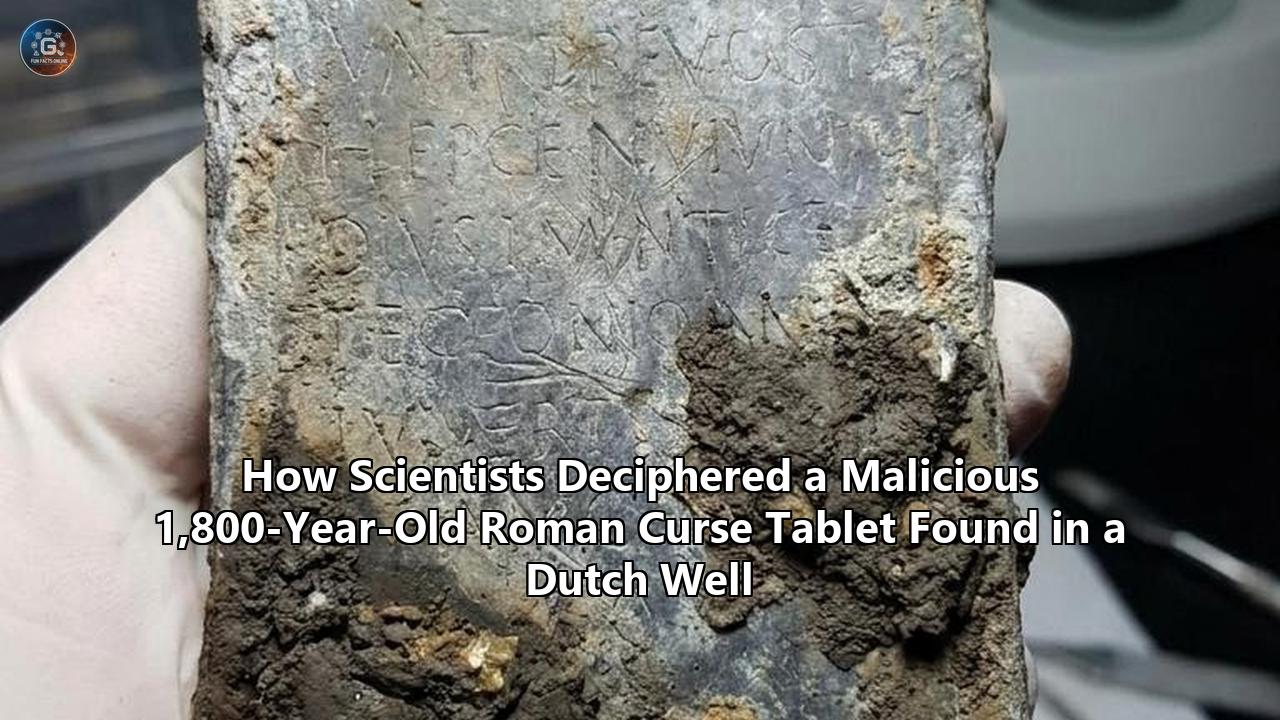
In June 2026, researchers at the Institute for Papyrology at Heidelberg University announced the successful decipherment of a highly unusual, 1,800-year-old lead sheet discovered in a Roman-era well in the Netherlands. Measuring just 9.3 by 4.8 centimeters, this modest artifact was unearthed beneath the town hall square (Raadhuisplein) in the municipality of Heerlen. In antiquity, this site was Coriovallum, a bustling Roman military and administrative settlement in the province of Germania Inferior (Lower Germania).
Using an advanced computational imaging technique known as Reflectance Transformation Imaging (RTI), a scientific team led by Dr. Rodney Ast and Dr. Julia Lougovaya managed to read the faint, corroded inscriptions scratched into the lead. What they uncovered was a rare Roman curse tablet—known to classicists as a defixio in Latin or a katadesmos in Greek—designed to invoke powerful deities and demons to harm, bind, or restrain an opponent.
But this was no ordinary local curse. While the vast majority of curse tablets recovered from Rome’s northern frontier are written in Latin and address local grievances within Western European frameworks, the Heerlen tablet was written in Ancient Greek and structured around an Egyptian-style magical tradition. It named four enslaved individuals: two men with Latin names and two women with Greek names, identifying them as "fellow slaves".
The decipherment of the Heerlen tablet is more than a triumph of modern archaeological science; it serves as a powerful case study for understanding how ideas, people, and religious practices migrated across the vast expanse of the Roman Empire. By examining the precise technology used to read this fragile metal sheet, the linguistic and magical traditions fused within its text, and the human lives it briefly illuminates, we can extract profound lessons about the globalization of the ancient world, the psychology of the marginalized, and the digital future of historical preservation.
The Tech Behind the Text: Reflectance Transformation Imaging
The first major lesson of the Heerlen discovery lies in the field of digital epigraphy. For centuries, the study of ancient texts was constrained by the physical limitations of the artifacts themselves. Lead curse tablets, which have been recovered by the thousands from archaeological sites across Europe, North Africa, and the Middle East, present a unique set of conservation and legibility challenges.
Lead is a soft, malleable metal, which made it highly attractive to ancient magical practitioners who could easily scratch texts into its surface with an iron or bronze stylus. However, over centuries of burial in damp wells, graves, or rivers, lead undergoes severe oxidation. It forms a brittle, white or gray crust of lead carbonate and other minerals that obscures the original incisions. Furthermore, many of these tablets were folded, rolled, or pierced with iron nails to symbolically "bind" the victim, making any attempt to physically unroll them highly risky. Even when a tablet is flat or has been carefully unfolded by a conservator, the scratches are often so shallow and worn that they are virtually invisible under standard, ambient museum lighting.
To overcome these obstacles without destroying the artifact, Dr. Rodney Ast and his colleagues at Heidelberg University utilized Reflectance Transformation Imaging (RTI).
The Mechanics of RTI
RTI is a computational photographic method that captures a subject’s surface shape and color, allowing researchers to interactively re-light the object from any direction in a virtual space. The process is highly methodical:
- Fixed Camera Position: The artifact is placed on a stable surface, and a high-resolution camera is mounted directly above it in a fixed position.
- Variable Light Sources: A series of photographs are taken—often dozens or hundreds—while a light source is moved to different, mathematically known positions in a virtual dome or hemisphere around the object.
- Mathematical Reconstruction: In each photograph, the varying angle of the light source casts unique micro-shadows across the surface’s scratches, pits, and textures.
- Surface Normal Map: Using specialized software, these images are digitally combined. The software analyzes the changes in light and shadow at each pixel across the entire photo set to calculate a "surface normal"—a 3D vector indicating the precise orientation of the surface at that exact point.
The resulting file is not a static flat photograph, but a dynamic, three-dimensional digital model of the tablet's texture. By utilizing an interactive viewer, epigraphists can drag a virtual light source across the screen, mimicking the effect of holding the tablet in their hands and tilting it under a lamp.
Unlocking the "Invisible"
For the Heerlen tablet, RTI proved to be the decisive factor. Under normal light, the surface appeared as a chaotic jumble of gray corrosion and faint, unreadable lines. By applying "specular enhancement"—a software filter that mathematically removes the color and reflectance of the lead, leaving only the raw physical topography—the scientists were able to isolate the intentional strokes of the ancient scribe's stylus from the natural cracks and pits of age.
This process revealed three distinct zones of writing: a section of ancient Greek script, a middle section containing highly specific non-linguistic magical sigils, and a final section detailing the names of the four slaves.
The success of this technique in Heerlen demonstrates a broader shift in modern archaeology. We are moving away from invasive, physical interventions toward non-destructive, digital reconstructions. Where past generations of archaeologists might have lost precious letters to crumbling lead flakes during physical cleaning, digital epigraphy now rescues these texts intact, preserving the physical integrity of the artifact while vastly increasing our ability to read it.
The Geography of the Occult: Syncretism on the Roman Frontier
To fully appreciate the historical importance of the Heerlen find, one must understand the environment in which it was buried. Coriovallum was not an intellectual capital like Athens or Alexandria. Located at the crucial intersection of the Via Belgica (which linked Cologne on the Rhine to Boulogne-sur-Mer on the English Channel) and the Via Treverorum (linking Aachen to Xanten), it was a frontier settlement. It was inhabited by Roman soldiers, local Gallo-Roman potters, administrative clerks, merchants, and slaves.
Its most famous archaeological feature is its massive public bathhouse, constructed in the mid-first century AD and expanded under Hadrian. Coriovallum was a place of pragmatic, hard-nosed colonial life. Yet, buried in a pit or well beneath what is now the town hall square, this Roman curse tablet reveals a highly sophisticated, deeply esoteric magical tradition that had traveled thousands of miles.
| Feature | Typical Northern Frontier Curse Tablet | The Heerlen Curse Tablet |
|---|---|---|
| Language | Latin (often cursive, vulgar Latin) | Ancient Greek (clear, stylized) |
| Tradition | Roman/Celtic syncretism (appealing to Sulis, Mercury, or local water spirits) | Egyptian-style magical tradition (invoking Egyptian deities/demons) |
| Symbols | Minimal or none; text-focused | Contains characteres (distinct magical sigils) |
| Socio-Cultural Origin | Local litigants, soldiers, or victims of minor theft | Highly mobile individuals, potentially from Egypt or the Eastern Mediterranean |
The Hellenistic-Egyptian Magical Formula
The presence of Greek text invoking Egyptian deities in a Dutch well is a vivid demonstration of Roman "globalization." Following the conquest of Egypt by Octavian in 30 BC, the rich, centuries-old traditions of Egyptian temple magic began to merge rapidly with Greek philosophy, Jewish mysticism, and Roman pragmatism. This syncretism is heavily documented in the Papyri Graecae Magicae (Greek Magical Papyri), a collection of spellbooks compiled in Roman Egypt between the second century BC and the fifth century AD.
These spellbooks were not the work of uneducated street conjurers; they were sophisticated grimoires written by literate, highly specialized scribes who understood how to manipulate language, divine names, and cosmic symbols. The Heerlen tablet utilizes exactly this type of formulaic magic. It does not simply ask a local god to punish a thief. Instead, it invokes a series of divine entities and demons rooted in the Egyptian underworld, using Greek as the ritual lingua franca to "bind" (katadein) the targets.
This reminds us that the borders of the Roman Empire were incredibly porous when it came to belief systems. The Roman army and the networks of imperial administration did not just transport grain, wine, and weapons; they acted as a nervous system through which the most intimate and esoteric beliefs of the Nile Delta could find their way to the damp, cold forests of the Rhine and the Meuse.
The Scribes of the Shadow World: Analyzing the Inhabitants of the Tablet
At the heart of the Heerlen tablet's text is a deeply human mystery. The inscription contains the names of four individuals, explicitly identified as "fellow slaves" (syndouloi):
- Two men with Latin names
- Two women with Greek names
In the highly stratified world of the Roman military outpost, slaves were legally categorized as instrumentum vocale—"speaking tools." They possessed no formal legal standing, could not bring charges in a Roman court, and were subject to the absolute authority of their masters. In the official epigraphy of monuments, tombstones, and public buildings, their voices are almost completely silent. But in the lead sheets dropped into the darkness of wells, their private lives, tensions, and networks of solidarity or rivalry come to light.
Papyrologist Dr. Rodney Ast proposed two competing, yet equally compelling, hypotheses for how we should interpret the presence of these four names:
Hypothesis A: The Curse Directed Against the Four Slaves
In this scenario, an external actor—perhaps an overseer, a master, or a rival slave—commissioned the tablet to harm or neutralize these four individuals. In the competitive environment of a Roman household or imperial estate, slaves often competed fiercely for favor, resources, or the promise of manumission (freedom).
A curse tablet targeting four slaves simultaneously suggests a coordinated effort to suppress them. Perhaps they had formed a cooperative faction within the household, or perhaps they were suspected of a joint crime, such as theft or conspiracy, and an overseer used magic to "bind" their minds and tongues, preventing them from defending themselves or coordinating their alibis.
Hypothesis B: The Curse Written By or For the Slaves
Alternatively, the four "fellow slaves" may have banded together to cast a curse against an unnamed oppressor. In this reading, the tablet represents a form of collective, covert resistance. Because enslaved people could not seek justice through the Roman legal system, they turned to the cosmic tribunal of the underworld.
By writing their own names on the tablet as the initiators of the curse, they were presenting a united front to the chthonic deities, calling upon supernatural forces to strike down a master, an abusive supervisor, or a free legal adversary whose name they dared not write out of fear of physical retribution if the tablet were ever discovered.
       [ Cosmic Tribunal: Chthonic Deities / Demons ]
                              ^
                              | (Invoked via Greek/Egyptian Spell)
                              |
                     [ The Heerlen Tablet ]
                    /                      \
         [ Hypothesis A ]              [ Hypothesis B ]
         Curse directed                Curse initiated
        AGAINST the slaves             BY the slaves
         (To bind/silence)            (To combat oppressor)
The Migration of the Sorceress
Adding another layer of intrigue is the hypothesis put forward by Dr. Julia Lougovaya. She suggests that one of the two women with Greek names may have been the actual author of the inscription.
If this woman had been enslaved in Roman Egypt and subsequently trafficked across the empire to the northern frontier of Lower Germania, she would have carried her specialized cultural capital with her: her literacy in Greek, her familiarity with the complex ritual structures of Egyptian magic, and her knowledge of how to construct a technically perfect defixio.
In a cold military outpost like Coriovallum, this woman may have been recognized by her fellow slaves as a possessor of formidable, esoteric power—a woman who could communicate directly with the gods of the dead to solve earthly disputes. For a small fee or out of solidarity, she may have agreed to craft this tablet, scratching out the Greek characters and drawing the sacred characteres to channel their collective desperation into a potent weapon of spiritual warfare.
The Anatomy of a Defixio: Understanding the Magic
To understand how the creator of the Heerlen tablet expected the spell to work, we must examine the specific elements of a Roman curse tablet’s construction. This was not a chaotic expression of anger; it was a highly structured, quasi-legal procedure designed to manipulate the supernatural world.
The Power of Lead
The material choice of lead was deeply symbolic. Lead is heavy, cold, dull, and highly toxic—all properties that the ancient magician wished to transfer to the victim.
Furthermore, lead was a byproduct of silver mining, mined from deep within the earth. In the ancient mind, this direct physical connection to the subterranean realms made it the perfect physical medium for communicating with chthonic (underworld) deities such as Pluto, Proserpina, Hecate, Hermes Chthonios, and various local or foreign demons. When the scribe inscribed a curse on lead, they were quite literally writing on a piece of the underworld itself.
The Role of Wells and Pits
The deposition of the tablet in a well or pit beneath the town hall square of Coriovallum was also a vital step in the ritual.
In antiquity, water sources, deep pits, and graves were seen as literal portals to the underworld. Water, especially stagnant or deep well water, acted as a conductive medium, carrying the written message directly down to the spirits of the dead and the deities of the earth.
Magicians particularly sought out wells or graves associated with those who had died prematurely, violently, or without proper burial (known as the aori or biaiothanatoi). These restless spirits were believed to linger near their places of death or burial, trapped between worlds, making them highly susceptible to being conscripted by a sorcerer to do their bidding. By dropping the lead sheet into the well, the author of the Heerlen curse was "mailing" their petition directly to the supernatural executioners below.
The Characteres: The Divine IP Addresses
One of the most remarkable features revealed by the RTI analysis of the Heerlen tablet was the presence of three characteres.
   Typical "Characteres" (Magical Sigils)

        *---o      o===o      o--*--o
       /             |           |
      o              o           o
In the magical papyri and lead tablets of the late Roman Empire, characteres are non-linguistic, abstract symbols. They often feature straight lines ending in small circles, stars, or complex geometric crossings.
In theurgic and magical theory, these symbols were not human inventions. They were believed to be the true, primordial names or visual signatures of cosmic forces, angels, and demons. While human language (whether Greek or Latin) was limited and prone to misunderstanding, characteres bypassed human intellect entirely. They were viewed as a form of cosmic "source code."
When inscribed on a tablet, they functioned like a direct spiritual address, forcing the invoked entities to pay attention to the petition and execute the binding curse without delay.
The Broader Historical Lessons: What the Heerlen Tablet Teaches Us
The successful decipherment of the Heerlen curse tablet provides historians with a series of vital insights that challenge traditional, simplified views of the Roman Empire.
Lesson 1: The Frontier Was a Polyglot, Multicultural Hub
Popular depictions of Roman frontier provinces like Lower Germania often paint a picture of sharp cultural dichotomies: civilizing Roman soldiers in stone forts on one side, and wild Celtic or Germanic tribes in wooden huts on the other.
The Heerlen tablet completely upends this binary. It reveals that even in a relatively small military settlement like Coriovallum, the local population was incredibly diverse, interconnected, and polyglot. Here, under the damp skies of the modern-day Netherlands, we find:
- Slaves with Greek and Latin names.
- A scribe capable of writing professional-grade Ancient Greek.
- A deep familiarity with specialized religious and magical traditions originating in Hellenistic Egypt.
This indicates a level of physical and intellectual mobility that rivaled the modern era. People, books, ideas, and religious practices flowed constantly along the Roman road networks, ensuring that even the most distant outpost was plugged directly into the cultural currents of the Eastern Mediterranean.
Lesson 2: "High" and "Low" Magic Coexisted
In the Roman world, there was a strict legal and social division between accepted religious practices and forbidden, clandestine magic. Public prayers, sacrifices to the civic gods, and imperial cult rituals were encouraged as essential for the stability of the state. Conversely, private, malicious magic—especially spells designed to cause physical harm, manipulate love, or ruin a business rival—was officially outlawed, carrying severe penalties under Roman law, including crucifixion or exposure to wild beasts.
Yet, as the Heerlen find and other discoveries across Europe demonstrate, these laws did little to deter the practice of magic. Magic was an integrated, everyday reality for people at all levels of Roman society.
When official channels of justice failed—or were completely inaccessible, as they were for the enslaved—the shadow world of the defixio offered a highly structured, alternative system of cosmic dispute resolution. It was a world where the powerless could seek vengeance, and the powerful could secretly sabotage their rivals, all utilizing the same syncretic magical toolkits.
Lesson 3: The Epigraphic Turn and the Recovery of Silenced Histories
Historically, our understanding of the ancient world has been heavily skewed toward the perspectives of wealthy, literate elite men—emperors, senators, generals, and historians. The physical monuments they left behind were designed to project power, order, and orthodoxy.
Curse tablets represent what archaeologists call "the epigraphy of the everyday". They do not speak in the polished, formal language of monumental inscriptions. Instead, they capture raw, private human emotions: jealousy, hatred, desperation, fear, and love.
By developing and refining non-destructive technologies like RTI and synchrotron X-ray tomography, modern science is effectively democratizing the archaeological record. It is allowing us to bypass the official propaganda of the Roman state and read the private, unvarnished thoughts of the people who actually built, maintained, and suffered under that empire—including the enslaved individuals named on the Heerlen lead sheet.
Comparative Analysis: The Global Context of Curse Tablets
To understand how unique the Heerlen tablet is, it is helpful to contrast it with other major curse tablet discoveries made throughout the Roman world.
The Bath (Aquae Sulis) Tablets (United Kingdom)
One of the most famous collections of curse tablets was recovered from the hot springs of Aquae Sulis (modern-day Bath, England). Over 130 tablets, dating primarily from the second to fourth centuries AD, were found thrown into the sacred spring of the goddess Sulis Minerva.
Unlike the Heerlen tablet, the Bath inscriptions are written almost exclusively in Latin (often featuring British Latin dialects and spelling variations). Furthermore, their content is highly localized and focused on petty crimes. The writers frequently petition the goddess to punish thieves who have stolen their cloaks, bathing gear, or small amounts of money while they were relaxing in the baths.
The Bath tablets represent a highly localized, domestic use of judicial curses, operating within a standard Romano-British cultural framework. The Heerlen tablet, by contrast, represents a far more exotic, highly specialized transplant of Eastern Mediterranean esotericism into a military frontier.
The Mainz Defixiones (Germany)
Discovered during excavations for a shopping mall in Mainz (ancient Mogontiacum) in 1997, this collection of over 30 lead tablets was found within a sanctuary dedicated to Isis Panthea and Mater Magna.
Dating from the first to third centuries AD, many of these tablets are written in Latin and feature curses aimed at unfaithful lovers, thieves, and legal opponents.
While the Mainz tablets show some eastern religious influence (via the worship of Isis and Cybele), their linguistic and structural execution remains largely Latinate. The Heerlen tablet stands out even in comparison to Mainz, as it maintains its pure Greek linguistic structure and highly specific Egyptian formulaic spells, despite being found even further north.
The Kerameikos Wells (Athens, Greece)
In Greece, archaeologists recovered 30 lead curse tablets from a 2,500-year-old well in the Kerameikos area of Athens.
These tablets, dating to the Classical and Hellenistic periods, are written in Greek and are heavily focused on binding political adversaries, athletic competitors, and actors.
The Heerlen tablet represents a direct descendant of this classical Greek katadesmos tradition, but one that has been thoroughly infused with Roman-era Egyptian magic and carried across the continent by the tides of imperial trade and slavery.
Future Horizons: What Lies Ahead for the Heerlen Tablet
The decipherment of the Heerlen curse tablet is not the end of the story, but the beginning of a new chapter in the study of Roman Germany and ancient magic.
Scientific Publication and Comparative Analysis
The research team at Heidelberg University is currently preparing a comprehensive, peer-reviewed scientific study of the tablet’s full transcription.
Once published, this text will be integrated into global databases of ancient magic, such as the Thesaurus Defixionum. Comparative epigraphists will be able to analyze the specific linguistic formulas and names used on the Heerlen sheet, potentially identifying matches with known magical handbooks or other tablets found across the empire. This could help pin down the precise origin of the scribe or the magical family to which the spell belongs.
Museum Exhibition
The physical tablet is slated to be returned to the Netherlands, where it will be placed on public display at the Thermenmuseum (Heerlen Museum).
The museum, which houses the spectacular remains of the Roman bathhouse, plans to create an interactive exhibition around the artifact. Visitors will be able to view the tiny lead sheet alongside digital displays that show the RTI scans, allowing them to virtually "re-light" the tablet and trace the ancient Greek letters and magical symbols for themselves.
Continued Excavations in Heerlen
The discovery of the tablet beneath the Raadhuisplein occurred during a series of intensive rescue excavations preceding the redevelopment of the town hall square.
Because the Roman remains of Coriovallum lie just 60 to 80 centimeters below the modern street level, archaeologists have uncovered an array of highly significant structures, including the foundations of a large public building (potentially a temple or administrative basilica), early Roman graves, and everyday objects like metal ear-cleaning spoons, cloak pins, and white clay pottery.
The success of the curse tablet decipherment has heightened interest in these excavations. Archaeologists are continuing to sift through the lower layers of the site, particularly targeting wells, pits, and structural foundations in the hope of recovering more organic materials, coins, and perhaps additional lead documents that could shed light on the lives of the four slaves and the community they inhabited.
The Persistent Echoes of Ancient Desperation
The 1,800-year-old Roman curse tablet from Heerlen stands as a testament to the enduring power of human emotion and the remarkable capabilities of modern science. Through the lens of this single, tiny sheet of corroded lead, we can observe the massive, complex machinery of the Roman Empire at work: the forced migration of enslaved people across thousands of miles, the rapid blending of Greek, Egyptian, and Roman religious ideas, and the creation of highly specialized, secret networks of ritual resistance.
At the same time, the project highlights a profound technological lesson. By applying advanced computational imaging like Reflectance Transformation Imaging, modern researchers are not just reading old texts; they are actively rescuing voices that were intended to be buried in the dark forever.
The names of the two men and two women inscribed on the lead sheet—briefly illuminated by virtual light—remind us that beneath the grand, stone monuments of the ancient world lies a rich, complicated, and deeply human history of survival, conflict, and hope, waiting to be deciphered.
Reference:
- https://www.crazyalchemist.com/news/roman-era-curse-tablet-discovered-beneath-a-dutch-town-square/
- https://www.independent.co.uk/news/science/archaeology/ancient-tablet-magic-spells-enemies-b2998153.html
- https://archaeology.org/news/2026/06/19/roman-curse-tablet-from-the-netherlands-studied/
- https://www.labrujulaverde.com/en/2026/06/archaeologists-decipher-a-roman-curse-tablet-with-magical-symbols-found-in-ancient-coriovallum/
- https://allthatsinteresting.com/heerlen-netherlands-roman-curse-tablet
- https://arkeonews.net/1800-year-old-curse-tablet-in-the-netherlands-reveals-a-greek-spell-written-in-egyptian-style/
- https://greekreporter.com/2026/06/19/ancient-greek-curse-tablet-harm-enemies-netherlands/
- https://www.synchrotron-soleil.fr/en/news/roman-era-curse-tablet-studied-x-ray-tomography-psiche-beamline
- https://arkeonews.net/1800-year-old-curse-tablet-in-the-netherlands-reveals-a-greek-spell-written-in-egyptian-style/
- https://allthatsinteresting.com/heerlen-netherlands-roman-curse-tablet
- https://www.livius.org/articles/place/coriovallum-heerlen/
- https://www.romanreconstructions.com/roman-bathhouse-at-heerlen/
- https://www.independent.co.uk/news/science/archaeology/ancient-tablet-magic-spells-enemies-b2998153.html
- https://www.museum.nl/en/het-romeins-museum
- https://www.viabelgica.nl/en/hier-ligt-coriovallum-op-60-centimeter-van-heerlen/