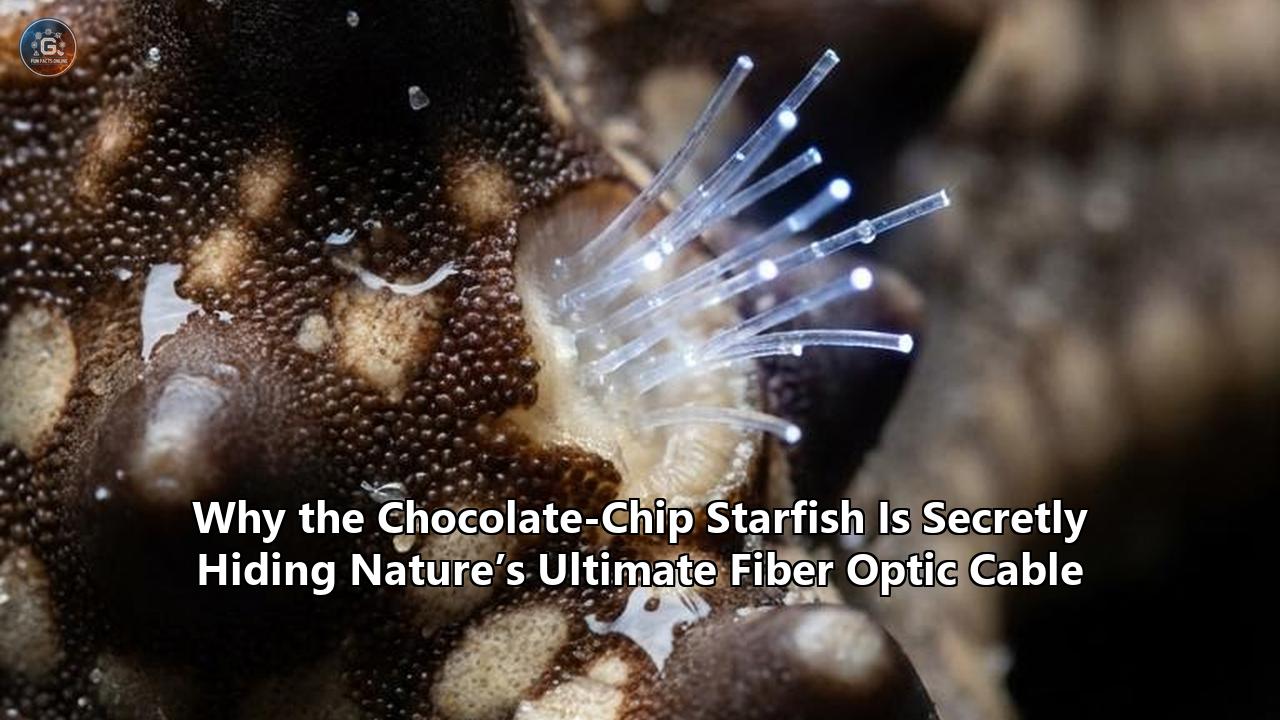
On June 8, 2026, a team of materials scientists and biologists led by Associate Professor Ling Li from the Department of Materials Science and Engineering at the University of Pennsylvania published a study in the Proceedings of the National Academy of Sciences (PNAS) that fundamentally challenges the traditional divide between structural protection and optical transmission. The study reveals that a common marine invertebrate, Protoreaster nodosus—popularly known as the chocolate chip starfish—has evolved a skeletal structure at the tips of its arms that acts as a natural, highly efficient fiber-optic network.
For decades, material science has operated under a strict trade-off: materials that are strong and load-bearing, such as concrete, bones, and shells, are almost universally opaque. Conversely, materials that transmit light, such as silica glass and clear polymers, are notoriously brittle and mechanically fragile. Yet, at the very tip of each arm of the chocolate chip starfish sits a highly specialized, mineralized skeletal element called the terminal plate. Within this single-crystalline calcitic plate lies a radially arranged array of microscopic, cone-shaped light-guiding structures (LGSs).
These LGSs function precisely like modern fiber-optic cables. The Penn-led research team demonstrated that each individual micro-cone transmits approximately 70% of incident light and concentrates it nearly threefold (2.8x) at its base. When acting collectively as a radial array, these structures capture light over a wide 120-degree field of view, boosting the light intensity inside the starfish’s arm by up to eightfold.
Astonishingly, this optical pathway does not weaken the starfish’s armor. Instead, the integration of these solid light guides within the porous skeletal meshwork increases the local mechanical stiffness of the terminal plate by threefold. By analyzing the biophysical properties of this system, researchers have uncovered a masterclass in multifunctional natural engineering—one that could redefine how humans design lightweight structural sensors, resilient building materials, and highly durable optical communication networks.
The Chocolate-Chip Starfish: An Unlikely Optoelectronic Pioneer
To the casual beachgoer or marine aquarist, Protoreaster nodosus is simply a slow-moving, charismatic inhabitant of the shallow, warm waters of the Indo-Pacific region. Characterized by its creamy, cookie-dough-colored body and punctuated by thick, dark brown tubercles that look strikingly like chocolate chips, this echinoderm is a staple of seagrass meadows and sandy lagoons. Historically, the starfish's "chocolate chips" were understood to serve purely defensive and physical purposes: these calcified, horn-like projections intimidate potential predators, such as triggerfish and puffers, making the starfish appear dangerous and difficult to swallow.
However, the evolutionary success of the chocolate chip starfish relies on more than just passive, spiny armor. Like all echinoderms, its entire body is supported by an endoskeleton composed of thousands of individual, mineralized elements called ossicles. These ossicles are not solid bone; they are made of stereom, a highly porous, three-dimensional microlattice composed of single-crystalline, magnesium-rich calcite ($Ca_x Mg_{1-x} CO_3$).
+-------------------------------------------------------------+
|               PROTOREASTER NODOSUS ENDOSKELETON             |
+-------------------------------------------------------------+
|                                                             |
|   [ stochastic stereom matrix ]                             |
|   - Porous, open-cell single-crystalline calcite            |
|   - Highly damage-tolerant, energy-absorbing                |
|                                                             |
|            |                                   |            |
|            v                                   v            |
|   [ non-sensory ossicles ]            [ terminal plate ]    |
|   - Standard structural armor         - Tip of each arm     |
|   - Optimized for load-bearing        - Radially aligned    |
|                                         LGS micro-cones     |
|                                       - Co-optimized for    |
|                                         mechanics + optics  |
|                                                             |
+-------------------------------------------------------------+
While the stereom throughout most of the starfish's body is optimized for lightweight structural support, energy absorption, and flexibility, the terminal plate at the tip of each ray is fundamentally different.
This specific region of the sea star has long intrigued biologists because of its connection to locomotion and environmental sensing. The chocolate chip starfish is known to exhibit strong positive phototaxis, consistently crawling toward light sources when exposed to directional illumination. It navigates its complex reef environment using a combination of a decentralized nervous system and visual cues.
For years, scientists focused their attention on the "optical cushions"—rudimentary, organic compound eyes located on the underside (oral side) of each arm tip. These organic eyes, while lacking lenses, allow the sea star to detect large, dark structures like coral reefs for navigation.
What the UPenn-led team discovered, however, is that the hard, mineralized terminal plate on the upper (aboral) side of the arm tip is not just a protective lid for these delicate tissues. Instead, it is a sophisticated biophotonic collector. By shaping its porous calcitic lattice into highly ordered, solid micro-cones, the chocolate chip starfish has built an array of physical wave-guides directly into its protective skull.
Anatomy of the Terminal Plate: Cones, Calcite, and the Microlattice
To understand how the terminal plate manipulates light, the researchers utilized state-of-the-art imaging techniques, including synchrotron micro-computed tomography ($\mu$-CT) at the Advanced Photon Source of the Argonne National Laboratory, alongside single-crystal X-ray diffraction (SCXRD) and electron backscatter diffraction (EBSD).
Their structural analysis revealed that the terminal plate is a dome-like, single-crystalline calcitic shield. While other ossicles feature a highly regular, diamond-triply periodic minimal surface geometry, the terminal plate’s microstructure is characterized by a random, stochastic stereom network. This porous network is decorated on its outer surface with circular protrusions, or "cobbles," which measure up to 100 micrometers in diameter.
Beneath these surface cobbles lie the light-guiding structures (LGSs). These structures are solid, elongated, cone-like features embedded directly within the porous, open-cell foam of the stereom. The geometrical characteristics of these cones are highly consistent:
- Top Diameter ($D_{\text{top}}$): $70.6 \pm 21.8 \ \mu\text{m}$ (where light enters from the ocean)
- Bottom Diameter ($D_{\text{bot}}$): $18.4 \pm 6.9 \ \mu\text{m}$ (where light exits internally)
- Length ($L$): $262.8 \pm 72.0 \ \mu\text{m}$
- Orientation: The longitudinal axes of these cones are radially arranged, converging toward an underlying internal cavity situated approximately 80 micrometers beneath the terminal plate.
                  Light Input (Ocean)
                     \   |   /
                      v  v  v
                +-----------------+  <-- Surface Cobble (D_top ~ 70 µm)
                 \               /
                  \             /
                   \   Solid   /     <-- Magnesium-Rich Single-Crystal Calcite
                    \ Calcite /          (Cone Length ~ 260 µm)
                     \  LGS  /
                      \     /
                       \   /
                        \ /
                         v           <-- Output Face (D_bot ~ 18 µm)
                         |
                   (Light Focused)
                         |
                         v
                +-----------------+
                | Internal Cavity |  <-- Photoreceptive Target Zone
                +-----------------+
The choice of magnesium-rich single-crystalline calcite as the building material is both brilliant and highly problematic from an optical standpoint. Calcite ($CaCO_3$) is a highly anisotropic crystal. It is famous for its strong birefringence (double refraction), meaning that when a ray of light enters a calcite crystal, it is split into two distinct rays—the ordinary ray and the extraordinary ray—each traveling at different speeds and in different directions. In synthetic optics, unaligned birefringence causes severe scattering, double-imaging, and loss of signal clarity.
To neutralize this optical handicap, the chocolate chip starfish employs a precise crystallographic trick: it aligns the atomic lattice of the calcite so that its optical axis (the c-axis) is perfectly parallel to the longitudinal axis of each individual LGS cone. By ensuring that incoming light travels along this specific crystal direction, the starfish eliminates the double-refraction effect entirely. Light passes straight down the length of the solid calcitic cone without being split, blurred, or scattered by the crystalline lattice, allowing the mineralized structure to serve as a pristine optical wave-guide.
Contrasting Technologies: The Starfish’s Single-Crystal Calcite vs. Human Glass Fibers
The discovery of the LGS array in the chocolate chip starfish provides an excellent opportunity to compare and contrast how biological evolution and human industrial engineering solve the challenge of guiding light through solid media. While both systems rely on the same fundamental principles of electromagnetic wave propagation, their materials, fabrication methods, structural properties, and physical trade-offs are drastically different.
| Feature / Property | Human Optical Fiber (Silica Glass) | Starfish Light-Guiding Structure (LGS) |
|---|---|---|
| Primary Material | High-purity synthetic silica glass ($SiO_2$) | Biogenic, magnesium-rich single-crystal calcite ($Ca_x Mg_{1-x} CO_3$) |
| Light Guiding Physics | Step-index Total Internal Reflection (TIR) via distinct core and cladding layers | Geometrical focusing and step-index refraction via a solid, tapered cone embedded in a highly porous, air/fluid-filled stereom matrix |
| Optical Anisotropy | Isotropic (no direction-dependent optical properties) | Highly anisotropic (birefringent); mitigated by aligning the crystallographic c-axis with the direction of light propagation |
| Mechanical Role | Non-structural; extremely fragile; requires heavy protective polymer/Kevlar jacketing | Multifunctional; acts as a structural reinforcement, increasing skeletal stiffness threefold |
| Tapering / Geometry | Uniform cylindrical cross-section; engineered to prevent light escape over long distances | Tapered, cone-like geometry; designed to maximize light concentration (2.8x) and collect light from a wide angle (120°) |
| Manufacturing Method | High-temperature drawing towers (exceeding 2,000°C); highly energy-intensive | Ambient-temperature, aqueous biomineralization controlled by organic matrix proteins |
The Physics of Wave-Guiding: Core/Cladding vs. Porous Embedding
Human-engineered fiber optics operate primarily through Total Internal Reflection (TIR). A standard optical fiber consists of a high-index core surrounded by a lower-index cladding. When light enters the core at an angle shallower than the critical angle, it is continuously reflected off the core-cladding boundary, traveling miles with virtually zero signal loss.
The chocolate chip starfish, by contrast, uses a different optical geometry. The solid LGS cones, with a refractive index of approximately 1.65 (typical for magnesium-rich calcite), are embedded within the open-cell porous stereom. The pores of the active stereom in a living sea star are filled with seawater (refractive index of ~1.34) and soft, organic cellular tissues (refractive index of ~1.35 to 1.40).
Because the refractive index of the solid calcite core (1.65) is significantly higher than that of the surrounding fluid-filled porous matrix (~1.35), the interface between the LGS cone and the stereom wall acts as a highly reflective boundary. Any light that enters the wide, 70-micrometer mouth of the cone and strikes the outer boundary is reflected inward, channeled down the narrowing taper, and focused out of the narrow, 18-micrometer base. This is not just a passive conduit; it is an active non-imaging optical concentrator, functionally similar to a Winston cone used in high-energy physics and solar energy harvesting.
HUMAN OPTICAL FIBER (Isotropic TIR)
======================================================
[ Cladding: Low Refractive Index (n = 1.45) ]
------------------------------------------------------
=======> Light Ray ---> (Reflects off boundary) ---> Core (n = 1.46)
------------------------------------------------------
[ Cladding: Low Refractive Index (n = 1.45) ]
======================================================

STARFISH LGS CONE (Tapered Focusing)
======================================================
  [ Porous Stereom Matrix filled with Seawater (n = 1.34) ]
  \
   \  Solid Calcite Cone (n = 1.65)
    =======> Light Ray ---> (Reflected & Focused down)
   /
  /
======================================================
Mechanical Trade-offs: Fragility vs. Load-Bearing Armor
The most profound contrast between human and biological fiber optics lies in their mechanical capabilities.
If you strip a human optical fiber of its protective polymer buffers, Kevlar strength members, and outer plastic jacketing, the bare silica glass core is incredibly vulnerable. A micro-scratch on its surface can cause catastrophic crack propagation under minimal tensile or bending stress. Human fiber optics are strictly monofunctional: they are designed to transmit data and are deliberately isolated from any structural load-bearing role in engineering applications.
The chocolate chip starfish completely rejects this monofunctional design. Its light guides are not delicate components that must be cushioned from the outside world. They are the outside world's cushion. The LGS cones are integrated seamlessly into the sea star's skeleton, functioning simultaneously as high-efficiency optical pathways and as structural reinforcement pillars. This co-optimization represents an entirely new way of thinking about materials, showing that cellular solids can contain dense, structural nodes that actively guide electromagnetic waves without introducing structural weak points.
Contrasting Biological Designs: The Terminal Plate vs. Other Natural Light Guides
The chocolate chip starfish is not the first organism discovered to manipulate light using biomineralized or biological structures. To appreciate the unique nature of the terminal plate, it is helpful to contrast it with three other famous biophotonic structures found in nature: the glass spicules of deep-sea sponges, the microlenses of brittle stars, and the mineralized eyes of chitons.
+---------------------------------------------------------------------------------+
|                           NATURAL BIOPHOTONIC EVOLUTION                         |
+---------------------------------------------------------------------------------+
|                                                                                 |
|   [ Euplectella aspergillum ]                                                   |
|   - Silica glass spicules                                                       |
|   - Excellent optical transmission, but highly brittle                          |
|   - Non-structural; passive ocean floor anchoring                              |
|                                                                                 |
|   [ Ophiocoma wendtii ]                                                         |
|   - Calcite microlenses (cobbles)                                               |
|   - Focuses light onto surface-level nerves                                     |
|   - Lacks deep, wave-guiding cone channels                                      |
|                                                                                 |
|   [ Acanthopleura granulata ]                                                   |
|   - Aragonite mineralized eyes                                                  |
|   - Compromises shell armor strength (eyes introduce weak points)               |
|                                                                                 |
|   [ Protoreaster nodosus ]                                                      |
|   - Calcite LGS cone array                                                      |
|   - 70% light transmission, 120° field of view, 8x collective brightening       |
|   - Mechanically reinforces skeleton (3x stiffness increase)                    |
|                                                                                 |
+---------------------------------------------------------------------------------+
1. Glass Spicules of Euplectella aspergillum (The Venus Flower Basket)
The deep-sea glass sponge Euplectella aspergillum is famous for its intricate, cylindrical skeleton made of amorphous silica ($SiO_2$). The sponge produces long, hair-like skeletal fibers called basalia spicules that anchor it to the muddy ocean floor.
In 2004, researchers discovered that these spicules have optical properties that are strikingly similar to commercial telecommunication fibers. They feature a high-index silica core surrounded by a lower-index organic/inorganic concentric cladding, allowing them to guide light via total internal reflection in the pitch-black depths of the abyssal plain.
- The Contrast: While the glass sponge's spicules are outstanding optical fibers, they are composed of amorphous silica and are structurally isolated as flexible, anchoring threads. They do not have to bear heavy, dynamic compressive loads, nor are they integrated into a rigid 3D skeletal plate like the LGS of the chocolate chip starfish. Furthermore, the glass sponge's spicules are synthesized via passive chemical deposition of silica, whereas the starfish's terminal plate is a single-crystal calcitic lattice engineered at the atomic scale to align its optical axis and eliminate double refraction.
2. Calcite Microlenses of Ophiocoma wendtii (The Brittle Star)
Brittle stars, close relatives of sea stars, possess an upper skeleton covered in tiny, dome-like calcitic protrusions that act as microlenses. These "cobbles" focus light onto a network of photoreceptor nerves situated directly beneath them, allowing the brittle star to detect changes in light and shadow, potentially spotting approaching predators.
- The Contrast: The microlenses of the brittle star are shallow, surface-level hemispheres designed strictly to focus light onto a planar nerve layer. They do not penetrate deep into the skeleton. The chocolate chip starfish's LGSs, however, are highly elongated, deep-channeling cones (~250 micrometers in length). Instead of merely bending light at the surface, the starfish’s LGSs act as physical waveguides, carrying light deep through the thickness of the terminal plate and concentrating it into an internal skeletal cavity.
3. Aragonite Eyes of Acanthopleura granulata (The West Indian Fuzzy Chiton)
Chitons are marine mollusks protected by eight overlapping, hard armor plates. The species Acanthopleura granulata has evolved hundreds of tiny, functional eyes embedded directly into its outermost shell layer. These eyes contain lenses made of aragonite ($CaCO_3$, a polymorph of calcite), allowing the chiton to form actual, rudimentary images of approaching predators.
- The Contrast: The chiton's optical strategy comes with a severe structural penalty. The integration of hundreds of soft sensory structures and mineralized lenses into the chiton's armor introduces local material boundaries and weak points. Extensive mechanical testing has shown that as the size and density of these eyes increase, the local mechanical strength and indentation modulus of the chiton's protective armor drop significantly.
- This is where the chocolate chip starfish achieves an engineering miracle: it side-steps this trade-off completely. The LGS array in the terminal plate does not compromise the skeletal armor; instead, the mechanical-optical co-optimization actually makes the skeleton stiffer and more damage-tolerant.
The Mechanical Paradox: Why Nature’s Fiber Optics Actually Make the Skeleton Stronger
To understand why the LGS array enhances rather than degrades the strength of the starfish's skeleton, the Penn research team conducted finite-element (FE) mechanical simulations and in-situ compression tests. They compared the elastic response and stress distribution of the LGS-embedded terminal plate against a baseline, purely stochastic porous stereom structure.
Normally, introducing solid, dense structures into a porous cellular material (such as inserting solid ceramic rods into a sponge) is a recipe for mechanical failure. Under compressive loads, the stark contrast in stiffness between the solid rods and the flexible, porous matrix creates massive stress concentrations at their boundaries. This typically leads to localized micro-cracking, debonding, and rapid, catastrophic structural collapse.
The chocolate chip starfish avoids this failure pathway through three specific design features:
- Continuity of the Crystalline Lattice: The solid LGS cones and the surrounding porous stereom are not separate, bonded components. They are sculpted out of a single, continuous, single-crystalline calcitic lattice. There are no material interfaces or phase boundaries between the optical fibers and the structural meshwork. The transition from the dense, solid cone to the open-cell porous lattice is entirely topological, which eliminates interface debonding and allows stress to flow smoothly from the solid fiber into the load-spreading porous matrix.
- The Power of the Taper: The geometry of the LGS is tapered, narrowing from a $70\text{-}\mu\text{m}$ diameter at the top to an $18\text{-}\mu\text{m}$ diameter at the bottom. This taper is highly advantageous for load distribution. Under vertical compressive forces, the wide top of the cone acts as a broad "arch," absorbing the impact and gradually transferring and distributing the stress down its length into the surrounding stereom walls. The cone shape reduces stress localization, mitigating the risk of sudden cracks forming at the base of the light guides.
- Threefold Stiffness Enhancement: The FE simulations demonstrated that the presence of the radially aligned LGS cones increases the compressive stiffness of the terminal plate by approximately threefold compared to a standard, random stereom network. Rather than acting as mechanical vulnerabilities, the solid light-guiding cones serve as structural reinforcing pillars—comparable to the concrete columns used to support the floors of a parking garage.
           STRESS DISTRIBUTION COMPARISON (Compressive Load)

   Standard Porous Stereom           LGS-Reinforced Terminal Plate
   ========================           =============================
   [Load]   [Load]   [Load]           [Load]     [Load]     [Load]
     |        |        |                |          |          |
     v        v        v                v          v          v
   +----------------------+          +--[  Solid LGS Arch  ]--+
   |  o   o   o   o   o   |          |   \                /   |
   | o   o   o   o   o   o|          |    \  Stress Flow /    |
   |  o   o   o   o   o   |          |     \  Distributed       |
   | o   o   o   o   o   o|          |   o  \  Smoothly /  o  |
   +----------------------+          +-------[Narrow Base]----+
    High local strain on              LGS acts as a load-bearing
    individual porous struts          pillar, increasing stiffness 3x!
This mechanical-optical co-optimization represents a massive leap forward for materials science. The chocolate chip starfish has proven that a biological organism can construct a high-performance optical sensory system that actively strengthens its skeletal armor, rather than weakening it.
The Physics of the Array: Concentrating, Amplifying, and Gathering the Light
To quantify the optical performance of this biomineralized system, the research team performed advanced ray-tracing and Finite-Difference Time-Domain (FDTD) simulations on 3D models reconstructed from their high-resolution synchrotron scans.
The optical simulations revealed that the LGS array is a remarkably sophisticated light-harvesting system. Its optical behavior can be analyzed across three distinct scales: the individual cone, the collective array, and the internal focus cavity.
Scale 1: The Individual LGS Cone
When light hits the outer surface of the terminal plate, it enters the wide, circular mouth ($D_{\text{top}}$) of an LGS cone.
- High Transmission Efficiency: Because the single-crystalline calcite is highly transparent and aligned along its optical c-axis, the cone exhibits very low absorption and scattering. At normal incidence (light hitting the cone straight-on), approximately 70% of the incident light is successfully transmitted through the length of the 260-micrometer cone to its exit face.
- Intense Optical Concentration: Because the exit face ($D_{\text{bot}} \approx 18.4 \ \mu\text{m}$) has a surface area that is roughly 15 times smaller than the input face ($D_{\text{top}} \approx 70.6 \ \mu\text{m}$), the light traveling down the tapering cone is physically compressed. This geometric concentration focuses the light, boosting the light intensity at the exit face by 2.8-fold compared to the light hitting the surface.
Scale 2: The Collective Radial Array
The true power of the starfish’s biophotonic system emerges when looking at the LGSs as a collective radial array. The LGS cones do not all point in the same direction; they are arranged in a dome-like, fan-shaped radial pattern.
- 120-Degree Field of View: This fan-like arrangement allows the terminal plate to capture light over a broad, 120-degree field of view. This is a massive evolutionary advantage for a slow-moving animal that lacks a neck, rotating eyes, or the ability to quickly turn its body. No matter where a light source or shadow is located in the surrounding water, at least a portion of the radial LGS array will capture it.
- 8x Collective Brightening: Because the LGS cones are radially oriented, their narrow exit faces all converge toward a single, central focal area—the underlying internal cavity of the terminal plate. When light enters the dome from multiple angles, the LGS array gathers these disparate light inputs and funnels them down to the same central space. This collective focusing results in an integrated transmitted light intensity inside the arm that is sixfold to eightfold (6x to 8x) greater than the raw, incoming light intensity perceived by any single cone.
                LIGHT AMPLIFICATION PROCESS

      Light from 120° Angle       Light from 120° Angle
           \     |     /               \     |     /
            v    v    v                 v    v    v
         +-----------------------------------------+
         | [LGS 1]   [LGS 2]   [LGS 3]   [LGS 4]   |  <-- Radial Array
         |   \          |         |         /      |
         |    \         |         |        /       |
         |     \        |         |       /        |  <-- Cones Converge
         |      v       v         v      v         |
         |                                         |
         |         [ INTERNAL CAVITY ]             |  <-- 6x to 8x
         |         (Concentrated Light)            |      Integrated
         |                                         |      Brightness!
         +-----------------------------------------+
The Evolutionary Enigma: What Does a Starfish See with its Skeleton?
While the optical and mechanical physics of the chocolate chip starfish’s terminal plate are now clear, a profound evolutionary question remains: Why does a starfish need nature's ultimate fiber-optic cable? What is Protoreaster nodosus actually doing with all this gathered, concentrated, and amplified light?
The exact biological and neurological purpose of this light-guiding system is still a subject of active research and scientific debate. Currently, marine biologists and biophysicists have proposed three primary, competing hypotheses:
+---------------------------------------------------------------------------------+
|                       COMPETING EVOLUTIONARY HYPOTHESES                         |
+---------------------------------------------------------------------------------+
|                                                                                 |
|   [ HYPOTHESIS 1: Mineral-Shielded Visual Navigation ]                          |
|   - Cones funnel light to deep, protected photoreceptors.                       |
|   - Complements fragile oral compound eyes.                                     |
|   - High-stiffness LGS array protects visual system from reef impacts.          |
|                                                                                 |
|   [ HYPOTHESIS 2: Photosynthetic Symbiosis Support ]                             |
|   - Deep-dwelling algae require concentrated solar light to survive.             |
|   - LGS array acts as a biological solar concentrator for internal symbionts.   |
|                                                                                 |
|   [ HYPOTHESIS 3: Thermal Regulation & Depth Sensing ]                          |
|   - Tapered cones gather light to track water temperature or pressure.          |
|   - Guides positive phototaxis to keep starfish in optimal shallow environments. |
|                                                                                 |
+---------------------------------------------------------------------------------+
Hypothesis 1: Mineral-Shielded Visual Navigation
The most widely supported hypothesis is that the LGS array is a highly integrated, physically protected visual system. Many echinoderms have simple photoreceptors scattered across their bodies, but they are highly vulnerable to predators and physical damage from waves and sand.
By utilizing the terminal plate, the chocolate chip starfish can place its delicate, organic photoreceptor tissues deep within the internal cavity of the ossicle. The hard, single-crystalline calcitic LGS cones act as protective glass windows, keeping the soft sensory cells safe from the grinding forces of coral sand and wave impacts while funneling light directly to them.
This system likely works in tandem with the organic compound eyes (optical cushions) on the oral side of the arm tips. While the oral eyes look downward and outward to navigate along the sea floor and find reefs, the aboral LGS array looks upward and outward, monitoring the open water, tracking the diurnal cycle, and detecting the shadows of large, swimming predators overhead.
Hypothesis 2: Support for Photosynthetic Symbionts
Some researchers hypothesize that the terminal plate does not serve a visual sensory function at all. Instead, it might act as a biological solar concentrator designed to support symbiotic, photosynthetic microalgae (zooxanthellae) living inside the starfish's tissues.
Many marine invertebrates form mutualistic relationships with photosynthetic algae, trading metabolic waste products for oxygen and sugars. In the turbid, sediment-rich waters of shallow lagoons, getting enough light to fuel photosynthesis can be a challenge. The LGS array’s ability to gather light from a wide 120-degree angle and amplify it up to eightfold would make it a highly effective biological greenhouse, channeling life-giving solar radiation deep into the starfish's internal tissues where the symbiotic algae reside.
Hypothesis 3: Non-Visual Phototaxis and Depth Sensing
A third possibility is that the LGS array is a highly specialized organ for non-visual phototaxis and depth sensing. The chocolate chip starfish is highly sensitive to depth; adults are found in lagoons up to 40 meters deep, while juveniles are restricted to shallow sandy flats under 2 meters deep.
By concentrating and measuring light intensity via the radial LGS array, the sea star's nervous system can easily calculate its depth and orientation relative to the sun. This would allow the animal to maintain its optimal ecological zone without needing a complex, brain-heavy visual processing system.
From Biomineral to Building Block: Transforming Materials Engineering
The structural, mechanical, and optical principles discovered within the terminal plate of the chocolate chip starfish have immense potential for human engineering. By analyzing and copying this biomineralized system, researchers are already designing a new class of multifunctional bio-inspired materials.
+---------------------------------------------------------------------------------+
|                       BIO-INSPIRED ENGINEERING APPLICATIONS                     |
+---------------------------------------------------------------------------------+
|                                                                                 |
|   [ Smart, Light-Transmitting Concrete ]                                        |
|   - Embeds tapered glass/mineral cones in concrete matrix.                      |
|   - Increases building structural integrity while channeling natural light.    |
|   - Drastically reduces internal lighting electricity costs.                    |
|                                                                                 |
|   [ Damage-Tolerant Aerospace & Deep-Sea Sensors ]                              |
|   - Monolithic panels with continuous, built-in LGS optical fibers.             |
|   - Structural hull/skin acts as a continuous load-bearing shield.              |
|   - Eliminates fragile fiber lines, reducing risk of sensory failure.           |
|                                                                                 |
|   [ Resilient Solar Energy Concentrators ]                                      |
|   - Tapered arrays capture sunlight across wide angles without rotation.        |
|   - Built from tough, single-crystalline materials to resist sandstorms.        |
|   - Maximizes solar cell efficiency while maintaining structural toughness.     |
|                                                                                 |
+---------------------------------------------------------------------------------+
1. Smart, Light-Transmitting Concrete for Green Architecture
Modern green buildings are increasingly incorporating "translucent concrete" to allow natural sunlight to penetrate deep into structural walls, reducing electricity costs for indoor illumination. However, current human-made translucent concrete is fabricated by embedding thousands of thin, fragile plastic optical fibers into a traditional concrete mix. This process is labor-intensive, expensive, and significantly reduces the concrete's load-bearing capacity, meaning it can only be used for non-structural, decorative partition walls.
By copying the chocolate chip starfish's terminal plate, civil engineers could design structural, load-bearing concrete embedded with continuous, tapered mineral or glass cones. Rather than acting as weak points, these tapered "light pillars" would increase the compressive stiffness and shear resistance of the concrete, allowing architects to build primary, load-bearing walls that are incredibly strong and naturally illuminated by the sun.
2. Damage-Tolerant Optical Sensors for Extreme Environments
In aerospace and deep-sea exploration, vehicles must continuously monitor the structural health of their hulls using optical strain and pressure sensors. Traditionally, this requires running delicate fiber-optic cables along the interior of the vehicle's skin. If the hull experiences an impact or extreme stress, these fragile glass fibers are often the first components to snap, blinding the vehicle's monitoring systems.
Using the lessons of the starfish's single-crystalline LGS array, materials scientists can utilize advanced additive manufacturing (3D printing) to fabricate monolithic, multifunctional structural panels. These panels would feature built-in, tapered optical waveguides made of tough, single-crystalline minerals or advanced ceramics.
Because the waveguides would be a continuous, topological extension of the structural panel itself (lacking fragile interfaces), the vehicle's outer skin could serve as a highly resilient, load-bearing shield and a high-resolution, damage-tolerant optical sensor array simultaneously.
3. Resilient, Wide-Angle Solar Concentrators
Standard photovoltaic solar panels are highly reliant on solar-tracking systems—mechanical motors that rotate the panels throughout the day to ensure they are pointing directly at the sun. These mechanical trackers are expensive, heavy, prone to failure, and highly vulnerable to dust and wind in desert environments.
An array of bio-inspired, tapered LGS cones could be placed directly over solar cells. Because of the radial geometry and 120-degree field of view of the starfish design, this passive, solid-state concentrator could capture sunlight from virtually any angle throughout the day, focusing it directly onto the underlying solar cells without needing any moving parts.
Furthermore, by utilizing tough, magnesium-rich crystalline structures similar to the starfish's calcite, these solar concentrators would be incredibly resistant to scratching, cracking, and erosion from sandstorms, ensuring long-term operational survival in the world’s harshest deserts.
The Road Ahead for Bio-Inspired Material Systems
The publication of the June 2026 PNAS paper is just the first step in a long, exciting journey of scientific discovery and engineering translation. To fully realize the potential of this natural biophotonic system, several major challenges and unanswered questions must be addressed in the coming years.
Unlocking the Biological Secrets
The immediate next milestone for the UPenn-led team and their collaborators is to confirm the presence and nature of the photoreceptor tissues residing within the internal cavity of the chocolate chip starfish's terminal plate.
Researchers are currently designing neurobiological experiments to record electrical signals from the nerves beneath the LGS array when exposed to different light wavelengths and angles. Finding these specialized photoreceptors will not only confirm the evolutionary purpose of this structure but will also show us how nature processes and decodes the complex, concentrated optical signals traveling through biomineralized skeletons.
Scaling Up Synthetic Mineral Fabrication
From an engineering perspective, the greatest hurdle is fabrication. Human manufacturing is highly adept at producing amorphous, isotropic materials like glass and polymers, or polycrystalline metals. However, fabricating large-scale, dual-scale, single-crystalline structures with precise crystallographic alignment (to match the starfish's c-axis trick) remains incredibly difficult.
To overcome this, material scientists are looking closely at the field of biomineralization—the chemical processes by which marine organisms grow pristine, single-crystal minerals at room temperature using organic proteins and templates. By mimicking these biological assembly pathways, researchers hope to develop low-temperature, environmentally friendly chemical synthesis methods that can grow perfect, aligned, single-crystal optical ceramics on an industrial scale.
The Power of Bio-Inspired Design
For centuries, human engineers have assumed that maximizing a material's performance in one domain (such as optical clarity) must inevitably come at the expense of another (such as structural strength). We have built a world of fragile glass windows and opaque concrete walls.
The chocolate chip starfish proves that this compromise is not a law of physics; it is simply a limitation of human design. In the shallow, sun-drenched waters of the Indo-Pacific, this slow-moving creature has spent millions of years perfecting a skeleton that is both a shield and a lens.
As we continue to decode the "Materials Rules of Life," we are entering an era where our buildings, vehicles, and devices will no longer be made of separate, single-purpose components. Instead, they will be built from integrated, multifunctional materials that are strong, smart, and alive with light—all thanks to the brilliant engineering hidden beneath the "chocolate chips" of a humble starfish.
Reference:
- https://www.pnas.org/toc/pnas/123/24
- https://www.pnas.org/doi/10.1073/pnas.2533437123
- https://vajiramandravi.com/current-affairs/upsc-prelims-current-affairs/2026/06/14/
- https://www.researchgate.net/institution/Virginia_State_University
- https://www.pnas.org/doi/10.1073/pnas.2533437123
- https://www.pnas.org/doi/10.1073/pnas.2533437123
- https://aquacustomfishtanks.com/fascinating-feeding-technique-of-the-chocolate-chip-starfish/
- https://en.wikipedia.org/wiki/Protoreaster_nodosus
- https://www.liveaquaria.com/products/chocolate-chip-sea-star
- https://www.larazon.es/ciencia/descubren-que-esqueleto-estrellas-mar-canaliza-luz-sabemos-que_202606086a271141ddbf36750d4bdf95.html
- https://orbi.umons.ac.be/handle/20.500.12907/55423
- https://www.researchgate.net/publication/406457280_A_biomineralized_light-guiding_structure_in_the_porous_calcitic_skeleton_of_the_sea_star_Protoreaster_nodosus
- https://www.reddit.com/r/forbiddensnacks/comments/l2clnx/chocolate_chip_sea_stars_protoreaster_nodosus/
- https://lingliatvt.wixsite.com/ling-li/cv
- https://www.researchgate.net/publication/284224285_Multifunctionality_of_chiton_biomineralized_armor_with_an_integrated_visual_system
- https://pmc.ncbi.nlm.nih.gov/articles/PMC12746419/
- https://events.cornell.edu/event/mse-seminar-ling-li-upenn
- https://orcid.org/0000-0002-9905-1494
- https://orcid.org/0000-0003-1550-7245