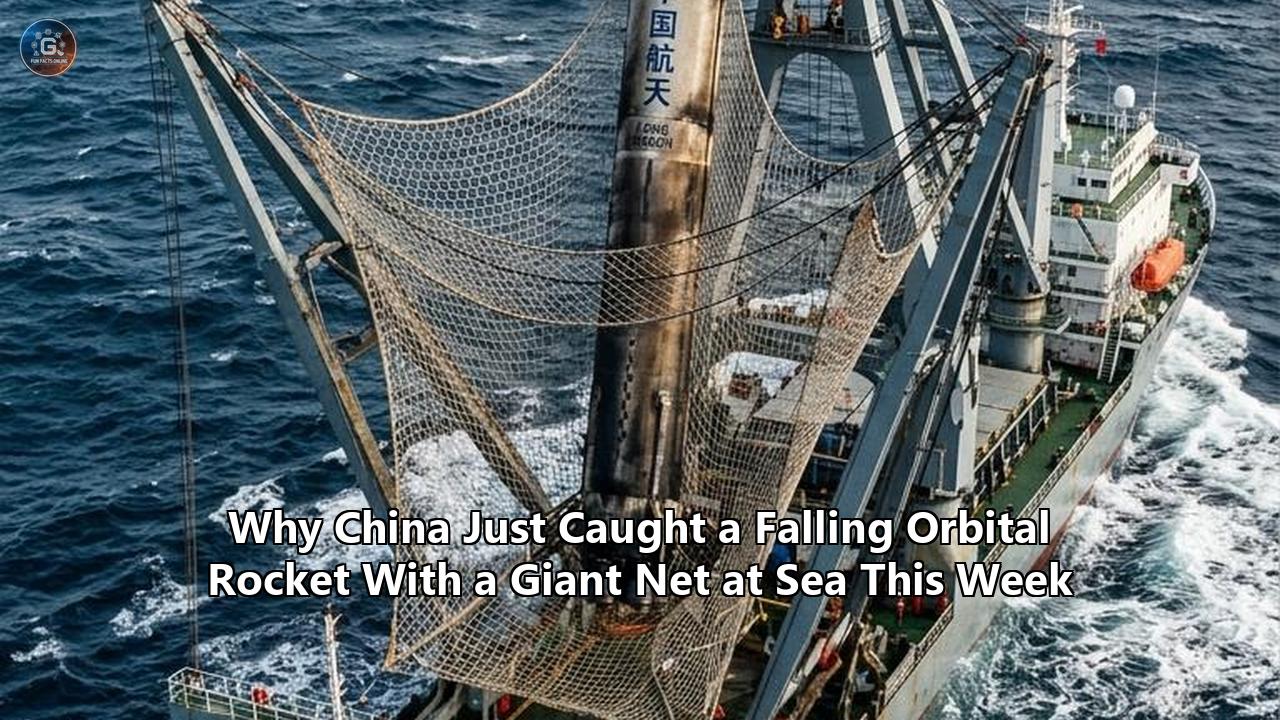
Six minutes after lifting off from the tropical coast of Hainan, a 207-foot orbital rocket booster dropped vertically through the clouds over the South China Sea. Rather than deploying four sprawling carbon-fiber landing legs to set down on a flat ocean barge, the core stage of China’s Long March 10B unveiled a radically different recovery mechanism. Four steel capture hooks extended from near the top of its five-meter-wide hull, snagging a matrix of heavy-duty, hydraulic-damped steel cables suspended across a specialized recovery vessel named Linghangzhe (Pathfinder). As the net absorbed the booster's final kinetic energy, the 63-meter stage came to a complete rest, suspended above the deck.
The flight executed by the China Aerospace Science and Technology Corporation (CASC) on July 10, 2026, delivered an orbital payload into low Earth orbit while achieving two major historical firsts. It marked the first time China successfully returned an orbital-class rocket booster intact, making it only the second nation after the United States to master propulsive orbital booster recovery. More significantly, it marked the world’s first successful operational capture of a space launch vehicle using a marine net-and-cable system.
This mission offers a compelling case study in structural mass optimization and launch system architecture. For over a decade, the aerospace industry treated propulsive leg landings—pioneered by SpaceX’s Falcon 9—as the default path to orbital reusability. China's successful deployment of a shipboard net capture breaks that consensus, demonstrating an alternative engineering framework that shifts heavy recovery hardware off the rocket and onto maritime platforms.
The Physics of the Catch: Anatomy of a Net Recovery
To understand why CASC opted for a net instead of traditional landing gear, one must examine the extreme mechanical constraints of booster recovery. During an orbital launch, a first-stage booster accelerates a vehicle to hypersonic velocities before separating from the upper stage at altitudes typically exceeding 60 kilometers. To return safely, the stage must execute three distinct engine burns: a boostback burn to reverse its downrange velocity, a entry burn to decelerate through the dense layers of the upper atmosphere, and a final landing burn to reduce its terminal velocity to zero at the exact moment of touchdown.
+--------------------------------------------------------------------------------+
|                        LONG MARCH 10B RECOVERY PROFILE                         |
+--------------------------------------------------------------------------------+
|                                                                                |
|  1. Stage Separation (~60 km altitude)                                         |
|     \                                                                          |
|      *---> Upper Stage Continues to Orbit                                      |
|     /                                                                          |
|  2. Atmospheric Reentry                                                        |
|     |  * Grid Fins Deploy for Aerodynamic Guidance                             |
|     |  * Hypersonic Deceleration Phase                                         |
|     v                                                                          |
|  3. Terminal Descent                                                           |
|     |  * Engine Ignition for Final Landing Burn                                |
|     |  * Guidance Telemetry Lock with Vessel                                   |
|     v                                                                          |
|  4. Net Capture                                                                |
|     |  * 4 Top-Mounted Hooks Deploy                                            |
|     |  * Engagement with Hydraulic-Damped Steel Cables                         |
|     v                                                                          |
|  5. Secure Landing aboard 'Linghangzhe' in South China Sea                     |
+--------------------------------------------------------------------------------+
During the July 10 mission, the Long March 10B booster followed this exact trajectory. Powered by seven YF-100K engines burning kerosene and liquid oxygen (LOX), the first stage generated 890 tonnes of thrust at liftoff. After stage separation, four grid fins near the top of the vehicle deployed to provide aerodynamic control through the atmosphere. As the stage approached the maritime recovery zone, a single YF-100K engine ignited for the final deceleration maneuver.
Instead of deploying heavy telescoping landing legs, the rocket deployed four high-strength latching hooks from its upper interstage ring. The recovery ship Linghangzhe—a custom-built 100-meter platform equipped with active wave-compensation systems—presented a wide, flexible grid of high-tensile steel cables linked to large-displacement hydraulic shock absorbers.
The hooks engaged the cables roughly 15 meters above the vessel deck. The hydraulic arrestors stroked rapidly, absorbing the residual downward momentum over a distance of several meters and reducing the acceleration spikes that can cripple internal propellant tanks or turbomachinery. Auxiliary automated winches locked the stage into a vertical cradle within seconds, neutralizing the rocking motion induced by sea waves.
Principle 1: Eliminating the Inert Mass Penalty
The primary motivation behind net recovery boils down to a fundamental equation of rocket design: Tsiolkovsky’s rocket equation. In any launch vehicle, every kilogram of dead weight added to the first stage requires additional propellant to accelerate, directly eroding the ultimate payload capacity delivered to orbit.
$$\Delta v = v_e \ln \left( \frac{m_0}{m_f} \right)$$
In traditional vertical landing designs, landing legs are a massive mass penalty:
- Structural Mass: Heavy carbon-fiber or titanium legs, along with their deployable struts, locking latches, and high-pressure pneumatic actuators, add significant dry mass to the rocket.
- Payload Reduction: On a medium-to-heavy lifter like SpaceX's Falcon 9, landing legs and associated hardware add between 2,000 and 2,500 kilograms of inert mass. In rocket performance terms, every kilogram of structural weight added to the returning stage reduces low-Earth-orbit (LEO) payload performance by a nearly equivalent margin.
- Thermal Protection: Legs mounted near the base of the rocket are exposed to intense thermal radiation and acoustic vibration from engine plumes during both ascent and landing burns, requiring heavy thermal insulation.
+---------------------------------------------------------------------------------+
|                    STRUCTURAL TRADE-OFF: LEGS VS. NET CAPTURE                   |
+---------------------------------------------------------------------------------+
|  Feature                   | Legged Recovery (e.g. Falcon 9)| Net-Capture (LM-10B)|
+----------------------------+--------------------------------+-------------------+
|  Vehicle Onboard Gear      | Heavy legs, struts, actuators  | Light top-hooks   |
|  Inert Mass Penalty        | High (~2.0 to 2.5 tonnes)      | Low (< 0.5 tonnes)|
|  LEO Payload (Reusable)    | ~17.5 tonnes                   | ~16.0 tonnes*     |
|  Ground/Sea Complexity     | Low (Flat landing pad)         | High (Active net) |
|  Engine Clearance at Landing| Low (Close to ocean surface)  | High (Suspended)  |
+---------------------------------------------------------------------------------+
* Note: Long March 10B achieves 16t with kerosene-LOX in a 63m airframe.
By removing landing legs from the Long March 10B, engineers at the China Academy of Launch Vehicle Technology (CALT) eliminated the majority of this dead weight. The top-mounted hooks used for net capture are compact structural hardpoints integrated directly into the reinforced interstage ring—a component that must already be engineered to withstand the compressive loads of the upper stage and payload.
According to Chen Muye, a senior structural expert at CALT, this architecture yields massive performance benefits:
"Net-based recovery helps simplify the rocket's onboard structure, reduces vehicle mass, and increases payload capacity," Chen noted following the mission. "By moving the shock-absorption apparatus off the vehicle and onto the recovery ship, we gain immediate margin in payload delivery."
In its reusable configuration, the 63-meter Long March 10B can loft 16 metric tons (35,275 pounds) to Low Earth Orbit. CALT estimates that using traditional landing legs on a kerosene-fueled airframe of equivalent dimensions would have cut payload capacity by 15% to 20%, requiring a significantly larger rocket to lift the same payload.
Principle 2: Off-Boarding Complexity to Marine Assets
The second key lesson from China’s successful catch is the strategic decision to transfer system complexity away from the flight hardware and onto ground or sea infrastructure.
In aerospace design, components fly under extreme constraint: they must endure cryogenic temperatures, high acoustic loads, vacuum conditions, intense vibration, and severe atmospheric heating. Every sensor, valve, or hydraulic piston installed on a rocket stage represents a potential point of failure that must be lightweight, ultra-reliable, and capable of operating under intense physical stress.
                     OFF-BOARDING SYSTEM COMPLEXITY

       Traditional Flight Systems           Net-Capture Architecture
     +----------------------------+       +----------------------------+
     | Onboard Landing Legs       |       | Minimal Hardpoint Hooks    |
     | High-Pressure Actuators    | ----> | Integrated Interstage Ring |
     | Heavy Base Heat-Shielding  |       | Standardized Grid Fins     |
     +----------------------------+       +----------------------------+
                  |                                     |
                  v                                     v
         FLIGHT-CRITICAL MASS                  SHIP-BASED HYDRAULICS
     (Flies under extreme stress)            (Stationary, reusable,
                                              easily serviced at sea)
Net-capture recovery flips this paradigm by placing the heaviest, most complex mechanical components on the recovery vessel:
- Hydraulic Damping Capacity: The steel cables on Linghangzhe are linked to heavy industrial hydraulic rams mounted below the ship's main deck. These rams do not face flight weight restrictions; they can be built as large, heavy, and robust as necessary to absorb hundreds of kilojoules of kinetic energy safely.
- Modular Energy Dissipation: If a landing booster approaches with a slight vertical or horizontal velocity overshoot, the shipboard damping system adjusts cable tension in real time using active hydraulic valving. This reduces the precision throttling burden placed on the rocket’s YF-100K engines.
- Expanded Target Window: A flat drone ship pad requires a rocket stage to land precisely within a tight radius—typically within 5 to 10 meters of the center circle—to avoid tipping over upon leg contact. The net framework on Linghangzhe creates a capture envelope that tolerates significantly wider horizontal drift. If the booster enters the recovery area slightly off-target, the flexible tensioned cables automatically channel the stage toward the center of the capture net as it settles.
This design philosophy is conceptually similar to SpaceX's "Mechazilla" tower catch system used for the Starship Super Heavy booster at Starbase, Texas, which uses massive mechanical arms attached to a launch tower to catch descending boosters in mid-air. However, while SpaceX opted to build its netless catch system on permanent land-based launch towers, CASC adapted the concept specifically for flexible maritime operations. Executing rocket recovery at sea allows China to bypass geographic constraints, avoiding overflight of populated landmasses while capturing boosters hundreds of kilometers downrange along the natural launch azimuth.
Marine Hydrodynamics and Guidance Telemetry
Capturing a 63-meter cylinder falling at supersonic speeds onto a ship moving on ocean swells requires synchronization across navigation, control, and marine engineering. Implementing rocket recovery at sea presents dynamic variables that simply do not exist on land, including wave heave, ship roll and pitch, ocean currents, and localized surface wind shear.
During the July 10 recovery, CASC deployed an advanced multi-tiered tracking and coordination network to align the vehicle with the vessel:
+---------------------------------------------------------------------------------+
|                       REAL-TIME RECOVERY TELEMETRY LOOP                         |
+---------------------------------------------------------------------------------+
|                                                                                 |
|   +-----------------------+                    +----------------------------+   |
|   |  Long March 10B       |                    |  Vessel 'Linghangzhe'      |   |
|   |  * Dual-Antenna RTK-GPS| <--- 100 Hz Data -> |  * Dynamic Positioning     |   |
|   |  * Inertial Sensors   |     Link Exchange  |  * Optical Laser Arrays    |   |
|   |  * Engine Throttling  |                    |  * Hydraulic Net Tensioners|   |
|   +-----------------------+                    +----------------------------+   |
|               \                                              /                  |
|                \                                            /                   |
|                 +------------------> <---------------------+                    |
|                                      |                                          |
|                          Closed-Loop Guidance Control                           |
|                          Accuracy: < 0.5m Relative Position                     |
|                                                                                 |
+---------------------------------------------------------------------------------+
1. High-Frequency Telemetry Exchange
Throughout the final two minutes of flight, the Long March 10B booster and Linghangzhe exchanged position, attitude, and velocity data at a rate of 100 Hertz over a dedicated ultra-high-frequency (UHF) datalink. Dual Real-Time Kinematic (RTK) differential GPS units mounted on both the rocket and the vessel provided relative positioning accuracy down to less than 10 centimeters.
2. Shipboard Dynamic Positioning
Linghangzhe uses 360-degree azimuth thrusters controlled by an automated dynamic positioning system. The vessel holds its heading directly into prevailing sea swells to minimize roll while actively adjusting its spatial position to compensate for surface currents, maintaining a stable reference platform for the descending rocket.3. Optical Guidance Alignment
As the booster passed below an altitude of 500 meters, high-frame-rate infrared camera arrays mounted on the ship deck locked onto specialized optical targets on the rocket's interstage ring. This optical tracking loop ran in parallel with satellite navigation, providing real-time vector corrections to the booster's cold-gas thrusters and gimbaling YF-100K engines.
4. Marine Sea State Tolerances
Standard drone ship landings with tripod or quad-pod landing gear become highly risky when sea swells exceed 1.5 to 2.0 meters (Sea State 4), as leg landing gears can skid or slide across wet steel decks, or tip over if the deck rolls during contact. By contrast, net capture suspends the rocket stage above the deck. Once the hooks grab the cables, the stage's center of mass hangs below the capture plane, creating a self-righting pendulum effect that dramatically improves stability in rough waters.
Strategic Context: Megaconstellations and Manned Lunar Missions
To understand why China invested heavily in net capture technology, one must look beyond single launches to Beijing's broader national space strategy. China is currently executing two massive orbital initiatives that require a dramatic increase in launch capacity:
+----------------------------------------------------------------------------------+
|                    CHINA'S DUAL STRATEGIC SPACE DRIVERS                          |
+----------------------------------------------------------------------------------+
|                                                                                  |
|   1. LEO MEGAPROJECTS                                                            |
|      * Guowang Constellation: ~13,000 satellites                                 |
|      * Qianfan (Thousand Sails): ~14,000 satellites                              |
|      * Requirement: High launch cadence, maximum LEO payload mass per launch     |
|                                                                                  |
|   2. CREWED LUNAR PROGRAM (LM-10 ARCHITECTURE)                                   |
|      * Target: Chinese astronaut lunar landing before 2030                       |
|      * Requirement: Reusable heavy lift capacity, low unit launch costs          |
|      * LM-10B serves as the reusable flight testbed for LM-10 lunar variant     |
|                                                                                  |
+----------------------------------------------------------------------------------+
The Megaconstellation Race
China has committed to building two low-Earth-orbit broadband satellite constellations to rival SpaceX's Starlink: the state-backed Guowang network (planned for roughly 13,000 satellites) and the Shanghai-backed Qianfan or Thousand Sails network (planned for over 14,000 satellites). Deploying tens of thousands of satellites within strict regulatory timeframes set by the International Telecommunication Union (ITU) requires an unprecedented launch frequency.
Traditional expendable rockets like the Long March 2D, 3B, and 4B cannot deliver the sheer tonnage required at a competitive cost. Mastering rocket recovery at sea enables CASC and commercial Chinese spin-offs to reuse first-stage boosters repeatedly, lowering satellite deployment costs while scaling launch capacity.
The Pathway to the Moon
The Long March 10B is not merely a satellite launcher; it is a direct derivative of the Long March 10 architecture—the super-heavy launch vehicle China is developing to land astronauts on the Moon before 2030. The Long March 10 crewed variant will feature three 5-meter-diameter cores strapped together.
Testing reusable technologies on the single-core Long March 10B allows CALT engineers to gather real-world flight data on re-entry dynamics, thermal loads, and structural stresses. Reusability for the triple-core lunar launcher will significantly reduce the per-mission cost of China’s lunar exploration campaign.
Comparative Analysis: Three Approaches to Booster Reuse
The success of the Long March 10B introduces a third distinct engineering approach to orbital booster recovery. Comparing these three methods highlights the trade-offs modern aerospace firms must navigate:
+------------------------------------------------------------------------------------------+
|                     COMPARATIVE ARCHITECTURAL MATRIX FOR BOOSTER REUSE                   |
+------------------------------------------------------------------------------------------+
| Metric / Feature      | SpaceX Falcon 9          | SpaceX Starship        | CASC Long March 10B |
+-----------------------+--------------------------+------------------------+---------------------+
| Landing Mechanism     | Deployable Carbon Legs   | Tower Chopstick Catch  | Marine Net Catch    |
| Capture Location      | Droneship / Land Pad     | Launch Pad Tower       | Offshore Ship Net   |
| Onboard Mass Penalty  | High (~2.0 - 2.5 tonnes) | Extremely Low (Pins)   | Low (< 0.5 tonnes)  |
| Downrange Flexibility | High (Positionable ship) | None (Fixed to tower)  | High (Mobile vessel)|
| Infrastructure Cost   | Moderate (Barge deck)    | High (Massive Tower)   | High (Custom Vessel)|
| Propellant Combination| LOX / Kerosene (RP-1)    | LOX / Liquid Methane   | LOX / Kerosene (RP-1)|
| Sea State Sensitivity | High (Skid/Tip risk)     | N/A (Land Based)       | Low (Suspended net) |
+------------------------------------------------------------------------------------------+
1. SpaceX Falcon 9 (Deployable Legs + Autonomous Droneship)
- Strengths: Simple ground infrastructure; drone ships are effectively passive flat steel decks. High operational flexibility across multiple launch sites.
- Weaknesses: High structural weight penalty from landing legs. Engines land extremely close to saltwater spray on ocean landings, requiring extensive cleaning and refurbishment. Vulnerable to deck sliding in high sea states.
2. SpaceX Starship / Super Heavy (Tower Catch / Mechazilla)
- Strengths: Zero landing gear weight on the booster (uses small hardpoint load-bearing pins). Allows rapid turnaround directly on the launch pad without moving the booster from a ship.
- Weaknesses: Zero downrange trajectory flexibility. The booster must return precisely to the launch pad, consuming significant propellant on a full boostback burn. Destructive launch pad failure risks destroying multi-billion-dollar ground infrastructure.
3. CASC Long March 10B (Shipboard Net Capture)
- Strengths: Combines the low vehicle mass penalty of a catch system with the downrange trajectory flexibility of ocean recovery. Eliminates landing gear while retaining the energy savings of downrange ocean landing profiles. Elevates engines well above ocean water, preventing direct saltwater immersion.
- Weaknesses: High complexity in shipboard operations. Requires real-time active synchronization between two moving vehicles (rocket and ship) in open water.
The Refurbishment Challenge: From Capture to Re-Flight
Catching a rocket booster in a giant net at sea is a major milestone, but it is only the first step toward true reusability. The true test for CASC will be turn-around efficiency: how quickly, cleanly, and cheaply that stage can be inspected, refurbished, and launched again.
+----------------------------------------------------------------------------------+
|                      BOOSTER REFURBISHMENT PIPELINE                              |
+----------------------------------------------------------------------------------+
|                                                                                  |
|   1. MARITIME TRANSPORT                                                          |
|      * Secure stage in Linghangzhe deck cradle                                   |
|      * Desalination / Fresh-water rinse during transit to Hainan port            |
|                                                                                  |
|   2. NON-DESTRUCTIVE EVALUATION (NDE)                                            |
|      * Ultrasound / X-ray inspection of top capture hooks & interstage ring      |
|      * Laser alignment check on 63m structural core frame                        |
|                                                                                  |
|   3. PROPULSION & AVIONICS OVERHAUL                                              |
|      * Turbopump disassembly & bearing inspection on YF-100K engines             |
|      * Re-certification of cold-gas thrusters & grid-fin actuators               |
|                                                                                  |
|   4. STATIC FIRE & RE-FLIGHT                                                     |
|      * Full-duration ground ignition test at Dongfeng/Wenchang static test stand |
|      * Integration with upper stage for second orbital flight (Target: Late 2026)|
|                                                                                  |
+----------------------------------------------------------------------------------+
Saltwater Corrosion Mitigation
One major operational advantage of net recovery is engine isolation. When traditional legged boosters land on flat drone ships, engine nozzles settle just feet above the deck, where ocean spray and residual combustion byproducts create a harsh corrosive environment. Because the Long March 10B is captured near its top interstage ring, its seven YF-100K engines hang suspended several meters above the ship deck. This height differential keeps critical turbomachinery, gimballing actuators, and plumbing free from direct exposure to deck wash and saltwater spray.
Structural Integrity Inspection
Top-mounted capture introduces concentrated load spikes where the hooks meet the cables. While landing legs distribute shock loads through the lower thrust structure, net capture transfers landing shock into the interstage ring. CALT technicians are conducting non-destructive evaluation (NDE)—including ultrasonic testing and X-ray imaging—to verify that the load-bearing airframe experienced no micro-fracturing or localized buckling during engagement.
CASC announced that the primary goal for this booster is a complete refurbishment cycle leading to a target re-flight before the end of 2026. If successful, it will prove that net recovery can support the rapid, low-cost turnaround required for high-frequency operations.
China’s Broader Commercial Space Ecosystem
The Long March 10B net recovery reflects a broader push across China's state-owned and commercial space sectors to master reusable launch technology. China’s space ecosystem is executing a multi-pronged strategy, exploring different propellant combinations, structural materials, and recovery schemes:
+-------------------------------------------------------------------------------------------+
|                   SELECT CHINESE REUSABLE ROCKET DEVELOPMENTS (2025-2026)                  |
+-------------------------------------------------------------------------------------------+
| Vehicle / Developer   | Fuel Type          | Structural Material | Primary Recovery Method|
+-----------------------+--------------------+---------------------+------------------------+
| Long March 10B (CASC) | Kerosene / LOX     | Aluminum-Lithium    | Marine Net Capture     |
| Zhuque-3 (LandSpace)  | Methane / LOX      | Stainless Steel     | Legged Landing Barge   |
| Tianlong-3 (SpaceBio) | Kerosene / LOX     | Aluminum Alloy      | Droneship / Land Pad   |
| SQX-3 (iSpace)        | Methane / LOX      | Stainless Steel     | Droneship ('Stellar')  |
| Kinetica-2 (CAS Space)| Kerosene / LOX     | Aluminum Alloy      | Legged / Net Hybrid    |
+-------------------------------------------------------------------------------------------+- LandSpace (Zhuque-3): LandSpace debuted its stainless-steel, methane-fueled Zhuque-3 rocket in December 2025. While its initial booster recovery test experienced an anomaly during the final landing burn, the firm continues static fire testing at the Dongfeng Space Zone to prepare for a successful ocean barge landing.
- iSpace (Hyperbola-3 / SQX-3): In late 2025, commercial firm iSpace took delivery of its customized recovery ship Xingjiguihang (Stellar Return), featuring a 40-by-60 meter deck designed to support methane-fueled booster recoveries.
- CAS Space (Kinetica-2): A commercial spinoff of the Chinese Academy of Sciences, CAS Space is developing medium-lift reusable launch vehicles designed to support both land-based and sea-based landing profiles.
This ecosystem creates an environment where state-owned aerospace giants like CASC and private startups compete directly. Breakthroughs in one sector—such as CASC's net capture system—quickly inform technical approaches across the entire industry.
Lessons for Global Space Logistics
China’s successful net capture of an orbital booster provides three key strategic insights for the global space industry:
+----------------------------------------------------------------------------------+
|                     KEY LESSONS FOR GLOBAL SPACE LOGISTICS                       |
+----------------------------------------------------------------------------------+
|                                                                                  |
|   1. REUSABILITY HAS NO SINGLE BLUEPRINT                                         |
|      * Falcon 9's legged design is not the only viable pathway to reuse.         |
|      * Alternative capture mechanisms can optimize payload margins.               |
|                                                                                  |
|   2. INFRASTRUCTURE SHIFTS CAN BE GAME-CHANGERS                                  |
|      * Offloading weight from flight hardware to maritime platforms maximizes     |
|        orbital delivery capacity.                                                |
|                                                                                  |
|   3. MARITIME FLEXIBILITY IS ESSENTIAL FOR FAST SCALING                          |
|      * Sea recovery avoids overland launch constraints and safety risks,         |
|        enabling higher launch cadences near equatorial coastlines.               |
|                                                                                  |
+----------------------------------------------------------------------------------+
1. The Dominance of Legged Landings Is Ending
For ten years, the aerospace sector treated propulsive leg landings as the gold standard of booster recovery. China's net capture proves that alternative architectures can successfully recover orbital vehicles. By removing landing legs, designers can trade landing platform complexity for vehicle performance, optimizing rockets for maximum payload efficiency.
2. Infrastructure Investment Unlocks Vehicle Mass
The success of the Linghangzhe platform highlights a fundamental law of modern transportation: invest in specialized receiving infrastructure to build simpler, lighter, and cheaper vehicles. Just as aircraft rely on external arresting wires on aircraft carriers rather than carrying heavy onboard stopping mechanisms, rockets can rely on specialized off-board platforms to absorb landing energies.
3. Sea Recovery Solves Geographical Bottlenecks
For nations with high population densities or restricted overland flight corridors, land-based return-to-launch-site (RTLS) maneuvers are often politically or geographically impossible. Establishing robust systems for rocket recovery at sea allows launch providers to drop boosters safely into open ocean waters, preserving low-risk downrange trajectories while recovering valuable rocket components intact.
Strategic Implications and Future Milestones
The successful recovery of the Long March 10B booster resets the timeline for global launch competition. For years, Western space analysts argued that China was lagging far behind SpaceX in reusable launch technology. While SpaceX maintains a massive lead in total launch volume and fleet re-flight history, China’s ability to execute a novel net capture on its very first attempt demonstrates rapid technological convergence.
+----------------------------------------------------------------------------------+
|                          KEY MILESTONES TO WATCH (2026-2027)                     |
+----------------------------------------------------------------------------------+
|                                                                                  |
|   [ ] Late 2026: Post-flight inspection and static fire of LM-10B booster.        |
|   [ ] Late 2026: Attempted SECOND FLIGHT of the recovered LM-10B first stage.    |
|   [ ] Early 2027: Maiden flight of commercial reusable vehicles (Zhuque-3, SQX-3)|
|   [ ] 2027-2028: High-cadence LM-10B launches for Guowang deployment.             |
|   [ ] Pre-2030:  Triple-core Long March 10 crewed lunar demonstration flight.    |
|                                                                                  |
+----------------------------------------------------------------------------------+
Several critical metrics will determine whether this net-capture architecture can scale into an operational workhorse:
- Turnaround Speed: How many weeks or months will it take CASC to inspect, service, and static-fire the recovered Long March 10B stage before it is cleared for its second flight?
- Cable and Net Wear: How many landings can the high-tensile steel cables and hydraulic dampening units on Linghangzhe endure before requiring cable replacement or overhaul?
- Adverse Weather Performance: What are the operational sea-state limits for net capture, and how often will South China Sea weather conditions delay planned recoveries?
As CASC technicians at Hainan process the recovered stage, the global space industry is watching closely. Catching a falling orbital rocket in a giant net at sea was once considered an eccentric design concept. Today, it stands as a proven operational reality—and a glimpse into the future of low-cost access to space.
Reference:
- https://www.space.com/space-exploration/launches-spacecraft/making-history-china-lands-rocket-during-an-orbital-launch-for-1st-time-ever
- https://satnews.com/2026/07/11/china-achieves-historic-first-orbital-booster-recovery-via-at-sea-net-system/
- https://spacedaily.com/sd-china-just-caught-a-rocket-booster-in-a-net-at-sea-and-the-detail-everyone-missed-is-that-the-refly-is-scheduled-before-the-stage-has-even-finished-cooling/
- https://okdiario.com/techy/en/china-landed-a-reusable-rocket-on-its-first-attempt-the-quiet-leap-that-could-reshape-the-space-race/6682/
- https://www.19fortyfive.com/2026/07/china-caught-a-falling-rocket-booster-in-a-giant-net-at-sea-on-its-maiden-flight-using-four-hooks-instead-of-landing-legs-and-says-the-same-stage-will-fly-again-before-2026-ends/
- https://www.koreapost.com/news/articleView.html?idxno=49066
- https://english.news.cn/20251201/4963f91267404a60b2849ca6317fac03/c.html
- https://www.globaltimes.cn/page/202512/1349548.shtml
- https://www.scmp.com/news/china/science/article/3360553/china-used-giant-net-land-reusable-rocket-does-idea-have-legs
- https://www.koreapost.com/news/articleView.html?idxno=49069
- https://www.scmp.com/news/china/science/article/3335004/chinas-first-reusable-rocket-zhuque-3-makes-maiden-voyage-recovery-attempt-fails
- https://en.wikipedia.org/wiki/Zhuque-3