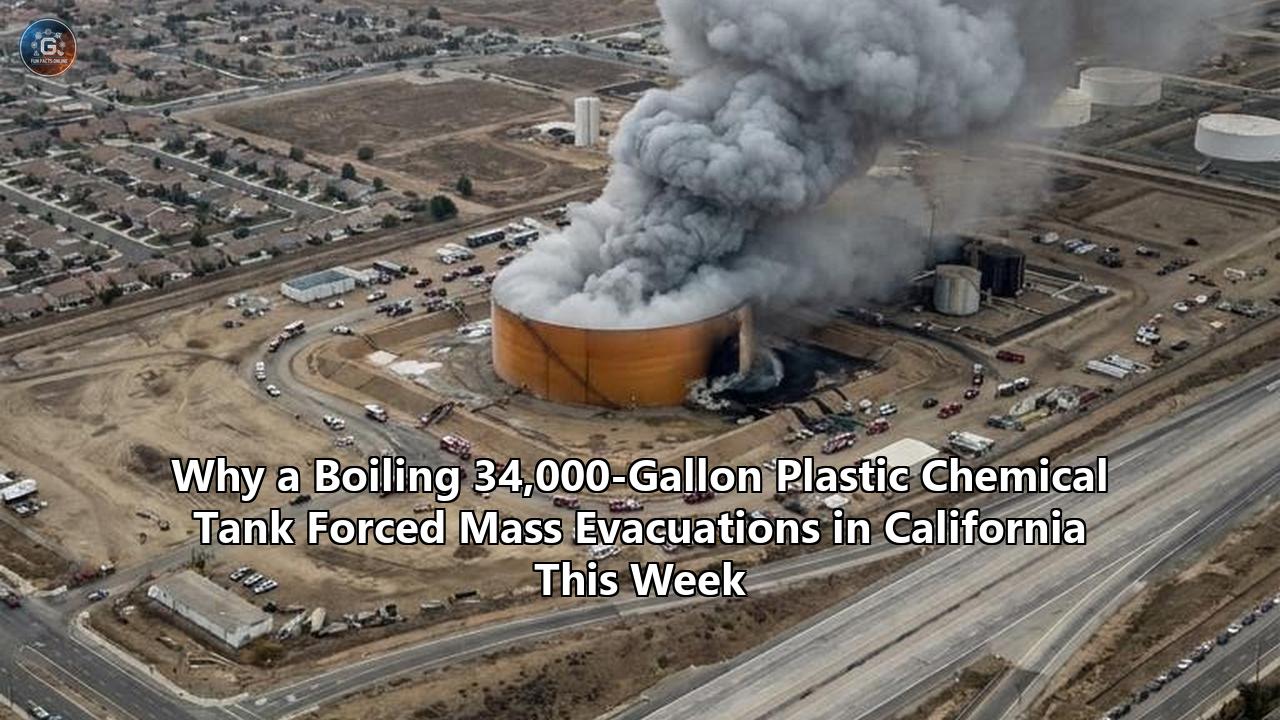
On the afternoon of Thursday, May 21, 2026, a routine industrial operation in a suburban Orange County neighborhood transformed into one of the most high-stakes, terrifying chemical standoffs in modern California history. For days, the city of Garden Grove and its surrounding municipalities have been gripped by the imminent threat of a catastrophic explosion at a local aerospace manufacturing plant. A 34,000-gallon chemical storage tank, filled with thousands of gallons of highly volatile methyl methacrylate (MMA), began undergoing a violent, self-accelerating runaway chemical reaction.
As internal temperatures surged past 100 degrees Fahrenheit, the tank began to swell, its safety valves failed, and local emergency officials were left with a grim, binary prognosis: either the tank would rupture, spilling thousands of gallons of toxic liquid, or it would experience a Boiling Liquid Expanding Vapor Explosion (BLEVE)—effectively turning the suburban facility into a massive, shrapnel-hurling bomb.
The crisis prompted the immediate, mandatory displacement of more than 50,000 residents across six Southern California cities. It forced the closure of dozens of schools just days before summer break, triggered a state of emergency declaration by Governor Gavin Newsom, and initiated a desperate, around-the-clock water-deluge operation by hazardous materials teams.
This massive California chemical tank evacuation has brought a quiet, middle-class pocket of Orange County to a grinding halt. As the incident enters its fifth day, investigators, chemical engineers, and emergency responders are tracing the chain of mechanical and procedural failures that allowed a stable industrial monomer to transform into an uncontrolled, boiling pressure cooker.
12122 Western Avenue: The Epicenter of the Crisis
To understand how a quiet, suburban community found itself in the shadow of a potential chemical blast, one must look closely at the facility at the center of the storm: the GKN Aerospace Transparency Systems plant, located at 12122 Western Avenue in Garden Grove.
       WESTERN AVENUE (GKN Aerospace Facility)
  _________________________________________________
 |                                                 |
 |  [Tank 1: COMPROMISED] <-- Runaway Polymerization
 |   - Cap: 34,000 Gal       (Temp > 100°F & Rising)
 |   - Content: ~7,000 Gal MMA                     |
 |                                                 |
 |  [Tank 2: Stable]       [Tank 3: Stable]        |
 |   (Structurally Sound)   (Structurally Sound)   |
 |_________________________________________________|
                          |
             [Blast Mitigation Barriers]
                          |
  ________________________v________________________
    STREET CLOSURES & MANDATORY EVACUATION ZONE
    ( Garden Grove, Stanton, Westminster, Anaheim,
      Buena Park, Cypress — 50,000+ Displaced )
  _________________________________________________
Occupying a 15.5-acre industrial footprint, the facility is highly specialized, dedicated to the manufacture of military flight canopies, cockpit shields, passenger windows, and specialized transparencies for commercial aviation giants like Boeing and Airbus. Since GKN Aerospace established operations at this site in 1993, the surrounding region has experienced significant residential growth. Today, the facility is tightly hemmed in by family homes, retail strip malls, and public schools, illustrating the uneasy coexistence of heavy industrial manufacturing and suburban life.
At approximately 3:30 p.m. PDT on Thursday, workers at the plant noticed vapor clouds venting from one of the site's primary chemical storage vats—a 34,000-gallon tank containing between 6,000 and 7,000 gallons of liquid methyl methacrylate (MMA).
MMA is an essential precursor used in the synthesis of polymethyl methacrylate (PMMA), more commonly known as acrylic glass, Plexiglas, or Lucite. It is the core material GKN uses to cast shatter-resistant, high-optical-clarity windows for commercial aircraft and high-performance military jets.
Within minutes of the initial vapor release, the plant's automated safety systems responded. High-pressure water sprinklers situated above the chemical tanks activated, attempting to cool the vessel's exterior shell. The Orange County Fire Authority (OCFA) arrived on the scene at 3:32 p.m., deploying specialized hazardous materials teams to assess what initially appeared to be a localized, controllable leak.
Out of an abundance of caution, authorities established a localized perimeter and issued an initial, small-scale evacuation order for immediate neighbors.
By Thursday night, the situation seemed to stabilize. External infrared drone sweeps conducted by the OCFA indicated that the outer shell of the tank was cooling. Believing the emergency was contained, emergency managers lifted the evacuation orders, allowing weary residents to return to their beds.
It was a premature relief. The real monster was not on the outside of the tank, but deep within its core.
The Chemistry of Runaway Polymerization: The Self-Feeding Monster
To grasp why the Garden Grove tank became so dangerous, one must examine the specific, volatile chemistry of methyl methacrylate. Under normal conditions, MMA is a colorless, liquid monomer with a pungent, sweet, fruity odor. It has an incredibly low flashpoint of just 50 degrees Fahrenheit (10 degrees Celsius)—meaning that at standard room temperature, it constantly releases vapors that can easily ignite if they encounter a spark, static charge, or open flame.
To prevent liquid MMA from spontaneously reacting and forming solid plastic, chemical manufacturers must meticulously manage its environment. It requires two primary safeguards:
- Chemical Inhibitors: Active stabilizers, such as hydroquinone (HQ) or monomethyl ether of hydroquinone (MEHQ), are mixed into the liquid. These inhibitors act as "radical scavengers," consuming any stray free radicals before they can initiate polymerization.
- Active Temperature Control: MMA must be kept cool, ideally well below 50 degrees Fahrenheit, to slow down molecular movement and suppress the natural tendency of the monomer molecules to bond.
At the GKN facility, both of these safety barriers collapsed.
"What we are seeing is a classic, catastrophic example of runaway self-heating polymerization," explains Dr. Elias Picazo, an associate professor of chemistry at the University of Southern California (USC), who has been closely analyzing the incident. "MMA is a monomer. Its natural state, when prompted, is to link up with other MMA molecules to form long polymer chains—acrylic plastic. This process is highly exothermic, meaning it releases a tremendous amount of heat as those chemical bonds form."
     STAGE 1: Normal Storage (Stabilized & Chilled)
     [ Liquid MMA + Active Inhibitors ]  <-- Under 50°F (Safe)

     STAGE 2: Initiation (Stabilizer Depletion / Cooling Failure)
     [ Free Radicals Form ] --> Polymerization Begins (Exothermic)

     STAGE 3: Runaway Reaction (Self-Accelerating Loop)
     [ Heat Released ] --> [ Reaction Accelerates ] --> [ More Heat Released ]
     (Internal temperatures climb 1°F per hour, vaporizing MMA liquid)

     STAGE 4: Crisis State (Pressure Cooker)
     [ High-Pressure MMA Vapor ] + [ Solidified Polymer Clogging Valves ]
     --> Risk of BLEVE (Catastrophic Structural Failure / Explosion)
If the temperature of the storage tank rises, or if the chemical inhibitors are depleted, the polymerization reaction begins. Because the reaction is exothermic, it releases heat into the surrounding liquid. That heat, in turn, increases the temperature of the remaining monomer, which dramatically accelerates the rate of polymerization.
This creates a positive feedback loop: more reaction equals more heat; more heat equals a faster reaction.
"Once this self-accelerating loop crosses a certain thermal threshold, it becomes virtually impossible to stop," Dr. Picazo notes. "The liquid begins to boil, converting the volatile monomer into a highly pressurized gas. Because the tank is a sealed container, that expanding gas has nowhere to go. If the pressure exceeds the structural limits of the tank, the vessel fails catastrophically."
By Friday morning, May 22, the true scale of the failure became apparent. When hazmat teams physically entered the high-hazard zone to read the mechanical gauges directly attached to the tank, they discovered that while the external shell had been cooled by the sprinkler systems, the core temperature of the monomer inside was 77 degrees Fahrenheit and climbing at a rate of approximately one degree per hour.
By Saturday night, the internal temperature had surged past 100 degrees Fahrenheit—the absolute maximum limit of the tank’s physical thermometer. The chemical was literally boiling inside its plastic-lined steel container, and there was no way to get inside to cool it.
The "Gummed-Up" Valves: Why the Crisis Could Not Be Stopped
When a chemical tank begins to overheat, standard industrial mitigation protocols dictate a few immediate interventions:
- Pump a massive dose of concentrated chemical inhibitor (a "kill shot") directly into the tank to neutralize the free radicals and halt the polymerization process.
- Drain the liquid chemical out of the failing tank and transfer it to a secure, empty vessel nearby.
- Route the accumulating vapors through a scrubber system to safely vent pressure without releasing toxic gas into the atmosphere.
At GKN Aerospace, none of these options were on the table. The runaway reaction had already progressed too far, creating a secondary physical barrier that stymied engineers at every turn.
As the methyl methacrylate polymerized, it did not remain a uniform, neat liquid. Instead, it rapidly transformed into a thick, sticky, semi-solid gel, which quickly hardened into a dense, solid acrylic plastic. This rapid solidification occurred directly inside the tank’s internal plumbing, feed lines, and control valves.
"The valves on the tank are completely broken—or, more accurately, they are heavily 'gummed up' with polymerized acrylic," Orange County Fire Authority Division Chief and Incident Commander Craig Covey revealed during a Friday afternoon press conference. "This created massive operational challenges. We couldn't pump anything in to neutralize the reaction, and we couldn't pump the liquid out to safe storage tanks. We were essentially dealing with a completely sealed, boiling pressure cooker, and all of our traditional release valves were frozen shut by solid plastic."
The GKN facility had indeed set up empty, structurally sound containment tanks nearby, ready to receive the volatile chemical. But with the plumbing lines entirely blocked by hardened acrylic, the rescue crews could only watch from a distance as the internal pressure continued its inexorable climb.
With mechanical intervention rendered impossible, Chief Covey delivered a chilling assessment of the situation on Friday, May 22:
"We have a tank that is actively in crisis. There are literally two options left remaining. One: the tank fails and spills a total of about 6,000 to 7,000 gallons of very bad chemicals into the parking lot in that area. Or two: the tank goes into a thermal runaway and blows up, affecting the tanks that are around them that have fuel or the chemicals in them as well... This thing is going to fail, and we don't know when."
The Threat of a BLEVE: The Catastrophic Worst-Case Scenario
The primary fear driving the massive emergency response was a phenomenon known in the industrial safety and firefighting sectors as a BLEVE—a Boiling Liquid Expanding Vapor Explosion.
A BLEVE is one of the most violent events that can occur in industrial chemistry. It occurs when a vessel containing a pressurized liquid above its boiling point undergoes a sudden, catastrophic structural failure.
 1. HIGH PRESSURE & TEMPERATURE
    Internal temperature exceeds boiling point of MMA (100°C/212°F).
    Vapor pressure climbs exponentially.
      ____________________
     (  VAPOR (Pressurized)
     (~~~~~~~~~~~~~~~~~~~~
     (  LIQUID (Boiling)
     (____________________

 2. VESSEL FAILURE (CRACK / WEAK SPOT)
    The structural integrity of the tank degrades due to extreme stress.
      ______\  /__________
     (      \  /
     (~~~~~~~~~~~~~~~~~~~~
     (  LIQUID (Boiling)
     (____________________

 3. SUDDEN DEPRESSURIZATION & EXPLOSION
    Instant drop in pressure causes the remaining boiling liquid to
    flash-vaporize instantly. The volume expands over 100-fold,
    shattering the tank and igniting a massive, vaporized fireball.
          \    |    /
         -  EXPLOSION -
          /    |    \
When the vessel breaches, the sudden drop in pressure causes the remaining liquid to flash-vaporize instantaneously. This instantaneous phase change from liquid to gas results in a massive, explosive expansion of volume—typically over a hundred-fold—which shatters the heavy steel tank, throwing large metal fragments (shrapnel) for thousands of feet and releasing a massive, rapidly expanding cloud of highly flammable vapor that instantly ignites into a devastating fireball.
On Saturday, May 23, the Orange County Fire Authority released a detailed blast radius hazard map showing exactly what would happen if the GKN tank experienced a full BLEVE. The map depicted three concentric zones of destruction:
The Severe Blast Zone (Within 1,100 Feet)
This immediate zone represents the area of maximum destruction. If the tank were to explode, any structures within this perimeter would suffer total or near-total structural collapse. Firefighters warned of "significant harm" and a high probability of fatalities for anyone caught in this area.
This zone directly bisects a residential neighborhood in the neighboring city of Stanton, specifically targeting homes along Santa Rosalia Street, south of Laurelton Avenue, and north of Lampson Avenue.
The Moderate Blast Zone (Within 0.3 Miles)
Within this second ring, the shockwave of the explosion would be powerful enough to blow doors off their hinges, tear roofs from rafters, and shatter reinforced concrete walls. Flying debris and heavy structural damage would pose extreme, life-threatening risks to residents.
The Light Blast Zone (Within 0.4 Miles)
In the outermost zone, the blast wave would shatter residential windows, collapse garage doors, and send dangerous glass shards flying into homes. Anyone outdoors within this radius would be at risk of severe ear damage, respiratory trauma from the shockwave, and secondary injuries from falling debris.
"The severe blast zone isn't just an industrial yard—it is a neighborhood of families, schools, and small businesses," said Nick Freeman, an OCFA division chief. "This is why the evacuation orders have been so unyielding. We aren't just planning for a bad spill; we are planning for a major explosive event that could level homes."
Making matters worse, the compromised 34,000-gallon tank is not isolated. It sits in close proximity to two other large chemical storage tanks at the GKN facility. While those adjacent tanks have been monitored and deemed structurally sound, a major explosion of the primary tank would almost certainly rupture them, releasing their own volatile chemical and fuel payloads and triggering an uncontrollable cascade of secondary explosions and toxic fires.
Hour-by-Hour: The Anatomy of a High-Stakes Hazmat Battle
The emergency response has been a chess match between human ingenuity and the laws of thermodynamics. The timeline of the crisis reveals how close Southern California came to a major industrial disaster.
 THURSDAY, MAY 21
  - 3:30 PM: Vapor leak detected at GKN Aerospace; OCFA Hazmat responds.
  - 5:46 PM: Initial evacuation ordered; automatic sprinklers activated.
  - Nighttime: External drone readings show cooling; evacuations briefly lifted.

 FRIDAY, MAY 22
  - Morning: Hazmat teams enter hot zone. Discover internal temp is 77°F and rising.
  - Afternoon: Chief Craig Covey announces tank is "in crisis"; valves are clogged.
  - 2:00 PM: Mass evacuation orders reissued; expanded to six Orange County cities.

 SATURDAY, MAY 23
  - Morning: Internal temp reaches 90°F. State of Emergency declared by Gov. Newsom.
  - Nighttime: Specialists on a high-risk recon mission discover a potential crack.

 SUNDAY, MAY 24
  - Morning: Internal temp hits 100°F (gauge maximum). Crack confirmed as pressure-relieving.
  - 9:00 PM: Chief TJ McGovern announces high-risk "all-night mission" to test pressure.

 MONDAY, MAY 25
  - Morning: Response teams evaluate pressure data to determine if BLEVE risk is neutralized.
Thursday, May 21: The Initial Outbreak and False Comfort
- 3:30 p.m. PDT: A vapor leak is detected at the GKN Aerospace facility on Western Avenue. Workers report a heavy, sweet chemical smell. OCFA units and hazardous materials trucks are dispatched immediately.
- 5:46 p.m.: The first localized evacuation orders are issued for residents and businesses within a two-block radius of the plant.
- 7:11 p.m.: The internal pressure of the tank triggers a secondary pressure-relief valve, venting a concentrated cloud of MMA vapor into the air. The plant's high-volume water deluge system activates, spraying thousands of gallons of water directly onto the tank’s exterior to absorb heat and knock down the vapors.
- Late Night: Drone footage utilizing thermal imaging cameras shows a steady drop in the temperature of the tank’s outer skin. Relying on this data, incident command believes the reaction has stabilized and lifts the evacuation orders.
Friday, May 22: The Horrifying Discovery and Mass Evacuation
- 7:00 a.m. - 9:00 a.m.: A specialized hazmat team in heavy chemical-resistant suits enters the immediate hazard zone to conduct a physical inspection of the tank. They read the physical thermometer mounted directly to the tank's internal core. To their horror, they discover the core temperature is actually 77 degrees Fahrenheit and climbing by one degree every hour. The external drone readings had been a mask—only showing the temperature of the outer steel shell being chilled by the continuous water spray, while the core was boiling.
- 10:00 a.m.: Engineers attempt to pump in inhibitors or drain the tank. They discover the internal plumbing is completely blocked by solidified, polymerized acrylic plastic. The valves are frozen shut.
- 2:00 p.m.: Incident Commander Craig Covey holds an emergency press conference, warning that the tank is "actively in crisis" and will inevitably fail or explode.
- 4:00 p.m.: A massive California chemical tank evacuation order is issued, expanding the exclusion zone to a one-mile radius. The order covers over 50,000 residents across six adjacent cities: Garden Grove, Stanton, Westminster, Anaheim, Buena Park, and Cypress. Over a dozen public schools are abruptly closed, and parents are told to pick up their children immediately.
Saturday, May 23: State of Emergency and the Dangerous Recon Mission
- 9:00 a.m.: The internal temperature of the tank is measured at 90 degrees Fahrenheit. The tank begins to visibly bulge under the immense internal pressure.
- 12:00 p.m.: California Governor Gavin Newsom officially declares a State of Emergency for Orange County, mobilizing all available state resources, including the California Governor's Office of Emergency Services (Cal OES) and the California National Guard, to assist local first responders.
- Late Night: Under the cover of darkness, a highly specialized, hand-picked tactical team of chemical engineers and elite firefighters enters the evacuation zone. Using hand-held diagnostic equipment, they conduct a close-range reconnaissance mission on the bulging tank. They discover a "potential crack" or fissure running along the seam of the tank.
Sunday, May 24: The Thermometer Redlines
- 10:00 a.m.: State Senator Tom Umberg reveals to reporters that the tank's internal temperature has officially reached 100 degrees Fahrenheit—the absolute maximum limit of the physical thermometer. The core temperature is likely much higher, and the reaction continues unabated.
- 1:00 p.m.: OCFA Interim Chief TJ McGovern clarifies that the discovered crack is highly significant. Rather than being a sign of immediate failure, the crack appears to be acting as an accidental, natural pressure-relief valve, allowing microscopic amounts of vapor to escape and preventing the explosive pressure buildup that triggers a BLEVE.
- 9:00 p.m.: Chief McGovern announces a high-stakes, all-night tactical mission to physically measure the pressure inside the cracked tank. "This operation will confirm whether the pressure in the tank has been successfully released and if the BLEVE threat is finally eliminated," McGovern says. He pleads with evacuated residents to stay away: "Please help us. Stay out of the evacuation zone. Let us run our operation."
The Crack: An Unlikely Ally in the Hazard Zone
The discovery of a physical crack in a failing 34,000-gallon chemical storage tank would normally be cause for outright panic. In this unique chemical crisis, however, it became the first genuine sign of hope for emergency responders.
       UN-CRACKED pressurized TANK
   _________________________________
  |  =============================  | <-- Pressure builds exponentially
  |  =============================  |     with no outlet.
  |_________________________________|
                  ||
                  v
       [ CATASTROPHE: BLEVE ]

       CRACKED PRESSURIZED TANK
   ___________________   ___________
  |  === VAPOR ====>  \ /           | <-- Crack acts as an accidental,
  |  ================  |  ========  |     microscopic relief valve.
  |___________________/ \___________|
                  ||
                  v
       [ CONTROLLED PRESSURE RELEASE ]
"If a pressurized chemical tank is going to fail, you want it to fail through a slow, controlled crack rather than a sudden, catastrophic explosion," explains Dr. Picazo. "Think of a balloon. If you poke it with a needle, it pops violently. But if you slowly let the air leak out of a tiny tear in the neck, it deflates safely. A crack in the tank allows the pressurized gas to escape slowly. This relieves the extreme internal pressure, preventing the tank from reaching the critical mechanical threshold required for a BLEVE."
Furthermore, the physical leakage of vapor has a cooling effect. As the volatile liquid MMA evaporates and escapes through the crack, it carries latent heat away from the core of the reaction, helping to slow down the self-accelerating thermal runaway.
However, the strategy is fraught with extreme danger. First responders must constantly balance the benefits of pressure relief against the severe risks of toxic vapor release and localized fire hazards.
If the escaping vapors encounter any ignition source—such as a spark from a nearby mechanical system, static electricity, or even a running car engine in the evacuation zone—they could instantly ignite, flash-backing directly into the tank and causing the very explosion crews are trying to prevent.
To mitigate this, crews have maintained a constant, high-volume water deluge from multiple directions, using specialized water monitors to disperse and knock down the vapors before they can travel and accumulate.
                 [ CONTINUOUS HEAVY WATER DELUGE ]
                                |
                                v
     [ escaping mma vapor ] <------- [ high-pressure water spray ]
                                |
                                v
               [ Vapors Knocked Down & Diluted ]
                                |
                                v
               [ Captured by Sandbag Barriers ]
If the crack widens too quickly, the sudden loss of structural integrity could cause the entire tank to tear open in a split second, releasing all 7,000 gallons of boiling chemical in a massive wave.
To prepare for this possibility, hazardous materials crews spent Saturday and Sunday building extensive secondary containment dikes using thousands of sandbags and synthetic chemical-absorption barriers around the GKN facility's parking lot.
"We have designed a network of containment barriers and holding dikes," said Chief Covey. "If the tank fails and spills its contents onto the ground, we can trap the liquid in the parking lot and channel it into controlled areas, preventing it from entering storm drains, local creeks, or reaching the Pacific Ocean. Once the liquid is contained, our hazmat teams in heavy protective suits can safely neutralize and recover it."
50,000 Lives Upended: The Human Cost of Displacement
While chemical engineers and fire chiefs battle the thermodynamics of the tank, the human toll of the California chemical tank evacuation continues to mount across Orange County. What began as a localized neighborhood alert quickly became a massive humanitarian challenge, displacing approximately 50,000 people from their homes.
                    EVACUATION IMPACT AT A GLANCE
  _________________________________________________________________
 |                                                                 |
 |  MANDATORY EVACUATION CITIES:                                   |
 |  - Garden Grove, Stanton, Westminster, Anaheim, Buena Park,     |
 |    Cypress                                       |
 |                                                                 |
 |  SHELTER SITES & STATUS:                                        |
 |  - Rancho Alamitos High School (Full / Closed)          |
 |  - Los Amigos High School (At Capacity)                 |
 |  - Savanna High School (At Capacity)                    |
 |  - Golden West College Gymnasium (Open / Receiving)     |
 |                                                                 |
 |  SCHOOL SYSTEM IMPACT:                                          |
 |  - 12 Garden Grove USD campuses closed; shifted to emergency     |
 |    distance learning for the remainder of the school year.|
 |_________________________________________________________________|
The evacuation zone covers a highly diverse, densely populated suburban region. Notably, the zone borders Westminster and Garden Grove's "Little Saigon"—home to the largest Vietnamese-American population outside of Vietnam. This created immediate, severe communication challenges during the initial hours of the crisis.
"When the emergency alert blared on my phone, it was only in English," said Yen, a 71-year-old grandmother who has lived two blocks from the GKN facility since immigrating from Vietnam in 1980. "I immediately worried about my neighbors. Many of the elderly residents here do not speak or read English well. They do not watch English news. If the tank blew up, they would have had no idea what was happening."
Recognizing the gap, local Vietnamese-language television stations, radio broadcasters, and community advocates quickly stepped in, translating updates from the unified command and urging residents to take the evacuation orders seriously.
By Friday afternoon, police officers from Garden Grove and Stanton were conducting door-to-door sweeps, using loudspeakers in both English and Vietnamese to clear the neighborhoods.
Yet, local officials estimate that roughly 15% of the residents within the mandatory evacuation zone initially refused to leave, citing fears of looting, concerns for their pets, or disbelief in the severity of the threat.
"We understand that this is frightening and incredibly disruptive," Garden Grove Mayor Stephanie Klopfenstein said in an emotional address. "But this is not a false alarm. The evacuation orders are in place because your life is in danger. If this tank explodes, emergency services will not be able to reach you. Please, leave now."
For those who did flee, the search for shelter has been an ongoing struggle. Within 24 hours, the initial emergency shelters established at Rancho Alamitos High School, Los Amigos High School, and Savanna High School reached maximum capacity. Families with dogs, cats, and birds were seen sleeping in their cars in public park lots outside the exclusion zone.
On Saturday night, the American Red Cross and local authorities scrambled to open a massive, secondary shelter inside the Golden West College gymnasium in Huntington Beach to accommodate the overflow of displaced families.
The crisis has also thrown the local education system into chaos at the worst possible time: the final week of the school year.
The Garden Grove Unified School District announced that twelve of its campuses—including elementary, intermediate, and two major high schools, Pacifica and Rancho Alamitos—would remain closed through the final day of the school year on Wednesday, May 27. The district was forced to abruptly pivot thousands of students to emergency distance learning, canceling all year-end celebrations, sports events, and graduation preparations.
Class-Action Lawsuits and GKN's Troubled Safety Record
As the emergency response continues, residents are demanding answers about how such a massive volume of highly volatile chemicals could be stored so close to their homes, and why the facility’s safety systems failed so completely.
On Saturday, May 23, while firefighters were still spraying the boiling tank with water, a major federal class-action lawsuit was filed against GKN Aerospace Transparency Systems (and its parent company, Melrose Industries) in the U.S. District Court for the Central District of California.
The lawsuit, jointly filed by the X-Law Group P.C. and the Presidio Law Firm on behalf of displaced Garden Grove and Stanton residents, seeks hundreds of millions of dollars in damages.
                     SUMMARY OF CLASS-ACTION LITIGATION
  _________________________________________________________________
 |                                                                 |
 |  PLAINTIFFS: Displaced residents of Garden Grove & Stanton      |
 |  DEFENDANTS: GKN Aerospace Transparency Systems Inc. &          |
 |             Melrose Industries PLC                              |
 |                                                                 |
 |  CORE CAUSES OF ACTION:                                         |
 |  - Gross negligence in chemical storage & facility maintenance  |
 |  - Diminution of real estate & property values                  |
 |  - Uncompensated loss of use of primary residences              |
 |  - Severe health risks & exposure to toxic MMA vapors           |
 |  - Out-of-pocket evacuation, lodging, & displacement expenses   |
 |                                                                 |
 |  DAMAGES SOUGHT: Compensatory & punitive damages in the         |
 |                  hundreds of millions of dollars        |
 |_________________________________________________________________|
The lawsuit alleges that GKN Aerospace was grossly negligent in its maintenance of the 34,000-gallon storage tank and its associated safety systems.
According to the legal filing, the runaway polymerization reaction was entirely preventable, caused by a failure to properly monitor inhibitor levels in the tank and a lack of redundant, heavy-duty mechanical cooling systems.
The suit also seeks compensation for the severe disruption to residents' lives, the loss of use of their homes, out-of-pocket evacuation expenses, and the long-term diminution of property values in the shadow of a major industrial chemical hazard.
"GKN has operated this facility in our community for decades, making billions of dollars manufacturing windows for military jets, while the residents bear 100% of the risk," said lead attorney Robert Vance during a press conference outside a shelter. "The fact that a single chemical tank can shut down six cities, displace 50,000 people, and threaten to blow up a neighborhood is proof of systemic, corporate failure. We intend to hold them fully accountable."
An investigation into GKN's regulatory history reveals a series of past safety citations and minimal fines that critics argue did little to deter poor maintenance practices.
According to records from the California Occupational Safety and Health Administration (Cal/OSHA), the Garden Grove facility has been cited multiple times over the past decade for minor safety infractions, including a minimal $2,898 fine for workplace safety violations—an amount that critics and labor advocates have decried as a mere "cost of doing business."
Furthermore, the facility's production, maintenance, and quality control workers are represented by Teamsters Local 952 under a collective bargaining agreement that has historically raised concerns about safety protocols, chemical storage standards, and aging infrastructure at the 33-year-old plant.
In a public statement released on Sunday, GKN Aerospace apologized to the displaced residents and business owners:
"We are deeply sorry for the stress, disruption, and fear this incident has caused to our neighbors in Garden Grove and the surrounding communities. Our absolute, single priority right now is working alongside local, state, and federal emergency agencies to safely resolve this situation. We are mobilizing every available expert and technical resource to stabilize the facility and ensure that our community is made safe."
The Political Backlash and Call for Federal Disaster Declaration
The scale of the crisis has quickly elevated the incident from a local hazard to a major state and federal political issue. Following Governor Gavin Newsom's emergency declaration on Saturday, local and state lawmakers have intensified pressure on the federal government to step in with direct, high-level assistance.
                POLITICAL RESPONSE & COORDINATION
  _______________________________________________________________
 |                                                               |
 |  STATE LEVEL:                                                 |
 |  - Governor Gavin Newsom declares State of Emergency. |
 |  - Cal OES deploys incident management personnel.     |
 |                                                               |
 |  FEDERAL LEVEL:                                               |
 |  - Rep. Derek Tran, Sens. Adam Schiff & Alex Padilla lobby    |
 |    the White House for a Federal Emergency Declaration.|
 |  - EPA and FEMA deployed to active unified command.                                                    |
 |_______________________________________________________________|
On Sunday, May 24, U.S. Representative Derek Tran (D-Orange), whose district includes the impacted neighborhoods, co-signed a formal letter with California Senators Adam Schiff and Alex Padilla. The letter, addressed directly to President Donald Trump, urged the immediate approval of a federal emergency declaration under the Stafford Act.
"The 'Western Incident' at the GKN Aerospace facility remains an active, unresolved crisis of unprecedented proportions for our community," the lawmakers wrote. "With approximately 50,000 residents displaced, public schools closed, and local resources stretched to their absolute limits, we require immediate, direct federal intervention and protective measures to prevent a catastrophic explosion and protect public health."
The Federal Emergency Management Agency (FEMA) and the Environmental Protection Agency (EPA) have already deployed incident management teams to the unified command post, which was set up at the Los Alamitos Racetrack in nearby Cypress.
EPA Administrator Lee Zeldin, speaking to reporters on Sunday, noted that while a BLEVE remains the "worst-case, catastrophic result" of the crisis, the agency’s mathematical modeling suggests a controlled pressure release and localized vapor containment is the most probable path forward.
"Right now, this is a highly coordinated emergency response," Zeldin said. "Our mobile air-monitoring units are stationed throughout the perimeter of the evacuation zone, and so far, air quality tests have shown that chemical concentrations in the atmosphere remain within safe, normal limits for the public. But we cannot let our guard down. The potential for a sudden, high-volume release remains real until that tank is fully stabilized."
Stabilization: The All-Night Sunday Mission
As Sunday, May 24, drew to a close, the entire response effort pivoted toward a critical, high-risk tactical operation.
Just before 9:00 p.m., OCFA Interim Fire Chief TJ McGovern announced that a specialized joint team of hazmat experts, chemical engineers, and structural specialists would embark on an "all-night mission" directly inside the high-hazard zone.
           SUNDAY-MONDAY OVERNIGHT STRATEGIC OBJECTIVES
  _______________________________________________________________
 |                                                               |
 |  1. DEPLOY PHYSICAL PRESSURE TRANSDUCERS                       |
 |     Connect electronic monitoring systems directly to the     |
 |     compromised tank's core.                                  |
 |                                                               |
 |  2. QUANTIFY INTERNAL PRESSURE LEVELS                          |
 |     Determine if the discovered crack is successfully         |
 |     venting gas or if pressure is still building.             |
 |                                                               |
 |  3. CALCULATE MONOMER EXPANSION & SOLIDIFICATION              |
 |     Map the ratio of solid polymer to boiling liquid inside   |
 |     the 34,000-gallon vessel.                         |
 |                                                               |
 |  4. DEFINE "SAFE ENTRY" PARAMETERS                            |
 |     Establish the precise conditions required to downgrade the|
 |     BLEVE threat and allow residents to return home.          |
 |_______________________________________________________________|
The primary objective of the overnight mission was to physically connect advanced, electronic pressure transducers directly to the compromised tank’s core. Because the manual temperature gauge had redlined at 100 degrees Fahrenheit, and the physical valves were blocked, responders had been operating with limited, indirect data.
"We need to confirm, with precise, empirical data, that the pressure in the tank has been safely released through the crack and that the BLEVE threat has been eliminated," Chief McGovern explained in a video update. "This is the worst-case catastrophic event we’ve been talking about, and we are not there yet. We need to run this operation tonight, analyze the data, and make educated decisions about when it will be safe to let people go home."
If the pressure readings confirm that the tank has stabilized—meaning the internal pressure has reached a safe, manageable equilibrium with the atmosphere—crews can begin the slow, arduous process of permanently neutralizing the remaining chemical.
However, if the pressure is still building despite the crack, the risk of a catastrophic explosion remains active, and the evacuation orders will be extended indefinitely.
Looking Ahead: The Lessons of the Garden Grove Standoff
As Southern California residents await the results of the high-stakes pressure test, the ongoing California chemical tank evacuation has already ignited a broader, urgent debate about the zoning of heavy industrial facilities in modern urban centers.
For decades, cities like Garden Grove, Stanton, and Anaheim have welcomed industrial manufacturers, providing high-paying jobs and driving local economic development. Yet, the rapid expansion of suburban housing has created a landscape where heavy chemical storage sits mere yards from bedroom windows, elementary school playgrounds, and tourist attractions like Disneyland.
"This crisis must be a wake-up call for urban planners and state regulators," says Professor Andrew Whelton, an expert in environmental and ecological engineering at Purdue University, who frequently consults on large-scale chemical disasters. "Storing 34,000 gallons of a highly volatile, self-heating monomer like MMA in a densely populated residential area is a recipe for disaster. When something goes wrong—whether it’s a cooling failure, a stabilizer breakdown, or a mechanical valve malfunction—the consequences are borne entirely by the local community."
Once the immediate threat of an explosion is neutralized, a massive investigation will begin.
Investigators from the U.S. Chemical Safety and Hazard Investigation Board (CSB), Cal/OSHA, and local environmental agencies will descend on the GKN Aerospace plant. They will seek to answer several critical questions:
- Why did the facility’s primary cooling system fail, allowing the MMA tank to reach temperatures that initiated polymerization?
- Was there adequate, regular testing of the chemical inhibitors inside the storage tank prior to the incident?
- Why were there no manual or redundant mechanical bypasses to allow emergency responders to inject inhibitors once the primary control valves became gummed up with plastic?
- Did the facility comply with all local, state, and federal risk management planning (RMP) regulations?
For now, the empty, silent streets of Garden Grove stand as a stark, haunting reminder of the volatile forces that power modern aviation and manufacturing. As the sun rises over Orange County, thousands of families remain displaced, schools remain closed, and emergency crews continue their vigil, waiting to see if a boiling tank of plastic will finally be tamed, or if it will deliver the catastrophic blast they have spent days fighting to prevent.
Reference:
- https://www.theguardian.com/us-news/2026/may/22/california-orange-county-chemical-tank
- https://www.latimes.com/california/story/2026-05-21/residents-evacuated-toxic-leak-garden-grove-aerospace-company
- https://www.cbsnews.com/news/garden-grove-methyl-methacrylate-chemical-tank-california/
- https://newsroom.ocde.us/several-garden-grove-unified-campuses-closed-following-chemical-leak-response/
- https://www.youtube.com/watch?v=olMMV5UoOMU
- https://www.youtube.com/watch?v=JIg5sNo461s
- https://www.aljazeera.com/news/2026/5/23/failing-chemical-tank-forces-thousands-to-evacuate-in-southern-california
- https://en.wikipedia.org/wiki/Garden_Grove_chemical_leak
- https://today.rtl.lu/news/world/thousands-ordered-to-evacuate-around-leaking-california-chemical-tank-1968309325
- https://www.wsws.org/en/articles/2026/05/25/ekkk-m25.html
- https://www.cbsnews.com/losangeles/news/california-chemical-leak-orange-county-garden-grove-emergency/
- https://www.1news.co.nz/2026/05/24/california-shelters-swell-with-40000-as-chemical-tank-threat-looms/
- https://www.cbsnews.com/news/garden-grove-methyl-methacrylate-chemical-tank-california/
- https://www.latimes.com/california/story/2026-05-24/failing-orange-county-chemical-tank-rises-to-100-degrees-maximum-temperature-on-gauge
- https://www.latimes.com/california/live/garden-grove-gas-leak-live-evacuation-maps-closures-and-updates
- https://www.cbsnews.com/losangeles/news/garden-grove-chemical-leak-plans-orange-county-california-evacuations/
- https://www.cbsnews.com/losangeles/news/california-chemical-leak-orange-county-garden-grove-emergency/
- https://www.latimes.com/california/story/2026-05-24/garden-grove-chemical-tank-crack-reduces-explosion-risk
- https://wdnyradio.com/2026/05/22/evacuation-orders-issued-in-california-city-over-chemical-tank-it-fails-or-it-blows-up/
- https://www.nprillinois.org/2026-05-22/40-000-people-under-evacuation-orders-after-chemical-tank-leak-in-southern-california
- https://time.com/article/2026/05/24/garden-grove-chemical-tank-explosion-/
- https://www.youtube.com/watch?v=eavsk6vowxY
- https://www.wsoctv.com/unavailable-location/?outputType=amp
- https://www.hindustantimes.com/world-news/us-news/garden-grove-chemical-incident-update-california-lawmakers-urge-trump-to-approve-federal-emergency-at-gkn-aerospace-101779655654544-amp.html
- https://www.scmp.com/news/world/united-states-canada/article/3354705/possible-fissure-california-chemical-tank-may-help-prevent-explosion-official-says