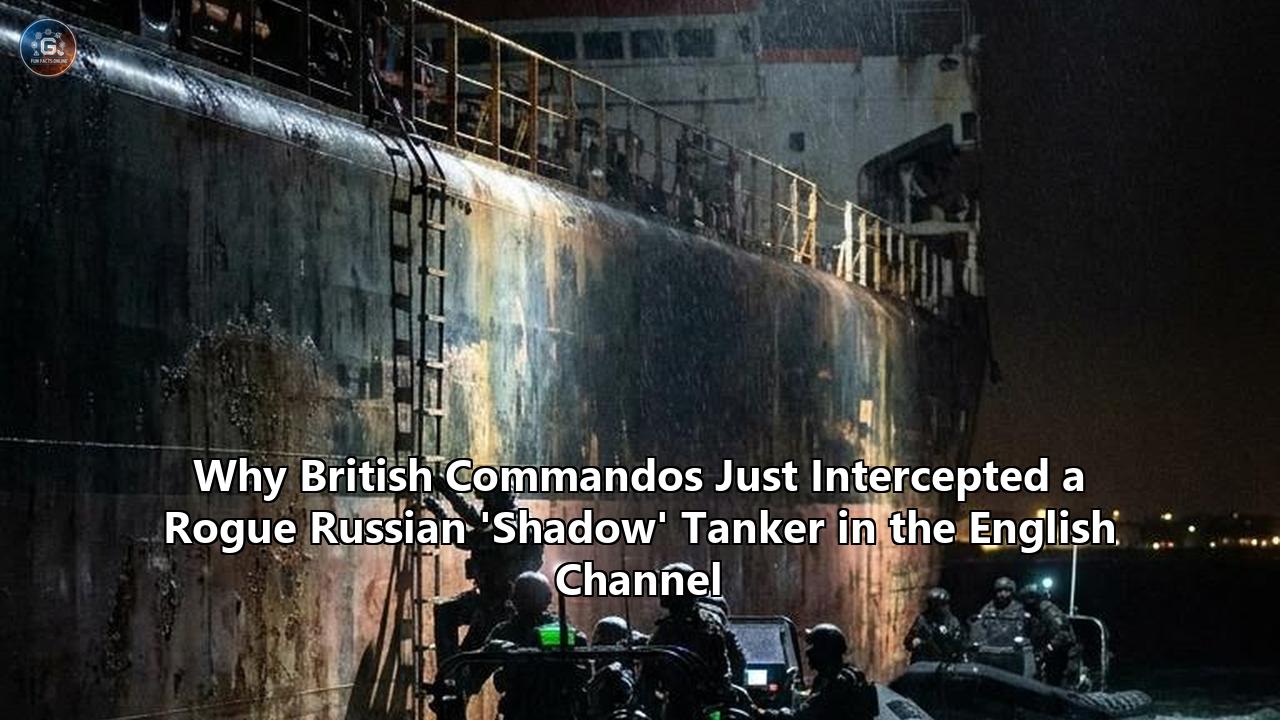
In the pitch-black hours of Sunday, June 14, 2026, a highly coordinated military and law enforcement operation unfolded in the choppy waters of the English Channel, south of the Isle of Wight. Under the cover of darkness, elite green berets from 42 Commando Royal Marines, alongside specially trained law enforcement officers from the National Crime Agency (NCA), executed a daring fast-rope insertion from Merlin Mk4 and Chinook helicopters onto the deck of the Smyrtos, a Cameroon-flagged crude oil tanker. Overhead, RAF P-8 Poseidon maritime patrol aircraft and Wildcat helicopters provided constant aerial surveillance, while the Royal Navy’s Type 23 frigate HMS Sutherland and the Hunt-class mine countermeasures vessel HMS Ledbury boxed the tanker in, cutting off any avenue of escape.
The six-hour operation, which concluded in the first hours of daylight, represents the first time the United Kingdom has led an armed naval capture of a sanctioned vessel since the outbreak of the war in Ukraine. The Smyrtos, loaded with Russian crude oil from the Baltic port of Ust-Luga and bound for India, was successfully boarded, secured, and escorted to an anchorage off Portland near Weymouth, Dorset, where British authorities are currently holding the vessel and inspecting its cargo, paperwork, and technical safety.
This high-stakes Russian shadow tanker intercept was not merely a localized law enforcement action. It is a watershed moment in the economic and geopolitical war between the West and the Kremlin, signaling a dramatic shift in how maritime democracies intend to police the high seas. For years, Moscow has bypassed Western sanctions by operating a massive, unregulated "shadow fleet" of aging tankers to keep its war treasury flush with petrodollars. By directly intercepting and seizing the Smyrtos, London has pierced the veil of sovereign impunity that these rogue vessels have long enjoyed.
The dramatic raid took place against a backdrop of acute political turmoil in London, occurring just three days after the shock resignations of Defence Secretary John Healey and Armed Forces Minister Al Carns over a bitter dispute regarding military funding and the delayed Defence Investment Plan (DIP). The subsequent appointment of former Security Minister Dan Jarvis to the defense portfolio set the stage for an immediate, high-profile demonstration of British military resolve.
Yet behind the dramatic headlines lies a complex web of international maritime law, severe ecological risk, and deep geopolitical calculations. Understanding why British commandos boarded the Smyrtos requires examining the structural challenges posed by Russia's shadow fleet, the legal grey zones that have shielded these vessels, and the emerging Anglo-French blueprint designed to dismantle the Kremlin’s maritime lifeline.
The Anatomy of the Threat: Inside Russia’s "Shadow Fleet"
To comprehend the significance of the Russian shadow tanker intercept, one must first understand the scale of the parallel maritime ecosystem that Russia has constructed since its full-scale invasion of Ukraine in February 2022.
Following the implementation of the G7-led $60-per-barrel price cap on Russian crude oil, which sought to limit Moscow's oil revenues while keeping global oil markets supplied, the Kremlin embarked on a massive, covert purchasing spree. Using a labyrinth of shell companies based in maritime hubs like Dubai, Hong Kong, Istanbul, and various offshore tax havens, Russia acquired hundreds of secondhand oil tankers. Today, this shadow fleet is estimated to comprise over 700 vessels, transporting roughly 75% of Russia’s sanctioned oil exports.
                     RUSSIA'S SHADOW FLEET MECHANICS

   +-------------------+                     +-----------------------+
   |   Russian Port    |                     |   Shell Companies     |
   |   (e.g., Ust-Luga)|                     | (Dubai, HK, Istanbul) |
   +---------+---------+                     +-----------+-----------+
             |                                           |
             | Loads Crude Oil                           | Purchases Ships
             v                                           v
   +-----------------------------------------------------------------+
   |                      THE SHADOW TANKER                          |
   |  - Ageing vessel (>15 years)                                    |
   |  - Flag of Convenience (e.g., Cameroon, Gabon, Comoros)         |
   |  - Opaque, non-Western P&I Insurance                            |
   |  - Frequent name changes (Myrtos -> Smyrtos)                    |
   +---------------------------------+-------------------------------+
                                     |
                                     | Transits Global Straits
                                     v
                        +--------------------------+
                        |  Consumer Nations        |
                        |  (e.g., India, China)    |
                        +--------------------------+
The ship at the center of the June 14 raid, the Smyrtos, is a textbook example of this shadow fleet architecture. Originally named the Myrtos, the vessel was officially sanctioned by the United Kingdom in July 2025 due to its role in transporting Russian energy products. Following the designation, the ship's owners engaged in a classic maritime shell game: they altered the vessel's name to Smyrtos, transferred its registration to a false Cameroonian flag of convenience, and registered it under a new, opaque corporate entity designed to obscure its ultimate Russian ownership.
These vessels exhibit several defining, high-risk characteristics:
- Extreme Age: The vast majority of shadow tankers are over 15 years old—the threshold at which major international oil companies typically retire vessels due to the exponential rise in structural fatigue, corrosion, and mechanical failure.
- Regulatory Evasion: They operate outside the jurisdiction of Western maritime services. This means they are classed by non-aligned classification societies, often lacking the rigorous safety inspections required by organizations like Lloyd's Register or the American Bureau of Shipping.
- Opaque Flags: To evade international enforcement, shadow tankers register under flags of convenience—countries like Cameroon, Gabon, Comoros, and the Cook Islands—which have minimal regulatory oversight, lack the capacity to police their fleets, and are often willing to look the other way in exchange for registration fees.
- Deceptive Practices: Shadow tankers routinely engage in spoofing—manipulating their Automatic Identification System (AIS) transponders to broadcast false locations—or turning them off entirely ("going dark") during sensitive parts of their voyages, such as ship-to-ship (STS) transfers in the middle of the ocean.
By utilizing this parallel fleet, the Kremlin has managed to largely decouple its oil export trade from Western shipping, insurance, and financial services. This allows Russia to sell its oil above the G7 price cap, funneling billions of dollars directly back into its domestic military-industrial complex to produce the missiles, glide bombs, and drones currently devastating Ukrainian infrastructure.
The Environmental and Geopolitical Time Bomb
The threat posed by the shadow fleet is not merely economic; it is an ecological and security crisis of the highest order. The English Channel is the busiest shipping lane in the world, with over 500 vessels transiting the narrow Dover Strait every single day. Operating a fleet of aging, poorly maintained, under-insured, or completely uninsured tankers through this congested choke point is a recipe for a catastrophic environmental disaster.
Under standard maritime protocols, global commercial vessels carry Protection and Indemnity (P&I) insurance provided by a tight-knit cartel of Western insurers known as the International Group of P&I Clubs. This insurance guarantees up to billions of dollars in coverage to pay for salvage, cleanup, and environmental damages in the event of a collision or oil spill.
Shadow fleet vessels, by design, do not have access to Western P&I clubs. Instead, they rely on highly suspect, state-backed Russian insurers or obscure, unrated firms in non-sanctions-aligned countries. In many cases, they sail with fraudulent insurance certificates.
If a vessel like the Smyrtos—laden with nearly a million barrels of heavy Russian crude—were to suffer a catastrophic engine failure, run aground, or collide with another vessel in the English Channel, the consequences would be devastating:
- Ecological Destruction: A massive oil spill in the Channel would decimate marine ecosystems, ruin delicate coastal fisheries, and contaminate hundreds of miles of British and French coastlines.
- Clean-Up Bankruptcy: Because the shadow tanker's insurance is effectively worthless, the astronomical costs of the cleanup operation—potentially running into billions of pounds—would fall directly on the taxpayers of the UK, France, and neighboring European coastal states.
- Economic Paralysis: A major salvage and cleanup operation could force the temporary closure or severe restriction of the Dover Strait, paralyzing European trade and dealing a devastating blow to global supply chains.
                           THE INSOLVENCY LOOPHOLE

   +------------------------------------+      +-----------------------------------+
   |      STANDARD GLOBAL TANKER        |      |       RUSSIAN SHADOW TANKER       |
   +------------------------------------+      +-----------------------------------+
   | - Age: <12 Years                   |      | - Age: >15 Years                  |
   | - Insurer: Western P&I Club        |      | - Insurer: Opaque Russian/None    |
   | - Liability Cap: ~$1-2 Billion     |      | - Liability Cap: Effectively Zero |
   | - Inspection: Highly Rigorous      |      | - Inspection: Self-Certified/Poor |
   +-----------------+------------------+      +-----------------+-----------------+
                     |                                           |
                     | Collision/Spill                           | Collision/Spill
                     v                                           v
   +------------------------------------+      +-----------------------------------+
   | Insurers payout cleanup costs;     |      | Owner disappears; Opaque insurer  |
   | local taxpayers are protected.     |      | defaults. Coastal state pays bill.|
   +------------------------------------+      +-----------------------------------+
Furthermore, Western intelligence agencies have increasingly viewed the shadow fleet as a vector for Russian hybrid warfare. These vessels are suspected of acting as intelligence-gathering platforms, carrying sophisticated electronic monitoring equipment, and being involved in the sabotage of undersea infrastructure.
In the Baltic Sea, several mysterious incidents involving severed telecommunications cables and damaged gas pipelines have occurred in close proximity to transiting shadow fleet vessels. By operating under the cover of commercial shipping, these rogue tankers provide the Kremlin with plausible deniability while probing and potentially disrupting critical Western maritime infrastructure.
The Legal Grey Zone: Innocent Passage and UNCLOS Obstacles
Given the severe ecological and security threats, a persistent question has vexed Western policymakers: Why has it taken so long to stop these vessels? The answer lies in the highly protective framework of international maritime law, specifically the 1982 United Nations Convention on the Law of the Sea (UNCLOS).
UNCLOS was drafted in an era when the primary objective of maritime nations was to ensure the free, unhindered flow of global commerce. Under UNCLOS, the oceans are governed by several key principles that the shadow fleet has successfully weaponized:
The Right of Innocent Passage (Article 17)
Ships of all states, whether coastal or land-locked, enjoy the right of innocent passage through the territorial sea of a coastal state. Passage is considered "innocent" so long as it is not prejudicial to the peace, good order, or security of the coastal state.
Crucially, UNCLOS states that the mere carriage of oil, or even a history of regulatory non-compliance, does not automatically render a passage "non-innocent." Unless a vessel is actively engaged in weapons testing, smuggling, spying, or deliberate and severe pollution while inside territorial waters, a coastal state has no legal authority to stop, board, or detain it.
Flag-State Jurisdiction
On the high seas, and to a large extent within territorial seas, a vessel is subject to the exclusive jurisdiction of its flag state. Under international law, only the state under whose flag a ship flies (such as Cameroon) has the authority to enforce regulatory compliance, conduct boardings, or seize the vessel.
If a coastal state like the UK boards a foreign-flagged vessel in international waters without the explicit consent of the flag state, it is committing an act of maritime interdiction that can be interpreted under international law as an act of aggression or piracy.
The Problem of International Straits
The English Channel, as an international strait connecting the North Sea to the Atlantic Ocean, is subject to even stricter transit passage regimes. Under transit passage rules, coastal states cannot suspend or hamper the passage of foreign vessels through international straits, further limiting the legal tools available to the UK and France to block the shadow fleet.
For years, Russia has exploited these legal protections. Moscow understood that while Western nations could sanction individual ships and ban them from entering Western ports, they could not legally stop those same ships from transiting through their territorial waters en route to non-aligned ports in India or China.
The Russian shadow tanker intercept of the Smyrtos marks a decisive, aggressive break from this legal straightjacket.
To justify the boarding, the British government utilized a combination of domestic sanctions legislation and creative interpretations of maritime law. In March 2026, Prime Minister Keir Starmer announced a major policy shift, declaring that British armed forces would henceforth be authorized to board and seize sanctioned shadow fleet vessels passing through UK waters.
The legal core of the British argument is that because the Smyrtos was officially sanctioned, its attempt to transit UK-adjacent waters while carrying illicit cargo to fund an illegal war of aggression directly threatened the security of the coastal state, thereby stripping it of its right to "innocent passage."
Furthermore, because Cameroon has consistently failed to police its registry or ensure its vessels adhere to basic international safety and environmental regulations, the UK and its allies argue that such "flag of convenience" states have forfeited their exclusive jurisdiction over highly hazardous vessels.
Westminster's Internal Crucible: The Political Backdrop
While the strategic rationale for the Russian shadow tanker intercept is clear, the timing of the June 14 raid was deeply intertwined with a severe domestic political crisis gripping the British government.
Just three days prior, on Thursday, June 11, 2026, the UK defense establishment was rocked by the sudden, joint resignations of Defence Secretary John Healey and Armed Forces Minister Al Carns. In a scathing resignation letter addressed to Prime Minister Keir Starmer, Healey—a highly respected figure who had served as Defence Secretary since Labour’s election victory in July 2024—accused the Prime Minister and Chancellor Rachel Reeves of putting the nation's security at risk.
                  THE WESTMINSTER DEFENSE SPENDING CRISIS

   +-----------------------------------------------------------------+
   |                  John Healey (Ex-Defense Sec)                   |
   |  - Demanded £18 Billion to plug a major DIP funding deficit     |
   |  - Warned of Russian attack on NATO by 2030                     |
   |  - Resigned June 11, 2026, in protest of inadequate funding     |
   +--------------------------------+--------------------------------+
                                    |
                                    v
   +-----------------------------------------------------------------+
   |                   Keir Starmer (Prime Minister)                 |
   |  - Treasury offered compromise of £13.5 Billion                 |
   |  - Facing leadership challenge / plumetting popularity          |
   |  - Urgently needed to demonstrate military strength             |
   +--------------------------------+--------------------------------+
                                    |
                                    v
   +-----------------------------------------------------------------+
   |                    Dan Jarvis (New Defense Sec)                 |
   |  - Appointed June 11, 2026 (Former Security Minister)           |
   |  - Ordered the high-profile interception of the Smyrtos         |
   |  - Seeks to renegotiate the Defence Investment Plan (DIP)       |
   +-----------------------------------------------------------------+
The core of the dispute centered on the long-delayed Defence Investment Plan (DIP). Healey had requested an £18 billion cash injection to plug a massive deficit in major defense projects, argue that the UK's armed forces were drastically underprepared for the rapidly deteriorating global security environment.
Healey highlighted explicit British intelligence warnings that Russia could launch a direct attack on a NATO nation as early as 2030. He argued that Starmer’s proposed funding settlement—which would raise defense spending to just 2.68% of GDP by 2030—fell dangerously short of the 3% target required to deter Russian aggression.
Healey's resignation, closely followed by that of Al Carns—a decorated former Royal Marines Colonel—pushed Starmer's government to the brink of collapse. With local election defeats, a pending, highly critical by-election in Makerfield, and a potential leadership challenge from Greater Manchester Mayor Andy Burnham looming in the autumn, Starmer's authority was severely weakened.
In a swift bid to stabilize his administration, Starmer promoted Security Minister Dan Jarvis—a former Army officer—to the role of Defence Secretary on Thursday evening.
For Starmer and the newly installed Jarvis, the transit of the sanctioned Smyrtos through the English Channel over the weekend presented a high-risk, high-reward political opportunity.
By authorizing an immediate, dramatic, and highly visible military operation to seize the vessel, Downing Street could:
- Project Strength: Rebut Healey’s narrative that the government was weak on defense and unwilling to use the military to protect national interests.
- Unify the Narrative: Demonstrate that despite domestic funding disputes, the Royal Navy and Royal Marines remain highly capable, lethal, and ready to execute complex operations at a moment's notice.
- Establish Jarvis’s Credentials: Provide the new Defence Secretary with an immediate tactical success, bolstering his position before he represents the UK at the upcoming G7 summit in France and the critical NATO summit in Ankara.
The Prime Minister’s active promotion of the raid on social media, including a highly publicized video on TikTok accompanied by the caption "Another bad day to be Vladimir Putin," underscores the intense political utility of the operation for a beleaguered Downing Street.
The Collaborative Shield: Anglo-French Tactics and Law Enforcement
The execution of the Russian shadow tanker intercept was a masterclass in modern, inter-agency, and multinational maritime security. Rather than a purely military exercise, the operation was structured as a hybrid law enforcement and military mission, drawing on a diverse range of capabilities.
The Tactical Execution
The boarding was carried out by 42 Commando, a specialized unit of the Royal Marines Commando Force that focuses on Maritime Interdiction Operations (MIO). Operating from Merlin Mk4 helicopters of the Commando Helicopter Force and RAF Chinooks, the commandos utilized fast-rope techniques to board the Smyrtos in the dead of night while the vessel was underway.
                       TACTICAL COMMAND STRUCTURE

                  +----------------------------------+
                  |    National Security Council     |
                  |     (Directed by PM Starmer)     |
                  +----------------+-----------------+
                                   |
                                   v
                  +----------------------------------+
                  |       Ministry of Defence        |
                  |      (Sec. State Dan Jarvis)     |
                  +----------------+-----------------+
                                   |
                                   | Coordinates
                                   v
         +-------------------------+-------------------------+
         |                                                   |
         v                                                   v
+------------------+                                +------------------+
|   Royal Navy &   |                                |  National Crime  |
|   Royal Marines  |                                |   Agency (NCA)   |
+--------+---------+                                +--------+---------+
         |                                                   |
         | Secures Ship (42 Commando)                        | Seizes Records
         | Provides Escort (Sutherland, Ledbury)             | Investigates Sanctions
         v                                                   v
+----------------------------------------------------------------------+
|                     THE ANGLO-FRENCH CHANNEL WALL                    |
| - Joint maritime intelligence sharing with French Navy               |
| - Coordinated tracking of shadow fleet movements through Dover Strait|
+----------------------------------------------------------------------+
Lieutenant Colonel Tom Quinn, who commented on the tactical aspects of the mission, noted that despite the inherent dangers of boarding a massive, moving tanker at night, the commandos encountered no physical resistance from the vessel's crew. "Once we boarded the vessel and moved to the bridge, the dialogue that we had with them was professional, safe, and indeed the crew enabled us to conduct the actions that we needed to complete to safely take control," Quinn stated.
The Role of the National Crime Agency (NCA)
Crucially, the Royal Marines did not act alone. They were accompanied by specially trained law enforcement officers from the National Crime Agency (NCA).
While the Marines secured the ship physically, the NCA officers immediately seized control of the vessel’s bridge and administrative offices. The law enforcement team spent hours searching the cabins, inspecting the ship’s logbooks, examining manifestos, and downloading electronic navigation and communication data.
This military-police hybrid model is essential for legal compliance. Because the vessel was seized on sanctions-busting and regulatory grounds, the evidence gathered by the NCA will form the basis of subsequent legal proceedings in British courts, ensuring the detention of the vessel can withstand rigorous judicial review.
The Anglo-French Channel Wall
The operation was conducted in "close coordination with the French," reflecting a growing, undeclared joint effort by London and Paris to lock down the English Channel against rogue Russian shipping.
This level of cooperation has been quietly building throughout early 2026:
- January 2026: French maritime forces intercepted and impounded the suspect Russian shadow tanker Grinch.
- March 2026: French authorities detained the Deyna, a tanker sailing under a Mozambican flag from Murmansk, as it attempted to transit French-adjacent waters near Marseille.
- June 2026: The British-led seizure of the Smyrtos off Portland, supported by French intelligence and tracking assets.
By coordinating their intelligence, tracking systems, and naval assets, the UK and France are effectively establishing an "Anglo-French Wall" in the Dover Strait. For the shadow fleet, this means that transiting the English Channel is no longer a low-risk voyage. Any vessel under sanction, operating with dubious registration, or lacking verifiable insurance is now highly vulnerable to interception and seizure by either British or French forces.
Future Ramifications and the Risk of Maritime Escalation
The successful Russian shadow tanker intercept of the Smyrtos has sent shockwaves through the maritime industry and sparked a furious reaction from Moscow. As the vessel remains anchored off Portland under heavy guard, the long-term implications of this operation are beginning to emerge, reshaping geopolitical tensions, international maritime law, and the global oil trade.
The Precedent for Global Choke Points
The most significant consequence of the Smyrtos seizure is the precedent it sets for other maritime choke points. If the UK can legally and physically intercept shadow fleet vessels in the English Channel, other nations are likely to follow suit.
| Maritime Bottleneck | Key Coastal States | Potential Impact of Adopting the UK Model |
|---|---|---|
| The Danish Straits | Denmark, Sweden | Could completely choke off Russia's primary oil export route from the Baltic Sea ports (Primosk and Ust-Luga). |
| The Turkish Straits | Turkey | Could severely restrict Russian oil and grain exports originating from the Black Sea. |
| The Strait of Gibraltar | Spain, Morocco | Could block shadow tankers attempting to transit between the Atlantic Ocean and the Mediterranean Sea. |
| The Strait of Hormuz | Oman, UAE, Iran | Could complicate the transit of non-aligned oil shipments, though heavily contested by Iranian forces. |
Denmark, Sweden, and Finland are watching the British action with intense interest. The Baltic Sea is a highly sensitive ecological zone, and Baltic nations have long feared a devastating oil spill from a crumbling Russian shadow tanker. If the Danish government adopts the British legal framework—arguing that uninsured, sanctioned shadow tankers pose an unacceptable, imminent threat to environmental security—it could shut down the Danish Straits to Russian oil exports entirely, dealing a lethal blow to Moscow's energy revenues.
The Threat of Russian Retaliation
Moscow's reaction to the seizure has been a mix of official silence and aggressive rhetoric from political hardliners. While the Russian Embassy in London has yet to release a formal diplomatic protest, Dmitry Rogozin, a prominent Russian senator and former head of the Roscosmos space agency, issued a chilling warning.
Rogozin suggested that in response to Western interceptions, Russia should consider booby-trapping its future tankers with explosive charges so they could be remotely detonated if boarded by Western commandos.
While Rogozin's threats are likely bluster designed to deter future boardings, they point to a very real danger: the potential militarization of the shadow fleet. To protect its oil revenue, the Kremlin could take several escalatory steps:
- Armed Guards: Russia may begin placing armed private security contractors or active-duty military personnel aboard shadow tankers to resist Western boardings, raising the prospect of lethal firefights on the high seas.
- Naval Escorts: The Russian Navy could begin providing active warship escorts for shadow tankers transiting through international straits. Earlier in the spring of 2026, Russian warships were observed escorting several tankers through the Channel. While the Smyrtos was left unprotected, future voyages may feature a heavy naval presence, dramatically increasing the risk of a direct military confrontation between Royal Navy and Russian warships.
- Asymmetric Retaliation: Moscow could retaliate by seizing Western commercial vessels transiting through areas where Russia projects naval power, such as the Black Sea, the Arctic, or the Sea of Okhotsk.
The Redirection of Global Shipping Lanes
The immediate tactical impact of the June 14 intercept was visible on global ship-tracking databases within hours of the raid. According to MarineTraffic data, several other suspected shadow fleet vessels approaching the English Channel abruptly altered their courses, turning away from the Dover Strait to avoid the newly established Anglo-French dragnet.
                 ALTERED SHADOW FLEET TRANSIT ROUTES

    [ Russia's Baltic Ports ]
               |
               v
     +---------+---------+
     |   The North Sea   |
     +---------+---------+
               |
      +--------+--------+  (U.K. Intercept / Sanctions Risk)
      |                 |
      v                 v
[ ROUTE A: CANCELLED ]  [ ROUTE B: THE NEW DETOUR ]
- Transit: English Channel - Transit: Around North of Scotland
- Fast, low fuel cost   - Long, treacherous, high fuel cost
- Extreme risk of seizure - Outside direct Anglo-French intercept zone
To deliver their oil to buyers in India and China, these tankers must now take the long, treacherous route around the north of Scotland and down through the Atlantic Ocean, bypassing the English Channel entirely. This detour adds thousands of miles to their voyages, increases fuel costs, extends delivery times, and severely reduces the operational efficiency of the shadow fleet.
The Looming Legal Battles
As the Smyrtos sits at anchor off the coast of Dorset, a massive legal battle is set to unfold in British courts. The UK government must decide what to do with the seized vessel and its highly valuable cargo of crude oil.
Under the Sanctions and Anti-Money Laundering Act 2018 (SAMLA), the British government has the authority to freeze assets, but permanently seizing and selling a foreign-flagged vessel's cargo requires a high standard of proof.
Lawyers representing the ship's shell owners are expected to launch a fierce legal challenge, arguing that the boarding was an illegal act of piracy in international waters and demanding the immediate release of the ship and compensation for lost transit time.
How the British judiciary handles this case will establish the legal guidelines for the rest of the world. If the courts uphold the seizure, it will provide a robust legal template for other G7 nations to permanently confiscate Russian shadow fleet assets and potentially redirect the proceeds of sold oil to fund the reconstruction of Ukraine.
Conclusion: A Line in the Sand
The dramatic Russian shadow tanker intercept in the English Channel on June 14, 2026, represents a bold, high-stakes gamble by the British government. By deploying 42 Commando and the National Crime Agency to seize the Smyrtos, Prime Minister Keir Starmer has demonstrated that the West is no longer willing to allow the Kremlin to use legal loopholes and shell companies to fund its war machine with impunity.
The operation has successfully defined the challenge: the shadow fleet is not just a sanctions-busting mechanism, but a severe ecological, financial, and hybrid security threat that imperils the coastal states of Europe. By executing a flawless tactical operation in close coordination with France, the UK has presented a highly effective, scalable solution to a problem that had previously flummoxed Western policymakers.
Yet, this victory has raised the stakes. As Dan Jarvis settles into his role as Defence Secretary amid a brutal domestic debate over military spending, the shadow of the Smyrtos will loom large over his tenure.
The critical questions for the coming months are clear:
- Will Russia respond by arming its tankers or deploying naval escorts?
- Will the European Union and G7 nations rally behind the UK's legal framework and shut down other vital maritime passages to the shadow fleet?
- And will the British courts provide the legal seal of approval needed to make the seizure of the Smyrtos a permanent, devastating blow to Vladimir Putin’s war chest?
One thing is certain: on the dark waters of the English Channel, a line has been drawn in the sand. The era of the unregulated, untouchable shadow tanker is officially over.
Reference:
- https://www.theguardian.com/uk-news/2026/jun/14/british-forces-intercept-russian-shadow-fleet-vessel-english-channel
- https://www.royalnavy.mod.uk/news/2026/june/15/20260615-royal-navy-leads-boarding-operation-on-shadow-fleet-tanker
- https://www.marinelink.com/news/video-british-commandos-intercept-russian-540277
- https://www.navaltoday.com/2026/06/15/uk-intercepts-russian-shadow-fleet-vessel-in-english-channel-video/
- https://www.aljazeera.com/news/2026/6/14/uk-boards-and-seizes-russian-shadow-fleet-tanker-in-english-channel
- https://www.reddit.com/r/geopolitics/comments/1u5hqpo/royal_marines_board_russian_shadow_fleet_oil/
- https://novaramedia.com/2026/06/12/john-healey-quit-to-send-a-message-to-britains-next-prime-minister/
- https://www.theguardian.com/politics/2026/jun/11/john-healey-resigns-defence-secretary-military-spending
- https://www.brusselstimes.com/2186874/united-kingdom-dan-jarvis-named-new-defence-secretary
- https://www.themoscowtimes.com/2026/06/14/uk-intercepts-russian-shadow-fleet-vessel-in-english-channel-a93009
- https://time.com/article/2026/06/11/uk-defense-minister-john-healey-resigns-military-spending-dispute-starmer/
- https://www.euractiv.com/news/second-uk-minister-quits-in-defence-spending-row-piling-pressure-on-pm/
- https://www.aljazeera.com/news/2026/6/11/britains-defence-%E2%81%A0minister-healey-quits-over-defence-spending
- https://breakingdefense.com/2026/06/british-defense-secretary-john-healey-resigns-over-defense-funding/
- https://www.theguardian.com/politics/2026/jun/14/defence-secretary-dan-jarvis-uk-plan-military-spending-dip