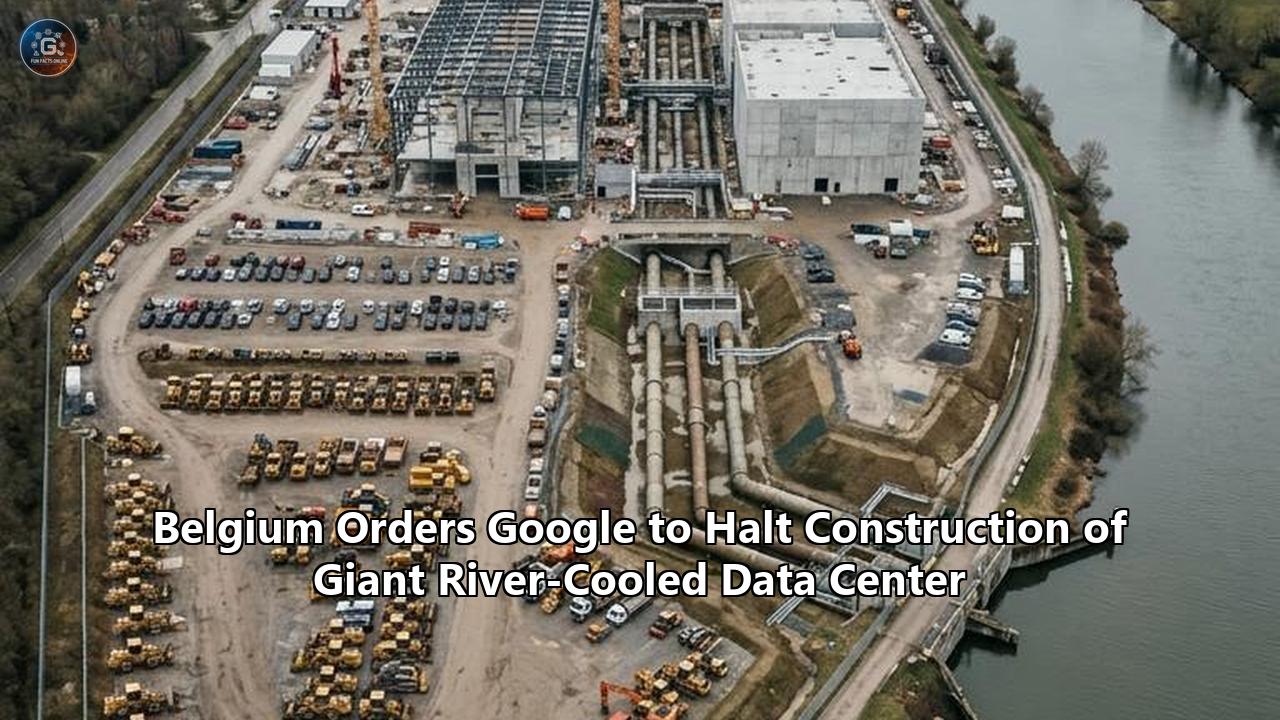
On Thursday, November 26, 2026, regional planning inspectors entered the Écopole industrial park straddling Farciennes and Aiseau-Presles in Belgium’s Hainaut province, bringing a direct halt to construction on Google’s second major Belgian cloud campus. The inspectors delivered an immediate verbal stop-work order to approximately 300 contractors on-site, a directive confirmed in writing hours later to Google and its local development subsidiary, Crystal Computing.
The enforcement action followed an on-site verification that caught the multinational mid-stride: contractors had nearly finished the physical superstructure of a massive 30,000-square-meter data hall—spanning roughly three hectares—despite the fact that the regional government had formally revoked the facility’s planning permit three months earlier.
Wallonia’s senior planning official, Raphaël Stokis, confirmed the shutdown after an emergency dossier filed by environmental organizations and local citizen groups demonstrated that construction had continued uninterrupted throughout the autumn. Regional inspectors have now referred the matter to public prosecutors for potential criminal enforcement over unauthorized building activity.
The sudden regulatory freeze exposes an acute structural conflict at the heart of the global artificial intelligence buildout: the collision between computational cooling demands and regional freshwater limits. The Farciennes dispute centers on Google’s attempt to abandon its originally permitted air-cooling design in favor of an industrial-scale river-water cooling system drawn from the Sambre River. While river-water evaporative cooling would have slashed the facility’s electrical overhead, it would have drawn up to 600 cubic meters of river water every hour, evaporating the vast majority of it into the atmosphere during seasonal periods of severe drought.
As the matter heads toward a pivotal January 7, 2027 hearing before Belgium’s Council of State, the confrontation offers a stark study in contrasts: corporate haste versus administrative sovereignty, energy optimization versus hydrological preservation, and the legacy model of resource-intensive data processing versus the stringent environmental constraints now reshaping European infrastructure.
The Permitting Pivot: Air-Cooled Blueprint vs. River-Cooled Monolith
The project at Farciennes was originally conceived as a conventional expansion of Belgium’s digital backbone. In February 2024, Google secured regional approval to construct three discrete, air-cooled data center buildings across a 53-hectare parcel in Écopole, a rehabilitated brownfield site formerly dominated by coal extraction. The municipal leadership of Farciennes and Sambreville initially celebrated the €1 billion project as an economic catalyst for the post-industrial Charleroi basin, promising 100 direct high-tech positions alongside hundreds of specialized construction roles. Regional and federal dignitaries, including then-Federal Energy Minister Tinne Van der Straeten, attended the campus's ceremonial groundbreaking in April 2024.
+-----------------------------------------------------------------------------------+
|                        PERMIT ARCHITECTURE COMPARISON                             |
+------------------------------------+----------------------------------------------+
| February 2024 Original Permit      | 2025/2026 Amended Application (Revoked)      |
+------------------------------------+----------------------------------------------+
| • Three separate data halls        | • Two halls merged into one 30,000 m² hall   |
| • 160 MW total planned capacity    | • Consolidated high-density AI architecture  |
| • Ambient air-cooling / chillers   | • Evaporative liquid cooling via river water |
| • Zero river water withdrawal      | • 600 m³/hour withdrawal from Sambre River   |
| • Higher grid electricity demand   | • Over 75% evaporated; <25% returned         |
| • PUE: ~1.25 – 1.35                | • PUE: ~1.10 – 1.15                          |
| • Status: Legally active           | • Status: Revoked Aug 2026; Halt Nov 2026    |
+------------------------------------+----------------------------------------------+
Within a year of securing that baseline approval, Google’s operational requirements shifted dramatically. Driven by the transition from standard cloud hosting to high-density compute clusters designed for generative AI workloads, Google filed a comprehensive modification request in 2025.
The company sought to merge two of the three planned air-cooled buildings into a single, high-density mega-structure spanning 30,000 square meters. Alongside this architectural consolidation came a radical thermal overhaul: Google proposed abandoning the dry-cooling design in favor of direct liquid cooling supported by an open-loop abstraction system linked directly to the nearby Sambre River.
The engineering rationale for the switch was anchored in thermodynamic efficiency. Air-cooling systems become inefficient when server rack power densities climb above 30 to 40 kilowatts (kW), a threshold routinely exceeded by advanced accelerator clusters that draw between 40 kW and 100 kW per rack. Evaporative cooling using water provides superior heat transfer, suppressing the facility's Power Usage Effectiveness (PUE)—the ratio of total energy consumed by the facility over the energy delivered to the IT equipment.
However, the hydrological cost was immense. Under the modified application, Crystal Computing requested authorization to pump up to 600 cubic meters (600,000 liters) of water per hour out of the Sambre River. Based on the thermal dynamics of the proposed evaporative cooling towers, less than a quarter of that volume would be returned to the Sambre as heated discharge; more than 75% would be lost to atmospheric evaporation.
In April 2026, the Walloon regional administration quietly approved the amendment. Yet that decision ignited a swift civic backlash. A coalition of local residents, spearheaded by neighbors Samuel Melchior and Xavine Mus, joined forces with regional environmental advocates to mount a formal administrative challenge in May 2026. They argued that allocating billions of liters of river water to an overseas technology conglomerate was untenable in a province already battered by repeated summer heatwaves and falling aquifer levels.
The turning point arrived on August 14, 2026. Walloon Infrastructure and Territory Minister François Desquesnes (Les Engagés) intervened, overturning the administrative approval and formally revoking the amended permit. Citing the precautionary principle, Desquesnes noted that during the summer of 2026, fifteen Walloon municipalities were under strict residential water bans, prohibiting citizens from watering gardens or filling pools.
The regional hydrological network was under such intense stress that authorities had to execute massive emergency discharges from the Lacs de l'Eau d'Heure reservoir network simply to maintain navigable water levels in regional canals and preserve minimal ecological streamflows in the Sambre.
"This proposed cooling system involves pumping water from the Sambre River," Desquesnes stated when issuing the revocation. "The current situation demonstrates that climate change is at work and that we must therefore preserve water resources. The cubic meters the company plans to pump from the Sambre seem significantly large to me. I cannot accept that they change their cooling method. I do not wish to commit the region for 20 years in an ecological context that is changing fundamentally".
The Defiance on the Ground: At-Risk Construction vs. Administrative Law
While Minister Desquesnes’ decision in August stripped the legal foundation from the river-cooled mega-facility, work at the Écopole site did not pause. Instead, Google and its primary contractors initiated an aggressive phase of at-risk construction.
In corporate real estate and hyperscale development, "at-risk construction" refers to building ahead of regulatory finality, banking on legal appeals, political settlements, or retrospective modifications to legitimize work before commissioning. On October 17, 2026, Crystal Computing lodged an appeal with Belgium's highest administrative court, the Council of State, seeking the urgent suspension and total annulment of Desquesnes’ revocation. Rather than awaiting the court’s judgment, the project’s cranes, concrete mixers, and paving teams accelerated their operations.
+-----------------------------------------------------------------------------------+
|                        TIMELINE OF THE DISPUTE (2024–2027)                        |
+-------------------+---------------------------------------------------------------+
| Date              | Milestone                                                     |
+-------------------+---------------------------------------------------------------+
| February 2024     | Wallonia grants permit for three air-cooled data centers.     |
| April 2024        | Ceremonial groundbreaking at Écopole brownfield site.        |
| Early 2025        | Google submits amendment: merge halls, use Sambre water.      |
| April 2026        | Regional administration approves amended permit.              |
| May 2026          | Citizens Melchior and Mus file administrative appeal.         |
| August 14, 2026   | Minister François Desquesnes revokes amended permit.          |
| Autumn 2026       | Google accelerates construction of 30,000 m² unified shell.   |
| October 17, 2026  | Google appeals revocation to Belgium's Council of State.      |
| November 23, 2026 | Greenpeace files emergency complaint backed by satellite data.|
| November 26, 2026 | Wallonia issues stop-work order to 300 on-site workers.       |
| January 7, 2027   | Scheduled public hearing before Belgium's Council of State.   |
+-------------------+---------------------------------------------------------------+
The scale of this non-compliance was brought to light through systematic open-source intelligence and citizen monitoring. Local residents noticed that rather than excavating the footings for three separate structures as mandated by the still-valid 2024 permit, crews were finishing the structural roof trusses and surrounding asphalt aprons of a single, continuous 30,000-square-meter facility.
Greenpeace Belgium initiated direct monitoring, utilizing high-resolution commercial satellite imagery and targeted drone surveillance to track the development across five observation dates between August 13 and November 14, 2026. The images confirmed that the entire unified footprint had been enclosed and paved well after the amended permit had been quashed.
"Tech giants are not above the law," said Nadia Cornejo, spokesperson for Greenpeace Belgium, upon submitting the evidence to the Walloon government on November 23. "This stop-order should have occurred in August, the moment the permit was cancelled. Continuing construction on a revoked design shows total disrespect for the local environment, the surrounding community, and the legal framework".
When regional inspectors arrived unannounced on November 26, they found the building shell virtually complete. Google attempted to defend its position by arguing that because the initial 2024 permit remained valid, construction was lawful.
However, Wallonia’s planning authorities dismissed this defense. The physical structure built on the ground was not the trio of air-cooled buildings authorized in 2024; it was the physical manifestation of the revoked 2025/2026 amendment, engineered specifically with intake infrastructure, thermal channels, and structural dimensions tailored for liquid cooling.
"If you have a permit to build three family bungalows and you instead erect an unbroken, seven-story apartment block, you cannot claim you are operating under your original permit simply because both provide housing," noted a senior Walloon regional official involved in the inspection. "The physical reality on the ground in Farciennes is that Google constructed the building from the refused permit".
In response to the halt, Google maintained a measured public posture. "We are committed to an open and collaborative dialogue with the regional government and independent experts regarding our investments in Wallonia," a Google spokesperson stated, noting that the enterprise had invested billions in Belgian digital infrastructure over the past fifteen years.
Yet that diplomatic language did not prevent the regional government from forwarding a criminal complaint to the Hainaut public prosecutor's office, marking an unprecedented legal escalation against a Big Tech operator in Belgium.
Thermodynamic Architectures: Evaporation vs. Air vs. Closed-Loop Systems
To understand why Google risked millions of euros in capital expenditure by forging ahead with an unauthorized design, one must examine the physics of modern high-performance data center cooling. The clash at Farciennes represents a broader technological friction between three competing heat-rejection paradigms: open-loop evaporative cooling, dry air cooling, and closed-loop direct-to-chip liquid systems.
+---------------------------------------------------------------------------------------------------+
|                                COOLING ARCHITECTURES COMPARED                                     |
+------------------------+-----------------------------+--------------------+-----------------------+
| Metric / Feature       | Sambre River Evaporative    | Ambient Dry Air    | Closed-Loop Direct-   |
|                        | (Google Amended Plan)       | (2024 Permit)      | to-Chip (Alternative) |
+------------------------+-----------------------------+--------------------+-----------------------+
| Heat Transfer Medium   | Water (High specific heat)  | Ambient Air        | Dielectric / Glycol   |
| Direct Water Use       | Up to 600 m³/hr withdrawal  | Zero               | Negligible (Closed)   |
| Evaporative Loss       | ~75% to 80% loss to air     | None               | Minimal               |
| Electrical Overhead    | Minimal (PUE 1.10 – 1.15)   | High (PUE 1.30+)   | Moderate (PUE ~1.18)  |
| Max Rack Density       | High (50–100 kW/rack)       | Low (15–30 kW)     | Ultra-High (100 kW+)  |
| Capital Cost           | Moderate                    | Moderate-Low       | High                  |
| Ecological Risk        | High (River drought/heat)   | Low                | Very Low              |
+------------------------+-----------------------------+--------------------+-----------------------+
1. Open-Loop Evaporative River Cooling (The Google Proposal)
Water is an exceptional thermal transfer agent. Its specific heat capacity is approximately 4.184 Joules per gram per degree Celsius ($J/g^\circ C$)—more than four times that of dry air ($1.005\ J/g^\circ C$). Even more critically, the latent heat of vaporization of water is roughly 2,260 kilojoules per kilogram ($kJ/kg$).
When an evaporative cooling tower transfers thermal energy from server secondary loops to raw water drawn from a river, it evaporates a fraction of that water, carrying away massive quantities of heat with minimal electrical assistance.
- The Thermodynamic Advantage: The facility requires relatively small pump motors and low-energy fans rather than energy-hungry mechanical chillers. This allows the data center to achieve a stellar PUE of 1.12 to 1.15, protecting corporate energy balance sheets and matching Google’s aggressive targets for carbon neutrality.
- The Ecological Tradeoff: The design functions as a giant water-consumption engine. Pumping 600 cubic meters per hour equates to 14,400 cubic meters per day. By discharging more than 75% of that water into the air as steam and water vapor, the facility withdraws water from an already depleted hydrological basin and permanently removes it from the immediate watershed.
- The Thermal Discharge Problem: The remaining 25% of water returned to the Sambre is returned at elevated temperatures. Under European Union Water Framework Directive standards, raising the ambient temperature of a river by even two or three degrees Celsius can trigger algal blooms, crater dissolved oxygen levels, and devastate local fish populations, particularly during summer low-flow conditions.
2. Ambient Dry Air Cooling (The 2024 Approved Baseline)
Dry cooling architectures isolate the data center from local water bodies entirely. Servers reject their heat into closed internal air channels; powerful computer room air handlers (CRAHs) circulate that heated air across large radiator heat exchangers mounted on the exterior roof or utility yard, where high-velocity motorized fans blow ambient outdoor air across the coils.
- The Ecological Advantage: Complete water independence. The system consumes zero liters of river water, eliminates the risk of thermal river pollution, and circumvents local water extraction limits.
- The Thermodynamic Limitation: Air is a poor thermal conductor. When outdoor summer temperatures climb to 35°C or 38°C—temperatures increasingly common in southern Belgium—the thermal gradient between the ambient air and the server exhaust air shrinks dramatically. To prevent servers from crashing or throttling their clock speeds, data centers must turn on massive mechanical chillers (compressor-driven refrigeration loops).
- The Grid Tradeoff: Running giant chiller plants causes the data center’s PUE to spike above 1.35 or 1.45. For a 160-megawatt IT load, a PUE increase of 0.20 translates to an additional 32 megawatts of continuous parasitic electrical draw—enough electricity to power tens of thousands of households. In a region where grid operator Elia is already wrestling with capacity constraints driven by industrial electrification and nuclear retirements, that extra power draw creates severe friction.
3. Closed-Loop Direct-to-Chip (DTC) Liquid Cooling (The Emerging Alternative)
A third approach, increasingly deployed in specialized AI data centers, involves pumping dielectric fluids or treated water-glycol mixtures directly through sealed copper micro-channel cold plates fastened to the graphics processing units (GPUs) and central processing units (CPUs).
- The Hybrid Advantage: Closed-loop DTC systems remove heat directly at the chip level, handling high rack densities of 100 kW or more without boiling open river water. Because the liquid leaves the chip at high temperatures (often 50°C to 60°C), that captured heat can be expelled using dry coolers without needing continuous water evaporation, or even routed into municipal district heating schemes.
- The Capex Tradeoff: DTC systems demand substantially higher upfront capital expenditure, bespoke chassis architectures, complex fluid-distribution manifolds, and rigorous leak-detection matrices. Crucially, they require retrofitting server procurement pipelines, something hyperscalers resist doing on a site-by-site basis when their standard global deployment model relies on uniform evaporative modularity.
Google's decision to bypass the permitted air-cooling blueprint and push for the Sambre extraction revealed an aggressive optimization for energy over water. When operating at scale, evaporative water systems offer the cheapest path to lowering electrical consumption, but they externalize the cost directly onto the surrounding river ecosystem.
Hydrological Tale of Two Campuses: Saint-Ghislain vs. Farciennes
The dispute at Farciennes cannot be evaluated in isolation from the broader history of the Google data center Belgium footprint. Google’s Belgian operations began nearly two decades ago in Saint-Ghislain, near Mons, approximately 50 kilometers west of Farciennes. That site provides a vital contrast, demonstrating how shifting climate conditions and changing social expectations transformed what was once hailed as industrial sustainability into a target of regulatory intervention.
+-----------------------------------------------------------------------------------+
|                        TALE OF TWO BELGIAN SITES                                  |
+--------------------------+---------------------------+----------------------------+
| Feature                  | Saint-Ghislain (Campus 1) | Farciennes / Écopole       |
+--------------------------+---------------------------+----------------------------+
| Construction Origin      | 2008 – 2010               | 2024 – 2026                |
| Water Source             | Canal Nimy-Blaton         | Sambre River               |
| Waterway Nature          | Engineered shipping canal | Natural river catchment    |
| Water Withdrawal         | ~1 billion liters/year    | ~5.25 billion liters/year* |
| Historical Regulatory    | High flexibility, open-   | Strict precautionary       |
| Climate                  | arms regional development | scrutiny, drought bans     |
| Public Opposition        | Minimal at founding       | Intense civic & NGO action |
| Regional Government Role | Facilitator, land partner | Permitting authority, halt |
+--------------------------+---------------------------+----------------------------+
*Calculated at peak permitted rate of 600 m³/hr continuous abstraction.
When Google established its first major European data hub at Saint-Ghislain in 2008, the facility drew global acclaim for eliminating energy-draining mechanical chillers entirely. Instead, Google partnered with the Walloon regional canal authority to tap the Canal Nimy-Blaton-Péronnes.
The facility purifies industrial canal water at an on-site treatment plant, cycles it through heat exchangers to absorb server heat, and evaporates the resulting steam into the sky. The Saint-Ghislain facility withdraws roughly one billion liters of water every year, returning only about one-quarter to the canal network.
In 2008, this was seen as a triumph of industrial ecology: Google was repurposing non-potable canal water rather than drinking water, cutting its carbon footprint and saving electricity. Walloon authorities, desperate to offset the collapse of traditional manufacturing and steelmaking in the Borinage basin, accommodated the project with wide latitude.
However, replicating that identical engineering model twenty years later along the Sambre River ran into an entirely different environmental and political reality:
1. Artificial Canal vs. Living River Catchment
The Canal Nimy-Blaton-Péronnes is an artificial shipping conduit with controlled water elevations regulated by locks, pumps, and sluices connected directly to the Escaut (Scheldt) basin. The Sambre, by contrast, is a natural river system that drains 2,740 square kilometers of catchment area across northern France and southern Belgium before converging with the Meuse at Namur. Its discharge fluctuates seasonally; during dry summers, natural flow rates drop severely, leaving the river vulnerable to thermal stress, oxygen crashes, and toxic concentration of industrial effluents.
2. The Hydrological Shock of the Mid-2020s
The baseline assumptions that governed Wallonia's water planning in 2008 have broken down under climate stress. Repeated, prolonged droughts have dried out the Ardennes soils and left regional rivers gasping for baseflow.
When Minister Desquesnes examined Google’s proposal to extract 600 cubic meters per hour from the Sambre, he was looking at an extraction rate equivalent to more than 5.25 million cubic meters per year at maximum operation—more than five times the volume withdrawn at Saint-Ghislain. Guaranteeing that allocation over a 20-year operational permit was an untenable gamble.
3. Sociopolitical Receptivity
In the late 2000s, hyperscale data centers were perceived as clean, invisible utilities that underpinned the digital economy without smoke, soot, or direct local pollution. Today, communities view them through the lens of resource competition.
In Farciennes, residents questioned why an American tech giant with an annual revenue exceeding $300 billion should be permitted to evaporate billions of liters of public river water during an official municipal drought, especially for an infrastructure project that promised merely 100 permanent local jobs.
The divergence between Saint-Ghislain and Farciennes illustrates how the physical footprint of computing has crossed an invisible sociopolitical boundary. What was once celebrated as an innovative green engineering trick is now scrutinized as an unsustainable industrial resource drain.
The Water-Energy Nexus: Trading Megawatts for Megaliters
The crisis at Farciennes highlights the corporate sustainability double bind confronting all hyperscale operators: the zero-sum trade-off between carbon emissions and water consumption.
For the past decade, major technology firms have prioritized clean energy scorecards. Google committed to operating on 24/7 carbon-free energy by 2030, matching every hour of data center electricity use with clean generation on the same regional grid. Every time a facility’s PUE ticks downward, the company needs to buy fewer megawatt-hours of wind and solar capacity to hit that target.
                 THE HYPERSCALE ZERO-SUM DILEMMA

               +----------------------------------+
               |     DATA CENTER COOLING GOAL     |
               |  Disperse 100+ MW of Chip Heat   |
               +-----------------+----------------+
                                 |
                 +---------------+---------------+
                 |                               |
                 v                               v
       CHOICE A: WATER-FIRST           CHOICE B: ENERGY-FIRST
       (Air-Cooled Systems)            (Evaporative Systems)
                 |                               |
  +--------------+--------------+ +--------------+--------------+
  | • Zero River Water Loss     | | • Minimal Grid Electricity  |
  | • Preserves Watersheds      | | • Excellent PUE (1.12)      |
  | • Severe PUE Penalty (1.35) | | • Enormous Water Deficit    |
  | • Massive Fan/Chiller Power | | • 75%+ Lost to Evaporation  |
  | • Adds 30+ MW to Grid Load  | | • Depletes Local Rivers     |
  +--------------+--------------+ +--------------+--------------+
                 |                               |
                 v                               v
      Strains Belgian Grid             Strains Sambre River
        & Carbon Targets                 & Municipal Basins
To drive PUE down toward the near-perfect theoretical ceiling of 1.0, data center designers leaned heavily on the latent heat of water evaporation. Water cooling allowed Google, Meta, and Microsoft to build data halls that operated with exceptional electrical efficiency.
Yet this strategy merely shifted the environmental footprint from the regional electrical grid to the local watershed:
- Carbon Accounting vs. Hydrological Accounting: Carbon accounting is fungible; a megawatt-hour of solar power fed into the Belgian grid in West Flanders can offset grid power consumed in Hainaut. Hydrology, however, is strictly local. A liter of water evaporated from the Sambre basin cannot be offset by funding watershed restoration projects in another country or even in another Belgian river valley.
- The Corporate "Water Positive" Blind Spot: Like several of its peers, Google announced a corporate target to become "water positive by 2030," pledging to replenish 120% of the freshwater its operations consume. However, corporate water replenishment initiatives typically rely on peripheral conservation projects—such as restoring wetlands, financing agricultural irrigation repairs, or funding watershed management hundreds of kilometers away. These interventions do nothing to mitigate the localized, real-time drop in stream levels when a single industrial consumer abstracts 600,000 liters every hour from an urban river during an August heatwave.
- The Rising Tide of AI Thermal Density: The sudden demand for generative AI hardware has exacerbated this tension. Training frontier models and serving real-time inferences requires tens of thousands of power-dense processors. Cooling an air-based data center packed with 50 kW racks requires enormous air handlers moving millions of cubic feet of air every minute, creating acoustic noise pollution and consuming immense fan power.
By seeking to alter its Farciennes permit, Google attempted to solve its computational heat problem using the easiest thermodynamic mechanism available—river water. Wallonia’s blunt refusal delivered a clear signal: regions will no longer allow tech firms to hit their carbon reduction goals by burning through local water reserves.
Regulatory Crosswinds: Belgium, The Netherlands, and Across Europe
The shutdown order delivered by Wallonia is not an isolated legal skirmish; it reflects a tightening wave of European regulatory pushback against data center expansion. As tech conglomerates seek to build the server infrastructure required for AI, they are encountering hard regulatory walls across the continent.
+-----------------------------------------------------------------------------------+
|                        EUROPEAN DATA CENTER REGULATORY RESPONSES                  |
+-------------+------------------------------------+--------------------------------+
| Country     | Primary Bottleneck / Strategy      | Regulatory Action Taken        |
+-------------+------------------------------------+--------------------------------+
| Belgium     | Water allocation & hydrological    | Ministerial permit revocation; |
| (Wallonia)  | preservation under drought stress. | Criminal referral for building |
|             |                                    | ahead of permit. |
+-------------+------------------------------------+--------------------------------+
| Netherlands | Severe spatial planning bans and   | National moratorium on mega-   |
|             | grid constraints (Zeewolde fight). | data centers; strict municipal |
|             |                                    | agricultural land preservation.|
+-------------+------------------------------------+--------------------------------+
| Ireland     | Electric grid overload in Dublin;  | De facto moratorium by CRU;    |
|             | data centers taking ~21% of grid.  | new builds forced off-grid     |
|             |                                    | or required to supply power.   |
+-------------+------------------------------------+--------------------------------+
| Germany     | Stringent waste-heat reuse rules;  | Energy Efficiency Act (EnEfG): |
|             | strict PUE ceilings (1.2 max).     | mandates 10%–20% heat reuse,   |
|             |                                    | eliminating pure evaporation.  |
+-------------+------------------------------------+--------------------------------+
| Finland     | Environmental assessments and      | Formal police investigations   |
|             | runoff protection in boreal zones. | and structural work halts on   |
|             |                                    | Google sites (Muhos/Kajaani).|
+-------------+------------------------------------+--------------------------------+
The Netherlands: Spatial Bans and Agricultural Defense
Just across Belgium’s northern border, the Netherlands was among the first European nations to halt data center expansion. Following public protests over Meta’s proposed 200-hectare mega-complex in Zeewolde, the Dutch central government instituted a national moratorium on large hyperscale facilities in 2022.
The Dutch parliament rebelled against sacrificing productive agricultural land and renewable energy capacity to server farms that offered minimal domestic employment. While Google secured grandfathered exceptions for facilities in Eemshaven and Hollands Kroon, it faces immense friction expanding anywhere else in the country.
Ireland: The Hard Grid Limit
In Ireland, long the epicenter of European cloud hosting, the regulatory choke point is electricity rather than water. Data centers consumed an astonishing 21% of Ireland’s entire metered electricity supply in 2023, surpassing the total electricity consumed by all urban households combined.
In response, the Commission for Regulation of Utilities (CRU) placed severe restrictions on new data center grid connections in the greater Dublin region. This effectively closed the door on new hyperscale builds unless developers could supply their own on-site dispatchable generation or grid-firming battery capacity.
Germany: Mandated Waste-Heat Capture
Germany’s Energy Efficiency Act (Energieeffizienzgesetz, or EnEfG) tackled the problem from an engineering standpoint. Rather than banning facilities outright, German federal law established rigid efficiency mandates: all data centers commencing operations after July 2026 must demonstrate an annualized PUE of 1.20 or lower and reuse a minimum of 10% of their waste heat, a target that rises to 20% by 2028.
Because open-loop evaporative cooling towers discard heat directly into the sky as low-grade steam, they cannot effectively capture waste heat for district networks. German regulations effectively force operators to adopt closed-loop liquid systems connected to municipal heat grids, prioritizing systemic efficiency over raw corporate operational costs.
Finland: Environmental Impact Halts
Even in the cooler Nordic climates, where water and power are comparatively abundant, Google has encountered intensifying regulatory friction. In November 2026, Finnish environmental authorities and supervisory agencies confirmed that construction at two Google development sites—in Muhos and Kajaani-Otanmäki—remained suspended pending comprehensive environmental impact assessments.
The Finnish authorities initiated formal inquiries to establish whether preliminary site works violated regional soil-drainage and waterway-protection laws, permitting only essential water-containment interventions to prevent ecological runoff into local rivers.
What Makes Wallonia Unique
Against this European backdrop, the situation surrounding the Google data center Belgium project at Farciennes stands out for two distinct reasons:
- The Brownfield Paradox: The site in question is not pristine Finnish wilderness or prime Dutch farmland; it is an industrial brownfield at Écopole, explicitly designated by regional authorities for heavy industrial redevelopment. Wallonia is an economically depressed region actively seeking industrial reinvention and foreign investment. That a Walloon minister would halt a €1 billion investment on a former coalfield underscores how acute the water supply crisis has become.
- The Severity of Enforcement: In Ireland and the Netherlands, battles were fought in planning board hearings before ground was broken. In Farciennes, Google had already constructed a 30,000-square-meter facility before the hammer fell. Halting an active construction site with 300 workers on-site and referring the multinational to criminal prosecutors marks one of the most aggressive enforcement postures an EU regional authority has ever taken against a major tech firm.
Grassroots Verification vs. Corporate Opacity
The operational pause at Farciennes was not initiated by regional bureaucracy; it was forced by civil society. The events between August and November 2026 expose an asymmetric cat-and-mouse dynamic between global tech operators and local communities.
When Minister Desquesnes revoked the permit amendment in August, regional authorities assumed construction would recalibrate to match the three smaller, air-cooled halls approved in February 2024. With limited municipal inspection resources, regional offices rely on routine, scheduled compliance visits.
       GRASSROOTS SURVEILLANCE & ENFORCEMENT VECTOR

+-------------------------------------------------------+
|  Local Citizens (Melchior & Mus)                      |
|  Notice heavy construction at revoked unified shell   |
+---------------------------+---------------------------+
                            | Alerts
                            v
+-------------------------------------------------------+
|  Greenpeace Belgium                                   |
|  Deploys drone flights & acquires commercial satellite|
|  imagery across 5 observation dates (Aug 13 – Nov 14) |
+---------------------------+---------------------------+
                            | Submits Emergency Dossier
                            v
+-------------------------------------------------------+
|  Walloon Government (Minister Desquesnes & Stokis)    |
|  Dispatches unannounced field inspectors on Nov 26    |
+---------------------------+---------------------------+
                            | Issues Injunction
                            v
+-------------------------------------------------------+
|  Site Enforcement                                     |
|  • Stop-work order issued to 300 on-site workers      |
|  • Criminal referral forwarded to public prosecutors  |
+-------------------------------------------------------+
Local residents recognized what was happening on the ground. Samuel Melchior and Xavine Mus, whose early appeals had prompted the August ministerial veto, watched continuous lines of cement trucks entering the site. They noticed that work was not proceeding on three separate foundations, but was finishing the single, massive structure matching the rejected application.
Realizing that administrative complaints alone would move too slowly, the residents contacted Greenpeace Belgium. The environmental organization sidestepped site security gates by deploying aerial surveillance. By procuring commercial satellite images from providers like Planet Labs and flying targeted drone tracks over the perimeter, Greenpeace documented that:
- Crews laid extensive foundation work for the central pumping connection toward the Sambre throughout September.
- The steel envelope and roof insulation of the single 30,000-square-meter mega-hall were enclosed in October.
- Heavy asphalt paving and logistical utility trenching matching the amended architectural layout were carried out through mid-November.
The visual dossier submitted to Minister Desquesnes’ office on November 23 was incontrovertible. It removed any plausible deniability that Google was merely executing preparatory grading or building the original 2024 air-cooled units. Within 72 hours of receiving the evidence, regional inspectors were on-site, shutting down the project.
This dynamic illustrates how satellite mapping and civilian drone technology have altered public-interest planning enforcement. A multi-billion-dollar enterprise can no longer mask structural non-compliance behind security fences; civilian-led monitoring can verify actual ground conditions and force regulatory enforcement in real time.
The Road Ahead: Scenarios for January 7 and Beyond
The future of the Google data center Belgium expansion at Farciennes now rests on two parallel proceedings: the judicial determination by Belgium’s Council of State and negotiations between Google's legal team and the Walloon regional government.
The legal confrontation will crest on January 7, 2027, when the Council of State holds its first public hearing regarding Crystal Computing’s request to annul the ministerial revocation. Greenpeace and several neighboring residents have officially joined the proceedings as intervening parties in support of the Walloon government.
+------------------------------------------------------------------------------------+
|                         STRATEGIC PATHWAYS FOR ÉCOPÔLE                             |
+------------------+------------------------------+----------------------------------+
| Scenario         | Technical Adjustments        | Strategic & Financial Tradeoffs  |
+------------------+------------------------------+----------------------------------+
| A. Judicial      | Proceed with 30,000 m² hall  | High political blowback; ongoing |
| Overturn         | using Sambre evaporative     | legal exposure; sets hostile     |
| (Council of      | water abstraction as         | precedent regarding regional     |
| State Victory)   | originally amended.          | ecological authority.            |
+------------------+------------------------------+----------------------------------+
| B. Structural    | Retrofit completed shell for | Significant Capex write-down;    |
| Retrofit         | dry-cooling chillers or      | higher ongoing electricity bills |
| (Air-Cooling)    | Direct-to-Chip closed loops. | and PUE; avoids river extraction.|
+------------------+------------------------------+----------------------------------+
| C. Industrial    | Integrate closed secondary   | Requires extensive pipeline      |
| Heat Integration | loops into Charleroi or      | construction; long regulatory    |
| Compromise       | Farciennes district heating. | lead time; turns heat to asset.  |
+------------------+------------------------------+----------------------------------+
| D. Site          | Demolish or mothball shell;  | Write-off of €100M+ in capex;    |
| Abandonment /    | shift compute workloads to   | massive reputational hit; deep   |
| Relocation       | other European sites.        | regional economic loss.          |
+------------------+------------------------------+----------------------------------+
Scenario A: Google Prevails Before the Council of State
If the Council of State rules that Minister Desquesnes exceeded his statutory authority or committed procedural errors by revoking the amended permit without adequate technical justification, the August revocation could be suspended or struck down.
In that case, the amended permit would be temporarily reinstated, giving Google a legal basis to continue work on the river-cooled mega-facility.
However, this outcome would trigger intense political and social friction. Local citizen groups have promised civil disobedience and blockades at the site entrance. Furthermore, the regional government could initiate an emergency environmental review under updated drought protocols, subjecting the project to a fresh round of water-use restrictions under Walloon environmental law.
Scenario B: The Structural Retrofit (Air-Cooling Pivot)
If the Council of State upholds the ministerial veto, Google will face a stark physical dilemma: what to do with a 30,000-square-meter building shell that was designed for river cooling.
Under this scenario, Google would be forced to submit a completely new permit application to adapt the existing mega-building for a closed-loop or dry-cooling architecture.
- The Cost: Retrofitting the nearly completed structure with massive rooftop dry coolers or compressor chillers will require substantial structural modifications, reinforcing roof spans, running new internal utility paths, and writing down millions of euros in river-specific intake infrastructure.
- The Grid Hurdle: The electrical draw of the facility would jump immediately, requiring Google to negotiate with Belgian grid operator Elia for additional power allocation, a process that could take months or years and face regulatory delays of its own.
Scenario C: The District Heating Compromise
A third path—modeled on successful projects in Scandinavia and Germany—would involve a negotiated settlement where Google eliminates evaporative river cooling and converts the facility into an industrial heat provider.
By installing closed-loop liquid systems that capture server heat without consuming Sambre water, Google could pipe hot water into municipal district heating networks in Farciennes and Charleroi. Rather than exhausting river steam into the air, the facility’s waste heat would warm local social housing, schools, and civic buildings across Hainaut.
This approach would satisfy Wallonia’s circular economy demands and protect the Sambre River, but it would require multi-million-euro investments in district energy pipelines and an operational compromise that hyperscalers typically avoid.
Scenario D: Site Abandonment
The nuclear option for Google would be to mothball or abandon the Farciennes project, writing off its investment and absorbing the loss. With its existing multi-billion-euro presence in Saint-Ghislain and an active multi-billion cloud expansion across Europe, Google could theoretically walk away from the Charleroi basin if regulatory costs escalate.
However, given the soaring demand for AI compute capacity and the difficulty of securing large parcels with power access anywhere in northwestern Europe, walking away from a nearly enclosed 30,000 m² shell represents an expensive last resort.
What the Farciennes Showdown Means for AI’s Future
The standoff at the Écopole site marks a turning point for digital infrastructure in Europe. The era when hyperscale operators could treat cooling water as an abundant, frictionless utility has ended.
As compute workloads shift toward ultra-dense AI hardware, the physical infrastructure that powers cloud services is colliding directly with environmental limits. The assumption that energy efficiency can be purchased by consuming local water resources is no longer legally or socially viable.
By issuing a stop-work order and referring Google to prosecutors, Wallonia has established an assertive precedent: local environmental stewardship and the precautionary protection of rivers take precedence over corporate infrastructure schedules. Whether the Council of State backs the regional government or offers Google an administrative lifeline on January 7, the confrontation in Farciennes signals that the next generation of cloud infrastructure will be defined not merely by compute power, but by hard ecological constraints on the ground.
Reference:
- https://mlq.ai/news/wallonia-orders-google-to-stop-work-on-its-farciennes-data-center/
- https://www.dutchstartup.ai/en/nieuws/google-continues-building-data-center-in-farciennes-despite-revoked-permit
- https://superpowerdaily.com/posts/belgian-authorities-order-google-to-halt-data-center-construction-after-permit-revocation
- https://cryptobriefing.com/belgium-halts-google-data-center-construction/
- https://www.unite.ai/greenpeace-reports-construction-halt-at-googles-belgian-data-center/
- https://www.techzine.eu/news/infrastructure/146102/regional-authority-halts-belgian-google-data-center-construction/
- https://www.techzine.eu/news/infrastructure/146072/google-builds-belgian-data-center-despite-a-dispute-over-a-permit/
- https://www.dutchstartup.ai/en/nieuws/google-continues-building-data-center-in-farciennes-despite-revoked-permit
- https://thenextweb.com/news/google-data-centre-wallonia-halt-farciennes-permit
- https://forbesmiddleeast.com/innovation/artificial-intelligence-machine-learning/belgium-orders-google-to-stop-work-on-3-hectare-data-center-building
- https://www.waternewseurope.com/belgium-walloon-minister-blocks-googles-use-of-river-water-for-data-centre/
- https://www.techzine.eu/news/infrastructure/146102/regional-authority-halts-belgian-google-data-center-construction/
- https://www.theguardian.com/world/2026/nov/27/belgian-authorities-order-google-to-halt-datacentre-construction-over-lack-of-permits