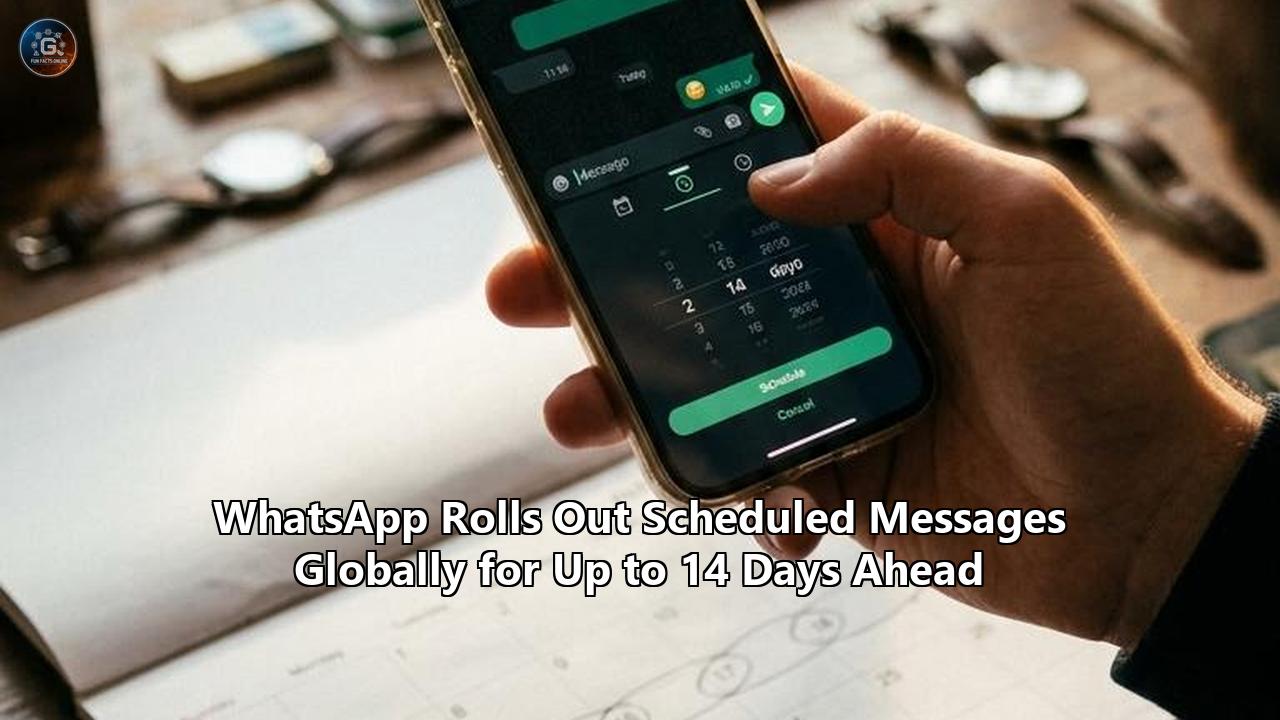
WhatsApp has officially rolled out native scheduled messages to its global user base across Android and iOS, with companion desktop and web clients following closely behind. The update allows users to draft a message and defer its delivery for any interval ranging from 10 minutes to 14 days. Delivered identically to ordinary real-time messages, the scheduled dispatches carry no visual badges, timing indicators, or metadata cues that reveal to the recipient that they were composed days in advance.
The announcement ends years of speculation and resolves one of the platform’s most persistent feature requests. To the end user, the interface is straightforward: long-pressing the send button opens an inline date-and-time selector, queues the message, and makes it manageable via a dedicated roster within the chat information screen. Up to 30 pending messages can be queued per conversation thread.
Beneath this operational simplicity lies a complex cryptographic and infrastructural challenge. Unlike competing platforms that maintain server-side message stores or force the user’s mobile device to wake up in the background to dispatch messages, WhatsApp has executed a hybrid architecture: messages are stored and dispatched from Meta’s central relay servers even if the sender’s phone is completely powered off, has a depleted battery, or sits without network connectivity. Crucially, Meta maintains that every scheduled dispatch remains protected by default end-to-end encryption (E2EE).
Reconciling delayed server-side message distribution with the strict mathematical forward-secrecy properties of the Signal Protocol requires structural trade-offs. The rollout reveals how Meta’s engineering teams chose to resolve cryptographic out-of-order state transitions, group sender-key lifecycles, platform spam vectors, and commercial boundaries separating ordinary consumer chats from the multi-billion-dollar WhatsApp Business Cloud API.
User Action: Long-press 'Send'
       │
       ▼
[Date & Time Picker (T + 10m to T + 14d)]
       │
       ▼
Client advances Ratchet State & seals Ciphertext Envelope
       │
       ▼
Ciphertext + Blind Epoch Delivery Timestamp uploaded via Noise Pipe
       │
       ▼
Meta Relaying Infrastructure (Temporal Queue / Ephemeral Buffer)
       │
       ├───────────────────────────────────────────┐
       ▼                                           ▼
Sender device goes offline / powers down      Cancellation requested before T
       │                                           │
       ▼                                           ▼
Scheduler triggers at T                       Ciphertext purged from Server Buffer
       │
       ▼
Payload dispatched to Recipient Device(s)
       │
       ▼
Recipient decrypts using preserved Ratchet / Skipped-Key Cache
The Cryptographic Challenge: Delayed Delivery in a Zero-Knowledge Environment
Delivering a message hours or weeks into the future is computationally trivial when a service operates a centralized, plaintext cloud model. On platforms where the hosting servers maintain persistent database copies of chat logs and possess the cryptographic keys to read and re-render conversation streams, scheduling a dispatch is nothing more than inserting a database row with an execution timestamp and triggering a cron-style scheduling daemon to deliver it.
WhatsApp does not operate on that architecture. Personal conversations between users have run by default on the Signal Protocol since 2016. Under this scheme, message encryption occurs exclusively on client endpoints using the Double Ratchet Algorithm—a mechanism that merges an asymmetric Diffie-Hellman (DH) ratchet with a symmetric key derivation function (KDF) ratchet. Every individual exchange produces short-lived, single-use keys. Once a message key encrypts a single message payload, it is cryptographically erased from the transmitting device to guarantee forward secrecy. Even if an attacker compromises the physical memory of a sender or recipient device at a later date, they cannot derive past keys or decrypt historic traffic.
This zero-knowledge baseline creates an engineering dilemma when users want to schedule WhatsApp messages while remaining offline at the time of delivery. If a message is composed on a Monday morning to be delivered the following Friday at midnight, an encrypted messaging platform historically faced two choices:
- Client-Side Queuing: The message payload sits encrypted inside the local SQLite database of the sender’s smartphone. At Friday midnight, an internal operating system alarm (such as Android’s AlarmManager or Apple’s background execution daemons) wakes the application, triggers the cryptographic handshake with the network, and transmits the payload.
- Server-Side Plaintext Queuing: The user drafts the message, uploads the plaintext to a central server, and the server encrypts and transmits the message when the timer expires.
Both of these patterns carry severe systemic flaws. The client-side approach breaks immediately if the phone runs out of battery, loses network coverage, or gets aggressively killed by aggressive OS-level memory management—such as Android's Doze mode or iOS background execution limits. The server-side plaintext approach completely strips away end-to-end encryption, violating WhatsApp’s privacy commitments and exposing unsent messages to corporate subpoena, platform breaches, and insider threats.
To deliver server-side reliability without central key access, WhatsApp had to build a deferred-ciphertext relay pipeline.
The Lifecycle of a Deferred Ratchet State
When a user opts to schedule WhatsApp messages, the client application cannot simply pause its execution thread. The message text or media payload must be sealed immediately under the current cryptographic session state established with the recipient.
Sender Device                                Meta Cloud Relay                           Recipient Device
     │                                              │                                          │
     ├─ 1. Generate ephemeral Message Key (K_m)    │                                          │
     ├─ 2. Encrypt Plaintext -> Ciphertext Envelope │                                          │
     ├─ 3. Advance Local Sending KDF Chain          │                                          │
     ├─ 4. Attach delivery header: {send_at: T}    │                                          │
     │                                              │                                          │
     ├──────── 5. Transmit Encrypted Package ──────>│                                          │
     │            (via Noise Pipe protocol)         │                                          │
     │                                              ├─ 6. Verify authentication                │
     │                                              ├─ 7. Insert into Temporal Buffer Queue    │
     │                                              │    (Payload remains opaque blob)        │
     ▼                                              │                                          │
[Device enters Sleep / Offline State]               │                                          │
                                                    │                                          │
                                                    │ (Wait until Epoch Time = T)              │
                                                    │                                          │
                                                    ├─ 8. Pop from Temporal Buffer ───────────>│
                                                    │                                          ├─ 9. Match Ratchet Step
                                                    │                                          ├─ 10. Derive K_m from
                                                    │                                          │     skipped/active keys
                                                    │                                          ├─ 11. Decrypt Plaintext
                                                    │                                          │     to Local Database
                                                    ▼                                          ▼
To execute this, the client takes the composed message, initiates a ratchet step on the local sending chain, and derives an ephemeral message key ($K_m$) via HMAC-based Key Derivation (HKDF). The payload is encrypted using AES-256 in Galois/Counter Mode (AES-GCM), which provides both confidentiality and message authenticity.
Immediately after encrypting, the sender’s client advances its sending chain key. It does not wait for Friday midnight. If it did not advance the chain immediately, the sending chain would freeze. If the user continued to chat in real time with the same recipient between Monday and Friday, the application would risk producing cryptographic collisions, re-using key material, or desynchronizing the ratchet steps.
Once encrypted, the device wraps the resulting ciphertext inside a metadata routing envelope. This envelope includes:
- The recipient’s public account identifier (their phone number hash/JID).
- The intended delivery epoch timestamp (send_at).
- The cryptographic initialization vector and ephemeral public ratchet parameters needed for the recipient's Double Ratchet calculations.
- A client-generated unique schedule identifier used for tracking and deletion commands.
The client then transmits this pre-sealed ciphertext package over an authenticated Noise Protocol channel directly to Meta’s relay infrastructure. Once the server acknowledges receipt, the sender’s phone can be powered off, thrown into airplane mode, or destroyed entirely. The server holds the opaque blob in a specialized temporal buffer queue, blind to its contents, waiting for the epoch clock to strike the designated target second.
The Out-of-Order Ratchet Problem
While pre-encrypting and deferring delivery solves the offline problem, it introduces an acute cryptographic challenge: message reordering across extended time horizons.
The Signal Protocol was engineered for near-synchronous communication. When Alice sends Bob a real-time message, Bob receives it within seconds, advances his receiving ratchet, derives the matching key, decrypts the payload, and deletes the key.
Consider what happens over a 14-day scheduling window:
- On Day 1, Alice schedules Message $M_1$ to be delivered to Bob on Day 14. Her client advances its ratchet to Step 1 and uploads the sealed envelope of $M_1$ to the server buffer.
- Between Day 2 and Day 13, Alice and Bob carry out an active, real-time conversation. They exchange 400 real-time messages ($M_2$ through $M_{401}$).
- With each of those 400 messages, Alice and Bob’s devices continuously perform Diffie-Hellman round-trips and KDF chain advances, moving their active ratchet state hundreds of steps forward.
- On Day 14, the server’s temporal queue pops $M_1$ and transmits it to Bob’s device.
When Bob’s device receives $M_1$, its cryptographic state has long since moved past Step 1. If Bob’s device had simply discarded the cryptographic parameters from Day 1 to preserve forward secrecy, $M_1$ would be mathematically undecryptable, causing a fatal decryption error (commonly surfaced in early cryptographic clients as "Waiting for this message. This may take a while").
ALICE SENDING CHAIN (Day 1)
Chain Key 0 ───► [KDF] ───► Chain Key 1 (Used for M_1: Scheduled for Day 14)
                   │
                   ▼
              [Live Conversation Occurs: Days 2 through 13]
                   │
Chain Key 1 ───► [KDF] ───► Chain Key 2 (M_2) ──► ... ──► Chain Key 401 (M_401)
                   │
                   └────────────────────────────────────────┐
                                                            ▼
BOB RECEIVING CHAIN                                   Bob receives M_2...M_401
                                                      Bob must store Skipped Key for Step 1
                                                      in local encrypted enclave for up to 14 days
                                                            │
Day 14: Server delivers M_1 ────────────────────────────────┘
Bob loads Skipped Key 1 -> Decrypts M_1 -> Immediately overwrites key with zeros
To resolve this, the Signal Protocol includes an algorithm for handling skipped message keys. When a client receives a message associated with a ratchet step that is ahead of its current receiving chain, it derives all intervening message keys, saves them in an internal encrypted table of "skipped keys," and advances its ratchet directly to the new step.
However, WhatsApp's scheduled messages invert this typical race condition. When Alice queues $M_1$ and then sends $M_2$ immediately, Bob receives $M_2$ first. Bob’s client notes that $M_2$ corresponds to Step 2, while his local receiving chain is at Step 0. Bob’s client automatically computes the message key for Step 1, stores that unconsumed message key in a secured local database cache, and processes $M_2$.
For the scheduled message to decrypt successfully on Day 14, Bob's device must retain that single skipped message key in its local encrypted key storage for the entire two-week window.
This creates a forward-secrecy trade-off. If Bob’s physical device were compromised via forensic extraction on Day 10, that unconsumed message key sitting in the skipped-keys table could theoretically be extracted to decrypt $M_1$ if the attacker also intercepted the server’s buffered ciphertext.
To mitigate this attack surface without breaking the user experience, engineers had to place hard constraints on the system:
- The 14-Day Outer Limit: Capping the scheduling window at exactly 14 days prevents infinite accumulation of orphaned skipped keys in client storage.
- The 30-Message In-Flight Quota: Restricting users to 30 pending scheduled messages per conversation prevents a malicious client from intentionally exhausting a target device’s skipped-key memory table. Unbounded skipped-key generation can degrade client performance or induce denial-of-service conditions in the local database.
- Aggressive Key Pruning: If a scheduled message is deleted by the sender prior to transmission, a cancellation envelope instructs the recipient device (if reachable) or the server to release the associated references. Once $M_1$ is finally decrypted on Day 14, its key is overwritten with zeros in Bob's volatile memory and wiped from disk.
Group Chats and the Sender Key Architecture
The engineering complexities amplify significantly when scaling deferred messages from direct one-to-one chats to group conversations. In a private group containing hundreds of participants, pairwise Double Ratchet encryption across all members becomes computationally prohibitive. If Alice were to send an immediate or scheduled message to a group of 1,024 members using pairwise sessions, her device would have to generate 1,024 distinct ciphertexts and upload them all.
Instead, WhatsApp implements the Signal Sender Key Protocol for group communications.
┌────────────────────────────────────────────────────────────────────────┐
│                   ALICE'S SENDER KEY STATE (Group X)                   │
│                                                                        │
│  Symmetric Sender Key (32 bytes) + Signing Key (Curve25519)            │
│  Distributed pairwise to members via Double Ratchet when Alice joined  │
└───────────────────────────────────┬────────────────────────────────────┘
                                    │
                                    ▼
       ┌──────────────────────────────────────────────────────────┐
       │ Day 1: Alice schedules Group Message for Day 10          │
       │ Payload encrypted ONCE with Alice's Group Chain Key      │
       │ Ciphertext uploaded to Meta Relay with recipient roster  │
       │ Roster = [Bob, Carol, Dave]                              │
       └────────────────────────────┬─────────────────────────────┘
                                    │
                 ┌──────────────────┴──────────────────┐
                 │                                     │
                 ▼                                     ▼
      Day 3: Eve joins Group                Day 5: Dave leaves Group
      (Receives new Sender Key              (Server updates membership
       distribution from Alice)              registry for Group X)
                 │                                     │
                 └──────────────────┬──────────────────┘
                                    │
                                    ▼
       ┌──────────────────────────────────────────────────────────┐
       │ Day 10: Meta Relay pops Scheduled Message                │
       │ Evaluates delivery based on Cryptographic Baseline       │
       │                                                          │
       │ • Bob & Carol: Receive envelope -> Successfully decrypt  │
       │ • Dave: Suppressed by server (No longer in group)       │
       │ • Eve: Excluded from delivery list (Cannot decrypt)      │
       └──────────────────────────────────────────────────────────┘
In the Sender Key protocol, each group participant generates an ephemeral 32-byte symmetric Sender Key and an asymmetric signature key pair. When Alice first interacts with the group, her phone encrypts this single Sender Key individually for every group member using their existing pairwise Double Ratchet sessions.
Once this distribution is complete, Alice can broadcast messages efficiently: her device encrypts the message payload once using a symmetric key derived from her Sender Key ratchet, signs the ciphertext with her signing key, and uploads that single encrypted blob to Meta’s server. The server then fans out that exact same ciphertext to every participant in the group.
When Alice uses the native tool to schedule WhatsApp messages to a group chat, this mechanism imposes strict cryptographic boundaries:
1. The Dynamic Membership Paradox
What happens if Alice schedules a group message on Day 1, a new user (Eve) is added to the group on Day 3, and the message fires on Day 10?
Meta confirmed during the feature rollout that scheduled group messages are delivered exclusively to users who were members of the group at the exact time the message was scheduled.
This is not merely a product policy decision; it is a cryptographic constraint. When Alice seals the message on Day 1, the ciphertext is locked using Alice’s Day 1 Sender Key chain. When Eve joins the group on Day 3, protocol specifications mandate that the group's cryptographic epoch resets: Alice’s client generates a fresh Sender Key and distributes it to the new roster to protect backward secrecy.
Eve never receives Alice’s historic Day 1 Sender Key. If the server were to fan out the scheduled message to Eve on Day 10, Eve’s application would be completely incapable of decrypting the ciphertext. Delivering it would produce an unrecoverable protocol error. Thus, the server’s scheduled dispatch engine must cross-reference the recipient list sealed at the time of generation rather than the group membership roster present at the moment of release.
2. Member Removal and Forward Secrecy Leakage
The inverse scenario presents a greater privacy challenge: what if Dave is a member of the group on Day 1 when Alice schedules the message, but Dave is removed from or leaves the group on Day 5, before the message is released on Day 10?
Because Dave was present on Day 1, his phone already possesses the Sender Key material required to decrypt that message. If Meta’s server blindly distributed the message to all Day 1 recipients on Day 10, Dave’s device would intercept the ciphertext over the network and decrypt it—allowing an ex-member to read a communication broadcast days after his departure.
To prevent this data leak, Meta relies on its central transport orchestrators. While the server cannot inspect the contents of the message, it continuously tracks group membership state tables. When the temporal queue triggers the fan-out on Day 10, the server performs a membership verification check against the group registry:
$$\text{Delivery Roster} = \text{Roster}_{T_{\text{scheduled}}} \cap \text{Roster}_{T_{\text{delivery}}}$$
Any user who has left the group or had their account revoked between $T_{\text{scheduled}}$ and $T_{\text{delivery}}$ is dropped from the transport routing manifest. Even though Dave’s device mathematically possesses the key to decrypt the payload, the server refuses to deliver the encrypted envelope to his network connection.
The Network & Server Topology: How Meta Delivers While Your Phone Is Dead
The defining infrastructural difference between this update and previous community workarounds is the complete decoupling of the sender's physical hardware from message execution. Historically, users relied on third-party Android utilities like SKEDit or MacroDroid, or iOS Shortcuts automations, to simulate timed messaging. Those services operated by acquiring invasive OS Accessibility permissions to virtually tap on the screen and hit "Send" at a predetermined time, or by running fragile background polling loops that failed if the device was locked, powered off, or disconnected.
WhatsApp’s implementation shifts the temporal state machine entirely into Meta’s global infrastructure while keeping the payload cryptographically unreadable.
                  ┌──────────────────────────────────────────────┐
                  │          WhatsApp Sender Client             │
                  └──────────────────────┬───────────────────────┘
                                         │
                                         │ (Noise Pipe TLS Handshake)
                                         ▼
                  ┌──────────────────────────────────────────────┐
                  │       WhatsApp Edge Access Tier (Erlang)     │
                  └──────────────────────┬───────────────────────┘
                                         │
                     ┌───────────────────┴───────────────────┐
                     │                                       │
     [Plaintext Media Payload]                     [Ciphertext Envelope]
                     │                                       │
                     ▼                                       ▼
┌────────────────────────────────────────┐ ┌───────────────────────────────────┐
│     Encrypted Media Store (CDN)        │ │   Temporal Storage Subsystem      │
│  • AES-CBC-256 Media Ciphertext        │ │   • Key: {send_at, Chat_ID}       │
│  • Ephemeral Token / Hash Identification│ │   • Val: Encrypted Routing Blob   │
└────────────────────────────────────────┘ │   • Backed by Sharded RocksDB     │
                     │                     └─────────────────┬─────────────────┘
                     │                                       │
                     │ (Media pointer embedded in Envelope)  │
                     └───────────────────┬───────────────────┘
                                         │ (Timer Loop / Epoch Fire)
                                         ▼
                  ┌──────────────────────────────────────────────┐
                  │      Server Dispatch / Fan-Out Engine        │
                  └──────────────────────┬───────────────────────┘
                                         │
                     ┌───────────────────┴───────────────────┐
                     ▼                                       ▼
        [Push Notification Gateway]            [Direct Noise Socket]
             (Apple APNs / FCM)               (If Recipient Online)
                     │                                       │
                     └───────────────────┬───────────────────┘
                                         ▼
                  ┌──────────────────────────────────────────────┐
                  │         Recipient Mobile Device              │
                  │   • Receives Ciphertext Envelope             │
                  │   • Fetches Media from CDN via Token         │
                  │   • Decrypts Media using In-Envelope Key     │
                  │   • Re-renders as standard incoming message  │
                  └──────────────────────────────────────────────┘
The Edge Access Tier and Noise Pipes
When a client establishes a connection with WhatsApp’s server clusters, it bypasses traditional HTTPS/REST overhead. Instead, the application negotiates an optimized session protocol based on the Noise Protocol Framework (specifically Noise Pipes using Curve25519, AES-GCM, and SHA-256). Noise Pipes allow ultra-low-latency, zero-round-trip-time (0-RTT) handshakes when returning to a previously authenticated server.
When a scheduled message is submitted, it travels through this Noise Pipe as an asynchronous task packet targeting WhatsApp’s backend runtime, historically anchored in highly concurrent Erlang and C++ clusters.
The Temporal Storage Subsystem
Inside the data center, the relay server identifies that the payload contains a deferred execution header. It routes the packet to an internal temporal scheduling service.
This scheduling tier behaves as a massively distributed timer wheel. Messages are indexed chronologically by their target dispatch timestamp (send_at) and partitioned across database clusters utilizing specialized RocksDB key-value storage engines.
The server stores:
- The encrypted payload envelope (completely opaque).
- Target recipient routing endpoints.
- A cancellation token unique to that scheduled item.
- An expiration TTL (Time-to-Live).
Because the message contents cannot be analyzed by Meta’s anti-spam or content classification engines while in this state, the server treats it strictly as a binary blob.
Separating Media Blobs from Cryptographic Envelopes
A critical architectural problem arises when a user schedules heavy media, such as a 60-second 4K video or high-resolution photograph. Storing multi-megabyte media files directly inside the real-time temporal queue would lead to rapid database degradation, memory fragmentation, and latency spikes across the messaging pipeline.
To avoid this, WhatsApp uses the same dual-tier media routing framework it employs for instant messaging:
- When Alice attaches a video to a scheduled message, her phone encrypts the media file locally using a randomly generated 32-byte symmetric AES-CBC key.
- The phone uploads this encrypted media ciphertext to Meta's content distribution servers (blobstore). The media sits on the CDN as an inert, encrypted block.
- The cryptographic key required to unlock that media file, along with the file's SHA-256 hash and download URI, is placed inside the small text-based message envelope.
- It is this small metadata envelope that is encrypted using the recipient's Double Ratchet / Sender Key, tagged with the send_at timestamp, and placed into the server’s temporal queue.
When the scheduled timestamp arrives, the server dispatches only the lightweight envelope to Bob. Bob’s phone decrypts the envelope, reads the embedded media keys and URI, pulls the encrypted block from the CDN, decrypts it locally, and presents the video in the conversation thread.
If Alice deletes the scheduled message before its dispatch time, a command drops the envelope from the temporal queue and sends an immediate reclamation call to the CDN to purge the unreferenced media blob.
Cross-Platform Architectural Comparison
The architectural difficulty of building scheduled messages varies dramatically depending on an application’s underlying trust and encryption model. The trade-offs WhatsApp chose become clearer when set beside how Telegram and Signal handle deferred messaging.
| Feature / Architecture Dimension | WhatsApp (2026 Implementation) | Telegram | Signal |
|---|---|---|---|
| Default Encryption Model | End-to-End Encrypted (Signal Protocol) by default | Client-to-Server (Plaintext on MTProto server) in standard chats | End-to-End Encrypted (Signal Protocol) by default |
| Scheduled Storage Location | Server-side temporal queue (Encrypted Ciphertext Blob) | Server-side active database (Plaintext / Central Server Key) | Client-side queue (Local SQLite database on device) |
| Delivery if Sender Phone Off? | Yes (Dispatched directly from server cluster) | Yes (Dispatched directly from server cluster) | No (Device must be awake, online, and functional) |
| Recipient Visibility | Looks identical to normal message (No badges) | Looks identical to normal message | Looks identical to normal message |
| Maximum Scheduling Window | Up to 14 days | Up to 365 days | Typically 1–7 days (OS background execution limits) |
| In-Flight Message Cap | 30 pending messages per chat | Up to 100 scheduled messages per chat | System memory dependent |
| Inline Content/Time Editing | No (Must delete and reschedule) | Yes (Server-side text editing allowed anytime) | No (Local queue recreation required) |
| Group Membership Handling | Cryptographically locked to members at time of scheduling | Delivered to any current member at dispatch time | Client checks group roster at dispatch moment |
Telegram has supported scheduled messages since late 2019. Because standard Telegram chats are not end-to-end encrypted, its servers hold the plain text of every conversation. For Telegram, delaying a message requires only setting a scheduled task in their central cloud architecture. If a user wants to edit the message five minutes before it goes out, the server modifies the string in its database.
Signal, committed to zero-knowledge architecture, introduced message scheduling on its Android client via local queuing. Signal deliberately avoided hosting delayed ciphertext queues on its infrastructure to minimize metadata exposure. As a result, Signal’s scheduling fails if the user’s phone battery dies, if the user enters an area without coverage, or if the operating system shuts down background tasks.
WhatsApp opted for an intermediate path: taking on the architectural cost of running a global, server-side temporal database while maintaining the mathematical protections of end-to-end encryption.
Anti-Abuse Engineering: Rate Limits, Time Floors, and Vector Mitigation
Introducing time-delayed automation to a messaging network with over two billion daily active users creates acute vulnerabilities to systemic abuse. If left unrestricted, bad actors could harness scheduled messaging to orchestrate targeted harassment, automate spam campaigns, or mount denial-of-service assaults on recipient devices.
To protect network health, Meta implemented several behavioral constraints within the protocol:
1. The 10-Minute Minimum Floor
Users cannot schedule a message for two minutes into the future; the interface enforces a strict 10-minute minimum interval.
From a distributed systems perspective, a short scheduling window (such as 30 to 90 seconds) creates race conditions. Due to network latency, clock drift between client hardware and server hyper-accurate atomic clocks, and packet retransmissions over poor mobile connections, a message scheduled for two minutes ahead could arrive at the server edge when its delivery window has already passed.
Furthermore, the 10-minute floor gives users a practical cancellation window. It prevents micro-bursting, where an attacker queues rapid-fire bursts designed to overwhelm a recipient’s device notifications faster than the recipient can block the sender.
2. The 30-Message Per-Chat Quota
The platform sets an absolute limit of 30 pending scheduled messages per conversation.
                                  [Rate Limiter & Quota Gate]
                                               │
                                 Pending Count >= 30 in Chat?
                                               │
                                ┌──────────────┴──────────────┐
                                │                             │
                              (YES)                          (NO)
                                │                             │
                                ▼                             ▼
                    [Reject: Error Code 429]        [Allow: Push to Temporal Queue]
                    Client UI: "Limit Reached"      Server increment: Chat_Queue_Counter
This quota solves two problems:
- Cryptographic Memory Exhaustion: As established in the Double Ratchet analysis, delayed messages force the recipient's phone to cache skipped message keys. If a spammer were allowed to schedule 5,000 discrete messages to a single contact, the target device would be forced to calculate and retain thousands of cryptographic keys in local SQLite tables, which could degrade application performance or exhaust local storage.
- Server Resource Exhaustion: Without a quota, malicious actors could treat WhatsApp’s server-side temporal queue as an arbitrary, free, decentralized storage layer, holding high-resolution media blobs on Meta’s infrastructure for weeks without triggering active chat bandwidth billing.
3. Preserving Spam Reporting Under E2EE
One of WhatsApp's main defenses against bad actors is its user reporting mechanism. When a user reports a contact for abuse or spam, the reporting device automatically decrypts and forwards the most recent five messages of that conversation directly to Meta's human review and automated abuse-detection pipelines.
Because scheduled messages are delivered without special badges or structural distinctions, they enter the recipient’s standard message store. If an abusive actor schedules an offensive message to land at 3:00 AM while their own phone is offline, the recipient’s device can report the message the moment it arrives.
The client unpacks the local decrypted message payload, packages it alongside the sender’s cryptographic signature, and dispatches it to Meta's safety pipelines. The sender’s offline status provides no shield against account suspension or hardware IMEI banning.
The Commercial and Political Tension: The WhatsApp Business Boundary
Beyond cryptography and systems engineering, the introduction of scheduled messages touches on product politics and platform monetization. Meta operates two distinct messaging applications built atop the same protocol: the consumer WhatsApp client and the WhatsApp Business App, alongside the enterprise-grade WhatsApp Business Cloud API.
                     ┌──────────────────────────────────────────┐
                     │          META MESSAGING PLATFORM         │
                     └────────────────────┬─────────────────────┘
                                          │
            ┌─────────────────────────────┴─────────────────────────────┐
            ▼                                                           ▼
┌──────────────────────────────┐                         ┌──────────────────────────────┐
│  Consumer & Small Business   │                         │  WhatsApp Business Cloud API │
│  Native Scheduler            │                         │  Enterprise Platform         │
├──────────────────────────────┤                         ├──────────────────────────────┤
│ • Cost: 100% Free            │                         │ • Cost: Billed Per Template  │
│ • Window: 10m to 14 Days   │                         │ • Window: Unlimited Timeline │
│ • Capacity: Max 30 / Chat  │                         │ • Capacity: Enterprise Scale │
│ • Target: P2P & Micro-Shops  │                         │ • Target: CRM / Mass Comms   │
│ • Architecture: Device E2EE │                         │ • Architecture: Cloud API    │
└──────────────────────────────┘                         └──────────────────────────────┘
For years, small business owners in regions like India, Brazil, and Indonesia—where WhatsApp functions as the primary digital economy infrastructure—relied on awkward workarounds to run time-delayed customer communications. They paid for unregulated third-party Android APKs or invested in costly technical integrations with official Business Solution Providers (BSPs).
The decision to provide native scheduling directly within the standard app gives individual consumers and small shop owners powerful tooling. A bakery owner can now schedule WhatsApp messages on Sunday evening to confirm customer deliveries for Tuesday morning, without paying a third-party software provider.
However, this consumer feature introduced commercial risks inside Meta:
- Cannibalization of Business API Revenues: Meta generates billions of dollars by billing brands per conversation thread initiated via the WhatsApp Business API. If medium-sized businesses could use the free consumer app to automate outbound marketing broadcasts, API adoption could stall.
- The Strategic Compromise: To protect API revenues while satisfying consumer demand, Meta applied product boundaries. The 14-day scheduling cap, the 30-message queue limit, the absence of recurring or automated bulk sending, and the manual composition flow ensure that enterprise CRM workflows cannot run on the consumer client. Organizations running massive automated campaigns still have to use the official paid Business Cloud API.
Regulatory Pressures: The EU Digital Markets Act
The rollout also coincides with regulatory pressure in the European Union under the Digital Markets Act (DMA). Designated as a core platform gatekeeper, Meta is legally required under DMA Article 7 to make WhatsApp interoperable with third-party messaging services.
Interoperability between end-to-end encrypted messaging systems is challenging on basic real-time text exchanges. Introducing proprietary architectural mechanisms—such as server-side encrypted temporal queues with strict 14-day Double Ratchet skipped-key retention requirements—creates new technical friction for third-party networks attempting to interoperate.
If an external messaging client on an open standard like Matrix or RCS bridges into WhatsApp, bridging a scheduled message requires both systems to agree on how to hold deferred cryptographic states without compromising forward secrecy. By deploying this capability globally, Meta establishes its implementation as the functional benchmark that cross-platform interoperability frameworks must accommodate.
Technical Constraints and Product Trade-Offs
To maintain architectural stability and prevent protocol desynchronization, Meta launched the feature with definitive functional boundaries:
1. The Immutability of Scheduled Payloads
Once a message is scheduled and uploaded to the server, it cannot be edited. If a user notices a typographical error or wants to adjust the delivery time, they cannot simply change the text or update the timestamp. They must delete the scheduled item entirely and compose a new one.
This limitation stems from the cryptographic design: the message text is already encrypted with a single-use key derived from a specific ratchet step and sealed inside a signed envelope.
Allowing inline edits would require the client to either:
- Issue a remote command instructing the server to modify an opaque binary payload (which is impossible without the server having the decryption key), or
- Trigger a secondary cryptographic transaction that invalidates the prior ratchet step, generates a new ephemeral key, re-encrypts the text, and updates the server queue.
To prevent protocol errors and edge-case race conditions, WhatsApp's engineers opted for the simpler, more resilient primitive: delete and replace.
┌────────────────────────────────────────────────────────────────────────┐
│                        CANCELLATION WORKFLOW                           │
└────────────────────────────────────────────────────────────────────────┘

Sender Phone                          Meta Server                  Recipient Phone
     │                                     │                              │
     ├─ User taps "Delete Scheduled"       │                              │
     ├─ Generate Cancel Envelope {ID}      │                              │
     │                                     │                              │
     ├────── Post Cancellation Call ──────>│                              │
     │                                     ├─ Match ID in Temporal Queue │
     │                                     ├─ Purge Ciphertext Blob       │
     │                                     ├─ Drop Media Pointer from CDN │
     │                                     │                              │
     ▼                                     ▼                              ▼
[Local queue item removed]        [Queue entry erased]           [Completely unaware;
                                                                  no notification sent]
2. Deletion Without Recipient Artifacts
When a user deletes a standard real-time message after it has been delivered, WhatsApp displays a visible placeholder: "This message was deleted."
With scheduled messages, deleting an item prior to its delivery timestamp leaves zero traces. The server simply removes the ciphertext record from its RocksDB temporal queue. Because the recipient’s device was never notified of the scheduled message in the first place, the placeholder is unnecessary. The cancellation occurs silently in the cloud.
3. Media Bundling Restrictions
While standard WhatsApp chats allow users to select and send up to 100 images or videos simultaneously in a single clustered bubble, scheduled messages are restricted to a single media file per dispatch.
This keeps the deferred payload lightweight. It minimizes the processing time required to upload, encrypt, and buffer compound media descriptors, reducing the risk of client timeouts over unstable mobile connections.
How to Access and Manage Scheduled Messages
The capability is rolling out globally across the latest production builds of WhatsApp for Android and iOS. Because the update relies on activation flags within Meta's server fleet, availability will expand progressively over several weeks.
                 COMPOSING A SCHEDULED MESSAGE
                 ─────────────────────────────
 1. Open Target Conversation (Direct 1:1 or Group Chat)
 2. Type message or attach single photo/video
 3. Long-press the circular 'Send' arrow button
 4. Select desired Date and Time from bottom modal
    (Minimum: Current Time + 10 mins | Maximum: Current Time + 14 days)
 5. Tap 'Schedule' to confirm and upload encrypted envelope

                 MANAGING / CANCELING PENDING QUEUE
                 ──────────────────────────────────
 1. Open the Chat Information Screen (Tap recipient/group header)
 2. Select the 'Scheduled Messages' menu item
 3. Review all pending dispatches associated with that specific thread
 4. Tap the trash icon or overflow menu to Delete
To schedule WhatsApp messages once the feature is active on an account, open any personal or group chat, type a message or select a media item, and long-press the green send arrow. The interface surfaces a date-and-time selector allowing any delivery window from 10 minutes up to 14 days ahead.
Users can review all pending messages queued for a given conversation by navigating to the chat information screen (accessed by tapping the contact or group header) and opening the Scheduled Messages section.
From this panel, upcoming dispatches can be reviewed or deleted before transmission. Senders cannot edit the message text or alter the scheduled time directly; updating a pending item requires deleting the queued entry and creating a new one.
Architectural Trajectories: What to Watch Next
The introduction of native scheduled messages closes a long-standing feature gap between WhatsApp and rivals like Telegram and Signal. More importantly, it demonstrates how a secure messaging platform can offer server-side utility without abandoning end-to-end encryption.
As the system matures, several open technical frontiers remain:
- Cross-Device Queue Synchronization: WhatsApp's multi-device framework relies on App State Sync (an encrypted, distributed key-value store synchronizing preferences and state across paired laptops, tablets, and browsers). Currently, scheduled queues are primarily initiated and held via primary mobile devices. Watching how companion clients manage, view, and invalidate these server-side queues without creating cross-device synchronization locks will be an important metric for multi-device reliability.
- Cryptographic Protocol Evolution (MLS Integration): The broader encrypted messaging ecosystem is evaluating Messaging Layer Security (MLS), an IETF standard that replaces Sender Keys with tree-based key derivation ($O(\log N)$ scalability). If WhatsApp transitions group conversations to MLS to meet European DMA interoperability rules, the temporal scheduling architecture will need to be re-engineered around MLS group epoch proposals rather than frozen Sender Key ratchets.
- In-Flight Ephemeral Modifications: While inline editing is unsupported in this initial release, user demand will likely push Meta’s engineering teams to explore zero-knowledge update mechanisms. Designing a protocol that safely replaces buffered ciphertexts without opening replay-attack vulnerabilities will be the next major iteration for WhatsApp’s cryptographic pipeline.
For now, the platform has rolled out an update that looks like a simple convenience on the surface, but represents a carefully engineered balance of distributed queue reliability and end-to-end cryptographic privacy.
Reference:
- https://wabetainfo.com/whatsapp-launches-scheduled-messages-on-android-and-ios/
- https://www.sammobile.com/news/whatsapp-schedule-messages-advance/
- https://thetechrevolutionist.com/2026/11/whatsapp-scheduled-messages-send-later-14-days.html
- https://www.newswire.lk/2026/11/26/whatsapp-introduces-message-scheduling-feature/
- https://www.infiq.in/glossary/end-to-end-encryption
- https://onclickinnovations.com/blog/how-end-to-end-encryption-works-whatsapp-signal/
- https://fr.scribd.com/presentation/585896676/WhatsApp-End-to-End-Encryption
- https://aicassindra.com/blogs/system_design/whatsapp_architecture_end_to_end.html
- https://medium.com/@ravikumar.makwana/whatsapps-end-to-end-message-encryption-c3b410dbb97f
- https://mlq.ai/news/whatsapp-adds-scheduled-messages-up-to-14-days-ahead-for-groups-and-dms/
- https://www.trykondo.com/blog/whatsapp-send-later
- https://blueticks.co/blog/schedule-whatsapp-messages-iphone-android-without-app
- https://www.quora.com/Can-you-schedule-a-message-in-Signal-Messenger
- https://aboutsignal.com/signal-messenger-user-guide/
- https://www.indiatoday.in/technology/story/whatsapp-scheduled-messages-roll-out-on-ios-and-android-how-to-use-the-feature-3047044-2026-11-26
- https://startuppedia.in/trending/whatsapp-rolls-out-scheduled-messages-feature-kunal-shah-says-be-the-first-one-to-wish-for-their-bdays-now-12842268
- https://wabetainfo.com/whatsapp-launches-scheduled-messages-on-android-and-ios/
- https://www.androidauthority.com/whatsapp-message-scheduling-3739465/