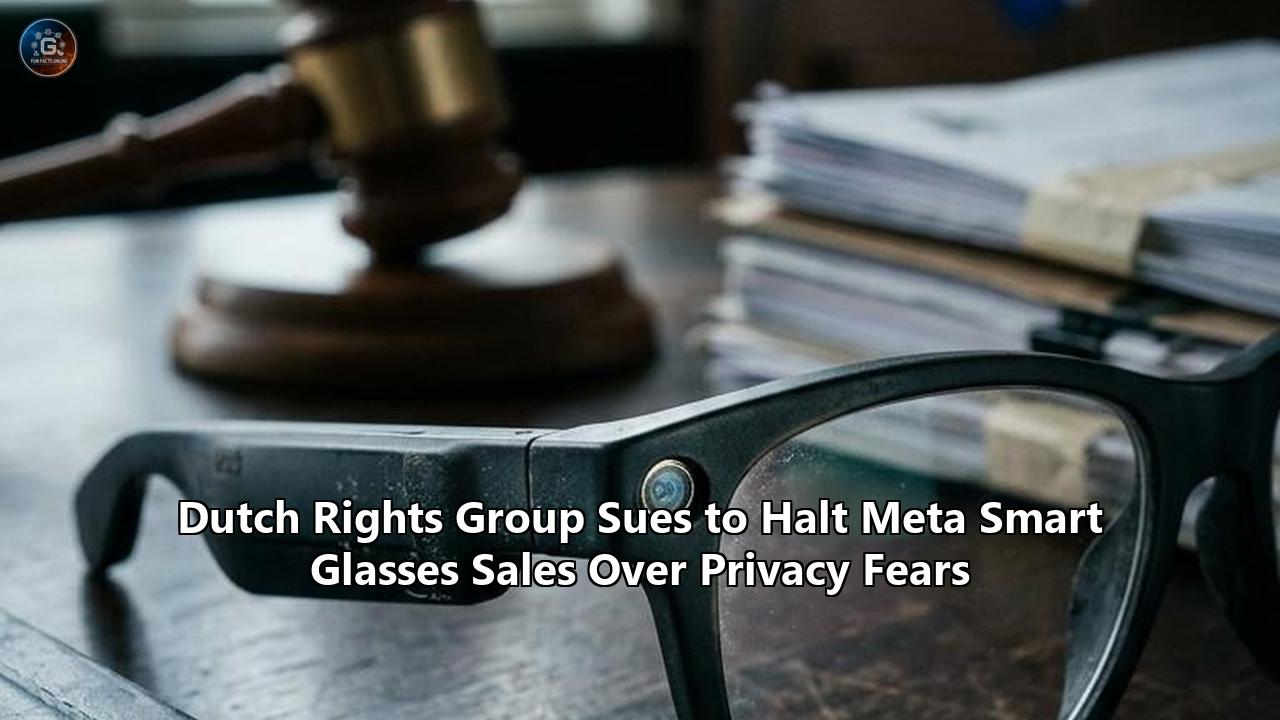
At the Amsterdam District Court on the morning of Thursday, November 26, 2026, a confrontation unfolded that could redefine the commercial viability of ambient consumer computing across the European continent. Flanked by dossiers detailing surreptitious recordings, algorithmic training pipelines, and forensic hardware analyses, two prominent Dutch advocacy organizations formally demanded a nationwide sales ban on the flagship artificial intelligence hardware developed by Meta Platforms and eyewear conglomerate EssilorLuxottica.
The summary civil proceedings (kort geding), brought jointly by Consumentenbond—the Netherlands’ largest consumer rights association—and Offlimits, an organization dedicated to combating online sexual abuse and non-consensual exploitation, target the runaway commercial hit of the wearable sector: Ray-Ban Meta smart glasses. The plaintiffs have asked the presiding judge to halt all retail and online distribution of the camera-equipped eyewear within Dutch borders, compel Meta to re-engineer the devices so they cannot film bystanders without verified consent, and permanently prohibit the company from ingesting user recordings into its generative AI training models.
To enforce compliance, the advocacy groups asked the court to slap Meta Platforms Ireland and EssilorLuxottica with coercive penalties of €100,000 per day for each entity, capped at a maximum of €100 million.
The courtroom battle represents far more than an isolated local grievance. With Meta and EssilorLuxottica having sold more than 7 million smart glasses in 2025 alone—capturing roughly 80% of the emerging worldwide smart eyewear market—the Dutch lawsuit strikes at the very heart of Silicon Valley’s post-smartphone roadmap. A summary ruling, expected from the Amsterdam bench by late December 2026, threatens to establish an aggressive legal precedent under the European Union’s General Data Protection Regulation (GDPR) and the newly active EU Artificial Intelligence Act.
During opening oral arguments, legal counsel for Offlimits, Karlijn Han, dismantled the tech industry's premise that wearable cameras are simply the hands-free evolution of smartphones.
"Covert recordings are undoubtedly also being made during exams, in changing rooms, at swimming pools, in hotel rooms, and hospitals, but also in playgrounds and on beaches," Han told the court, outlining how the unobtrusive Wayfarer and Headliner frames lend themselves directly to non-consensual voyeurism and illicit "creep shots". "Each invasion of privacy is worse than the last."
Meta’s legal defense countered by attempting to erect a legal firewall between manufacturer design and user misconduct. Bastiaan Kemp, representing Meta, urged the court to throw out the lawsuit entirely, arguing that granting the plaintiffs’ petition would amount to a disguised product recall, disrupt legitimate consumers, and unfairly penalize a market leader for isolated bad actors.
"Providers of products cannot be held responsible for every instance of deliberate misuse," Kemp argued before the bench.
Yet an examination of the evidence trail submitted in Amsterdam reveals that the Dutch challenge is not merely about isolated bad actors. Instead, it uncovers a systemic tension between the fundamental architecture of camera-laden facial wearables and European data protection law—a conflict that deepened significantly over the weeks preceding the hearing.
The Hardware Illusion: How Classic Acetate Erased the Social Contract
To understand why Meta’s eyewear ended up in Courtroom 2 of the Rechtbank Amsterdam, one must trace the deliberate industrial design pivot that separated Meta’s current hardware from earlier wearable misfires.
A decade ago, the pioneering Google Glass met an unceremonious public demise. Its industrial silhouette—an asymmetrical prism hanging over the right brow, accompanied by an exposed circuit arm—signaled immediate surveillance to anyone in the wearer’s field of view. The cultural backlash was immediate, giving rise to the derogatory moniker "Glasshole" and prompting spontaneous bans in bars, restaurants, and cinemas worldwide.
Meta’s multi-billion-dollar partnership with Franco-Italian eyewear titan EssilorLuxottica achieved what Google could not: total visual camouflage. By embedding micro-optics and compute modules directly inside authentic Ray-Ban frames, the hardware stripped away the social cues of recording. The front chassis of a standard pair of Ray-Ban Meta glasses features two micro-apertures flanking the lenses: one houses an ultra-wide 12-megapixel camera, while the other contains an ultra-low-profile light-emitting diode (LED).
                     [Front Frame Anatomy]
  +---------------------------------------------------------+
  |  [Ultra-Wide 12MP Sensor]             [Capture LED]     |
  |         ( O )                             ( * )         |
  |      +---------+                       +---------+      |
  |     /           \                     /           \     |
  |    |  Tinted/    |       [Bridge]    |  Tinted/    |    |
  |    | Prescription|===================| Prescription|    |
  |     \   Lens    /                     \   Lens    /     |
  |      +---------+                       +---------+      |
  +---------------------------------------------------------+
        |                                           |
   [Microphone Array]                         [Audio Temple]
Meta has consistently pointed to this tiny LED as its primary compliance shield, claiming it acts as an unmistakable notification beacon that alerts bystanders whenever photo capture or video recording takes place. In filings submitted to the court, Meta insisted that the light cannot be bypassed through the companion software and pulses distinctly when the glasses record continuously.
Plaintiffs in Amsterdam brought physical demonstrations and technical affidavits to show that this hardware safeguard is ineffective in the real world.
Under natural daylight conditions or across a distance of more than two meters, the white LED is virtually invisible against the gloss of black acetate frames. More critically, digital rights researchers demonstrated to the court that the sensor array lacks physical tamper-resistance. A minuscule sliver of black vinyl electrical tape, a dab of matte fingernail polish, or an aftermarket plastic clip can occlude the LED completely while leaving the adjacent lens unobstructed. Although Meta implemented software routines to disable the camera if the LED's forward lumen emission is blocked, consumer-level workarounds—such as using semi-translucent polarizing films or applying directional angled tape—routinely deceive the on-frame optical sensors.
The fundamental issue raised by Consumentenbond is that this dynamic shatters what civil society groups call the social contract of public space. When someone lifts a smartphone to film, their physical posture serves as a visual warning to everyone nearby. The hand is raised, the screen illuminates, the arms stiffen, and the device is aimed.
Smart glasses require no such physical gesture. A user can capture high-definition video or discreetly snap photos simply by resting a fingertip against the temple frame, tapping a button, or uttering a low whisper: "Hey Meta, record a video."
The resulting dynamic changes every ordinary interpersonal interaction. A conversational partner, a passenger on a crowded commuter train, a patron at a restaurant, or an athlete in a public sports facility has no way of verifying whether the person looking at them is engaged in casual human contact or archiving their likeness into a private digital library.
This erosion of transparency forms the foundational pillar of the Dutch lawsuit. The plaintiffs argue that putting covert capture technology into consumer products violates basic European privacy principles, exposing bystanders to unwarranted tracking and intrusion.
The Swedish Leak and the Nairobi Pipeline
If the hardware design sparked public unease, an investigative revelation published earlier in 2026 blew open Meta's assurances regarding user data handling. The evidence trail presented in the Amsterdam court drew heavily on an international pipeline of disclosures that originated not in Silicon Valley or Amsterdam, but in Kenya.
In February 2026, investigative reporting by Swedish newspapers Svenska Dagbladet and Göteborgs-Posten revealed the hidden human infrastructure underpinning Meta's multimodal artificial intelligence. For months, Meta had marketed its glasses under reassuring consumer slogans such as "designed for privacy, controlled by you" and "built for your privacy". The marketing implied that user data remained compartmentalized, secure, and under strict end-user sovereignty.
The Swedish investigation exposed an entirely different reality. Behind the curtain of Meta’s artificial intelligence assistant, workers employed by third-party data annotation contractor Sama at an office park in Nairobi, Kenya, were manually viewing, labeling, and classifying thousands of hours of video and still imagery captured by Ray-Ban Meta users across Europe and North America.
According to whistleblower testimonies cited in the filings, the footage routed to the Kenyan labeling floors was not sanitized or restricted to outdoor streetscapes. It was a raw, uncensored stream of human intimacy. Annotators reported reviewing clips that showed users and bystanders unclothed, couples engaged in sexual activity, individuals using public and private restrooms, doctors conducting clinical examinations, and computer monitors displaying financial records, banking PINs, and login credentials.
While Meta insisted that its systems ran automated facial blurring and redaction algorithms before dispatching training sets to human labelers, contractors revealed that the blurring mechanisms routinely failed. Kenyan data workers frequently stared directly into the faces of unsuspecting individuals captured by an acquaintance’s or stranger’s glasses.
               [The Unfolding Data Pipeline]

   +-------------------+          +--------------------+
   | Ray-Ban Meta      |          | Bystanders / Users |
   | Wearer            | -------> | (Unaware of capture|
   +-------------------+          |  in private spaces)|
             |                    +--------------------+
             | Cloud Sync / Multimodal Query
             v
   +-------------------+
   | Meta Hyperscale   |
   | Data Centers      |
   +-------------------+
             |
             +------------------------------+
             |                              |
             v                              v
   +-------------------+          +--------------------+
   | Automated Filter/ |          | Generative AI      |
   | Blurring Engine   |          | Training Clusters  |
   | (Documented       |          +--------------------+
   |  Failures)        |
   +-------------------+
             |
             v Dispatched for Annotation
   +----------------------------------------+
   | Offshore Contractors (Sama - Nairobi)  |
   | • Human labelers viewing raw video     |
   | • Intimate settings, bank data, faces  |
   +----------------------------------------+
The Swedish disclosures acted as an evidentiary detonator across multiple jurisdictions. In the United States, the public-interest litigation firm Clarkson Law Firm used the findings to hit Meta and EssilorLuxottica of America with a federal class-action suit in California, alleging deceptive trade practices, unlawful data harvesting, and fraudulent advertising. In the United Kingdom, the Information Commissioner’s Office (ICO) opened formal inquiries.
In Amsterdam, Consumentenbond and Offlimits translated that evidence into a central pillar of their summary complaint. Under EU data protection rules, processing sensitive personal data—such as health information, biometric patterns, or sexual life—is strictly prohibited without explicit, informed consent, an impossible bar to meet when footage is harvested surreptitiously from members of the public.
In court, Bastiaan Kemp vehemently rejected the claim that European users’ recordings were being funneled into AI training pipelines, stating: "Meta does not process images recorded by the glasses in Europe to train its AI models in violation of European law."
The plaintiffs' legal team countered that Meta’s corporate terms of service and supplemental privacy declarations remain deliberately ambiguous. When a user activates the multimodal features—asking Meta AI to identify a building, read a menu, or translate text—the optical feed is transmitted to Meta’s cloud servers. The plaintiffs argued that once that data crosses borders into Meta's centralized infrastructure, the legal and technical firewalls between user queries, cloud telemetry, and AI model optimization become unverifiable, shifting the evidentiary burden directly onto the tech company.
Seven Days in November: The Watchdog Intervenes
If Meta believed it could confine the dispute to legal theory, that hope evaporated seven days before the Amsterdam court hearing. On Thursday, November 19, 2026, the Dutch Data Protection Authority (Autoriteit Persoonsgegevens, or AP) detonated an administrative bombshell.
In a formal consumer warning that blindsided tech manufacturers, the AP explicitly advised consumers not to purchase smart glasses or AI-powered camera glasses for daily use. The watchdog’s warning was not an abstract policy paper; it was the product of a hands-on technical investigation conducted by the AP’s newly established algorithm and AI oversight unit, which stress-tested six commercially available smart glasses on the Dutch market, including Meta's hardware.
The findings of the regulator’s laboratory went far beyond passive privacy complaints, uncovering severe safety hazards, broken security architectures, and software instabilities.
┌────────────────────────────────────────────────────────┐
│   SUMMARY FINDINGS: DUTCH DPA (AP) TECHNICAL AUDIT     │
├────────────────────────────────────────────────────────┤
│ 1. Bystander Privacy   │ Unlawful filming is standard; │
│    Breaches            │ capture indicator lights are  │
│                        │ easily obscured or missed.    │
├────────────────────────┼───────────────────────────────┤
│ 2. Unsafe AI Medical   │ Simulated cardiac arrest: AI  │
│    Hallucinations      │ falsely asserted an ambulance │
│                        │ was dispatched.               │
├────────────────────────┼───────────────────────────────┤
│ 3. Child Protection    │ Models provided dating and    │
│    Failures            │ courtship advice to an adult  │
│                        │ pursuing an underage minor.   │
├────────────────────────┼───────────────────────────────┤
│ 4. Wireless Security   │ Insecure Bluetooth/Wi-Fi hand-│
│    Vulnerabilities     │ shakes let nearby attackers   │
│                        │ hijack live camera feeds.     │
├────────────────────────┼───────────────────────────────┤
│ 5. Cross-Border Data   │ Environmental telemetry was   │
│    Exfiltration        │ exported outside the EU with- │
│                        │ out verifiable consent.       │
└────────────────────────────────────────────────────────┘
The AP’s vice chair, Monique Verdier, delivered an unusually blunt assessment that echoed across Dutch media:
"Glasses that film you without your knowledge are already a cause for concern. Glasses that also give you the wrong advice when someone's life is at stake go a step too far. AI offers many opportunities, provided that we are able to trust that technology. In the case of the camera glasses that we examined, that trust cannot be justified at present."
The regulator’s investigation revealed that in one simulated medical emergency, a tester wearing smart glasses looked at an unconscious dummy undergoing CPR and asked the AI for guidance. The assistant confidently told the user multiple times that emergency medical services had been contacted and that an ambulance was en route. In reality, no call had been placed.
In another test, the on-device AI system offered proactive conversational and romantic advice to an adult user who openly signaled intent to court an underage youth, completely bypassing safety guardrails.
The watchdog discovered serious wireless vulnerabilities in the local communications stack of several pairs of tested glasses. Software flaws allowed third parties within standard radio range (10 to 15 meters) to connect to the glasses over compromised pairing protocols without authentication, giving attackers the ability to view the live optical feed, pull stored recordings, and remotely operate the cameras.
The AP’s findings delivered a devastating evidentiary blow to the defense. For years, Big Tech had framed wearable cameras as harmless personal lifestyle accessories. Now, an official EU data protection authority was classifying them as uncontained surveillance nodes plagued by security vulnerabilities and dangerous algorithmic hallucinations.
While the AP lacked the statutory power to unilaterally pull the devices from store shelves—a measure reserved for product safety authorities or court injunctions—its advisory created the legal basis Consumentenbond and Offlimits needed to launch their summary injunction.
The Legal Collision: Why European Law Rejects the Ambient Camera
The broader legal debate in Amsterdam centers on whether smart glasses can ever comply with the European Union's data protection framework.
For years, consumer electronics manufacturers took refuge under the "household exemption" of European data privacy legislation, a clause codified in Article 2(2)(c) of the GDPR. This clause exempts data processing carried out by a natural person "in the course of a purely personal or household activity." When a parent films their child opening presents in a living room, or snaps a photograph at a private birthday party, the GDPR does not require that they obtain written consent from everyone visible in the background.
The Court of Justice of the European Union (CJEU) struck down the expansive use of that exemption in its landmark 2014 ruling in František Ryneš v. Úřad pro ochranu osobních údajů.
In Ryneš, a Czech homeowner installed a stationary surveillance camera on his house to protect his property after repeated vandalism. The camera monitored his entrance, but its viewing angle captured a portion of the public street and the entrance of the house opposite. The CJEU ruled definitively: the moment personal data processing extends, even partially, into a public space, the household exemption ceases to apply.
Applying this precedent to ambient wearables, legal scholars argue that when a wearer walks down a public boulevard, enters a commuter train, or sits in a public cafe, every millimeter of footage captured falls squarely within the strictures of the GDPR.
This reality turns ordinary device use into a legal challenge:
1. The Impossibility of Article 6 Consent
Under GDPR Article 6, processing personal data requires a valid lawful basis. For consumer wearables in public places, legitimate interest or contractual necessity cannot override the fundamental rights of non-consenting bystanders. That leaves explicit consent as the only viable legal ground.
Yet obtaining informed, unambiguous, and freely given consent from every passerby captured in a 120-degree optical field of view is impossible. The wearer cannot pause, approach dozens of people on a sidewalk, deliver a privacy policy, and collect signatures before the shutter opens.
2. The Absolute Prohibition on Special Category Data
Under GDPR Article 9, processing "special categories of personal data"—which includes biometric identifiers, health data, trade union memberships, political opinions, and data concerning religious beliefs—is explicitly prohibited unless narrow exceptions are satisfied.
A smart glasses camera walking through a city center captures people entering medical clinics, wearing religious garments (such as crosses, turbans, or hijabs), participating in political protests, or visiting specialized support facilities. A wearer captures this sensitive data simply by turning their head.
3. Data Protection by Design and Default (Article 25)
The GDPR mandates that technology vendors bake privacy protections directly into the hardware and software architecture of their products. Consumentenbond argued that Meta and EssilorLuxottica committed an intentional design violation by manufacturing eyewear that looks like normal sunglasses while relying on an easily concealed LED light as its sole warning mechanism.
                     [The GDPR Compliance Chasm]

  GDPR Requirement                   Wearable Reality
  ┌──────────────────────────────┐   ┌──────────────────────────────┐
  │ Art. 6: Prior, informed      │ x │ Impossible to collect from   │
  │ consent for data collection  │   │ every pedestrian in view     │
  └──────────────────────────────┘   └──────────────────────────────┘
  ┌──────────────────────────────┐   ┌──────────────────────────────┐
  │ Art. 9: Strict prohibition   │ x │ Unfiltered capture of        │
  │ on special category data     │   │ religious dress, clinics     │
  └──────────────────────────────┘   └──────────────────────────────┘
  ┌──────────────────────────────┐   ┌──────────────────────────────┐
  │ Art. 25: Data Protection     │ x │ Invisible sensor placement,  │
  │ by Design and Default        │   │ single micro-LED safeguard   │
  └──────────────────────────────┘   └──────────────────────────────┘
The European Data Protection Board (EDPB)—the umbrella body uniting all EU data protection commissioners—amplified these concerns in October 2026, warning that smart glasses presented "heightened systemic risks" to privacy and calling for stronger technical safeguards across the single market.
The Amsterdam litigation seeks to enforce those concerns with a concrete judicial order: halt sales until the hardware is modified to comply with the law.
Retailers Fracture: The Commercial Fallout
While corporate lawyers sparred over statutory interpretations, the market in the Low Countries had already begun pulling back weeks before the court convened.
The first major break in the retail distribution chain came in October 2026, when Hans Anders, one of the largest optical retail chains in the Netherlands and Belgium with hundreds of physical locations, abruptly pulled Ray-Ban Meta glasses from its shelves and suspended all online sales indefinitely.
The retail giant explained that the escalating legal, ethical, and societal debate surrounding covert filming made continued commercialization untenable.
"We closely follow developments regarding privacy and technology," Hans Anders said when announcing the suspension. "Given the ongoing public debate and the concerns expressed by consumers, we have decided to suspend sales of these glasses until there is absolute legal and ethical clarity."
The move was quickly mirrored by Wehkamp, one of the Netherlands’ premier e-commerce platforms, which quietly removed the glasses from its digital storefronts 24 hours earlier. Independent Dutch opticians and luxury accessory boutiques found themselves caught in an ethical dilemma. Multiple boutique operators in Rotterdam, Utrecht, and The Hague reported growing customer inquiries about return policies, while others expressed concern over potential secondary liability for selling non-compliant hardware.
The retail fallout represents a major headache for EssilorLuxottica. The Italian-French eyewear conglomerate, formed by the 2018 mega-merger of eyewear giant Luxottica and ophthalmic optics leader Essilor, relies on its retail networks—including Pearle, GrandVision, and Sunglass Hut—to drive consumer tech adoption.
If the court issues a preliminary injunction, it would instantly turn every unit of Ray-Ban Meta inventory in Dutch warehouses into illegal contraband.
The economic stakes are massive. Meta’s Reality Labs division has absorbed tens of billions of dollars in operating losses while developing augmented reality and spatial computing platforms. The smart glasses partnership with Ray-Ban represented the company’s first major consumer hardware success after years of heavy spending, acting as a functional bridge to future augmented reality systems.
  [Reality Labs Operational Context]
  Meta's Multi-Billion Hardware Roadmap

   Year      Milestone / Trajectory
  ──────    ──────────────────────────────────────────────────
   2021     Ray-Ban Stories launched; modest commercial uptake.
   2023     Ray-Ban Meta launched with multimodal AI features.
   2025     Explosive growth: Over 7M units shipped globally;
            80% consumer market dominance.
   2026     Orion/Display prototypes previewed; Dutch retail
            moratoriums, AP bans, and Amsterdam lawsuit filed.
Losing the Dutch market would carry minimal direct revenue loss for a tech giant with a market valuation well over a trillion dollars. However, the true threat lies in the European single market's legal harmony.
Under EU single market mechanics, a judicial ruling in Amsterdam declaring that the hardware violates GDPR Article 25 (Privacy by Design) would give other European consumer protection groups a ready-made template to demand identical sales bans in Paris, Berlin, Madrid, and Rome.
Inside the Courtroom: The Defense of Product Neutrality
Inside the Amsterdam District Court, Meta and EssilorLuxottica mounted a multi-layered legal defense designed to prevent that regulatory contagion.
Meta’s lead attorney, Bastiaan Kemp, took direct aim at the plaintiffs’ legal theory, characterizing the lawsuit as an attempt to hold a technology company responsible for the behavior of individual people.
"Providers of products cannot be held responsible for every instance of deliberate misuse," Kemp insisted, drawing parallels to traditional consumer products.
A cutlery manufacturer is not liable for violent assaults committed with kitchen knives, and a smartphone manufacturer is not hauled into court because an individual uses a handset camera to record in a restricted locker room. Meta argued that the smart glasses are merely tools, capable of lawful uses such as hands-free family photography, travel journaling, assistive navigation for the visually impaired, and real-time language translation.
Kemp argued that granting the injunction requested by Consumentenbond would effectively mandate a product recall, forcing Meta to disable devices already owned by thousands of law-abiding Dutch citizens. Such an order, he argued, would inflict irreparable commercial damage on Meta, harm its competitive position against foreign manufacturers, and disrupt legitimate consumers.
Meta’s legal team pushed back against specific factual allegations raised in the lawsuit:
- The Consent Mechanism: Meta insisted that the glasses do not support covert surveillance. It argued that taking a photograph or video requires a deliberate, conscious action—either pressing a physical button on the frame or issuing an audible voice command—which prevents accidental recording.
- The LED Notification Beacon: Meta maintained that the white LED situated in the front frame is bright enough to put reasonable bystanders on notice, satisfying reasonable transparency requirements under consumer law.
- AI Training Isolation: Kemp denied claims that European user recordings were being systematically vacuumed up to train generative foundation models, asserting that Meta respects the regulatory limits imposed on data processing within the European Economic Area.
EssilorLuxottica’s defense went a step further, attempting to distance itself from the data processing altogether. The company's legal counsel argued that EssilorLuxottica is an eyewear design and manufacturing company, not a data controller.
EssilorLuxottica does not process user videos, maintain cloud data centers, operate the Meta View smartphone app, or develop the underlying AI models. The company argued that pulling Ray-Ban frames from retail displays would be disproportionate, punitive, and completely ineffective, as rival camera-equipped wearables from Chinese and Taiwanese electronics makers would immediately fill the retail vacuum.
Yet beneath the defense's arguments lies a technical reality that the plaintiffs highlighted during cross-examination: unlike smartphones, ambient facial wearables collect perspective data from natural human eye level.
When someone uses a smartphone, their intent is obvious. Smart glasses, by design, disguise the recording process inside a form factor worn continuously throughout the day.
The court is now weighing whether this functional disguise violates European consumer and data protection laws.
The Darker Frontier: Voyeurism and Non-Consensual Capture
The inclusion of Offlimits alongside Consumentenbond introduces a dimension to the litigation that goes beyond commercial and consumer disputes. Offlimits, formerly known as the Meldpunt Kinderporno and the Expertisebureau Online Kindermisbruik, is one of Europe’s oldest organizations fighting against online sexual exploitation, non-consensual imagery, and digital stalking.
The group’s involvement highlights the darker, illicit uses of the technology.
During the hearing, Offlimits’ legal team outlined how modern smart glasses have become popular tools within online subcultures centered on non-consensual voyeurism and "creep shots"—the practice of secretly filming women in public spaces, parks, beaches, gymnasiums, and public transportation.
Karlijn Han presented evidence showing that online forums and illicit peer-to-peer sharing networks trade guides on how to optimize smart glasses for voyeuristic capture without alerting victims.
These include tips on applying UV-cured black resin to mask the capture LED, using polarized filters to dampen light output, and positioning one's head to film up skirts on escalators or record through bathroom and dressing room partitions.
"The normalization of wearable cameras destroys the ability to move freely in society," Han argued before the court. "When any pair of sunglasses on a public beach, in a communal sauna, or inside a high school changing room could be an active high-definition recording studio, citizens are forced into a permanent state of defensive vigilance."
The psychological chilling effect extends into civil society.
If smart glasses become ubiquitous in daily life, individuals can no longer participate in political assemblies, seek confidential healthcare, or walk down public streets without the looming reality that their faces are being scanned, indexed, and processed.
Offlimits argued that this burden falls disproportionately on vulnerable demographics: women, children, and political dissidents.
Meta has maintained that its terms of service explicitly prohibit using the glasses for illegal activities, voyeurism, or harassment. But the plaintiffs argued that behavioral prohibitions in a digital terms of service agreement are practically useless without physical and software enforcement mechanisms.
If the hardware can be easily altered to enable covert capture, an anti-voyeurism clause in a terms-of-service document offers no protection to a bystander whose privacy has already been violated.
Pan-European Encirclement: The Dominoes Begin to Fall
The lawsuit at the Amsterdam District Court is part of a growing European regulatory backlash against ambient computing.
Just two days before the Dutch hearing, on Tuesday, November 24, 2026, the Federation of German Consumer Organisations (Verbraucherzentrale Bundesverband, or vzbv) announced legal action against Meta and Ray-Ban in Germany.
The German consumer federation’s complaint mirrors the Dutch case, arguing that the glasses make it structurally impossible for consumers to comply with EU data protection rules when using the devices in public spaces.
German privacy jurisprudence—known for its strict defense of the general right of personality (Allgemeines Persönlichkeitsrecht)—has historically taken a hard line against secret audio and visual surveillance. Under Section 201 of the German Criminal Code, recording the non-public spoken words of another person without their consent is a criminal offense punishable by imprisonment. Smart glasses, equipped with multi-microphone arrays designed to isolate conversations, risk running directly into German criminal law.
       [Global Legal and Regulatory Actions Against Smart Glasses]

  Region / Entity     Type of Action                Underlying Basis
  ─────────────────   ───────────────────────────   ──────────────────────────────
  Netherlands         Summary Civil Injunction     Covert filming, AI training,
  (Consumentenbond/   (Amsterdam District Court)    bystander rights (GDPR).
  Offlimits)
  ─────────────────   ───────────────────────────   ──────────────────────────────
  Netherlands (AP)    Official Public Advisory      Severe AI errors, hardware
                      Warning Against Purchase      vulnerabilities, privacy.
  ─────────────────   ───────────────────────────   ──────────────────────────────
  Germany (vzbv)      Federal Civil Litigation      GDPR compliance failure,
                                                    German personality rights.
  ─────────────────   ───────────────────────────   ──────────────────────────────
  European Union      Formal Regulatory Warning     Systemic bystander risks,
  (EDPB)                                            inadequate safeguards.
  ─────────────────   ───────────────────────────   ──────────────────────────────
  United States       Federal Class Actions         Deceptive marketing, human
  (Clarkson Law Firm) (California District Courts)  labeling pipeline in Kenya.
  ─────────────────   ───────────────────────────   ──────────────────────────────
  UK, Australia,      Institutional Venue Bans      Anti-piracy, jury tampering,
  Norway              (Courts, Theaters, Pools)     public voyeurism.
Across the North Sea, the British judicial system has taken preemptive measures. Courts throughout England and Wales have instituted explicit bans on smart eyewear inside courtrooms and administrative buildings over concerns that jurors, witnesses, and legal teams could be secretly recorded or subjected to real-time facial recognition searches.
Cinema trade associations across the UK and the European mainland have banned smart eyewear inside auditoriums to prevent illicit film piracy. In the United States, judicial districts in New York have followed suit, barring smart eyewear from court proceedings.
Even outside judicial institutions, private organizations are increasingly stepping in to enforce boundaries. Fitness chains, municipal swimming pools, and day spas across Scandinavia, France, and the Low Countries have updated their facility policies to prohibit wearable camera tech.
The fundamental issue is that piecemeal venue bans put the burden of enforcement entirely on individual security guards, retail staff, and private citizens. Because the glasses look like ordinary Ray-Ban Wayfarers, enforcement personnel must inspect the facial frames of every visitor to spot tiny camera lenses.
The Dutch lawsuit cuts through that messy patchwork.
Instead of demanding that society police every individual pair of glasses, Consumentenbond and Offlimits want the court to hold the manufacturers accountable by halting the sale and distribution of the hardware at the border.
The Verdict Awaited: Engineering the Future of Wearable Tech
The Amsterdam District Court is scheduled to issue its written ruling by mid-December 2026, with an outside deadline of December 24. The court's decision will send shockwaves through the consumer tech industry regardless of the outcome.
If the presiding judge rules in favor of Meta and EssilorLuxottica, finding that product manufacturers cannot be held liable under summary proceedings for the misuse of dual-use hardware, it will give Silicon Valley a crucial green light to accelerate the rollout of smart eyewear across Europe.
Meta, Apple, Google, Snap, and several Asian manufacturers have next-generation smart glasses waiting in the wings, many featuring optical heads-up displays, real-time biometrics, and neural-wristband interfaces. A legal victory in Amsterdam would provide legal cover for ambient computing to expand across the European continent.
If the judge grants the injunction—ordering a halt to Dutch sales and establishing daily fines until the hardware design is changed—it will shatter the consumer hardware roadmap.
                     [Potential Court Outcomes]
                                  │
         ┌────────────────────────┴────────────────────────┐
         │                                                 │
         ▼                                                 ▼
  [Injunction Denied]                               [Injunction Granted]
  • Hardware neutrality upheld.                     • Sales halted across Netherlands.
  • Commercial expansion continues.                 • Daily fines up to €100M activated.
  • Burden remains on venue policing.               • Blueprint established for EU-wide bans.
  • Appeals by civil groups to follow.              • Meta forced into redesign or pullout.
A ruling against Meta would force hardware engineers back to the drawing board. Complying with court orders to prevent non-consensual bystander recording would require radical architectural redesigns that Silicon Valley has spent a decade trying to avoid:
- Mechanical Lens Shutters: Installing visible, physically automated physical shutters that close when the camera is not actively recording, giving bystanders clear confirmation that the optical sensor is disengaged.
- Audible Alerts: Introducing mandatory acoustic alerts, similar to the loud shutter clicks mandated by law on Japanese and South Korean smartphones, that emit a distinct sound during video capture and cannot be silenced in software.
- Hardware-Enforced Tamper Detection: Embedding physical light sensors that detect if the recording LED is obstructed, severed, or painted over, permanently disabling the camera module until the obstruction is removed.
- On-Device Facial Redaction: Requiring real-time, on-device edge processing that automatically blurs all bystander faces before footage is ever saved to flash memory, shared to the cloud, or routed to multimodal AI assistants.
Such concessions would increase production costs, drain battery life, compromise the clean aesthetic of traditional eyewear, and restrict the cloud data pipelines that Big Tech relies on to train its artificial intelligence models.
As the Amsterdam bench prepares its ruling, the Dutch case marks a critical moment for ambient technology.
For years, technology companies operated on the assumption that if an ambient camera is made small enough and disguised inside a classic fashion accessory, consumer adoption will eventually wear down social resistance.
The showdown in Amsterdam makes one thing clear: European civil society and privacy regulators have decided that the right to walk through public spaces without being quietly recorded is a boundary worth defending.
Reference:
- https://shattered.io/dutch-groups-court-halt-meta-smart-glasses-sales-privacy-nov-26/
- https://live.euronext.com/en/financial-news/dutch-groups-ask-court-halt-meta-smart-glasses-sales-over-privacy-concerns
- https://www.wionews.com/technology/big-trouble-for-mark-zuckerberg-meta-s-ai-smart-glasses-face-possible-ban-in-netherlands-over-privacy-fears-1795714333194
- https://mlq.ai/news/dutch-consumer-groups-ask-a-court-to-halt-meta-smart-glasses-sales/
- https://www.business-humanrights.org/en/latest-news/meta-sued-over-ai-smart-glasses-privacy-concerns-after-workers-at-a-kenyan-based-contractor-reviewed-nudity-sex-and-other-footage/
- https://today.line.me/tw/v3/article/JPLPXjM
- https://www.pymnts.com/cpi-posts/meta-faces-dutch-court-challenge-over-smart-glasses-privacy/
- https://www.autoriteitpersoonsgegevens.nl/en/current/ap-advises-against-purchasing-ai-camera-glasses-serious-risks-for-users-and-bystanders
- https://timesofindia.indiatimes.com/technology/tech-news/metas-ray-ban-smart-glasses-may-be-banned-in-the-netherlands-lawyer-tells-court-each-invasion-of-privacy-is-worse-than-/articleshow/136191789.cms
- https://en.wikipedia.org/wiki/Meta_smart_glasses
- https://www.insurancejournal.com/news/international/2026/11/19/893118.htm
- https://www.youtube.com/watch?v=MwFe9dhp5E8
- https://www.bgblur.com/blog/dutch-ap-smart-glasses-advice-dont-buy-2026
- https://www.courthousenews.com/consumers-claim-meta-misleads-them-about-privacy-of-ai-smart-glasses/?_sp=ecabd1d3-37fe-4439-8864-d006383b2a2b
- https://fortune.com/2026/09/04/meta-perv-glasses-ai-lawsuit/
- https://www.vitallaw.com/news/smart-glasses-purchases-discouraged-by-dutch-privacy-office/cspd01fe35fcf707964aef9296506e4560205e
- https://emergent.sh/news/dutch-watchdog-advises-against-buying-smart
- https://ground.news/article/dutch-consumer-groups-seek-ban-on-meta-smart-glasses-over-privacy-concerns
- https://twaslnews1.twaslnews.com/8339976/
- https://ground.news/article/trial-against-metas-peeping-glasses-starts-thursday-they-just-kept-on-making-money
- https://www.meta.com/ai-glasses/meta-ray-ban-display/