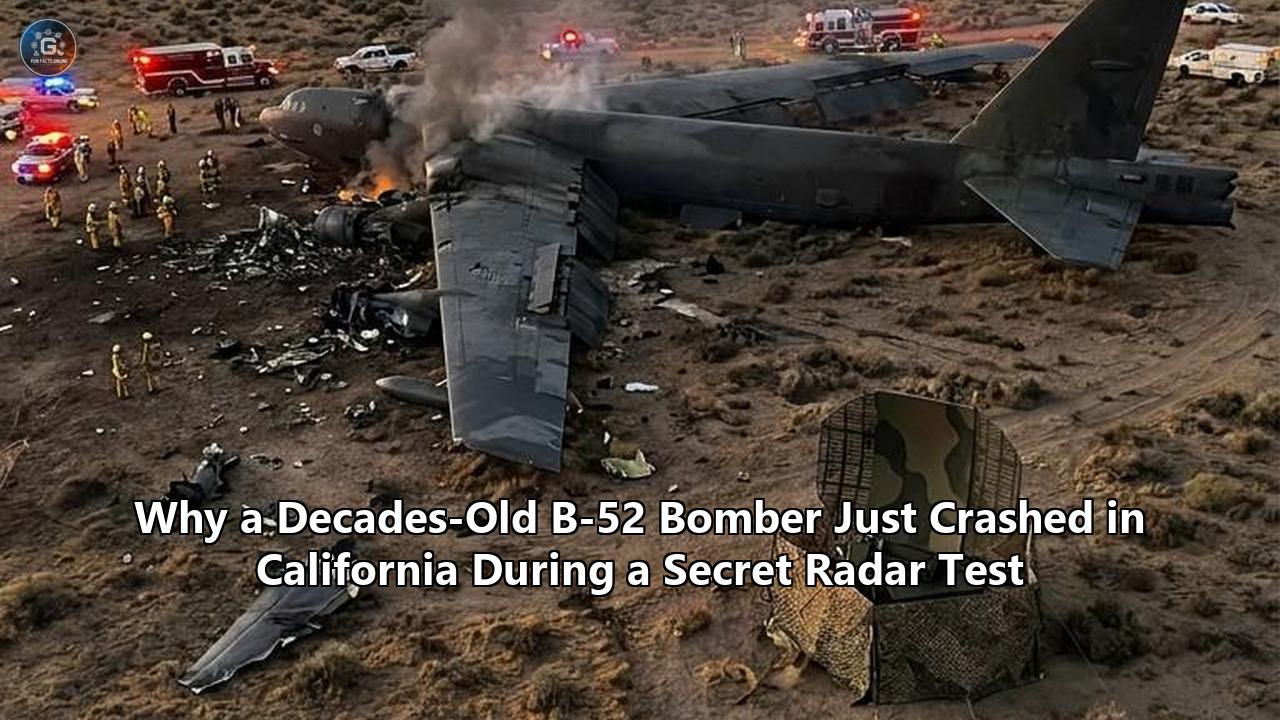
The Telemetry of Tragedy: 112 Seconds Over the Mojave
At 11:20:03 a.m. PDT on Monday, June 15, 2026, the wheels of a Boeing B-52H Stratofortress strategic bomber, serial number 60-0061, left the runway at Edwards Air Force Base in California. The flight was scheduled as a local developmental test sortie under the auspices of the 412th Test Wing. On board was an unusually large complement of eight personnel: a mixed crew of Air Force flight test pilots, flight test engineers, government civilians, and two defense contractors from Boeing. They were evaluating the newly integrated AN/APQ-188 Active Electronically Scanned Array (AESA) radar system.
The flight path, reconstructed from multilateration tracking data collected by local receivers, lasted exactly 112 seconds from the moment of rotation to the final telemetry signal.
| Telemetry Timestamp (PDT) | Altitude (Feet MSL) | Estimated Ground Speed (Knots) | Rate of Climb/Descent (FPM) | Flight Phase / Attitude |
|---|---|---|---|---|
| 11:20:03 | 2,302 (Runway Elevation) | 142 | 0 | Rotation & Takeoff |
| 11:20:18 | 2,850 | 165 | +2,190 | Positive Rate of Climb, gear retraction initiated |
| 11:20:35 | 3,420 | 178 | +1,950 | Climb continuing, initiation of scheduled test pattern |
| 11:20:51 | 3,910 | 172 | +1,840 | Unscheduled sharp right bank initiated |
| 11:21:10 | 3,550 | 158 | -1,080 | Desynchronized thrust profile; steepening bank |
| 11:21:28 | 2,900 | 135 | -2,170 | Near 180-degree turn completed; severe yaw instability |
| 11:21:44 | 1,800 | 122 | -4,120 | Loss of control; plunge toward alternative runway |
| 11:21:55 | 810 (Ground Impact) | 114 | -5,056 | Terminal impact and catastrophic hull rupture |
The flight tracking data captured the final, desperate maneuvers of the aircraft. After reaching a peak altitude of approximately 3,910 feet Mean Sea Level (MSL)—roughly 1,600 feet above the runway surface—the bomber entered an uncommanded, sharp right bank. Telemetry indicates the crew attempted to execute a 180-degree emergency turn to line up with an alternate runway. Instead, the heavy bomber began a rapid, uncontrolled descent, culminating in a terminal plunge.
The rate of descent recorded in the final three seconds of flight was 5,056 feet (1,541 meters) per minute. This is roughly 10 times the normal rate of descent for an aircraft of this class during a standard landing approach.
At 11:21:55 a.m., the aircraft struck the ground within base boundaries, erupting into a massive fireball that sent a plume of black smoke visible across the Antelope Valley.
First responders from the 412th Test Wing's emergency services were dispatched immediately. However, after reviewing the base’s high-definition optical tracking cameras and telemetry recordings, investigators quickly concluded that the B-52 bomber crash California was completely unsurvivable. All eight occupants were killed instantly.
Flight Telemetry Profile (Altitude vs. Time)

  4000 ft +--[Max Alt: 3,910 ft]---\
          |                        \
  3000 ft |                         \---\
          |                              \
  2000 ft |                               \
          |                                \
  1000 ft |                                 \---[Impact: 5,056 FPM]
          +--------------------------------------------------------
          0s      20s      40s      60s      80s     100s     112s
The Flight-Control Mechanics: Deciphering the 5,056-Foot-per-Minute Plunge
Aviation safety experts analyzing the initial telemetry focus heavily on the rapid sequence of events following takeoff. Jeff Guzzetti, a former crash investigator for both the Federal Aviation Administration (FAA) and the National Transportation Safety Board (NTSB), observed that the tight timeline and low altitude point directly to a severe, catastrophic controllability failure.
"The way the B-52 crashed so quickly after takeoff, without establishing a stable climb profile, indicates a primary flight control malfunction or an unmanageable aerodynamic asymmetry," Guzzetti said.
The B-52 Stratofortress is aerodynamically unique and highly complex. Unlike modern strategic aircraft, which rely on fly-by-wire computer systems to coordinate control surface movements, the B-52H utilizes a legacy, cable-driven flight control system for its primary surfaces, supplemented by hydraulic actuators for spoilers and the horizontal stabilizer.
               === B-52H Lateral Control Surfaces ===

      Outboard Spoilers (6 Panels per Wing) - Hydraulic Actuation
      |-------------------|               |-------------------|
      | [ ][ ][ ][ ][ ][ ]|               | [ ][ ][ ][ ][ ][ ]|
      |-------------------|               |-------------------|
    =========================           =========================
   /   Left Wing Surface     \         /   Right Wing Surface    \
  /                           \       /                           \
 /                             \     /                             \

* Primary Roll: Handled almost entirely by spoilers.
* Primary Yaw: Managed by a single, legacy rudder.
* Primary Pitch: Managed by a massive, variable-incidence horizontal stabilizer.
To control roll, the B-52 does not use traditional ailerons during normal flight; instead, it relies on a series of 12 spoiler panels (six on each wing) that rise to disrupt lift on the banking wing. This design choice, while allowing for a highly flexible, high-aspect-ratio wing, introduces potential failure modes:
- Asymmetric Spoiler Deployment: If a mechanical rigging error or hydraulic line rupture causes the spoilers on one wing to deploy while the opposite side remains flush, the aircraft will experience an uncontrollable roll moment. At low airspeed immediately after takeoff, the aerodynamic authority of the rudder is insufficient to counteract such an asymmetry.
- Thrust Asymmetry: The B-52H is powered by eight Pratt & Whitney TF33-P-3/103 turbofan engines, paired in four dual-nacelle pods. A dual-engine failure on one side during the critical rotation phase introduces a massive yawing moment. If the pilot attempts to compensate by banking into the dead engines, a catastrophic aerodynamic stall can occur.
- Stabilizer Runaway: Pitch control is managed via a variable-incidence horizontal stabilizer driven by a hydraulic screw-jack. A mechanical jam or runaway of this system can force the aircraft into an unrecoverable dive or climb, exceeding the physical strength of the pilots to counteract via the manual elevator control columns.
Given the descent rate of 5,056 feet per minute, investigators are scrutinizing the maintenance records of serial 60-0061. The aircraft had just undergone an extensive modification period at Boeing’s San Antonio facility in Texas before arriving at Edwards in December 2025. When heavy military aircraft undergo deep-level depot maintenance, flight control cables must be disconnected, rerouted, and retensioned.
A rigging error—wherein control lines for spoilers or the rudder are cross-routed or tensioned outside of tight technical tolerances—could remain undetected during ground testing but manifest instantly under aerodynamic loads upon takeoff.
The Sixty-Six-Year-Old Airframe: Structural Fatigue and the 32,500-Hour Limit
The lost bomber, B-52H serial number 60-0061, was built in 1960. At the time of its loss on June 15, 2026, the airframe was exactly 66 years old. It is one of only 76 operational B-52Hs remaining in the U.S. Air Force inventory, out of an original run of 744 Stratofortresses built by Boeing between 1952 and 1962.
To understand why the Air Force continues to fly aircraft that are older than the parents of their pilots, one must look at the quantitative structural metrics of the fleet.
Unlike commercial airliners, which accumulate pressurization and depressurization cycles rapidly due to short, frequent routes, strategic bombers are low-cycle, high-endurance platforms. A standard B-52 training or test mission frequently lasts between 8 to 12 hours, meaning the airframe experiences only one takeoff, one pressurization cycle, and one landing for every dozen flight hours logged.
Furthermore, the B-52 was massively overbuilt during the Cold War. Designed to withstand the intense thermal and aerodynamic overpressures of a nearby nuclear blast, its structural components were fabricated with significant design margins.
B-52H Structural Life Limits vs. Fleet Average (Flight Hours)

   0 hrs        10,000       20,000       30,000       40,000
   |------------|------------|------------|------------|----|

   [Original Design Life: 10,000 hrs]
   ==========================

   [Current Fleet Average: 21,000 hrs]
   =================================================

   [Calculated Upper Wing Spar Fatigue Limit: 32,500 - 37,500 hrs]
   ========================================================================
The primary engineering limit on the service life of the B-52 is the structural fatigue of its upper wing skin. Because the wings of the Stratofortress span a massive 185 feet (56.4 meters) and flex up to 22 feet at the tips during flight, the metal alloy of the upper wing surfaces undergoes constant tension and compression.
The Air Force has calculated the absolute economic and structural limit of these upper wing surfaces to be between 32,500 and 37,500 flight hours, depending on the specific flight profile history of each tail number.
As of 2026, the data indicates:
- Average Fleet Age: 64.5 years.
- Average Cumulative Flight Hours per Airframe: Approximately 21,000 hours.
- Annual Accumulation Rate: ~380 flight hours per aircraft.
- Remaining Fatigue Headroom: Minimum of 11,500 hours per airframe, representing roughly 30 years of remaining operational utility at current utilization rates.
However, these statistics do not mean the airframes are immune to the ravages of chronologic age. Metal fatigue, stress corrosion cracking (SCC), and galvanic degradation are cumulative physical processes. In the 1960s, the Air Force was forced to initiate the three-phase "High Stress" program to address fatigue cracks that developed after bombers were re-tasked from high-altitude nuclear cruise profiles to highly turbulent, low-altitude conventional penetration profiles.
Subsequent retrofits, such as the "Pacer Plank" program completed in 1977, stripped and reskinned extensive portions of the wings to extend the bomber’s life.
For a developmental test aircraft like serial 60-0061, the physical demands are significantly higher than for standard operational bombers based at Minot AFB or Barksdale AFB. Test aircraft are frequently subjected to asymmetric loading, high-G banks, rapid deceleration trials, and the addition of heavy, non-standard nose modifications that alter the structural harmonics of the forward fuselage.
The investigation into the B-52 bomber crash California will require metallurgical analysis of the wing spars and fuselage attachment lugs to determine if an undetected micro-crack—possibly masked by the installation of the heavy, new radar assembly—propagated catastrophically during the stress of rotation.
The $48.6 Billion Ledger: Economic Reality of Keeping the B-52 in the Sky
To understand why the Pentagon is willing to tolerate the risks of flying 66-year-old aircraft through developmental testing, one must analyze the balance sheets of the U.S. bomber fleet. The Air Force is currently executing an overarching modernization initiative designed to transition its heavy bomber inventory from a four-platform force (B-1B Lancer, B-2A Spirit, B-52H Stratofortress, and B-21 Raider) to a simplified, two-platform force consisting entirely of the new, stealthy B-21 Raider and the modernized B-52J.
U.S. Bomber Operational Cost Comparison (Per Flight Hour)

  $200,000 +-------------------------------------------------------+
           |                                                       |
  $150,000 |                                    $169,313 (B-2A)    |
           |                                        |
  $100,000 |                                                       |
           |                  $88,300 (B-1B)                       |
   $50,000 |                            $69,708 (B-52H)    |
           |                                        |
           +-------------------------------------------------------+
The operating cost metrics make the strategic rationale clear:
- B-2A Spirit: Costing approximately $169,313 per flight hour to operate, the stealth bomber requires highly specialized, climate-controlled hangars to maintain its radar-absorbent coatings. With only 19 aircraft remaining in service, the fleet lacks economies of scale, leading to exorbitant spare parts fabrication costs.
- B-1B Lancer: Operating at approximately $88,300 per flight hour, the variable-sweep wing Lancer is structurally fatigued after decades of high-tempo operations over Iraq and Afghanistan. Wing pivot mechanisms and aging hydraulic systems yield low mission-capable rates.
- B-52H Stratofortress: Despite its age, the B-52H operates at a highly efficient $69,708 to $88,300 per flight hour, depending on the mission profile. The aircraft utilizes conventional, unpressurized fuselage areas, has no complex low-observable coatings to maintain, and possesses a vast inventory of scavenged and newly manufactured spare parts.
To secure this platform's utility through the year 2050, the Department of Defense has budgeted an estimated $48.6 billion across several interconnected modernization programs:
1. B-52 Commercial Engine Replacement Program (CERP)
- Budget: $15 billion (up from an initial $12.5 billion estimate).
- Objective: Replace the eight legacy Pratt & Whitney TF33 engines on all 76 aircraft with ~650 Rolls-Royce F130 turbofan engines.
- Impact: A projected 30% increase in fuel efficiency, a 20% range extension, and the elimination of depot-level engine overhauls (the F130 engines are designed to remain on the wing for their entire projected life cycle of 20+ years).
- Status: Slipped by three years; Initial Operational Capability (IOC) is now projected for 2033.
2. B-52 Radar Modernization Program (RMP)
- Budget: $3.3 billion (representing a $1 billion cost overrun from baseline estimates).
- Objective: Retrofit the fleet with the Raytheon AN/APQ-188 Active Electronically Scanned Array (AESA) radar, replacing the obsolete 1980s-era mechanically scanned AN/APQ-166.
- Status: Facing schedule slips. Initial operational capability was pushed from 2027 to 2030 due to hardware and software integration failures.
3. Avionics, Communications, and Structural Upgrades
- Budget: ~$30.3 billion remaining.
- Objective: Integration of the AGM-181 Long Range Stand-Off (LRSO) nuclear cruise missile, digital glass cockpits, modern secure satellite communications, and localized wing skin replacements.
These investments will transition the aircraft's designation from B-52H to B-52J. The loss of serial 60-0061 is not merely a financial blow of roughly $94 million (the inflation-adjusted cost of an individual H-model airframe); it represents the destruction of the lead flight-test asset for the entire $3.3 billion Radar Modernization Program.
With only one prototype aircraft modified and delivered to Edwards AFB for active flight testing, this crash completely halts the developmental test matrix, threatening to cascade delays across the entire $48.6 billion modernization effort.
The System Under Test: The AN/APQ-188 AESA Radar and Programmatic Breaches
The core objective of the ill-fated June 15 mission was the evaluation of the Raytheon AN/APQ-188 Active Electronically Scanned Array (AESA) radar. In modern warfare, a strategic bomber operating in contested environments cannot survive or effectively execute its mission with obsolete sensor suites.
The legacy AN/APQ-166 radar, utilizing technology finalized in the mid-1980s, relies on a mechanically steered antenna dish. It is highly vulnerable to modern digital radio frequency memory (DRFM) jamming, lacks multi-target tracking capabilities, and suffers from low mean-time-between-failures (MTBF)—averaging less than 60 hours of operation before requiring physical maintenance.
The new AN/APQ-188 is a derived variant of the AN/APG-79 AESA radar, which has logged hundreds of thousands of operational flight hours on the U.S. Navy’s F/A-18E/F Super Hornet and EA-18G Growler.
AN/APQ-188 Integration Layout (B-52H Nose Profile)

                 +-----------------------------------------+
                 | [Liquid Cooling Unit]                   |
                 | - Dissipates high thermal load of AESA  |
                 +-------------------+---------------------+
                                     | (Coolant Lines)
                                     v
   \======\                  +---------------+
    \      \                 |               |
     \      \                |  AN/APQ-188   |   (Fighter-derived AESA array
      \======\===============>|  AESA Array   |    mounted at downward angle
      /      /               |               |    for ground mapping/targeting)
     /      /                +---------------+
    /      /
   /======/
By transitioning to an AESA system, the B-52J gains several capabilities:
- Simultaneous Multi-Domain Modes: The radar can execute ground-mapping, terrain-following, weather-detection, and target tracking concurrently, without the mechanical delay of steering a physical dish.
- Electronic Warfare (EW) Synergy: The AESA's thousands of individual transmit-receive (TR) modules can focus high-power radio frequency energy to jam enemy air-defense radars, turning the bomber into a potent electronic attack platform.
- Enhanced Stand-Off Targeting: It provides the high-resolution synthetic aperture radar (SAR) imagery required to program target coordinates into precision stand-off munitions, such as the AGM-158 Joint Air-to-Surface Standoff Missile (JASSM-ER), at ranges exceeding 500 miles.
Despite these advantages, the physical and digital integration of a fighter-derived radar into the cavernous, unpressurized nose of a Cold War bomber has proven to be a programmatic nightmare. The program has suffered a series of major delays and cost overruns that triggered a Nunn-McCurdy cost breach.
Under U.S. law, a Nunn-McCurdy breach occurs when the program acquisition unit cost (PAUC) or average procurement unit cost (APUC) increases by 15% or more over its current baseline.
The specific cost escalation metrics for the B-52 Radar Modernization Program are:
- Original 2021 Unit Upgrade Estimate: $30.8 million per aircraft.
- Revised 2024 Unit Upgrade Estimate: $33.9 million per aircraft (a 12.6% jump).
- Peak Cost Escalation (2025 Breach): Over 17% unit cost growth, forcing the Air Force to notify Congress.
- Total Budget Expansion: Pushed the program’s total cost estimate from $2.34 billion to approximately $3.3 billion, a cost jump of nearly $1 billion.
The Government Accountability Office (GAO) and the Pentagon's Director of Operational Test and Evaluation (DOT&E) have identified several technical and integration hurdles that drove these overruns:
- Optical Converter Failures: The RMP utilize two Display and System Sensor Processors (DSSPs) as its core mission computers. During system integration testing, the processor's fiber-optic converter—designed to manage high-speed data communications between sensor arrays and flight deck displays—repeatedly failed, corrupting telemetry streams and cockpit interfaces.
- Thermal Management and Cooling Deficiencies: Unlike the legacy mechanical radar, an AESA radar generates an immense amount of thermal energy. To prevent the TR modules from overheating, Boeing had to design a highly complex, closed-loop liquid-cooling system. This system must work in tandem with engine bleed-air heating loops designed to keep the radar electronics from freezing when flying at cruise altitudes of 45,000 feet. Software defects in the environmental control computer frequently caused these two systems to work against each other, either overheating or freezing the radar arrays during simulation runs.
- Software Maturity Defect Rates: The GAO's 2025 assessment highlighted that the radar software development program had compiled a "higher-than-expected number of defects" in its integration laboratory testing. Because the radar hardware utilizes legacy architectures dating back 20 years, modern software-emulated "digital twins" could not be easily created, forcing engineers to rely on slow, physical laboratory test benches to diagnose code errors.
The decision to proceed with flight testing on serial 60-0061 in late 2025—despite these outstanding software and thermal integration issues—was a calculated risk by the Air Force to prevent the program schedule from slipping even further. The B-52 bomber crash California now introduces an urgent, critical question for the crash board: did a software loop error in the radar's environmental control system command a catastrophic bleed-air valve failure, or did a coolant line rupture, flooding the forward electronics bay and shorting out the primary flight control columns?
A Historic Safety Ledger: Comparing June 15 to Four Decades of Strategic Losses
While flight testing of military aircraft carries inherent risks, the B-52 Stratofortress has maintained an exceptionally strong safety record over its seven decades of service, particularly when compared to other legacy platforms.
The accident on June 15, 2026, represents the deadliest crash involving a B-52 in 44 years. To contextualize this event within the safety parameters of strategic aviation, one must look at the historical data of major B-52 class mishaps over the last several decades:
| Date | Location | Aircraft Tail / Variant | Fatalities | Primary Cause of Mishap |
|---|---|---|---|---|
| June 15, 2026 | Edwards AFB, CA | 60-0061 / B-52H | 8 | Under Investigation (Suspected flight control / system integration failure) |
| May 19, 2016 | Andersen AFB, Guam | 61-0007 / B-52H | 0 | Aborted takeoff due to bird strike; runway overrun and post-crash fire |
| July 21, 2008 | Apra Harbor, Guam | 60-0053 / B-52H | 6 | Aerodynamic stall caused by improper stabilizer trim setting during descent |
| June 24, 1994 | Fairchild AFB, WA | 61-0026 / B-52H | 4 | Pilot error; aggressive low-level maneuvering exceeded safe bank angle limits |
| Feb 3, 1991 | Diego Garcia, Indian Ocean | 59-2593 / B-52G | 3 | Catastrophic electrical system failure and subsequent engine flameouts |
| Dec 16, 1982 | Mather AFB, CA | 57-0148 / B-52G | 9 | Fuel system explosion during touch-and-go training maneuvers |
Analyzing this historical safety ledger reveals several important trends:
- The Crew Size Metric: A standard operational B-52H flies with a crew of five: pilot, co-pilot, radar navigator, navigator, and electronic warfare officer. In both the 1982 Mather AFB crash (9 dead) and the June 15, 2026 crash (8 dead), the aircraft was carrying extra personnel. For the 2026 flight, these extra occupants were specialized flight test engineers and Boeing contractors. Because test flights require real-time monitoring of raw sensor data that cannot be fully transmitted via telemetry, technicians are often required to fly aboard the prototype. This multiplies the potential loss of life when a catastrophic failure occurs.
- The Departure from Operational Norms: Standard operational B-52 flights are exceptionally safe because they are tightly bounded by conservative flight envelopes. However, developmental test flights conducted by the 412th Test Wing deliberately push the aircraft to its limits. Crews intentionally execute high-stress maneuvers, engine shutdowns, rapid climbs, and systems shut-offs to verify safety margins. Consequently, the mishap rate for developmental test wings is historically higher than that of standard operational bombardment wings.
- The Aging System Factor: In older aircraft, "latent defects"—such as hidden corrosion within electrical conduits, hydraulic line embrittlement, and micro-fractures in structural forgings—can remain dormant for years. These issues may only manifest when the airframe is subjected to the unique aerodynamic stresses of a new flight profile or the physical weight of modified equipment.
The Developmental Testing Paradigm: Inside the 412th Test Wing’s Operations
Edwards Air Force Base, situated on a massive 301,000-acre tract in California's Mojave Desert, is the historic heart of the American flight test universe. It was here that Chuck Yeager broke the sound barrier in the Bell X-1 in 1947, and it is where the nation’s newest stealth bomber, the B-21 Raider, completed its inaugural flight in November 2023.
The host unit, the 412th Test Wing, is charged with the complex task of testing and evaluating new aircraft, weapons, avionics, and software before they are cleared for mass production and deployment to the operational fleet.
                 ==================================
                 |       412th Test Wing          |
                 | "Proof by Trial" - Edwards AFB |
                 ==================================
                                 |
        +------------------------+------------------------+
        |                                                 |
        v                                                 v
 [Personnel Footprint]                             [Asset Profile]
 - 5,000+ Active Duty & Civilians           - Avg. 90 Test Aircraft
 - 1,700+ Maintenance Specialists          - 30+ Aircraft Designs
 - 10,000+ Base Support Personnel          - ~7,400 Annual Sorties
To manage this diverse fleet, the 412th Test Wing utilizes a "Combined Test Force" (CTF) organizational structure. The CTF brings together military pilots, civilian flight test engineers, and primary defense contractors into a single unit. This integration is designed to accelerate the development cycle, but it also means that when a prototype crashes, the casualties are distributed across the entire defense enterprise.
Among the eight victims of the B-52 bomber crash California were two Boeing engineers whose primary job was the real-time optimization of the AN/APQ-188’s signal processing software.
The physical environment of Edwards AFB makes it ideal for flight testing, but it also introduces unique stressors:
- The Dry Lakebeds: Edwards features Rogers Dry Lake and Rosamond Dry Lake, which provide over 59 miles of flat, unpaved runways. These natural surfaces have saved dozens of damaged or malfunctioning test aircraft over the last 80 years. However, when a control failure occurs at an altitude of less than 2,000 feet during takeoff, the vast expanse of the lakebeds offers no safety margin; the time to react is measured in seconds.
- Thermal and Altitude Variations: The Mojave Desert experiences extreme temperature swings, often exceeding 100°F (38°C) in June. These high ambient temperatures significantly reduce air density—a phenomenon known as "high density altitude." For a heavy, eight-engine bomber like the B-52, high density altitude dramatically reduces engine thrust and wing lift during the critical takeoff phase, narrowing the margin of safety if an engine fails or a flight control surface malfunctions.
- The Digital Range Infrastructure: The 412th Test Wing operates the Ridley Mission Control Center, which monitors every test flight via hundreds of high-frequency telemetry channels. The Ridley computers capture real-time data on engine temperatures, hydraulic pressures, control surface deflections, and structural stresses. This extensive digital footprint means that although the aircraft was completely destroyed by the post-crash fire, investigators will have access to millions of data points leading up to the exact millisecond of impact.
The Road to B-52J: Projecting Timelines, Risks, and Milestones Post-Crash
The loss of serial 60-0061 at Edwards Air Force Base is far more than a localized tragedy; it is a major bottleneck for the strategic modernization plans of the United States Air Force. The B-52 Radar Modernization Program was already operating on a highly compressed, high-risk schedule after years of software-driven delays and cost overruns.
                === Programmatic Roadblock ===

 [Original RMP Schedule]
   2021 Baseline ---> Dec 2025 Test Bed Arrival ---> Late 2026 Production Decision

 [Current Reality Post-Crash]
   June 15, 2026: Destruction of Lead Prototype (60-0061)
   - Zero active AESA flight test beds remaining in inventory.
   - Six-month crash investigation halts Edwards flightline.
   - Retrofit of successor test bed will require 12 to 18 months.
The primary programmatic risk identified by the Government Accountability Office (GAO) in its weapon systems assessments is the Air Force's highly aggressive "concurrency" strategy. Concurrency is the practice of initiating low-rate initial production (LRIP) of a weapon system before developmental flight testing is complete.
The Air Force had planned to make its first low-rate initial production decision for the Raytheon AESA radar in the fourth quarter of fiscal year 2026—only months after the B-52 bomber crash California.
Under the original timeline:
- December 2025: First modified B-52 arrives at Edwards to begin flight testing.
- Q4 FY2026: First LRIP production contract award.
- 2028–2029: System verification review and final operational test evaluation.
- 2030: Initial Operational Capability (IOC) of the upgraded radar across the fleet.
The GAO warned that this strategy was highly risky, as the production decision would occur roughly two years before system-level flight testing or a system verification review could be completed. If flight testing revealed major structural, aerodynamic, or electromagnetic defects, the Air Force would be forced to pay millions of dollars to retrofit already-manufactured radars.
With the destruction of serial 60-0061, this concurrent strategy is now in jeopardy.
- The Hardware Deficit: The Air Force currently has zero other B-52s equipped with the AN/APQ-188 radar. To resume flight testing, a second B-52H must be pulled from the operational fleet, flown to Boeing’s San Antonio depot, stripped down, and retrofitted with the AESA array, its liquid-cooling loops, and its dual Display and System Sensor Processors. Historically, this modification process requires between 12 and 18 months to execute.
- The Investigation Stand-Down: Col. James Hayes indicated that a formal military accident investigation board (AIB) can take up to six months to complete its work. Until the AIB determines the exact root cause of the crash, the Air Force will likely place a safety hold on any further physical modifications to the B-52 nose structure, effectively freezing the Radar Modernization Program.
- The Delayed Redesignation: The transition to the B-52J configuration is a multi-step process. Under the original roadmap, the bombers would first receive the AESA radar (temporarily designated as B-52I), and then receive the Rolls-Royce F130 engines starting in 2026, culminating in the fully-realized B-52J by 2033. If the radar program experiences a multi-year delay, the Air Force may be forced to alter its integration sequence, installing the new engines on legacy-radar airframes first.
The Long-Term Viability of the B-52 Fleet
The Edwards tragedy forces a fundamental re-evaluation of the limits of aircraft life extension. Can a military organization indefinitely modernize a 1960s-era airframe, or is there a hard thermodynamic and physical limit where the complexity of integrating 21st-century microelectronics, high-output power arrays, and exotic cooling loops onto a legacy platform introduces unmanageable, systemic risks?
For now, the Air Force has no viable alternative. The Northrop Grumman B-21 Raider, while progressing through testing, is an expensive, highly classified stealth platform designed for penetrating high-threat air defense networks. The B-21 is too valuable and its operating costs too high to use as a "truck" for launching long-range cruise missiles in uncontested airspace.
For that mission, the Air Force requires the B-52’s massive 70,000-pound payload capacity and long range.
The investigation into the B-52 bomber crash California will yield critical engineering data in the months ahead. Whether the cause is determined to be a mechanical failure, a software defect, or a structural fatigue anomaly, the outcomes will reshape the future of American strategic airpower.
The cost of this "Proof by Trial" was tragically high: eight human lives and the loss of a vital national defense asset. The challenge now facing the U.S. Air Force is how to learn from this disaster and find a safe, reliable path to keep its aging fleet flying through the mid-21st century.
Reference:
- https://www.aerospacetestinginternational.com/news/b-52-crashes-at-edwards-killing-eight-during-radar-test-flight.html
- https://www.cbsnews.com/losangeles/news/us-air-force-b-52-crashes-edwards-air-force-base/
- https://www.pbs.org/newshour/nation/b-52-on-test-flight-plunged-at-nearly-a-mile-a-minute-before-crashing-early-data-shows
- https://www.theguardian.com/us-news/2026/jun/16/us-air-force-b52-bomber-crash
- https://www.theguardian.com/us-news/2026/jun/15/b52-bomber-crash-california-military-base
- https://www.military.com/two-military-aircraft-crashes-reported-within-24-hours
- https://www.freepressjournal.in/world/us-air-force-b-52-stratofortress-bomber-crashes-during-test-mission-in-california-8-killed-video
- https://airport-data.com/aircraft/60-0061
- https://www.airdatanews.com/b-52-bomber-testing-new-aesa-radar-crashes-at-edwards-air-force-base/
- https://en.wikipedia.org/wiki/2026_Edwards_Air_Force_Base_B-52_crash
- https://groups.google.com/g/soarabq/c/NsbtW1N84d0
- https://www.reddit.com/r/WarCollege/comments/6wn0n0/on_structural_and_metal_fatigue_in_the_b52/
- https://www.quora.com/Why-do-B-52-bombers-have-fewer-flying-hours-compared-to-commercial-jets-and-how-does-this-affect-their-longevity
- https://aviation.stackexchange.com/questions/78369/what-is-the-life-limit-due-to-metal-fatigue-in-large-bombers
- https://en.wikipedia.org/wiki/Boeing_B-52_Stratofortress
- https://www.newsweek.com/b52-crash-edwards-afb-stratofortress-california-air-force-12075664
- https://thedefensewatch.com/aerospace-aviation/us-air-force-faces-critical-test-fleet-loss-as-b-52-bomber-crashes-during-edwards-mission/
- https://breakingdefense.com/2026/05/b-52-modernization-stabilized-after-cost-spikes-schedule-delays-air-force-official-says/
- https://www.reddit.com/r/AviationHistory/comments/1mr0xj2/did_you_know_the_b52h_cost_per_flying_hour_is/
- https://theaviationgeekclub.com/did-you-know-the-b-52h-cost-per-flying-hour-is-69708-compared-with-169313-for-the-b-2a-the-reasons-why-the-b-52-will-serve-until-at-least-2050/
- https://migflug.com/jetflights/b-52-stratofortress-70-years-new-engines-rolls-royce-f130-b-52j-100-years/
- https://www.airandspaceforces.com/gao-b-52j-initial-operational-capability-three-year-delay/
- https://theaviationist.com/2025/12/11/b-52-aesa-radar-arrives-edwards-afb/
- https://boeing.mediaroom.com/news-releases-statements?item=131626
- https://www.forbes.com/sites/petersuciu/2025/12/16/first-cold-war-era-b-52-upgraded-with-21st-century-radar-system/
- https://www.youtube.com/watch?v=QPVEtm5Mk2Q
- https://www.twz.com/air/this-is-what-the-b-52s-new-radar-looks-like
- https://simpleflying.com/b-52j-bomber-nightmare-usaf-2025/
- https://militarywatchmagazine.com/article/b52-upgrade-cost-overruns-cuts
- https://www.twz.com/air/b-52-radar-upgrade-alternatives-info-sought-by-air-force
- https://nationalsecurityjournal.org/bomber-bottleneck-radar-woes-could-ground-the-b-52j-upgrade/
- https://www.aerospacetestinginternational.com/news/b-52-crashes-at-edwards-killing-eight-during-radar-test-flight.html
- https://simpleflying.com/412th-test-wing-edwards-air-force-base/
- https://en.wikipedia.org/wiki/412th_Test_Wing