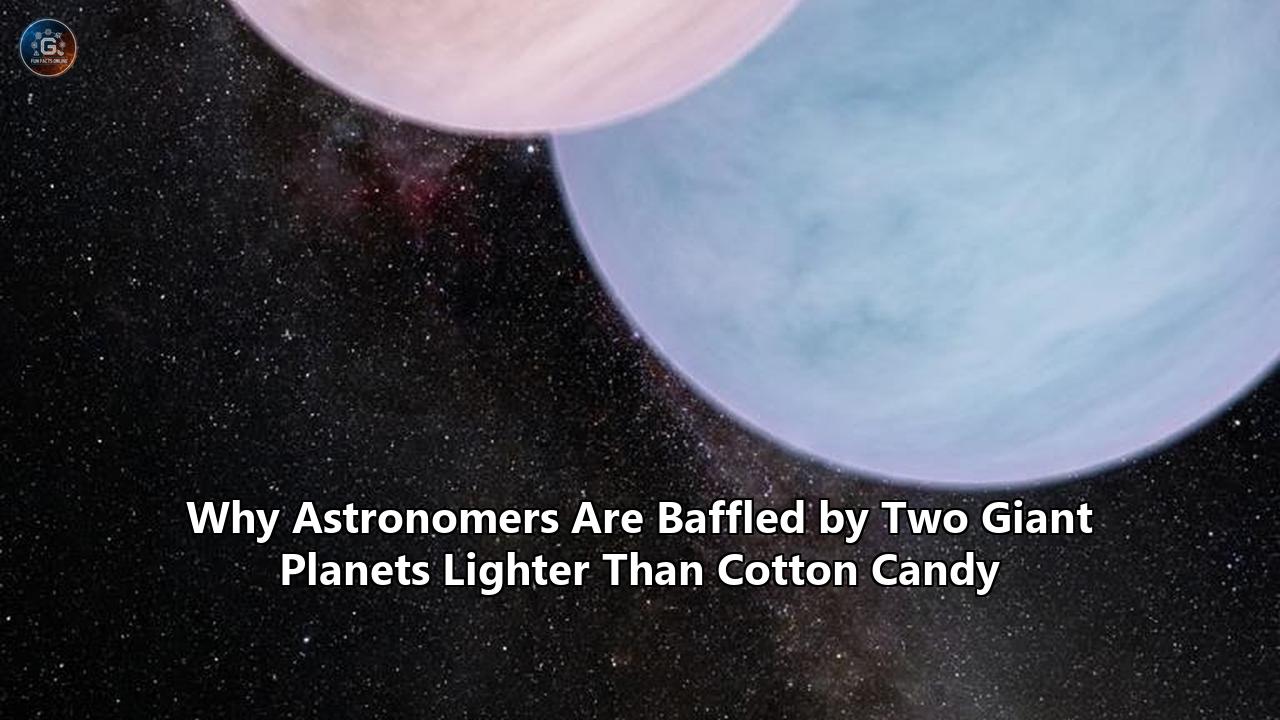
The discovery of two massive, fluffy worlds in a single stellar system has forced astrophysicists to reconsider their most basic assumptions about how gas giants form and evolve. Orbiting a bright dwarf star designated TOI-791, located approximately 1,110 light-years away in the southern constellation Volans (the Flying Fish), these two newly confirmed exoplanets—TOI-791 b and TOI-791 c—possess average densities lower than that of spun sugar.
Led by Dr. Georgina Dransfield of the University of Oxford, an international team of astronomers published their findings in the Monthly Notices of the Royal Astronomical Society, detailing a system that is as mechanically precise as it is physically confounding. TOI-791 b and TOI-791 c are roughly the size of Jupiter, yet they hold only a tiny fraction of its mass. While Jupiter has an average density of $1.33\text{ g/cm}^3$, the density of TOI-791 b is a mere $0.038\text{ g/cm}^3$, and its sibling TOI-791 c measures just $0.047\text{ g/cm}^3$. Standard cotton candy, by comparison, typically sits at about $0.05\text{ g/cm}^3$.
These so-called cotton candy planets—or "super-puffs"—are among the rarest objects in the known universe. Out of nearly 6,300 exoplanets confirmed by NASA and international space agencies, fewer than 40 fit this ultra-low-density profile, and finding two orbiting the same star is an exceptionally rare occurrence. The existence of these worlds is a profound scientific puzzle: under classical models of planetary formation, planets with so little mass should not be able to gather or retain such enormous, bloated atmospheres. Instead, they should either fail to grow into gas giants at all, or their tenuous gaseous envelopes should be rapidly stripped away by the stellar winds of their host stars.
+-----------------------------------------------------------------------------------+
|                        DENSITY COMPARISON AT A GLANCE                             |
+----------------------+--------------------------+---------------------------------+
| Object / Planet      | Density (g/cm³)          | Scale Relative to TOI-791 b     |
+----------------------+--------------------------+---------------------------------+
| Earth                | 5.51                     | ~145x denser                    |
| Jupiter              | 1.33                     | ~35x denser                     |
| Water                | 1.00                     | ~26x denser                     |
| Saturn               | 0.69                     | ~18x denser                     |
| Shaving Foam (fresh) | ~0.06                    | ~1.6x denser                    |
| Cotton Candy         | ~0.05                    | ~1.3x denser                    |
| TOI-791 c            | 0.047                    | ~1.2x denser                    |
| TOI-791 b            | 0.038                    | 1.0x (Baseline)                 |
+----------------------+--------------------------+---------------------------------+
The confirmation of the TOI-791 system has triggered a competitive debate among astrophysicists, pitting different observational techniques, planetary structural models, and evolutionary theories against one another. Some astronomers argue that these planets are genuine gas giants with minuscule solid cores and colossal hydrogen-helium envelopes. Others contend that they are optical illusions, suggesting the calculated volumes are artificially inflated by high-altitude smog layers or vast, tilted ring systems. Understanding which of these competing explanations is correct will tell us not only how these extreme anomalies came to be, but how our own solar system emerged from the primordial dust of a newborn Sun.
The Physics of Featherweights: Breaking Down the Numbers
To appreciate why the TOI-791 system is so troubling to astronomers, one must examine the physical dimensions of these worlds. Under standard gravitational physics, density is a straightforward calculation: mass divided by volume. However, in exoplanet science, measuring these two variables requires two entirely different sets of observations, both of which are pushed to their absolute technological limits when applied to super-puff planets.
TOI-791 b: The Whisper-Weight Giant
The inner planet, TOI-791 b, has a radius equivalent to $0.993 \pm 0.033$ Jupiter radii ($R_{\text{Jup}}$), making it essentially identical in physical size to the largest planet in our solar system. Yet, its mass is estimated to be just 3.0% of Jupiter’s mass ($M_{\text{Jup}}$), which translates to roughly 9.5 Earth masses ($M_{\oplus}$).
If you were to place TOI-791 b in a cosmic-sized bathtub, it would not only float—it would ride high on the surface like an empty plastic bottle. Its bulk density of $0.038\text{ g/cm}^3$ makes it lighter than almost any solid or liquid material found in daily life. Dransfield described the physical reality of the planet as "comparable to a nice blob of shaving foam, fresh from the can."
TOI-791 c: The Bloated Sibling
The outer planet, TOI-791 c, is even larger, with a radius of $1.155 \pm 0.040 R_{\text{Jup}}$—significantly wider than Jupiter. Despite this grand scale, its mass is a mere 5.9% of Jupiter’s, or about 18.8 Earth masses. This yields a density of $0.047\text{ g/cm}^3$, placing it just under the density threshold of standard carnival cotton candy.
   TOI-791 b                                    TOI-791 c
   [Radius: 0.993 Jupiter]                      [Radius: 1.155 Jupiter]
   [Mass: 3.0% Jupiter]                         [Mass: 5.9% Jupiter]
   [Density: 0.038 g/cm³]                       [Density: 0.047 g/cm³]

               O=================================O
               |      Host Star: TOI-791         |
               |      Type: F7 Dwarf             |
               |      Distance: 1,110 lt-years   |
               O=================================O
                       /                 \
                      /                   \
          139-day orbit                   232-day orbit
                    /                       \
             [TOI-791 b]                 [TOI-791 c]
These dimensions present a stark departure from the planets in our solar system. Saturn, our fluffiest planet, has a density of $0.69\text{ g/cm}^3$, which is roughly 18 times denser than TOI-791 b. Earth, composed primarily of iron and silicate rock, has a bulk density of $5.51\text{ g/cm}^3$, making it roughly 145 times denser than the inner world of the TOI-791 system.
The physical structure implied by these figures is bizarre. If these planets are indeed spherical gas spheres, their solid cores must be incredibly small. For a planet of Jupiter’s size to weigh so little, more than 80% to 90% of its total mass must consist of highly extended hydrogen and helium gas. This means that the solid, rocky-metal core at the center of each planet can be no more than a few times the mass of Earth. The remaining volume is occupied by a massive, bloated atmospheric envelope extending tens of thousands of kilometers into space—a structure that challenges the laws of hydrodynamic equilibrium.
TTVs vs. Radial Velocity: How to Weigh a Cosmic Ghost
To understand why astronomers are so confident in these impossible numbers, one must analyze the competing technologies used to measure exoplanetary masses. For decades, the gold standard of exoplanet characterization has been the Radial Velocity (RV) method. Also known as the "wobble" method, RV uses high-precision spectrographs to measure the subtle Doppler shift in a star’s light as it is pulled back and forth by the gravity of an orbiting planet.
However, when applied to cotton candy planets, the Radial Velocity method faces a severe technological bottleneck:
- The Signal-to-Noise Problem: Because super-puffs have very low masses, their gravitational tug on their host stars is incredibly weak. TOI-791 is an F7-type dwarf star, which is larger, hotter, and more active than our Sun. F7 stars exhibit significant stellar "jitter"—pulsations, convective bubbling, and starspots that shift the stellar spectrum and create noise.
- The Sensitivity Limit: The radial velocity signal produced by a 9.5-Earth-mass planet on a 139-day orbit around an F7 star is mere centimeters per second. This is far below the detection threshold of even the world's most advanced spectrographs, such as ESPRESSO on the Very Large Telescope or HARPS-N.
To overcome this limitation, Dransfield’s team bypassed the star entirely, relying instead on Transit Timing Variations (TTVs). This technique relies on the gravitational interactions between the planets themselves.
               [PLANET B] --->                 <--- [PLANET C]
                       \                         /
                        \                       /
                         \  Gravitational Tug  /
                          *-------------------*
In a single-planet system, a planet orbits its star with clockwork regularity. If its orbital period is 139 days, it will pass in front of its star—transiting—exactly every 139 days, down to the second. However, in a multi-planet system, the planets gravitationally pull on each other as they pass.
When the inner planet, TOI-791 b, approaches the outer planet, TOI-791 c, the gravitational attraction pulls the inner planet forward, causing it to transit slightly earlier than expected. After it passes, the gravitational drag pulls it backward, causing the next transit to occur slightly late. By observing these tiny transit timing variations over several years, astronomers can mathematically model the system’s dynamics. The magnitude of the timing shifts is directly proportional to the masses of the planets.
For the TOI-791 system, the TTV signal is dramatically amplified by a rare gravitational lock known as a 5:3 mean-motion resonance. For every five orbits completed by TOI-791 b, TOI-791 c completes almost exactly three. This means the planets repeatedly line up in the same orbital configurations, delivering regular, synchronized gravitational kicks to one another. This resonant amplification created a clear, measurable TTV signal that allowed Dransfield’s team to calculate the precise masses of these wispy worlds, bypassing the noisy stellar interference of the host star.
Antarctica's 11-Hour Eye: How ASTEP and TESS Cracked the Case
The detection of these long-period, low-density planets represents a monumental triumph of observational coordination, combining space-based assets with one of the most remote astronomical outposts on Earth.
The primary detection of the planets was initiated by NASA’s Transiting Exoplanet Survey Satellite (TESS). Launched in 2018, TESS monitors large sectors of the sky, looking for the periodic dimming of stars as planets transit in front of them. However, TESS has a major operational constraint: it typically observes a given sector of the sky for only 27 days before moving on.
Because TOI-791 b and TOI-791 c have exceptionally long orbital periods for transiting planets—139 days and 232 days, respectively—TESS could only capture a fraction of their transits during its standard observing runs. It required seven years of TESS operations, yielding a total of 1,122 days of cumulative data on the system, to build a reliable orbital profile. The initial candidates were not flagged by automated algorithms but by human eyes: volunteers participating in the Planet Hunters TESS citizen-science project flagged candidate b in 2019 and candidate c in 2023.
+-----------------------------------------------------------------------------------+
|                        TESS vs. ASTEP: OBSERVATIONAL TRADEOFFS                    |
+----------------------+--------------------------+---------------------------------+
| Metric               | NASA's TESS Space Tel.   | ASTEP Ground Telescope (Ant.)   |
+----------------------+--------------------------+---------------------------------+
| Location             | High Earth Orbit         | Concordia Station, Dome C       |
| Sky Coverage         | Wide-field (All-Sky)     | Targeted (Southern Sky)         |
| Uninterrupted Window | Max 27 days per sector   | 3+ months of polar night        |
| Atmospheric Jitter   | Zero (vacuum of space)   | Minimal (stable polar air)      |
| Diurnal Cycle        | None                     | None (during Antarctic winter)  |
| Primary Value        | Initial discovery        | Capturing ultra-long transits   |
+----------------------+--------------------------+---------------------------------+
Once the candidates were flagged, astronomers faced another hurdle: verifying the precise duration and shape of the transits. Because the planets orbit far from their star, their transit durations are exceptionally long, lasting more than 11 hours.
For a standard ground-based observatory in Chile, Hawaii, or Europe, an 11-hour transit is nearly impossible to observe in its entirety. The Earth's rotation dictates that a star will rise, cross the sky, and set within a window that rarely allows for 11 continuous hours of nighttime viewing. If the transit begins after dusk, the sun will rise before it finishes, leaving astronomers with an incomplete light curve that introduces significant uncertainties into the calculated radius.
To solve this problem, the team utilized the Antarctic Search for Transiting ExoPlanets (ASTEP) telescope. Located at Concordia Station on the high Antarctic plateau of Dome C, ASTEP is a specialized 40 cm telescope operated jointly by researchers from the Université Côte d'Azur, the Observatoire de la Côte d'Azur, and international collaborators.
                                    [ ASTEP ]
                             Concordia Station, Dome C
                           _.-'''''''-._
                         .'             '.
                        /                 \
                       |   NO SUNRISE      |  ==> 3 Months of Continuous
                       |   FOR MONTHS      |      Uninterrupted Polar Night
                        \                 /
                         '.             .'
                           '-........'-'
Dome C is widely considered one of the best astronomical sites on Earth. Sitting at an altitude of 3,233 meters, the air is extremely cold, exceptionally dry, and remarkably still, minimizing atmospheric distortion. More importantly, during the southern hemisphere's winter, Concordia Station experiences months of continuous, uninterrupted polar night.
This continuous darkness allowed ASTEP to track the long-period transits of TOI-791 b and c from start to finish in a single, uninterrupted observing run. Prof. Amaury Triaud of the University of Birmingham, the UK’s Principal Investigator for ASTEP, emphasized the telescope’s unique contribution: "Being able to use a telescope in Antarctica, leveraging its incredibly long nights and optimal astronomical conditions, enables to collect data like no other telescope on Earth." The resulting light curves provided the precise transit depths and timings necessary to confirm the planets' exceptionally low densities.
The Core Accretion Paradox: Why Cotton Candy Planets Shouldn't Exist
The physical existence of TOI-791 b and c strikes at the very heart of the core accretion model, the leading theory of planet formation. Developed over decades to explain our solar system, core accretion describes a two-step process:
- The Solid Phase: Within the gas-rich protoplanetary disk of dust and gas surrounding a newborn star, microscopic dust grains collide and stick together. Over millions of years, these grains grow into pebbles, then planetesimals, and finally into solid, rocky-metal cores.
- The Gas Phase: Once a solid core grows large enough, its gravity begins to draw in hydrogen and helium gas from the surrounding disk, forming an atmosphere.
According to classical physics, there is a strict thermodynamic threshold in this process known as the critical core mass:
$$\text{Critical Core Mass} \approx 10 M_{\oplus}$$
If a planetary core is smaller than 10 Earth masses, its gravitational pull is too weak to overcome the thermal pressure of the surrounding gas. The gas remains hot, expanded, and in radiative-convective equilibrium. The planet can only retain a relatively modest atmosphere, representing a tiny fraction of its total mass—much like Earth, Venus, or even Uranus and Neptune, whose gas envelopes make up less than 15% of their total mass.
However, if a core reaches or exceeds the 10-Earth-mass threshold, the gas pressure can no more resist gravity. The gas in the inner atmosphere begins to cool, compress, and collapse onto the core. This collapse creates a massive pocket of low pressure that draws in more gas from the disk. This triggers a runaway process: the planet rapidly accretes gas, ballooning into a high-mass gas giant like Jupiter (which has a core of roughly 10–20 Earth masses but a total mass of 318 Earth masses).
                     CLASSICAL CORE ACCRETION MODEL

  [ Core < 10 Earth Masses ]            [ Core > 10 Earth Masses ]
             |                                      |
   Tenuous, stable gas layer              Runaway Gas Accretion Triggered
             |                                      |
   Result: Sub-Neptune                    Result: High-Mass Gas Giant (Jupiter)
             |                                      |
             +------------------ BUT ------------------+
                                |
                 [ COTTON CANDY PLANETS (TOI-791) ]
                 - Masses: 9.5 and 18.8 Earth Masses
                 - Physical Size: Jupiter-sized
                 - Density: Lower than Cotton Candy
                 *How did they stop their gas accretion?*
This is where the TOI-791 system presents an active paradox. TOI-791 b has a total mass of just 9.5 Earth masses—below the traditional critical threshold for runaway gas accretion—yet it possesses a Jupiter-sized gas envelope. Conversely, TOI-791 c has a mass of 18.8 Earth masses, which is well above the threshold. It should have triggered runaway accretion, rapidly pulling in hundreds of Earth masses of gas to become a dense Jupiter-like giant. Instead, it remained a giant, puffy featherweight.
Standard models of planet formation simply cannot reconcile these properties. If a planet has enough gravity to pull in a Jupiter-sized volume of gas, its core should be massive enough to trigger runaway accretion, converting it into a heavy giant. If its core is too small to trigger runaway accretion, it shouldn't have been able to gather a Jupiter-sized atmosphere in the first place.
"We don't know where to put these planets in all the formation theories we have right now because they are outliers of all of them," Dransfield explained. "They represent a puzzle for us to solve about how giant planets like Jupiter and the super-puffs form."
Competing Scientific Explanations: Real Giants or Clever Illusions?
To resolve this paradox, the astrophysics community has split into competing camps, proposing radically different models of what these planets are actually made of and how they were detected. These competing theories can be grouped into three main hypotheses, each presenting unique tradeoffs.
       +--------------------------------------------------------+
       |               THREE COMPETING HYPOTHESES               |
       +--------------------------------------------------------+
       |                                                        |
       |  [Hypothesis A: Photochemical Haze]                     |
       |  - Core is normal-sized.                               |
       |  - High-altitude smog blocks light, inflating radius.  |
       |  - Pros: Explains flat spectra.                        |
       |  - Cons: Requires ongoing aerosol production.          |
       |                                                        |
       |  [Hypothesis B: Tilted Planetary Rings]                |
       |  - Planet is compact; surrounded by wide rings.        |
       |  - Rings block starlight, mimicking giant transit.     |
       |  - Pros: No anomalous core physics required.           |
       |  - Cons: Rings highly unstable close to star.          |
       |                                                        |
       |  [Hypothesis C: Cold Out-of-Equilibrium Formation]     |
       |  - Planet is genuinely giant and puffy.                |
       |  - Formed beyond snow line; migrated inward.           |
       |  - Pros: Physically realistic under cold gas physics.  |
       |  - Cons: Tenuous atmospheres should evaporate fast.    |
       |                                                        |
       +--------------------------------------------------------+
Hypothesis A: The High-Altitude Photochemical Haze Model
This explanation, championed by atmospheric scientists like Dr. Peter Gao and Dr. Heather Knutson, suggests that super-puffs are not actually as puffy as they look. Instead, their extremely low calculated densities are an observational illusion caused by high-altitude photochemical hazes.
Under this model, the planet has a relatively standard, compact core and a normal-sized, moderately dense atmosphere. However, as high-energy ultraviolet (UV) radiation from the host star hits the methane and other carbon-rich molecules in the upper atmosphere, it breaks them down, initiating organic chemistry that produces complex, soot-like aerosol particles—similar to the orange organic smog surrounding Saturn's moon Titan.
These fine particulates remain suspended in the upper atmosphere, forming an extremely high, opaque haze layer. When the planet transits its star, this haze layer blocks the starlight at a much higher altitude than the actual gas-envelope boundary. Because the transit method only measures the radius where starlight is blocked, astronomers calculate a massive, inflated volume for the planet. When they divide the planet's true mass by this artificially inflated volume, the resulting density collapses to near zero, mimicking a cotton candy planets profile.
- The Tradeoffs: This theory is highly attractive because it does not require any radical modifications to core accretion physics. The core can easily be a standard 5-to-8-Earth-mass core, which is fully consistent with planet formation models.
- The Evidence: In March 2026, a study led by Jessica Libby-Roberts of Penn State used the James Webb Space Telescope (JWST) to observe the transmission spectrum of Kepler-51d, the coolest and least dense of the three classic Kepler-51 super-puffs. The JWST data revealed the thickest layer of haze ever detected on an exoplanet. This layer of atmospheric smog was so thick that it completely flattened the transmission spectrum, preventing JWST from detecting specific chemical elements. This was a major point for the haze hypothesis, proving that at least some super-puffs are indeed shrouded in high-altitude smog that distorts our measurements of their size.
                 HAZE HYPOTHESIS: AN OPTICAL ILLUSION

                 Actual Planet Radius  <====== [True Planet Boundary]
               ........................
             .   Opaque Haze Layer    . <==== [Apparent Transit Radius]
            .                          .      (Blocks starlight high up,
           .      +--------------+      .      making planet look huge)
          .       |  Solid Core  |       .
           .      +--------------+      .
            .                          .
             .                        .
               ........................
Hypothesis B: The Tilted Ring Model
Proposed by Dr. Anthony Piro of the Carnegie Institution for Science and Shreyas Vissapragada of Caltech, this hypothesis suggests that some cotton candy planets are actually normal-density worlds surrounded by massive, tilted ring systems.
When we observe an exoplanet transit, we see only the shadow it casts on its host star; we cannot directly image the disk. If a planet has a wide, flat, opaque ring system (like Saturn's, but tilted relative to our line of sight), the rings will block a substantial portion of the star’s light as the planet passes.
If astronomers assume the transit light curve is produced by a perfectly spherical planet, they will interpret the large drop in brightness as coming from a single, giant, sphere-shaped body. This leads to an enormous overestimate of the planet's radius and a corresponding underestimate of its density.
               Transit Shadow of a Spherical Super-Puff:
                         . - ~ ~ ~ - .
                       /               \
                      /                 \
                     |      Planet       |
                      \                 /
                       \               /
                         ` - _ _ _ - '

               Transit Shadow of a Compact Planet with Tilted Rings:
                             _  _
                           -     -
                         /    _    \
                       /    -   -    \
                      |    | Core |   |  ===> Casts the same total shadow,
                       \    - _ -    /       fooling astronomers into
                         \         /         calculating a giant radius.
- _ -- The Tradeoffs: The ring model is elegant because, like the haze hypothesis, it relies on simple geometry and known structures rather than demanding new, non-equilibrium thermodynamic pathways for gas accretion.
- The Constraints: However, rings present severe dynamical challenges. To explain the low densities of these planets, the rings would have to extend very far from the planet. Because TOI-791 b and c orbit relatively close to their host star (though much further out than typical "hot Jupiters"), the intense stellar radiation and gravitational tidal forces of the star would quickly heat and disperse icy rings. To survive, the rings would have to be composed of large, rocky, porous particles, which are dynamically more difficult to form and maintain. Furthermore, rings would produce a highly specific, slightly asymmetric transit light curve during ingress (as the ring enters the stellar disk) and egress. Dransfield's team found no such asymmetry in the ultra-precise ASTEP and TESS light curves of TOI-791 b and c, which strongly disfavors the ring model for this particular system.
Hypothesis C: Cold Formation and Inward Migration
The third theory, which is the leading model supported by Dransfield’s team, assumes that the planets’ low densities are physically real. Under this scenario, the planets formed far out in the cold, quiet regions of the protoplanetary disk, beyond the snow line (or ice line)—the boundary in a protoplanetary disk where temperatures are cold enough for water, carbon dioxide, and methane to freeze into solid ice grains.
 Protoplanetary Disk:

 [ Host Star ] ====> [ Warm Inner Disk ] ====> | [ COLD OUTER DISK ]
                                               | (Beyond the Snow Line)
                                               | - Core grows slowly via ice/pebbles
                                               | - Gas is cold, dense, and quiet
                                               | - Rapid accretion of puffy gas
                                               |   without collapsing core
                                               v
                                         [ Inward Migration ]
                                         (Driven by disk gravity/resonance)
In these distant, cold regions, several factors align to favor the creation of super-puffs:
- Slow, Steady Growth: Solid cores can grow slowly via "pebble accretion," utilizing icy material that is highly adhesive.
- Cold Gas Dynamics: Because the gas in the outer disk is extremely cold, its thermal pressure is low, allowing even low-mass cores (under 10 Earth masses) to pull in enormous volumes of hydrogen and helium.
- Halting Runway Accretion: Before the core could grow massive enough to trigger runaway accretion and become a heavy, Jupiter-like world, the gas in the protoplanetary disk began to dissipate. This "froze" the planets in their ultra-light, highly extended state.
- Resonant Migration: Gravitational interactions with the remaining gas disk then drove the two planets inward. Because they migrated together, their mutual gravity locked them into the 5:3 mean-motion resonance we observe today.
- The Major Tradeoff: The primary challenge to this model is one of survival. Once these ultra-light, puffed-up planets migrate into the warm, inner regions of the system, they are exposed to intense high-energy UV and X-ray radiation from their host star. With such low surface gravity, these tenuous, extended atmospheres should undergo rapid "hydrodynamic escape" (photoevaporation). The gas should literally boil away into space, stripping the planets down to rocky cores or mini-Neptunes within tens of millions of years.
How TOI-791 b and c have managed to retain their vast, wispy atmospheres over long periods remains a central mystery of the system.
Clash of the Puffs: Comparing TOI-791 with Kepler-51, WASP-107b, and WASP-193b
To contextualize the unique nature of the TOI-791 discovery, it is useful to compare it with the other legendary "fluffy" exoplanets discovered over the past decade. Each of these planetary systems represents a different cosmic environment, presenting astronomers with distinct clues and contradictions.
+--------------------------------------------------------------------------------------------------------+
|                                    COMPARATIVE ANALYSIS OF SUPER-PUFF SYSTEMS                           |
+----------------------+----------------------+----------------------+-----------------------------------+
| Metric / System      | TOI-791 b & c        | Kepler-51 b, c & d   | WASP-193b                         |
+----------------------+----------------------+----------------------+-----------------------------------+
| Star Type            | F7 Dwarf             | Sun-like (G-type)    | F-type                            |
| Distance             | 1,110 light-years    | 2,615 light-years    | 1,232 light-years                 |
| System Age           | Under evaluation     | ~500 million years   | ~Several billion years            |
| Orbital Period(s)    | 139 and 232 days     | 45, 85, and 130 days | 6.25 days                         |
| Transit Duration     | >11 hours            | 3 to 5 hours         | ~3.5 hours                        |
| Densest Planet (sys) | 0.047 g/cm³          | ~0.046 g/cm³         | 0.059 g/cm³                       |
| Key Technology       | TESS + ASTEP (Ant.)  | Kepler + JWST        | WASP-South + RV spectroscopy      |
| Core Enigma          | Resonance (5:3) TTVs | Multiple puffs       | Solitary, ultra-close puff        |
+----------------------+----------------------+----------------------+-----------------------------------+
The Kepler-51 System: The Young, Smoggy Benchmark
Located about 2,615 light-years away in the constellation Cygnus, Kepler-51 is a relatively young star system, estimated to be only about 500 million years old.
It hosts four known planets, at least three of which are classic super-puffs (Kepler-51b, c, and d), with densities below $0.1\text{ g/cm}^3$.
- The Comparison: Kepler-51 is the only other system known to host multiple super-puff planets in close gravitational proximity. Like TOI-791, the masses of the Kepler-51 planets were determined primarily through Transit Timing Variations.
- The Contrast: The crucial difference lies in the age and distance of the orbits. The Kepler-51 planets orbit much closer to their star, with periods ranging from 45 to 130 days. Because the system is young (500 Myr), astronomers believe we are catching these planets "in the act" of contracting. Over the next several billion years, as stellar radiation strips away their outer layers and the gas cools and contracts, they are expected to shrink into standard, dense sub-Neptunes.
- The TOI-791 Advantage: TOI-791 b and c have much longer orbits (139 and 232 days), meaning they are exposed to far less intense stellar radiation. This suggests that they are not necessarily temporary, transitioning states, but may represent stable, long-term configurations of planetary structure.
WASP-107b: The "Planet That Shouldn't Exist"
Discovered in 2017, WASP-107b is a highly bloated world orbiting a star 212 light-years away. It has a mass similar to Neptune (roughly 10% of Jupiter) but a radius nearly identical to Jupiter, yielding an incredibly low density.
- The Comparison: In 2021, Caroline Piaulet of the University of Montreal utilized the Keck Observatory to re-measure WASP-107b's mass, confirming its solid core was no more massive than four Earths. This proved that massive gas envelope accretion could indeed occur on cores much less massive than previously thought.
- The Contrast: WASP-107b is a solitary giant on a very short, 5.7-day orbit, placing it in the "warm/hot" planet regime. It is exposed to severe stellar radiation. To explain why its atmosphere hasn't been completely blown away, some astronomers have proposed tidal heating. Gravitational interactions with a second, massive, highly eccentric planet in the same system (WASP-107c) constantly stretch and compress WASP-107b, dumping tidal energy into its interior. This heat causes the gaseous envelope to swell and expand, keeping the planet bloated.
For TOI-791 b and c, however, the orbits are nearly circular and far more distant, making tidal heating an unlikely driver of their extreme inflation.
WASP-193b: The Dandelion Puff-Ball
Announced in late 2023 and detailed extensively in 2024, WASP-193b is a hot, transiting gas giant located approximately 1,232 light-years away. It is 50% larger than Jupiter but has just 14% of its mass, resulting in a density of $0.059\text{ g/cm}^3$.
- The Comparison: Like the TOI-791 worlds, WASP-193b is often compared to cotton candy in both density and composition (mostly hydrogen and helium).
- The Contrast: WASP-193b is a highly irradiated planet, orbiting its star at a distance over five times closer than Mercury orbits our Sun. It has an equilibrium temperature of a smoldering 1,254 Kelvin (981 °C). This intense heat causes the planet’s atmosphere to thermally expand.
The TOI-791 planets, by contrast, are located in a temperate orbital regime. While they are close to their F7 star relative to our solar system's gas giants, their long orbits mean they are not subjected to the scorching temperatures that drive thermal inflation in hot Jupiters. Their puffy nature cannot be explained by extreme stellar heating, leaving their physical structures as true evolutionary mysteries.
The Next Frontier: What JWST Transmission Spectroscopy Will Reveal
The discovery of the TOI-791 system has set up a highly anticipated scientific campaign. Dransfield’s team and other international collaborations have already proposed follow-up observations using the James Webb Space Telescope (JWST).
To determine which of the competing theories—photochemical hazes, tilted rings, or genuine cotton-candy physics—is correct, astronomers will perform transmission spectroscopy during the planets' transits.
                                  [ JWST ]
                                     |
                                     | (Observes infrared light)
                                     v
                 * * * * * [ Opaque Smog / Hazes ] * * * * *
                 |                                         |
                 | ====> Flat, Featureless Spectrum        |
                 |                                         |
                 * * * * * [ Clear, Bloated Gas ] * * * * *
                 |                                         |
                 | ====> Spectral Fingerprints Detected     |
                 |       (Water, Methane, Carbon Dioxide)  |
As the host star's light passes through the thin outer fringes of the planet's atmosphere during a transit, the gas molecules absorb specific wavelengths of light. This leaves telltale dark lines—chemical fingerprints—in the stellar spectrum.
- If the Haze Hypothesis is correct: The transmission spectrum of TOI-791 b and c will be flat and completely featureless across both near-infrared and mid-infrared wavelengths, identical to what JWST observed on Kepler-51d. The thick smog will block the starlight at all wavelengths, concealing any molecular signatures.
- If the Ring Hypothesis is correct: The spectrum will also be flat, but astronomers will be able to detect subtle optical distortions in the light curve during ingress and egress, as well as a specific polarization of the reflected starlight.
- If the Genuinely Bloated Gas Giant Hypothesis is correct: JWST will be able to peer through the clear, extended hydrogen-helium envelope. The telescope will detect strong absorption lines of carbon-, nitrogen-, and oxygen-bearing chemical species.
If JWST can resolve these spectral lines, it will unlock the atmospheric chemistry of these worlds. Specifically, measuring the ratio of carbon to oxygen (the C/O ratio) and the abundance of water vapor will tell us exactly where in the protoplanetary disk these planets formed.
A high C/O ratio and low water abundance would suggest they formed very far out, beyond the carbon monoxide snow line, where cold temperatures allowed them to accumulate their massive gaseous envelopes before migrating inward. Conversely, a solar-like chemical composition would suggest they somehow formed closer to the star, forcing theorists to rewrite their models of core accretion from scratch.
Embracing the Complexity of Planet Formation
The confirmation of TOI-791 b and c serves as a humbling reminder of the diversity of the cosmos. For centuries, our understanding of planet formation was built on a single, highly limited data set: the eight planets orbiting our Sun. We assumed that rocky planets always formed close to their star, and gas giants always formed far away, developing dense cores and highly compressed, heavy gas shells.
As our telescopes have pushed deeper into the galactic dark, finding worlds that are as light as shaving foam and lighter than cotton candy, those assumptions have shattered. Whether these new worlds are indeed colossal, featherweight spheres of hydrogen and helium, or compact planets disguised by high-altitude smog and planetary rings, they challenge our understanding of planetary physics.
As the James Webb Space Telescope prepares to turn its mirrors toward the southern constellation of Volans, astronomers are eager to see what lies beneath the fluffy exterior of these cosmic oddities. The answers they find may finally explain how the most improbable worlds in the galaxy managed to exist.
Reference Studies & Data Sources
- TOI-791 System Discovery: Dransfield et al. (June 2026). "ASTEP confirmation of a pair of long-period Jupiter-sized planets with extremely low densities transiting TOI-791." Monthly Notices of the Royal Astronomical Society, Vol. 549, Issue 4.
- Kepler-51d Haze Study: Libby-Roberts et al. (March 2026). "JWST observations of the ultra-low-density planet Kepler-51d." The Astronomical Journal.
- WASP-193b Characterization: Barkaoui et al. (May 2024). "An extremely low-density gas giant planet orbiting an F-type star." Nature Astronomy.
- WASP-107b Internal Structure: Piaulet et al. (January 2021). "WASP-107b’s Density Is Even Lower: A Case Study for the Physics of Planetary Gas Envelope Accretion and Orbital Migration." The Astronomical Journal.
- The Ringed Super-Puff Hypothesis: Piro & Vissapragada (2020). "Exploring Rings as an Explanation for Ultra-low-density Exoplanets." The Astronomical Journal.
Reference:
- https://www.sciencedaily.com/releases/2026/06/260626124659.htm
- https://www.magd.ox.ac.uk/news/george-dransfield-discovers-giant-super-puff-planets/
- https://www.ox.ac.uk/news/2026-06-24-researchers-discover-pair-of-giant-super-puff-planets-lighter-than-candy-floss
- https://www.eurekalert.org/news-releases/1132934
- https://www.space.com/exoplanet-2nd-lightest-cotton-candy
- https://timesofindia.indiatimes.com/science/scientists-discover-two-giant-planets-lighter-than-cotton-candy-1110-light-years-away/articleshow/132018406.cms
- https://www.cbsnews.com/news/super-puff-planets-lighter-than-cotton-candy-found/
- http://www.icr.org/article/superpuff-exoplanets-evidence-of-youth/
- https://www.psu.edu/news/eberly-college-science/story/origin-lowest-density-super-puff-planet-remains-hazy-mystery
- https://www.sciencealert.com/scientists-discover-massive-planet-as-light-and-fluffy-as-cotton-candy
- https://www.researchgate.net/publication/407288012_TOI-2147_b_and_TOI-6019_b_Two_eccentric_warm_Jupiters_detected_and_characterized_with_TESS_and_MaHPS
- https://academic.oup.com/mnras/article/549/4/stag864/8715235
- https://astrobiology.com/2024/12/jwst-discovers-a-new-planet-in-the-kepler-51-system.html
- https://www.sci.news/astronomy/super-puff-exoplanets-ring-systems-08191.html
- https://www.cbsnews.com/news/super-puff-planets-lighter-than-cotton-candy-found/
- https://www.wboc.com/news/national/astronomers-find-biggest-super-puff-planets-yet-that-are-lighter-than-cotton-candy/article_6258a24b-22e4-5faa-93e3-00602e4d5733.html
- https://www.birmingham.ac.uk/news/2026/university-of-birmingham-researchers-help-discover-candy-floss-planets-among-lightest-ever-found-1
- https://www.linkresearcher.com/theses/02551c4a-92f6-456a-af28-e516c7df3b12
- https://timesofindia.indiatimes.com/science/scientists-discover-two-giant-planets-lighter-than-cotton-candy-1110-light-years-away/articleshow/132018406.cms
- https://science.nasa.gov/missions/tess/nasas-tess-mission-reveals-the-puffiest-planets-ever-found/
- https://www.supercluster.com/editorial/the-strange-case-of-the-misplaced-cotton-candy-world
- https://www.reddit.com/r/science/comments/1ugd9qm/astronomers_find_2_gigantic_planets_lighter_than/
- https://www.wftv.com/unavailable-location/
- https://www.popsci.com/science/cotton-candy-super-puff-planets/
- https://en.wikipedia.org/wiki/WASP-193b
- https://www.iflscience.com/two-super-puff-planets-the-size-of-jupiter-have-masses-10-20-times-that-of-earth-and-a-lower-density-than-cotton-candy-83915
- https://www.tunefm.net/2021/02/12/the-puffiest-of-planets/
- https://wasp-planets.net/page/4/
- https://www.sciencedaily.com/releases/2024/05/240514141403.htm
- https://www.space.com/27286-alien-planet-aging-host-star.html
- https://www.engadget.com/2202239/nasa-tess-cotton-candy-planet-discovery/
- https://scholarlypublications.universiteitleiden.nl/access/item%3A2913664/view
- https://www.ox.ac.uk/news/2026-06-24-researchers-discover-pair-of-giant-super-puff-planets-lighter-than-candy-floss
- https://orcid.org/0000-0003-1464-9276
- https://www.physics.ox.ac.uk/our-people/dransfield/publications
- https://grokipedia.com/page/Super-puff
- https://arxiv.org/abs/2001.00055
- https://arxiv.org/pdf/1912.02701
- https://arxiv.org/abs/1805.10488
- https://www.sciencedaily.com/releases/2026/03/260317064449.htm
- https://science.nasa.gov/missions/tess/nasas-tess-mission-reveals-the-puffiest-planets-ever-found/
- https://www.ox.ac.uk/news/2026-06-24-researchers-discover-pair-of-giant-super-puff-planets-lighter-than-candy-floss
- https://esahubble.org/images/opo1960a/
- https://www.sciencemug.com/2021/01/the-true-reason-why-wasp-107b-newly.html
- https://briankoberlein.com/blog/planet-super-puff/
- https://www.space.com/kepler-51d-superpuff-exoplanet
- https://www.stsci.edu/hst-program-info/download/hst/pdf/17585/
- https://astrobiology.com/2024/05/astronomers-spot-wasp-193b-a-giant-planet-as-light-as-cotton-candy.html
- https://www.thebrighterside.news/post/giant-planet-that-shouldnt-exist-is-forcing-astronomers-to-rethink-planetary-science/
- https://www.sci.news/astronomy/warm-jupiter-cool-red-dwarf-08849.html
- https://en.wikipedia.org/wiki/TOI-791