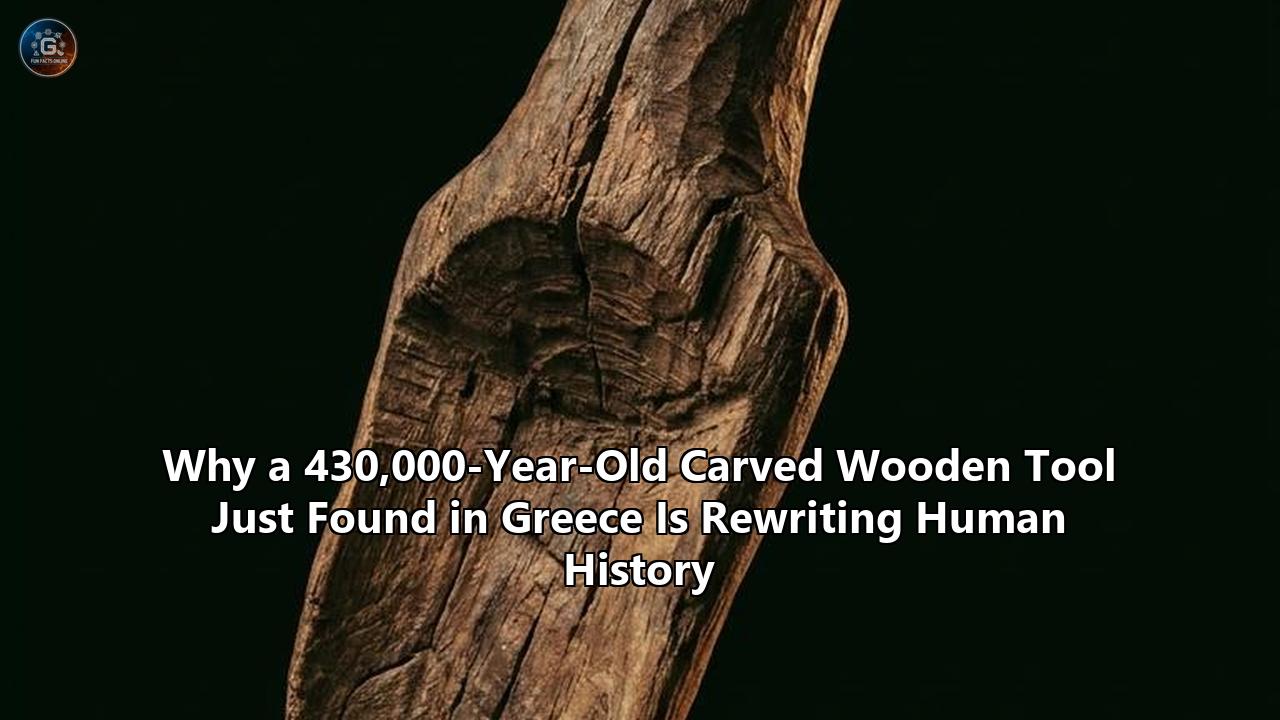
In the deep basin of Megalopolis on the southern Greek peninsula, where a massive opencast coal mine has carved away layers of the earth, archaeologists have uncovered an artifact that upends long-held assumptions about early human technology. The discovery, published in the Proceedings of the National Academy of Sciences (PNAS), reveals the existence of the oldest known handheld wooden tools ever found, dating back roughly 430,000 years.
Lead authors Dr. Annemieke Milks of the University of Reading and Professor Katerina Harvati of the University of Tübingen, along with an international research team, identified two worked wooden objects among a treasure trove of Pleistocene remains at the waterlogged site of Marathousa 1.
One is an 81-centimeter (31.9-inch) digging stick crafted from an alder trunk, while the other is a tiny, highly mysterious 5.7-centimeter (2.2-inch) finger-held tool made of willow or poplar. Found alongside the bones of a butchered straight-tusked elephant (Palaeoloxodon antiquus), these tools push back the timeline for handheld, shaped wooden implements by at least 40,000 years.
MARATHOUSA 1: A SNAPSHOT OF PREHISTORIC TECHNOLOGY
┌──────────────────────────────────────────────────────────┐
│ Age: ~430,000 Years Ago (Middle Pleistocene / MIS 12)    │
├──────────────────────────────────────────────────────────┤
│ Location: Megalopolis Basin, Peloponnese, Greece         │
├──────────────────────────────────────────────────────────┤
│ Key Artifacts:                                           │
│  • Specimen ID 39: 81-cm Alder Digging Stick             │
│  • Specimen ID 13: 5.7-cm Willow/Poplar Micro-Tool       │
│  • Specimen ID 67: Alder Trunk with Carnivore Claw Marks │
├──────────────────────────────────────────────────────────┤
│ Associated Finds:                                        │
│  • Near-complete Straight-Tusked Elephant skeleton       │
│  • Over 2,000 Stone Tools (Flint flakes and debitage)     │
│  • Cut-marked bones of hippos, deer, and turtles         │
└──────────────────────────────────────────────────────────┘
By presenting direct physical evidence of early hominins manipulating plant materials with precision, this discovery challenges the traditional, stone-centric narrative of the Paleolithic. It reveals a highly sophisticated, multi-material technological system where wood, stone, and bone were used in concert to survive a brutal ice age.
The Environmental Crucible: Life in a Glacial Microrefugium
To understand the significance of this discovery, we must look to the climate of Europe during the Middle Pleistocene. Approximately 430,000 years ago, the continent was gripped by Marine Isotope Stage 12 (MIS12)—one of the most severe and prolonged glacial periods of the entire Pleistocene Epoch. Glaciers covered northern and central Europe, turning once-habitable forests into frozen, wind-swept tundras.
For early hominins, survival required migrating southward to localized sanctuaries known as microrefugia. The Megalopolis basin in Greece's central Peloponnese was one such haven. Ringed by protective mountains, this basin harbored a deep, stable lake surrounded by lush, marshy wetlands. While northern Europe was largely unlivable, this basin offered a mild microclimate and a rich abundance of resources.
               MIS 12 GLACIAL EUROPE
 ┌──────────────────────────────────────────────────┐
 │ [ Glacial Ice Sheets ]                           │
 │ (Inhospitable, Frozen Tundra)                    │
 │                                                  │
 │           ▼ Migration Southward                  │
 │                                                  │
 │ [ Mediterranean Basin ]                          │
 │ (Temperate zones, broad forests)                 │
 │                                                  │
 │           ▼ Regional Haven                       │
 │                                                  │
 │ [ Megalopolis Basin Refugium (Marathousa 1) ]    │
 │ (Wetlands, lakeshore, wood and animal resources) │
 └──────────────────────────────────────────────────┘
This moist lakeshore environment supported a diverse array of megafauna, including the massive straight-tusked elephant, hippopotamuses, giant deer, and turtles. It also provided a rich supply of softwoods and hardwoods.
Early hominins did not merely forage opportunistically in this refuge; they systematically exploited the properties of the local vegetation. The discovery of a 430000 year old wooden tool at Marathousa 1 demonstrates that these ancient people possessed a deep, empirical understanding of different wood species, choosing specific trees for specific tasks.
- *Alder (Alnus sp.): Used for the 81-centimeter digging stick. Alder is highly resistant to rot when submerged in water, and its wood is straight and moderately dense, making it easy to carve while remaining resilient to the high torque of digging through thick mud.
- Willow or Poplar (Salix sp. / Populus sp.): Used for the 5.7-centimeter micro-tool. These woods are lightweight, highly flexible, and close-grained, allowing for extremely fine, splinter-free carving on a miniature scale.
This targeted selection of raw materials reveals that early hominins were not simply grabbing fallen branches. Instead, they were practicing active forestry, assessing the physical properties of living trees, and matching them to the functional demands of their toolkits.
Active Foraging vs. Big Game Hunting: The Digging Stick Paradigm
The discovery of the 81-centimeter alder digging stick offers a vital counterweight to the prevailing "man the hunter" narrative that dominates Paleolithic archaeology. For over a century, the study of early human evolution has focused heavily on hunting, butchery, and meat consumption. This focus is partly a result of the durability of stone and bone, which preserve far more easily than the wood tools used for gathering plants.
The Schöningen Spears vs. The Marathousa Digging Stick
To understand how the Marathousa digging stick rewrites this narrative, we can compare and contrast it with the famous Schöningen spears found in Germany, which date to around 300,000 years ago.
| Feature | The Schöningen Spears (Germany) | The Marathousa Digging Stick (Greece) |
|---|---|---|
| Age | ~300,000 Years Ago | ~430,000 Years Ago |
| Material | Spruce (Picea) and Larch (Larix) | Alder (Alnus*) |
| Primary Function | Big-game hunting (javelins/thrusting spears) | Underground foraging (digging up tubers and roots) |
| Socioeconomic Role | High-risk, cooperative hunting of horses and large mammals | Stable, daily carbohydrate collection for the community |
| Design Logic | Aerodynamic, center of gravity shifted forward, fire-hardened tips | Lever-action, flattened working edge, rounded handle |
The Schöningen spears paint a picture of a society heavily dependent on the high-risk, high-reward activity of big-game hunting. The manufacture of these aerodynamic spears required selecting slow-growing conifers, carving them to balance perfectly, and fire-hardening the tips. This technology was designed to project force over a distance to bring down large, fast animals.
In contrast, the Marathousa digging stick represents a different, highly stable survival strategy: the systematic extraction of underground storage organs (USOs). In the marshy, wet soils of the Megalopolis lakeshore, nutritious tubers, roots, and bulbs were buried deep in the mud. Accessing these dense packets of carbohydrates required a tool that could pierce, lever, and scrape without breaking.
The 81-centimeter alder stick features a rounded end that served as a comfortable handle, and a flattened, heavily frayed, and splintered working end. This fraying is consistent with repeated, high-torque contact with coarse, wet soils containing silt and gravel.
               THE MECHANICS OF THE DIGGING STICK
      Rounded Grip                   Shaped, Flattened Edge
   ┌─────────────────┐             ┌─────────────────────────┐
   │  Comfortable    │             │  Beveled and thinned    │
   │  hand interface │             │  for soil penetration   │
   └────────┬────────┘             └────────────┬────────────┘
            │                                   │
  [================== Alder Trunk Shaft ==================]  ◄─── 81 cm Total Length
                                                │
                                   ┌────────────┴────────────┐
                                   │  Fraying and splintering│
                                   │  from soil abrasion     │
                                   └─────────────────────────┘
The Energetic Trade-offs of Middle Pleistocene Subsistence
This tool highlights the complex division of labor and dietary diversity of Middle Pleistocene hominins. While hunting provided essential proteins and fats, it was an unstable food source. A hunting party could return empty-handed, but the lakeshore wetlands offered a predictable, abundant harvest of starchy plants—provided the group had the technology to dig them up.
Furthermore, the digging stick is an inclusive technology. While big-game hunting with heavy wooden spears likely required physical strength, speed, and high risk, plant foraging with digging sticks could be performed by all members of a social group, including females, children, and the elderly.
The digging stick demonstrates that the daily caloric foundation of these ancient communities was built on a reliable, technologically aided plant foraging system, challenging the idea that early humans survived on meat alone.
Handheld Tools vs. Structural Timber: Marathousa 1 vs. Kalambo Falls
Another key comparison lies between the Marathousa 1 tools and the older woodcraft found at Kalambo Falls in Zambia, which dates back to roughly 476,000 years ago.
┌────────────────────────────────────────────────────────┐
│               COGNITIVE EVOLUTIONARY PATHS             │
├────────────────────────────────────────────────────────┤
│  KALAMBO FALLS (~476k Years Ago)                       │
│  Structural Woodworking                                │
│   • Heavy, interlocking logs                           │
│   • Sedentary workspace creation                       │
│   • Modifying the landscape                            │
│                                                        │
│                    VS                                  │
│                                                        │
│  MARATHOUSA 1 (~430k Years Ago)                        │
│  Handheld, Task-Specific Tools                         │
│   • Light, portable implements                         │
│   • Ergonomic bodily extension                         │
│   • Precision manipulation and mobility                │
└────────────────────────────────────────────────────────┘
While Kalambo Falls holds the record for the oldest intentional modification of wood, the nature of that find is fundamentally different from the Greek discoveries. At Kalambo Falls, researchers found two massive, interlocking bushwillow logs joined by an intentionally carved notch. This structure was likely part of an elevated platform, walkway, or shelter designed to keep hominins dry in a wet flood plain.
The differences between these two discoveries highlight two distinct branches of early human cognitive and technological development:
Spatial Engineering vs. Biomechanical Ergonomics
The Kalambo Falls logs represent structural engineering. The cognitive task involved was spatial planning—modifying the physical landscape to create a stationary, artificial platform. This required moving heavy timber, aligning large components, and understanding how static structures load and balance. It implies a degree of local stability and a focus on constructing a shared, sedentary living space.
The Marathousa 1 tools, on the other hand, represent ergonomic design. Rather than altering the landscape, these tools were designed to extend the physical capabilities of the individual human body. Crafting a handheld tool requires an understanding of:
- The Biomechanics of the Hand: Creating a grip that matches the palm and fingers to prevent slipping and blisters during heavy use.
- Force Transfer: Designing a tool shaft that can channel muscular energy from the shoulder and arm down to a tiny, concentrated working edge without snapping.
- Portability: Shifting from heavy, stationary logs to light, transportable implements that can be carried over long distances. This matches a mobile, flexible foraging strategy.
┌─────────────────────────────────────────────────────────────────┐
│              PORTABILITY AND COGNITIVE MOBILITY                 │
├─────────────────────────────────────────────────────────────────┤
│                                                                 │
│  Static Woodworking (Kalambo Falls):                             │
│  [ Forest Source ] ───► [ Transport to Site ] ───► [ Built Base] │
│                                                                 │
│  Mobile Woodworking (Marathousa 1):                              │
│  [ Wood Selection ] ───► [ Shaving/Shaping ] ───► [ Carried Tool]│
│                                                            │     │
│                                                            ▼     │
│                                                      [ Active Use│
│                                                        at Lake ] │
└─────────────────────────────────────────────────────────────────┘
The Concept of the Miniature
This focus on ergonomic design is especially clear in the 5.7-centimeter willow or poplar tool found at Marathousa 1. This tiny object, completely debarked and shaped with rounded, pitted ends, is the first tool of its kind documented from the Middle Pleistocene.
While structural woodcraft relies on mass and bulk, this micro-tool was designed to be held between the fingers for delicate, fine-motor tasks. It shows that early hominin toolmaking was not limited to heavy bashing or digging. Instead, they were capable of the precise, delicate work required to create and use miniature organic tools.
Wood vs. Stone vs. Bone: Challenging the "Stone Age" Narrative
The term "Stone Age" has long shaped our view of early human history. It suggests a world where hominins relied almost entirely on stone for survival. However, this narrative is heavily skewed by preservation bias. Stone is virtually indestructible, while organic materials like wood and bone decay rapidly under normal conditions.
When studying this 430000 year old wooden tool alongside the stone and bone artifacts found at Marathousa 1, we can see a much more balanced picture of prehistoric technology.
                 THE PALEO-MATERIAL SPECTRUM
 ┌────────────────────────────────────────────────────────┐
 │   STONE (Lithics)                                      │
 │   • Subtractive mechanics (knapping)                   │
 │   • Brittle, highly sharp, rigid                       │
 │   • Primary Use: Butchery, cutting, wood carving       │
 ├────────────────────────────────────────────────────────┤
 │   BONE (Worked Osteodontokeratic)                      │
 │   • Splitting and polishing                            │
 │   • Highly compressional, semi-elastic                 │
 │   • Primary Use: Knapping hammers, heavy wedging       │
 ├────────────────────────────────────────────────────────┤
 │   WOOD (Xylology)                                      │
 │   • Shaving, peeling, and scraping                     │
 │   • Flexible, impact-absorbing, lightweight            │
 │   • Primary Use: Leverage, digging, fine retouching    │
 └────────────────────────────────────────────────────────┘
The lithic assembly at Marathousa 1 is extensive, consisting of over 2,000 small stone flakes, debris, and tools made from local flint and quartz. Alongside these stone tools are worked bones, including a 480,000-year-old hammer made from an elephant bone discovered at a similar European site (Boxgrove, England), which was used to shape stone flakes.
By comparing the mechanical properties and fabrication methods of these three materials, we can see how they complemented each other:
1. Stone (Lithics): The Rigid Edge
Stone tools are shaped through subtractive conchoidal fracturing. Knapping flint or quartz requires striking the rock at specific angles to split off razor-sharp flakes.
While stone is incredibly sharp and hard, it is brittle, heavy, and cannot absorb impact without shattering. It is ideal for cutting meat, scraping hides, and carving wood, but poorly suited for tasks requiring leverage, elasticity, or impact absorption.
2. Bone: The Compressed Wedge
Bone is tougher and more flexible than stone, but less elastic than wood. Shuffling between the two, bone resists high compressive forces, making it perfect for hammers used to knap stone tools.
However, bone is difficult to shape into long, flexible shafts and tends to splinter along its longitudinal grain when subjected to bending or twisting forces.
3. Wood: The Elastic Shaft
Wood is the ultimate flexible material. It is lightweight, can withstand significant bending and twisting forces, and absorbs impact without shattering.
Working wood requires a completely different approach than working stone or bone. Instead of fracturing or splitting the material, the toolmaker must peel, shave, scrape, and smooth it.
The Reciprocal Cycle of Paleolithic Technology
The discovery at Marathousa 1 reveals that these three materials did not exist in isolation. Instead, they were part of a connected, circular system of manufacturing:
        THE RECIRCULATING TECHNOLOGY CYCLE
    ┌─────────────────────────────────────────┐
    │          1. STONE TOOLS                 │
    │  Knapped flint used as sharp flakes     │
    └────────────────────┬────────────────────┘
                         │
                         │ Shaves and shapes
                         ▼
    ┌─────────────────────────────────────────┐
    │          2. WOODEN TOOLS                │
    │  Digging sticks & finger-held retouchers│
    └────────────────────┬────────────────────┘
                         │
                         │ Retouches and refines
                         ▼
    ┌─────────────────────────────────────────┐
    │          3. LITHIC REFINEMENT           │
    │  Micro-tool adjusts edge of flint flake │
    └────────────────────┬────────────────────┘
                         │
                         │ Carves and processes
                         ▼
    ┌─────────────────────────────────────────┐
    │          4. ANIMAL HARVESTING           │
    │  Bones converted to knapping hammers    │
    └─────────────────────────────────────────┘
This cycle reveals that wood technology was a "meta-technology"—technology used to make technology. Early hominins used stone flakes to peel and carve alder branches into digging sticks.
At the same time, they used the tiny willow or poplar tool to carefully pressure-flake and press the edges of their stone tools, keeping them sharp. This reciprocal relationship between wood and stone shows a level of technological planning and complexity that was once thought to belong only to modern humans.
Nature vs. Artifact: Sifting Human Design from Natural Taphonomy
One of the biggest challenges in Paleolithic archaeology is proving that an unassuming piece of wood or bone was actually modified by humans. This issue was raised by researchers like Jarod Hutson, an archaeologist at the Smithsonian National Museum of Natural History who was not involved in the study. Hutson noted that the simple, natural look of the Marathousa 1 wood fragments makes them difficult to interpret.
"It's difficult to get excited about these because they don't strike you immediately as wooden tools," Hutson remarked to the Associated Press. "And we don't know what they were used for."
This skepticism highlights a fundamental challenge: how do we distinguish a 430,000-year-old handheld tool from a branch that was simply broken by falling rocks, gnawed by animals, or worn smooth by river water?
The research team solved this problem by using a rigorous, multi-layered scientific approach that compared the worked tools with natural wood debris.
     DISTINGUISHING NATURAL DAMAGE FROM HUMAN CARVING
┌────────────────────────────────────────────────────────────┐
│   NATURAL DEFORMATION                                      │
│   • Random, scattered impact marks                         │
│   • Cracks aligned purely with natural wood grain          │
│   • Surface wear spread evenly across the entire surface   │
│   • Striations showing random, multi-directional angles    │
├────────────────────────────────────────────────────────────┤
│   HUMAN MODIFICATION (Marathousa Tools)                     │
│   • Rhythmic, overlapping flat facets (shaving)            │
│   • Microscopic "stop marks" where a stone edge halted     │
│   • Use-wear concentrated on specific functional zones     │
│   • Unidirectional striations matching carving motions     │
└────────────────────────────────────────────────────────────┘
To prove these objects were authentic tools, the team analyzed the entire collection of 144 wood pieces recovered from Marathousa 1 using several advanced techniques:
Micro-Wear Analysis and 3D CT Scanning
The researchers examined the wood surfaces under high-magnification stereomicroscopes and used 3D computed tomography (CT) scanning to peer inside the fossilized fibers.
On both the alder digging stick and the willow/poplar micro-tool, they discovered clear, overlapping flat surfaces, or facets, left by stone tools. These facets showed microscopic "stop marks"—tiny ridges of compressed wood fibers that form when a stone flake is pushed along a branch and suddenly stops. These marks cannot be replicated by water wear, sediment pressure, or animal activity.
Contrast with Carnivore Damage
The value of this microscopic approach is clearly illustrated by a third wood specimen found at the site: a larger alder trunk fragment.
Unlike the digging stick, this fragment did not show the clean, flat facets of stone tool carving. Instead, it featured deep, jagged, V-shaped grooves. Microscopic analysis revealed these were claw marks left by a large carnivore, likely a Middle Pleistocene bear.
  CARVING MARKS VS. CARNIVORE CLAWS

  Stone Carving (Tool)        Carnivore Claw (Specimen 67)
     _ _ . . _ _                  \             /
   (   .  .  .   )                 \           /
   [ Flat Facets ]                 [ Deep Gouge]
   Smooth, shaved,                 Jagged, crushed,
   flat planes.                    U- or V-shaped.
By placing these claw marks right next to the carved tools, the team was able to draw a clear contrast between human and animal activity. This animal interaction also highlights the competitive environment of the Megalopolis basin. Hominins were butchering giant elephants at the water's edge, while large predators were close behind, eager to scavenge the remains.
Taphonomic Controls
If the markings on the tools had been caused by natural forces, such as river gravel or sediment pressure, then all 144 wood fragments found at the site should have shown similar wear.
However, only two specimens exhibited these specific, systematic patterns of carving and use-wear. This clear difference proved that these two objects had been singled out, shaped, and used by hominins.
Waterlogged Preservation: The Double-Edged Sword of Wetland Archaeology
The discovery of these tools was made possible by the unique preservation conditions of the Megalopolis basin. Under normal circumstances, wood buried in soil decays within decades due to fungi, bacteria, and oxygen.
For wood to survive for nearly half a million years, it must be sealed in a highly specific environment.
                    THE PATH TO PRESERVATION
 ┌────────────────────────────────────────────────────────┐
 │ 1. DEPOSITION                                          │
 │    Tool left in quiet lakeshore mud/silt               │
 ├────────────────────────────────────────────────────────┤
 │ 2. RAPID BURIAL                                        │
 │    Quickly sealed under fine sediments, blocking air   │
 ├────────────────────────────────────────────────────────┤
 │ 3. WATERLOGGING                                        │
 │    Submerged in groundwater, creating anaerobic zone   │
 ├────────────────────────────────────────────────────────┤
 │ 4. STABILIZATION                                       │
 │    Decomposition halts; wood cells saturated with water│
 └────────────────────────────────────────────────────────┘
At Marathousa 1, the tools were left in the shallow mud of an ancient lakeshore. They were rapidly buried under fine silts and organic sediments, sealing them away from oxygen.
Submerged in groundwater, this anaerobic (oxygen-free) environment halted the decay process. Over hundreds of thousands of years, the organic components of the wood cells were slowly replaced by water, preserving the physical shape and microscopic surface details of the tools.
While these waterlogged conditions are ideal for preservation, they present massive challenges for modern archaeologists during and after excavation:
The Conservation Dilemma: PEG vs. Controlled Freeze-Drying
When waterlogged wood is excavated and exposed to the open air, the water saturating its cell walls begins to evaporate. Because the original cellulose has largely degraded, the surface tension of the evaporating water causes the weakened cell walls to collapse.
Within hours, a beautifully preserved 430,000-year-old tool can shrink, warp, crack, and crumble into unidentifiable dust.
To prevent this, conservators must use advanced stabilization techniques to replace the water inside the wood with a stable solid. Two main approaches are used to preserve waterlogged organic artifacts:
Approach A: Polyethylene Glycol (PEG) Impregnation
- Process: The waterlogged artifact is submerged in a bath of Polyethylene Glycol (PEG), a water-soluble synthetic wax. Over months or even years, the PEG slowly diffuses into the wood, replacing the water and coating the cellular structure. The wood is then slowly dried.
- Trade-offs: PEG is highly effective at preventing shrinkage and warping, making it the standard choice for large timbers. However, PEG can darken the wood, obscure fine surface details, and make microscopic analysis or chemical testing of the wood fibers difficult.
Approach B: Controlled Freeze-Drying (Lyophilization)
- Process: The waterlogged wood is frozen, and then placed in a vacuum chamber. Through sublimation, the ice turns directly into water vapor without passing through a liquid phase. This avoids the surface tension forces that collapse cell walls.
- Trade-offs: This method preserves fine surface details, wood color, and microscopic tool marks. However, it requires expensive, highly controlled vacuum chambers and can cause cracking if the freezing process is not perfectly managed.
For delicate artifacts like the Marathousa 1 tools, where every microscopic scratch is vital for analysis, researchers must combine these approaches. They often use low concentrations of PEG to provide basic structural support, followed by controlled freeze-drying to protect the fine surface details.
This painstaking process ensures the tools can be studied under microscopes and preserved for future research without falling apart.
The Evolutionary Authors: Who Wielded the Megalopolis Tools?
One of the most intriguing mysteries of Marathousa 1 is the identity of the toolmakers. No hominin skeletal remains have been found at the site, leaving researchers to deduce the authors of these tools based on the age of the site and the regional fossil record.
                     THE POTENTIAL CREATORS
 ┌─────────────────────────────────────────────────────────┐
 │ CANDIDATE 1: HOMO HEIDELBERGENSIS                       │
 │ • Ancestral to both Neanderthals and modern humans      │
 │ • Known for robust stature and expanding brain size     │
 │ • Associated with heavy handaxes and Schöningen spears │
 ├─────────────────────────────────────────────────────────┤
 │ CANDIDATE 2: EARLY NEANDERTHALS                         │
 │ • Emerging in Europe during the MIS 12 glacial period   │
 │ • Highly adapted to cold, shifting climates             │
 │ • Possessed powerful hands suited for woodworking       │
 └─────────────────────────────────────────────────────────┘
Both candidates represent a critical phase in human evolution characterized by rapid brain expansion and the development of complex behaviors.
Hand Morphology and the Precision Grip
The analysis of the 430000 year old wooden tool highlights a key evolutionary point: the hand morphology of Middle Pleistocene hominins.
For many years, some anthropologists believed that pre-modern humans lacked the manual dexterity required for highly precise, delicate tasks. They argued that Neanderthals and their ancestors relied on a powerful "power grip" (like holding a heavy hammerstone) rather than the "precision grip" (holding a small object between the fingertips) used by modern humans.
       POWER GRIP                    PRECISION GRIP
     ┌────────────┐                  ┌────────────┐
     │  Holding   │                  │  Pinching  │
     │  a heavy   │                  │  a small   │
     │  branch    │                  │  twig      │
     └─────┬──────┘                  └─────┬──────┘
           │                               │
    [ High Torque ]                 [ Fine Motor ]
The 5.7-centimeter willow or poplar tool directly refutes this idea. Measuring just over two inches, this tiny, debarked, and rounded tool could only be used by pinching it between the fingers.
Its existence proves that 430,000 years ago, hominins in Greece possessed the anatomical structures and neurological pathways needed for fine-motor control. Their hands were fully capable of both high-power woodwork, like carving a long digging stick, and high-precision tasks, like using a tiny finger-held tool to shape stone flakes.
Moving Forward: What to Watch For Next
The discovery of the Marathousa 1 tools has opened up new avenues of research that will shape our understanding of human evolution for years to come. As scientists continue to analyze these finds, several key areas of study are emerging:
Experimental Replication and Biomechanics
Archaeologists are currently working to replicate the Marathousa tools using replica Middle Pleistocene stone implements. By carving alder and willow with flint flakes, they hope to determine:
- The exact amount of time and energy required to make these tools.
- The specific wear patterns left on stone tools during woodworking, which will help researchers identify "woodworking stone tools" at other sites where the wood itself has decayed.
- The force and motion required to use the digging stick, helping to confirm its role in harvesting roots and tubers.
        EXPERIMENTAL WOODWORKING REPLICATION
 ┌────────────────────────────────────────────────────────┐
 │ 1. HARVESTING                                          │
 │    Cutting fresh alder and willow branches with flint  │
 ├────────────────────────────────────────────────────────┤
 │ 2. DEBARKING & SHAPING                                 │
 │    Using flint flakes to scrape away bark and shape tip│
 ├────────────────────────────────────────────────────────┤
 │ 3. USE-WEAR ANALYSIS                                   │
 │    Comparing replica tool marks with ancient artifacts │
 └────────────────────────────────────────────────────────┘
Re-Evaluating Museum Archives
Now that researchers know what to look for, they are re-evaluating existing collections of Pleistocene wood. Many museums hold wood fragments excavated from waterlogged sites that were originally dismissed as natural debris.
By analyzing these archives with modern 3D CT scanning and micro-wear analysis, scientists may identify other ancient wooden tools that were previously overlooked.
The Search for Hominin Fossils
The ongoing excavations in the Megalopolis basin remain a focus for paleoanthropologists. Finding hominin fossil remains—such as teeth or bone fragments—at Marathousa 1 would finally resolve the identity of the toolmakers, linking these advanced woodworking behaviors to a specific hominin species.
Ultimately, the story of the 430000 year old wooden tool is far from complete. It reminds us that our understanding of the deep past is often limited by what survives the ravages of time.
By looking past the durable stone tools of the "Stone Age," this discovery reveals a richer, more diverse picture of early human life—one where our ancestors worked with a wide range of natural materials to carve out a life in a challenging, changing world.
Reference:
- https://www.zmescience.com/science/archaeology/oldest-wooden-tool/
- https://www.sciencedaily.com/releases/2026/05/260523103939.htm
- https://archaeology.org/news/2026/01/28/430000-year-old-wooden-tools-found-in-greece/
- https://www.livescience.com/archaeology/human-evolution/430-000-year-old-wooden-handheld-tools-from-greece-are-the-oldest-on-record-and-they-predate-modern-humans
- https://www.pnas.org/doi/10.1073/pnas.2515479123
- https://greekreporter.com/2026/01/27/wooden-tools-found-greece-oldest/
- https://archaeologymag.com/2026/01/430000-year-old-wooden-tools-marathousa/
- https://www.ap.org/news-highlights/spotlights/2026/scientists-recover-the-oldest-wooden-tools-from-a-site-in-greece/
- https://apnews.com/article/oldest-wooden-tools-marathousa-1-6e07cfc79f6d8ba648138f805531b933
- https://archaeologymag.com/2026/01/430000-year-old-wooden-tools-marathousa/
- https://www.irishtimes.com/world/europe/2026/02/02/430000-year-old-wooden-tools-excavated-in-greece-are-the-oldest-ever-found/
- https://popular-archaeology.com/article/early-use-of-wooden-tools-by-hominins/
- https://www.smithsonianmag.com/smart-news/archaeologists-unearthed-a-430000-year-old-stick-after-careful-analysis-they-say-it-could-be-the-oldest-wooden-tool-ever-discovered-180988073/
- https://www.sci.news/archaeology/earliest-handheld-wooden-tools-14512.html
- https://earthsky.org/human-world/oldest-wooden-tools-yet-unearthed-found-in-southern-greece/
- https://www.reading.ac.uk/news/2026/Research-News/Earliest-evidence-of-wooden-tools-used-by-humans