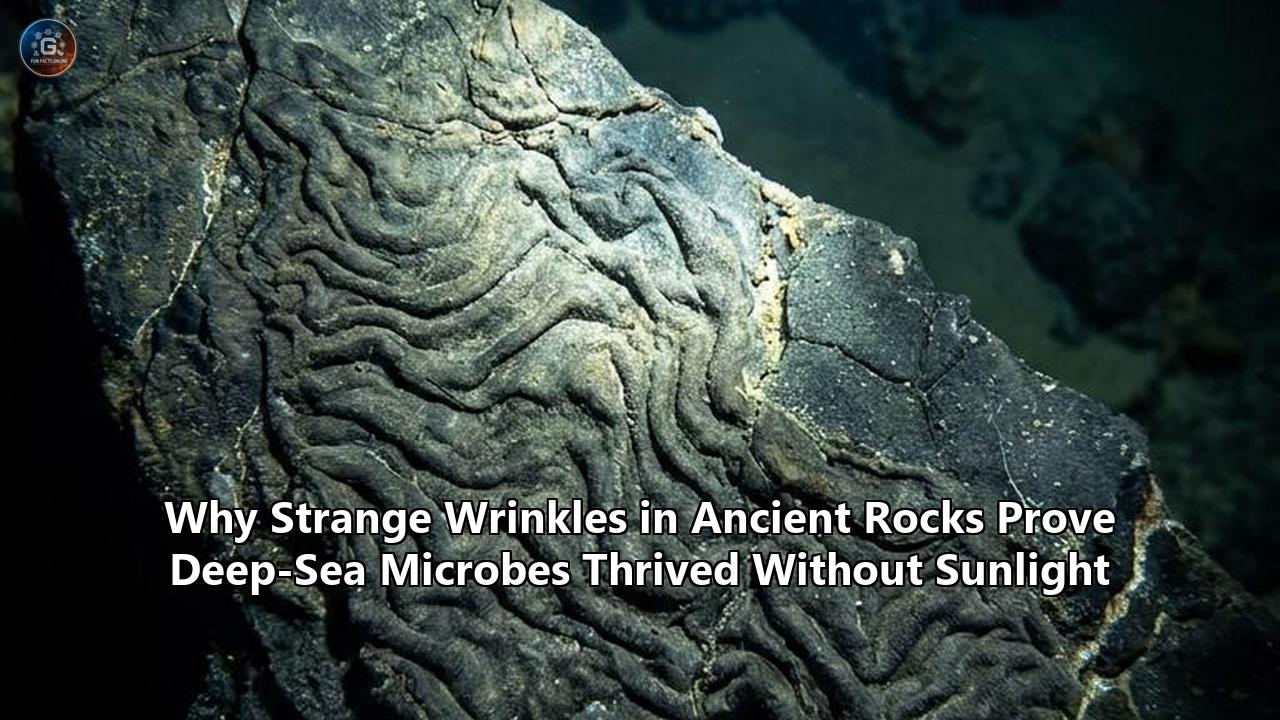
In late June 2026, a paper published in the journal Geology began circulating through the global geobiology community, systematically dismantling a core tenet of how scientists read the history of life on Earth. The study, led by Dr. Rowan Martindale of the University of Texas at Austin's Jackson School of Geosciences, presents a startling revelation: mysterious, wrinkled textures preserved in 180-million-year-old Moroccan rocks—long assumed to be the exclusive fingerprints of shallow-water, sunlight-dependent organisms—were actually forged in the pitch-black depths of the ancient ocean.
For more than a century, geologists viewed these microscopic and macroscopic "wrinkle structures" as reliable paleo-barometers. Where there were wrinkles, there was light, tides, and shallow coastal waters. By proving that these delicate sedimentary patterns were instead built by ancient deep sea microbes operating entirely without sunlight, Martindale and her co-authors have rewritten the rules of fossil preservation. The discovery does more than solve a localized geological mystery in the High Atlas Mountains; it expands our understanding of where life could survive on early Earth and reshapes the search for biological signatures on other worlds.
To understand how this breakthrough upends decades of scientific consensus, one must trace the timeline of a discovery that was initially dismissed as a physical impossibility, only to be vindicated by a combination of field geology, advanced geochemistry, and modern deep-ocean exploration.
The Shallow-Water Dogma: The History of Wrinkle Structures
To appreciate the scale of the current geological disruption, it is necessary to step back into the mid-20th century, when geologists first began systematically cataloging the bizarre textures found on the bedding planes of ancient sandstones and siltstones. Among the most common yet enigmatic of these textures were "wrinkle structures"—sometimes described as "elephant skin" due to their highly characteristic crinkled, pocketed, and runneled appearance.
These structures, which can range from fractions of a millimeter to several centimeters in relief, are categorized under the broader umbrella of Microbially Induced Sedimentary Structures (MISS). The term MISS, coined formally by geobiologist Nora Noffke in 1996, describes the physical remnants of interactions between benthic microbial mats and the physical dynamics of sediment transport.
For decades, the formation of these structures was explained through a highly specific ecological script:
- Colonization: A dense community of photosynthetic microbes—principally cyanobacteria—colonized the surface of a sandy seafloor or tidal flat, binding the individual quartz grains together with sticky extracellular polymeric substances (EPS).
- Biostabilization: The resulting microbial mat acted as a protective blanket, shielding the loose sand from being easily eroded by waves, tides, or wind currents.
- Baffling and Trapping: As water moved over the mat, the sticky surface actively trapped suspended sediment grains, adding layers to the structure.
- Deformation and Wrinkling: When physical forces—such as gentle currents, gas buildup from photosynthetic respiration, or minor sediment shifts—pressed against this cohesive microbial skin, it wrinkled like a wet bedsheet.
Because cyanobacteria rely on solar radiation to fuel photosynthesis, geologists treated these fossilized wrinkles as definitive "paleo-depth" indicators. If a rock layer displayed wrinkle structures, it was assumed to have formed within the photic zone—the upper 100 to 200 meters of the water column where light can still penetrate.
[Traditional Geobiological Model]
Sunlight ──> Photosynthetic Microbial Mat (Cyanobacteria) ──> Sediment Binding ──> Waves/Tides ──> Wrinkle Structures (Shallow Photic Zone Only)
This shallow-water interpretation was reinforced by a stark evolutionary dividing line known as the Agronomic Revolution (or the Cambrian Substrate Revolution). Before the Cambrian explosion roughly 540 million years ago, the seafloor of the world's oceans was largely quiet, undisturbed, and carpeted by extensive microbial mats. Wrinkle structures were incredibly abundant in these Precambrian rocks.
However, once complex, multicellular animals evolved, they began burrowing vertically into the sediment, seeking food and shelter. This constant biological churning—known as bioturbation—essentially acted as a giant blender, ripping up microbial mats before they could leave their mark in the geologic record.
Consequently, in rocks younger than 540 million years, wrinkle structures became exceedingly rare. When they did appear in post-Cambrian strata, geologists argued they could only survive in hyper-stressful, extreme shallow-water environments—such as hypersaline lagoons or toxic coastal bays—where burrowing animals could not live, or immediately following mass extinction events that temporarily wiped out the bioturbating marine fauna.
If a geologist encountered wrinkle-like patterns in deep-water sedimentary rocks, they were routinely written off as abiotic artifacts. The prevailing explanation was that these deep-water features were "flow-induced deformation structures"—purely physical marks left by the shear stress of underwater landslides pushing semi-consolidated mud down a slope. The biological origin of deep-sea wrinkles was, for all practical purposes, locked out of mainstream geological theory.
2016: The Accidental Discovery in the Dadès Valley
The first major crack in this long-standing geological dogma appeared quiet, unannounced, and entirely by accident.
In 2016, Dr. Rowan Martindale was trekking through the rugged, sun-scorched terrain of the Dadès Valley in Morocco’s Central High Atlas Mountains. An expert in ancient marine ecosystems, Martindale was not looking for microbial mats. Her primary mission, alongside colleagues such as Stéphane Bodin of Aarhus University, was to investigate the ecology of ancient coral reefs that thrived during the Early Jurassic period, approximately 180 million years ago.
To access the target reef formations, the team had to traverse thick, repetitive sequences of a specific type of rock known as turbidites.
[Turbidite Formation Sequence]
1. Submarine Landslide (Debris, sand, and mud rush down continental slope)
2. Deceleration (Flow slows down as it reaches the flat abyssal plain)
3. Sorting (Heavy sand grains settle first; fine silt and mud settle last on top)
4. Ripple Formation (Residual currents sculpt the top of the sand layer into ripples)
5. Quiet Interval (A period of geological silence before the next landslide event)
Turbidites are the geological remnants of massive, gravity-driven underwater avalanches. When unstable slopes of sand and mud on the continental shelf collapse, they send a roaring, high-density slurry of sediment plunging down the continental slope into the deep ocean basin. As the flow slows down on the flat deep-sea floor, the sediment settles out: first the heavy sands, then the finer silts, and finally the light muds.
Because turbidites are formed by high-energy geological events, their surfaces are frequently sculpted into large sedimentary ripple marks. But as Martindale walked across a beautifully exposed, rippled bedding plane within the Tagoudite Formation, she noticed a subtle, anomalous texture overlying the larger sandy ripples.
Superimposed directly on the crests and troughs of the ancient current ripples was a delicate, millimeter-scale network of ridges and pits. To anyone untrained in geobiology, it might have looked like weathered rock. To Martindale, who had spent years studying Triassic fossil beds, the pattern was instantly recognizable: it was the classic, organic "elephant skin" texture of a fossilized microbial mat.
"Stéphane, you need to get back here," Martindale recalled saying to Bodin. "These are wrinkle structures!"
Bodin, a sedimentologist familiar with the local stratigraphy, immediately recognized the profound paradox of her observation. The turbidite layers they were standing on were not shallow-water deposits. Based on regional geological mapping and basin reconstructions, these rocks had settled in an ancient deep-water trough at a depth of at least 180 to 200 meters (roughly 600 feet) below the ocean surface.
They were standing in the pitch black of an ancient Jurassic ocean basin. The wrinkles they were looking at simply should not have been there.
The Skeptical Interregnum: Defending the Status Quo
Recognizing that an extraordinary claim requires extraordinary evidence, Martindale and her team did not immediately rush to publish. They knew that the broader geological community would view their discovery with deep skepticism.
Between 2016 and 2024, the researchers returned to the Moroccan field sites, collected samples, and built a highly rigorous geological and biological defense. The skepticism they faced was rooted in three seemingly insurmountable arguments:
1. The Light Problem (The Photic Zone Barrier)
The primary objection was physical. At a depth of 180 meters or more, particularly in an active tectonic basin prone to muddy underwater landslides, the water column would have been highly turbid. Sunlight could not have penetrated to the seafloor in any quantity sufficient to support photosynthesis.
If the wrinkle-forming microbes were photosynthetic cyanobacteria—the undisputed builders of almost all known post-Cambrian wrinkle structures—they would have starved to death within days. Therefore, critics argued, the structures must be abiotic.
2. The Bioturbation Problem (The Grazing Army)
The second objection was biological. The Early Jurassic was not the barren Precambrian. The deep seafloor was occupied by a diverse array of burrowing invertebrates, detritus feeders, and marine worms.
Even if a microbial mat managed to grow on the turbidites, the local animal population should have quickly burrowed through the sediment, destroying the delicate surface wrinkles. In a well-oxygenated, food-limited deep-ocean basin, a lush mat of microbial protein would have been an irresistible feast, wiped out long before it could be buried and turned to stone.
3. The Abiotic Alternative (Physical Shear Marks)
The third objection was mechanical. It is well documented that when a submarine landslide (a turbidity current) travels over a soft, muddy seafloor, the sheer frictional drag of the sediment flow can deform the top few millimeters of mud, creating physical wrinkles, crinkles, and ridges that look deceptively biological.
To the untrained eye, these physical shear marks are identical to microbial wrinkles. How could Martindale prove that physical forces during an underwater landslide didn't simply push the mud into these patterns?
Deciphering the Mystery: The Multi-Pronged Forensic Investigation
To dismantle these objections, the research team conducted a meticulous, multi-pronged forensic investigation that spanned geology, organic chemistry, and marine biology.
[The Forensic Strategy]
┌──────────────────────────────────────────────┐
│             Field Stratigraphy               │ ──> Proved deep-sea depositional depth
└──────────────────────────────────────────────┘
                       │
                       ▼
┌──────────────────────────────────────────────┐
│            Thin-Section Analysis             │ ──> Disproved abiotic mechanical shearing
└──────────────────────────────────────────────┘
                       │
                       ▼
┌──────────────────────────────────────────────┐
│           Geochemical TOC Testing            │ ──> Confirmed elevated biological carbon
└──────────────────────────────────────────────┘
                       │
                       ▼
┌──────────────────────────────────────────────┐
│           Modern ROV Comparisons             │ ──> Linked fossil to modern chemolithotrophs
└──────────────────────────────────────────────┘
Step 1: Confirming the Depth
First, the team solidified the sedimentological context. By analyzing the composition of the sand grains, the marine microfossils (such as deep-water radiolarians and benthic foraminifera) present in adjacent strata, and the structural style of the turbidite beds, they confirmed beyond a doubt that these sediments were deposited in a deep, aphotic (lightless) marine basin. The depth of 180 to 200 meters was actually a conservative estimate; the basin may have been even deeper.
Step 2: Proving Biological Origin via Petrography
Next, the team addressed the "abiotic shear" argument. Under a high-powered microscope, physical shear marks in rocks reveal telltale signs of mechanical distress: mineral grains are fractured, aligned in the direction of the flow, and show signs of being physically dragged.
In contrast, biological wrinkle structures show a completely different internal organization. When Martindale’s team cut thin-sections of the Moroccan wrinkle rocks, they observed that the sedimentary grains within the wrinkles were trapped and bound in a highly chaotic, interwoven mesh.
The sand grains were suspended in what appeared to be the mineralized ghosts of biological filaments. There was no directional shearing. The micro-textures showed that the sediment was stabilized and held in place before and during the deposition of the overlying mud, a classic hallmark of biological biostabilization.
Step 3: The Geochemical Smoking Gun
To seal the case for a biological origin, the researchers turned to organic geochemistry. If these wrinkles were indeed the remains of thick microbial mats, they should contain a concentrated geochemical signature of life.
The team performed elemental analysis on the rock samples, measuring the Total Organic Carbon (TOC) levels.
The results were definitive: the rock layers directly beneath the wrinkle structures contained significantly elevated levels of organic carbon compared to the surrounding sediment. This concentrated organic carbon layer was not a random geologic occurrence; it was the mineralized, carbonaceous residue of a once-living sheet of biomass.
[Geochemical TOC Profile of the Sediment Layer]
Top: Overlying Turbidite Mud (Low Carbon)
────────────────────────────────────────────────────
Middle: Wrinkle Structure Interface (HIGH CARBON - Biological Residue)
────────────────────────────────────────────────────
Bottom: Underlying Ripple Sand (Low Carbon)
The geochemical data confirmed that these structures were not physical scars, but the actual fossilized remains of ancient deep sea microbes.
Chemosynthesis: Life Sustained by Landslides
With the biological origin and deep-water context firmly established, the team had to answer the most difficult question of all: if there was no light, how did these microbial mats survive, grow, and generate enough energy to form such extensive structures?
The answer lay in a metabolic process called chemosynthesis (specifically, chemolithoautotrophy).
Unlike phototrophs, which harvest solar photons to split water and carbon dioxide, chemolithotrophs derive their energy from chemical reactions. They oxidize inorganic molecules—such as hydrogen sulfide ($H_2S$), methane ($CH_4$), or ferrous iron ($Fe^{2+}$)—to fuel the production of organic matter.
[Photosynthesis vs. Chemosynthesis in Microbial Mats]

Photosynthesis:
Sunlight + CO2 + H2O ──> Sugars + O2  (Used by Shallow-Water Cyanobacteria)

Chemosynthesis:
Chemical Energy (e.g., H2S) + CO2 + O2 ──> Sugars + Sulfates + H2O  (Used by Deep-Sea Mats)
In their paper, Martindale and her co-authors proposed a brilliant, elegant model that linked the physical destruction of the submarine landslides with the biological creation of the microbial mats.
The Nutrient Conveyor Belt
In a typical deep-ocean basin, food is scarce. Organic matter slowly drifts down from the sunlit surface as "marine snow," but most of it is devoured long before it reaches the abyssal plain.
However, a turbidity current changes everything. When an underwater landslide occurs, it acts as a massive nutrient conveyor belt. It sweeps terrestrial organic matter, coastal plant debris, shallow-water animal remains, and nutrient-rich sediments off the continental shelf and shoves them rapidly into the deep ocean basin.
Once the sediment settled, this sudden influx of organic material began to decompose. Deep-sea heterotrophic bacteria quickly consumed the available oxygen to break down the organic matter, driving the local sediment into a highly reduced, anaerobic (oxygen-depleted) state.
This decomposition produced a massive plume of hydrogen sulfide ($H_2S$) and other reduced chemical compounds rising out of the newly deposited sand and mud.
The Window of Opportunity
This environmental shift created the perfect ecological niche for chemosynthetic, sulfur-oxidizing bacteria.
During the quiet geological intervals between submarine landslides—which could last for decades or centuries—these chemosynthetic microbes flourished. They colonised the fresh, nutrient-rich turbidite sands, forming thick, rubbery mats.
As the microbes grew, they stabilized the sediment, trapping sand grains and forming the delicate wrinkles that Martindale observed.
If another landslide occurred too quickly, the mat was ripped apart. But occasionally, the interval between slides was long enough for the mat to fully mature and stabilize. When the next gentle sediment flow arrived, instead of eroding the mat, it buried it, preserving the wrinkles in a protective capsule of mud.
The Chemical Shield: Defeating the Grazing Army
The chemosynthesis model solved the light problem, but it still left the bioturbation problem wide open. Why didn't the abundant marine worms and burrowing animals of the Jurassic devour these highly nutritious microbial mats?
The researchers proposed a fascinating ecological defense mechanism: chemical warfare.
Many modern sulfur-oxidizing bacteria, such as those in the family Beggiatoaceae, store massive amounts of nitrate and sulfur within their cells. As they process hydrogen sulfide, they produce elemental sulfur and sulfuric acid as byproducts, and they can emit toxic, foul-tasting sulfur compounds directly into the surrounding water.
[The Toxic Chemical Shield Concept]
         ┌───────────────────────────────┐
         │     Water Column (Jurassic)   │
         │  (Burrowing worms & grazers)  │
         └───────────────────────────────┘
                         │
                         ▼  [Animals repelled by toxic sulfur fumes]
               ░░░░░░░░░░░░░░░░░░░  <-- Chemical Barrier (H2S / Sulfide Plume)
         ┌───────────────────────────────┐
         │ Chemosynthetic Microbial Mat │  <-- Thick, cohesive, stabilizing the sand
         └───────────────────────────────┘
         ┌───────────────────────────────┐
         │       Turbidite Sediment      │  <-- Rich in decaying organic nutrients
         └───────────────────────────────┘
By generating a highly localized, toxic, and suboxic boundary layer directly above the mat, these ancient deep sea microbes effectively built an invisible chemical shield.
Any burrowing worm or grazing mollusk that attempted to feed on the mat would have been repelled or killed by the toxic concentrations of hydrogen sulfide.
This chemical shield allowed the microbial mats to remain completely undisturbed by bioturbators for years, giving them ample time to wrinkle the sediment, stabilize the bedding plane, and ultimately fossilize.
Bridging Deep Time with the Modern Deep Ocean
To confirm that their theoretical model of chemosynthetic wrinkle structures was biologically plausible, Martindale and her colleagues looked at the modern deep ocean. What they found was a stunning confirmation of their hypothesis.
With the advent of advanced Remotely Operated Vehicles (ROVs) and deep-sea submersibles over the last few decades, oceanographers have mapped vast, silent ecosystems in the dark ocean. Among the most remarkable of these are the giant chemosynthetic microbial mats that blanket continental slopes, oxygen minimum zones, and hydrothermal vents.
[Comparison: Modern vs. Ancient Deep-Sea Mats]

Modern Deep-Sea Mats (e.g., Beggiatoa / Thioploca):
- Found at depths from 150m to 5,000m
- Fuelled by decay of swept-down organic matter, cold seeps, or whale falls
- Repel grazers using sulfur chemistry
- Form highly cohesive, carpet-like structures on sediments

Ancient Moroccan Mats (Tagoudite Formation):
- Formed at depths of 180m+ in the Jurassic
- Fuelled by organic-rich turbidites (submarine landslides)
- Kept animals at bay via a toxic chemical shield
- Left distinct fossilized "wrinkle structures" in the rock record
In regions like the Peru-Chile Trench or the Gulf of California, modern sulfur-oxidizing bacteria such as Thioploca and Beggiatoa form thick, white-to-yellow, rubbery blankets over deep-sea muds.
These modern mats thrive in environments heavily influenced by organic-rich gravity deposits, exactly like the turbidites of ancient Morocco. They can colonize a fresh, landslide-deposited sediment layer within a matter of weeks, exploiting the sudden geochemical bounty.
Furthermore, oceanographers have documented modern chemosynthetic mats thriving on "whale falls"—the carcasses of massive whales that sink to the abyssal plain, providing a localized, massive burst of decomposing organic matter and hydrogen sulfide.
The parallels were undeniable. The modern deep sea is home to some of the largest, most productive, yet least visible ecosystems on our planet—and they operate entirely in the dark, utilizing the exact same geochemical mechanics that Martindale's team deduced from 180-million-year-old rocks.
Upending Geobiological Paradigms
The publication of Martindale's paper in Geology has sent shockwaves through the geobiology community, forcing scientists to confront a profound historical bias in how they interpret the fossil record.
As Jake Bailey, a professor at the University of Minnesota who specializes in microbial geology, remarked:
"In the present, some of the largest microbial ecosystems on our planet are found in the dark ocean. The research here shows that certain ancient sedimentary structures may record the presence of these chemolithotrophs rather than phototrophs."
This realization exposes a massive blind spot in paleontology. Because wrinkle structures were universally assumed to be photosynthetic, geologists have spent more than a century mapping ancient coastlines and shallow seas based on where these fossilized wrinkles were found.
Many geological formations that were previously interpreted as shallow, tide-swept beaches may actually have been deep, dark, and unstable submarine canyons.
[The Historical Interpretation Bias]

Old Interpretation:
Fossil Wrinkles ──> Photoautotrophs ──> Shallow Lagoon/Beach ──> Near Coastline

New Interpretation:
                  ┌──> Photoautotrophs ──> Shallow Waters
Fossil Wrinkles ──┤
                  └──> Chemolithotrophs ──> Deep Dark Basin (Turbidite-Fed)
The study highlights that we can no longer make lazy assumptions about the environment based on surface textures alone.
Without meticulous geochemical testing (like measuring TOC and looking for biological micro-textures), we cannot know whether a wrinkle in a rock was made by a microbe basking in the Jurassic sun or by an ancient deep-sea microbe feeding on the toxic, decaying ruins of an underwater landslide.
The Martian Horizon: A New Blueprint for the Search for Life
While the implications of this discovery are revolutionary for understanding Earth's history, they are arguably even more profound for the field of astrobiology and the search for extraterrestrial life.
For decades, space agencies like NASA and the European Space Agency (ESA) have designed their Mars exploration missions around a "follow the water, find the light" philosophy.
Robotic rovers like Curiosity and Perseverance have spent years exploring ancient lake basins, such as Jezero Crater and Gale Crater, specifically targeting ancient delta deposits and shallow shoreline sandstones.
The goal has been to find fossilized microbial mats (stromatolites or MISS) left behind by ancient photosynthetic Martian organisms that lived in shallow, sunlit waters.
This shallow-water focus is built on the assumption that shallow lakes or ocean margins are the most likely places to preserve readable biosignatures.
However, Mars is a cold, harsh planet that lost its protective magnetic field and thick atmosphere early in its history, exposing its surface to intense, deadly ultraviolet radiation and cosmic bombardment.
If life did evolve on Mars, it is highly unlikely that it could have survived for long on a sunlit, radiation-blasted shoreline.
[Mars Exploration Strategy Shift]

Traditional Strategy:
Target: Ancient Shallow Deltas / Lake Margins
Goal: Find Photosynthetic Stromatolites / MISS
Risk: Highly exposed to ancient UV radiation; preservation often poor due to erosion.

New Strategy (Post-Morocco Discovery):
Target: Ancient Deep-Water Turbidite Basins (e.g., Yellowknife Bay equivalents)
Goal: Find Chemosynthetic Wrinkle Structures
Advantage: Deep water shielded organisms from UV radiation; landslide burial provides rapid, pristine preservation.
The discovery that ancient deep sea microbes could build large, easily recognizable wrinkle structures in deep, dark, and highly unstable environments completely changes the Martian search parameters.
Deep-water sedimentary basins on Mars—long ignored by astrobiologists as too dark and hostile for life—might actually host the most pristine, well-preserved fossil records on the red planet.
In deep-water settings, Martian life would have been safely shielded from deadly UV radiation.
Furthermore, because Mars has active geological evidence of massive, gravity-driven sediment flows and landslides, ancient Martian deep-water basins are filled with thick sequences of turbidites—the exact rock type that preserved the Moroccan wrinkles.
If chemosynthetic Martian microbes thrived in the dark, fed by the chemical nutrients brought down by gravity flows, they may have left behind distinct wrinkle structures that are currently sitting in deep, unexplored canyons.
Indeed, observations made by the Curiosity rover in the Gillespie Lake Member of Yellowknife Bay have already revealed sandstone beds with curious, wrinkle-like textures that closely resemble terrestrial MISS.
At the time of their discovery, scientists debated whether a cold, shallow lake on Mars could have supported photosynthetic mats.
Martindale's work in Morocco provides a highly compelling alternative: those Martian wrinkles may not be the remains of a sunlit lake at all, but rather the chemosynthetic fingerprints of Martian microbes that thrived in the dark, muddy depths of an ancient planetary basin.
What to Watch Next
As the scientific community digests the implications of this discovery, several critical research paths are opening up, promising to expand this story even further:
- Re-evaluating Archive Collections: Geobiologists are already planning to revisit archived rock samples from the Precambrian, Cambrian, and younger eras. Many deep-water formations previously cataloged as containing "abiotic flow structures" will undergo geochemical testing to see if they hold the chemical signatures of deep-sea chemolithotrophs.
- Decoding the Terminology: Researchers are pushing for a more standardized, diagnostic vocabulary to describe sedimentary wrinkles. As Martindale noted, "The terminology is pretty lax... wrinkly can mean lots of things." Establishing precise micro-structural criteria to distinguish between phototrophic, chemotrophic, and physical wrinkles will be a priority for the next generation of sedimentologists.
- Targeting Future Mars Missions: Astrobiologists are using this new model to lobby space agencies to redirect future rover landing sites and camera targets toward deep-water, turbidite-rich geologic formations on Mars, rather than focusing exclusively on shallow-water deltas.
The strange wrinkles in the rocks of Morocco have proven that life does not need the sun to leave a lasting mark on history. In the deepest, darkest corners of our planet—and perhaps on worlds far beyond our own—the history of life is written not in light, but in the enduring, quiet architecture of the deep.
Reference:
- https://www.jsg.utexas.edu/news/2026/02/look-again-those-wrinkly-rocks-may-actually-be-a-fossilized-microbial-community/
- https://www.sciencedaily.com/releases/2026/06/260621111234.htm
- https://www.earth.com/news/wrinkled-rocks-found-on-deep-seabeds-were-once-home-to-microbes-that-lived-without-sunlight/
- https://www.techexplorist.com/deep-sea-wrinkle-structures-180-million-year-old-rocks/102228/
- https://www.livescience.com/planet-earth/geology/scientist-accidentally-stumbles-across-bizarre-ancient-wrinkle-structures-in-morocco-that-shouldnt-be-there
- https://www.the-microbiologist.com/news/rare-microbial-wrinkle-structures-signs-of-ancient-life-turn-up-in-an-unexpected-place/7779.article
- https://www.sciencedaily.com/releases/2026/03/260307213247.htm
- https://en.wikipedia.org/wiki/Microbially_induced_sedimentary_structure
- https://rock.geosociety.org/net/gsatoday/archive/18/10/pdf/i1052-5173-18-10-4.pdf
- https://pmc.ncbi.nlm.nih.gov/articles/PMC3870916/
- https://www.researchgate.net/publication/314672106_Microbially_Induced_Sedimentary_Structures
- https://en.clickpetroleoegas.com.br/scientists-discover-ancient-life-marks-in-180-million-year-old-moroccan-ocean-rocks-flpc96/
- https://scitechdaily.com/these-wrinkles-shouldnt-exist-a-geologists-hike-uncovers-a-180-million-year-old-mystery/
- https://astrobiology.com/2026/02/wrinkly-rocks-may-actually-be-a-fossilized-microbial-community.html
- https://www.thenews.com.pk/latest/1407344-scientists-find-ancient-microbial-life-in-places-it-shouldnt-exist