For decades, science education has framed asteroid impacts as the ultimate engines of planetary destruction. We look at the 180-kilometer-wide Chicxulub crater in Mexico and see the tombstone of the dinosaurs, a scar marking an apocalypse of fire, vaporized rock, and global winter. However, a publication in the journal Nature Communications Earth & Environment is forcing a major reevaluation of this destructive narrative.
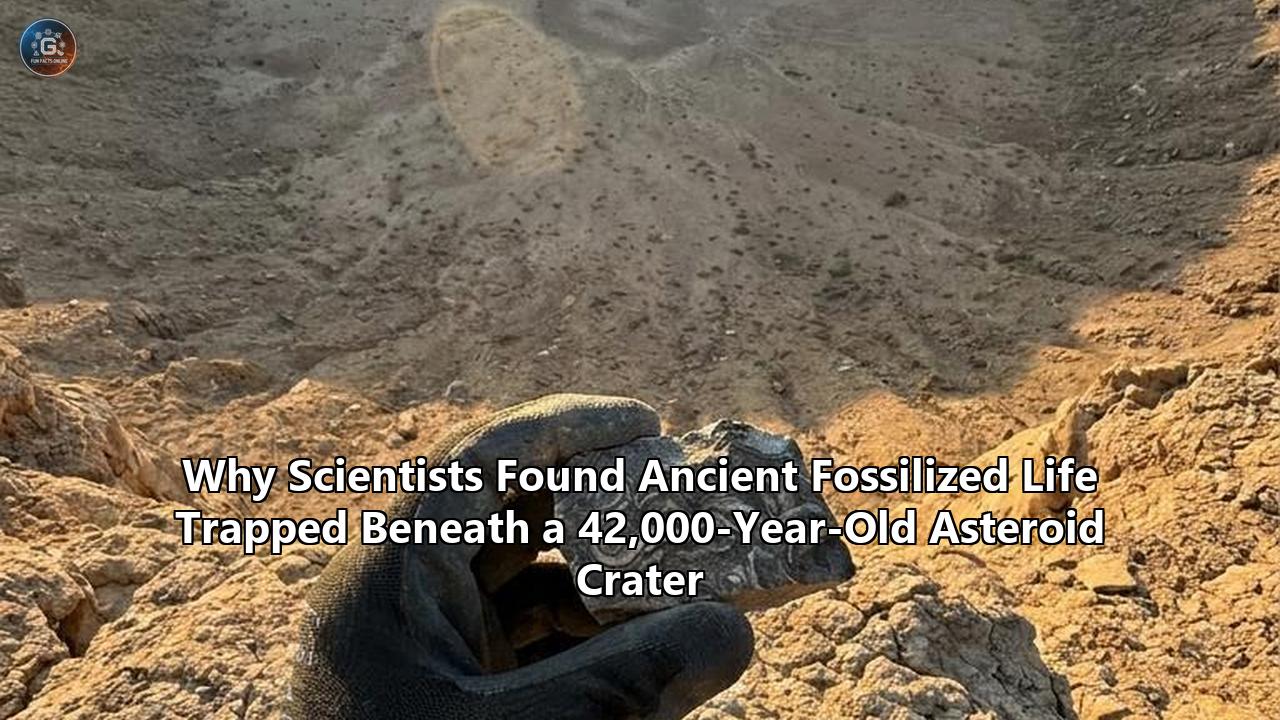
A research team led by Dr. Jaesoo Lim, a principal investigator at the Korea Institute of Geoscience and Mineral Resources (KIGAM), has discovered fossilized stromatolites—layered, mineralized structures built by ancient microbial communities—buried deep within the Hapcheon impact crater in South Korea. The bowl-shaped basin was carved out by a massive asteroid collision approximately 42,300 years ago. What makes the discovery profound is not merely the age of the crater, but what happened inside it in the millennia following the impact.
Geochemical and radiocarbon analyses reveal that these microbial structures did not exist prior to the collision. Instead, they grew and flourished inside a warm, mineral-rich hydrothermal lake generated directly by the kinetic energy of the asteroid. Dating of the fossilized structures places their growth between 23,400 and 14,600 years ago, demonstrating that the asteroid-induced hydrothermal system remained active and biologically productive for tens of thousands of years.
This discovery serves as a high-resolution geological case study. By examining the micro-scale dynamics of this relatively young South Korean basin, scientists are extracting fundamental principles about how cosmic bombardments may have functioned as the primary incubators for early life on Earth and potentially on other worlds. The cosmic hammer that shatters a planet, it turns out, is often the very tool that carves out its capacity to breathe.
The Jeokjung-Chogye Basin: A Micro-Scale Time Machine
To understand the broader implications of the KIGAM discovery, one must first look at the unique setting of the Hapcheon crater, also known as the Jeokjung-Chogye Basin. Located in South Korea’s South Gyeongnam Province, the site is a visually striking, circular valley spanning roughly seven kilometers in diameter. For centuries, the local population was oblivious to the cataclysmic origins of their home. The flat, fertile floor of the basin made it an ideal, sheltered location for cultivating high-yield rice crops.
   [ Asteroid Impact ~42,300 Years Ago ]
                    │
                    ▼
   [ Kinetic Energy ──► Thermal Energy ]
                    │
                    ▼
     [ Crustal Fracturing & Melting ]
                    │
                    ▼
[ Rain & Groundwater Influx ──► Hydrothermal Lake ]
                    │
                    ▼
  [ Mineral-Rich, Warm Alkaline Habitat ]
                    │
                    ▼
   [ Microbial Colonization (Stromatolites) ]
It was not until 2021 that Dr. Lim’s team officially confirmed the basin as South Korea’s only known terrestrial meteorite impact site. They did so by identifying telltale geological markers: shatter cones (v-shaped rock fractures produced by high-pressure shockwaves) and shocked quartz, whose crystalline structure had been permanently deformed by the sheer force of the collision.
But why do geologists care so deeply about a minor, 42,000-year-old impact crater when studying the origins of life? The answer lies in the "preservation paradox" of Earth's geology.
Most of the asteroid impacts associated with the origin of life occurred during the Hadean and early Archean eons, particularly during the Late Heavy Bombardment (LHB) between 4.1 and 3.8 billion years ago. During this epoch, tens of thousands of bolides battered the young Earth. However, because of plate tectonics, continuous volcanic resurfacing, and relentless erosion, virtually all of Earth’s primordial crust has been destroyed. The few remaining Archean rock formations, such as those in Western Australia or South Africa, have been subjected to billions of years of heat and pressure, warping their chemical signatures and leaving paleontologists to debate the biological origin of their fossils.
The Hapcheon crater bypasses this preservation barrier. At just 42,300 years old, it is geologically brand new—yet it physically mirrors the exact hydrothermal, structural, and chemical processes that occurred in the ancient, battered crust of the early Earth. By studying this modern analog, researchers have been able to peer "under the hood" of a post-impact ecosystem with a level of analytical precision that is impossible in deep-time geology.
The KIGAM team targeted the northwestern edge of the crater basin, drilling down 140 meters beneath the agricultural fields. There, preserved in the lacustrine (lake-bed) sediments, they discovered several dome-shaped, laminated mineral structures measuring 10 to 20 centimeters in diameter. These were fossilized stromatolites.
Examining this young fossilized life asteroid crater site allows scientists to extract three core principles regarding how cosmic impacts actively foster, rather than merely extinguish, biology.
Principle 1: The Post-Impact Hydrothermal Engine
The first principle illustrated by the Hapcheon case study is that an asteroid impact creates a self-sustaining, long-term geothermal engine.
When a multi-megaton space rock collides with a terrestrial surface, the physics of the event are catastrophic. Kinetic energy is instantly converted into thermal energy, vaporizing the impactor and melting the target bedrock. The crust beneath the crater is deeply fractured, shattered, and brecciated.
While the surface quickly cools, the subsurface remains an intense reservoir of residual heat. The deep-seated melt sheets and hot rock act as a giant thermal battery. As rainwater and regional groundwater flow into the newly formed, bowl-shaped depression, they percolate downward through the newly created fractures. The water is superheated by the buried rock, becomes enriched with dissolved minerals, and rises back to the surface as hot springs and alkaline seeps.
               ~~~~~~~~ [ Crater Lake ] ~~~~~~~~
              ▲                                 │
   Hot, Mineral-Rich                            │ Cold Groundwater
    Water Outflow                               │   Percolation
              │                                 ▼
         [ Fractured ]                     [ Shattered ]
         [  Bedrock  ]                     [  Bedrock  ]
              ▲                                 │
              └─────── [ Subsurface Melt ] ◄────┘
                       (Deep Thermal Heat Source)
At Hapcheon, this hydrothermal circulation was not a fleeting phenomenon. In larger craters, such as the 24-kilometer-wide Ries crater in Germany, geochemical evidence suggests hydrothermal activity persisted for up to 250,000 years. Even at the modest Hapcheon site, KIGAM’s sediment analysis demonstrates that the post-impact lake remained geothermally active for at least 27,000 years.
For single-celled organisms, 27,000 years is an evolutionary eternity. It represents millions of microbial generations living in a sheltered, consistently warm basin. The impact did not merely leave a scar; it engineered a stable, localized, geothermal spa.
Principle 2: Geochemical Signatures of the Space Rock
A critical aspect of the KIGAM team's investigation was proving that these stromatolites were directly linked to the hydrothermal activity triggered by the asteroid, rather than being standard lake deposits. To establish this link, the researchers analyzed the geochemical proxies locked within the fossilized microbial mats.
They uncovered two distinct geochemical smoking guns:
The Europium Anomaly
Europium is a rare earth element that exists in different oxidation states depending on the temperature and chemistry of its fluid environment. In typical, low-temperature lakes, europium remains stable. However, in high-temperature, reducing hydrothermal systems, minerals selectively enrich or deplete europium, leaving a distinct geochemical signal known as a "Europium anomaly."
Dr. Lim’s team found a pronounced Europium anomaly in the inner layers of the stromatolites. Crucially, this signal grew weaker in the outer, younger layers of the fossilized structures. This decay curve perfectly matches the expected thermal decline of the crater's hydrothermal system as the subsurface rocks slowly cooled over thousands of years. It is definitive proof that the biological activity of these microbial communities was intimately synchronized with the dying pulse of the asteroid’s thermal energy.
The Extraterrestrial Fingerprint
Perhaps the most striking finding was the presence of an extraterrestrial chemical signature embedded directly within the biological layers. The team detected trace amounts of meteoritic material—amounting to roughly 0.02% of the total mass of the stromatolites—including a unique osmium isotope ratio.
When the asteroid struck, it pulverized its own metallic and silicate body, distributing a fine aerosol of iridium, osmium, and other transition metals across the crater basin. As the hydrothermal lake formed, the circulating hot water dissolved these alien elements. The microbial mats actively incorporated this chemical fallout into their mineralized structures, utilizing the iron, nickel, and sulfur as metabolic catalysts.
Through this geochemical footprint, the fossilized life asteroid crater discovery shows how biological organisms can utilize the literal physical remnants of a cosmic impactor to construct their homes.
Principle 3: Solving the Thermodynamic "Water Paradox"
The Hapcheon case study also addresses one of the most stubborn intellectual bottlenecks in origin-of-life research: the thermodynamic "Water Paradox".
For decades, the dominant scientific consensus was that life likely began in the deep ocean, around volcanic hydrothermic vents (often referred to as "black smokers"). These deep-sea vents are rich in minerals and geothermal energy, making them intuitive cradles for early biochemistry.
However, deep-sea origin models face a severe chemical hurdle. The fundamental molecules of life—such as RNA, DNA, and proteins—are polymers, which are chains of smaller molecules (nucleotides and amino acids) linked together. The chemical reaction that links these monomers into polymers is a condensation reaction, which releases a molecule of water.
In a deep-ocean environment, where water is infinitely abundant, the laws of chemical equilibrium work against this process. Thermodynamically, liquid water forces the reaction in reverse, breaking down complex polymer chains back into simple monomers through a process called hydrolysis. In short: you cannot easily build the complex molecular scaffolding of life in an environment that is constantly drowning in water.
[ DRY CYCLE: Evaporation ]
    Monomers (e.g., Nucleotides) ──► Concentration ──► Polymerization (RNA/DNA Links)

[ WET CYCLE: Rain/Inflow ]
    Polymers ──► Hydration ──► Dispersal & Protection in Warm, Alkaline Water
To solve the Water Paradox, prebiotic chemistry requires alternating wet and dry cycles.
- The Dry Cycle: Evaporation drives the condensation reactions, concentrating organic molecules on a muddy surface and forcing them to link into complex chains.
- The Wet Cycle: Periodic rehydration dissolves the newly formed polymers, allowing them to interact and seek shelter in protective mineral pockets.
Deep-ocean vents cannot provide this cyclic dehydration. Terrestrial, land-based hot springs can—but on the barren, volcanic early Earth, shallow freshwater basins were rare, vulnerable to being wiped out by volcanic eruptions or diluted by the global ocean.
This is where terrestrial impact craters provide the perfect compromise. When an asteroid hits a landmass, it creates a self-contained, closed-drainage basin with shallow, fluctuating shorelines. As the water levels of the post-impact lake rise and fall with local weather and thermal output, the margins of the crater undergo constant, highly regulated wet-and-dry cycles.
The clay minerals created by the hydrothermal weathering of shattered rock act as catalytic templates, grabbing organic molecules and organizing them. The periodic drying out of the shoreline mud allows these molecules to polymerize, while the subsequent wet cycle washes the newly formed chains back into the safety of the warm, alkaline lake.
By showing that a land-based asteroid crater can host an active, highly stable hydrothermal lake system for tens of thousands of years, the Hapcheon discovery provides a real-world, physical framework for how the Water Paradox was solved during Earth's earliest history.
Craters as "Oxygen Oases" for the Early Earth
The implications of the South Korean discovery extend beyond the chemical origins of life; they also offer a vital perspective on how Earth’s atmosphere became rich in oxygen.
Roughly 2.4 billion years ago, our planet underwent the Great Oxidation Event (GOE), a dramatic atmospheric transition during which free oxygen began to accumulate in the atmosphere, eventually paving the way for complex, multicellular life. The primary drivers of this oxygenation were cyanobacteria—microorganisms that developed the ability to perform oxygenic photosynthesis, splitting water molecules and releasing oxygen as a byproduct.
However, the transition to an oxygen-rich world was not a sudden, global switch. For hundreds of millions of years prior to the GOE, cyanobacteria were engaged in an uphill battle. The early Earth was highly reducing, packed with volcanic gases like methane, hydrogen sulfide, and soluble iron that acted as massive "oxygen sinks," instantly consuming any free oxygen the microbes produced.
To overcome these sinks and build up atmospheric oxygen, cyanobacteria needed isolated, highly productive nurseries. Scientists refer to these hypothetical habitats as "oxygen oases"—localized, sheltered environments where microbial populations could reach high enough densities to overwhelm local chemical sinks and pump oxygen directly into their immediate surroundings.
                     ┌────────────────────────┐
                     │  Extraterrestrial Dust │
                     │  & Shattered Bedrock   │
                     └───────────┬────────────┘
                                 │ Releases
                                 ▼
                     ┌────────────────────────┐
                     │ Essential Nutrients:   │
                     │ Phosphorus, Iron, Zinc │
                     └───────────┬────────────┘
                                 │ Fueling
                                 ▼
                     ┌────────────────────────┐
                     │  Microbial Bloom &     │
                     │  Oxygen Production     │
                     └────────────────────────┘
The Hapcheon case study suggests that terrestrial impact craters were the premier candidate sites for these oxygen oases.
An impact crater lake is, by definition, an isolated basin. It is physically shielded from the chaotic chemistry of the open ocean. Furthermore, the physical shattering of the rock releases massive amounts of essential nutrients—such as phosphorus, iron, and zinc—directly into the water column.
When combined with the continuous supply of warm, geothermally heated water, these nutrients would have triggered massive microbial blooms. Inside these protected volcanic bowls, photosynthetic cyanobacteria could thrive, building up dense, layered stromatolite mats.
The study of this fossilized life asteroid crater site in South Korea demonstrates that the hydrothermal lake hosted these structures for millennia. On the early Earth, which was peppered with tens of thousands of impact craters, these basins would have functioned as a vast, interconnected network of oxygen-producing factories. Slowly but surely, these oases saturated their immediate basins with oxygen, eventually spilling over to transform the global atmosphere.
It is a striking ecological irony: the very space rocks that possessed the power to sterilize regional ecosystems were also the geological greenhouses that allowed the oxygenation of the planet to take root.
Astrobiology and the Hunt for Martian Biosignatures
Perhaps the most immediate and practical application of the Hapcheon discovery is how it redefines the search for past life on other planets, most notably Mars.
Mars is currently a cold, hyper-arid desert, but geomorphological evidence from satellites and surface rovers confirms that it was once a wet, active world. Crucially, because Mars lacks a dynamic plate tectonic system like Earth’s, its ancient surface has not been recycled. The Martian landscape is essentially a preserved fossil of the Hadean and Archean eons, covered in millions of pristine, water-carved impact craters.
For years, astrobiologists have targeted Mars's ancient lacustrine environments. NASA's Perseverance rover, for example, is currently exploring Jezero Crater, a 45-kilometer-wide basin that once held a prominent lake.
                                  [ Earth (Hapcheon) ]
                                           │
                        Provides High-Resolution Geochemical Protocols:
                        • Europium anomalies
                        • Osmium isotope tracking
                        • Micro-lamination analysis
                                           │
                                           ▼
                                   [ Mars (Jezero) ]
The discovery in South Korea provides a highly detailed search template for missions on the Red Planet. It suggests that if we want to find definitive evidence of Martian biology, we should not just look for generic lake-bed clay deposits. Instead, we must look for the distinct geochemical and structural signatures of post-impact hydrothermal systems.
The lesson from Hapcheon is that astrobiologists should search for:
- Shattered fault zones: The areas along the inner rims of craters where hydrothermal fluids once seeped to the surface.
- Europium anomalies in Martian minerals: Distinct chemical gradients in carbonate and silicate rocks that would indicate the cooling signature of an ancient hydrothermal spring.
- Trace meteoritic isotopes embedded in rock laminations: Finding organic-like rock layers enriched with transition metals of meteoric origin would mimic the exact biosignatures found beneath the South Korean rice fields.
If a modest, 7-kilometer crater in South Korea could maintain a warm, thriving ecosystem for nearly 30,000 years, then the massive impact craters of ancient Mars—which were frequently filled with water—could have easily sustained hydrothermal life for hundreds of thousands of years, even as the rest of the Martian atmosphere was thinning and freezing over. The search for a fossilized life asteroid crater on Mars has just been handed its most precise geological roadmap yet.
What to Watch Next: The Changing View of Cosmic Impacts
The KIGAM discovery at Hapcheon has opened up several exciting pathways for geobiologists and planetary scientists. Moving forward, several key milestones and unresolved questions will dominate the scientific discourse:
1. Expanding the Search to Other Young Terrestrial Craters
Scientists will now actively apply the geochemical and drilling protocols developed at Hapcheon to other young, well-preserved craters across the globe. Sites like India’s Lonar crater (a 50,000-year-old basaltic impact site) and Ghana's Bosumtwi crater (a 1.07-million-year-old crater lake) are prime targets. If these sites also yield similar fossilized microbial mats and hydrothermal signatures, it will confirm that impact-driven biogenesis is a universal geological law, rather than a localized anomaly unique to South Korea.
2. Refining Prebiotic Chemistry Models
Prebiotic chemists will use the physical parameters of the Hapcheon crater lake (its temperature profile, mineral concentrations, and wet-dry cycles) to run realistic laboratory simulations of the origins of life. By mimicking the exact water chemistry of an cooling impact basin, researchers hope to synthesize complex RNA and peptide chains, further bridging the gap between non-living chemistry and primitive biology.
3. Mars Sample Return Integration
As NASA and ESA finalize plans for the Mars Sample Return (MSR) mission, the geochemical insights from the Hapcheon stromatolites will guide how these precious Martian core samples are analyzed in ultra-clean terrestrial laboratories. The precise mass spectrometry techniques used to identify the 0.02% meteoritic material and Europium anomalies in South Korea will be used to analyze Martian rocks, searching for the definitive proof of extraterrestrial life.
The Coexistence of Destruction and Creation
The discovery of fossilized life inside the Hapcheon impact crater represents a profound shift in how we conceptualize the relationship between our planet and the wider cosmos.
For centuries, science viewed space as a silent, hostile void, and asteroid impacts as purely intrusive, destructive violations of Earth’s biological status quo. We cataloged the craters on our moon and the scars on our own planet as mere monuments to violence.
The work of Dr. Jaesoo Lim and his team reveals a far more complex, integrated truth. The cosmos and the biosphere are not in a state of constant war. Instead, they are locked in a deep, creative feedback loop. The very rocks that break a world are often the very engines that make it whole. By fracturing the crust, releasing deep geogenic heat, liberating vital minerals, and carving out protective, cyclic basins, asteroid impacts engineered the precise, physical sanctuaries required for our earliest ancestors to assemble, breathe, and ultimately thrive.
As we look up at the cratered face of the moon, or down at the fertile, rice-filled valleys of South Korea, we are no longer looking at graves. We are looking at the nurseries of life.
Key Takeaways from the Hapcheon Crater Discovery
| Parameter | Scientific Detail | Geological & Biological Significance |
|---|---|---|
| Crater Age | ~42,300 years old | Pristine, modern analog for ancient Hadean/Archean crust. |
| Stromatolite Diameter | 10 to 20 centimeters | First definitive stromatolites found inside a post-impact hydrothermal lake. |
| Growth Period | 23,400 to 14,600 years ago | Proves the impact-induced hydrothermal system was active for tens of thousands of years. |
| Geochemical Markers | Europium anomaly & 0.02% meteoritic material | Confirms biological growth was directly fueled by the asteroid's thermal and chemical legacy. |
| Astrogenetic Value | Solves the "Water Paradox" | Shows how fluctuating crater lake shorelines allow organic polymerization. |
| Planetary Target | Mars Craters (e.g., Jezero) | Provides a precise geochemical guide for detecting ancient Martian life. |
Reference:
- https://www.youtube.com/watch?v=Bi10OWZBkVU
- https://www.skyatnightmagazine.com/news/hapcheon-impact-crater-stromatolites-earth-oxygen
- https://scienceblog.com/how-asteroid-strikes-may-have-sparked-earths-first-breath-of-oxygen/
- https://www.universetoday.com/articles/early-life-on-earth-may-have-thrived-in-impact-craters
- https://www.earth.com/news/lakes-formed-by-asteroid-impacts-may-have-fostered-stromatolites-early-oxygen-producing-life-over-3-5-billion-years-ago/
- https://www.sciencealert.com/evidence-of-ancient-life-found-buried-under-an-asteroid-crater
- https://www.sciencedaily.com/releases/2026/05/260521072357.htm
- https://www.sci.news/paleontology/crater-lake-stromatolites-14785.html
- https://www.sci.news/news/othersciences/geoscience