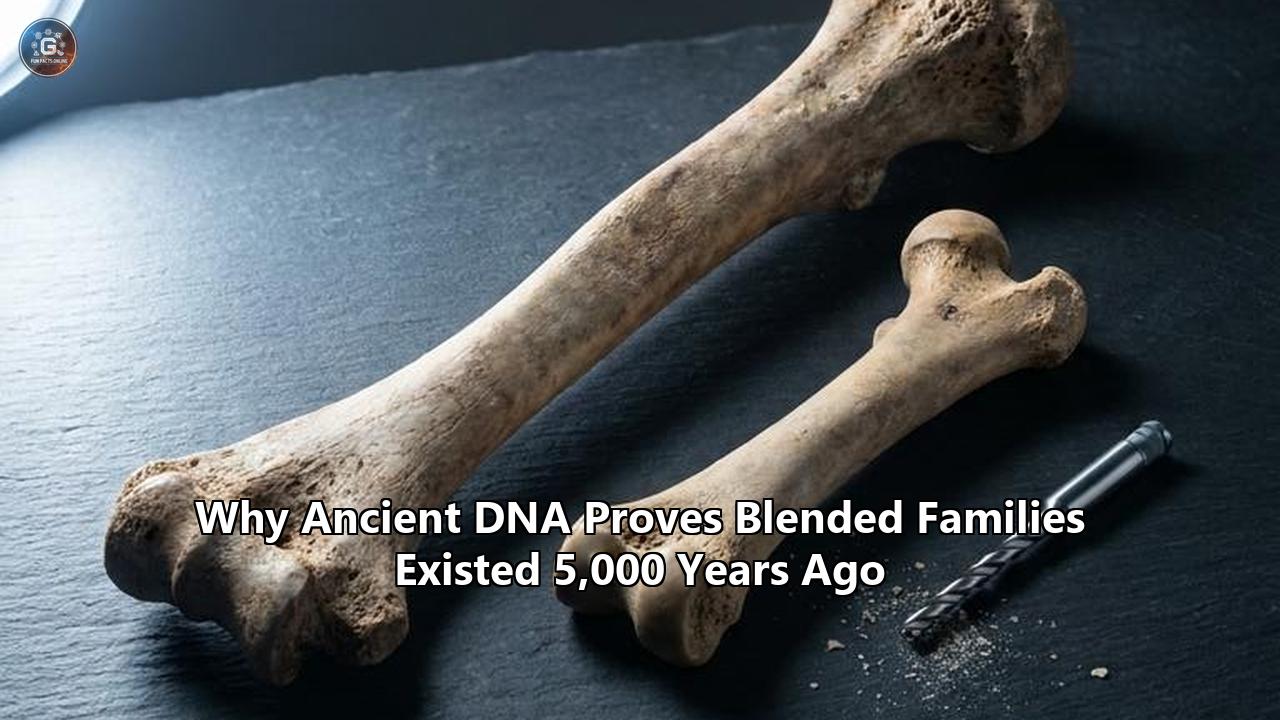
A major genomic study has fundamentally upended our understanding of the prehistoric household, proving that the concept of the modern "blended" or "patchwork" family is not a recent social development, but a deeply rooted human survival strategy dating back more than 5,000 years.
Published in the journal Science, an international research project analyzed the genomes of 203 Late Neolithic individuals buried across six megalithic grave complexes in Central Europe. Led by researchers at Kiel University’s Institute of Clinical Molecular Biology (IKMB), the team compared genetic profiles to reconstruct the intimate social structures of the Wartberg and Western Funnel Beaker cultures, which thrived between 3600 and 2800 BCE.
The findings are striking: the massive stone tombs of the Late Neolithic were not exclusive biological vaults reserved solely for nuclear families or closed genetic dynasties. Instead, they functioned as communal resting places for highly flexible "patchwork families". In these prehistoric communities, children from different biological backgrounds grew up together, and social belonging—rather than strict genetic relation—determined who was laid to rest side-by-side.
Furthermore, the study exposed a level of geographic mobility that challenges long-held assumptions about Neolithic life. Genetic analysis identified a first-degree father-son pair buried roughly 225 kilometers (140 miles) apart—the father in the southern gallery grave of Niedertiefenbach and his subadult son far to the north in Sorsum. This extraordinary distance, traveled in an era long before domesticated horses were used for transport in Central Europe, reveals that early farming communities were bound by expansive, long-distance social and biological networks.
Through this new ancient dna evidence, science is dismantling the myth of the isolated, static prehistoric bloodline, forcing a systematic reappraisal of how early humans organized their lives, sustained their communities, and defined the very concept of family.
The Stakeholders: Who Is Affected by This Genetic Paradigm Shift?
The revelation that prehistoric societies prioritized social kinship over biological descent is sending shockwaves through several academic disciplines and reshaping modern cultural conversations about human nature.
                  ┌────────────────────────────────────────┐
                  │      ANCIENT DNA REVELATIONS           │
                  │   OF PREHISTORIC PATCHWORK FAMILIES    │
                  └───────────────────┬────────────────────┘
                                      │
         ┌────────────────────────────┼────────────────────────────┐
         ▼                            ▼                            ▼
┌─────────────────┐          ┌─────────────────┐          ┌─────────────────┐
│  ARCHAEOLOGISTS │          │   GENETICISTS   │          │ SOCIAL SCIENCES │
├─────────────────┤          ├─────────────────┤          ├─────────────────┤
│Must stop        │          │Must move past   │          │Dismantles the   │
│equating tombs   │          │"genetic         │          │myth that the    │
│with single      │          │reductionism" &  │          │nuclear family   │
│nuclear          │          │integrate social │          │is the only      │
│bloodlines.      │          │models.          │          │"natural" form.  │
└─────────────────┘          └─────────────────┘          └─────────────────┘
Archaeologists and Prehistorians
For over a century, the field of prehistoric archaeology operated under the working assumption that communal burial structures, such as European gallery graves and passage tombs, served as ancestral vaults for highly localized, biologically related elites. Whenever researchers uncovered a cluster of bodies within a megalithic chamber or beneath a household floor, the default interpretation was that of a nuclear family or a direct patrilineal lineage.
This study invalidates that assumption. Archaeologists must now re-evaluate centuries of excavation data. If biological relatedness was not the primary driver for inclusion in these sacred monumental spaces, then the cultural significance of the tombs themselves must be completely reassessed. Megaliths are no longer viewed simply as territorial markers or family mausoleums, but as symbols of broader social integration, communal labor, and collective identity.
Molecular Anthropologists and Geneticists
The rapidly expanding field of paleogenomics has often faced criticism for "genetic reductionism"—the tendency to equate biological relatedness directly with human social structure. This study forces geneticists to adopt more nuanced interpretive frameworks.
As Dr. Sabina Cveček, an anthropologist at the Field Museum of Natural History and lead author of a complementary April 2026 kinship study in the Cambridge Archaeological Journal, points out, human kinship has never been defined solely by genetic traits. The new research obliges geneticists to collaborate more closely with socio-cultural anthropologists, creating multidimensional models that look beyond coefficients of relatedness ($r$-values) to interpret how ancient populations actually structured their households.
Contemporary Society and the Philosophy of the Family
Perhaps the most profound impact of this discovery lies outside the laboratory. For generations, modern Western legal, religious, and political systems have treated the nuclear biological family as the "natural" baseline of human social organization. Non-traditional structures, such as blended families, adoption, fosterage, and communal parenting, are frequently treated as modern, industrial-era anomalies.
The ancient dna evidence strips away this appeal to nature. By demonstrating that patchwork families were widespread and highly successful 5,000 years ago during the crucial transition to settled agriculture, this research proves that human survival has always depended on our capacity to build flexible, non-biological social safety nets. It reframes modern domestic diversity not as a breakdown of traditional values, but as a return to an ancient, highly adaptive evolutionary strategy.
The Scientific Underpinnings: How the DNA Was Recovered and Analyzed
Reconstructing the social structures of communities that lived five millennia ago requires a delicate synthesis of molecular biology, physical anthropology, and biogeochemistry. The international team at Kiel University, coordinated by Professor Ben Krause-Kyora and led by researcher Nicolas Antonio da Silva, achieved this by sampling human remains from some of Central Europe's most famous Late Neolithic sites.
Petrous Bone Extraction and High-Resolution Sequencing
To extract genetic material capable of revealing precise family trees, the researchers focused on the petrous bone—the dense, pyramidal portion of the temporal bone housed within the inner ear. The petrous bone is widely recognized as the premier reservoir for ancient DNA preservation, shielding fragile double-helix structures from the environmental degradation, moisture, and bacterial contamination that typically destroy DNA in porous long bones.
Working in dedicated cleanroom facilities at Kiel University, the team carefully drilled into the petrous bones of 203 individuals, extracting microscopic bone powder. Using next-generation sequencing (NGS) technologies, they successfully mapped genome-wide data, focusing on single nucleotide polymorphisms (SNPs)—the individual variations in DNA sequences that serve as genetic markers.
┌────────────────────────────────────────────────────────┐
│             PETROUS BONE SAMPLE EXTRACTION             │
│  (Dense inner ear structure yields highly preserved DNA)│
└───────────────────────────┬────────────────────────────┘
                            ▼
┌────────────────────────────────────────────────────────┐
│           NEXT-GENERATION GENOMIC SEQUENCING           │
│      (Mapping genome-wide SNPs and paternal/maternal   │
│                  uniparental markers)                  │
└───────────────────────────┬────────────────────────────┘
                            ▼
┌────────────────────────────────────────────────────────┐
│               KINSHIP COEFFICIENT ANALYSIS             │
│      (Calculating R-values to establish biological     │
│                    relationships)                      │
└───────────────────────────┬────────────────────────────┘
                            ▼
┌────────────────────────────────────────────────────────┐
│            STRONTIUM ISOTOPE RATIO TESTING             │
│     (Determining geographic origins and mobility of    │
│                  specific individuals)                 │
└────────────────────────────────────────────────────────┘
Calculating Kinship Coefficients ($r$-Values)
To distinguish biological relatives from unrelated community members, the geneticists calculated the kinship coefficient ($r$) between every pair of individuals buried within each tomb. The coefficient of relatedness measures the probability that two individuals share a given gene by common descent:
- First-Degree Relatives ($r \approx 0.5$): Parent-offspring pairs or full siblings.
- Second-Degree Relatives ($r \approx 0.25$): Half-siblings, grandparents/grandchildren, or aunts/uncles/nieces/nephews.
- Third-Degree Relatives ($r \approx 0.125$): First cousins, great-grandparents, or great-grandchildren.
When the team applied these calculations to the 203 individuals from the German megaliths, they found that only about 13% of the people buried together in the monumental chambers shared close biological ties (first- or second-degree). The vast majority of the individuals resting side-by-side showed no close genetic relationship whatsoever, yet they were interred within the same communal grave pits with identical funerary rites.
This stark contrast with other European megalithic regions—such as Ireland and Sweden, where tombs were often reserved strictly for elite biological patrilines—revealed a distinct social model in Central Europe based on inclusive social affiliation.
Strontium Isotope Analysis: Tracking Prehistoric Travel
To complement the genetic data, the researchers utilized strontium isotope ratio values ($^{87}\text{Sr}/^{86}\text{Sr}$) extracted from the tooth enamel of the deceased. Strontium is an element found in bedrock; as it erodes into the soil and water, it enters the food chain and is absorbed by humans during childhood, permanently locking into the developing enamel of their teeth.
Because different geological formations have unique strontium isotope signatures, scientists can compare the strontium ratio in an individual's teeth with the local geology of their burial site. If the signatures do not match, it proves the individual spent their childhood elsewhere and migrated to the community later in life.
By layering strontium isotope data over the genetic pedigrees, the Kiel University team was able to map the exact movement of individuals across the landscape, proving that long-distance migration and regional integration were common features of Late Neolithic life.
What Changes in Our Understanding of the Neolithic Era?
The transition from mobile hunter-gatherer bands to settled, agricultural societies—known as the Neolithic Revolution—has long been depicted as a period of tightening territorial control, where genetic bloodlines and land inheritance became the dominant organizing principles of human life. The new genomic data fundamentally alters this narrative in several key ways.
The Dissolution of the "Static Bloodline" Myth
In historical and archaeological literature, early farming communities are frequently portrayed as closed, inward-looking clans. It was believed that the introduction of permanent settlements and wealth accumulation led to the creation of rigid, biological lineages designed to pass land, livestock, and social status down through direct genetic heirs.
The ancient dna evidence reveals that Late Neolithic societies in Central Europe were actually characterized by a high degree of social flexibility. Rather than functioning as exclusive, genetically pure clans, these communities operated as open, adaptive networks. They were fully capable of absorbing biologically unrelated individuals, stepchildren, and partners into their core households and burial groups, treating them with equal respect and social standing in both life and death.
| Traditional View of Neolithic Social Structure | New Genomic View of Neolithic Social Structure |
|---|---|
| Closed, localized biological clans | Expansive, fluid, regional social networks |
| Tombs reserved for elite genetic bloodlines | Tombs serving as communal hubs for "patchwork families" |
| Low mobility, highly territorial populations | High mobility, active long-distance exchange networks |
| Family defined strictly by biological descent | Family defined by co-residence, shared labor, and choice |
| Cultural styles spread by mass migration | Cultural styles spread by long-distance social networks |
The Real Meaning of Megalithic Tombs
For decades, researchers debated the primary function of Europe's megalithic monuments. Were they territorial markers designed to warn off rival clans? Were they shrines to elite patriarchs?
The German evidence suggests that, in Central Europe, megaliths functioned as monuments to social cohesion and shared belonging. Professor Almut Nebel, a co-author of the study from Kiel University's IKMB, notes that these were not simply graves of biological families, but "burial places of blended communities".
By burying genetically unrelated individuals together in these monumental stone structures, Neolithic communities were physically and symbolically cementing social bonds that transcended biology. The shared labor required to haul, carve, and erect these massive stones was matched by the shared social responsibility of mourning and commemorating a diverse, cooperative household.
  ┌──────────────────────────────────────────────────────────┐
  │              THE MEGALITH AS A SOCIAL HEARTH             │
  │                                                          │
  │   [ Unrelated Individual ]    <─── Social Kinship ───>    │
  │              │                                           │
  │              ▼                                           │
  │    ┌──────────────────┐                                  │
  │    │  CO-RESIDENCE &  │   <─── Shared Labor, Meals,      │
  │    │   SHARED LAND    │        and Daily Survival        │
  │    └────────┬─────────┘                                  │
  │             │                                            │
  │             ▼                                            │
  │    ┌──────────────────┐                                  │
  │    │   COMMUNAL TOMB  │   <─── Equal Burial Rites        │
  │    └──────────────────┘        Regardless of Biology     │
  └──────────────────────────────────────────────────────────┘
The Sorsum-Niedertiefenbach Connection: Re-evaluating Prehistoric Mobility
One of the most concrete examples of this social fluidity is the biological father-son pair identified by the researchers. The father was laid to rest in the megalithic tomb of Niedertiefenbach in modern-day Hesse, while his subadult son was buried in the Sorsum tomb in Lower Saxony, approximately 225 kilometers to the north.
This is the first time a first-degree genetic relationship has been documented across such a vast distance in the Neolithic world. It is highly unlikely that this separation was the result of a random, isolated wandering. Instead, it indicates a structured system of long-distance interaction.
The authors of the Science study suggest several plausible scenarios for why the boy was buried so far from his father. He may have been sent to Sorsum as part of a fosterage arrangement, a common practice in many historical and ethnographic societies where children are raised by distant allies to strengthen regional ties.
Alternatively, he could have been an apprentice learning regional craft specialties, such as advanced pottery techniques or stone masonry, or even a living pledge of peace (a political hostage) between distinct regional groups. This level of generational mobility demonstrates that prehistoric Europe was highly interconnected, with people regularly traversing hundreds of kilometers along established social pathways.
Cultural Exchange Over Mass Migration
The study also resolves a long-standing archaeological puzzle: how did megalithic architecture and specific cultural styles spread across Europe? One school of thought argued that the expansion of monument-building was driven by the physical migration of a single, dominant population group that displaced local residents. Another theory proposed that the tradition was transmitted culturally, through the exchange of ideas and practices between different, settled groups.
The Kiel-led study strongly supports the second model. Genetic analysis revealed that the individuals buried at the Western Funnel Beaker site of Sorsum and the five nearby Wartberg culture sites formed a genetically continuous, homogeneous population.
Despite their genetic indistinguishability, these two groups maintained separate archaeological identities, using different styles of pottery, tools, and stylistic variations in their tombs. Sorsum represented a northern branch of the Wartberg world that adopted Funnel Beaker material traditions while remaining biologically and socially anchored to their Wartberg neighbors to the south.
The dissemination of monument-building was therefore a cultural process. Ideas, architectural styles, and religious practices flowed through established social networks, carried by mobile individuals who bridged cultural divides without requiring mass population displacements.
Short-Term Consequences: The Immediate Impact on Archaeological Research
The publication of this genomic data has triggered an immediate methodological shift across archaeological institutions and research laboratories worldwide.
The Death of the "One Grave, One Bloodline" Assumption
The most immediate consequence is the abandonment of genetic reductionism in the interpretation of ancient burial sites. Excavators can no longer assume that individuals sharing a grave, a domestic floor, or a monumental structure represent a single, direct biological family.
This shift is already altering current excavations. When ancient remains are recovered, laboratories are immediately integrating multi-isotope testing (strontium, oxygen, carbon, and nitrogen) alongside high-resolution genomic sequencing.
By mapping dietary changes, childhood geographic origins, and biological kinship simultaneously, researchers can build highly detailed profiles of each individual's life history. This multi-proxy approach is revealing that many previously excavated "family graves" actually contain complex social networks of step-parents, adopted children, and unrelated partners.
                     ┌─────────────────────────────┐
                     │   MULTIDISCIPLINARY GRAVE   │
                     │          ANALYSIS           │
                     └──────────────┬──────────────┘
                                    │
         ┌──────────────────────────┼──────────────────────────┐
         ▼                          ▼                          ▼
┌─────────────────┐        ┌─────────────────┐        ┌─────────────────┐
│   GENOMICS      │        │    ISOTOPES     │        │  SPATIAL MAPS   │
├─────────────────┤        ├─────────────────┤        ├─────────────────┤
│Reveals biological│        │Tracks dietary   │        │Correlates biological│
│kinship or lack  │        │origins, mobility│        │and social links │
│thereof ($r$).   │        │and environment. │        │to grave layouts.│
└─────────────────┘        └─────────────────┘        └─────────────────┘
The Re-Evaluation of Museum Archives
Millions of prehistoric human bones currently reside in cardboard boxes and storage drawers in museums and university archives worldwide, excavated during the 19th and 20th centuries before modern genetic technologies existed. This study has sparked a major movement to re-analyze these legacy collections.
Research teams are securing funding to extract DNA and isotopes from previously cataloged skeletons, looking for hidden patterns of long-distance kinship, adoption, and social mobility that went completely undetected by traditional physical osteology. This archival "re-excavation" promises to generate a wealth of new insights into ancient social dynamics without requiring the disruption of undisturbed archaeological sites.
The Rise of Transdisciplinary Kinship Projects
The need to bridge the gap between biological data and social reality has led to the creation of ambitious, transdisciplinary research initiatives. A prime example is the MSCA X-KIN project, led by Dr. Sabina Cveček at the Austrian Academy of Sciences and the Field Museum of Natural History.
This project aims to align ethnographic kinship reports from historically documented societies with archaeological and genomic data from key prehistoric Eurasian sites, including Çatalhöyük in Turkey, Lepenski Vir in Serbia, Arslantepe in Italy, and Vučedol in Croatia. By triangulating molecular biology, socio-cultural anthropology, and contextual archaeology, these initiatives are developing a unified framework to decode the "material codes" of ancient families.
Long-Term Consequences: A Philosophical and Cultural Reappraisal
Over the next several decades, the cumulative impact of this ancient dna evidence will extend far beyond the walls of academia, altering how modern society conceptualizes human nature, evolution, and social resilience.
De-Naturalizing the Nuclear Family
For centuries, the nuclear family (consisting of a biologically related mother, father, and their genetic offspring) has been held up as the foundational, "natural" building block of human civilization. This biological determinism has been used to justify specific legal frameworks, inheritance laws, welfare policies, and social hierarchies, while casting non-traditional families as modern deviations or evolutionary compromises.
In the long term, paleogenomics will dismantle this philosophical stance. By proving that the very societies that built the foundations of modern civilization—the early agriculturalists of the Neolithic—were organized around flexible, socially constructed "patchwork" families, science is demonstrating that human kinship is fundamentally a product of culture, choice, and shared practice, rather than simple genetic destiny. This will provide powerful historical and scientific legitimacy to diverse modern family structures, including step-families, adoptive households, LGBTQ+ families, and co-housing communities.
┌────────────────────────────────────────────────────────┐
│             THE EVOLUTION OF HUMAN RESILIENCE          │
├────────────────────────────────────────────────────────┤
│  GENETIC KINSHIP (Kin Selection)                       │
│  • Hamilton's Rule: Help those who share your genes.    │
│  • Effective for small, isolated bands.                │
│                                                        │
│  SOCIAL KINSHIP (Reciprocal Altruism)                 │
│  • Prehistoric Reality: Fostering, stepchildren,       │
│    and communal labor networks.                        │
│  • Essential for large, settled farming communities.  │
├────────────────────────────────────────────────────────┤
│  Outcome: Expanded labor pool, avoided inbreeding,      │
│  and secured regional peace alliances.                 │
└────────────────────────────────────────────────────────┘
Rethinking Evolutionary Resilience
The discovery of prehistoric patchwork families also challenges traditional evolutionary models of "kin selection." According to classic evolutionary biology, altruistic behaviors are primarily driven by genetic self-interest; individuals are evolutionary incentivized to help close biological relatives who carry copies of their own genes (a concept mathematically formalized as Hamilton's Rule).
While biological kin selection remains a powerful force, the Neolithic genomic data highlights the critical evolutionary success of "social selection" or "reciprocal altruism" built on social kinship. Communities that possessed the cultural flexibility to absorb stepchildren, foster orphans, integrate unrelated workers, and maintain long-distance familial alliances were far more resilient to ecological crises, localized crop failures, and demographic shocks.
A family unit restricted solely to biological relatives is highly vulnerable; if a parent dies or a crop fails, the unit can quickly collapse. A "patchwork" family, however, can distribute labor, adopt children from struggling households, and call upon distant, genetically unrelated allies for aid.
This social flexibility likely prevented genetic bottlenecks and localized extinctions, suggesting that humanity's greatest evolutionary superpower is not our capacity for competitive genetics, but our unique ability to form deep, lasting, and sacred cooperative bonds with people who are completely unrelated to us.
Parallel Discoveries: Blended Families Across Prehistoric Europe and Asia
The German megalithic study is not an isolated anomaly. Over the past several years, a series of genomic and archaeological analyses across different regions and time periods have confirmed that social kinship was a widespread organizing principle of the ancient world.
                     ┌─────────────────────────────┐
                     │  WIDESPREAD EVIDENCE OF     │
                     │   SOCIAL KINSHIP SYSTEMS    │
                     └──────────────┬──────────────┘
                                    │
         ┌──────────────────────────┼──────────────────────────┐
         ▼                          ▼                          ▼
┌─────────────────┐        ┌─────────────────┐        ┌─────────────────┐
│ HAZLETON NORTH  │        │   ÇATALHÖYÜK    │        │GURGY 'LES NOISATS'│
├─────────────────┤        ├─────────────────┤        ├─────────────────┤
│3700-3600 BCE    │        │6000 BCE         │        │4700 BCE         │
│(England)        │        │(Turkey)         │        │(France)         │
│Stepsons adopted │        │Households built │        │Female exogamy & │
│into patrilineal │        │on shared labor  │        │moving ancestor  │
│lineage.         │        │& co-residence.  │        │bones.           │
└─────────────────┘        └─────────────────┘        └─────────────────┘
Hazleton North, England: The Adopted Stepsons of the Cotswolds
In December 2021, an international team published a landmark study in Nature mapping the oldest family tree ever reconstructed, using DNA extracted from 35 individuals buried in the 5,700-year-old Hazleton North long cairn in the Cotswolds. The individuals lived around 3700–3600 BCE, shortly after farming was introduced to Britain.
The researchers discovered that 27 of the 35 entombed individuals belonged to five continuous generations of a single extended family, descended from one patriarch who had children with four different women (either through polygyny or sequential monogamy).
Crucially, the study also uncovered three males who were buried alongside their biological mothers but not their biological fathers. This genomic layout proved that these individuals were "stepsons" adopted into the patrilineal lineage. Their mothers had entered relationships with men of the Hazleton lineage, bringing their children from prior partnerships with them.
These adopted stepsons grew up as full members of the household and were buried in the primary family tomb, demonstrating that step-parenting and child adoption were fully institutionalized social practices at the very dawn of British agriculture. Furthermore, eight individuals in the tomb had no biological relationship to the family tree, proving once again that genetic relatedness was not the sole criterion for being commemorated as family.
Çatalhöyük, Turkey: Kinship of the Shared Hearth
In April 2026, researchers published an extensive analysis of Çatalhöyük, a massive, 8,000-year-old proto-urban settlement in Central Anatolia where up to 10,000 people lived in mud-brick houses packed tightly together. For decades, the primary mystery of Çatalhöyük was how these families were structured. The dead were buried directly beneath the plaster floors of the homes, leading archaeologists to assume that each house was a private family home containing generations of biological relatives.
The genomic analysis shattered this assumption. The study revealed that many of the individuals buried within the same household lacked close biological ties.
Instead of biological descent, kinship in Çatalhöyük was built through daily practice. Those who lived together, shared meals from the same clay hearth (commensality), maintained the plaster walls, and labored in the surrounding agricultural fields became "kin". In death, they were laid to rest beneath the floor of the house they had collectively sustained, proving that the physical home—rather than blood—was the primary anchor of family identity.
Gurgy "les Noisats", France: Patrilocality and the Mobile Ancestor
Another vital piece of the prehistoric puzzle comes from the 6,700-year-old Neolithic burial site of Gurgy "les Noisats" in the Paris Basin of northern France. In a 2023 study published in Nature, researchers reconstructed two unprecedentedly massive family trees: the first connecting 64 individuals over seven generations (the largest ancient pedigree ever mapped), and the second connecting twelve individuals over five generations.
The Gurgy site revealed a strict patrilocal social structure. Almost all the adult men buried at the site were descended from the paternal line, whereas almost all the adult women were genetically unrelated to the local community, indicating they had relocated from distant groups to join their partners (female exogamy).
However, the most surprising discovery was the "founding father" of the cemetery. His skeletal remains were buried as a secondary deposit inside the grave of an unrelated woman.
Because his genomic data showed he was the biological ancestor of dozens of individuals buried across the seven-generation pedigree, researchers realized his bones must have been carefully dug up from wherever he had originally died, carried across the landscape as the community migrated, and re-buried at Gurgy.
This physical movement of skeletal ancestors shows that the dead, much like the living, were highly mobile agents of social cohesion. The physical preservation and re-burial of ancestral bones served as a portable social anchor, cementing the family's identity and connection to their lineage as they moved and settled new territories.
Technical Challenges in Ancient DNA Reconstruction
While the results of these studies are highly illuminating, reconstructing prehistoric family trees is fraught with immense technical and statistical challenges. Ancient DNA is highly fragmented, chemically damaged, and prone to contamination, requiring sophisticated mathematical models to translate partial genomes into accurate family pedigrees.
                     ┌─────────────────────────────┐
                     │      TECHNICAL BIASES       │
                     │      IN PALEOGENOMICS       │
                     └──────────────┬──────────────┘
                                    │
         ┌──────────────────────────┼──────────────────────────┐
         ▼                          ▼                          ▼
┌─────────────────┐        ┌─────────────────┐        ┌─────────────────┐
│POST-MORTEM DECAY│        │ CONTAMINATION   │        │SAMPLING BIASES  │
├─────────────────┤        ├─────────────────┤        ├─────────────────┤
│C-to-T transitions│        │Modern handling  │        │Tombs preserve   │
│and fragmentation│        │by excavators can│        │only a fraction of│
│require complex  │        │compromise bone  │        │the actual living│
│bioinformatics.  │        │samples.         │        │community.       │
└─────────────────┘        └─────────────────┘        └─────────────────┘
Post-Mortem DNA Damage and Cytosine Deamination
As soon as an organism dies, its DNA begins to degrade. Over thousands of years, water, oxygen, and soil microbes break the long double-helix strands into short fragments, often averaging only 30 to 50 base pairs in length.
Furthermore, ancient DNA undergoes a specific chemical decay process known as cytosine deamination, where cytosine bases at the ends of the DNA fragments lose an amine group and convert into uracil. During laboratory sequencing, this uracil is read as thymine, resulting in characteristic "C-to-T" mutations at the ends of the genetic sequences.
To overcome this, paleogenomicists utilize specialized bioinformatic algorithms that recognize these C-to-T transitions. While this damage serves as a diagnostic "authenticity stamp" proving the DNA is truly ancient and not modern contamination, it also limits the resolution of the genetic data, requiring researchers to use advanced statistical models to fill in the missing genomic gaps.
The Danger of Modern Contamination
The second major challenge is modern human DNA contamination. Every archaeologist, excavator, and laboratory technician who handles a bone can transfer their own DNA onto the sample. Because modern DNA is highly intact and undamaged, it easily overwhelms the fragile, degraded ancient DNA during sequencing.
To mitigate this risk, modern excavations of human remains are conducted under strict sterile conditions. Excavators wear full-body suits, masks, and gloves, and the bones destined for DNA analysis are immediately placed in sterile, sealed containers. In the laboratory, the outer surface of the bones is physically shaved off or exposed to ultraviolet light to destroy superficial contamination before the inner petrous bone is drilled.
The Funerary Filter: Sampling Biases in Tombs
A fundamental limitation of paleogenomic kinship studies is the "funerary filter"—the reality that the individuals buried within a tomb do not represent a perfect census of the living community.
Not everyone who lived in a Neolithic village was granted burial in a megalithic tomb. Children who died in infancy, individuals of lower social status, or those who died far from home may have been buried elsewhere, cremated, or exposed to the elements, leaving no archaeological trace.
Therefore, when geneticists reconstruct a family tree showing a lack of adult daughters or missing paternal links, they are seeing a highly curated, culturally constructed selection of the dead, rather than a direct, unfiltered map of a living household. Archaeologists must always interpret the genetic pedigrees within the context of the specific cultural biases that dictated who was allowed into the sacred space of the tomb.
Forward-Looking Perspective: The Unresolved Questions of Prehistoric Kinship
As the "ancient DNA revolution" marches forward, it is opening up an array of new questions that will dominate archaeological research for years to come.
                     ┌─────────────────────────────┐
                     │   THE NEXT FRONTIERS IN     │
                     │    PREHISTORIC KINSHIP      │
                     └──────────────┬──────────────┘
                                    │
         ┌──────────────────────────┼──────────────────────────┐
         ▼                          ▼                          ▼
┌─────────────────┐        ┌─────────────────┐        ┌─────────────────┐
│ SOCIAL TRANSITION│        │RITUALS OF ADOPTION│      │ GENDER DYNAMICS │
├─────────────────┤        ├─────────────────┤        ├─────────────────┤
│How did kinship  │        │What symbolic    │        │How did the transition│
│change as Bronze │        │ceremonies and   │        │to the Bronze Age│
│Age inequality   │        │legal codes      │        │affect female    │
│expanded?        │        │marked new kin?  │        │agency?          │
└─────────────────┘        └─────────────────┘        └─────────────────┘
The Bronze Age Transition: Did Wealth Crush Social Kinship?
One of the most pressing questions is how these flexible, patchwork social structures shifted as Europe transitioned from the Late Neolithic into the Bronze and Iron Ages. The Bronze Age (~2200 to 800 BCE) saw the rise of intense social stratification, the accumulation of metal wealth, and the emergence of institutionalized warfare.
Did the rise of private property and hereditary elites crush the socially flexible, cooperative "patchwork" families of the Neolithic, replacing them with rigid, patriarchal dynasties designed to keep wealth within strict biological lines?
Some initial studies from the Bronze Age Urals and Southern Germany suggest a tightening of biological patrilines among the ruling elites, but whether this social rigidity extended to the lower classes of society remains a major area of active research.
Deciphering the Rituals of Ancient Adoption
While the genetic data proves that step-parenting, fosterage, and adoption were widespread, the physical bones cannot tell us how these transitions were ritualized. How did a biologically unrelated individual become "kin" in the eyes of the community?
Did they undergo symbolic ceremonies, such as shared scarification, ritual gift exchanges, or public adoption feasts? Archaeologists are now searching for subtle clues in the grave goods, burial positioning, and body modifications of unrelated individuals to see if we can read the physical "contracts" of prehistoric social kinship.
The Role of Female Agency in High-Mobility Networks
The discovery that women and girls were highly mobile—frequently moving between different regional communities—raises critical questions about prehistoric gender dynamics. Was this mobility driven by coercive, patriarchal systems where women were traded as passive diplomatic assets between rival clans? Or did women wield significant agency, acting as active ambassadors, traders, and cultural bridges who voluntarily navigated and maintained the vast, 250-kilometer social networks that bound the Neolithic world?
By analyzing the nutritional status, physical stress markers, and individual grave goods of highly mobile females compared to local residents, bioarchaeologists hope to reconstruct a clearer picture of the political and social power held by prehistoric women.
Ultimately, the expanding database of ancient genomes continues to dismantle the simplistic, linear models of human social evolution. The prehistoric past was not a primitive, black-and-white world of isolated, blood-bound clans. It was a complex, highly dynamic, and deeply human landscape—one where the capacity to form diverse, blended, and long-distance patchwork families was already a key pillar of our shared survival.
Reference:
- https://www.ancient-origins.net/news-history-archaeology/neolithic-patchwork-families-00102813
- https://arkeonews.net/ancient-dna-reveals-5000-year-old-blended-families-buried-in-europes-megalithic-tombs/
- https://archaeologymag.com/2026/05/patchwork-families-in-europe-over-5000-years-ago/
- https://www.discovermagazine.com/europe-s-megalithic-tombs-linked-families-across-far-distances-including-a-father-and-son-buried-140-miles-apart-49139
- https://www.ancient-origins.net/news-history-archaeology/neolithic-patchwork-families-00102813
- https://www.anthropology.net/p/the-tombs-were-not-for-families
- https://ittihaas.com/api/apps/685bf8c05cf93a74890518d0/functions/newsSharePage?newsId=69e3a2c0d0f29171fe76c75c&slug=ancient-dna-and-burial-practices-at-atalhyk-reveal-kinship-was-driven-by-shared-lives-not-just-blood
- https://thedebrief.org/5000-years-ago-two-ancient-megalithic-societies-shared-an-unknown-connection-now-genetic-science-reveals-their-long-hidden-secrets/
- https://www.sciepublish.com/article/pii/722
- https://www.sabinacvecek.com/projects
- https://www.discovermagazine.com/ancient-dna-reveals-family-was-not-always-about-blood-and-may-redefine-kinship-48955
- https://www.youtube.com/watch?v=4YRJuanWfyQ
- https://www.sciencedaily.com/releases/2023/07/230726113054.htm
- https://archaeologymag.com/2026/05/patchwork-families-in-europe-over-5000-years-ago/
- https://archaeologymag.com/2026/05/dna-links-400-year-old-finland-burial-to-sami-ancestry/
- https://www.eurekalert.org/news-releases/1128501
- https://reich.hms.harvard.edu/sites/reich.hms.harvard.edu/files/inline-files/Blended%20families%20existed%20in%20the%20Neolithic%20age%2C%20say%20Harvard%20scientists_Telegraph.pdf
- https://www.livescience.com/archaeology/largest-ever-genetic-family-tree-reconstructed-for-neolithic-people-in-france-using-ancient-dna
- https://www.oeaw.ac.at/en/oeai/forschung/praehistorie-wana-archaeologie/prehistoric-phenomena/x-kin
- https://www.oxfordmail.co.uk/news/19802743.oldest-family-tree-pieced-together-5-000-year-old-extended-familys-dna/
- https://www.archaeology.wiki/blog/2023/07/27/family-trees-from-the-european-neolithic/
- https://archaeology.org/news/2023/07/26/230727-france-neolithic-family/
- https://www.researchgate.net/publication/397446212_Beyond_Genetics_Exploring_Aspects_of_Non-Biological_Kinship_in_Prehistoric_Times