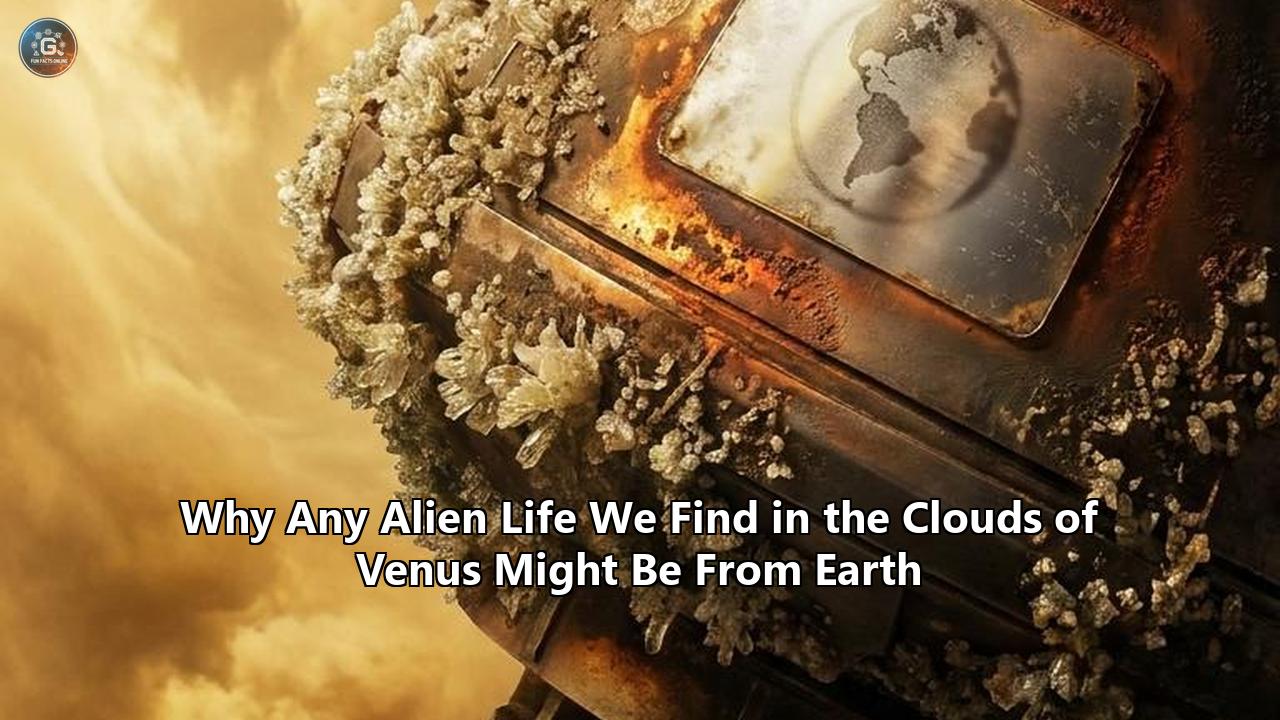
A new mathematical analysis presented at the 2026 Lunar and Planetary Science Conference (LPSC) has calculated that asteroid impacts over the last 1 billion years have launched approximately 20 billion viable terrestrial cells directly into the cloud deck of Venus. This quantitative modeling, conducted by researchers at the Johns Hopkins University Applied Physics Laboratory (JHUAPL) and Sandia National Laboratories, indicates that a steady stream of roughly 100 viable Earth-born cells enters the Venusian atmosphere every single year.
The publication of this study coincides with intense preparations for the summer 2026 launch of the Rocket Lab Venus Life Finder mission—the first-ever privately funded interplanetary probe designed to search for organic compounds in the Venusian clouds. This $10 million mission will deploy a 17-kilogram atmospheric probe equipped with an Autofluorescence Nephelometer (AFN). During its rapid five-minute descent through the highly acidic cloud layers between 45 and 65 kilometers altitude, the instrument will scan individual droplets for the UV fluorescent signature of organic molecules.
However, these concurrent developments have reignited intense debates over whether any signs of life on Venus would represent a truly independent genesis of biology, or merely the discovery of long-lost terrestrial descendants. If the upcoming mission or its successors detect organic compounds or living organisms, there is a distinct, mathematically sound possibility that these microbes originally hailed from Earth.
           TERRESTRIAL CELL TRANSFER TO VENUS
  ┌──────────────────────────────────────────────────┐
  │  Total Ejected Cells (4.5 Gyr): ~10^20 - 10^23   │
  └────────────────────────┬─────────────────────────┘
                           │
                           ▼ (Shock Survival & Ejection)
  ┌──────────────────────────────────────────────────┐
  │  Surviving Escape Velocity: 1% - 10%             │
  └────────────────────────┬─────────────────────────┘
                           │
                           ▼ (Interplanetary Transit: Radiation & Vacuum)
  ┌──────────────────────────────────────────────────┐
  │  Intersecting Venus Orbit: ~0.1% - 1%            │
  └────────────────────────┬─────────────────────────┘
                           │
                           ▼ (Atmospheric Entry & "Pancaking" Dispersal)
  ┌──────────────────────────────────────────────────┐
  │  Delivered to Cloud Deck: 20 Billion (Last 1 Gyr)│
  └──────────────────────────────────────────────────┘
The Dynamics of Interplanetary Lithopanspermia
The natural transport of viable organisms between planetary bodies, known as lithopanspermia, relies on a highly energetic chain of ballistic events. For a terrestrial microbe to find its way to Venus, it must first survive a massive asteroid impact on Earth. This impact must generate pressures high enough to accelerate surface rocks beyond Earth’s escape velocity of 11.186 kilometers per second, but low enough to prevent thermal sterilization of the biological material inside the rock.
Ballistics of Impact Ejection
When an asteroid with a diameter of 10 kilometers—similar to the Chicxulub impactor—strikes Earth at a velocity of 20 kilometers per second, it transfers roughly $10^{23}$ Joules of kinetic energy to the crust. This release of energy vaporizes the impactor and a massive volume of target rock, creating a transient crater up to 100 kilometers wide.
Adjacent to this zone of total melting and vaporization lies the "spall zone." In this region, near-surface rocks experience a phenomenon where the shock wave reflecting off the free surface of Earth cancels out the compressive stresses. This interference allows rock fragments to be accelerated to hypervelocities while experiencing relatively low shock pressures and minimal heating.
- Peak Shock Pressures: Spall-zone ejecta escape the planet while experiencing shock pressures between 10 and 40 Gigapascals (GPa).
- Post-Shock Heating: Under these pressures, the temperature rise in basaltic or granitic rocks remains below 100°C to 150°C, which is well within the survival limits of many bacterial endospores.
- Ejecta Volume: Hydrodynamic simulations indicate that a Chicxulub-scale impact ejects approximately $10^7$ to $10^8$ metric tons of unsterilized crustal rock directly into heliocentric orbits.
Orbital Trajectories and Transfer Efficiency
Once liberated from Earth’s gravitational well, these rocky fragments travel along heliocentric orbits. Over millions of years, gravitational perturbations from Earth, Venus, and Jupiter constantly alter their trajectories.
Numerical integrations of these orbital pathways yield highly consistent transfer dynamics:
| Parameter | Earth-to-Venus Transfer | Mars-to-Earth Transfer |
|---|---|---|
| Typical Velocity at Infinite Distance ($v_{\infty}$) | 2.5 to 5.0 km/s | 3.0 to 6.0 km/s |
| Mean Transit Time to Destination | 100,000 to 1,000,000 years | 500,000 to 2,000,000 years |
| Direct Express Routes (< 100 years) | 0.01% of ejecta | 0.005% of ejecta |
| Total Orbit Intersection Probability | 0.5% to 1.5% | 1.0% to 5.0% |
| Average Velocity during Destination Entry | 11.5 to 13.5 km/s | 17.5 to 22.5 km/s |
Because Venus lies closer to the Sun, terrestrial ejecta must drop inward against the solar gravity gradient. This path is highly efficient. Gravitational focus from Venus’s mass—which is 81.5% of Earth's—substantially increases the collision cross-section for incoming terrestrial meteorites, making Venus a highly receptive target for Earth's ejected material.
Quantifying the Transfer: The Venus Life Equation
To rigorously evaluate the likelihood of lithopanspermia, the JHUAPL and Sandia National Laboratories team utilized the Venus Life Equation (VLE). First formulated by planetary scientists in 2021 as a structured framework to assess astrobiological probabilities, the VLE operates similarly to the Drake Equation. It multiplies several distinct physical and biological factors to calculate the potential density of viable organisms delivered to Venus.
$$L = O \times R \times C$$
Where:
- $L$ is the likelihood of extant, viable life on Venus.
- $O$ represents the origination and seeding factor (the rate of viable cell delivery or local abiogenesis).
- $R$ represents the robustness and survival of the organisms during transit and delivery.
- $C$ is the continuity factor, representing the long-term habitability and stability of the cloud environment.
                THE VENUS LIFE EQUATION (VLE)
               ┌─────────────────────────────┐
               │        L = O x R x C        │
               └──────────────┬──────────────┘
                              │
         ┌────────────────────┼────────────────────┐
         ▼                    ▼                    ▼
   Origination (O)      Robustness (R)       Continuity (C)
  • Abiogenesis rate   • Vacuum survival    • Cloud stability
  • Ballistic seeding  • Radiation limits   • Solvent survival
  • Spall-zone ejecta  • Thermal tolerance  • Metabolic growth
Modeling the "Pancake" Entry and Dispersal
A major challenge of lithopanspermia is surviving atmospheric entry. When a terrestrial meteorite hits Venus's thick carbon dioxide atmosphere, it experiences extreme deceleration and frictional heating.
To model this, the 2026 study applied the "pancake model" of bolide fragmentation.
- Atmospheric Compression: As a large meteoroid enters the upper atmosphere of Venus at roughly 12 kilometers per second, the pressure on its leading face quickly exceeds the mechanical strength of the rock.
- Deformation and Flattening: Instead of remaining a solid block, the meteoroid flattens laterally into a pancake-like shape. This significantly increases its cross-sectional area.
- Horizontal Airburst Dispersal: The rapid increase in surface area leads to a catastrophic airburst at high altitudes, typically between 60 and 80 kilometers above the surface.
- Cloud Deck Drop: This explosive fragmentation disperses fine dust and individual mineral grains horizontally across thousands of square kilometers. Any biological cells trapped within the rock's micro-fissures are released gently into the cooler upper layers of the atmosphere, avoiding the extreme thermal ablation that destroys the meteoroid's core.
The JHUAPL and Sandia team integrated these entry mechanics with estimated terrestrial crustal cell densities (averaging $10^6$ to $10^9$ cells per gram of rock in deep subsurface aquifers and surface soil).
Their models yielded two primary scenarios for the delivery of Earth-born cells:
Scenario A: The Continuous Low-Density Drift
In this highly conservative model, the calculations account only for small, routine impacts on Earth that launch minor amounts of ejecta.
- Yearly Seeding Rate: Roughly 100 viable cells are dispersed into the Venusian cloud deck per Earth year.
- Cumulative 1-Billion-Year Yield: Approximately 20 billion viable cells delivered.
- Survival Profile: Microbes travel inside small, sub-millimeter dust grains that decelerate high in the Venusian atmosphere, avoiding high temperatures.
Scenario B: Catastrophic Bolide Airbursts
In this model, major impacts on Earth (such as the Chicxulub or Sudbury events) launch billions of tons of crustal material into space all at once.
- Event Frequency: Occurs every 30 to 100 million years.
- Viable Entry Yield: Hundreds of billions of viable cells are delivered in a single, massive atmospheric deposition event.
- Dispersal Mechanics: The sudden airburst of massive Earth meteoroids in Venus's upper atmosphere blankets large swaths of the cloud deck with a fine mist of viable endospores.
Biological Resilience in Space and Entry
For a terrestrial cell to successfully seed Venus, it must withstand three distinct, highly hostile regimes: the physical shock of ejection, the extreme conditions of interplanetary transit, and the thermal forces of atmospheric entry. Quantitative experiments on extreme biological organisms on Earth have proven that these barriers are far from absolute.
       STAGES OF SURVIVAL AND CRITICAL BIOLOGICAL LIMITS
  ┌────────────────────────────────────────────────────────┐
  │ 1. EJECTION SHOCK                                      │
  │    • Peak Shock Limit: 32 - 40 Gigapascals (GPa)       │
  │    • Critical Organism: Bacillus subtilis endospores   │
  └───────────────────────────┬────────────────────────────┘
                              │
                              ▼
  ┌────────────────────────────────────────────────────────┐
  │ 2. INTERPLANETARY TRANSIT                              │
  │    • Ionizing Radiation Limit: 15,000 Gray (Gy)        │
  │    • Temperature Range: 10 Kelvin to 350 Kelvin        │
  │    • Critical Organism: Deinococcus radiodurans        │
  └───────────────────────────┬────────────────────────────┘
                              │
                              ▼
  ┌────────────────────────────────────────────────────────┐
  │ 3. VENUS ENTRY & DISPERSAL                             │
  │    • Peak Deceleration: 60 - 200 Gs                     │
  │    • Peak Interior Temp: < 120°C                        │
  │    • Dispersal Altitude: 45 - 65 Kilometers            │
  └────────────────────────────────────────────────────────┘
Shock Tolerance and Acceleration Survival
Ejection from Earth’s crust requires survival of extreme shock pressures. Over the past two decades, researchers have utilized light-gas guns to subject various extremophiles to simulated impact forces:
- Spore-Forming Bacteria (Bacillus subtilis): High-velocity impact tests demonstrate that Bacillus subtilis endospores survive shock pressures up to 32 GPa. At these pressures, the survival rate is roughly 1 in $10^5$, which is more than sufficient given the massive starting populations in terrestrial soil.
- Cyanobacteria (Chroococcidiopsis): These photosynthetic organisms survive shock pressures up to 10 GPa. They could potentially survive ejecta originating from shallow lakebeds or ocean sediments.
- Lichens (Xanthoria elegans): These composite organisms survive shocks up to 22 GPa, showcasing the resilience of eukaryotic systems to high mechanical stress.
The Interplanetary Transit Environment
During the journey from Earth to Venus, organisms face a vacuum with pressures down to $10^{-14}$ Pascal, temperatures near absolute zero (10 Kelvin), and intense radiation.
Ionizing Radiation
Interplanetary space is filled with Galactic Cosmic Rays (GCRs) and Solar Particle Events (SPEs). GCRs deliver a steady radiation dose of approximately 0.1 to 0.2 Gray (Gy) per year, while SPEs can deliver thousands of Grays in a matter of hours.
- The bacterium Deinococcus radiodurans can survive acute radiation doses up to 15,000 Gy with zero loss of viability, and up to 5,000 Gy with minimal DNA damage.
- In space, D. radiodurans repairs its shattered double-stranded DNA within hours of rehydration by utilizing redundant genomic copies (typically 4 to 10 per cell).
Ultraviolet (UV) Radiation
Solar UV radiation (specifically UVC at 200–280 nm) is highly lethal because it directly damages nucleic acids. However, a dust shield only a few micrometers thick is enough to block this radiation.
Data from the European Space Agency’s EXPOSE missions on the International Space Station (ISS) demonstrated that Bacillus subtilis spores mixed with simulated meteorite dust survived 18 months of open space exposure with a survival rate exceeding 50%. Shielded from UV light inside rocky fissures, these spores can remain viable in space for up to several million years.
       EXTREMOPHILE TOXICOLOGICAL & PHYSICAL LIMITS
┌─────────────────────────┬─────────────────────────────────┐
│ Stressor                │ Maximum Known Survival Limit    │
├─────────────────────────┼─────────────────────────────────┤
│ Shock Pressure          │ 32 GPa (B. subtilis)            │
│ Ionizing Radiation      │ 15,000 Gray (D. radiodurans)    │
│ Thermal Extremes (Dry)  │ -270°C to +140°C                │
│ Acceleration (Static)   │ 400,000 G (E. coli)             │
│ Vacuum Pressure         │ 10^-14 Pa (Endospores)          │
└─────────────────────────┴─────────────────────────────────┘
The Venusian Cloud Deck: A Viable Ecological Niche
While the surface of Venus is incredibly hostile—with a temperature of 450°C and pressures of 92 bar—the planet's cloud deck, located between 48 and 60 kilometers altitude, is one of the most temperate zones in the solar system.
- Temperature Range: 0°C to 60°C (with 30°C / 86°F occurring at roughly 50 kilometers altitude).
- Atmospheric Pressure: 0.4 to 1.1 bar, nearly identical to sea-level pressure on Earth.
- Solar Irradiation: Abundant sunlight, suitable for photosynthesis or UV-based metabolic pathways.
For these reasons, the search for life on Venus has shifted from the parched surface to these temperate cloud decks.
                 THE VENUSIAN CLOUD LANDSCAPE
 ┌────────────────────────────────────────────────────────┐  ~ 65 km
 │  Upper Cloud Deck: -20°C to 0°C | 0.1 bar              │
 ├────────────────────────────────────────────────────────┤  ~ 50 km
 │  Temperate Zone:   20°C to 50°C | 0.5 to 1.0 bar       │  <-- Target Zone
 ├────────────────────────────────────────────────────────┤  ~ 45 km
 │  Lower Cloud Deck: 60°C to 90°C | 2.0 bar              │
 ├────────────────────────────────────────────────────────┤
 │                                                        │
 │                                                        │
 │  Supercritical CO2 Atmosphere                          │
 │                                                        │
 │                                                        │
 ├────────────────────────────────────────────────────────┤  ~ 0 km
 │  Surface: 450°C | 92 bar (Lead-melting heat)           │
 └────────────────────────────────────────────────────────┘
The Acid Solvent Paradox
The primary obstacle to life in these clouds is their chemical composition. The droplets are not composed of water, but rather 80% to 95% concentrated sulfuric acid ($H_2SO_4$). Historically, scientists assumed this high acidity would quickly destroy all organic molecules via rapid dehydration and acid hydrolysis.
However, a series of chemical studies led by MIT researchers between 2023 and 2025 disproved this assumption.
- Amino Acid Stability: The MIT team suspended 20 biogenic amino acids in concentrated sulfuric acid (81% and 98% $H_2SO_4$ solutions). They found that 11 of these amino acids (including alanine, glycine, valine, and leucine) remained completely stable and unmodified for weeks. The remaining nine experienced minor modifications only on their side chains, while their primary peptide structures remained fully intact.
- Nucleobase Integrity: In a 2023 study published in the Proceedings of the National Academy of Sciences (PNAS), researchers demonstrated that the nucleic acid bases adenine, cytosine, guanine, thymine, and uracil remain stable in concentrated sulfuric acid. The molecules did not degrade, indicating that the genetic building blocks of Earth-based DNA and RNA could physically survive in this environment.
Understanding these chemical tolerances is essential for any future search for life on Venus.
Sulfuric acid is highly polar and can act as an alternative solvent for biochemical reactions. While it behaves as a disruptive dehydrating agent to unadapted terrestrial cells, specialized organisms could use it as a stable medium.
If Earth-born microbes were deposited into this cloud deck, those capable of surviving extreme acid conditions (such as the iron-oxidizing Picrophilus oshimae, which grows at a pH of -0.06) would have a clear evolutionary head start.
Anthropogenic Seeding: Modern Spacecraft Contamination
While lithopanspermia has been transporting Earth-born material to Venus for billions of years, a much faster pathway has emerged over the last seven decades: human space exploration.
Beginning with the Soviet Union's Venera 1 in 1961, humanity has sent dozens of robotic probes to Venus. Many of these probes entered the atmosphere or landed on the surface, potentially carrying viable terrestrial microbes.
The Limits of Category II Planetary Protection
The Committee on Space Research (COSPAR) establishes international standards to prevent forward contamination of other worlds. Under these guidelines, space missions are categorized by risk:
- Category I: Missions to bodies with no direct scientific interest for the origin of life (e.g., Mercury). No planetary protection requirements.
- Category II: Missions to bodies of significant interest for the origin of life, but where there is only a remote chance that contamination would compromise future science. Venus is classified under Category II.
- Category IV: Missions to bodies with a high chance of hosting life, where contamination could easily ruin scientific investigations (e.g., Mars). These missions face strict sterilization requirements.
                     COSPAR MISSION CATEGORIES
 ┌──────────────────────┬───────────────────────────────────────────┐
 │ Category             │ Requirements / Target Bodies              │
 ├──────────────────────┼───────────────────────────────────────────┤
 │ Category I           │ No requirements (Mercury, Asteroids)      │
 ├──────────────────────┼───────────────────────────────────────────┤
 │ Category II          │ Simple documentation, flybys/landers      │
 │                      │ (Venus, Moon, Jovian Gas Giants)          │
 ├──────────────────────┼───────────────────────────────────────────┤
 │ Category III / IV    │ Active bioburden reduction, cleanrooms    │
 │                      │ (Mars, Europa, Enceladus)                 │
 └──────────────────────┴───────────────────────────────────────────┘
Because Venus is categorized under Category II, missions are only required to provide basic post-launch documentation. They do not undergo the rigorous dry-heat microbial reduction or cleanroom assembly protocols mandated for Mars landers.
Quantifying the Spacecraft Bioburden
A typical unsterilized spacecraft assembled in a standard industrial cleanroom carries a significant biological load (bioburden).
$$\text{Bioburden} = A \times D_{\text{surf}}$$
Where:
- $A$ is the total surface area of the spacecraft.
- $D_{\text{surf}}$ is the surface spore density (typically averaging $10^4$ to $10^5$ viable endospores per square meter on unsterilized aerospace components).
Applying this calculation to historical Venus missions reveals a high probability of biological seeding:
| Spacecraft / Probe | Launch Year | Estimated Surface Area ($m^2$) | Estimated Bioburden at Launch (Spores) | Entry / Landing Outcome |
|---|---|---|---|---|
| Venera 4 | 1967 | 12.5 | $1.25 \times 10^6$ | Crushed in atmosphere at 26 km altitude. |
| Pioneer Venus Large Probe | 1978 | 4.8 | $4.80 \times 10^5$ | Impacted surface; did not survive. |
| Pioneer Venus Small Probes (3) | 1978 | 6.3 (combined) | $6.30 \times 10^5$ | Impacted surface; one transmitted for 67 min. |
| Venera 13 | 1981 | 18.2 | $1.82 \times 10^6$ | Survived on surface for 127 minutes. |
| Vega 1 & 2 Balloons | 1985 | 15.4 (combined) | $1.54 \times 10^6$ | Floated in the cloud deck at 54 km for 46 hours. |
The Case of the Soviet Vega Balloons
The 1985 Vega 1 and Vega 2 missions are particularly notable for forward contamination risks. Each mission deployed a helium-filled balloon into the temperate Venusian cloud deck at an altitude of approximately 54 kilometers.
These balloons were made of a teflon-matrix fabric coated with an organic fluoropolymer. They drifted in the atmosphere for over 46 hours, directly exposing their surfaces to the temperate, 30°C cloud environment.
                VEGA BALLOON IN THE VENUSIAN SKY (1985)
                       ┌─────────────────┐
                       │  Helium Balloon │ <-- Unsterilized Teflon surface
                       └────────┬────────┘     (Carrying up to 10^6 spores)
                                │
                        Cloud   │ 54 km Altitude
                     Droplets   │ (Temperate 30°C Zone)
                       o   o   o│o   o   o
                      o   o   ┌─┴─┐ o   o
                       o  o   │   │ o  o   <-- Gondola with instruments
                              └───┘
Because these balloons were not fully sterilized before launch, they may have introduced millions of viable, spore-forming terrestrial bacteria (such as Bacillus and Clostridium species) directly into the cloud droplets.
If these spores survived the acidic conditions, this historical mission may have initiated the active seeding of the planet with terrestrial life. Consequently, this opens up the possibility that the first confirmed discovery of life on Venus could simply be our own spacecraft contamination returned to us.
Technical Specifications: The 2026 Morning Star Mission
To determine if organic chemistry is active in the clouds of Venus, Rocket Lab and MIT are launching the Venus Life Finder mission.
- Launch Vehicle: Rocket Lab Electron rocket.
- Spacecraft Bus: High-performance Photon Explorer cruise stage.
- Total Wet Mass: 300 kilograms.
- Atmospheric Probe Mass: 17 kilograms (37 pounds).
- Probe Diameter: 40 centimeters (16 inches).
- Total Mission Budget: < $10 million.
                 ROCKET LAB PROBE SYSTEM ARCHITECTURE
    ┌─────────────────────────────────────────────────────────────┐
    │ Photon Explorer Cruise Stage                                │
    │ • Deep-space tracking, S-band communications                │
    │ • Monopropellant propulsion for trajectory adjustments      │
    └──────────────────────────────┬──────────────────────────────┘
                                   │
                                   ▼ (Separation 30 mins before entry)
    ┌─────────────────────────────────────────────────────────────┐
    │ Atmospheric Entry Probe (17 kg, 40 cm diameter)            │
    │ • Carbon-phenolic heat shield (Woven thermal protection)    │
    │ • Relies on aerodynamic drag (No parachute system)         │
    ├─────────────────────────────────────────────────────────────┤
    │ Scientific Payload: Autofluorescence Nephelometer (AFN)     │
    │ • Mass: < 1 kg | Power: < 50 Watts                         │
    │ • Light Source: 440 nm UV Laser Diode                       │
    │ • Detectors: Dual photodetectors (30° and 150° angles)       │
    └─────────────────────────────────────────────────────────────┘
The Autofluorescence Nephelometer (AFN) Instrument
The probe's single, highly specialized instrument is the Autofluorescence Nephelometer (AFN), designed to operate under low-power and tight mass constraints:
- Mass: < 1.0 kilogram.
- Power Consumption: < 50 Watts.
- Excitation Source: 440-nanometer (blue/UV) semiconductor laser diode.
- Detection Bands: Scattered light at 440 nm; fluorescent emissions between 470 and 520 nm.
- Sampling Frequency: Measures individual aerosol particles at a rate of up to 10,000 particles per second.
Operation During Descent
The probe will enter the night-side atmosphere of Venus to eliminate solar background light, which would otherwise interfere with the sensitive optical sensors of the AFN.
                 AFN OPTICAL MEASUREMENT PATHWAY

                          [440 nm Laser Diode]
                                  │
                                  ▼ (Excitation beam)
  Incoming Droplet  ────>         * <─── (Fluorescence of organic rings)
                                 / \
      (30° Scatter)             /   \             (150° Backscatter)
      Measures size ──────────> /     \ <────────── Measures particle
and refractive index [PMT 1] [PMT 2] asphericity (solid cores)- High-Altitude Entry: The probe enters the upper atmosphere at 11 kilometers per second, using a carbon-phenolic heat shield to absorb the extreme thermal shock.
- Deceleration Peak: Peak deceleration forces reach 60 Gs.
- Active Sampling Window: Upon entering the upper cloud deck at 65 kilometers, a protective optical window opens. For exactly five minutes, as the probe falls from 65 km to 45 km, the AFN continuously shoots its laser through the streaming clouds.
- Organic Fluorescent Detection: As sulfuric acid droplets pass through the laser beam, any organic molecules containing delocalized ring electrons (such as amino acids or polycyclic aromatic hydrocarbons) will absorb the 440 nm light and fluoresce at longer wavelengths (470–520 nm).
- Sphericity Measurements: Dual photodetectors placed at 30-degree and 150-degree angles will simultaneously measure backscatter. This allows the instrument to determine if the droplets are perfect liquid spheres (pure sulfuric acid) or irregular, aspherical particles. Irregular shapes would indicate solid mineral cores or potential biological structures suspended within the acid.
- Data Transmission: At 45 kilometers altitude, the cloud deck ends and temperatures rise quickly toward 200°C. The probe has roughly 20 minutes to transmit its data back to the orbiting Photon stage before the intense heat destroys its electronics.
Astrobiology Fleet: Comparing Core Missions
While Rocket Lab's mission is a private, low-cost pathfinder, several space agencies are preparing larger missions to Venus over the next decade. These missions will deploy advanced chemical laboratories to analyze the planet's atmospheric composition.
                  COMPARING VENUS EXPLORATION ROADMAP
 ┌───────────────────┬──────────────────┬──────────────────┬────────────────┐
 │ Mission Profile   │ Rocket Lab VLF   │ NASA DAVINCI     │ UK/ESA VERVE   │
 ├───────────────────┼──────────────────┼──────────────────┼────────────────┤
 │ Target Launch     │ Summer 2026      │ Early 2030s      │ ~2031          │
 │ Wet Mass          │ 300 kg           │ ~3,000 kg        │ ~150 kg        │
 │ Probe Mass        │ 17 kg            │ ~220 kg          │ N/A (Orbiter)  │
 │ Payload           │ AFN Nephelometer │ VMS Mass Spec,   │ Sub-mm         │
 │                   │                  │ TLS Laser Spec   │ Spectrometer   │
 │ Est. Cost         │ < $10 Million    │ ~$500 Million    │ ~$58 Million   │
 └───────────────────┴──────────────────┴──────────────────┴────────────────┘
NASA's DAVINCI Mission
- Mission Profile: A deep-atmosphere descent probe and flyby spacecraft slated for launch in the early 2030s.
- Science Instruments:
Venus Mass Spectrometer (VMS): Directly measures noble gases, trace gases, and heavy organic isotopes during a 63-minute descent.
Tunable Laser Spectrometer (TLS): Measures concentrations of water vapor, sulfur compounds, carbon dioxide, and potential phosphine markers.
- Objective: Provide the first comprehensive chemical profile of the Venusian atmosphere from the clouds down to the surface.
The UK-Led VERVE Proposal
- Mission Profile: The Venus Explorer for Reduced Vapours in the Environment (VERVE) is a $58 million mission proposed in late 2025.
- Payload: High-sensitivity sub-millimeter spectrometers.
- Objective: Map the distribution of phosphine ($PH_3$) and ammonia ($NH_3$) gases in the upper atmosphere to determine if their origin is volcanic or biological.
Forensic Astrobiology: Distinguishing Earthly Descendants
If the AFN on Rocket Lab's probe or the mass spectrometers on DAVINCI detect complex organic compounds, scientists must determine their origin. Did they arise from an independent origin of life, or are they descendants of Earth-born organisms delivered by lithopanspermia or historical spacecraft contamination?
                         FORENSIC BIOCHEMICAL FILTERS

  Incoming Biological Sample ───────> [TEST 1: Chirality Filter]
                                        │
                                        ├─── L-Aminos/D-Sugars Only ────> (Terrestrial Match)
                                        │
                                        └─── Symmetric/Racemic Mixtures ──> (Prebiotic Chemistry)
                                        │
                                        ▼ (Alternative Chirality)
                                      [TEST 2: Genetic Scaffold]
                                        │
                                        ├─── Standard A-T-G-C-U DNA ─────> (Terrestrial Match)
                                        │
                                        └─── 8-Base / Alternative DNA ───> (Potential Alien Genesis)
                                        │
                                        ▼ (Isotopic Signature)
                                      [TEST 3: Deuterium Ratio]
                                        │
                                        ├─── Low Earth D/H Ratio ────────> (Earth-Born Hitchhiker)
                                        │
                                        └─── 150x Deuterium Enrichment ──> (Indigenous Venusian)
To resolve this question, astrobiologists have established a set of molecular "forensic filters."
1. Optical Chirality (Enantiomeric Ratios)
All life on Earth is homochiral: it uses exclusively left-handed (L) amino acids to build proteins and right-handed (D) ribose sugars to construct DNA and RNA.
- Terrestrial Match: If Venusian organic samples exhibit a strict L-amino acid and D-sugar bias, they are highly likely to be of terrestrial origin.
- Alien Genesis: A prebiotic or independent origin would likely display a racemic mixture (a 50/50 balance of left- and right-handed forms) or utilize the opposite chiral configuration (D-amino acids and L-sugars).
2. Genetic Architecture and the Nucleobase Toolkit
Terrestrial life uses a highly specific genetic alphabet consisting of five primary nucleobases: Adenine, Thymine, Guanine, Cytosine, and Uracil (A, T, G, C, U).
- Terrestrial Match: Organisms utilizing the standard 20 biogenic amino acids and the exact same five-nucleobase genetic code are likely related to Earth.
- Alien Genesis: Finding alternative genetic structures—such as expanded genetic alphabets (e.g., the synthetic eight-base Hachimoji DNA system) or alternative amino acids like alpha-methyl amino acids—would point to a separate origin of life.
3. Deuterium-to-Hydrogen (D/H) Isotopic Signatures
Because Venus has lost most of its lighter hydrogen ($^1\text{H}$) to space over billions of years, its atmosphere is highly enriched in the heavier isotope, deuterium ($^2\text{H}$ or $\text{D}$).
- Venus Atmospheric Ratio: The D/H ratio in the Venusian atmosphere is roughly 150 times higher than that of Earth's oceans.
- Indigenous Venusian Life: Any indigenous microbes that evolved on Venus over billions of years would use local water sources. Their cellular structures would reflect this extreme deuterium enrichment.
- Terrestrial Hitchhikers: Modern spacecraft contaminants or recently delivered Earth-born cells would maintain Earth’s low D/H ratio. Over millions of years, evolutionary adaptation might shift this ratio, but recent arrivals would remain distinct.
The Road Ahead for Venusian Astrobiology
With Rocket Lab's Venus Life Finder mission targeting a launch in the summer of 2026, the scientific community is on the verge of obtaining its first direct, in-situ measurements of Venus's cloud chemistry in more than forty years. The data returned by this mission will shape our understanding of atmospheric chemistry and help refine the search parameters for larger missions like NASA's DAVINCI and ESA's EnVision.
As these probes venture to our sister planet, they must carry refined planetary protection protocols and advanced detection instruments. If signs of life are found within the acid-drenched clouds, the challenge will be to determine its true origin: is it a brand-new branch of the tree of life, or a long-lost terrestrial relative that made the ultimate interplanetary journey?
References
- Nautil.us (September 30, 2025) "The first private mission to the morning star..."
- Sciencenews.org (March 3, 2025) "Droplets of Venus' clouds may someday come to Earth..."
- Sciencedaily.com (June 25, 2026) "Earth may have been seeding Venus with life for billions of years..."
- Sci.news (March 20, 2024) "Could Earth's sister planet actually host life..."
- Forbes (July 10, 2025) "A U.K.-led mission aims to determine if microbial life exists in Venus's clouds..."
- Wikipedia: Venus Life Finder Mission Profile.
- Supercluster.com (April 8, 2025) "The mission — tentatively called the Rocket Lab mission to Venus..."
- Planetary.org "Rocket Lab is partnering with MIT to develop the Venus Life Finder mission..."
- Aero-space.eu (January 5, 2026) "Rocket Lab is continuing preparations for what it describes as the first private mission to Venus..."
- Morningstarmissions.space "Scientific output: Detect and derive particle size and number density..."
- CNES (2024) "The COSPAR Policy on Planetary Protection..."
- CNES (2024) "Planetary Protection Category IV and V standards..."
- NASA Jet Propulsion Laboratory (2024) "Planetary Protection Metagenomics in Spaceflight..."
- Hayadan.com (June 3, 2026) "Panspermia: Earth to Venus orbital dynamics and modeling..."
- Skyatnightmagazine.com (November 15, 2023) "Results of the EXPOSE experiments on the ISS..."
- Sciencealert.com (April 12, 2026) "Using the Venus Life Equation..."
- Wikipedia: Panspermia theory, lithopanspermia, and directed panspermia.
Reference:
- https://www.sciencedaily.com/releases/2026/06/260625014805.htm
- https://nautil.us/seeking-signs-of-life-on-venus-1238038
- https://aero-space.eu/2026/01/05/rocket-lab-advances-plans-for-a-private-venus-probe-targeting-a-2026-launch/
- https://en.wikipedia.org/wiki/Venus_Life_Finder
- https://www.supercluster.com/editorial/rocket-labs-daring-mission-to-venus-will-search-for-signs-of-life
- https://www.morningstarmissions.space/rocketlabmissiontovenus
- https://www.sciencealert.com/if-venus-has-life-it-may-have-come-from-earth-scientists-say
- https://www.skyatnightmagazine.com/space-science/panspermia-life-theory
- https://en.wikipedia.org/wiki/Panspermia
- https://www.forbes.com/sites/jamiecartereurope/2025/07/10/new-uk-mission-could-prove-signs-of-alien-life-on-venus/
- https://www.planetary.org/space-missions/rocket-lab-venus-mission
- https://www.sciencenews.org/article/venus-life-signs-private-mission
- https://www.sci.news/space/venus-clouds-habitability-12782.html
- https://cosparhq.cnes.fr/assets/uploads/2021/01/Research_Outreach_PPP_2020.pdf
- https://cosparhq.cnes.fr/assets/uploads/2020/07/PPPolicyJune-2020_Final_Web.pdf
- https://sma.nasa.gov/docs/default-source/sma-disciplines-and-programs/planetary-protection/mpz_pp_standards_noanimation.pdf?sfvrsn=b3f7d7f8_0
- https://hayadan.com/earth-seeding-venus-clouds-life