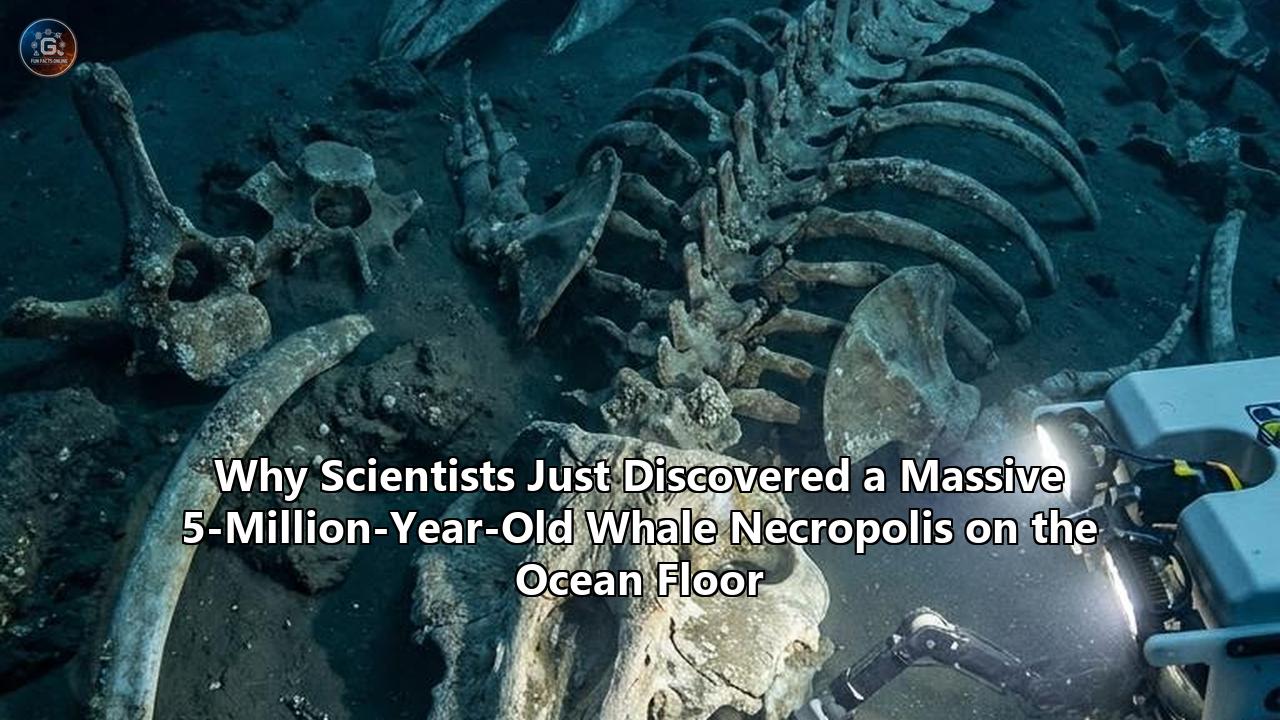
On June 10, 2026, a team of international scientists announced one of the most astonishing deep-sea discoveries of the 21st century: a massive 5-million-year-old "necropolis" of whales lying on the floor of the southeastern Indian Ocean. Located deep within the Diamantina Fracture Zone, a rugged rift valley that splits the seafloor between Australia and Antarctica, this sprawling graveyard contains the remains of nearly 500 whales preserved across a 1,200-kilometer (745-mile) corridor.
Published in the journal Nature, the study reveals that this cetacean cemetery is not only the largest and deepest ever found, but also the oldest. Some of the specimens lie at staggering depths of up to 7,002 meters (22,972 feet)—deep within the hadal zone, where life exists under crushing pressures and in complete, freezing darkness.
"We did not expect to find this massive graveyard for whales," says lead author Xiaotong Peng, a deep-sea researcher at the Chinese Academy of Sciences' Institute of Deep-Sea Science and Engineering (IDSSE). "Finding an isolated whale fall here or there would not have been surprising, but we have never seen anything on this scale before."
This discovery challenges long-held assumptions about how organic carbon is sequestered in the deepest parts of our oceans and how deep-sea species disperse across thousands of miles of otherwise barren seafloor. Beyond the ecological implications, the discovery of these ancient whale fossils provides paleontologists with a continuous evolutionary archive dating back 5.3 million years to the Early Pliocene. To unravel how such a colossal graveyard formed, and why it survived intact for millions of years, scientists must weigh competing geological, biological, and technological approaches.
The Anatomy of a Hadal Graveyard
The expedition, conducted in 2023 under the Global Hadal Exploration Programme (GHEP), was not initially looking for whale bones. The research vessel R/V Tansuoyihao was exploring the Diamantina Zone's extreme trenches to study tectonic fluid activities and deep-sea mineral chemistry. However, when the mechanical arms of their deep-sea submersible illuminated a series of dense, white structures protruding from the dark sediment, the mission’s focus immediately shifted.
Over the course of 32 targeted dives, the scientific team systematically mapped the area, documenting 485 individual whale fall sites. Within this "supercorridor," they identified 476 fossilized skeletons alongside five active whale falls—carcasses of more recently deceased whales still undergoing active biological decomposition.
When a whale dies, its massive body sinks to the seafloor in a process known as a "whale fall." In the nutrient-scarce desert of the deep ocean, a single carcass delivers an enormous burst of organic matter, equivalent to thousands of years of normal "marine snow" (the steady drift of organic debris from the upper ocean).
What makes the Diamantina Zone unique is the sheer density of these events. The team documented an average density of 759.5 whale remains per square kilometer. Extrapolating this across the wider unexplored regions of the fracture zone suggests that this underwater canyon could hold upwards of 10 million carcasses accumulated over millions of years.
This concentration represents a massive, previously unquantified carbon sink. Assuming an average whale mass of two tons, the sequestered carbon in this necropolis is estimated at approximately 6.7 million tons—fundamentally altering our calculations of how carbon is moved and stored in the deep biosphere.
Passive Funnel vs. Active Foraging Trap: Two Competing Theories on the Necropolis' Origin
How did nearly 500 whale skeletons accumulate along a single narrow trench in the southeastern Indian Ocean? Two competing scientific hypotheses have emerged to explain this unprecedented density of ancient whale fossils, representing a fascinating interplay between geology and biology.
The Passive Geomorphological Funnel
The first hypothesis, favored by geophysicists, suggests that the Diamantina Fracture Zone acts as a colossal, passive geological trap. Formed between 50 and 60 million years ago when the Australian and Antarctic tectonic plates tore apart, the zone features a series of steep, V-shaped valleys and chasms.
Proponents of this view argue that deep-ocean currents and gravity combine to funnel sinking carcasses from a wide area into the deepest troughs of the fracture zone. When a whale dies in the upper water column, its carcass begins a long, slow descent. In a flat abyssal plain, these carcasses would be scattered sparsely over thousands of miles.
However, the steep, V-shaped topography of the Diamantina Zone funnels these falling masses down toward the trench floor. This geological "catchment basin" concentrates centuries of whale falls into a narrow, linear corridor, turning it into a natural accumulation point.
The Active Biological Foraging Hotspot
The competing biological hypothesis, presented by marine mammalogists and ecologists, argues that the high density of carcasses reflects an active, long-term biological hotspot. The overwhelming majority of the remains found in the necropolis belong to beaked whales (family Ziphiidae), highly specialized, deep-diving marine mammals.
According to this theory, the waters above the Diamantina Zone have served as a primary foraging ground for beaked whales for at least 5.3 million years. Beaked whales are known to dive to extreme depths to hunt deep-sea squid. However, these dives are physiologically taxing. The maximum physiological dive depth for modern beaked whales is estimated to be around 3,000 meters; diving deeper risks lung collapse, fatal exhaustion, or decompression sickness.
Proponents of the biological hypothesis argue that many of the whales in the necropolis did not merely drift into the trench from elsewhere; rather, they died in situ due to foraging miscalculations, illness, or senescence while diving near their physiological limits.
Weighing the Evidence
While both mechanisms likely played a role, the biological hypothesis offers a more compelling explanation for the unique species composition of the graveyard. If the trench were merely a passive geomorphological funnel, one would expect to see a representative sample of all large pelagic organisms that died in the region, including sharks, giant squid, and a broader variety of baleen whales.
Instead, the striking dominance of beaked whale skulls suggests a highly selective taphonomic filter—one driven by the animals' specific behaviors and ecological preferences. However, the passive funnel model remains essential for explaining why these skeletons have stayed so tightly clustered within the deepest parts of the rift valley, preventing them from being swept away by erratic abyssal currents.
HOVs vs. ROVs: The Tech Battle for the Hadal Zone
Finding and exploring a 1,200-kilometer corridor of bone at depths exceeding 6,000 meters requires highly sophisticated deep-sea technology. The 2023 expedition that yielded this discovery highlights a long-running debate within oceanography: the use of Human-Occupied Vehicles (HOVs) versus Remotely Operated Vehicles (ROVs) and Autonomous Underwater Vehicles (AUVs).
The Case for HOVs: The Fendouzhe Submersible
For this study, researchers utilized China's state-of-the-art human-occupied submersible, Fendouzhe (meaning "Striver"), which conducted 32 dives to the seafloor of the Diamantina Zone. Accommodating up to three scientists, Fendouzhe is designed to withstand the immense pressure of the hadal zone (up to 1,000 atmospheres).
The primary advantage of an HOV is the immediate, high-fidelity spatial synthesis it affords researchers. Inside the titanium cabin, scientists can look through viewport windows and perceive the deep-sea environment with three-dimensional depth perception. This was crucial when the team first spotted the unusual bone fragments.
Because scientists were physically present, they were able to pivot their research objectives instantly. A human crew can recognize the scientific significance of an anomalous geological feature immediately, manual-maneuver the robotic arms with zero signal lag, and coordinate delicate fossil sampling operations on the fly.
The Case for ROVs and AUVs
Conversely, many Western oceanographic institutions have shifted their focus away from manned submersibles toward robotic platforms like ROVs and AUVs. Robotic systems offer several significant advantages over HOVs:
- Unlimited Power and Time: ROVs are tethered to a surface ship, allowing them to stay at the bottom for days or weeks at a time, whereas an HOV like Fendouzhe is strictly limited by battery life and human life-support constraints (typically restricting bottom-time to less than 8 hours).
- Cost and Safety: Operating an HOV is exceptionally expensive and presents an inherent risk to human life. If a structural failure occurs at 7,000 meters, it is catastrophic. ROVs eliminate this risk completely.
- Broader Coverage: AUVs can be programmed to map vast swaths of the ocean floor using sonar, covering far more ground than a slow-moving, manned vehicle.
Technological Synthesis
The Diamantina discovery demonstrates that despite the rise of advanced robotics, human presence remains invaluable for exploratory science. While an AUV might have mapped the topography of the Diamantina Zone, and an ROV could have collected samples, the cognitive synthesis required to identify, map, and systematically study nearly 500 distinct whale falls over a short campaign was dramatically accelerated by having researchers physically present in the trench.
The immediate spatial awareness of the researchers inside Fendouzhe allowed them to perceive the subtle boundaries between fossilized bone and surrounding manganese-encrusted rocks, leading to the highly targeted recovery of fragile cetacean skulls.
| Metric | HOV (e.g., Fendouzhe) | ROV / AUV |
|---|---|---|
| Human Presence | Direct (up to 3 scientists inside the cabin) | Remote (controlled by shipboard pilots) |
| Latency & Control | Zero lag; real-time hand-eye coordination | High latency at hadal depths; control via fiber-optic tether |
| Dive Duration | Highly limited (approx. 6–10 hours due to battery and life support) | Virtually unlimited; power supplied continuously from the surface vessel |
| Cost & Risk | Extremely high; human lives at stake; requires massive surface support | Moderate to low; no risk to human life; smaller footprint |
| Spatial Synthesis | Superior; 3D stereoscopic human vision and contextual awareness | Limited; 2D camera feeds with restricted field of view |
Dating the Depths: Strontium Isotopes vs. Sediment Stratigraphy
Determining the age of bones sitting on the ocean floor for millions of years is a formidable geochemical challenge. For the Diamantina project, researchers had to choose between two fundamentally different dating methodologies: sediment core biostratigraphy and direct strontium isotope dating.
Traditional Sediment Core Biostratigraphy
In typical marine geology, researchers date deep-sea finds by analyzing the surrounding sediment. This method relies on drilling sediment cores near the fossil site and analyzing the layers of microfossils—such as foraminifera, diatoms, and radiolarians—trapped within the silt. By matching these microfossil assemblages to known geological epochs, scientists can establish a relative age for the layers of sediment covering a fossil.
However, this traditional approach faced severe limitations in the Diamantina Fracture Zone:
- Low Sedimentation Rates: The deep, remote trenches of the southeastern Indian Ocean experience incredibly low rates of sedimentation. Without a steady rain of terrestrial dust or biological debris from the surface, sediment accumulates at a rate of only a few millimeters per millennium.
- Current-Driven Erosion: Abyssal currents sweeping through the narrow trenches frequently scour the seafloor, shifting fine sediments and leaving ancient bones completely exposed directly on the basaltic bedrock.
- Stratigraphic Disruption: Because the sediment is thin and constantly disturbed, a relative age based on sedimentary layers would be highly inaccurate and could easily underestimate the age of the fossils by millions of years.
Direct Strontium Isotope Dating
To overcome these limitations, the research team bypassed the surrounding sediment entirely and applied Strontium Isotope Stratigraphy ($^{87}\text{Sr}/^{86}\text{Sr}$) directly to the recovered whale bones.
This technique relies on the fact that the ratio of two strontium isotopes ($^{87}\text{Sr}$ and $^{86}\text{Sr}$) in global seawater has fluctuated in a highly predictable, well-documented pattern over geological time. When a marine organism builds its bones or shell, it incorporates strontium from the surrounding seawater into its mineral lattice (specifically, into the calcium phosphate mineral hydroxyapatite). Because the isotopic ratio of strontium does not change during fossilization or radioactive decay, the $^{87}\text{Sr}/^{86}\text{Sr}$ ratio locked inside the bone acts as a chemical timestamp of the exact time the animal lived.
The team analyzed 43 recovered fossils, successfully dating 33 of them using this method. The strontium isotope ratios revealed a staggering temporal span: while some bones were relatively modern, the oldest fossilized skulls dated back to 5.3 million years ago, indicating continuous accumulation since the Early Pliocene.
The Taphonomic Miracle
Direct strontium isotope dating was only possible because of a unique taphonomic miracle. Under normal circumstances, bone-eating worms of the genus Osedax consume fallen whale skeletons, drilling into the bones to extract lipids and leaving nothing behind within a few decades.
Determining how these ancient whale fossils remained exposed for millions of years without decomposing requires examining several protective factors. First, the bones belonged primarily to beaked whales, whose skull bones (particularly the rostrum, or snout) are exceptionally dense and hypermineralized. This high density resisted the boring mechanisms of Osedax worms.
Second, the slow sedimentation rates allowed dissolved iron and manganese in the seawater to precipitate directly onto the exposed bones. Over millennia, this process coated the bones in a thick, protective crust of ferromanganese oxides, essentially sealing them in armor and shielding them from both biological degradation and chemical dissolution in the corrosive hadal waters.
While the presence of ancient whale fossils at hadal depths presents a unique taphonomic puzzle, strontium isotope dating provided a precise geochronological anchor that sediment analysis never could have achieved.
To Harvest or to Harbor: The Ethical Dilemma of Deep-Sea Sampling
The discovery of the Diamantina necropolis has reignited a deep-seated philosophical debate within the scientific community: should researchers recover these unique geological artifacts for laboratory study, or should they be left undisturbed in situ as active, fragile ecosystems?
The Argument for Extraction
Paleontologists and evolutionary biologists argue that physical recovery of the bones is absolutely necessary to advance science. Deep-diving beaked whales are among the most elusive and poorly understood mammals on Earth; several species are known only from a handful of carcasses that have washed ashore.
By utilizing Fendouzhe’s robotic arms to collect fossil skulls, the international research team was able to perform high-resolution CT scans and comparative anatomical analyses. This led directly to the identification of an entirely new, extinct species of beaked whale, named Pterocetus diamantinae, alongside fossils of other extinct taxa like Pterocetus benguelae.
Without physical recovery, scientists would remain blind to the evolutionary history of these deep-diving cetaceans. "These fossils give us a direct window into the Pliocene," explains study co-author and biologist Xikun Song. "They show that beaked whales were already specialized deep-divers in the Indian Ocean by that time."
The Argument for In-Situ Preservation
On the other side of the debate, deep-sea ecologists and conservationists advocate for a strict "hands-off" approach. A whale fall is not merely a pile of dead bone; it is a vital biological oasis in an otherwise food-starved desert. When a massive whale carcass sinks to the seafloor, it triggers a succession of ecological communities that can persist for up to a century.
          [ STAGE 1: MOBILE SCAVENGER ]
          - Duration: Months to ~2 years
          - Key Fauna: Hagfish, sleeper sharks, crabs
          - Process: Strip soft tissue and blubber
                        │
                        ▼
          [ STAGE 2: OPPORTUNISTIC ]
          - Duration: Months to ~2 years
          - Key Fauna: Snails, bristle worms, crustaceans
          - Process: Feed on organic-rich sediment and bone fragments
                        │
                        ▼
          [ STAGE 3: SULFOPHILIC ]
          - Duration: Decades (up to 50+ years)
          - Key Fauna: Chemosymbiotic clams, tubeworms, Osedax
          - Process: Anaerobic breakdown of bone lipids emits hydrogen sulfide
                        │
                        ▼
          [ STAGE 4: REEF / SKELETAL ]
          - Duration: Centuries to Millennia
          - Key Fauna: Deep-sea corals, anemones, sponges
          - Process: Depleted mineral bones act as hard anchors for colonizers
The Diamantina expedition documented five active whale-fall ecosystems still thriving in the sulfophilic stage at depths of up to 6,789 meters—the deepest active whale falls ever recorded. These active sites are home to an array of highly specialized species, many of which are entirely new to science, including three species of brittle stars that appear to live exclusively on whale bones, and a rare wood-associated sea daisy (Xyloplax sp.) found at record-breaking depths.
Ecologists argue that removing these bones disrupts these highly localized, slow-growing communities. Furthermore, because the bones have remained exposed for over 5 million years, they serve as crucial evolutionary "stepping stones" that allow chemosynthetic species to migrate and maintain genetic connectivity across thousands of miles of deep-sea floor between isolated hydrothermal vents and cold seeps. Removing even a fraction of these bones could disrupt this ancient, delicate "supercorridor".
Finding a Balanced Protocol
The researchers addressed this dilemma by adopting a highly selective sampling protocol. Rather than bulk-harvesting bones, they used the submersible's manipulator arms to recover only a small, representative subset of highly mineralized skulls (43 samples out of 485 sites) that were no longer hosting active, lipid-fueled sulfophilic communities.
The active whale falls, heavily covered in microbial mats and dense populations of bone-boring Osedax worms, were left completely untouched. This hybrid approach allowed paleontologists to extract invaluable evolutionary data while leaving the vibrant, modern ecosystems intact to continue their million-year-old role as deep-sea refugia.
Mapping the Hadal "Supercorridor" of the Future
The discovery of the Diamantina necropolis fundamentally alters our understanding of the deep ocean's role in global biogeography and carbon cycling. By demonstrating that whale falls can remain exposed and active for millions of years at hadal depths, the study opens up new avenues of research for the global scientific community.
A New Model for the Deep-Sea Carbon Sink
Historically, models of global carbon sequestration have focused primarily on "marine snow"—the slow, diffuse rain of microscopic organic debris from the surface to the deep ocean. The Diamantina discovery forces a reassessment of these models.
The presence of millions of tons of sequestered carbon in a localized, hadal trench suggests that the ocean floor may be far more dynamic in its carbon-storage capacity than previously assumed. As nations and scientific organizations seek to quantify natural carbon sinks to combat global climate change, understanding these massive, deep-sea carbon repositories becomes increasingly critical.
Unresolved Questions and Future Milestones
As the Global Hadal Exploration Programme (GHEP) continues to map the deepest trenches of our oceans, several profound questions remain unanswered:
- Are there other hadal necropolises? Scientists suspect that similar mega-graveyards may exist in other core beaked-whale habitats around the globe, such as off the coasts of South Africa, the Iberian Peninsula, or the sub-Antarctic Crozet and Kerguelen islands.
- How do hadal species migrate? Genetic testing of the newly discovered organisms living on the Diamantina bones will reveal whether these whale falls truly act as active evolutionary conduits, linking the ecosystems of the Indian, Pacific, and Atlantic oceans.
- What can they tell us about Pliocene climate change? The continuous, 5-million-year fossil record preserved in the trench offers a high-resolution archive of how whale populations responded to past periods of global warming and shifting ocean currents.
The Diamantina Fracture Zone has transitioned from a remote, unexplored abyssal scar into one of the most significant paleontological and ecological archives on the planet. As deep-sea technologies continue to advance, the secrets locked within this "city of the dead" will undoubtedly continue to reshape our understanding of life, death, and evolution in the final frontier of the deep ocean.
Reference:
- https://gizmodo.com/scientists-have-just-discovered-a-5-million-year-old-whale-necropolis-in-the-deep-sea-2000769050
- https://www.sciencealert.com/giant-whale-graveyard-found-in-the-ocean-is-like-a-drowned-city-of-the-dead
- https://www.theguardian.com/environment/2026/jun/10/deepest-most-extensive-whale-graveyard-discovered-indian-ocean
- https://www.nationalgeographic.com/science/article/whale-graveyard-deep-sea-bones-fossils
- https://www.eurekalert.org/news-releases/1131566
- https://www.iflscience.com/biggest-deepest-whale-graveyard-ever-found-contains-nearly-500-whales-with-some-as-old-as-5-million-years-83776
- https://www.popsci.com/environment/whale-graveyard-indian-ocean/
- https://www.discoverwildlife.com/animal-facts/marine-animals/whale-graveyard
- https://www.eurekalert.org/news-releases/1131566
- https://www.discovermagazine.com/a-whale-necropolis-beneath-the-indian-ocean-may-hold-over-10-million-carcasses-built-up-over-5-million-years-49231
- https://www.theguardian.com/environment/2026/jun/10/deepest-most-extensive-whale-graveyard-discovered-indian-ocean
- https://www.nationalgeographic.com/science/article/whale-graveyard-deep-sea-bones-fossils
- https://www.cp24.com/news/world/2026/06/10/scientists-discover-a-deep-whale-graveyard-that-is-teeming-with-life/
- https://www.cbsnews.com/news/whale-graveyard-discovered-sub-bottom-ocean/
- https://biz.chosun.com/en/en-science/2026/06/11/IZC5KOULUFHHBM27DOYRKCSCCE/
- https://www.cbsnews.com/news/whale-graveyard-discovered-sub-bottom-ocean/
- https://www.unipi.it/en/news/a-vast-whale-graveyard-discovered-in-the-depths-of-the-indian-ocean/
- https://www.livescience.com/animals/whales/scientists-discover-5-million-year-old-whale-graveyard-stretching-for-hundreds-of-miles-in-the-indian-ocean
- https://www.mdpi.com/2077-1312/12/1/17
- https://gizmodo.com/scientists-have-just-discovered-a-5-million-year-old-whale-necropolis-in-the-deep-sea-2000769050
- https://www.popsci.com/environment/whale-graveyard-indian-ocean/