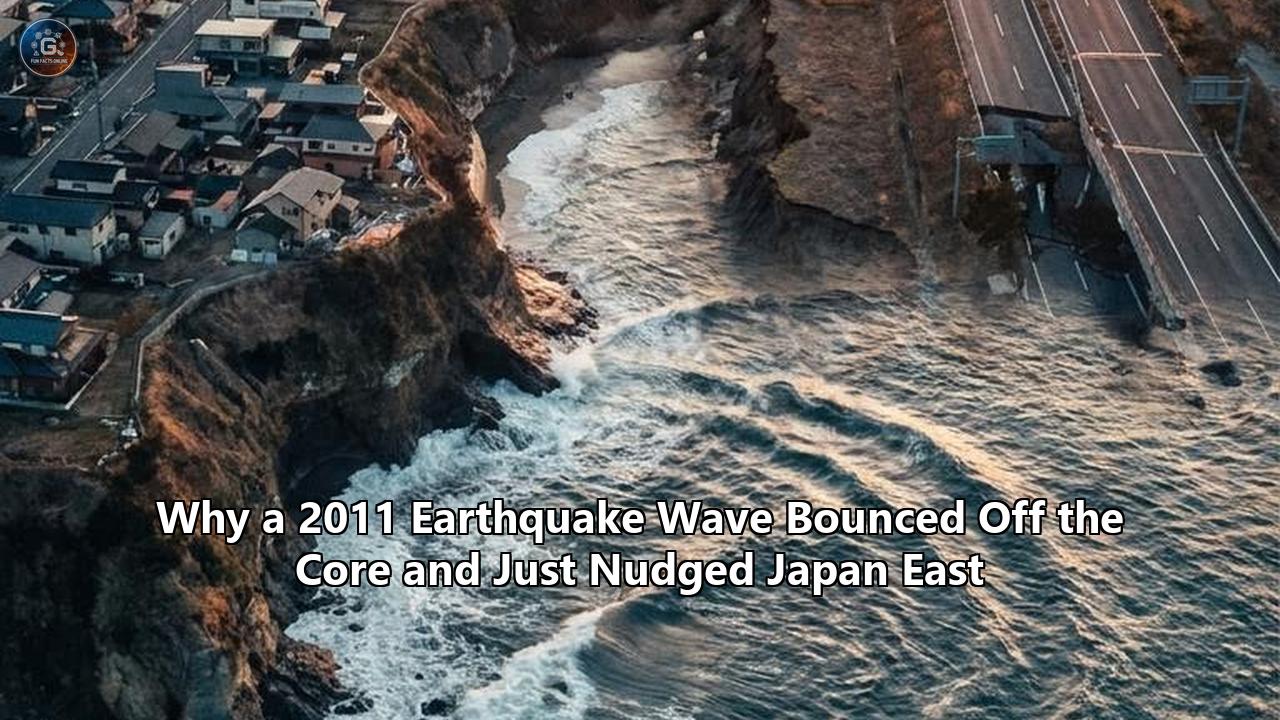
On June 18, 2026, a paper published in the journal Science quietly dismantled a foundational assumption of modern geophysics.
The paper, titled "ScS-Triggered Slip on Megathrust Interfaces after the 2011 Mw 9.0 Tohoku-Oki Earthquake"—authored by University of Chicago seismologist Sunyoung Park, legendary Caltech geophysicist Hiroo Kanamori, and Luis Rivera—revealed a hidden, continent-spanning phenomenon that went unnoticed in the chaotic aftermath of the 2011 disaster.
Roughly 15 minutes after the massive magnitude 9.0 Tohoku-Oki mainshock had ended, and before the catastrophic tsunami had finished its initial assault on the northeastern coast of Honshu, the entire Japanese archipelago shifted 5 to 6 millimeters to the east. The movement was recorded from Hokkaido in the frozen north to Kyushu in the temperate south. It was a nationwide, near-instantaneous, and silent lurch that did not correspond to any known aftershock or local earthquake.
For fifteen years, this tiny geodetic anomaly was ignored, dismissed as instrument noise, or chalked up to complex postseismic processing errors. Now, the research team has proved that Japan was nudged by an enormous seismic wave that had plunged 2,900 kilometers straight down to the boundary of Earth’s liquid outer core, bounced off that metallic mirror, and roared back to the surface.
                 Tohoku-Oki M9.0 Epicenter
                       \        /
                        \      /
       Mantle            \    /   (Traveling 2,900 km down)
                          v  v
      ----------------------------------------- Core-Mantle Boundary (CMB)
                          ^  ^
       Liquid Core       /    \   (Bouncing back as ScS wave)
                        /      \
                       v        v
                Reactivating Japan's Plate Boundaries
This represents the first confirmed observation of a core-reflected seismic wave triggering a tectonic fault to slip. It exposes a previously unrecognized class of seismic hazard. When a megaquake strikes, the deep interior of our planet does not merely absorb the energy; it acts as a delay-line echo chamber, focusing and returning seismic energy to strike already-stressed tectonic junctions from below.
The 6-Millimeter Ghost in the Machine
To understand how this discovery was made, one must look at the instrument array that recorded it. Japan is the most thoroughly monitored piece of real estate on the planet. Following the devastating 1995 Kobe earthquake, the Geospatial Information Authority of Japan (GSI) built GEONET (GNSS Earth Observation Network System). This array consists of over 1,200 continuous Global Navigation Satellite System (GNSS) tracking stations spaced roughly 20 kilometers apart across the entire country.
During the March 11, 2011 Tohoku-Oki earthquake, GEONET captured tectonic movement with unprecedented precision. The mainshock was a subduction zone event where the Pacific Plate, sliding westward at roughly 8 centimeters per year, suddenly slipped underneath the Okhotsk Plate (which carries northern Japan). The main rupture zone was approximately 500 kilometers long. Near the epicenter off the Miyagi coast, the seafloor lurched an astonishing 50 meters eastward. On the mainland, coastal areas shifted several meters toward the ocean.
But amidst this massive, macro-scale deformation, a tiny, step-like signal was buried deep within the GPS time-series records.
GPS Displacement (mm)
   |
10 |                                   ------------------- (After slip)
 5 |                                  /
   |             ---------------------  <-- Sudden 5-6 mm step-like lurch
 0 |____________/                           triggered by core reflection
   +----------------------------------------------------> Time (Minutes post-quake)
                0                    15
Between 13 and 16 minutes after the mainshock, long after the primary high-frequency shaking had subsided, GPS receivers nationwide recorded an additional eastward offset. Unlike the coseismic deformation, which decayed sharply with distance from the Tohoku epicenter, this secondary offset occurred almost uniformly across the entire length of the Japanese archipelago.
Why the Signal Was Overlooked
In the weeks and years following March 11, 2011, researchers were overwhelmed by an avalanche of data. Thousands of papers analyzed the primary rupture, the mechanics of the 40-meter tsunami, the tragic meltdowns at the Fukushima Daiichi nuclear plant, and the thousands of regional aftershocks.
Within this torrential stream of information, a 5-millimeter national offset was easily dismissed. In GPS geodesy, high-frequency "common-mode errors" (noise that affects all stations in an array simultaneously) are common. They can be caused by:
- Fluctuations in the ionosphere and troposphere that delay satellite signals.
- Localized tilts in the soils surrounding the concrete monuments holding the GPS antennas.
- Regional adjustments in water tables or atmospheric loading.
Because the shift occurred almost simultaneously across the country, most automated filters and early geodetic papers treated it as a processing artifact—a mathematical "glitch" to be ironed out of the time-series curves.
However, Sunyoung Park, an assistant professor of geophysical sciences at the University of Chicago, was troubled by this persistent wiggle in the archived GEONET data. Unlike random atmospheric noise, which creates a chaotic, non-directional drift, this specific step-like displacement moved every station in the exact same direction: eastward, toward the Japan Trench.
Furthermore, the timing of the step was curiously precise. It did not drift or smear across hours; it occurred abruptly, taking place over a window of approximately three minutes, precisely a quarter of an hour after the main fault had ruptured.
The Physics of the Core-Reflected S-Wave
To solve the mystery, Park and her colleagues turned to the fundamental physics of seismic wave propagation inside the Earth.
When an earthquake ruptures, it releases energy in the form of seismic waves that radiate outward in all directions. These are broadly categorized into surface waves (which travel along Earth's crust and cause the destructive rolling shaking felt by humans) and body waves (which plunge deep through the planet's interior).
        Body Waves vs. Surface Waves

        [Epicenter] * * * * * * * * [Surface Waves] (Slow, high damage)
         /   |   \
        /    |    \
       /     |     \  [Body Waves] (Fast, travel through interior)
      v      v      v
Body waves are further divided into two types:
- P-waves (Primary/Compressional waves): Longitudinal waves that compress and dilate the rock in the direction of travel. They are the fastest waves and can travel through both solid rock and liquid.
- S-waves (Secondary/Shear waves): Transverse waves that shear the rock side-to-side, perpendicular to the direction of travel. S-waves are slower than P-waves and, crucially, cannot travel through liquids, because liquids do not possess shear strength (they cannot resist sideways cutting forces).
As these waves dive into the deep Earth, they encounter changes in rock density and composition, which refract (bend) and reflect them. The most radical transition zone inside our planet lies at a depth of 2,891 kilometers: the Core-Mantle Boundary (CMB), also known as the Gutenberg discontinuity.
       =========================================  Earth's Surface
      |                                         |
      |             ROCKY MANTLE                |
      |          (Solid Silicate)               |
      |                                         |
       =========================================  Core-Mantle Boundary (CMB)
      |                                         |
      |            OUTER CORE                   |
      |       (Liquid Iron & Nickel)            |
      |                                         |
At the CMB, the solid silicate rock of the lower mantle abruptly meets the liquid iron-nickel alloy of the outer core.
The Core-Mantle Boundary as a Mirror
Because the liquid outer core cannot support shear forces, S-waves striking this boundary cannot penetrate it. Instead, they face an extreme "impedance contrast"—a boundary where the physical properties of the medium change so violently that transmission is blocked.
When an S-wave hits the liquid outer core, it has only two options:
- It can convert some of its energy into a compressional wave (P-wave) that can travel through the liquid core (a phase known as an SKS wave).
- It can bounce off the boundary, reflecting back up through the mantle toward the surface as a pure shear wave.
This pure, core-reflected shear wave is designated by seismologists as an ScS wave (where 'S' represents the downward shear wave, 'c' represents the reflection off the outer core, and the second 'S' represents the upward shear wave).
  Downward S-wave                      Upward S-wave (ScS)
        \                                     ^
         \                                   /
          \                                 /
           v                               /
  ------------------------------------------------- Core-Mantle Boundary (CMB)
                 Liquid Outer Core
Usually, ScS waves are seismological curiosities. By the time a shear wave travels 2,900 kilometers down through the mantle, reflects off the core, and travels 2,900 kilometers back up—a grueling 5,800-kilometer round-trip—it has lost almost all of its punch. The rocky mantle acts as a highly viscous, attenuating medium, absorbing the wave’s high-frequency energy and dispersing its amplitude. By the time most ScS waves return to the surface, they are faint, low-frequency murmurs that can only be picked up by ultra-sensitive broadband seismometers.
But the March 11, 2011 Tohoku-Oki earthquake was not a typical event. It was a planetary-scale convulsion.
The energy released by the M9.0 mainshock was so immense that the downward-propagating S-waves carried unprecedented seismic force. When this energy struck the outer core and bounced back, the resulting 2011 earthquake core reflection returned to the surface with a peak-to-peak amplitude exceeding one centimeter as recorded on seismometers across Japan.
The wave's return was so violent that it was clearly registered on Chinese stations thousands of kilometers away. Crucially, this returning ScS wave reached the underside of the Japanese islands almost simultaneously. Because the wave was traveling nearly vertically upward by the time it neared the surface, its wavefront hit the entire archipelago like a massive, upward-striking piston.
Unzipping 3,000 Kilometers of Plate Boundaries
The mere passage of a seismic wave should not permanently move a country.
Under classical elastic wave theory, when a seismic wave passes through a block of rock, the particles vibrate temporarily before returning to their original positions. If you drop a billiard ball onto a wooden table, the wood fibers compress and then expand; the table does not permanently deform.
The fact that the GEONET stations recorded a permanent 5-to-6-millimeter eastward offset meant that the passing ScS wave had done something permanent to the crust. As Caltech seismologist Zachary Ross noted, “That implies that there’s some amount of fault slip.”
To understand how a fleeting shear wave from the core could cause permanent fault slip, we must examine the complex tectonic crossroads that is Japan.
                  THE TECTONIC CROSSROADS OF JAPAN

                       [ OKHOTSK PLATE ]
                         (North American)
                            /
                           /   Japan Trench
   [ AMUR PLATE ]         / <================= [ PACIFIC PLATE ]
    (Eurasian)           /                       (Subducting West)
         \              /
          \            /
           \          /
            v        /
         [ PHILIPPINE SEA PLATE ]
The Japanese archipelago rests precariously at the convergence of four major tectonic plates:
- The Pacific Plate: Moving rapidly westward, subducting beneath northern Japan at the Japan Trench.
- The Okhotsk Plate: A microplate (often considered part of the North American Plate) that carries northern Honshu and Hokkaido.
- The Amur Plate: A microplate (often grouped with the Eurasian Plate) that carries southern and western Japan.
- The Philippine Sea Plate: Subducting northwestward beneath southern Japan at the Nankai Trough.
This means the rocky crust beneath Japan is riddled with massive, deeply locked megathrust fault systems. These faults are constantly squeezed and sheared by immense tectonic forces.
The Scope of the Triggered Slip
Using advanced geodetic inversion modeling, Park's team matched the nationwide GPS offsets with tectonic slip simulations. What they discovered was staggering.
The returning ScS wave did not merely trigger a slip on a single local fault. Because the wavefront arrived almost simultaneously across the entire 3,000-kilometer length of Japan, it triggered slip on multiple distinct plate boundaries simultaneously.
This "multiplate-interface slip event" unzipped two major plate boundaries:
- The Pacific-Okhotsk subduction zone off the northeast coast of Honshu (the plate interface that had ruptured during the mainshock).
- The Philippine Sea-Amur subduction zone along the Nankai Trough and Sagami Trough in southwestern Japan.
  [ Hokkaido ] ------------------------ Pacific-Okhotsk Interface (Slipped!)
         |
         |
  [ Honshu (Tohoku) ] ----------------- Mainshock Rupture Area (Slipped again!)
         |
         |
  [ Tokyo Region ] -------------------- Sagami Trough (Slipped!)
         |
         |
  [ Shikoku/Kyushu ] ------------------ Nankai Trough (Slipped!)
This represents the broadest seismic slip event ever documented by humanity. Its overall rupture length of approximately 3,000 kilometers is similar to the entire length of the Japanese mainland. To put this in perspective, this triggered slip area was:
- Six to seven times longer than the rupture length of the primary Tohoku-Oki earthquake.
- More than double the rupture length of the catastrophic 2004 Sumatra-Andaman earthquake (which ruptured ~1,300 kilometers of fault line).
The Silent Magnitude 7.5
Despite the enormous geographic scale of this multiplate slip, nobody in Japan felt a thing. There were no fresh buildings collapsing, no new tsunami alarms sounding, and no frantic seismogram spikes indicating another massive quake.
This is because the triggered slip occurred as a slow-slip event (SSE).
In a typical earthquake, a locked fault unzips at supersonic speeds (roughly 3 kilometers per second), releasing its energy in seconds or minutes and generating high-frequency, destructive vibrations.
In a slow-slip event, the tectonic plates glide past one another over a much longer period. In the case of the 2011 earthquake core reflection trigger, the plate boundaries slid past each other over the course of about three minutes.
Because the slip was distributed over a massive 3,000-kilometer interface and occurred slowly, the energy was released without generating the high-frequency seismic waves that shake buildings or register as conventional earthquakes on seismographs.
Yet, when seismologists calculate the total moment magnitude ($M_w$) of this slow, nationwide slip by multiplying the shear modulus of the rock by the slip area and the average displacement (5-6 mm), the total energy release is equivalent to a magnitude 7.5 earthquake.
An invisible, silent Mw 7.5 earthquake had crept across the entire length of Japan, triggered entirely by an echo from the center of the Earth.
Deconstructing the Alternatives: How the Team Ruled Out Other Theories
In the rigorous world of peer-reviewed geophysics, presenting a radical claim—such as a core-reflected wave triggering a 3,000-kilometer multiplate slip—requires bulletproof evidence. Park, Kanamori, and Rivera spent years playing the role of devil's advocate, systematically testing and discarding alternative explanations before submitting their work to Science.
Alternative 1: Postseismic Afterslip (Creep)
The most obvious counter-explanation for any delayed GPS shift after a megaquake is "afterslip".
When a major subduction zone ruptures, the surrounding sections of the fault that did not break are subjected to immense stress. Over the hours, days, and months following the quake, these adjacent regions release stress by sliding slowly and silently—a process called coseismic creep or afterslip.
However, afterslip obeys strict physical and mathematical laws:
- Spatial Localization: Afterslip occurs in the immediate vicinity of the mainshock rupture zone. For the Tohoku-Oki earthquake, afterslip should have been concentrated off the coast of Tohoku (northeastern Honshu) and decayed to zero as one moved toward southwestern Japan (Chubu, Kansai, and Kyushu).
- Temporal Decay: Afterslip begins immediately after the main rupture and decays logarithmically over time.
The observed 5-to-6-millimeter shift violated both rules. It did not decay with distance from Tohoku; stations in southern Kyushu, more than 1,000 kilometers away, shifted by nearly the same amount as stations in northern Honshu. Furthermore, the shift did not begin immediately; there was a distinct, quiet 13-minute gap after the mainshock before the shift abruptly occurred over a tight three-minute window.
Displacement Pattern: Afterslip vs. ScS-Triggered Slip

Afterslip:
[ Tohoku Epicenter ] ========> (Massive displacement, meters)
[ Tokyo Region ]    ===> (Moderate displacement, centimeters)
[ Kyushu Island ]   (Zero displacement)

ScS-Triggered Slip (Observed):
[ Tohoku Epicenter ] ====> (5-6 mm)
[ Tokyo Region ]    ====> (5-6 mm)
[ Kyushu Island ]   ====> (5-6 mm)
Alternative 2: Submarine Landslides
A magnitude 9.0 earthquake shakes the seafloor so violently that it inevitably triggers underwater landslides along the steep slopes of the Japan Trench. These massive movements of sediment displace water (contributing to tsunamis) and can alter local gravity fields and geodetic measurements.
The team modeled the geodetic effects of massive submarine landslides along the continental shelf. While landslides did occur, their physical displacement field is highly localized. A landslide off the coast of Sendai might shift a few coastal GPS monuments on the nearby Ojika Peninsula, but it cannot exert a coherent tectonic force capable of shifting stations in the mountains of Nagano or the distant islands of Okinawa.
Alternative 3: An Unidentified Aftershock
Could a large, deep aftershock have occurred 13 minutes after the mainshock, slipping the plates silently?
To test this, the researchers scrutinized records from Japan's F-net, an ultra-sensitive network of broadband seismometers designed to detect even the faintest deep-crustal seismic events.
While hundreds of small aftershocks were occurring, there was no seismic event recorded anywhere in or near Japan at that precise time that had a mechanism or magnitude capable of causing a country-wide geodetic step. Any conventional aftershock large enough to shift Japan by 5 millimeters would have registered as a massive, destructive event (at least Mw 7.5 to 8.0) that would have been immediately felt by the population and clearly recorded by global seismograph networks. No such wave signature existed in the data.
The Match Made in Seismology
The breakthrough came when Park plotted the arrival of the core-reflected ScS wave directly on top of the GPS geodetic time-series.
Seismic/GPS Alignment (13–16 min post-mainshock)

Seismogram (F-net):
                 _   _       _
                / \ / \     / \      <-- ScS wave arrival (high amplitude)
_______________/   V   \___/   \___
               ^
               | (Precise Alignment)
               v
GPS Geodetic Time-Series:
                         /---------  <-- Step-like permanent offset
________________________/
The temporal alignment was perfect. The permanent geodetic lurch began exactly as the first peaks of the returning ScS wave passed through the crust, and the offset flattened out into its new permanent position exactly as the tail-end of the ScS wave packet dissipated.
The core reflection was not merely a passive seismic wave passing through the Earth; it was the physical mechanism that had unlocked the plates.
How a Seismic Whisper Defeated Tectonic Friction
The discovery of this core-reflected triggering mechanism forces us to confront a baffling mechanical question:
How could a returning wave, which had lost the vast majority of its energy during its 5,800-kilometer journey, possess enough strength to slip massive, deeply locked plate boundaries that require gigapascals of force to move?
The answer lies in the physics of critical state and dynamic stress triggering.
1. The Supercritical State of Japan’s Faults
Before March 11, 2011, the subduction zones around Japan had been locking and accumulating stress for centuries. The Pacific Plate was relentlessly shoving its way westward, compressing the overriding Japanese crust like a giant, continent-sized metal spring.
When the mainshock occurred, it released a massive amount of this accumulated strain along a 500-kilometer segment of the Japan Trench. But this sudden release of stress was not uniform. In geophysics, when one segment of a fault slips, it transfers its stress to the adjacent, unruptured segments of the fault system—a process called static stress transfer.
           STRESS TRANSFER ALONG THE FAULT

  [ Ruptured Segment ]  =======> (Stress Released!)
         ||
         \/ (Stress pushed to adjacent areas)
  [ Adjacent Segments ] =======> (Stressed to the absolute limit!)
In the minutes immediately following the M9.0 rupture, the adjacent plate boundaries—including the southern portion of the Japan Trench, the Sagami Trough near Tokyo, and the Nankai Trough further south—were pushed to the absolute precipice of failure.
They were in a supercritical state. The friction holding these tectonic plates together was like a single, frayed thread holding back a heavy boulder on a steep hill.
2. The Role of Weak Clay Lubrication
In December 2013, the Japanese scientific drilling vessel Chikyu shattered records by drilling more than 800 meters into the ocean floor directly at the plate boundary of the Japan Trench, where the water was nearly 7,000 meters deep.
           JOIDES/CHIKYU DEEP-SEA DRILLING OPERATION

       [ Drill Ship Chikyu ]
               ||
               ||  (4 miles of water)
               \/
       ~~~~~~~~~~ Ocean Floor ~~~~~~~~~~~
               ||
               ||  (2,600 feet of rock)
               \/
       ================================== [ Plate Boundary Interface ]
                                           * Lined with slippery Smectite Clay *
The core samples recovered by the Chikyu team revealed a crucial geological secret: the plate boundary interface was lined with an incredibly thin layer of highly specialized, wet clay called smectite.
Under normal pressures, smectite clay is weak. But under the extreme pressures and temperatures of a subduction zone, when friction heats the water trapped inside this clay, the clay becomes extraordinarily slippery. It acts as a tectonic lubricant, dramatically lowering the coefficient of friction along the megathrust interface.
This meant that across broad sections of Japan's subduction zones, the plate interfaces were not held together by rugged, interlocking granite teeth, but by a slick, pressurized layer of clay that was primed to slide under the absolute minimum amount of lateral force.
3. Dynamic Shear Stress of the ScS Wave
Enter the returning ScS wave.
As the shear wave returned from the core-mantle boundary, it moved rock particles side-to-side in a transverse motion. When this wave packet arrived at the subduction interfaces beneath Japan, it applied a cyclic, transient dynamic shear stress to the faults.
                       [ Upward ScS Wave ]
                              ||
                              \/
               Shear Forces Shaking Left and Right

     <=== [ Overriding Plate ]  /  [ Subducting Plate ] ===>
                              ||
                              \/
                Temporary Reduction in Normal Stress
                      + Transient Shear Stress
                              ||
                              \/
                     * FAULT UNZIPS *
Even though the amplitude of this wave was tiny compared to the primary earthquake shaking, its unique physical delivery mechanism made it incredibly effective:
- Synchronicity: Because the wavefront arrived almost horizontally from directly below, it hit thousands of kilometers of fault lines at nearly the exact same instant.
- Stress Alignment: The side-to-side shear motion of the ScS wave aligned perfectly with the existing slip direction of the subducting plates.
- Resonance: The low-frequency nature of the ScS wave matched the natural resonance of deep, slippery fault zones, allowing the wave to pump energy into the fault over several cycles.
Like a gentle tap on a wine glass that is already filled to the absolute brim, the transient shear stress of the core-reflected wave was the final straw. It lowered the effective normal stress holding the plates together, allowing the lubricated smectite clay to yield.
The boundaries "unzipped," and Japan slid 5 to 6 millimeters eastward toward the deep trench.
Rewriting the Seismic Hazard Playbook
The realization that a 2011 earthquake core reflection could trigger a continent-scale slip event has sent shockwaves through the global seismological community. It shatters several long-held paradigms in earthquake hazard modeling.
The Old Model vs. The New Reality
Traditionally, earthquake forecasting and hazard mitigation models have operated under a "regional isolationist" framework.
                       TRADITIONAL SEISMIC MODEL

  [ Megathrust Rupture Zone ]  ============>  [ Local Aftershock Zone ]
                               (Spatially restricted to ~100-200 km)

  Deep Earth / Outer Core      ============>  (Ignored as a passive sink)
In this old model, when an earthquake occurs, seismologists calculate the risks of subsequent faults slipping based almost entirely on two factors:
- Static Stress Changes ($\Delta CFS$): Local changes in stress that remain in the rock immediately surrounding the ruptured fault. This effect decays exponentially with distance and is generally negligible beyond a few hundred kilometers.
- Surface-Wave Dynamic Triggering: The passage of high-amplitude Love and Rayleigh waves, which can trigger minor, shallow aftershocks as they ripple across the crust.
Core-reflected body waves (like ScS or PcP) were treated as passive, deep-Earth acoustics. They were used by scientists to map the structure of the core-mantle boundary or calculate the density of the mantle, but they were never considered a source of active surface hazards. They were assumed to be far too weak to overcome the immense frictional forces of deep crustal faults.
The discovery by Park's team flips this assumption on its head. It proves that deep-Earth reflections can couple directly with surface tectonics.
                          NEW SEISMIC MODEL

  [ Megathrust Rupture ]  ===(2,900 km down)===> [ Core-Mantle Boundary ]
                                                       ||
                                               (Reflects back up)
                                                       ||
  [ Multiplate Slip ]     <===(3,000 km wide)====  [ ScS Wave Echo ]
This means that a megaquake in one location can actively trigger massive, silent, or potentially violent slips thousands of kilometers away, delayed by the precise transit time of waves traveling to the core and back.
The Thirty-Minute Hazard Window
The most practical and urgent implication of this study concerns the immediate post-disaster response window.
When a magnitude 8.5+ megaquake strikes, emergency management systems, automated shutoffs, and tsunami warning networks scramble to assess the damage within the first 10 minutes.
We now know that there is a secondary, critical hazard window that opens approximately 12 to 20 minutes after the mainshock—the precise window during which the Earth's core bounces back the primary seismic energy.
| Time Post-Mainshock | Seismic Event | Physical Hazard |
|---|---|---|
| 0 – 5 Minutes | Primary Rupture & High-Frequency Shaking | Building collapse, localized fault displacement, landslide initiation. |
| 5 – 12 Minutes | Shaking subsides, Tsunami propagation | Tsunami waves approach shorelines, regional aftershocks begin. |
| 12 – 18 Minutes | Core-Reflected ScS Wave Arrival | nationwide multiplate slow-slip, reactivation of regional fault networks. |
| 18 – 30 Minutes | Secondary Stress Adjustment | Potential triggering of delayed, destructive aftershocks on adjacent faults. |
If adjacent faults are critically stressed but do not slip silently (as they did in Japan's lubricated smectite clay), the arrival of the core reflection could act as a hammer blow that triggers a secondary, massive, destructive earthquake.
This delayed triggering could happen hundreds of miles away from the original epicenter, catching populations that believed they were safely outside the primary damage zone completely off guard.
Unresolved Questions and the Search for Deep-Earth Echoes
The discovery of the 2011 earthquake core reflection trigger has opened a vast, unexplored frontier in geophysics. Seismologists around the world are rushing to re-analyze historical datasets to see if other mysterious "steps" have been missed.
1. Re-Evaluating Global Megaquakes
Do core-reflected triggers occur during every major earthquake?
Park’s team suggests that this phenomenon requires a rare combination of three factors:
- A mainshock of exceptional magnitude (likely $M_w > 8.5$) to generate an ScS wave with enough residual energy to affect the surface.
- An advanced, nationwide geodetic network (like GEONET) capable of resolving millimeter-scale offsets amidst the noise of a major disaster.
- Tectonic faults in a highly critical, lubricated state, primed to slip under transient stress.
Scientists are now building sophisticated geodetic filters to search for similar delayed, country-wide slips in the historical data of other subduction zones:
- Sumatra (2004, Mw 9.1-9.3): Did a core reflection trigger slips across the Sunda Trench or the Great Sumatran Fault? Because Indonesia lacked a dense, continuous GPS network like Japan's in 2004, the signal may have gone unrecorded.
- Chile (1960, Mw 9.5 & 2010, Mw 8.8): Did the Valdivia or Maule quakes trigger core-reflected slow slips along the Andes subduction zone?
- Alaska (1964, Mw 9.2): Did a deep bounce reactivate faults across the Aleutian Arc?
2. The Core-Mantle Boundary as a Focusing Lens
Another fascinating avenue of research is how the complex, rugged topography of the Core-Mantle Boundary affects these reflections.
The CMB is not a smooth, polished steel sphere. It is a highly dynamic zone featuring massive, continental-sized blobs of hot, dense rock known as Large Low-Shear-Velocity Provinces (LLSVPs) (specifically the "Tuzo" blob beneath Africa and the "Jason" blob beneath the Pacific), as well as ultra-low-velocity zones (ULVZs) and ancient, sunken tectonic plates.
                  THE CMB'S RUGGED TOPOGRAPHY

                  [ Solid Rocky Mantle ]
                 /                      \
                /   LLSVPs (Dense Blobs) \
               /       _..---.._          \
              v       /         \          v
       --------------|           |-------------- Core-Mantle Boundary (CMB)
                      \_       _/
                        `-----`
                  [ Liquid Outer Core ]
These deep-Earth structures can act as seismic lenses, focusing or defocusing the ScS waves as they bounce back to the surface.
If an ScS wave strikes a concave structure at the CMB, the reflected energy could be focused into a tight, ultra-high-amplitude beam—a "seismic spotlight"—that delivers an incredibly concentrated punch to a specific, localized patch of the Earth's crust.
Conversely, convex structures could scatter the energy, rendering the core reflection harmless.
Mapping these deep focusing zones will be critical for identifying which coastal cities and fault lines are most vulnerable to core-reflected seismic triggers.
3. The Promise of AI-Driven Geodesy
Detecting a 5-millimeter signal in real-time amidst the chaos of a major earthquake is a massive computational challenge.
In the future, seismologists hope to integrate machine learning and artificial intelligence algorithms directly into global GNSS monitoring systems. These AI networks can be trained on the specific spatial and temporal signatures of ScS waves.
If a major earthquake strikes, the AI could instantly model the downward propagation of the seismic energy, calculate where the core reflection will return 15 minutes later, and alert emergency management systems in those specific target zones to prepare for delayed slips, secondary quakes, or sudden sea-floor displacements.
A Connected Planet
The revelation that a core-reflected wave from the 2011 Tohoku-Oki earthquake nudged Japan eastward is more than just a triumph of data analysis. It is a profound reminder of the radical interconnectedness of our planet.
For centuries, humanity has viewed the Earth's interior as a series of isolated, static layers—the crust we live on, the sluggish mantle below, and the unreachable, molten core at the center, separate and locked away.
But the 2011 earthquake core reflection has bridged these vast distances. It has shown us that the energy released by the sliding of a tectonic plate off the coast of Japan can dive thousands of miles into the deep dark, strike the liquid iron heart of our world, and return to the surface to nudge an entire nation.
The deep Earth is not a silent spectator. It is an active participant in the ongoing, dynamic shaping of our surface world, sending back echoes of our most violent disasters to remind us that beneath our feet, everything is connected.
Reference:
- https://news.uchicago.edu/story/powerful-seismic-waves-japans-2011-earthquake-struck-earths-core-and-bounced-back-moving
- https://tiisys.com/blog/2026/06/19/post-195753/
- https://thedebrief.org/earthquake-that-shifted-the-entire-japanese-archipelago-reveals-previously-unrecognized-source-of-seismic-hazard/
- https://ground.news/article/a-2011-earthquake-bounced-a-seismic-wave-off-earths-core-nudging-japan-east_bc19d0
- https://www.sciencenews.org/article/japan-earthquake-seismic-wave-core
- https://timesofindia.indiatimes.com/science/scientists-analyse-seismic-waves-from-japans-2011-earthquake-that-reached-deep-into-the-earth-and-may-have-been-linked-to-subtle-postseismic-ground-movement-of-a-few-millimeters/articleshow/131854251.cms
- https://spacedaily.com/d-a-seismic-wave-from-japans-2011-magnitude-9-earthquake-travelled-nearly-2900-kilometres-down-to-earths-core-bounced-back-to-the-surface-13-minutes-later-and-shifted-the-entire-country-eastward-by/
- https://www.sciencealert.com/a-giant-seismic-wave-bounced-off-earths-core-and-may-have-shifted-japan
- https://gizmodo.com/massive-tohoku-earthquake-sent-a-seismic-wave-that-shifted-all-of-japan-2000773583
- https://timesofindia.indiatimes.com/science/scientists-analyse-seismic-waves-from-japans-2011-earthquake-that-reached-deep-into-the-earth-and-may-have-been-linked-to-subtle-postseismic-ground-movement-of-a-few-millimeters/articleshow/131854251.cms
- https://gizmodo.com/massive-tohoku-earthquake-sent-a-seismic-wave-that-shifted-all-of-japan-2000773583
- https://operativmm.az/en/post/scientists-uncover-secret-behind-japans-2011-tohoku-earthquake/73979
- https://www.unr.edu/nevada-today/news/2025/2011-japan-earthquake-paper
- https://www.independent.co.uk/news/science/japan-earthquake-2011-country-move-east-b2998870.html
- https://www.ibtimes.co.uk/hidden-seismic-wave-2011-japan-earthquake-1803766
- https://norwegianscitechnews.com/2017/03/going-deep-learn-secrets-japans-earthquakes/
- https://www.discovermagazine.com/a-seismic-wave-from-the-2011-japan-9-0-earthquake-shifted-the-entire-country-now-we-know-why-49270
- https://spacedaily.com/d-a-seismic-wave-from-japans-2011-magnitude-9-earthquake-travelled-nearly-2900-kilometres-down-to-earths-core-bounced-back-to-the-surface-13-minutes-later-and-shifted-the-entire-country-eastward-by/
- https://sundayguardianlive.com/world/2011-japan-earthquake-and-tsunami-shifted-whole-country-further-east-new-study-finds-209486/
- https://www.sciencealert.com/a-giant-seismic-wave-bounced-off-earths-core-and-may-have-shifted-japan
- https://biz.chosun.com/en/en-science/2026/06/19/WJTN4YNUEFBC3OHY7UKCOP3SLQ/