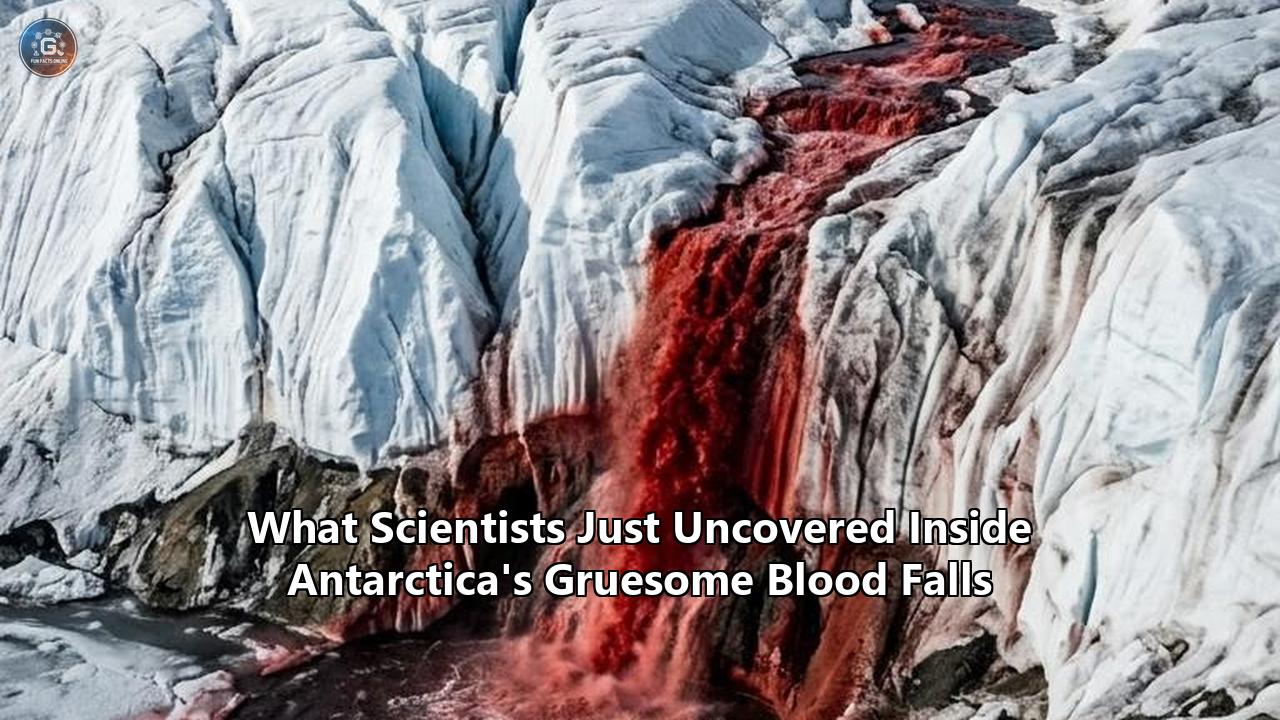
Deep in the frozen desert of East Antarctica’s McMurdo Dry Valleys, a five-story waterfall oozes out of the snout of Taylor Glacier, staining the stark white ice with a crimson discharge that looks like a hemorrhaging wound. Ever since British explorer Thomas Griffith Taylor first stumbled upon the feature in 1911 during Captain Robert Falcon Scott’s ill-fated Terra Nova expedition, scientists have struggled to explain how liquid water—much less a vibrant red fluid—could continuously cascade from a glacier locked in sub-zero polar cold.
Now, a team of researchers from the University of California, San Diego and Scripps Institution of Oceanography has uncovered the hidden biological origin of the phenomenon. In a study published in Nature Geoscience, scientists analyzing 167 environmental samples of ice, sediment, air, and water revealed that the crimson brine pouring out of the glacier contains a living, metabolizing community of marine microorganisms.
By analyzing messenger RNA (eRNA)—which isolates active cellular processes from passive genetic debris (eDNA)—the researchers proved that these marine microbes are not merely dead fossils or windblown contamination. Instead, they are the living descendants of an ancient sea trapped beneath hundreds of meters of ice millions of years ago, thriving in total darkness, devoid of oxygen, and isolated from the outside atmosphere.
This discovery resolves a century-old debate over how the feature formed and provides empirical proof that marine life can adapt and survive across geological epochs inside sealed subglacial reservoirs. The findings carry direct implications for understanding how life survived Earth’s "Snowball" glaciation events and offer a blueprint for detecting biological signals beneath the icy crusts of Mars, Europa, and Enceladus.
The Genetic Code of a Trapped Ocean
To determine where the subglacial water originated and how microbes survive inside it, researchers conducted an extensive environmental sequencing initiative across Taylor Valley. The team collected 167 samples from the blood-red discharge, surrounding glacier ice, nearby terrestrial soils, freshwater lakes, and coastal Antarctic waters.
Instead of relying solely on environmental DNA (eDNA)—which can persist in freezing environments for thousands of years long after an organism has died—the team extracted environmental RNA (eRNA). Because RNA degrades rapidly outside living cells, its presence serves as a biomarker for active cellular transcription, confirming that organisms are alive and conducting metabolic functions.
                     SUBGLACIAL BRINE ECOSYSTEM

     [ Taylor Glacier Ice Sheet (1.5M - 5M Years Old) ]
                            │
                            ▼
     ┌──────────────────────────────────────────────┐
     │  Oxygen-Deprived Hypersaline Subglacial Brine│
     │  - Temperature: -7°C (20.3°F)               │
     │  - Salinity: 3x-4x Ocean Water               │
     │  - Energy Source: Chemosynthetic Fe/S Cycle  │
     └──────────────────────┬───────────────────────┘
                            │
                            │ Episodic Subglacial
                            │ Pressure Discharge
                            ▼
     ┌──────────────────────────────────────────────┐
     │  Glacier Terminus Outflow (Blood Falls)      │
     │  - Iron(II) + Oxygen ──► Iron Nanospheres    │
     │  - Crimson Oxidation Stain on Ice            │
     └──────────────────────────────────────────────┘
The genetic results were unequivocal. While terrestrial soils and freshwater sites in the McMurdo Dry Valleys were dominated by land-based and freshwater prokaryotes, the red ice and sediment at the glacier terminus were overwhelmingly enriched with ocean-dwelling eukaryotic organisms.
"The biological activity that we observed from mRNA analyses suggests that this relic marine community isn't just frozen in time but has somehow persisted despite a very dramatic change of environment," explained Andrew Allen, a co-author of the study and researcher at UC San Diego. "The distance these communities reached in the Dry Valleys could be really important for interpreting the extent of ancient flooding."
More than 9% of the eukaryotic lineages found in the red brine matched species currently found in the open Southern Ocean, compared to barely 1% in surrounding terrestrial sites. The identified lineages included marine diatoms, dinoflagellates, haptophytes, and ciliates.
Furthermore, genetic analysis of the ambient air near the falls ruled out modern wind transport as the source of these ocean microbes. The airborne microbial signature differed significantly from the concentrated marine life found within the discharge, confirming that the outflow is fed by a trapped, ancient marine ecosystem rather than fresh deposits blowing in from the coast.
Chemistry of the Crimson Plume: Nanospheres and Oxidation
For decades after its 1911 discovery, popular scientific consensus attributed the red stain of Antarctica Blood Falls to microscopic red algae, similar to the chlamydomonas species that create "watermelon snow" in alpine regions. It was not until mid-century geochemical analyses confirmed an absence of photosynthetic pigments that scientists realized the color stemmed from an iron compound.
However, identifying the exact physical form of that iron proved difficult. Standard laboratory techniques, such as X-ray diffraction (XRD), continuously failed to identify known iron oxide minerals like hematite, magnetite, or goethite in the water samples.
┌─────────────────────────────────────────────────────────────────┐
│              IRON NANOSPHERE OXIDATION METRIC                   │
├─────────────────────────┬───────────────────────────────────────┤
│ Particle Diameter       │ ~10 to 100 nanometers                │
│ Structural State        │ Non-crystalline, amorphous matrix     │
│ Elemental Composition   │ Iron (Fe), Silicon (Si), Calcium (Ca),│
│                         │ Aluminum (Al), Sodium (Na), Chlorine  │
│ Optical Property        │ Soluble/clear sub-ice ──► Oxidizes to │
│                         │ vivid vermilion upon air exposure     │
└─────────────────────────┴───────────────────────────────────────┘
The mystery was solved when material scientists analyzed the outflow using high-resolution transmission electron microscopy (TEM). Instead of crystalline minerals, the water is filled with microscopic, non-crystalline structures known as iron-rich nanospheres.
These nanospheres are roughly one-hundredth the size of a human red blood cell. They are composed of an amorphous mixture of iron, silicon, calcium, aluminum, sodium, and chlorine.
While sealed beneath the glacier, the iron within the subterranean reservoir remains in a reduced, dissolved ferrous state ($Fe^{2+}$), which makes the liquid completely clear. But when subglacial hydraulic pressure forces the brine through fissures in the glacier ice and into the open air, the ferrous iron instantly reacts with atmospheric oxygen ($O_2$).
As the dissolved iron oxidizes into ferric iron ($Fe^{3+}$), it forms nanospheric complexes that scatter light and turn the cascading water a vivid red.
Because these nanospheres lack a rigid crystalline lattice, standard mineralogical sensors—including those deployed on Mars rovers—are blind to their presence, passing them off as unclassifiable background noise.
Living without Sun or Oxygen: The Subglacial Metabolic Engine
The survival of an active microbial community inside Antarctica Blood Falls challenges classical concepts of habitability. Sealed beneath 400 meters (1,300 feet) of solid glacial ice for an estimated 1.5 million to 5 million years, this subterranean reservoir receives zero sunlight. Phototrophic life—the engine of photosynthesis that powers the vast majority of Earth's surface biosphere—is impossible.
Furthermore, the reservoir is completely isolated from the atmosphere, rendering it entirely anoxic (devoid of dissolved oxygen).
To survive in this pitch-black, oxygen-free tomb, the resident microbes evolved a chemosynthetic cycle that leverages the chemical energy bound within the surrounding bedrock and dissolved marine salts.
                   SUBGLACIAL METABOLIC CYCLE

            ┌──────────────────────────────────────┐
            │ Bedrock Weathering / Pyrite (FeS2)   │
            └──────────────────┬───────────────────┘
                               │
            ┌──────────────────┴───────────────────┐
            ▼                                      ▼
   ┌─────────────────┐                    ┌─────────────────┐
   │ Fe(III) Reduction│                    │ Sulfate (SO4²⁻) │
   │ (Iron-Reducing  │                    │ Respiration     │
   │   Bacteria)     │                    └────────┬────────┘
   └────────┬────────┘                             │
            │                                      ▼
            │                             ┌─────────────────┐
            │                             │ Sulfite/Sulfide │
            │                             └────────┬────────┘
            │                                      │
            ▼                                      ▼
   ┌────────────────────────────────────────────────────────┐
   │ Chemolithoautotrophic Sulfur Oxidation                 │
   │ (e.g., Thiomicrospira arctica)                         │
   │ - Converts chemical bonds to cellular energy (ATP)     │
   │ - Recycles sulfur & iron without consuming oxygen       │
   └────────────────────────────────────────────────────────┘
The metabolic engine relies on a coupled iron-sulfur cascade:
- Bedrock Grinding: As Taylor Glacier moves over the underlying continent, its weight grinds the bed solid rock into fine mineral dust, liberating trapped iron and sulfur compounds.
- Sulfate Reduction: Anaerobic bacteria utilize sulfate ($SO_4^{2-}$), left over from the original seawater, as an electron acceptor to break down trace organic matter, producing reduced sulfur species.
- Iron Catalysis: Instead of allowing the reduced sulfur to react directly with iron to form insoluble iron pyrite ($FeS_2$), specialized bacteria like Thiomicrospira arctica (an autotrophic sulfur oxidizer that makes up nearly half of the subglacial bacterial population) utilize trace ferric iron ($Fe^{3+}$) stripped from the bedrock to oxidize intermediate sulfur compounds.
- Energy Generation: This metabolic handoff yields energy for the cell to fix inorganic carbon into biomass, recycling iron into its soluble ferrous state ($Fe^{2+}$) while generating a continuous stream of dissolved iron in the water.
This self-sustaining metabolic loop allows an entire food web of single-celled organisms to thrive without organic input from the outside world, recycling the same elemental constituents across millions of years.
Subglacial Hydrology: Why the Glacier Drop-Out Happens
One of the most perplexing features of the outflow is its episodic nature. The red waterfall does not flow continuously like a standard mountain stream. Instead, it bursts forth in irregular, powerful pulses, followed by long periods of dormancy that can last months or years.
A study published in Antarctic Science by a team of glaciologists and hydrologists revealed the physical mechanism driving these sudden eruptions.
By pairing high-frequency tiltmeter data, daily optical camera monitoring, and submerged lake thermistors at West Lake Bonney, researchers tracked a prolonged discharge event. They discovered that the release of red brine directly triggers a physical collapse of the overlying ice sheet.
                     SUBGLACIAL PRESSURE CYCLE

   1. RECHARGE PHASE:
      - Cryo-concentration increases subglacial brine volume.
      - Hydraulic pressure builds beneath 400m of solid ice.
      - Overlying glacier is pushed upward slightly.

   2. RUPTURE PHASE:
      - Subglacial hydraulic pressure exceeds ice shear strength.
      - Sealed subglacial channels fracture open at terminus.
      - Iron-rich brine erupts into Lake Bonney.

   3. RELIEF PHASE:
      - Internal reservoir pressure drops rapidly.
      - Glacier surface lowers by ~0.6 inches (1.5 cm).
      - Forward ice velocity drops by ~10% due to loss of basal lubrication.
      - Channel re-freezes; cycle resets.
When liquid brine accumulates in the subglacial basin beneath Taylor Glacier, pressure builds. Because the freezing point of the concentrated salt water is depressed to -7°C (20.3°F), the brine remains liquid despite being surrounded by cold-based glacial ice.
As the subglacial hydraulic pressure surpasses the mechanical strength of the ice, the brine forces open cracks along structural weaknesses in the glacier snout. The pressurized liquid rushes out in a multi-week eruption.
The study captured a single month-long discharge event that depressurized the subglacial aquifer. As the supporting fluid pressure bled off, the surface of Taylor Glacier dropped by 0.6 inches (1.5 cm), while the glacier’s forward movement slowed by 10% due to a sudden drop in basal lubrication.
Once the subglacial pressure dissipates, the shear weight of the ice seals the subglacial conduit, allowing the internal pressure to build once more for the next release.
Imaging the Hidden Network: Airborne Electromagnetics
For decades, glaciologists assumed that liquid water beneath Antarctic glaciers was limited to isolated pockets or thin boundary films caused by geothermal heating. However, geophysical surveys show that Antarctica Blood Falls is merely the surface release valve for a vast, interconnected subterranean groundwater system.
Using Airborne Transient Electromagnetics (AEM)—a technique where a massive sensor loop suspended beneath a helicopter emits electromagnetic pulses into the ground—geophysicists mapped the subsurface resistivity of the McMurdo Dry Valleys.
AIRBORNE TRANSIENT ELECTROMAGNETIC (AEM) RESISTIVITY MAP
═════════════════════════════════════════════════════════════════
Depth Below Surface        Resistivity Signal    Geological Interpretation
─────────────────────────────────────────────────────────────────
0m to 200m                 High (>1,000 Ω·m)     Solid Glacial Ice / Frozen Till
200m to 600m               Low (<10 Ω·m)         Hyper-Saline Liquid Brine Aquifer
>600m                      High (>5,000 Ω·m)     Crystalline Igneous Bedrock
═════════════════════════════════════════════════════════════════
Because salty liquid water is an exceptional conductor of electricity compared to solid ice or dry rock, the AEM surveys mapped a extensive, dark network of liquid brine beneath Taylor Valley.
The imaging revealed that the brine feeding the waterfall extends at least 12 kilometers (7.5 miles) up-glacier, reaching depths of over 600 meters (2,000 feet) beneath the ice sheet.
Even more startling, the data demonstrated that this subglacial aquifer connects multiple isolated lakes across the Dry Valleys—including Lake Bonney, Lake Fryxell, and Lake Vanda—below the permafrost layer.
This underground network forms an expansive, cold, dark habitat that spans hundreds of square kilometers, proving that deep Antarctic groundwater systems exist and harbor active microbial biospheres.
Paleoclimate Reconstruction: How an Ocean Fjord Was Trapped
The discovery of living marine eukaryotes inside the outflow allows paleoclimatologists to reconstruct the dramatic environmental transformation of East Antarctica.
During the mid-Miocene and early Pliocene epochs (roughly 3 million to 15 million years ago), global temperatures were significantly warmer than they are today, and sea levels were tens of meters higher.
During these warm intervals, the Southern Ocean flooded the coastal valleys of East Antarctica, turning Taylor Valley into an open, shallow ocean fjord teeming with marine plankton, diatoms, and single-celled eukaryotes.
PALEO-ENVIRONMENTAL TIMELINE OF TAYLOR VALLEY
─────────────────────────────────────────────────────────────────────────
1. MID-MIOCENE TO PLIOCENE (15M - 3M Years Ago)
   - Warm polar climate; high global sea levels.
   - Southern Ocean floods Taylor Valley, forming an open marine fjord.
   - Rich marine eukaryotic ecosystem flourishes in sunlight.

2. LATE PLIOCENE / EARLY PLEISTOCENE INITIATION (~1.5M - 3M Years Ago)
   - Planetary cooling begins; East Antarctic Ice Sheet expands.
   - Taylor Glacier advances down the valley, capping the fjord.
   - Trapped seawater is cut off from the atmosphere and sunlight.

3. CRYO-CONCENTRATION ERA (1.5M Years Ago to Present)
   - Pure water freezes onto the underside of the glacier.
   - Residual liquid becomes ultra-saline brine, lowering its freezing point.
   - Oxygen is exhausted; chemosynthetic microbes adapt to iron/sulfur cycle.
   - Active descendents of marine eukaryotes survive in deep isolation.
─────────────────────────────────────────────────────────────────────────
As the climate cooled at the onset of major Pleistocene glaciation cycles, the East Antarctic Ice Sheet expanded, and Taylor Glacier advanced down the valley toward the sea. The advancing ice sheet capped the fjord, trapping a massive pocket of seawater beneath hundreds of meters of solid ice.
As the cold ice sheet pressed down on the trapped sea, pure water slowly froze onto the base of the glacier. This process, known as cryo-concentration, squeezed out dissolved salts and minerals into the remaining liquid, increasing its salinity to three to four times that of normal seawater.
This elevation in salt concentration lowered the freezing point of the trapped water, preventing it from turning into solid ice even as ambient temperatures dropped far below freezing.
Sealed off from atmospheric oxygen and sunlight, the trapped marine eukaryotes were forced to adapt or perish. While larger multicellular organisms died off, resilient single-celled eukaryotic lineages adapted to their new hypersaline, anoxic environment, persisting across geological time in a living, sub-glacial time capsule.
Implications for Astrobiology: Searching for Life on Alien Worlds
The discovery that active eukaryotic life survives inside the iron-rich brine of Antarctica Blood Falls directly informs NASA’s search for extraterrestrial life in the solar system.
                             ASTROBIOLOGICAL ANALOG COMPARISON
┌───────────────────────┬──────────────────────────────┬──────────────────────────────┐
│ Environment Feature   │ Antarctica Blood Falls       │ Europa / Enceladus / Mars    │
├───────────────────────┼──────────────────────────────┼──────────────────────────────┤
│ Primary Energy Source │ Chemosynthetic Iron/Sulfur   │ Radiolytic / Hydrothermal    │
│ Thermal Regime        │ Sub-zero (-7°C liquid brine) │ Sub-zero ocean below ice     │
│ Solar Irradiation     │ Zero (Under 400m ice)        │ Zero (Under kilometers ice) │
│ Liquid State Driver   │ High Salinity / Pressure     │ Tidal Heating / High Salt    │
│ Primary Mineral Phase │ Amorphous Iron Nanospheres   │ Hydrated Salts / Amorphous Fe│
└───────────────────────┴──────────────────────────────┴──────────────────────────────┘
The Mars Connection
For decades, robotic explorers on Mars—including the Curiosity and Perseverance rovers—have searched for signs of ancient life by scanning Martian rocks for crystalline minerals like hematite, magnetite, or jarosite using X-ray diffraction and infrared spectroscopy.
However, the findings at Taylor Glacier show that biosignatures in cold, hypersaline environments may take the form of amorphous nanospheres that lack crystalline structure.
"Our research showed that analysis by rover vehicles wouldn't work on a planet like Mars, where the materials formed may be nanosize and noncrystalline," noted Ken Livi, a materials scientist at Johns Hopkins University. "To truly understand the nature of these materials on other worlds, we need analytical tools capable of resolving structures at the nanometer scale."
If ancient Martian lakes dried up or froze over in a similar fashion, signs of ancient or extant life may be encased in amorphous nanospheric matrices beneath the planet's ice caps or subterranean brine pockets—undetectable by current rover instrumentation.
Ocean Worlds: Europa and Enceladus
The discovery of active marine life inside an anoxic, subglacial reservoir provides a terrestrial model for the ice-covered oceans of Jupiter’s moon Europa and Saturn’s moon Enceladus.
Both moons harbor global oceans buried beneath kilometers of surface ice, devoid of sunlight and atmospheric contact.
Like the brine beneath Taylor Glacier, Europa’s subsurface ocean is kept liquid through a combination of high salinity and internal heat (driven by tidal flexing rather than solar radiation).
The fact that active eukaryotic life can sustain itself across millions of years via chemosynthetic iron-sulfur cycling beneath an Antarctic glacier proves that sub-ice oceans on icy moons possess the energy budgets and chemical pathways necessary to sustain complex biological communities.
Comparing Subglacial Lakes and Aquatic Systems
To understand how unique the environment beneath Taylor Glacier is, it helps to compare its physicochemical and biological characteristics against other major Antarctic subglacial and surface aquatic systems.
| Feature / Metric | Blood Falls (Taylor Glacier) | Lake Vostok | Don Juan Pond | Lake Bonney (Surface Lobe) |
|---|---|---|---|---|
| Glacial Overburden | ~400 meters | ~3,700 meters | None (Surface Pond) | Surface exposed / Permanent Ice Cover |
| Primary Water Origin | Ancient Marine Fjord | Meteoric Glacial Melt | Deep Continental Groundwater | Glacial Meltwater + Subglacial Outflow |
| Salinity | 3x to 4x Seawater | Freshwater | Ultra-Saline (>40% $CaCl_2$) | Stratified (Fresh surface, saline depth) |
| Dissolved Oxygen | Anoxic (0 mg/L) | Hyper-oxygenated | Anoxic to Sub-oxic | Oxic top, Anoxic bottom |
| Primary Mineral Phase | Amorphous Fe Nanospheres | Dissolved Silica / Carbonates | Antarcticite ($CaCl_2\cdot 6H_2O$) | Iron Hydroxides / Calcite |
| Dominant Life Forms | Marine Eukaryotes & Chemosynthetic Prokaryotes | Extremophilic Bacteria / Fungi | Halophilic Microbes | Mixed Terrestrial / Freshwater Microbes |
| Energy Source | $Fe^{3+}$ / $SO_4^{2-}$ Chemosynthesis | Organic Carbon / Geothermal | Chemical Weathering | Photosynthesis (Upper Lobe) / Chemosynthesis |
Technical Glossary: Understanding the Science
- Amorphous Nanospheres: Sub-microscopic, non-crystalline spherical particles (10–100 nanometers) composed of disordered elemental matrices that lack a repeating crystal lattice.
- Anoxic Environment: An environment completely devoid of dissolved free oxygen ($O_2$), requiring resident organisms to use alternative electron acceptors for cellular respiration.
- Chemosynthesis: The process by which certain organisms synthesize organic compounds using energy derived from inorganic chemical reactions rather than sunlight.
- Cryo-concentration: The process by which pure water freezes out of a solution, concentrating dissolved salts, minerals, and solutes in the remaining liquid phase and depressing its freezing point.
- Environmental RNA (eRNA): Genetic material extracted directly from environmental samples that reflects actively transcribed genes, serving as an indicator of living, metabolizing cells.
- Eukaryote: An organism whose cells contain a distinct, membrane-bound nucleus and specialized organelles (e.g., diatoms, dinoflagellates, plants, animals).
- Prokaryote: Single-celled organisms (bacteria and archaea) whose genetic material is not enclosed within a membrane-bound nucleus.
- Psychrophile: An organism that thrives in extremely cold temperatures, typically ranging from -20°C to +10°C (-4°F to 50°F).
What Comes Next for Antarctic Subglacial Research
The realization that Antarctica Blood Falls houses an active, living descendant community of an ancient sea opens up new avenues for polar research. However, studying these delicate systems presents significant technical and ethical challenges.
                      FUTURE RESEARCH ROADMAP

   1. CLEAN ACCESS DRILLING
      - Deployment of non-contaminating thermal melting probes (e.g., IceMole).
      - In-situ optical and chemical sampling without atmospheric exposure.

   2. HIGH-THROUGHPUT TRANSCRIPTOMICS
      - Real-time single-cell RNA sequencing of subglacial eukaryotes.
      - Mapping metabolic adaptation pathways across 1.5M+ years of isolation.

   3. CLIMATE CHANGE IMPACT MONITORING
      - Tracking regional ice-sheet thinning and subglacial pressure shifts.
      - Evaluating how warming air temperatures alter subglacial outflow frequency.

   4. INSTRUMENTATION FOR PLANETARY MISSIONS
      - Adapting TEM and nanosphere detection protocols for flight payloads.
      - Integrating miniaturized eRNA sequencers into future Mars/Europa probes.
Clean Access Technologies
The primary obstacle facing subglacial exploration is contamination. Introducing surface bacteria or modern organic compounds into an ecosystem isolated for millions of years could destroy the habitat and invalidate scientific measurements.
Future missions targeting the deep brine aquifer behind Taylor Glacier will employ clean-access melting probes, such as the IceMole—an autonomous, maneuverable thermal probe that sterilizes its own melt path using ultraviolet light and hot water filters. These technologies allow researchers to draw pristine samples directly from the subglacial conduit before the liquid reaches the surface and oxidizes.
Evolutionary Genomics
With active eRNA signatures successfully isolated, evolutionary biologists are preparing to sequence the full genomes of the trapped marine eukaryotes.
By comparing the genetic mutation rates of these subglacial organisms with their modern ocean-dwelling relatives, scientists can calculate the exact historical moment the ocean water was sealed beneath the glacier.
This genetic clock will yield a high-resolution timeline of Antarctic paleoclimate shifts, confirming precisely when the East Antarctic Ice Sheet advanced during the Pliocene-Pleistocene transition.
Climate Shifts and Subglacial Stability
As global temperatures continue to rise, the McMurdo Dry Valleys are experiencing increased summer surface melting and accelerated glacier thinning.
Glaciologists are monitoring whether rising air temperatures and changing ice mass balances will alter the hydraulic pressure inside the subglacial aquifer.
If Taylor Glacier continues to thin, the reduced overburden weight may trigger more frequent discharge events, altering the chemical and biological dynamics of West Lake Bonney and releasing more subglacial carbon and iron into the surface ecosystem.
The red waterfall at the snout of Taylor Glacier is no longer just a geological curiosity. It stands as a surface window into a vast, hidden biosphere—a living marine legacy preserved beneath the ice, reshaping our understanding of how life survives on Earth and how we might find it on distant worlds.
Reference:
- https://www.the-microbiologist.com/news/geology-antarcticas-blood-falls-reveals-an-ancient-marine-community/9607.article
- https://www.livescience.com/planet-earth/antarctica/scientists-uncover-big-clue-as-to-how-antarcticas-mysterious-blood-falls-came-to-be
- https://www.sciencealert.com/unique-refuge-a-lost-sea-may-still-be-alive-beneath-antarcticas-eerie-blood-falls
- https://www.newsweek.com/scientists-solve-blood-falls-mystery-antarctica-glacier-11555216
- https://www.geo.tv/latest/675977-mysterious-blood-falls-in-antarctica-scientists-uncover-major-clue-to-its-origins
- https://www.mtholyoke.edu/news/news-stories/antarctic-mystery-solved
- https://www.popsci.com/science/blood-falls-marine-life-antarctica/
- https://science.howstuffworks.com/environmental/earth/geology/blood-falls-antarctica.htm
- https://www.youtube.com/watch?v=eQq_QomxAX0
- https://www.frontiersin.org/journals/astronomy-and-space-sciences/articles/10.3389/fspas.2022.843174/full
- https://engineering.jhu.edu/MCP/2023/09/12/blood-falls-solved/
- https://journals.asm.org/doi/10.1128/aem.01396-06