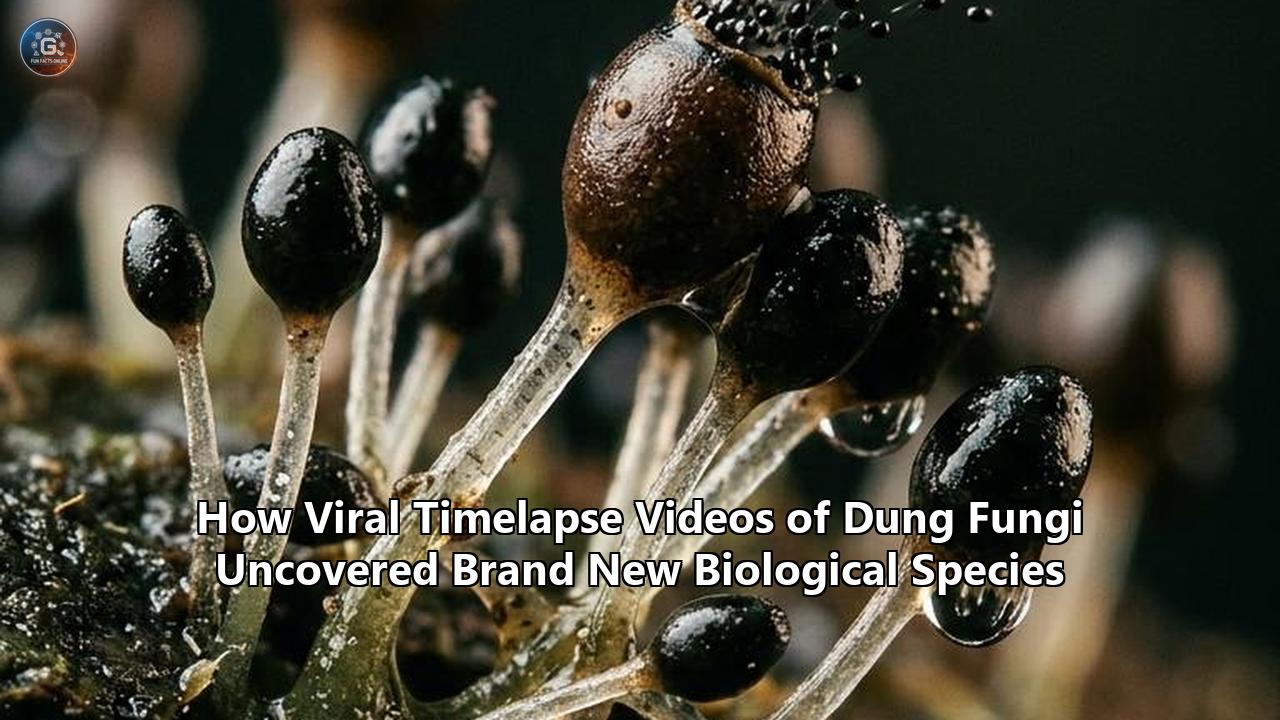
When a 27-year-old trainee lawyer in Edinburgh began replacing the clothes in his bedroom wardrobe with stacked plastic terrariums filled with Highland cattle cowpats, grouse droppings, and rabbit pellets, his housemate might have had cause for concern. But the resulting laboratory—outfitted with macro lenses, automated LED arrays, and intervalometers capturing photographs every 30 seconds—has yielded one of the most unexpected mycological breakthroughs in recent years.
Alfred Drummond-Herdman, a self-taught taxonomist, turned these incubations into viral social media content, racking up millions of views across Instagram and TikTok. Far beyond mere digital entertainment, his high-definition time-lapse recordings have provided the critical visual evidence needed to identify two brand-new biological species, with several additional candidate taxons currently undergoing formal description.
The discovery highlights an under-studied ecological niche: coprophilous (dung-loving) fungi. These highly specialized organisms race through their life cycles in a matter of hours or days, decomposing organic herbivore waste and recycling essential nutrients back into soils worldwide. Because many of these organisms are microscopic or decay almost instantly upon reaching maturity, traditional field surveying methods routinely miss them.
By marrying consumer-grade time-lapse videography with controlled indoor incubation and crowdsourced expertise, Drummond-Herdman’s project has sparked a broader debate within the scientific community. His work demonstrates how low-cost, continuous motion analysis can reveal cryptic biodiversity that standard institutional surveys and static laboratory sampling frequently overlook.
The Untapped Biodiversity of Manure Ecosystems
To understand why time-lapse photography has proved so disruptive in this field, one must first grasp the extreme environment of coprophilous ecology. Animal dung, particularly from herbivorous mammals and birds, represents a rich, highly concentrated, yet highly transient island of nutrients. Composed of partially digested cellulose, hemicellulose, nitrogenous waste, and minerals, a fresh herbivore deposit initiates an intense biological succession.
[Ingestion of Vegetation] ──> [Enzymatic Gut Activation] ──> [Deposition of Manure]
                                                                     │
 ┌───────────────────────────────────────────────────────────────────┘
 │
 ▼
[Stage 1: Zygomycetes] ──> [Stage 2: Ascomycetes] ──> [Stage 3: Basidiomycetes]
(0 – 48 Hours)             (3 – 10 Days)               (7 – 20+ Days)
e.g., Pilobolus            e.g., Ascobolus             e.g., Coprinopsis
The spores of coprophilous organisms do not merely land on manure from the air; they are ingested by grazing animals, surviving the caustic chemical environment of the digestive tract. In many cases, passing through the gut's heat and enzymatic acid is a required trigger that breaks spore dormancy. The moment the dung hits the ground, a competitive race begins:
- The Zygomycete Phase (0–48 Hours): Fast-growing "sugar fungi" like Pilobolus rapidly exploit easily accessible soluble carbohydrates. They construct high-pressure liquid stalks to blast their spore caps away from the dung and onto surrounding pasture grass to be eaten again.
- The Ascomycete Phase (3–10 Days): Microscopic cup fungi, including Ascobolus and Sordaria, break down more complex hemicelluloses, building specialized jacketed sacs (asci) that shoot spores toward ambient light sources.
- The Basidiomycete Phase (7–20+ Days): Larger, complex mushrooms—such as inkcaps (Coprinopsis) and conecaps (Conocybe)—utilize powerful lignin-degrading enzymes to digest the remaining structural fibers.
According to modern taxonomic estimates by the Royal Botanic Gardens, Kew, over two million fungal species remain completely undescribed globally. A significant fraction of this undiscovered biodiversity resides within micro-habitats like animal waste. Because traditional scientific field trips rely on sporadic human observation, fragile short-lived species that fruit at 3:00 AM and dissolve into liquid by morning are systematically ignored.
The emergence of affordable high-resolution photography has bridged this observational gap. By documenting these ephemeral lifecycles frame by frame, citizen scientists are systematically uncovering new dung fungi species that have eluded academic taxonomists for decades.
Methodological Comparison: Static Field Surveys vs. Continuous Incubation
The discovery of new fungal species historically depended on field mycologists walking through habitats with collection baskets, seeking visible fruiting bodies. In the study of coprophilous organisms, however, this traditional methodology faces severe technical limitations when compared to continuous indoor incubation.
| Analytical Parameter | Traditional Field Surveying | Continuous Time-Lapse Incubation |
|---|---|---|
| Observational Frequency | Single snapshot per visit (sporadic) | Frames captured every 30–300 seconds continuously |
| Environmental Control | Subject to ambient weather, rain, wind, desiccation | Regulated humidity, temperature, and lighting |
| Succession Tracking | Captures only organisms mature at the exact time of visit | Documents multi-week biological transitions in order |
| Behavioral Capture | Static physical morphology only | Motion dynamics: phototropism, spore propulsion, cap rotation |
| Equipment Overhead | Low (collection boxes, field hand lens) | Medium (macro cameras, intervalometers, terrariums) |
| Sample Integrity | High risk of insect consumption or physical weathering | Shielded from external pests; clean specimen collection |
The Field Survey Paradigm
Field surveying provides undeniable ecological context. Investigators observe how an organism behaves within an unmanipulated ecosystem, including its interactions with dung beetles, mites, and surrounding vegetation. However, field surveying of coprophilous organisms suffers from severe sampling bias.
Many coprophilous species possess fruiting bodies smaller than a millimeter in diameter. In the wild, rainstorms wash these microscopic structures away, wind desiccates delicate stalks, and local fauna consume them before a human researcher happens to pass by. A field trip captures a single, static instant in a process that unfolds over weeks, making it almost impossible to study structural changes over time.
The Continuous Incubation Paradigm
Indoor incubation, by contrast, treats a piece of dung as a self-contained microcosm. By placing wild-collected manure into closed, transparent terrariums under humid conditions, researchers create a protected environment where every dormant spore can germinate.
When paired with time-lapse photography, this approach turns observational taxonomy from a game of chance into a continuous stream of data. Cameras set to take pictures every 30 seconds capture critical diagnostic events:
- Phototropic alignment: How the stem bends toward ambient light to clear obstacles.
- Cap expansion and rotation: Dynamic twisting motions that align gills perpendicular to gravity for maximum spore release.
- Deliquescence: The controlled self-digestion of mushroom tissues into fluid, which aids in spore dispersal.
Time-Lapse Camera Setup (Every 30s)
  │
  ├──> [Frame-by-Frame Motion Analysis] ──> Identifies structural behaviors & growth rates
  │
  └──> [Targeted Micro-Harvesting] ─────> Yields pristine, undamaged sporing bodies
                                               │
                                               ▼
                                      [Microscopy + DNA Barcoding]
This continuous monitoring allows researchers to spot the precise moment a rare or unknown specimen reaches maturity. The photographer can then harvest the pristine fruiting body for microscopic analysis and DNA barcoding before it decays. Without time-lapse monitoring, these delicate structures disappear long before an investigator notices them.
Diagnostic Breakthroughs: Visual Motion Phenotyping vs. DNA Barcoding
The identification of new biological species has traditionally relied on physical characteristics (morphology) or modern molecular analysis (DNA barcoding). The integration of time-lapse video introduces a third diagnostic tool: visual motion phenotyping.
                      ┌───────────────────────────────────────┐
                      │    Modern Species Identification      │
                      └───────────────────┬───────────────────┘
                                          │
         ┌────────────────────────────────┼────────────────────────────────┐
         ▼                                ▼                                ▼
┌─────────────────┐              ┌─────────────────┐              ┌─────────────────┐
│   Morphology    │              │  DNA Barcoding  │              │ Motion Phenotype│
│  (Microscopy)   │              │   (ITS/LSU/TEF) │              │  (Time-Lapse)   │
└────────┬────────┘              └────────┬────────┘              └────────┬────────┘
         │                                │                                │
         │  • Spore shape & size          │  • Genetic divergence          │  • Cap rotation dynamics
         │  • Gill structure              │  • Sequence match databases    │  • Ballistic discharge angle
         │  • Cell arrangement            │  • Evolutionary tree placement │  • Growth velocity profiles
         │                                │                                │
         └────────────────────────────────┼────────────────────────────────┘
                                          │
                                          ▼
                      ┌───────────────────────────────────────┐
                      │ Confirmed New Biological Species      │
                      └───────────────────────────────────────┘
High-Throughput DNA Barcoding
Genomic sequencing—specifically targeting the Internal Transcribed Spacer (ITS) region, Large Subunit (LSU), or Translation Elongation Factor (TEF1) genes—is widely considered the standard for modern fungal taxonomy.
- Strengths: DNA sequencing can distinguish between cryptic species that appear physically identical under a microscope. It provides clear evolutionary relationships and works even when using damaged or incomplete tissue samples.
- Limitations: Genomic databases like GenBank are filled with unassigned sequences from "dark taxa"—fungi known only from environmental DNA, with no physical description or observed life cycle. Sequence data alone cannot tell you how a fungus looks, how it disperses its spores, or how it interacts with its environment.
Visual Motion Phenotyping via Time-Lapse
Time-lapse videography adds a dynamic behavioral layer that genetic sequencing cannot provide. By watching growth unfold over hours, researchers can measure specific physical behaviors that serve as diagnostic traits:
- Growth Velocity Metrics: Measuring stem elongation in millimeters per hour under standardized temperatures helps differentiate closely related species that look identical at maturity.
- Kinetic Cap Rotation: Certain coprophilous inkcaps execute systematic 180-degree cap rotations during expansion to navigate around physical obstacles like grass stems or dung debris. This behavioral adaptation varies predictably between distinct dung fungi species.
- Ejection Kinematics: High-speed time-lapse photography records the launch angle, distance, and timing of spore projection in species that use hydraulic propulsion.
While motion analysis cannot replace molecular sequencing, it fills a major gap in modern taxonomy. When Drummond-Herdman captured an unrecognized fungus growing on Scottish grouse droppings, the time-lapse footage revealed a unique combination of structural growth stages and spore ejection mechanics.
This visual evidence prompted subsequent microscopic inspection and targeted DNA barcoding, confirming that the organism was indeed an entirely new species rather than a physical variation of a known taxon.
Structural Evolution: Institutional Research vs. Decentralized Citizen Science
The discovery of new species in a spare bedroom highlights an ongoing shift in how ecological research is conducted. Classical taxonomy—the practice of finding, describing, and categorizing living organisms—is experiencing a structural divide between traditional academic institutions and decentralized networks of citizen scientists.
  TRADITIONAL ACADEMIC TAXONOMY               DECENTRALIZED CITIZEN SCIENCE
 ┌───────────────────────────────┐           ┌───────────────────────────────┐
 │ • High institutional funding   │           │ • Low-cost open source tech   │
 │ • Rigorous peer-review focus  │           │ • Viral social media reach    │
 │ • DNA sequencing facilities   │   VS.     │ • Crowdsourced sampling       │
 │ • Bottleneck: Lack of staff   │           │ • Continuous 24/7 incubation  │
 │ • Aesthetic bias against dung │           │ • Bottleneck: Sequencing access│
 └──────────────┬────────────────┘           └──────────────┬────────────────┘
                │                                           │
                └─────────────────────┬─────────────────────┘
                                      │
                                      ▼
                        [HYBRID TAXONOMIC PIPELINE]
            Citizen field sampling & time-lapse phenotyping
                                      +
            Academic genomic sequencing & formal publication
Institutional Science Constraints
Academic science excels at high-level molecular genetics, evolutionary tree building, and maintaining official natural history collections. However, university research faces structural challenges:
- Taxonomic Deprioritization: Funding agency priorities have shifted toward applied fields like medical biotechnology, agricultural industrialization, and synthetic biology. University taxonomy departments have shrunk worldwide, leaving few paid positions for dedicated fungal taxonomists.
- Aesthetic and Practical Biases: Organisms that grow on animal waste are rarely prioritized for research grants compared to plant pathogens or edible forest mushrooms.
- Operational Bottlenecks: Research labs operate on set business hours. They rarely have the staffing or flexibility required to monitor unpredictable micro-fungi fruiting continuously overnight.
The Citizen Science Advantage
Decentralized researchers operate outside these institutional constraints:
- Crowdsourced Sample Collection: Thanks to social media visibility, amateur mycologists build networks across different regions. Drummond-Herdman, for instance, receives animal waste samples through the mail from supporters across the UK, securing access to diverse ecological samples that no single academic team could collect.
- Unrestricted Longitudinal Observation: Operating out of home laboratories allows citizen scientists to run camera rigs 24 hours a day, 7 days a week. This continuous setup catches fleeting biological events that institutional schedules miss.
- Public Engagement and Fast Communication: Social media platforms allow citizen scientists to share high-definition videos with global audiences in real time. This rapid visibility attracts expert advice from specialists worldwide via open-source platforms and mycological forums.
The Emergence of the Hybrid Pipeline
The most productive path forward is not a competition, but a partnership between these two approaches. Amateurs act as a dispersed, highly responsive discovery network. They incubate substrates, produce detailed visual motion profiles, and isolate potential new species.
When a candidate species is identified, they partner with university labs to run DNA sequencing and complete the formal taxonomic registration on platforms like Index Fungorum or MycoBank. This hybrid pipeline combines the observational reach of dedicated amateurs with the scientific rigor of academic institutions.
Biomechanics On Camera: What Macro Time-Lapse Has Revealed
Beyond discovering brand-new dung fungi species, time-lapse videography has transformed our understanding of fungal biomechanics. By compressing days of physical development into seconds of clear motion, these videos uncover complex physical strategies that remain invisible during real-time observation.
  PILOBOLUS HYDRAULIC CANNON          COPRINOPSIS DELIQUESCENCE
 ┌───────────────────────────┐       ┌───────────────────────────┐
 │ Subsporangial Vesicle     │       │ Enzymatic Auto-Lysis      │
 │ High Internal Pressure    │       │ Gills Self-Digest         │
 │ (Up to 5.5 Atmosphere)    │       │ Converts Cap into Fluid   │
 │                           │       │                           │
 │ Launches Spore Ring @     │       │ Clears Obstacles so Inner │
 │ 20 Meters per Second      │       │ Spores Drop Cleanly       │
 └───────────────────────────┘       └───────────────────────────┘
1. Hydraulic Propulsion Systems (Pilobolus crystallinus)
One of the most remarkable phenomena captured on camera is the launch mechanism of Pilobolus, commonly known as the "hat-thrower" fungus. The fungus builds a transparent stalk topped with a fluid-filled bulb (subsporangial vesicle) and a black spore cap.
- Mechanism: The bulb acts as a natural lens, focusing light onto light-sensitive pigments at its base. The stalk turns toward the brightest light source—usually open grass away from the shaded dung pile.
- Launch: Internal water pressure increases to more than 5.5 atmospheres (roughly double the pressure in a typical car tire). The vesicle ruptures at a pre-set seam, blasting the spore cap outward at speeds exceeding 20 meters per second (over 45 mph).
- Time-Lapse Insight: High-speed interval photography shows how the stalk flexes slightly before launch, storing elastic energy in its cellular walls to maximize projectile distance.
2. Enzymatic Self-Digestion (Coprinopsis and Coprinus)
Inkcap mushrooms face a structural problem: their gills are packed tightly together to maximize spore production, but this dense layout makes it hard for mature spores to escape into the wind without hitting adjacent tissue.
- Mechanism: To solve this, inkcaps utilize enzymatic auto-lysis—they literally digest themselves. Starting at the bottom edge of the cap, the mushroom releases chitinase enzymes that melt the tissue into a thick black liquid.
- Time-Lapse Insight: Time-lapse recordings show that this self-digestion is not decay, but a tightly controlled growth strategy. As the bottom edge of the cap dissolves, it exposes the fresh gill tissue directly above it. This process rolls steadily up the cap, ensuring that freshly released spores always have a clear path into air currents without getting stuck.
3. Active Navigational Movement
Young fruiting bodies growing on animal droppings face a chaotic physical environment, full of dried manure overhangs, plant stems, and uneven surfaces.
- Time-Lapse Insight: Macro time-lapses show young stems making deliberate, weaving adjustments as they grow—a process known as circumnutation. Stems twist and rotate as they expand, testing the physical path ahead. If a stalk hits an obstruction, localized cellular growth bends the stem around the obstacle before realigning vertically toward light and gravity. This flexible growth strategy helps delicate structures survive in harsh environments.
Ecosystems in Transition: Environmental and Practical Applications
The study of coprophilous fungal diversity reaches far beyond taxonomy. These organisms play critical roles in ecosystem stability, soil fertility, and environmental monitoring, making their discovery increasingly relevant.
┌─────────────────────────────────────────────────────────────────┐
│               Ecosystem Impacts & Applications                  │
└────────────────────────────────┬────────────────────────────────┘
                                 │
         ┌───────────────────────┼───────────────────────┐
         ▼                       ▼                       ▼
┌─────────────────┐     ┌─────────────────┐     ┌─────────────────┐
│ Environmental   │     │ Agricultural    │     │ Industrial      │
│ Bio-Indicators  │     │ Impact          │     │ Bioprospecting  │
└────────┬────────┘     └────────┬────────┘     └────────┬────────┘
         │                       │                       │
         │ • Tracks wildlife     │ • Vulnerable to       │ • Powerful        │
         │   population shifts   │   veterinary drugs    │   lignin-breaking │
         │ • Monitors historical │   (e.g., ivermectin)  │   enzymes         │
         │   extinctions         │ • Essential for field │ • Source of novel │
         │   (Anthropocene)      │   nutrient recycling  │   antimicrobials  │
         └───────────────────────┴───────────────────────┘
Environmental Indicators and Anthropocene Tracking
Dung-dwelling fungi are sensitive indicators of ecological change. Because many species depend on specific animal hosts, changes in fungal populations reflect shifts in broader wildlife communities:
- Historical Extinction Tracking: Paleoecologists use fossilized spores from coprophilous species like Sporormiella in lake sediments to trace the collapse of prehistoric megafauna. A sudden drop in spore counts signals the loss of large herbivores long before human hunting artifacts appear in the fossil record.
- Modern Biodiversity Monitoring: Documenting wild dung fungi species across modern nature reserves gives scientists a non-invasive way to track health shifts in herbivore populations, including wild deer, grouse, and livestock.
Agricultural Health and Veterinary Impacts
In modern agriculture, coprophilous fungi are the primary drivers of pasture renewal. Without these specialized decomposers, herbivore droppings would accumulate on grazing lands, smothering plant growth and locking up vital nitrogen and phosphorus.
However, these fungal communities face serious threats from modern agricultural chemicals. Broad-spectrum antiparasitic medications—particularly synthetic vermicides like ivermectin administered to cattle and horses—pass through the animal's gut and remain active in their droppings.
Research shows these residues severely disrupt coprophilous fungal development, stalling decomposition and impairing natural nutrient cycling. Identifying which species are most vulnerable helps agronomists design livestock treatment schedules that protect beneficial pasture fungi.
Industrial Bioprospecting
The extreme biochemical tools coprophilous fungi use to break down tough plant material make them valuable resources for industrial biotechnology:
- Enzyme Discovery: Because these organisms thrive on pre-digested plant matter, they produce potent enzymes that break down tough lignin, cellulose, and hemicellulose. Industries use these enzymes to improve biofuel production, paper processing, and agricultural waste recycling.
- Novel Antimicrobials: Coprophilous species live in crowded, competitive environments alongside dense populations of bacteria and insects. To defend their food sources, they produce unique secondary metabolites, providing promising leads for new antibiotics, antifungals, and pest-control compounds.
AI Phenotyping and Decentralized Taxonomy
The convergence of viral time-lapse videography, affordable macro cameras, and citizen science marks an exciting shift in natural history research. What began as an unconventional bedroom experiment in Edinburgh has proved that significant biological discoveries are waiting in overlooked micro-habitats, right under our noses.
Looking ahead, several emerging technologies are poised to accelerate this field:
[Automated Time-Lapse Rigs]
            │
            ▼
[Computer Vision / AI Analysis] ──> Extracts growth speed, rotation, & color changes
            │
            ▼
[Global Citizen Science Portals] ──> Flags unusual morphospecies automatically
            │
            ▼
[Targeted DNA Sequencing] ────────> Confirms & registers new species in real time- AI-Driven Computer Vision: Integrating artificial intelligence models into time-lapse workflows will allow cameras to analyze growth patterns automatically. Machine learning algorithms can process thousands of video frames in seconds, calculating stem elongation rates, cap expansion angles, and spore-release timing to flag potentially unidentified species instantly.
- Accessible In-Field DNA Barcoding: Handheld DNA sequencers are becoming affordable enough for independent researchers. In the near future, citizen scientists will be able to perform time-lapse phenotyping and basic genetic sequencing under one roof, dramatically cutting the time required to formally describe a new species.
- Global Micro-Habitat Mapping: As open-source platforms bring together time-lapse creators worldwide, decentralized research networks will expand into tropical rainforests, arid grasslands, and alpine tundra. Documenting the specialized dung fungi species native to these under-sampled regions will fill critical gaps in our understanding of global biodiversity.
The success of these time-lapse discoveries sends a clear message to the scientific community: documenting biodiversity does not always require multi-million-dollar laboratory facilities. Sometimes, all it takes is an inquisitive mind, an inexpensive macro lens, patient observation, and a willingness to look closely at the places others reflexively avoid.
Reference:
- https://grandgoldman.com/es/blogs/business/fungus-on-faeces-students-timelapse-videos-go-viral
- https://www.theguardian.com/environment/2026/aug/02/alfred-drummond-herdman-animal-dung-fungi-films-aoe
- https://www.youtube.com/watch?v=R1ettkFmY7I
- https://www.youtube.com/watch?v=4933nSD24Uo
- https://www.youtube.com/watch?v=lHpRYV1PRMc
- https://www.youtube.com/watch?v=9zAa-ifXRSE
- https://www.smithsonianmag.com/science-nature/watch-amazing-time-lapse-growing-mushrooms-180976118/
- https://www.planetfungi.movie/timelapses