A fundamental question in geophysics has long puzzled researchers monitoring active volcanoes: why do two eruptions with identical chemical compositions, gas contents, and subsurface pressure profiles behave in radically opposite ways? While one volcano slowly spills sluggish streams of thick lava down its slopes, another fed by the exact same type of magma launches blinding, sustained fountains of molten rock hundreds of meters into the night sky.
A study published in Nature Communications by an international research team led by The University of Manchester, working alongside scientists at Diamond Light Source, provides a clear answer. The secret behind these dramatic vertical jets lies deep within the thermal history of the magma before it ever begins its upward journey.
Researchers discovered that when magma undergoes "superheating"—heated by deep mantle injections to temperatures well above the point where solid minerals can exist—it erases its own microscopic crystal seeds. By melting away nanoscale mineral nuclei and reorganizing the silicate liquid at a molecular level, superheated magma delays the formation of new crystals during its ascent by several hours.
Without microscopic crystals to stiffen the liquid, the ascending magma remains remarkably fluid, allowing volcanic gases to drive rapid, uninhibited upward acceleration. As this fluid, gas-saturated molten rock reaches the vent, the sudden drop in pressure triggers a catastrophic expansion of gas bubbles, launching spectacular jets of fire.
This finding alters classic theories of physical volcanology, revealing that a magma’s thermal memory acts as an internal control switch between gentle, effusive lava flows and intense, hazardous lava fountains.
                SUPERHEATED MAGMA ASCENT
┌────────────────────────────────────────────────────────┐
│ Deep Mantle Injection (Thermal Spike)                  │
│  └─ Temperature rises above liquidus                   │
│  └─ Pre-existing crystal seeds (nanolites) dissolve    │
└───────────────────────────┬────────────────────────────┘
                            │
                            ▼
┌────────────────────────────────────────────────────────┐
│ Ascent Phase (Kinetic Nucleation Delay)               │
│  └─ Melt stays 100% fluid (no crystal thickening)      │
│  └─ Dissolved gases remain locked in rapid rise        │
└───────────────────────────┬────────────────────────────┘
                            │
                            ▼
┌────────────────────────────────────────────────────────┐
│ Vent Decompression & Eruption                          │
│  └─ Gases exsolve rapidly near surface                 │
│  └─ Low viscosity allows violent jetting               │
│  └─ Result: Towering Lava Fountain                     │
└────────────────────────────────────────────────────────┘
The Microscopic Architecture of Magma
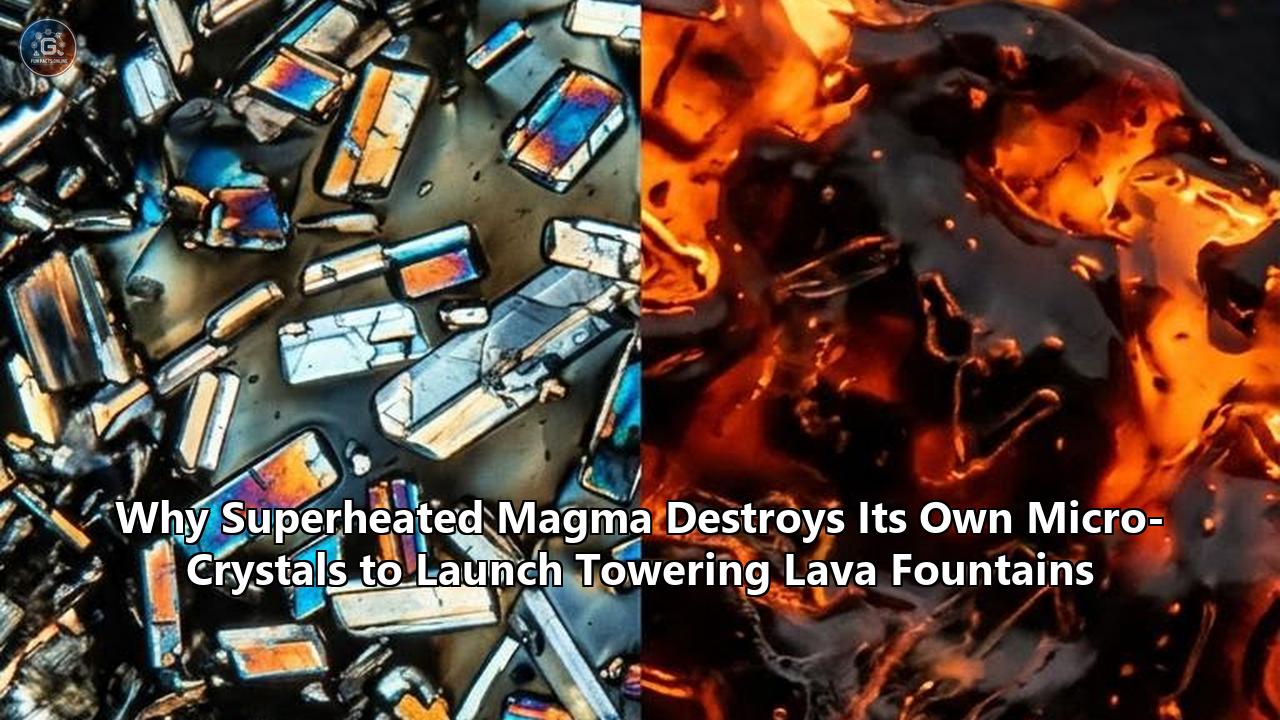
To understand why superheating alters volcanic behavior, it is necessary to look at molten rock not as a simple liquid, but as a complex, three-phase mixture of liquid silicate melt, suspended gas bubbles, and tiny mineral crystals.
When magma sits in a subsurface chamber, cooling causes microscopic minerals to crystallize out of the melt. Volcanologists categorize these microscopic solids into two main size classes:
- Microlites: Crystals ranging in size from 1 to 100 micrometers (roughly the width of a human hair down to a fraction of a cell).
- Nanolites: Microscopic mineral particles smaller than 1 micrometer, often measuring just 20 to 50 nanometers across.
Despite their tiny size, these micro-crystals wield immense power over volcanic eruptions. As crystals form, they create a mechanical framework inside the liquid. Just as adding flour thickens a thin broth into a heavy paste, a network of microlites and nanolites drastically increases the magma's viscosity—its internal resistance to flow.
When nanolites interlock or cluster together, they trap liquid silicate melt between them, compounding the thickening effect. A magma laden with micro-crystals can become thousands of times stiffer than a crystal-free melt of the exact same chemical composition.
This physical transition dictates how lava fountains form or fail to form. When ascending magma becomes choked with micro-crystals, its high viscosity slows down its climb through the conduit. This slow rise gives expanding gas bubbles time to coalesce, break through the sticky liquid, and escape harmlessly into surrounding rock fractures. Deprived of its gas propellants, the degassed, crystal-heavy magma oozes out at the surface as slow-moving lava flows or thick domes.
The Thermal Reset: How Superheating Erases Mineral Seeds
The recent study focused on magma erupted during the 2021 Tajogaite eruption on La Palma in Spain’s Canary Islands. During this months-long eruption, the volcano alternated between destroying homes with thick, slow-moving lava flows and shooting lava fountains hundreds of meters into the atmosphere.
   COOLING MAGMA (Standard)          SUPERHEATED MAGMA (Reset)
┌─────────────────────────────┐    ┌─────────────────────────────┐
│ High Micro-Crystal Density  │    │ Crystal Seeds Dissolved     │
│ Interlocking Network        │    │ Uniform Liquid Structure    │
│ High Viscosity / Slow Ascent│    │ Low Viscosity / Fast Ascent │
│ Gas Escapes Gently          │    │ Gas Trapped for Explosion   │
└──────────────┬──────────────┘    └──────────────┬──────────────┘
               │                                  │
               ▼                                  ▼
      Effusive Lava Flow                 Towering Lava Fountain
By conducting high-temperature, high-pressure laboratory experiments on tephrite lava from La Palma, researchers identified a hidden physical mechanism: a thermal reset driven by superheating.
Superheating occurs when a deep, hot recharge of magma rises from Earth's mantle and injects itself into a cooler, shallow magma reservoir. This thermal pulse raises the temperature of the stored magma past its liquidus—the thermodynamic threshold above which solid minerals cannot stably exist.
When magma reaches this state, two distinct phenomena occur at the microscopic scale:
1. Structural Dissolution of Nanolites
The intense heat melts existing microlites and breaks down sub-nanometer cluster arrangements—the invisible mineral seeds that normally serve as template sites for new crystal growth.
2. Molecular Homogenization
The liquid silicate network reorganizes itself into a uniform structure. The local chemistry becomes dispersed, removing the concentration gradients that allow minerals like olivine, pyroxene, and plagioclase to form quickly.
This thermal reset leaves a lasting kinetic legacy. Even when the magma subsequently moves away from the heat source and begins to cool as it climbs toward the surface, it cannot easily start growing crystals again. The chemical and structural "building blocks" required for crystal nucleation have been erased.
In laboratory trials recreating these underground conditions, magma that had not been superheated began forming micro-crystals within just 20 minutes of cooling. However, magma exposed to a strong pulse of superheating delayed crystal nucleation for more than eight hours under identical cooling conditions.
"Until now, we did not fully understand the dynamics of crystal growth for magmas that received an injection of superheat just before ascent," explained Dr. Barbara Bonechi, lead author of the study and Research Associate at The University of Manchester. "The history of crystal and bubble growth can dramatically control how a magma erupts, in particular as more crystals grow, they eventually have a dramatic effect on magma viscosity".
The Physics of Lava Fountaining
This hours-long delay in crystallization completely alters the fluid dynamics of the eruption. The fundamental physics behind how lava fountains form depends on a race against time between magma ascent speed and crystallization rates.
 Ascent
 Depth
   │   [Vent] Decompression / Choked Flow / Fountain Jet
   │      ▲
   │      │   Rapid Gas Bubble Expansion (Water Vapor, SO2)
   │      │
   │      │   Fluid Liquid Ascent (Zero Micro-Crystals)
   │      │
   │   [Conduit] Fast Acceleration Driven by Expansion
   │      ▲
   │      │   Kinetic Delay Window (Up to 8 Hours Crystal-Free)
   │      │
   │   [Reservoir] Superheated Thermal Injection (Seeds Destroyed)
   ▼
When superheated magma enters a volcanic conduit, it retains an extremely low viscosity, flowing almost as easily as warm olive oil. Because the melt remains crystal-free throughout its journey up the volcanic pipe, its internal friction stays minimal.
As the liquid ascends, the surrounding pressure decreases. Dissolved volcanic gases—primarily water vapor, carbon dioxide, and sulfur dioxide—begin to bubble out of solution (a process called exsolution). In a thick, crystal-rich magma, these bubbles struggle to expand, or they tear through the sticky melt in violent, localized explosions.
In a superheated, low-viscosity magma, the story is entirely different:
- Gas Trapping in a Fluid Matrix: The low structural viscosity allows billions of microscopic gas bubbles to nucleate simultaneously throughout the liquid.
- Hydrodynamic Acceleration: As pressure drops precipitously in the upper two kilometers of the crust, these bubbles expand rapidly. Because the liquid melt yields smoothly without tearing or stiffening, the expanding gas acts like a compressed spring releasing its energy.
- Choked Flow at the Vent: The volume of the gas-liquid foam expands exponentially, driving the mixture up the conduit at speeds exceeding tens of meters per second.
- Jetting Mechanics: When this high-velocity, two-phase fluid reaches the surface vent, it shoots into the atmosphere as a continuous jet. The gas propels molten droplets high above the crater rim, creating fire fountains that can reach heights of up to 1,000 meters.
If the magma had crystallized during its ascent, the rise speed would have plummeted, the gas would have separated from the liquid, and the towering fountain would have collapsed into a slow-moving lava flow. Destroying its own micro-crystals is the precise mechanism that allows superheated magma to power these extraordinary vertical jets.
Observing Micro-Crystals in Real Time
Unraveling mechanisms operating at 1,200 degrees Celsius under hundreds of megapascals of pressure required cutting-edge experimental techniques. Scientists could not simply place a camera inside an active subterranean conduit, so they brought the volcano into the laboratory.
                     SYNCHROTRON X-RAY SETUP

  [High-Energy Synchrotron X-Ray Beam]
                 │
                 ▼
     ┌──────────────────────┐
     │ X-Ray Transparent    │  <-- Sample: Molten Tephrite
     │ Pressure Vessel      │      (1,200°C / High Pressure)
     └──────────┬───────────┘
                │
                ▼
     ┌──────────────────────┐
     │ 3D Microtomography   │  <-- Captures crystal & bubble
     │ Detector             │      nucleation every 60 seconds
     └──────────────────────┘
The research team used Diamond Light Source, the UK’s national synchrotron science facility, to peer inside molten rock as it cooled. Using a specially engineered, high-pressure vessel transparent to X-rays, the researchers mounted natural rock samples from the La Palma eruption into the beamline.
By directing X-ray beams billions of times brighter than the sun through the pressure vessel, the team performed synchrotron X-ray microtomography. This technique allowed them to capture 3D spatial images of crystal nucleation and gas bubble growth inside the opaque liquid every minute.
To confirm that superheating had erased nanometer-scale seed structures, the researchers complemented synchrotron imaging with two specialized laboratory methods:
- Raman Spectroscopy: Laser light was scattered off quenched glass samples to detect subtle structural vibrations in the silicate network. The analysis confirmed that strongly superheated samples contained zero pre-existing nanolite clusters.
- Differential Scanning Calorimetry (DSC): By measuring tiny energy releases associated with mineral phase changes, researchers proved that superheated magmas required far greater undercooling (cooling significantly below the liquidus temperature) before mineral crystallization could begin.
To observe long-term crystallization behavior, parallel experiments were conducted in specialized high-pressure furnaces in Prague. Combining real-time X-ray imaging with long-duration furnace experiments provided hard experimental proof: superheating resets the magma's internal clock, keeping it completely liquid during the exact window of time needed to rise through Earth's crust.
Volcanic Case Studies: From La Palma to Hawaiʻi
The discovery of superheating-driven nucleation delays clarifies long-standing anomalies observed during famous volcanic eruptions worldwide.
      LA PALMA (2021)                     KĪLAUEA IKI (1959)
┌───────────────────────────┐       ┌───────────────────────────┐
│ Alternating Eruption      │       │ Towering Fire Fountains   │
│ Pulsed mantle recharges   │       │ Deep hot magma injection  │
│ Superheating = Fountains  │       │ Minimal internal crystals │
│ Cooler phases = Flows     │       │ Records up to 580m high   │
└───────────────────────────┘       └───────────────────────────┘
Tajogaite Eruption, La Palma (2021)
During the 85-day eruption on La Palma, scientists were fascinated by how quickly the volcano switched between effusive lava flows and intense Hawaiian-style lava fountaining.
The new research reveals that these transitions coincided with pulses of hot, fresh tephrite magma entering the shallow reservoir from depths below 30 kilometers. When fresh, superheated pulses arrived, crystal seeds dissolved, viscosity dropped, and high-velocity lava fountains erupted at the vent.
During periods between deep recharges, the magma stalled in shallow crustal pockets, cooled down below its liquidus, grew dense networks of microlites, and switched to slow, oozing lava flows.
Kīlauea Volcano, Hawaiʻi
Hawaiʻi’s Kīlauea is famous for dramatic lava fountains, including the legendary 1959 Kīlauea Iki eruption, which launched sustained lava fountains reaching record heights of 580 meters (1,900 feet).
Petrological studies of quenched scoria droplets from Kīlauea Iki revealed that the erupted basalt was exceptionally hot ($>1,200^\circ\text{C}$) and practically free of groundmass microlites upon exit. The rapid injection of superheated mantle magma into Kīlauea’s shallow reservoir erased crystal nuclei, providing ideal fluid conditions for continuous gas-driven fountaining.
Mount Etna, Italy
Sicily’s Mount Etna frequently undergoes dramatic episodes known as "paroxysms"—brief but intense eruptions featuring lava fountains that climb over 1,000 meters into the sky.
Etna's magma is basaltic trachyandesite, a composition that should theoretically grow crystals rapidly during ascent due to its moderate silica content. However, deep geophysical monitoring shows that paroxysms are triggered when deep, volatile-rich, superheated magma surges upward into Etna's central conduit. The superheating effect delays crystallization, keeping the fast-rising magma fluid enough to fuel extraordinary paroxysmic fountains.
Iceland's Reykjanes Peninsula
Recent activity along the Sundhnúkur crater row and Fagradalsfjall in Iceland has produced impressive, episodic lava fountaining alongside long lava flows.
Researchers analyzing gas chemistry and crystal textures found that pulsatory fountaining in Iceland corresponds directly to pressure and thermal cycles within shallow crustal magma chambers. Fresh thermal inputs periodically superheat the melt, destroying micro-crystals and generating the fluid conditions required to propel fountains hundreds of meters into the air.
Comparing Magma Behaviors
The physical differences between superheated magma and standard cooling magma illustrate why thermal history dominates eruptive behavior:
| Characteristic | Standard Cooling Magma | Superheated Magma |
|---|---|---|
| Thermodynamic State | Temperature below liquidus ($T < T_{\text{liquidus}}$) | Temperature exceeds liquidus ($T > T_{\text{liquidus}}$) |
| Micro-Crystal Content | High density of microlites & nanolites | Zero to trace micro-crystals (seeds dissolved) |
| Nucleation Timing | Rapid crystal growth within ~20 minutes | Delayed crystal growth for $>8$ hours |
| Melt Viscosity | High (sticky, non-Newtonian paste) | Extremely low (fluid, liquid-like flow) |
| Gas Escape Style | Gas bubbles escape or rupture violently | Gas bubbles remain locked in fast fluid flow |
| Ascent Speed | Slow, sluggish upward drift | Rapid, hydrodynamically driven acceleration |
| Eruptive Outcome | Slow lava flows, lava domes, or effusive vents | Towering, sustained lava fountains |
Upgrading Volcano Early-Warning Models
The revelation that superheating destroys microscopic crystals and delays future nucleation has direct implications for public safety and volcanic hazard forecasting.
Historically, volcanic hazard models relied on three main parameters to predict how an eruption would unfold:
- Magma Bulk Chemistry: Measuring silica content to estimate baseline viscosity.
- Volatile Content: Measuring dissolved gases ($H_2O$, $CO_2$, $SO_2$) to calculate potential explosive energy.
- Chamber Pressure: Tracking seismic tremors and ground deformation to estimate subterranean pressure buildup.
While these parameters are vital, they routinely fail to predict sudden switches in volcanic behavior—such as when an effusive eruption abruptly transforms into violent lava fountaining. By incorporating thermal history and crystal dissolution kinetics into computer simulations, volcanologists can close this critical predictive gap.
                TRADITIONAL HAZARD MODEL
┌────────────────────────────────────────────────────────┐
│ - Bulk Chemistry (Silica %)                            │
│ - Dissolved Volatiles (H2O, CO2)                       │  ==> Misses sudden style
│ - Shallow Chamber Pressure                             │      switches & fountaining
└────────────────────────────────────────────────────────┘

              NEXT-GENERATION HAZARD MODEL
┌────────────────────────────────────────────────────────┐
│ - Bulk Chemistry & Volatiles                           │
│ - Deep Seismic Tremor (Mantle Recharge)                │  ==> Accurately predicts
│ - Thermal History Tracking (Superheating)              │      lava fountain onset
│ - Kinetic Nucleation Delay Simulations                 │      and eruption severity
└────────────────────────────────────────────────────────┘
Co-author Dr. Margherita Polacci, Reader in Volcanology at The University of Manchester, emphasized the broader necessity of this approach: "Current volcanic hazard models typically focus on magma chemistry, gas content and pressure changes. By integrating the thermal history of magma and crystal nucleation delays into these models, we can better anticipate whether an impending eruption will manifest as localized lava flows or high-altitude lava fountains that threaten air traffic and surrounding communities".
When deep seismic monitoring detects fresh magma rising from the mantle into a shallow reservoir, scientists can now assume that superheating is occurring. By modeling the time required for that superheated magma to cool back down and begin crystallizing, civil defense authorities can calculate a precise time window during which the risk of extreme lava fountaining remains elevated.
Future Frontiers in Physical Volcanology
The discovery of heat-driven seed dissolution opens new avenues of inquiry across Earth science. Researchers are turning their attention to several key questions:
- Re-evaluating Archive Samples: Volcanologists are re-examining volcanic ash and tephra samples from historic eruptions worldwide using high-resolution Raman spectroscopy to scan for erased nanolite signatures.
- 3D Fluid Dynamic Simulations: Computational geophysicists are building 3D fluid dynamic models that link mantle heating pulses directly to conduit jetting mechanics. These simulations aim to predict how lava fountains form, evolve, and shut down over multi-week eruption cycles.
- Interplanetary Volcanism: Planetary scientists are applying these superheating principles to extraterrestrial volcanoes. Massive lava plains on the Moon, Mars, and Venus show evidence of ancient lava fountains that may have reached heights of dozens of kilometers, powered by superheated ultramafic magmas rising rapidly from planetary interiors.
Understanding that superheated magma destroys its own micro-crystals transforms how scientists interpret active volcanoes. By looking deep beneath the surface to read a magma's microscopic thermal memory, geophysicists are unlocking the secrets of Earth’s most spectacular displays of volcanic power.
Reference:
- https://www.sciencedaily.com/releases/2026/07/260731034200.htm
- https://scitechdaily.com/scientists-uncover-the-hidden-process-that-can-turn-magma-into-an-explosive-force/
- https://theanalyticalscientist.com/issues/2026/articles/june/the-making-of-a-lava-fountain/
- https://pmc.ncbi.nlm.nih.gov/articles/PMC10630439/
- https://physicsworld.com/a/nanocrystals-could-drive-explosive-volcanic-eruptions/
- https://www.bristol.ac.uk/news/2020/september/nanolites.html
- https://www.diamond.ac.uk/Home/News/LatestNews/2025/The-tiny-power-behind-volcanic-eruptions-.html
- https://www.diamond.ac.uk/Science/Research/Highlights/2022/How-magma-crystallisation-affects-volcanic-eruptions.html
- https://pmc.ncbi.nlm.nih.gov/articles/PMC10170078/
- https://www.nps.gov/para/learn/nature/magma-melts-and-eruption-types.htm
- https://par.nsf.gov/servlets/purl/10700586
- https://sustainability.stanford.edu/news/crystals-may-help-reveal-hidden-kilauea-volcano-behavior