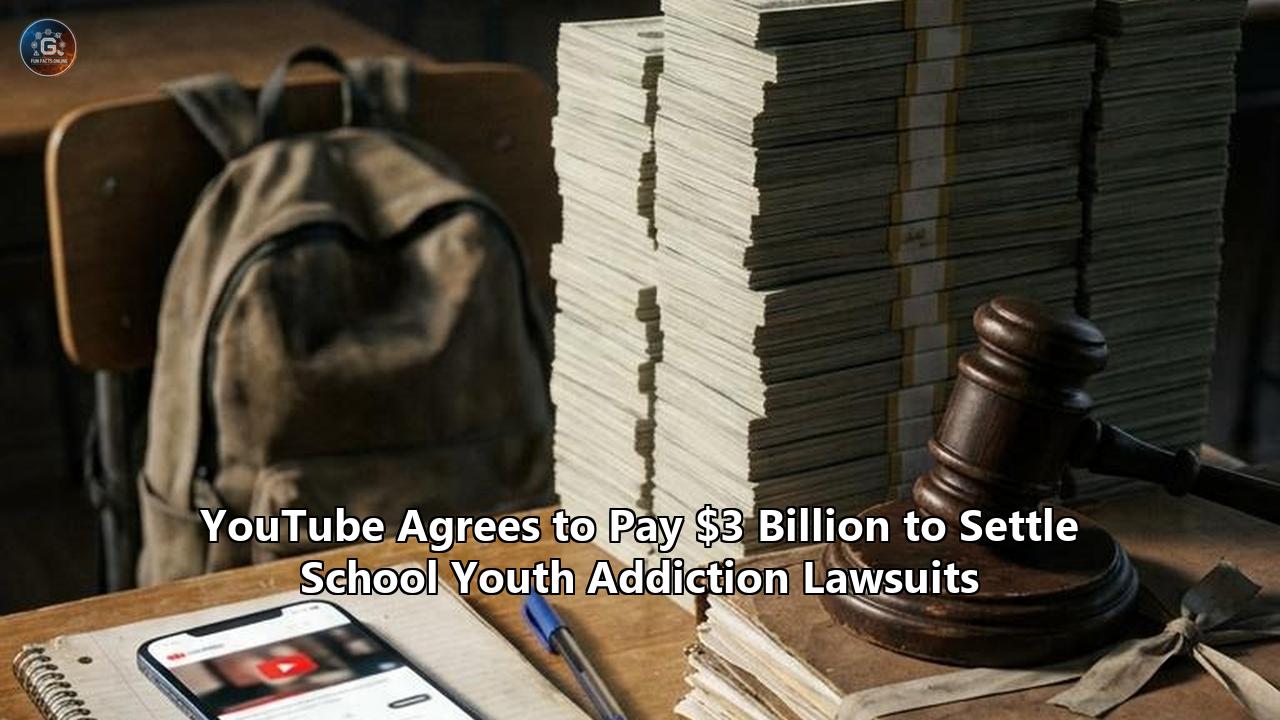
Alphabet’s video streaming subsidiary, YouTube, has agreed in principle to pay approximately $3 billion to settle a massive consolidation of lawsuits brought by thousands of public school districts across the United States. The deal, first disclosed through filings and legal sources in late November 2026, marks the largest corporate settlement directly negotiated with American school systems in history.
The legal confrontation, centralized before U.S. District Judge Yvonne Gonzalez Rogers in the U.S. District Court for the Northern District of California under Multidistrict Litigation (MDL) No. 3047, accused the tech giant of deliberately engineering its platform to foster compulsive, addictive consumption patterns in children and teenagers. School administrators from Los Angeles and New York City down to rural Kentucky documented that this algorithmic manipulation triggered an unprecedented student mental health emergency—forcing school boards to divert millions of dollars from core academic budgets into clinical psychological counseling, behavioral crisis management, and classroom surveillance systems.
While YouTube has maintained an official denial of wrongdoing throughout the four-year litigation, the $3 billion settlement represents a strategic move to neutralize immense financial liability. Unlike co-defendants Meta Platforms, ByteDance (TikTok), and Snap Inc., which remain bound to face a high-stakes bellwether trial initiated by the Tucson Unified School District in February 2027, YouTube has chosen to break ranks.
The resolution hinges on a formal opt-in threshold requiring a majority of plaintiff districts to accept its terms over the coming months, alongside judicial approval from Judge Gonzalez Rogers. Beyond the monetary distribution, the accord binds YouTube to structural, engineering-level safeguards that will reshape how teen users interact with the platform. As the details of the agreement emerge, understanding the mechanics of this settlement requires unpacking the legal vulnerabilities that cracked Silicon Valley's defensive armor, the neurobiology of adolescent addiction, the machine learning systems optimized to capture youth attention, and the financial trade-offs driving Alphabet’s decision to settle.
The School District Calculus: Why Public Education Became the Plaintiff
To comprehend how this historic settlement came to fruition, one must understand why public school boards—rather than class-action groups of parents or individual consumers—became the tip of the legal spear.
Historically, product liability litigation against technology firms faltered when brought by individual consumers. Personal injury claims inevitably became bogged down in idiosyncratic causation arguments: defense attorneys would point to a teenager’s family history, pre-existing psychological vulnerabilities, offline trauma, or concurrent stress factors to argue that a digital platform could not be definitively isolated as the sole proximate cause of an adolescent’s depression or self-harm.
School districts bypassed that evidentiary quagmire by presenting a collective, institutional harm.
Under American tort jurisprudence, local government entities can bring claims under common-law negligence and public nuisance if a corporate actor’s commercial activities foreseeably degrade a shared public resource or impose widespread municipal costs. School boards in Seattle, Miami-Dade, Tucson, and Breathitt County asserted that public schools are state-mandated learning environments whose operational mission was actively derailed by platform design choices.
                          COMPELLED RESOURCE DIVERSION

┌─────────────────────────────────┐       ┌─────────────────────────────────┐
│     Platform Design Choices     │       │     School Operational Drain    │
│  • Autoplay video queues        │       │  • Licensed mental health staff │
│  • Dopaminergic notification loops│───▶ │  • De-escalation specialists    │
│  • Infinite-feed Shorts architecture│   │  • Signal-blocking lock pouches │
│  • Recommendation rabbit holes  │       │  • Unfunded behavioral IEPs     │
└─────────────────────────────────┘       └─────────────────────────────────┘
                                                           │
                                                           ▼
                                          ┌─────────────────────────────────┐
                                          │   Actionable Municipal Injury   │
                                          │  • Quantifiable budget diversion│
                                          │  • Disrupted instructional time │
                                          │  • Bypasses personal health tort│
                                          └─────────────────────────────────┘
The evidentiary complaints submitted in MDL 3047 presented a detailed financial ledger of institutional disruption:
- Mental Health Infrastructure Expansion: School districts demonstrated that between 2012 and 2024, expenditures on school psychologists, licensed clinical social workers, and contracted behavioral health specialists skyrocketed by over 400% in suburban and urban districts alike. Districts were forced to create dedicated de-escalation rooms, suicide-risk screening protocols, and specialized mental health crisis teams to manage acute panic attacks, severe self-harm ideation, and disruptive behavioral outbursts occurring directly inside school facilities.
- The Disruption of Pedagogical Order: Superintendents submitted declarations detailing the collapse of classroom attention spans. Teachers reported spending between 15% and 25% of instructional periods policing screen compliance, confiscating devices, and managing student distress caused by viral social trends, peer exclusion, or exhaustion stemming from compulsive nighttime streaming.
- Infrastructure Costs for Device Interdiction: Public schools were compelled to allocate millions of dollars in capital expenditures toward mobile device interdiction. This included purchasing radio-frequency-blocking Faraday pouches (such as Yondr systems), reconfiguring school-wide enterprise Wi-Fi routers to throttle streaming protocols, and acquiring specialized classroom monitoring software licenses like GoGuardian and Securly to detect unapproved viewing on student laptops.
- The Unfunded Burden of Individualized Education Programs (IEPs): Federal law under the Individuals with Disabilities Education Act (IDEA) requires public schools to accommodate students diagnosed with emotional disturbance and learning impediments. Districts demonstrated that secondary emotional disturbance diagnoses tied to digital screen compulsions, sleep deprivation, and severe social withdrawal forced the creation of specialized, resource-intensive instructional accommodations funded entirely by local tax dollars.
YouTube, however, occupied a far more precarious position in this school litigation than Instagram, Snapchat, or TikTok. While platforms like TikTok and Instagram were universally classified by school administrations as extracurricular distractions to be blocked on district Wi-Fi, YouTube held a privileged, foundational presence inside the physical classroom.
Through Alphabet’s aggressive, decade-long education strategy, Google achieved near-monopolistic penetration in American K-12 schooling. Google Workspace for Education and hardware deployments of Chrome OS devices (Chromebooks) captured more than 60% of the mobile device market across U.S. public schools. In millions of classrooms, YouTube was formally whitelisted as an instructional tool: science teachers projected educational channels, history teachers assigned documentary video clips, and elementary curricula directed children to educational animations hosted on YouTube servers.
School district attorneys turned this classroom integration into a legal liability. Discovery filings demonstrated that Alphabet leveraged its institutional trust with educators to position its hardware and operating system inside schools, while leaving the dopaminergic recommendation algorithms, autoplay functions, and related video queues active on the platform.
A study from the Thomas B. Fordham Institute cited extensively by the plaintiffs revealed that more than 30% of high school students surveyed admitted to routinely using YouTube on school-issued devices during instructional periods for personal entertainment rather than teacher-assigned coursework. Public schools argued that YouTube functioned as a digital Trojan horse: marketed as an educational companion, but engineered to hijack attention for advertising revenue. This specific operational connection made the legal peril uniquely severe for Alphabet, laying the foundation for the historic YouTube youth addiction lawsuit settlement.
Inside the YouTube Youth Addiction Lawsuit: The Legal Strategy That Pierced Section 230
For nearly three decades, Big Tech companies operated behind an almost impregnable legal fortress: Section 230 of the Communications Decency Act of 1996 (47 U.S.C. § 230).
The statute, originally drafted in the infancy of the commercial World Wide Web to protect fledgling internet service providers from defamation suits arising from user posts, plainly states:
"No provider or user of an interactive computer service shall be treated as the publisher or speaker of any information provided by another information content provider."
For years, platforms successfully argued that whenever a user suffered harm from content discovered online—whether it was a dangerous viral stunt, material promoting an eating disorder, or cyberbullying—the company was merely a neutral conduit or "publisher," completely immune from civil liability.
The strategic breakthrough that animated the YouTube youth addiction lawsuit was conceived by a coalition of public-interest and mass-tort attorneys who sought to bypass Section 230 entirely. Rather than suing YouTube for the content hosted on its servers, the plaintiffs sued over the defective design of the software architecture itself.
                     SECTION 230: THE DOCTRINAL PIVOT

   TRADITIONAL CLAIMS (DISMISSED)             PLAINTIFFS' PRODUCT LIABILITY (ALLOWED)
┌─────────────────────────────────────┐      ┌─────────────────────────────────────┐
│      Content-Based Attacks          │      │     Structural Product Defects      │
│ • "YouTube hosted harmful video"    │      │ • "Autoplay bypasses consent"       │
│ • "The video promoted self-harm"     │      │ • "Infinite scroll removes cues"    │
│ • "The algorithm showed toxic clips"│      │ • "Intermittent rewards trigger RPE"│
│                                     │      │ • "Push alerts target school hours" │
│                │                    │      │                  │                  │
│                ▼                    │      │                  ▼                  │
│   BARRED BY SECTION 230(c)(1)       │      │      SURVIVES SECTION 230           │
│   (Treated as third-party speech)   │      │   (Proprietary corporate code)      │
└─────────────────────────────────────┘      └─────────────────────────────────────┘
The legal architecture relied on standard product liability doctrines codified in the Restatement (Third) of Torts:
- Defective Design: A product is defective in design when the foreseeable risks of harm posed by the product could have been reduced or avoided by the adoption of a reasonable alternative design, and the omission of that alternative renders the product not reasonably safe.
- Failure to Warn: The platform manufacturer knew or should have known through internal analytics that its engineering mechanics caused compulsive neurobiological dependency in minors, yet failed to provide meaningful warnings or protective guardrails to young consumers and educators.
In decisive preliminary rulings issued in late 2024, Judge Yvonne Gonzalez Rogers affirmed this distinction. The court ruled that features such as:
- Autoplay mechanisms that immediately initiate a new stream without explicit user actuation;
- Infinite scroll feeds (such as YouTube Shorts) that eliminate natural cognitive stopping points;
- Push notifications timed through machine learning to interrupt periods of disengagement or school instruction; and
- Variable reward schedules designed into algorithmic delivery queues,
do not constitute "third-party speech" protected by Section 230. Rather, they are proprietary, internal engineering features developed, coded, and deployed directly by the defendant technology companies. If a plaintiff argues that the code itself acts as an addictive behavioral mechanism, the claim challenges the platform's conduct as a product designer, not its discretion as a content publisher.
The viability of this legal theory was battle-tested in March 2026 in a Los Angeles County state court. In the first personal injury bellwether trial (P.F. v. Meta Platforms, Inc. and Google LLC), a jury returned a $6 million verdict in favor of a young woman who claimed that compulsive exposure to Instagram and YouTube during her adolescent years caused severe psychological trauma, depression, and body dysmorphia. Critically, the jury found both corporate defendants liable for negligence and assessed punitive damages, concluding that the companies had acted with malice or oppression by intentionally suppressing internal research on youth dependency.
The Los Angeles verdict altered Alphabet’s risk assessment. Two months later, in May 2026, on the eve of the first scheduled school district bellwether trial involving the Breathitt County School District in Kentucky, all four platform defendants settled out of court for a combined $27 million, with YouTube contributing over $2 million.
When Meta subsequently agreed in August 2026 to an $18 billion multistate settlement framework with state attorneys general to stave off broader regulatory crackdowns, the writing on the wall was unmistakable. YouTube was staring down thousands of coordinated school district trials in federal court, each prepared to present local financial audits, testimony from overwhelmed guidance counselors, and internal Google engineering documents before juries deeply sympathetic to the struggles of local classrooms.
The Neurobiology of the Feed: How Algorithmic Design Exploits Adolescent Brain Architecture
To understand the core scientific arguments advanced in the YouTube youth addiction lawsuit, one must examine human neurodevelopment. The plaintiffs' master complaints did not rely on colloquial definitions of addiction; they anchored their claims in peer-reviewed neuroscience, marshaling testimony from neuropsychologists, neurobiologists, and child development specialists.
At the center of the dispute is what developmental neuroscientists refer to as the neurodevelopmental mismatch or the dual-systems model of adolescent brain maturation.
During human adolescence—roughly spanning ages 10 to 24—the human brain undergoes structural remodeling. However, different regions of the brain develop at vastly different speeds.
                    THE ADOLESCENT NEURODEVELOPMENTAL MISMATCH

  Limbic System (Subcortical)              Prefrontal Cortex (Frontal Lobe)
  • Nucleus Accumbens & Amygdala           • Dorsolateral & Ventromedial PFC
  • Fully mature by early puberty           • Incomplete myelination until mid-20s
  • Governs emotion, sensation-seeking,    • Governs executive function, impulse
    and acute dopamine reward response       control, and long-term consequence calculation
  ─────────────────────────────             ─────────────────────────────
         HYPER-REACTIVE                            UNDER-DEVELOPED
                │                                         │
                └───────────────▶ [ THE GAP ] ◀───────────┘
                                       │
                                       ▼
                       Vulnerable to Algorithmic Hijacking
                       (High craving impulse, low braking capacity)
The subcortical limbic regions of the brain—most notably the nucleus accumbens (the core reward center) and the amygdala (which processes emotional salience)—mature early, supercharged by the hormonal shifts of puberty. This subcortical system is hyper-responsive to novelty, social validation, and immediate reward signals.
In sharp contrast, the prefrontal cortex (PFC)—specifically the dorsolateral prefrontal cortex (responsible for executive function, impulse inhibition, cognitive control, and long-term consequence evaluation)—does not reach structural maturity until an individual's mid-twenties. The biological process of myelination (the insulation of nerve fibers by lipid sheaths that enables rapid, efficient communication between brain regions) and synaptic pruning (the elimination of redundant neural connections to optimize cognitive processing) occurs along a back-to-front trajectory across the brain. The frontal lobes are the final frontier of this biological construction project.
Consequently, an adolescent possesses an adult-capacity engine for sensation-seeking and reward processing, coupled with an underdeveloped, child-caliber braking system for self-regulation and executive control.
The plaintiffs demonstrated that YouTube’s recommendation systems were optimized to exploit this biological gap through precise neurochemical mechanisms:
Dopamine Reward Prediction Error (RPE)
Dopamine is frequently misunderstood in popular culture as the neurotransmitter of pleasure. Neurobiologically, dopamine is the molecule of anticipation, motivation, and pursuit.
Groundbreaking research pioneered by neuroscientist Dr. Wolfram Schultz established the principle of Reward Prediction Error (RPE). When a dopamine neuron in the ventral tegmental area (VTA) fires, its activity corresponds to the difference between an expected reward and the actual reward received:
$$\text{RPE} = \text{Reward}_{\text{Received}} - \text{Reward}_{\text{Expected}}$$
If a reward is completely predictable (e.g., watching an instructional video of known length and known content), dopamine firing stabilizes at baseline upon receipt. There is no error in prediction; the brain learns nothing novel, and the motivational drive drops.
However, if a stimulus is delivered according to an unpredictable, variable schedule, RPE surges. Every unexpected spike in stimulation or emotional arousal triggers a massive burst of phasic dopamine release.
YouTube’s recommendation queue—and particularly the high-velocity vertical format of YouTube Shorts—is the digital embodiment of a variable ratio reinforcement schedule, identical to the behavioral mechanics discovered by B.F. Skinner in his mid-20th-century operant conditioning chambers.
When an adolescent opens YouTube or swipes through Shorts, they do not know what the next video will deliver. Video A might be boring (negative prediction error). Video B might be mildly engaging. Video C might deliver a high-octane sensory rush, a shocking visual gag, or an emotionally polarizing narrative (massive positive prediction error).
This unpredictability transforms the platform into an interactive slot machine. The adolescent brain becomes locked in an automated cycle of dopamine seeking, perpetually pulling the behavioral lever (swiping or clicking) to resolve the anticipation of the next variable reward.
                         THE VARIABLE REWARD CYCLE

                     ┌──────────────────────────────┐
                     │     Anticipation / Trigger   │
                     │  (Push alert / Habit loop)   │
                     └──────────────┬───────────────┘
                                    │
                                    ▼
                     ┌──────────────────────────────┐
                     │    Action (Low Friction)     │
                     │  (Click recommendation/Swipe)│
                     └──────────────┬───────────────┘
                                    │
                                    ▼
                     ┌──────────────────────────────┐
                     │   Variable Reward Payout     │
                     │  • Low value: Keep seeking   │
                     │  • High value: Phasic spike  │
                     └──────────────┬───────────────┘
                                    │
                                    ▼
                     ┌──────────────────────────────┐
                     │ Reward Prediction Error (RPE)│
                     │   Dopamine resets set point; │
                     │   compulsive loop reinforces │
                     └──────────────┬───────────────┘
                                    │
                                    └─────────▶ [ Loop Continues ]
The Dopamine Deficit State and Down-Regulation
In expert testimony submitted to the multidistrict litigation, addiction specialists like Stanford University's Dr. Anna Lembke explained the downstream neurological consequences of chronic, high-frequency variable dopaminergic stimulation.
The human brain operates on strict principles of evolutionary homeostasis. When the nucleus accumbens is repeatedly flooded with supra-physiological bursts of dopamine through hours of continuous digital video consumption, the brain interprets this surge as an abnormal, neurotoxic state of hyper-excitation.
To protect itself, the brain initiates compensatory neuroadaptation:
- It internalizes and down-regulates its surface-level D2 dopamine receptors.
- It ramps up the production of dynorphin, an endogenous opioid peptide that acts as a neurological depressant, muting dopamine transmission across the mesolimbic pathway.
This physiological adjustment shifts the adolescent's baseline hedonic set point into negative territory—a condition termed the dopamine deficit state.
When an adolescent is physically detached from their device—such as during a 50-minute mathematics lecture—their depleted dopamine signaling manifests clinically as:
- Intense psychological irritability,
- Restlessness and emotional agitation,
- Anhedonia (an inability to extract pleasure from ordinary, low-stimulation activities like reading, writing, or conversing),
- Severe attentional deficits.
The adolescent is no longer viewing videos to experience entertainment; they are compulsively driven to interact with the device simply to escape the baseline dysphoria created by receptor down-regulation. The school districts demonstrated that when teachers intervened to enforce classroom phone bans, the resulting behavioral volatility, aggression, and operational chaos were the direct clinical manifestations of digital withdrawal.
The Systematic Destruction of Stopping Cues
In nature and early media consumption, human behavior is regulated by environmental stopping cues. A book chapter ends; a magazine runs out of pages; a half-hour television broadcast concludes with closing credits; a VHS tape rewinds. Stopping cues introduce natural cognitive pauses that force the prefrontal cortex to re-engage, evaluate the passage of time, and deliberately decide whether to continue or transition to another activity.
The plaintiffs presented internal product documentation showing that YouTube deliberately engineered features to eliminate stopping cues:
- Autoplay: By automatically initiating a subsequent, algorithmically selected video within five seconds of a clip's conclusion, YouTube effectively bypasses the adolescent's delayed executive functioning. To stop watching, the user must muster active, inhibitory cognitive effort within a razor-thin temporal window to halt the software's default trajectory.
- Infinite Scrolling: In YouTube Shorts, the physical interface is rendered bottomless. The elimination of pagination or boundary structures ensures that the visual cortex is never provided an interface pause to calculate temporal investment. The visual processing stream remains permanently active, overriding internal cues of physical fatigue, hunger, or scholarly duty.
The Machine Learning Engine: Reverse-Engineering YouTube’s Recommendation Architecture
Beyond the neurobiology of the adolescent user, the school districts’ legal claims struck at the mathematical infrastructure powering YouTube: its recommendation and ranking algorithms.
YouTube is not a passive video library; it is an industrial-scale content distribution engine powered by advanced deep learning systems. According to company disclosures and foundational academic papers published by Google researchers (including Paul Covington, Jay Adams, and Emre Sargin), the modern YouTube recommendation engine is structured around a sophisticated, multi-stage neural network architecture.
               YOUTUBE'S TWO-STAGE DEEP LEARNING ARCHITECTURE

               ┌─────────────────────────────────────────┐
               │         Billions of Video Items         │
               └────────────────────┬────────────────────┘
                                    │
                                    ▼
       ================== CANDIDATE GENERATION ==================
       │  High-throughput deep collaborative filtering          │
       │  Inputs: Watch history, search tokens, demographics    │
       │  Compresses billions of candidates down to hundreds    │
       =============================┬============================
                                    │
                                    ▼
                         Hundreds of Video Candidates
                                    │
                                    ▼
       ======================== RANKING =========================
       │  Deep Neural Network scoring each candidate item       │
       │  Features: Video metadata, historical interaction rates│
       │  Loss Function: Weighted log-odds of expected watch time│
       =============================┬============================
                                    │
                                    ▼
               ┌─────────────────────────────────────────┐
               │    Ranked Recommendation Slate (Top N)   │
               │  (Displayed on Home Feed & Watch Next)  │
               └─────────────────────────────────────────┘
The system operates in two core pipeline phases:
Phase 1: Candidate Generation (Extreme Multiclass Classification)
In this initial stage, the algorithm treats recommendation as an extreme multiclass classification problem where the task is to accurately predict a specific video watch event $\omega_t$ at time step $t$ from a library of billions of candidate videos $V$, conditioned on a user's comprehensive interaction history and contextual vector $U$:
$$P(\omega_t = v \mid U) = \frac{e^{v \cdot u}}{\sum_{j \in V} e^{v_j \cdot u}}$$
Here, $u \in \mathbb{R}^N$ represents an embedded vector representation of the user’s history, and $v \in \mathbb{R}^N$ represents the vector embedding of each candidate video. The candidate generation network takes dense embeddings of:
- A user's continuous watch history,
- Explicit search query tokens,
- Contextual metadata (e.g., device type, geographic location, time of day), and
- Demographic signals (including inferred or registered age brackets).
These inputs are concatenated through multiple layers of rectified linear unit (ReLU) activation functions to project the user into an $N$-dimensional space. This space is then mapped against video embeddings using approximate nearest neighbors algorithms, paring down an unmanageable ocean of billions of videos to a curated pool of several hundred candidates.
Phase 2: The Deep Ranking Network and the "Watch Time" Loss Function
The candidate pool is subsequently routed into the Ranking Network, a much deeper, computationally intensive neural architecture that assigns a concrete numerical score to each candidate video. The highest-scoring items are presented to the user on the home feed or stacked in the "Watch Next" queue.
The critical legal and technical fault line exposed during litigation was the optimization objective embedded in the ranking system’s mathematical loss function.
In the platform's early architecture, recommendations were optimized for simple Click-Through Rate (CTR). However, CTR optimization produced rampant "clickbait"—videos with sensational thumbnails and titles that users clicked, found unrewarding, and rapidly abandoned within seconds.
To maximize advertising revenue, YouTube’s engineering teams overhauled the objective function: they switched from optimizing for clicks to optimizing directly for Expected Watch Time and Session Continuation Probability.
To achieve this, the ranking network was designed around weighted logistic regression. During training, positive instances (videos that were clicked and watched) are fed into the network with sample weights proportional to the observed watch time of that specific impression. Negative instances (videos that were displayed but bypassed) carry a unit weight of 1.
Mathematically, when logistic regression is trained under this weighted scheme, the learned odds closely approximate continuous watch time:
$$\text{Odds} = e^{W^T x} \approx \mathbb{E}[\text{Watch Time} \mid x]$$
Where $W$ represents the final layer weights and $x$ denotes the rich feature vector describing the video candidate and user context. By taking the exponential of the final linear combination, the system directly scores each video according to its expected watch time in seconds.
The Feedback Loop and Algorithmic "Rabbit Holes"
This mathematical formulation creates an aggressive behavioral feedback loop, particularly for young users whose cognitive self-regulation is naturally vulnerable.
Because the deep ranking network is heavily penalized by its loss function for recommending a video that prompts a user to exit the session, it naturally prioritizes media with extreme, emotionally salient, or compulsively bingeable properties. The system constantly calculates the probability of session termination:
$$\mathcal{L}_{\text{termination}} = P(\text{App Close} \mid \text{Video}_k)$$
If the algorithm identifies that a teenage user lingers on content associated with body dissatisfaction, extreme gaming sessions, interpersonal drama, or anxiety-inducing themes, its collaborative filtering mechanisms immediately search the global latent space for adjacent media that maximize total session duration.
The algorithmic recommendation system does not possess moral intent or subjective malice; it is a purely mathematical optimization engine executing its objective function. If serving a succession of increasingly sensational or dysregulating videos extends the adolescent’s streaming session from 15 minutes to three hours, the loss function treats that outcome as an empirical success.
The master complaint in the YouTube youth addiction lawsuit presented extensive data demonstrating that the algorithms actively guided vulnerable students down cognitive "rabbit holes". A search for a simple high school fitness routine would reliably degrade over several video hops into extreme dietary restriction material, hyper-sexualized body critique, or unscientific self-diagnosis channels—content profiles proven to escalate clinical anxiety and depression.
The Corporate Balance Sheet: Alphabet’s $3 Billion Calculation and the Economics of Attention
To outside observers, a $3 billion settlement represents a staggering financial penalty. In the history of municipal mass torts, corporate payouts to public entities rarely reach the billion-dollar threshold outside of historic environmental disasters (e.g., the BP Deepwater Horizon settlement) or systemic public health crises (e.g., the Master Settlement Agreement with Big Tobacco in 1998 and the National Opioid Settlements).
Yet, placed against the financial architecture of Alphabet Inc., the $3 billion settlement is a calculated, manageable cost of doing business.
                     ALPHABET ADVERTISING ENGINE VS. SETTLEMENT

   ┌───────────────────────────────────────────────────────────────┐
   │  Alphabet Total Annual Revenue (2025): ~$350+ Billion         │
   │                                                               │
   │  ┌─────────────────────────────────────────────────────────┐  │
   │  │  YouTube Ad Revenue Alone (2025): $40.37 Billion        │  │
   │  │                                                         │  │
   │  │  ┌───────────────────────────┐                          │  │
   │  │  │ YouTube Q3 2026 Ad Revenue│                          │  │
   │  │  │ $11.21 Billion (1 Quarter)│                          │  │
   │  │  └───────────────────────────┘                          │  │
   │  └─────────────────────────────────────────────────────────┘  │
   └───────────────────────────────────────────────────────────────┘
                                   │
                                   ▼
        ┌─────────────────────────────────────────────────────┐
        │  The Settlement: $3 Billion One-Time Payout         │
        │  • Less than 1% of Alphabet's annual gross revenue  │
        │  • Equivalent to ~24 days of YouTube ad revenue     │
        │  • Paid out across multiple installments/districts  │
        └─────────────────────────────────────────────────────┘
Alphabet's financial disclosures illustrate the scale of this trade-off:
- In the third quarter of 2026 alone, Alphabet reported YouTube advertising revenue of $11.207 billion.
- On an annualized basis, YouTube’s advertising machine generates between $44 billion and $46 billion, completely independent of Google Search, Google Cloud, or hardware sales.
- For the full calendar year 2025, YouTube recorded $40.367 billion in pure advertising revenue.
A $3 billion gross settlement pool represents approximately 6.7% of YouTube’s annual advertising income, or roughly 24 days of YouTube’s global ad revenue. When measured against Alphabet’s parent company top line—where total annual corporate revenues exceed $350 billion—the $3 billion expenditure amounts to less than 1% of annual corporate gross.
Why Alphabet Settled: The Strategic Shield
By committing to this settlement framework, Alphabet executives achieved several corporate and legal objectives:
- Elimination of Catastrophic Punitive Liability: In personal injury mass torts, compensatory damages (reimbursing schools for counseling costs) are minor compared to the threat of jury-awarded punitive damages. As demonstrated in the Los Angeles bellwether trial, juries presented with internal corporate memos demonstrating that engineers prioritized youth engagement over child psychiatric health were quick to assign punitive findings. A consolidated trial involving thousands of sympathetic public school boards could have yielded a verdict well into the tens of billions of dollars.
- Sealing Sensitive Corporate Discovery: Prolonged trial proceedings would have forced high-ranking Google product managers, data scientists, and senior executives onto public witness stands. The discovery process held the potential to expose unredacted internal communications, internal A/B testing logs, algorithmic optimization experiments, and metrics tracking youth screen habits—disclosures that could invite aggressive regulatory scrutiny from the Federal Trade Commission (FTC), the European Commission, and state attorneys general.
- Preservation of the K-12 Google Ecosystem: For Google, American public schools are an enterprise pipeline. Millions of children are onboarded into the Google digital ecosystem through Chromebooks, Google Classroom, and Google Workspace accounts provided by their schools. If school boards formally categorized Google and YouTube as hostile, bad-faith corporate actors, districts could begin decoupling from Google hardware and cloud ecosystems, transitioning to competing infrastructure provided by Apple or Microsoft. The settlement restores a stable business relationship with public education leadership.
- Pressure on Competitors (The Prisoner’s Dilemma): Meta, ByteDance, and Snap now face the February 2027 Tucson Unified School District trial without YouTube sharing defense costs, courtroom strategy, or jury animus. In multi-defendant mass tort litigation, the first major defendant to break ranks and settle establishes a high monetary baseline for everyone else, leaving the remaining defendants isolated before the court.
Mandated Architectural Reforms: What "Teen Safeguards" Actually Mean for Codebases
The financial component of the settlement is paired with structural requirements that strike at how YouTube builds software for minor users.
Historically, tech platforms responded to youth safety controversies by creating optional "parental control" dashboards, superficial "take a break" reminders, or digital literacy campaigns. Legal and psychological experts repeatedly pointed out that these measures were functionally useless: internal data revealed that less than 5% of teen accounts ever configured parental supervision settings, as the burden of enforcement was shifted entirely onto parents who lacked the technical leverage to police modern algorithmic software.
The school district settlement compels YouTube to move from optional, opt-in tools to protective defaults embedded directly into the platform's core codebase:
                     TECHNICAL SAFEGUARD ARCHITECTURAL SHIFT

        LEGACY OPTIONAL MECHANICS                  MANDATED CODEBASE DEFAULTS
┌───────────────────────────────────────┐  ┌───────────────────────────────────────┐
│ • Autoplay: Active by default         │  │ • Autoplay: Permanently disabled for  │
│ • "Take a Break" nudges: Opt-in only  │  │   minors via zero-state configuration │
│ • Infinite scroll: Unrestricted       │  │ • Compulsive Loop Circuit Breakers:   │
│ • Notifications: Real-time, 24/7      │  │   Algorithmic dampening of repetition │
│ • Content filtering: Surface-level    │  │ • Quiet Hours: Full suppression of push│
│ • Age verification: Basic checkbox    │  │   alerts during school and overnight  │
│                                       │  │ • Hard Friction: Break screens requiring│
│                                       │  │   active physical confirmation to exit│
└───────────────────────────────────────┘  └───────────────────────────────────────┘
The specific engineering remedies outlined in the settlement framework include:
1. Structural Autoplay Disablement for Minors
For all accounts verified or probabilistically identified as belonging to users under the age of 18, the autoplay feature must be permanently toggled off by default at the database and application levels. The application must not auto-execute a subsequent media stream. When a video concludes, the media player must transition to a static, neutral end-screen. This re-introduces the fundamental biological stopping cue necessary for the prefrontal cortex to assess time expenditure.
2. Compulsive Loop Interruption and "Circuit Breakers"
Engineers must introduce modifications to the Candidate Generation and Deep Ranking pipelines to detect compulsive, repetitive viewing cycles.
- If a minor user consumes multiple videos exploring identical, emotionally dysregulating themes (such as body weight critique, extreme fitness regimens, or doom-scrolling content) within a single session, the recommendation algorithm is compelled to introduce forced entropy.
- The system must actively suppress the top-ranked variable-salience recommendations and insert neutral, non-compulsive media or instructional educational content to intentionally break the dopamine loop.
3. Notification Blackouts During Instructional and Sleep Windows
The settlement mandates the enforcement of structural "Quiet Hours" within the push-notification routing architecture.
- YouTube servers are prohibited from pinging minor accounts with speculative recommendation alerts ("Check out what's trending now") during school hours (Monday through Friday, 8:00 AM to 3:30 PM local time) and late-night sleep cycles (10:00 PM to 6:00 AM local time).
- Notification queues are held at the server gateway and released only when the platform detects an active, user-initiated session outside restricted hours.
4. Implementation of Hard-Friction Interfaces
Instead of dismissible, passive banner warnings, the platform must implement "hard friction" architectural interruptions for teen accounts that exceed continuous viewing thresholds (e.g., 60 minutes). A hard-friction screen locks the interactive scroll mechanism, requiring the user to physically solve a low-level cognitive task or confirm their intent to continue through a deliberate, multi-step prompt. This delay forces cognitive reflection, counteracting the automaticity of subcortical reward chasing.
The Technical Challenge: Privacy vs. Age Verification
These architectural mandates present a major engineering challenge: accurate age verification.
If protective safeguards apply exclusively to users under 18, platforms must reliably determine which users are minors. Historically, users could bypass restrictions by self-reporting a fraudulent birthdate during account creation.
To comply with settlement conditions without constructing an intrusive surveillance apparatus, Alphabet is deploying behavioral machine learning models that infer user age brackets through interaction dynamics:
- Typing cadence and touch-screen swipe physics,
- Lexical vocabulary embedded in search queries,
- Video category consumption ratios, and
- Device interaction timeframes.
However, civil liberties organizations and digital privacy advocates warn that behavioral age estimation can lead to widespread personal data collection, creating tension between the mandate to shield children from algorithmic addiction and the imperative to protect adolescent digital privacy.
How the $3 Billion Will Be Distributed to Public Schools
A complex logistical challenge of the settlement is how the $3 billion compensation fund will be apportioned and deployed across thousands of independent public school districts.
The consolidation involves an immense diversity of plaintiffs: urban behemoths like the New York City Department of Education (serving roughly 1 million students) and Los Angeles Unified School District (serving over 500,000 students), alongside thousands of mid-sized suburban districts and resource-strained rural county systems like Breathitt County, Kentucky.
                     PROPOSED SETTLEMENT ALLOCATION MATRIX

                   ┌──────────────────────────────────────┐
                   │    Total Cash Escrow: ~$3 Billion    │
                   └──────────────────┬───────────────────┘
                                      │
               ┌──────────────────────┴──────────────────────┐
               ▼                                             ▼
  =============================                 =============================
  │  Base Allocation Pool     │                 │ Remediation Claim Pool    │
  │  (~60-70% of Funds)       │                 │ (~30-40% of Funds)        │
  =============================                 =============================
  │ • Distributed formulaically│                │ • Competitive audit grants│
  │ • Calibrated by student   │                 │ • Based on documented     │
  │   enrollment (ADA)        │                 │   mental health spending  │
  │ • Weighted by Title I     │                 │ • Specialized behavioral  │
  │   socioeconomic metrics   │                 │   infrastructure costs    │
  =============================                 =============================
Under the distribution framework supervised by court-appointed special masters, the funds will not simply be cut as unrestricted general-revenue checks. Instead, the money will flow through a multi-tiered Allocation Matrix structured around objective demographic and expenditure metrics:
Tier 1: The Base Enrollment and Demographic Formula
The primary tranche of the settlement pool—estimated at between 60% and 70% of net proceeds after court-approved legal fees—will be distributed formulaically based on Average Daily Attendance (ADA) and Title I eligibility:
- Every participating school district that opts into the settlement class will receive a baseline allocation calibrated to its documented student enrollment.
- Districts with higher percentages of low-income students (qualifying under Title I of the Elementary and Secondary Education Act) will receive weighted multiplier adjustments. Legal filings demonstrated that underfunded Title I schools suffered disproportionately from the youth mental health crisis, as students in economically vulnerable households frequently had less access to private adolescent psychiatric care, forcing local schools to serve as their sole mental health safety net.
Tier 2: The Documented Remediation Claim Pool
The remaining 30% to 40% of the settlement fund will be reserved for an audited claims process. Districts will have the opportunity to submit empirical accounting documentation to recover historical capital and operational outlays spent directly on social-media-related crisis interdiction:
- Documented contracts with third-party psychiatric, clinical counseling, and suicide-prevention healthcare providers hired to manage on-campus student emergencies.
- Procurement invoices for classroom signal-jamming equipment, phone-locking pouches, and specialized digital monitoring software suites deployed specifically to detect digital device compulsions.
- Overtime pay and specialized staffing expenditures incurred to manage severe behavioral outbursts, cyberbullying crises, and classroom disruptions tied to viral digital challenges.
Spending Guardrails: Ensuring the Money Reaches the Clinic
To prevent the settlement proceeds from being diverted into unrelated municipal infrastructure or general administrative overhead, the court order mandates strict usage guardrails.
Similar to the restitution guidelines established in the National Opioid Settlements, school systems will be legally required to direct their settlement distributions into approved, audited youth mental health initiatives:
- Hiring and retaining certified school psychologists, licensed clinical social workers (LCSWs), and peer-support behavioral interventionists.
- Developing evidence-based mental health and media literacy curricula that educate adolescents on the biological and cognitive mechanisms of algorithmic dependency.
- Funding extracurricular, non-digital sports, arts, and community programs designed to rebuild real-world social engagement during after-school hours.
The Broader Legal Battlefield: Meta, ByteDance, Snap, and the February 2027 Trial
While Alphabet’s settlement resolves its primary exposure to American public education, it leaves the remainder of the social media ecosystem in legal jeopardy.
The federal multidistrict litigation before Judge Gonzalez Rogers continues to press forward against three remaining corporate titans: Meta Platforms (Instagram and Facebook), ByteDance (TikTok), and Snap Inc. (Snapchat).
                 THE MDL 3047 DEFENDANT POSTURE POST-SETTLEMENT

┌─────────────────────────────────┐       ┌─────────────────────────────────┐
│       ALPHABET / YOUTUBE        │       │    META, TIKTOK, SNAP INC.      │
├─────────────────────────────────┤       ├─────────────────────────────────┤
│ • Status: Settled in Principle  │       │ • Status: Active Defendants     │
│ • Settlement Cost: ~$3 Billion  │       │ • Next Bellwether: Feb 2027     │
│ • Classroom Hardware: Preserved │       │   (Tucson Unified School Dist.) │
│ • Exposure: Civil actions muted │       │ • Exposure: Massive jury trial  │
│ • Dynamic: Separated from pack  │       │   with no shared defense pool   │
└─────────────────────────────────┘       └─────────────────────────────────┘
The next bellwether trial—scheduled to commence in Oakland, California, in February 2027—features the Tucson Unified School District of Arizona as lead plaintiff. Tucson, one of the largest public school systems in the American Southwest, will present years of local data tracking student anxiety spikes, school-site behavioral incidents, and extensive mental health expenditures against Meta, ByteDance, and Snap.
The legal position of these remaining defendants is precarious:
- Meta Platforms: Meta already executed an $18 billion framework agreement with state attorneys general in August 2026, which included a commitment to restrict minor users' daily scrolling on Instagram to two hours. However, that state regulatory deal does not resolve the independent common-law negligence and public nuisance claims brought by the school districts in federal court. Meta's internal documents, famously exposed by whistleblower Frances Haugen and augmented by millions of pages of discovery in MDL 3047, contain candid admissions from company researchers acknowledging that Instagram worsens body image issues for one in three teenage girls.
- ByteDance (TikTok): TikTok faces the most acute public and judicial scrutiny regarding the raw speed of its recommendation architecture. Its short-form, full-screen vertical video model—powered by a hyper-responsive deep reinforcement learning engine—generates faster engagement and steeper dopamine prediction spikes than long-form media. Multiple state attorneys general have recently filed specialized lawsuits targeting specific TikTok interface mechanics, including its "infinite loop" mechanics and push-notification frequency.
- Snap Inc.: Snapchat’s exposure centers on different, equally volatile product features: ephemeral messaging mechanics that incentivize rapid, continuous communication loops to maintain "Snapstreaks," alongside mapping and geolocation tools (Snap Map) that school districts argue have fueled localized peer harassment, school-yard fights, and severe social alienation.
By stepping out of the defense coalition, YouTube has shifted the balance of settlement leverage. If the remaining three defendants proceed to trial in Tucson in early 2027 and suffer an adverse jury verdict, the legal precedent could trigger financial exposure far exceeding YouTube's $3 billion figure.
Comparison: Historic Corporate Mass Torts vs. Big Tech
To grasp the magnitude of the $3 billion settlement and understand where technology product liability is heading, it is instructive to place this litigation alongside the historic corporate mass torts of the past half-century.
| Industry / Case | Primary Harm Alleged | Legal Theory Used | Key Settlement / Verdict Benchmark | Long-Term Regulatory Outcome |
|---|---|---|---|---|
| Big Tobacco (Master Settlement Agreement, 1998) | Physical disease, lung cancer, youth nicotine addiction | Public nuisance, failure to warn, deceptive marketing | $206+ Billion over 25 years to 46 states | Complete prohibition of youth marketing, marketing restrictions, creation of FDA tobacco oversight |
| Opioid Manufacturers & Distributors (MDL 2804, 2018–2024) | Opioid epidemic, overdose fatalities, municipal healthcare collapse | Public nuisance, deceptive marketing, failure to maintain controls | $50+ Billion aggregate across distributors and manufacturers | Strict opioid distribution tracking, corporate bankruptcies, dedicated state remediation funds |
| JUUL Labs (Multi-district litigation & States, 2022–2023) | Youth vaping epidemic, targeted adolescent nicotine addiction | Design defect, fraudulent marketing to minors | $1.7+ Billion across thousands of school districts and states | Severe flavor bans, complete overhaul of marketing practices, FDA marketing denial orders |
| YouTube / Alphabet (MDL 3047, 2026) | Adolescent mental health crisis, neurological screen dependency | Product liability design defect, negligence, public nuisance | ~$3 Billion cash settlement pool + structural engineering mandates | Default disabling of autoplay, compulsive loop circuit breakers, notification quiet hours |
For decades, the software and consumer technology sector operated under the assumption that it was structurally exempt from the strict product liability doctrines applied to hardware manufacturers, automobile companies, chemical processors, and pharmaceutical conglomerates. Software was viewed by the courts as abstract code, pure information, or protected First Amendment expression.
The YouTube youth addiction lawsuit dismantles that historical exemption.
By treating recommendation algorithms, variable reward schedules, and engagement mechanics as actionable physical and design defects, the judicial system has established that digital products engineered to alter human neurochemistry carry the same baseline duty of care as a physical automobile, a medical device, or a consumer drug.
The Road Ahead: Upcoming Milestones and Unresolved Questions
While the announcement of YouTube's $3 billion agreement in principle marks a historic turning point, the litigation is far from finished. The transition from an agreement in principle to a fully implemented, court-supervised consent decree will take several months and must clear complex legal hurdles.
School district boards, software engineers, and industry analysts will be monitoring several upcoming milestones:
1. The Class Opt-In Vote and Judicial Scrutiny
For the settlement to become binding and operational, it requires formal approval from U.S. District Judge Yvonne Gonzalez Rogers, as well as supermajority consent from the thousands of plaintiff school districts represented in the consolidated litigation.
- Over the coming months, school boards across the country will hold public meetings to vote on whether to formally join the settlement class or opt out.
- Districts that opt out retain the right to pursue individual, high-risk jury trials against Alphabet in their respective state jurisdictions.
- Judge Gonzalez Rogers will conduct formal fairness hearings to evaluate whether the $3 billion valuation adequately compensates the public school system for its documented financial injuries, and whether the proposed algorithmic safeguards are sufficiently robust and technically enforceable.
2. The Verification and Auditing of Algorithm Changes
One of the most consequential unresolved questions involves independent verification. How will the court, the school districts, and the public verify that YouTube has actually modified its deep neural networks to safeguard adolescents, rather than simply making superficial adjustments to its user interface?
Algorithmic systems are notoriously opaque—often described as "black boxes" even by the computer scientists who build them. The final consent decree is expected to establish an independent, court-appointed technical auditing committee.
This panel of independent computer scientists, child safety advocates, and machine learning researchers will require direct access to YouTube’s training data, loss function parameter weights, and internal A/B testing logs to verify that:
- Autoplay is genuinely suppressed across all minor device sessions.
- Compulsive watch-time weights have been neutralized for youth accounts.
- Server-side notification blackouts are actively operational.
3. The Congressional Impasse vs. Judicial Momentum
The $3 billion settlement underscores a striking governance reality: where the United States Congress has repeatedly stalled, the federal judiciary and municipal mass tort litigation have successfully forced structural changes on Big Tech.
For years, federal legislative efforts to establish national digital safety standards for minors—most notably the Kids Online Safety Act (KOSA) and updates to the Children's Online Privacy Protection Act (COPPA 2.0)—have been delayed by intense lobbying, partisan disputes over content moderation, and free-speech litigation.
Through MDL 3047, public school districts circumvented congressional inaction entirely. By leveraging the basic tools of common-law torts, local communities forced one of the most powerful technology companies in human history to write a multibillion-dollar restitution check and agree to structural software modifications.
As Meta, TikTok, and Snap prepare to walk into an Oakland courtroom in February 2027 to face a federal jury, the precedent established by this YouTube youth addiction lawsuit will define the proceedings. The legal and technological question is no longer whether digital software can be held legally responsible for its psychological impacts on the young, but rather how deeply the legal system will reach into the code to rewrite the rules of the attention economy.
Reference:
- https://mlq.ai/news/youtube-is-preparing-a-3-billion-settlement-of-school-district-social-media-addiction-claims/
- https://finance.biggo.com/news/7f6f4040-2a18-4809-b052-719bda2c5e3b
- https://gizmodo.com/youtube-reportedly-nearing-multi-billion-settlement-with-school-districts-over-social-media-addiction-harms-2000843341
- https://sskblaw.com/social-media-addiction-lawsuit-update-new-verdicts-settlements-and-claims-against-meta-tiktok-snapchat-and-youtube
- https://www.ktmc.com/featured-case/social-media-adolescent-addiction-personal-injury-products-liability/
- https://ua.news/en/dovkolo-svitu/youtube-mozhe-viplatiti-shkilnim-okrugam-ssha-blizko-3-mlrd-za-pozovami-channel-newsasia
- https://www.cryptopolitan.com/youtube-3b-settlement-us-schools-addiction/
- https://shattered.io/youtube-nears-3-billion-settlement-school-districts-addiction-claims/
- https://digitalcommons.law.scu.edu/cgi/viewcontent.cgi?params=/context/historical/article/3883/&path_info=IN_RE__SOCIAL_MEDIA_ADOLESCENT_ADDICTION_PERSONAL_INJURY_PRODUCTS_LIABILITY_LITIGATION__Docket_No._4_22_md_03047__N.D._Cal._Oct_06__2022___Court_Docket.pdf
- https://www.rgrdlaw.com/news-item-Chambers-Product-Liability-Safety-Practice-Guide-2026-The-Digital-Frontier-on-Trial-School-Districts-Versus-Social-Media-Giants.html
- https://www.engadget.com/2323927/youtube-could-pay-3-billion-to-settle-social-media-addiction-lawsuits-with-school-districts/
- https://seekingalpha.com/news/4675267-youtube-nears-3b-settlement-in-social-media-addiction-lawsuit-brought-by-school-districts?source=generic_rss
- https://www.seegerweiss.com/news/meta-settles-state-attorneys-general-claims-in-social-media-addiction-mdl/
- https://thenextweb.com/news/youtube-3b-settlement-school-districts-social-media-addiction