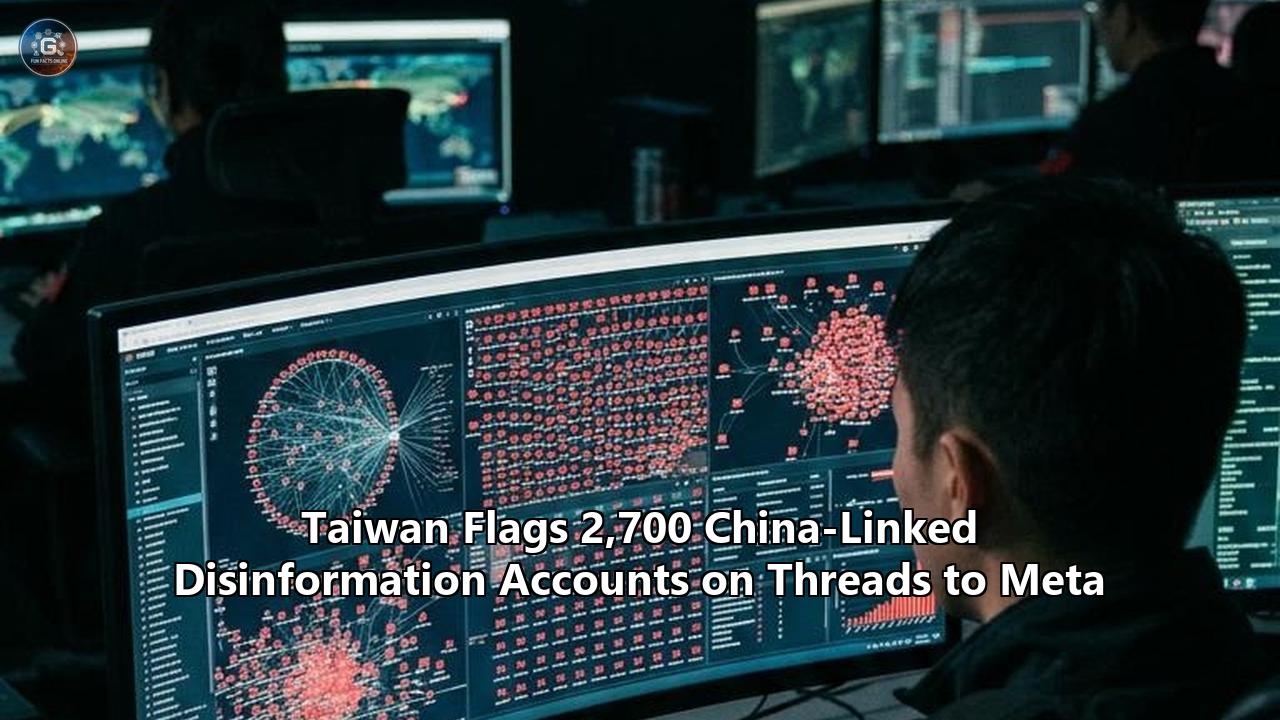
Taiwanese national security authorities have delivered a detailed dossier to Meta Platforms identifying nearly 2,700 coordinated accounts operating on Threads, the tech giant’s text-based social network. According to Taiwanese security officials and internal government intelligence reports reviewed by Reuters, the accounts formed a multi-tiered influence apparatus orchestrated to sway public opinion ahead of the island’s November 28, 2026 local elections.
The municipal and county elections—spanning mayoral contests, city councils, and local magistrates across 22 administrative divisions—serve as the defining midterm barometer for President Lai Ching-te’s administration before the 2028 presidential contest. Beijing, which views the ruling Democratic Progressive Party (DPP) as a separatist entity and has severed high-level communications with Taipei, has escalated its asymmetric grey-zone tactics across the Taiwan Strait. The weapon of choice in this operation, however, was not military intimidation or naval blockades, but algorithmic warfare executed inside one of Taiwan’s fastest-growing digital public squares.
The government investigation found that the clandestine network was engineered to bypass automated spam filters, cultivate authentic-seeming digital personas, and deploy more than 2,150 artificial intelligence-generated video assets designed to depress voter turnout and discredit key democratic candidates. One internal report noted that around 260 accounts within this cluster generated 2.35 million interactions—including comments, reposts, and quote-shares.
Meta confirmed it removed the flagged accounts, asserting that a significant portion had already been disabled by its automated integrity systems. Yet the Menlo Park company struck a conflicting tone, describing the assets as “low-quality fake accounts” that mostly lacked followers and had not posted about election-related matters. That stark divergence between Silicon Valley’s platform-level metrics and Taipei’s intelligence findings highlights an expanding gap in modern cognitive defense.
This incident serves as a critical case study of contemporary digital interference. The Threads campaign signals an operational shift: away from crude, mass-posted state propaganda toward subtle, algorithmic persona farming that relies on commercial proxies, synthetic media pipelines, and voter demobilization.
Anatomy of the Threads Infiltration: Infrastructure, Clusters, and Sleeper Networks
Understanding how this network operated requires analyzing the infrastructure that supported it. Taiwan has developed an unusually high concentration of Threads users. Industry analytics indicate Taiwanese accounts generate more than 21% of the platform’s global web traffic, making the island the second-largest traffic source worldwide behind the United States, despite having a population of just 23 million.
Threads became an accidental digital refuge for Taiwanese citizens weary of the hyper-polarized environments on Facebook, YouTube, and the bulletin-board forum PTT. The platform's algorithmic recommendation model, which surfaces content from strangers based on situational interest rather than established social graphs, made it an exceptionally lucrative target for hostile foreign operators.
                     COGNITIVE ATTACK ARCHITECTURE

  [ Global SIM Farms ]  -->  11 Jurisdictions (Colombia, PH, BR, UK, etc.)
            │
            ▼
  [ 27 Batch Clusters ] -->  2,700 Automated Accounts Created (July–Nov 2026)
            │
            ▼
  [ Sleeper Incubation] -->  Mundane Posts (Fortune-telling, Pets, Daily Grievances)
            │
            ▼
  [ Algorithmic Pivot ] -->  Targeted Smear Campaigns & Civic Disillusionment
            │
            ▼
  [ Synthetic Pipeline] -->  2,150+ Generative AI Deepfake Videos
            │
            ▼
  [ Strategic Output ]  -->  2.35M Interactions Urging Voter Abstention
According to the classified findings compiled by Taiwanese intelligence and corroborated by cybersecurity researchers, the 2,700 accounts were not created ad hoc. They were assembled through an industrial production chain:
- Batch Registration and Account Clusters: An exhaustive analysis of 2,400 flagged accounts revealed they were divided into 27 discrete clusters. Each cluster shared uniform naming syntax—often an everyday Chinese surname followed by algorithmic, high-entropy numerical strings—and was registered over the same tight windows between July and October 2026.
- Geographic Metadata Footprints: Among the analyzed accounts, 74% explicitly listed China as their account location in registration metadata, roughly 25% concealed their location data entirely, and 1% originated from Russian IP blocks. While operators often disguise their virtual locations, the operational security lapses in this batch left digital breadcrumbs directly tying the infrastructure back to mainland infrastructure hubs.
- Decentralized SIM Infrastructure: An investigation by Taiwan’s Wealth Magazine analyzing a random sample of 350 accounts tied to the network revealed that their phone-verification credentials routed through burner numbers issued across 11 foreign jurisdictions. The telecommunications routing showed 63 numbers registered in Colombia, 58 in the Philippines, 45 in Chile, 40 in Brazil, 39 in the United Kingdom, 37 in Indonesia, and 26 in South Africa. This internationalized telecom layer bypassed Meta's basic carrier-risk scoring models.
- Sleeper Persona Maturation: Rather than broadcasting political messaging immediately upon registration, the operators practiced patient behavioral masking. Accounts spent weeks publishing mundane human-interest posts, discussing pet care, traditional Chinese fortune-telling, horoscope forecasts, and relationship complaints.
This incubation phase served a dual purpose: it calibrated the Threads recommendation algorithm into categorizing the profiles as organic, everyday users, while establishing synthetic behavioral histories that evaded heuristic bot detection systems. Only after building this veneer of authenticity were the assets activated for coordinated political strikes.
The Cognitive Turn: From Ideological Persuasion to Manufactured Cynicism
The operational objective observed in the Threads campaign illustrates how adversary doctrines have evolved. Historical influence operations mounted by Beijing—such as the sprawling Spamouflage network tracked by Graphika and Meta since 2019—relied on ham-fisted ideological messaging. Early iterations deluged platforms with overt Chinese Communist Party (CCP) slogans, poorly translated defenses of maritime claims in the South China Sea, and robotic praises of Beijing’s modernization models. Those campaigns yielded dismal engagement numbers; users easily identified them as foreign propaganda and platforms systematically scrubbed them.
The November 2026 operation revealed a far more subtle strategy: voter demobilization through manufactured civic exhaustion.
“They don’t necessarily ask you to support certain candidates,” explained a Taiwanese security official who spoke on the condition of anonymity. “Instead, they make people turn against each other, grow disgusted with democracy, choose not to vote, and they intensify election divisions.”
                     DOCTRINAL EVOLUTION

   LEGACY PROPAGANDA (2018–2022)        COGNITIVE DEMOBILIZATION (2026)
   ─────────────────────────────        ───────────────────────────────
   • Overt pro-Beijing slogans          • Camouflaged domestic personas
   • Praise for CCP state governance    • Amplification of local grievances
   • "One Country, Two Systems" focus   • Promotion of political fatalism
   • Attempts to force persuasion      • "All politicians are corrupt"
   • Goal: Convert ideological support  • Goal: Depress democratic voter turnout
The primary tactic was not convincing Taiwanese citizens to embrace Beijing’s sovereignty claims. The operational goal was convincing them that their own democratic institutions were broken, corrupt, and ultimately pointless.
Accounts followed a calculated trajectory. After weeks of sharing benign daily updates, the personas pivoted to expressions of political fatigue. They posted personal testimonials detailing how they had previously supported the democratic system or the ruling party, only to feel betrayed by local economic conditions, housing costs, or energy policies. The posts concluded with calls for disengagement: “Both parties are equally dirty,” “Voting changes nothing,” and “I am staying home on November 28.”
By framing apathy as an act of personal enlightenment, the network sought to suppress participation in tightly contested races where margins of victory often hinge on a few thousand votes. Rather than attempting to change who citizens vote for, the operators sought to stop them from voting at all.
Weaponized Deepfakes and the Personal Smear: The Puma Shen Case
The technological dimension of the Threads campaign surfaced in the coordinated deployment of synthetic media pipelines. Taiwanese intelligence uncovered roughly 260 dedicated vector accounts within the broader 2,700-account footprint that were tasked with distributing more than 2,150 synthetic videos, accumulating 2.35 million user interactions.
The primary target was Puma Shen (Shen Pao-yang), the DPP candidate for Taipei Mayor. Shen is an influential figure in Taiwan’s defense circles: an associate professor of criminology, founder of the civil defense training organization Kuma Academy, and a prominent researcher on cross-strait disinformation. Because Shen has spent years exposing the operational mechanics of the CCP’s United Front Work Department, he has long been viewed as a high-priority ideological target by Beijing.
               SYNTHETIC MEDIA PRODUCTION PIPELINE

   ┌────────────────────────────────────────────────────────┐
   │ 1. Narrative Inception                                  │
   │    Fabricate personal scandal (e.g., student bullying) │
   └───────────────────────────┬────────────────────────────┘
                               │
                               ▼
   ┌────────────────────────────────────────────────────────┐
   │ 2. Automated Media Generation                          │
   │    Deepfake lip-sync engines, synthetic cloned audio,  │
   │    recurring hyper-stylized animated caricatures       │
   └───────────────────────────┬────────────────────────────┘
                               │
                               ▼
   ┌────────────────────────────────────────────────────────┐
   │ 3. Automated Seeding                                   │
   │    Batches of ~260 vector accounts post identical      │
   │    video packages within minutes of each other         │
   └───────────────────────────┬────────────────────────────┘
                               │
                               ▼
   ┌────────────────────────────────────────────────────────┐
   │ 4. Cross-Platform Echo Amplification                  │
   │    Threads algorithmic feeds surface clips to general   │
   │    audiences; secondary accounts post synthetic outrage│
   └───────────────────────────┬────────────────────────────┘
                               │
                               ▼
   ┌────────────────────────────────────────────────────────┐
   │ 5. Real-World Fallout                                  │
   │    Candidate forced into defensive refutations;        │
   │    prosecutors file indictments; mainstream media coverage│
   └────────────────────────────────────────────────────────┘
The investigation identified three distinct categories of generative content deployed against Shen:
- Fabricated Historical Scandals: Coordinated clusters circulated AI-manipulated footage and cloned-voice recordings purporting to show former classmates accusing Shen of violent bullying during his university years. The videos mimicked the format of investigative journalism, mixing archival footage with synthetic character generation to create an aura of investigative credibility.
- Synchronized Satirical Caricatures: Deutsche Welle reported that researchers at Taiwan's National Institute of Cyber Security tracked at least 194 Threads accounts that published 1,865 AI-generated political videos over several months. An examination of 174 clips specifically targeting Shen found a recurring cartoon-like digital caricature designed to mock his national security credentials, framing his civil defense initiatives as war-mongering grifts. Multiple automated accounts uploaded identical clips within minutes of each other, confirming synchronized distribution rather than organic sharing.
- Algorithmic Cross-Seeding: Rather than attempting to convince voters that Beijing’s favored policies were superior, the synthetic videos sought to make Shen seem unlikable and erratic. The goal was to force his campaign into permanent crisis management.
Shen forcefully denied the manufactured allegations. The legal machinery in Taiwan responded with rare speed: Taoyuan prosecutors secured an indictment against a 49-year-old local operative charged with distributing deepfake videos targeting Shen on Threads, illustrating how foreign state operations recruit or exploit local actors to amplify synthetic output.
The incident confirms a core lesson of computational propaganda: generative artificial intelligence no longer serves merely as an occasional tool for sensational hoaxes. It now operates as an industrial production line capable of generating thousands of hyper-targeted, defamatory video assets that pollute local electoral contests at negligible marginal cost.
The Platform Paradox: Follower Counts vs. Algorithmic Velocity
The fallout from the Threads incident exposed an architectural disagreement between platform trust-and-safety teams and national security agencies.
When Taiwan delivered its dossier, Meta took down the flagged accounts. Yet a Meta spokesperson publicly minimized the threat, asserting that the flagged profiles were simply “low-quality fake accounts,” that the vast majority had zero followers, and that none had posted election-related content.
This defense reveals an obsolete analytical framework within Silicon Valley. Meta's response relies on the mechanics of legacy social networks—such as the classic Facebook graph or early Twitter—where an account's distribution power was tied directly to its follower count. Under that model, an account with zero followers was essentially screaming into an empty room.
                      PLATFORM ARCHITECTURES

    LEGACY GRAPH-BASED NETWORK        CONTEMPORARY RECOMMENDATION ENGINE
    (Facebook, Early Twitter)                     (Threads, TikTok)

     [Account]                         [Account]
        │                                 │
        ▼                                 ▼
    [Followers] (Gated Reach)         [Algorithmic Content Pool]
        │                                 │
        ▼                                 ▼
     [Feed]                           [Vector Matching & Engagement Scoring]
                                          │
                                          ▼
                                     [For You Feed of Unconnected Users]
                                     (Reach Disconnected from Followers)
Modern recommendation engines function under completely different principles. Threads does not primarily serve users a chronological feed of accounts they have chosen to follow. Its algorithmic "For You" engine distributes posts based on predictive engagement scoring, content classification, and interaction velocity.
Under this design, an account created three days prior with zero followers can be served to hundreds of thousands of users if the platform’s engagement optimization models determine its content provokes strong reactions.
This dynamic explains how 260 accounts could accumulate 2.35 million interactions despite having negligible follower numbers. Operators of modern China disinformation campaigns do not waste time building follower bases. Instead, they exploit the recommendation system by flooding comment threads on high-traffic public posts, engineering viral hooks that trigger platform recommendation criteria, and cross-amplifying material through algorithmic swarming.
                 HOW ZERO-FOLLOWER BOTS ACHIEVE SCALE

  1. High-Traffic Anchor Post (News outlet, politician, public figure)
         │
         ├── Bot Cluster Infiltration (Comment-section hijacking)
         │       └── Seeds AI video / polarizing narrative
         │
         ├── Coordinated Cross-Liking (20–50 sibling accounts upvote)
         │       └── Triggers algorithmic "Top Comment" designation
         │
         └── Surface Expansion (Threads recommendation engine)
                 └── Pushes thread to tens of thousands of unconnected feeds
When platform security teams evaluate coordinated inauthentic behavior primarily through account-level follower counts, they misunderstand how influence moves through their own platforms. An account without followers is no longer impotent; in an algorithmic system, it is an expendable node optimized to game recommendation feeds before being detected and deleted.
Strategic Evolution: How China Disinformation Campaigns Adapted to Algorithmic Curation
The Threads takedown should not be viewed as an isolated skirmish. It is the latest iteration of a strategic adaptation that has been underway for nearly a decade. Analyzing how Chinese cognitive warfare has changed reveals three distinct generational shifts:
                  THREE GENERATIONS OF INFORMATION WARFARE

  Generation 1: 50-Cent Party (2010–2018)
  • Tactics: Manual posting, domestic forum flooding, blunt praise
  • Footprint: Confined largely to domestic networks and basic spam
  • Impact: Easily identified; zero organic international traction

  Generation 2: Spamouflage / Dragonbridge (2019–2023)
  • Tactics: Automated bot accounts, bulk multi-platform distribution
  • Content: Anti-Western memes, translated state media, crude deepfakes
  • Impact: High volume, low engagement; repeatedly purged by platforms

  Generation 3: Algorithmic Swarms & Commercial Proxies (2024–Present)
  • Tactics: Sleeper persona maturation, SMS farm routing, synthetic video
  • Content: Manufactured civic apathy, wedge-issue polarization, hyper-local smears
  • Impact: High algorithmic velocity, authentic-appearing engagement, demobilization
Modern China disinformation campaigns have systematically professionalized their operations. In its October 2026 report to the Legislative Yuan, Taiwan’s National Security Bureau (NSB) revealed it had detected more than 2.5 million pieces of disputed or false online content attributed to Chinese influence units during the first nine months of the year alone. The bureau detailed how Chinese military cyber units, the Ministry of State Security, and commercial marketing cutouts have divided their cognitive operations into distinct functional divisions:
1. Commercialization and Outsourcing
State security agencies no longer manage tactical bot operations exclusively in-house. They award procurement contracts to private public relations firms, search engine optimization shops, and technology enterprises based in cities like Shenzhen, Shanghai, and Chengdu.
Doublethink Lab’s investigation into the "Borderless Group" illustrates this commercialized ecosystem: researchers identified a commercial content farm network operating 1,217 domains hosting inauthentic news pages, backed by 549 inauthentic Threads accounts that generated more than 467,547 posts and replies. Nearly 98% of those accounts posted duplicate content across domains, building distribution rails that sat commercially dormant until activated for political operations.
2. Dispersed Infrastructure Routing
As major tech platforms improved detection for suspicious IP subnets originating from mainland China, operators adapted by using globally dispersed infrastructure.
The Threads case demonstrated phone verification through SIM banks in Colombia, Brazil, and the Philippines, combined with residential proxy networks that route traffic through ordinary consumer Internet of Things (IoT) devices in target countries. This makes adversarial bot traffic appear indistinguishable from everyday domestic broadband usage.
3. Hyper-Targeted Wedge Exploitation
The messaging avoids monolithic, top-down narratives. Operators focus instead on existing domestic friction points: energy policy, agricultural import bans, regional infrastructure spending, military conscription reforms, and candidate personalities.
By exploiting real domestic debates and amplifying internal frustration, adversary networks make their operations look like organic Taiwanese public discourse.
Lessons from Taiwan's Defense Ecosystem: The Whole-of-Society Countermeasure
Taiwan has not survived decades of cognitive warfare through government action alone. The island has built a resilient whole-of-society counter-interference model that unites civil society, open-source researchers, legal authorities, and the civic technology sector.
The Threads detection was not an accident; it came out of a collaborative defensive network designed specifically to spot abnormal coordination.
                     TAIWAN'S HYBRID DEFENSE ECOSYSTEM

      ┌────────────────────────────────────────────────────────┐
      │               Civic Intelligence Layer                 │
      │  Doublethink Lab, IORG, Taiwan FactCheck Center,       │
      │  Cofacts: Real-time rumor tracking & bot auditing      │
      └───────────────────────────┬────────────────────────────┘
                                  │
                                  ▼
      ┌────────────────────────────────────────────────────────┐
      │              Institutional Forensic Layer              │
      │  National Institute of Cyber Security, National         │
      │  Security Bureau (NSB): Forensic attribution           │
      └───────────────────────────┬────────────────────────────┘
                                  │
                                  ▼
      ┌────────────────────────────────────────────────────────┐
      │                Statutory & Legal Layer                 │
      │  Public Officials Election and Recall Act,             │
      │  Social Order Maintenance Act: Rapid prosecutions      │
      └───────────────────────────┬────────────────────────────┘
                                  │
                                  ▼
      ┌────────────────────────────────────────────────────────┐
      │               Platform Escalation Layer                │
      │  Coordinated dossiers delivered directly to Meta,      │
      │  Google, and ByteDance for network takedowns           │
      └────────────────────────────────────────────────────────┘
This hybrid defensive architecture offers clear lessons for open societies facing foreign information manipulation:
- Decouple Defense from State Censorship: Taiwan avoids top-down speech controls by relying on independent watchdogs. Organizations like the Taiwan Information Environment Research Center (IORG), Doublethink Lab, and Cofacts continuously monitor data feeds, trace narrative variants, and publish technical disclosures. When the public receives warnings from non-partisan civic groups rather than political actors, defenses against disinformation avoid partisan blowback.
- Rapid-Response Verification Ecosystems: Taiwan’s civil society pioneered participatory verification. Platforms like Cofacts connect crowdsourced verification to popular messaging services like LINE, giving citizens immediate access to fact-checking data directly within their private chat threads.
- Statutory Transparency for Digital Campaigns: The Legislative Yuan enacted amendments to the Public Officials Election and Recall Act that impose clear transparency mandates on political advertising and explicitly ban foreign-financed campaign communications. The law requires social platforms to maintain transparent political ad archives and establish rapid-removal mechanisms when deepfakes are used to defame candidates during official election cycles.
- The Attribution Dilemma: Despite these structural strengths, Taiwan's experience exposes an ongoing challenge: foreign adversaries intentionally operate within the ambiguity of grey-zone environments. Pinning a specific bot farm on a named unit of the People’s Liberation Army or the Ministry of State Security requires significant intelligence resources. This legal friction means counter-messaging often lags days behind the initial viral spread of synthetic content.
Core Principles for Regulating Recommendation Networks During Elections
The Threads incident provides several architectural and policy lessons for platforms, election authorities, and intelligence communities preparing for high-stakes votes worldwide:
1. Shift Audits from Graph Networks to Recommendation Feeds
Regulatory scrutiny and platform trust-and-safety guidelines remain largely built around followers, page likes, and broadcast graphs. Modern election protection policies must require platforms to audit their recommendation systems instead.
Regulators should mandate transparency around the velocity metrics that determine why unverified, zero-follower accounts are promoted into the feeds of users who never subscribed to them.
               RECOMMENDED DEFENSIVE AUDITING MATRIX

  Vulnerability Vector       Legacy Metric                 Required Modern Metric
  ───────────────────────────────────────────────────────────────────────────────
  Account Authority          Follower / Subscriber count   Interaction-to-follower ratio
  Content Reach              Chronological feed shares     Algorithmic feed impressions
  Network Integrity          Individual IP geofencing      SIM carrier / ASN batch tracing
  Synthetic Media            Manual post-hoc debunking     Cryptographic provenance tags
  Electoral Threat           Pro-candidate persuasion      Turnout suppression narratives
2. Monitor Sleeper Accounts and Lifecycle Shifts
The tactic of incubating accounts with benign lifestyle posts before pivoting to political smears shows that platforms must track behavioral changes over time.
Automated behavioral integrity systems must monitor drastic topical shifts—such as an account that posts exclusively about horoscopes for 90 days suddenly publishing 40 identical political video smears within three hours. Sudden thematic pivots combined with batch registration patterns should automatically trigger verification requirements.
3. Enforce Cryptographic Media Provenance
The circulation of over 2,150 synthetic videos targeting Taiwanese candidates underscores the limits of post-hoc debunking. Fact-checking cannot keep pace with generative video engines operating at industrial scale.
Social media networks must implement and enforce Coalition for Content Provenance and Authenticity (C2PA) cryptographic standards across their services. This infrastructure embeds cryptographic metadata at capture and flags manipulated or synthetically generated video content within the user interface before it can be recommended by platform algorithms.
4. Close the Platform-Intelligence Communication Gap
The friction between Taiwanese authorities and Meta illustrates how platform feedback loops remain broken. When national cyber defense authorities submit detailed technical dossiers with telecom routing, cluster groupings, and interaction telemetry, platforms cannot default to boilerplate PR statements claiming the accounts had no followers.
Operational protocols must include shared forensic taxonomy, shared data access for vetted academic researchers, and transparent post-action postmortems that explain discrepancies in interaction data.
The Road to 2028: The New Cognitive Battleground
The 2,700 accounts flagged on Threads are a preview of what democratic elections will face over the coming years. As Taiwan moves past its November 28 municipal elections, the focus immediately shifts toward the 2028 presidential race.
Beijing views that election as a pivotal historical window. The tactical innovations tested during this local election cycle—burner SIM routing across developing nations, persona cultivation on emerging text platforms, and targeted synthetic video smears—will likely be scaled and refined.
                      STRATEGIC HORIZON (2026–2028)

   Nov 28, 2026                 2027 Inter-Election Period          Early 2028
   Local Elections              Infrastructure Maturation           Presidential Contest
         │                                  │                                 │
         ▼                                  ▼                                 ▼
   • Baseline Tactical Test     • Autonomous Agent Swarms           • Scaled Cognitive Shocks
   • 2,700 Threads accounts     • Commercial Proxy Penetration      • Coordinated Disruption
   • 2,150 AI deepfake videos   • C2PA Provenance Evasion           • Direct Electoral Assault
   • Voter turnout suppression  • Deep-tissue polarization          • Democratic Legitimacy Tests
The next frontier of cognitive warfare is already taking shape. As researchers at Oxford, Berkeley, and the International Panel on the Information Environment have warned, influence operations are moving toward autonomous AI swarms.
Future campaigns will not rely on human operators copying and pasting video links across 27 clusters of pre-programmed accounts. They will deploy autonomous agents capable of parsing live political debates, learning a user's psychological pressure points from previous comments, and generating personalized responses in native vernacular that mimic human reasoning.
When these autonomous swarms are deployed across algorithmic recommendation engines like Threads, detecting the line between genuine domestic debate and coordinated foreign manipulation becomes exceptionally difficult.
Taiwan’s discovery of the Threads network pulled back the curtain on this evolving machine. The operation demonstrated that modern cognitive warfare rarely seeks to make people love the authoritarian alternative. Its real objective is persuading citizens that their democracy is broken, their politicians are thoroughly corrupt, and their vote no longer matters.
For open societies, defending against this strategy requires looking beyond individual false claims. It demands treating platform recommendation models, identity verification, and computational transparency as core pillars of national security. Taiwan has exposed the blueprint of this threat; the unresolved question is whether global platforms and democratic governments will fix their structural blind spots before the next election cycle begins.
Reference:
- https://timesofindia.indiatimes.com/world/china/taiwan-flags-nearly-2700-china-linked-accounts-to-meta-over-alleged-election-influence-campaign/articleshow/136017405.cms
- https://mlq.ai/news/taiwan-tells-meta-that-thousands-of-china-linked-accounts-are-trying-to-sway-its-elections-reuters-reports/
- https://www.thenews.com.pk/latest/1424385-taiwan-flags-2700-china-linked-threads-accounts-ahead-of-nov-28-elections
- https://www.jpost.com/international/article-915564
- https://www.visiontimes.com/2026/01/14/taiwan-security-agency-details-five-ccp-cognitive-warfare-tactics-targeting-taiwan-in-2025.html
- https://thedeepdive.ca/taiwan-reports-2-35m-ai-election-content-meta-says-flagged-accounts-had-no-election-posts/
- https://english.cw.com.tw/article/article.action?id=4815
- https://www.taiwannews.com.tw/news/6323133
- https://ketagalanmedia.com/2026/03/11/the-digital-night-market-why-threads-is-so-popular-in-taiwan/
- https://www.newsguardtech.com/special-reports/chinese-network-launches-hundreds-of-fake-dating-accounts-to-influence-the-next-taiwanese-election/
- https://www.institut-ega.org/l/china-linked-spamouflage-network-and-the-us-november-election/
- https://international.canada.ca/en/global-affairs/corporate/reports/rapid-response-mechanism/news/2023-china-spamouflage
- https://blog.google/threat-analysis-group/google-disrupted-dragonbridge-activity-q1-2024/
- https://news.az/news/taiwan-flags-nearly-2-700-suspected-china-linked-accounts-to-meta-ahead-of-elections
- https://95kqds.com/2026/11/19/exclusive-taiwan-tells-meta-thousands-of-china-linked-accounts-seek-to-influence-elections/
- https://www.theguardian.com/technology/2026/jan/22/experts-warn-of-threat-to-democracy-by-ai-bot-swarms-infesting-social-media
- https://www.theguardian.com/world/2019/dec/30/taiwan-presidential-election-referendum-on-ties-with-china
- https://thedeepdive.ca/taiwan-reports-2-35m-ai-election-content-meta-says-flagged-accounts-had-no-election-posts/
- https://www.taipeitimes.com/
- https://freedomhouse.org/country/taiwan/freedom-net/2024