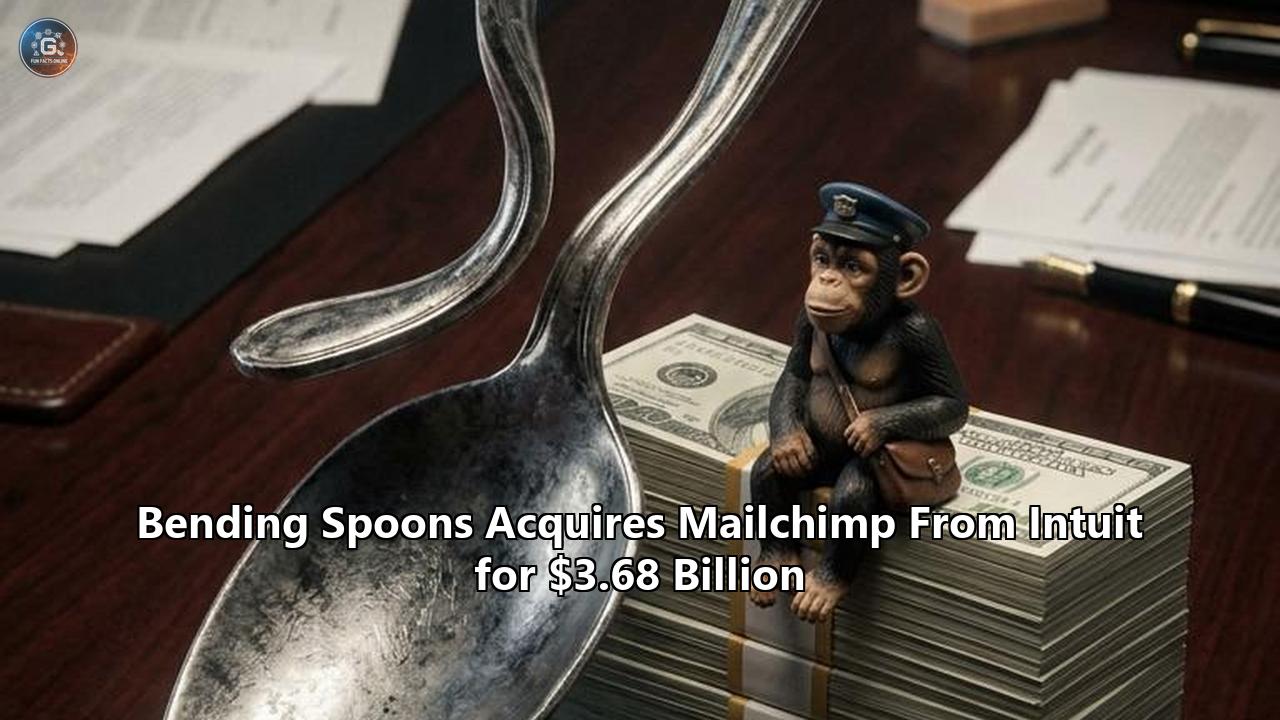
When financial regulators in Milan and Washington received the statutory filings on the morning of November 19, 2026, the numbers on the transaction sheet looked like a misprint.
Bending Spoons S.p.A., the aggressive Italian software holding company, had signed a definitive agreement to purchase Mailchimp from financial software conglomerate Intuit for an enterprise value of $3.68 billion in cash and equity. Five years earlier, in the euphoric autumn of 2021, Intuit had paid roughly $12 billion in cash and stock to acquire the very same company.
More than $8.3 billion in asset value had evaporated into the digital ether.
The transaction represents one of the steepest, most unsparing markdowns of a premier enterprise software asset in the history of the modern technology sector. Under the terms approved unanimously by Bending Spoons’ board of directors, the Milan-based firm will take 100% control of The Rocket Science Group LLC—the legal operating entity behind Mailchimp—along with its global assets, codebases, customer contracts, and balance-sheet liabilities. In an unusual financial structure, Intuit will immediately recycle $368 million of the gross proceeds—precisely 10 percent of the purchase price—back into newly minted shares of Bending Spoons, receiving approximately 8.8 million shares. Intuit walks away with roughly $3.31 billion in net cash, a minor equity foothold in its Italian buyer, and a bruising corporate lesson.
On Wall Street, the verdict arrived with swift brutality. Intuit’s stock plunged 10% in after-hours trading following the announcement, dragged down by an admission that its premier marketing platform had become an active drag on group revenue. Shares of Bending Spoons, which began trading on the Nasdaq under the ticker symbol BSP following a high-profile initial public offering on July 1, 2026, climbed 3%.
THE MAILCHIMP VALUATION ROLLERCOASTER
========================================================================
September 2021 (Acquired by Intuit)        : $12.00 Billion (15.0x Revenue)
November 2026 (Acquired by Bending Spoons) : $3.68 Billion  (2.9x Revenue)
------------------------------------------------------------------------
Net Paper Destruction                     : -$8.32 Billion (-69.3%)
Net Cash Extracted by Intuit              : ~$3.31 Billion
Intuit Reinvestment in Bending Spoons     : $368.00 Million (8.8M shares)
========================================================================
On paper, the corporate statement from Intuit framed the sale as an orderly strategic recalibration. "Mailchimp has helped millions of businesses grow and acquire customers through email marketing automation, and we are grateful to the Mailchimp team for what they have built," Jack Tam, Senior Vice President at Intuit, said in an official briefing. Tam added that offloading the asset would allow Intuit to "sharpen its focus" on artificial intelligence platforms for small business finance, funneling the multi-billion-dollar cash windfall directly into corporate share buybacks.
In Milan, Bending Spoons co-founder and Chief Executive Officer Luca Ferrari took a characteristically predatory stance, praising the platform's multi-decade legacy while laying the groundwork for a sweeping corporate overhaul. "Mailchimp is a powerful brand, built over two decades of reshaping the email marketing category and redefining how companies grow their audiences," Ferrari announced. "After closing, we’ll invest substantially in the business, building on the powerful, easy-to-use tools customers already value and rely on."
Behind the diplomatic language of corporate press desks lies an investigative paper trail that charts the end of an era in enterprise software. The deal marks the intersection of three converging forces: the catastrophic failure of Intuit’s multi-billion-dollar cross-selling experiment, the deflation of pandemic-era software valuations, and the relentless, mechanical rise of Bending Spoons—an outfit that has quietly transformed itself into digital tech's ultimate debt-fueled restructuring vehicle.
As the tech sector digests the news that Bending Spoons acquires Mailchimp, thousands of small-business operators, enterprise software rivals, and private equity desks are left scrambling to understand how a beloved, bootstrapped Atlanta icon fell into the hands of Europe’s most feared software operators.
The Forensic Ledger: How Intuit Broke the 2021 Playbook
To understand how an $8.3 billion loss becomes reality, one must inspect Intuit’s financial disclosures from the autumn of 2021. At the time, Intuit’s leadership believed they had pulled off a coup. Mailchimp was the undisputed crown jewel of bootstrapped software: an engine generating roughly $800 million in annual recurring revenue with 20% year-over-year top-line expansion, virtually zero debt, and gross margins hovering comfortably above 80%.
Intuit paid approximately 15 times trailing revenue. The operational hypothesis was straightforward: connect Mailchimp’s 13 million global users to QuickBooks’ small-business accounting ecosystem, creating a closed-loop operating system where a neighborhood coffee shop or an independent consultancy could handle marketing, sales, payroll, tax prep, and balance sheets within a single corporate orbit.
"It was an acquisition predicated entirely on hypothetical synergies," says Marcus Vance, managing director at Gotham Cloud Analytics and a long-time enterprise software auditor. "Intuit paid peak-cycle multiples at the exact top of the SaaS market. They assumed an accountant managing QuickBooks would instinctively pitch Mailchimp to their clients, and that a marketer sending a newsletter would happily migrate their general ledger to Intuit. The crossover never materialized."
Instead, regulatory filings reveal that Mailchimp became an anchor around Intuit's neck.
By the first fiscal quarter of 2027, Intuit’s consolidated earnings statements painted a dismal operational picture. While Intuit’s broader ecosystem expanded at a healthy 12% clip to generate $4.4 billion in quarterly revenue, Mailchimp’s revenue contracted by 1% year-over-year, registering just $313 million. Full-year guidance for the email platform was revised downward to between $1.256 billion and $1.266 million—representing essentially flat or negative growth.
INTUIT Q1 FY27 REVENUE DIVERGENCE
------------------------------------------------------------------------
Segment                  Quarterly Revenue     YoY Growth Rate
------------------------------------------------------------------------
Core Intuit Business     $4.40 Billion         +12.0%
Mailchimp Division       $313.00 Million       -1.0%
Consolidated Outlook     Drag from Mailchimp   Flattened Top-Line
------------------------------------------------------------------------
Source: Intuit Statutory Financial Filings, SEC Form 10-Q
In five years under Intuit’s stewardship, Mailchimp managed to increase its revenue from $800 million to $1.26 billion—a total expansion of 57%, or an average compound annual growth rate of under 10%. In the hyper-competitive software landscape, sitting beside QuickBooks’ base of small-business accounts should have generated explosive user growth. Instead, the product plateaued.
The balance sheet carried the wreckage. Intuit never officially took a public goodwill impairment on Mailchimp across its previous quarterly filings, despite internal metrics pointing to a structural valuation mismatch. By selling the asset for $3.68 billion, Intuit effectively priced Mailchimp at 2.9 times forward revenue. It was an explicit capitulation: Intuit chose to crystallize a massive paper loss rather than allow a zero-growth product to dilute its public narrative as an agile, AI-driven small-business platform.
"Intuit reached a crossroad," explains Elena Rostova, senior partner at Zurich Equity Research. "They realized that returning Mailchimp to double-digit growth would require billions of dollars in fundamental product re-architecture, rebuilding deliverability infrastructure, and battling agile new competitors. When Intuit’s leadership looked at the cash equation, they decided taking $3.3 billion in hard cash to fund immediate share buybacks was better than nursing a stalling business unit that public markets were punishing."
An Autopsy of the Atlanta Fairytale: From Bootstrapped Icon to Corporate Siphon
To grasp the magnitude of the transaction, one must step away from Wall Street ledgers and walk through the historic Ponce City Market offices in Atlanta, where Mailchimp spent twenty years writing what was long celebrated as the most successful self-funded story in American tech history.
Founded in 2001 by Ben Chestnut and Dan Kurzius as an offshoot of their web design agency, Mailchimp refused institutional venture capital from its inception. While their Silicon Valley peers burned hundreds of millions of dollars chasing hyper-growth, Chestnut and Kurzius built a profitable, cash-generative business around a simple freemium model and an irreverent brand mascot named Freddie the Chimp. They famously sponsored indie podcasts, supported local artists, and built an internal culture that positioned itself as the antithesis of sterile corporate software.
Yet that cultural capital began fracturing well before Bending Spoons surfaced on the cap sheet.
The turning point was September 2021. For years, Mailchimp’s executive leadership had assured rank-and-file workers that the company would never be sold to a corporate conglomerate, repeatedly justifying the absence of employee equity plans by claiming that remaining independent shielded staff from Wall Street pressures. When Chestnut and Kurzius announced they were selling to Intuit for $12 billion, the founders pocketed billions, while long-tenured engineers, designers, and customer support representatives received zero equity proceeds—only modest retention bonuses tied to future service.
"The cultural soul of Mailchimp died the day the Intuit deal closed," says a former principal product designer who worked at Mailchimp’s Atlanta headquarters for six years before resigning in 2024. Speaking on condition of anonymity due to non-disclosure agreements, the designer described an immediate shift toward corporate bureaucracy.
"Within six months, we were suffocated by Intuit compliance managers, enterprise sales metrics, and cross-functional synergy committees," the designer said. "We went from iterating on product features in forty-eight hours to spending three weeks preparing slide decks to justify changing a user dashboard button. The best engineering talent walked out the door within twelve months. What was left was a collection of legacy codebase systems that nobody fully understood anymore."
While Mailchimp struggled under Intuit's governance, competitors chipped away at its core customer base:
- Klaviyo systematically tore through Mailchimp’s e-commerce market share, offering direct, deep integrations with Shopify, predictive customer data modeling, and high-frequency attribution analytics that online merchants found indispensable.
- HubSpot moved down-market from enterprise marketing automation, presenting growing mid-sized businesses with a fully integrated CRM, content management system, and ticketing tool that made Mailchimp look like an expensive point solution.
- Brevo (formerly Sendinblue) undercut Mailchimp’s aggressive pricing tiers, offering flexible, send-based billing that attracted price-sensitive agencies and startups.
- Substack and Beehiiv siphoned away independent creators, publishers, and newsletter authors—the exact cohort that had served as Mailchimp’s most vocal brand evangelists during its early growth years.
Trapped between nimble, modern email tools and sprawling enterprise suites, Mailchimp became an expensive, bloated legacy tool. Intuit attempted to squeeze more value out of this stalling user base by repeatedly raising subscription rates and severely restricting its historic free tier, forcing free users onto paid plans while cutting back on live customer support.
The strategy temporarily elevated revenue, but it created an exodus of users. By 2026, Mailchimp was no longer an innovative product; it had become an entrenched corporate utility. And in the eyes of Bending Spoons, an entrenched corporate utility with high switching costs is the most attractive asset on earth.
The Milan Machine: Inside Bending Spoons’ Consolidation Engine
For the casual software user, Bending Spoons sounds like an obscure European digital agency. For corporate executives in Silicon Valley, it has become one of the most consequential software conglomerates of the decade.
Founded in Copenhagen in 2013 by Italian engineers Luca Ferrari, Matteo Danieli, Francesco Patarnello, Luca Querella, and Polish technologist Tomasz Greber, the firm soon relocated its headquarters to Milan. In its initial phase, Bending Spoons focused on building proprietary consumer mobile apps, scoring breakout commercial hits with video editing platform Splice and AI photo enhancer Remini.
BENDING SPOONS: KEY EXECUTIVES AND ARCHITECTS
------------------------------------------------------------------------
Luca Ferrari         : Chief Executive Officer & Co-Founder
Matteo Danieli       : Chief Product Officer & Co-Founder
Francesco Patarnello : Executive Leadership & Co-Founder
Luca Querella        : Technology Leadership & Co-Founder
Tomasz Greber        : Operations Leadership & Co-Founder
------------------------------------------------------------------------
Corporate Base       : Milan, Italy (Founded Copenhagen, 2013)
Public Listing       : Nasdaq (Ticker: BSP, Debuted July 1, 2026)
Anchor Backer        : Berkshire Hathaway (4.0% Stake / ~$930M invested)
------------------------------------------------------------------------
Around 2021, the company's executive suite realized that developing native consumer apps was subject to the whims of Apple and Google app store algorithms. Instead, they recognized an arbitrage opportunity in enterprise software: acquiring distressed, culturally prominent internet properties that had spent decades amassing loyal user bases, stripping out their operational bloat, moving their infrastructure onto a centralized stack, and optimizing their pricing for pure cash extraction.
The speed with which Bending Spoons executed this strategy is unprecedented. Over the last four years, the Italian holding company has completed more than 50 acquisitions, orchestrating a staggering buying spree across the North American and European software landscapes:
- Evernote (Acquired January 2023): Purchased for an estimated $200 million—a fraction of its peak $1 billion private valuation.
- Meetup (Acquired January 2024): Taken over from AlleyCorp and reorganized.
- WeTransfer (Acquired July 2024): Acquired after the Dutch file-sharing platform aborted its public offering.
- Brightcove (Acquired Late 2024): Absorbed for roughly $233 million, down from a historical peak near $1 billion.
- Vimeo (Acquired September 2025): Swallowed for $1.38 billion, bringing millions of legacy enterprise video accounts into the Milan fold.
- AOL (Acquired Fall 2025): Secured for an estimated $1.5 billion, absorbing millions of legacy subscription accounts.
- Eventbrite (Acquired Early 2026): Picked up for roughly $505 million, compared to its $1.76 billion valuation at IPO.
- Airtable (Acquired August 2026): Snatched for an enterprise value of $1.285 billion—a steep drop from its $11 billion peak private valuation.
- Miro (Acquired September 2026): Consolidated in a $1.355 billion transaction on $600 million in ARR.
BENDING SPOONS M&A TRAIL: THE PEAK-TO-PURCHASE ARBITRAGE
========================================================================
Asset        Year Acquired     Peak Historical Valuation    Bending Spoons Price
------------------------------------------------------------------------
Evernote     2023              $1.00 Billion                $200 Million
Brightcove   2024              $933 Million                 $233 Million
Eventbrite   2026              $1.76 Billion                $505 Million
Airtable     2026              $11.00 Billion               $1.285 Billion
Miro         2026              $17.50 Billion               $1.355 Billion
Mailchimp    2026              $12.00 Billion               $3.680 Billion
========================================================================
Total Peak Capitalization: ~$44.19 Billion | Consolidated Purchase: ~$7.25 Billion
Discount Captured by Bending Spoons: ~83.6% Average Enterprise Markdown
By July 2026, Bending Spoons’ capital requirements had outgrown private credit markets. The firm listed on the Nasdaq at an initial public offering price of $29 per share. Shortly after the IPO, Warren Buffett’s Berkshire Hathaway solidified its position as an anchor backer, injecting an additional $330 million in October 2026 to bring its total equity ownership in Bending Spoons to 4% (following an initial $600 million pre-IPO allocation).
With Mailchimp, Bending Spoons has reached an entirely new scale. Prior to this agreement, Bending Spoons reported consolidated full-year revenue of roughly $1.31 billion for 2025. Mailchimp alone generates $1.26 billion in annual recurring revenue. In a single transaction, Ferrari has doubled the operational size of his conglomerate.
To finance the massive acquisition, Bending Spoons simultaneously announced an oversubscribed private placement of $1.3 billion (€1.18 billion) in ordinary shares, selling 32.5 million shares to a coalition of global institutional asset managers, alongside debt facilities co-led by Citigroup and J.P. Morgan.
"Bending Spoons is not an engineering laboratory; it is an industrial machine for capital compounding," says Julian Thorne, head of European tech acquisitions at Apex Capital in London. "Their operational mandate is simple: buy assets that have achieved structural durability, cut operating expenses to the bone, centralize development in Milan, and milk the recurring subscription stream. To date, they have never sold a single material operating business. They buy to hold, and they extract cash relentlessly."
The Precedent Trail: What Happened at Evernote, WeTransfer, and Vimeo
To predict what Mailchimp will look like in eighteen months, one does not need a crystal ball. One only needs to examine the corporate autopsy reports of Bending Spoons’ previous acquisitions.
Across every single major acquisition in the Milan company's portfolio, Bending Spoons has deployed a predictable restructuring playbook with clinical precision:
- Complete Personnel Purge: Within six months of closing an acquisition, Bending Spoons historically dismisses between 70% and 95% of the existing workforce.
- Geographic Consolidation: Operations, product management, and engineering teams in high-cost tech hubs (San Francisco, New York, Amsterdam) are terminated, with product ownership transferred to centralized teams in Milan or low-cost regional contractor hubs.
- Infrastructure Centralization: Legacy data centers and bespoke microservice architectures are migrated onto Bending Spoons’ standardized corporate cloud infrastructure, slashing server costs and vendor contracts.
- Subscription Price Hikes: Existing subscription prices are increased by between 40% and 120%, testing customer willingness to pay.
- Decimation of Free Tiers: Legacy freemium tiers that made the products famous are systematically crippled or eliminated entirely, converting casual users into paying subscribers or driving them off the platform to reduce hosting overhead.
THE BENDING SPOONS RESTRUCTURING PLAYBOOK
========================================================================
Stage 1: Personnel Purge           | 70% - 95% headcount reductions
Stage 2: Regional Realignment      | Shutter US offices; relocate to Europe
Stage 3: Infrastructure Overhaul  | Migrate codebase to centralized stack
Stage 4: Aggressive Price Hikes    | Lift paid tiers by 40% to 120%
Stage 5: Freemium Elimination      | Cripple legacy free accounts
========================================================================
Ultimate Objective: Maximize free-cash-flow conversion from sticky users
The most famous execution of this strategy occurred at Evernote. Acquired in early 2023, Evernote was a cultural giant that had lost its technical edge. In July 2023, Bending Spoons laid off nearly the entire remaining United States and Chilean workforce, moving all development to Europe.
Shortly thereafter, Bending Spoons made Evernote's free tier essentially unusable: free users were suddenly capped at creating just 50 notes and one single notebook. At the same time, annual subscription prices for legacy users were increased dramatically. The internet erupted in fury, tech forums were flooded with migration guides, and users swore they would abandon the app.
Yet when financial analysts reviewed Bending Spoons’ IPO prospectuses three years later, Evernote’s operational numbers revealed a counterintuitive reality: while total active users cratered, overall net earnings and operating cash flows rose to historic highs. The users who remained were business professionals, academics, and legal researchers whose daily workflows were so dependent on Evernote that paying double the price was less painful than spending forty hours manually exporting ten years of archives.
A similar process unfolded at WeTransfer. After taking control of the Amsterdam-based file transfer platform in mid-2024, Bending Spoons announced sweeping workforce reductions, shuttered external creative community sponsorships, and restructured paid tiers. At Vimeo, hundreds of sales, marketing, and support roles were terminated within months of the deal closing in 2025, replaced by automated onboarding funnels and centralized European engineering pods.
Now that Bending Spoons acquires Mailchimp, the immediate question is what happens to Mailchimp’s remaining 1,200 employees scattered across Atlanta and remote hubs.
"If history is any indicator, there will be a quiet, dignified announcement about transition periods, followed by a total gutting of the Atlanta operation by the summer of 2027," says Clara Bennington, a labor consultant and tech organization specialist based in Austin. "Bending Spoons doesn’t need a massive enterprise sales team or expensive marketing departments in Georgia. They need a lean team of database engineers in Milan running deliverability algorithms, managing AWS instances, and maintaining billing systems. Everything else is viewed as an expense that dilutes shareholder returns."
The Mechanics of the Transaction: The Reinvestment Hedge and the Non-Compete
Corporate acquisitions at this scale contain structural mechanisms hidden in SEC exhibits that reveal how the parties view their own futures. In the contract binding Intuit and Bending Spoons, two specific clauses demand close scrutiny.
The first is Intuit’s mandatory $368 million equity reinvestment. Under Section 4.2 of the merger agreement, Intuit is not taking its entire $3.68 billion exit in cold cash; it is accepting 10% of the aggregate transaction value in newly issued Bending Spoons equity, representing approximately 8.8 million ordinary shares.
CAPITAL ALLOCATION MECHANISM
------------------------------------------------------------------------
Enterprise Purchase Price            : $3,680,000,000
Gross Cash Component                 : $3,312,000,000
Equity Reinvestment by Intuit        : $368,000,000
New Bending Spoons Shares to Intuit  : ~8,800,000
Intuit Resulting Ownership in BSP    : ~3.2% of Total Capitalization
------------------------------------------------------------------------
Source: Bending Spoons S.p.A. Form 6-K / Intuit Form 8-K
Why would Intuit—a company desperate to distance itself from Mailchimp’s declining metrics—agree to hold equity in the very buyer acquiring its problem child?
"It’s an equity rollover hedge," says David Sterling, an M&A tax partner at Chicago Global Advisory. "Intuit’s board knows Bending Spoons’ playbook. They know Luca Ferrari will probably cut $400 million in operational overhead out of Mailchimp within twelve months of closing. By taking a 10% equity position in Bending Spoons, Intuit preserves an upside link to the cost-reduction trade. If Bending Spoons successfully boosts Mailchimp's operating margins from 15% to 55%, Bending Spoons’ stock will surge, and Intuit’s equity stake could appreciate back toward $800 million or $1 billion. It allows Intuit’s executives to tell their board they didn't leave every drop of value on the table."
The second critical mechanism is an ironclad two-year non-compete covenant signed by Intuit. Under the terms of the closing conditions, Intuit is legally barred from launching, acquiring, or directly marketing a stand-alone email marketing automation tool or outbound newsletter distribution system until at least calendar year 2029.
This non-compete reveals how thoroughly Intuit has abandoned its ambition to build an end-to-end small-business software suite. By agreeing to sit on the sidelines of marketing software for two years, Intuit is conceding that its future lies strictly in accounting ledgers, algorithmic tax calculation, business credit lines, and mid-market ERP integrations.
Meanwhile, Bending Spoons has deployed financial advisors Citigroup and J.P. Morgan to assemble the acquisition financing, with legal counsel directed by Freshfields US LLP, and extensive accounting due diligence conducted by EY-Parthenon and EY STP. The transaction is expected to face standard review by antitrust regulators at the US Federal Trade Commission (FTC) and the European Commission’s Directorate-General for Competition, with final regulatory closure slated for early 2027.
Given that Bending Spoons does not currently control a competing outbound enterprise email marketing platform, regulatory clearances are expected to proceed without serious structural remedies.
The Great SaaS Repricing: The 3x Multiple Reality
When historians of modern financial markets look back at the mid-2020s, the sale of Mailchimp will likely be remembered as the moment the cloud software sector acknowledged its new economic reality.
For nearly a decade—culminating in the zero-interest-rate environment of 2020 and 2021—software-as-a-service companies were priced like sovereign assets. Investors accepted the gospel that software had no marginal cost of distribution, that user retention was practically infinite, and that recurring annual revenues deserved valuation multiples of 15x, 20x, or even 40x.
That financial framework has collapsed. The combination of higher capital costs, corporate belt-tightening, and the rapid commoditization of code brought on by generative AI has forced public and private markets to fundamentally reprice digital assets.
The evidence trail across Bending Spoons’ recent acquisitions lays bare this brutal repricing:
THE GREAT VALUATION CRASH: PEAK MULTIPLES VS. 2026 DEALS
------------------------------------------------------------------------
Asset        2021 Metric Peak          Bending Spoons Purchase Multiple
------------------------------------------------------------------------
Miro         $17.5B Peak Valuation     2.3x ARR ($1.355B on $600M Revenue)
Airtable     $11.0B Peak Valuation     ~2.5x ARR ($1.285B on ~$500M Revenue)
Mailchimp    $12.0B Purchase (15x)     2.9x ARR ($3.680B on $1.26B Revenue)
------------------------------------------------------------------------
Average Historical Peak Multiple : 18.2x Forward Revenue
Bending Spoons Blended Multiple :  2.6x Forward Revenue
Systemic Multiple Compression   :  -85.7% Across Tier-1 SaaS Names
"A lot of enterprise software businesses built over the past fifteen years are large, functionally profitable, and will simply never grow again," says Martin Green, general partner at Horizon Ridge Ventures. "Until this week, founders and public boards clung to the illusion that their assets were still worth 8 to 10 times revenue. The Mailchimp transaction shatters that illusion. When an undisputed category leader generating $1.26 billion in cash-backed revenue sells for 2.9 times top-line, that becomes the new market comp. If you run a mature SaaS company growing under 5% today, your business is worth 3 times revenue. Period."
The decline of Mailchimp also exposes a shift in how software utility is created. In 2012, building an email delivery engine capable of transmitting hundreds of millions of marketing messages through ISP spam filters was difficult technical work that required specialized deliverability engineers, server relationships, and reputation-monitoring algorithms.
Today, sending email at scale is an open-source utility. Cloud communications APIs like Twilio SendGrid, Amazon SES, and Postmark handle deliverability infrastructure for fractions of a cent per message. Meanwhile, frontier AI models generate marketing copy, automated customer segmentation, visual assets, and conditional campaign branches in seconds.
The proprietary advantage that Mailchimp spent twenty years constructing has been flattened. When corporate software buyers realize their underlying infrastructure has become an interchangeable commodity, paying premium enterprise subscription fees stops making financial sense.
The Inertia Tax: Why Switching Away Is Harder Than Enduring Price Hikes
In the hours following the announcement that Bending Spoons acquires Mailchimp, an inevitable ritual played out across digital marketing networks: independent agency consultants and digital media managers began warning their peers to export their audience databases and find new email providers.
Competitors moved in immediately. Dedicated migration tools, free data import credits, and aggressive discount campaigns were rolled out by rival software platforms, all hoping to harvest an exodus of disgruntled Mailchimp customers.
THE COMPETITIVE LAND GRAB
------------------------------------------------------------------------
Competitor        Target Segment               Core Value Proposition
------------------------------------------------------------------------
Klaviyo           E-Commerce & Retail Brands   Deep Shopify analytics & attribution
HubSpot           B2B & Mid-Market Accounts    Unified CRM, CMS, and sales pipeline
Brevo             Agencies & Cost-Sensitives   Volume-based send pricing (no list caps)
Beehiiv           Newsletters & Publishers     Monetization tools & referral networks
ActiveCampaign    Automation Specialists       Complex behavioral branching & triggers
------------------------------------------------------------------------
Yet for all the outrage, Bending Spoons’ entire business model relies on a factor competitors consistently underestimate: switching software is exhausting.
"Industry observers continually fall into the trap of assuming software users behave like purely rational economic actors who will switch platforms the second an owner raises prices," says Dr. Aris Thorne, a behavioral economist who studies enterprise software ecosystems at the Rotterdam School of Management. "In reality, mid-market business operations are defined by sheer organizational inertia."
Consider the operational burden faced by an e-commerce clothing brand or an international non-profit with 400,000 active subscribers hosted on Mailchimp:
- Data Migration Complexities: It is simple to export a basic CSV file of email addresses. It is difficult to export twelve years of behavioral data, engagement histories, unsubscribe records, custom field tags, and compliance audit trails.
- Automation Re-Engineering: A mature company often has dozens of automated drip campaigns: abandoned cart notifications, multi-week onboarding sequences, transactional shipping confirmations, customer win-back funnels, and re-engagement workflows. Moving platforms means rebuilding, testing, and debugging every single conditional automation branch from scratch.
- API Integration Dependencies: Mailchimp is deeply integrated into client websites, Shopify storefronts, WordPress blogs, point-of-sale registers, and internal data dashboards. Severing those links requires developer time, testing hours, and the constant risk that customer data might break during the cutover.
- Deliverability Re-Warming: Transitioning to a new platform requires "warming up" new dedicated IP addresses over a period of weeks, gradually sending small batches of mail to establish reputation with Gmail, Yahoo, and Outlook. If done incorrectly, marketing emails hit the spam folder, wiping out tens of thousands of dollars in immediate retail sales.
"Bending Spoons understands this dynamic better than anyone else in software," says the former Mailchimp product designer. "They don’t need to keep 100% of their customers. They can afford to watch 20% of their users leave in protest, provided they hike the subscription prices on the remaining 80% by 50%. The math works in their favor every time. It’s an inertia tax, and almost every entrenched business will eventually pay it."
The Consolidation Horizon: What Lies Ahead for Cloud Software
The transaction between Intuit and Bending Spoons is not an isolated corporate sale; it is the opening salvo of a broader consolidation wave reshaping the cloud software landscape.
As the deal moves toward its targeted regulatory closing in early 2027, the enterprise software ecosystem faces three pressing structural questions:
1. Will Bending Spoons Face Antitrust Scrutiny Over Ecosystem Bundling?
With Mailchimp now joining an expansive portfolio that includes Airtable, Miro, Eventbrite, Vimeo, and WeTransfer, Bending Spoons has quietly built an interlocking suite of productivity, collaboration, and marketing software. While the company has historically run its acquisitions as independent profit silos, rumors are circulating on European financial desks that Bending Spoons is architecting an enterprise bundle designed to compete directly with Microsoft 365 and Google Workspace for mid-sized business accounts.
If Luca Ferrari begins cross-leveraging user data, payment processors, and bundled pricing agreements across these platforms, regulators in Washington and Brussels may start scrutinizing its portfolio not as a collection of independent acquisitions, but as a digital holding conglomerate requiring strict antitrust oversight.
BENDING SPOONS ECOSYSTEM: THE SHADOW ENTERPRISE STACK
------------------------------------------------------------------------
Operational Layer        Portfolio Asset           Acquisition Year
------------------------------------------------------------------------
Database & Workflows     Airtable                  2026
Visual Collaboration     Miro                      2026
Marketing Automation     Mailchimp                 2026
Ticketing & Events       Eventbrite                2026
Enterprise Video         Vimeo                     2025
Digital File Transfer    WeTransfer                2024
Personal Productivity    Evernote                  2023
------------------------------------------------------------------------
2. Can Mailchimp's Infrastructure Survive the "Milan Transition"?
Operating an email deliverability platform at Mailchimp’s volume—transmitting billions of messages every week—is technically far more complex than maintaining a note-taking application like Evernote or an online video host like Vimeo. Maintaining clean IP reputations with global internet service providers requires constant, real-time abuse monitoring, sophisticated anti-phishing defenses, and active relationships with major postmasters.
If Bending Spoons executes its standard playbook by aggressively cutting engineering and customer support headcount, it risks destabilizing the core deliverability pipes that keep Mailchimp’s messages out of global spam folders. A major deliverability collapse could spark an immediate, catastrophic corporate churn event that no pricing hike could offset.
3. The Spread of the "Constellation Model"
For decades, Constellation Software—the Canadian holding company founded by Mark Leonard—quietly bought up thousands of boring, mission-critical vertical market software companies, earning extraordinary returns by cutting waste and never selling an asset. Bending Spoons is adapting this model for horizontal internet properties.
With billions of dollars in dry powder still sitting in private credit funds and institutional accounts, other aggressive financial buyers are preparing copycat vehicles. Hundreds of venture-backed software companies minted during the 2020–2021 market peak are running out of runway, unable to justify their previous private valuations and lacking an IPO window. For these stranded companies, an acquisition by a firm like Bending Spoons is no longer a worst-case scenario—it is becoming the only viable exit left on the table.
The Paper Trail Ends
In the final accounting, the fact that Bending Spoons acquires Mailchimp for $3.68 billion provides a sobering look at how quickly fortunes turn in the technology sector.
For Intuit, it represents a clean break from an ill-fated acquisition that cost its shareholders more than $8 billion in destroyed equity. For Mailchimp’s remaining staff, it heralds a period of deep corporate restructuring, geographic relocation, and operational cuts. And for Bending Spoons, it is the crowning acquisition of an aggressive global buying spree—a multi-billion-dollar bet that corporate inertia and recurring subscription models remain the most profitable assets on the internet.
The era of independent, quirky, bootstrapped software has officially drawn to a close. In its place sits the cold logic of the balance sheet, managed out of Milan, engineered for pure efficiency, and calculated down to the very last dollar.
Reference:
- https://www.scommerce.com/bending-spoons-mailchimp/
- https://investors.bendingspoons.com/newsroom/bending-spoons-to-acquire-mailchimp
- https://www.euronews.com/2026/11/20/bending-spoons-to-buy-mailchimp-from-intuit-in-332-billion-deal
- https://www.saastr.com/intuit-sells-mailchimp-for-3-68-billion-30-cents-on-the-dollar-2-9x-revenue-0-growth-and-the-biggest-deal-yet-for-bending-spoons/
- https://www.sequenzy.com/blog/bending-spoons-acquires-mailchimp
- https://www.siliconrepublic.com/business/italys-bending-spoons-to-buy-mailchimp-from-intuit-for-3-68bn
- https://techcrunch.com/2026/11/20/bending-spoons-buys-mailchimp-for-3-68-billion/
- https://dealroom.co/news/174504-bending-spoons-buys-mailchimp-from-intuit-for-3-68b/
- https://www.inc.com/jason-aten/bending-spoons-the-company-ruining-software-on-the-internet-is-buying-mailchimp/91440508
- https://www.eu-startups.com/2026/11/berkshire-hathaway-backed-bending-spoons-to-buy-mailchimp-for-e3-35-billion-announces-e1-18-billion-private-placement/