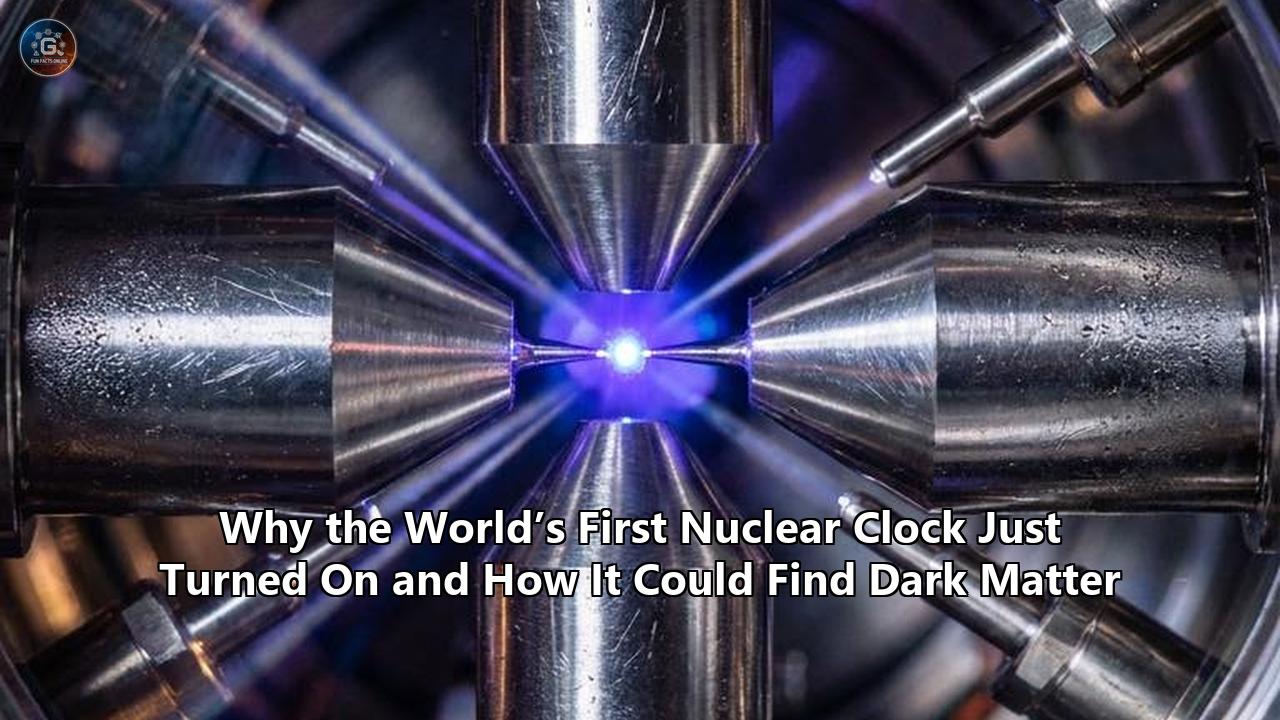
In a sterile, windowless laboratory at the Vienna University of Technology (TU Wien), a tiny, translucent crystal no larger than a grain of rice sits mounted inside a vacuum chamber. Laced with a trace amount of the radioactive isotope thorium-229, the crystal glows with a faint, ghostly violet light when struck by a specialized ultraviolet laser.
To the untrained eye, the setup looks like a modest chemistry experiment. To the international team of physicists gathered around the monitors, it represents the dawn of a new metrological era.
In June 2026, two independent research consortia—one led by the European collaboration of TU Wien and Germany’s National Metrology Institute (PTB), and the other by Tsinghua University in Beijing—announced that they had successfully transitioned the long-discussed concept of a "nuclear clock" into a fully operational, stand-alone timekeeping device.
By continuously locking a laser to the natural vibrations of an atomic nucleus, these teams did not just build a better clock. They unlocked a hyper-sensitive quantum sensor that is already being deployed to hunt for dark matter, the invisible scaffolding that makes up roughly 85% of the universe's matter but has eluded every direct detection attempt for nearly a century.
"In some types of measurements, we're already outperforming all of the atomic clocks," says Thorsten Schumm, a leading physicist at TU Wien.
The stakes are remarkably high. For decades, the standard for precise timekeeping has been held by optical atomic clocks, which track the transitions of electrons orbiting outside an atom. But electrons are flighty, easily perturbed by stray electromagnetic fields, temperature fluctuations, and environmental noise.
By shifting the timekeeper from the outer electron shell to the dense, tightly bound vault of the atomic nucleus, physicists have created a clock that is fundamentally shielded from the chaos of the outside world.
And because the forces holding that nucleus together are so finely balanced, this newly activated device is uniquely poised to detect the incredibly subtle, wave-like vibrations of hypothetical dark matter particles.
The Anomalous "Precious Gift" of Thorium-229
To understand why the creation of a functioning nuclear clock is such a profound achievement, one must follow an evidence trail that begins in 1976.
For nearly a century, physicists have known that atomic nuclei possess different energy states, much like the electron shells orbiting them. However, while electrons can be coaxed to jump between energy levels using the modest energy of visible or microwave laser light, atomic nuclei are bound by the strong nuclear force—the strongest force in the universe.
Shifting a nucleus from its ground state to an excited state typically requires highly energetic gamma rays or X-rays. Generating a laser capable of precisely controlling such transitions was deemed technologically impossible for the foreseeable future.
But in 1976, nuclear physicists L. Kroger and C. Reich, working at the Idaho National Engineering Laboratory, noticed a bizarre anomaly while studying the radioactive decay of uranium-233 into thorium-229.
According to their calculations, the nucleus of thorium-229 possessed an excited state—known as an isomer—that was exceptionally, almost inexplicably, close in energy to its ground state.
While a typical nuclear transition requires millions of electronvolts (MeV) of energy, the thorium-229 transition seemed to require less than 100 electronvolts. It was a cosmic fluke, a microscopic coincidence of nuclear structure.
"This nucleus is a quirk of nature, a precious gift," says theoretical physicist Andrei Derevianko of the University of Nevada, Reno, who has spent decades modeling the physics of a solid-state nuclear clock.
If the transition energy was low enough, it meant that a laser operating in the vacuum-ultraviolet (VUV) spectrum could, in theory, directly excite the thorium-229 nucleus.
If physicists could achieve this, they could use the nucleus as a pendulum. Because the nucleus is roughly 100,000 times smaller than the atom itself, and shielded by the dense cloud of surrounding electrons, it would be virtually immune to the external perturbations that plague conventional atomic clocks.
  TRADITIONAL OPTICAL ATOMIC CLOCK               NEW SOLID-STATE NUCLEAR CLOCK

       Stray EM Fields / Noise                     Shielding Electron Cloud
               │                                            │
               ▼                                            ▼
      ┌─────────────────┐                          ┌──────────────────┐
      │  Outer Electron │                          │  Atomic Nucleus  │
      │   (Vulnerable)  │                          │    (Shielded)    │
      └────────┬────────┘                          └────────┬─────────┘
               │                                            │
               ▼                                            ▼
      Sensitive to outside                        Highly stable; direct probe
       forces & disturbances                        of fundamental constants
Yet, identifying the exact "frequency" of this nuclear transition proved to be one of the most grueling searches in modern experimental physics.
For forty years, researchers knew the transition existed, but they didn’t know its exact wavelength. It was like trying to find a single, ultra-narrow radio station on a dial that stretched across a vast, uncharted spectrum.
Early estimates placed the transition anywhere between 3 and 10 electronvolts. It was only in the late 2010s and early 2020s that the window began to close, eventually pinning the transition down to approximately 8.4 electronvolts, corresponding to a VUV wavelength of roughly 148 nanometers.
From a Ticking Isotope to a Working Clock
The watershed moment came in early 2024, when researchers in Germany and Austria finally succeeded in using a VUV laser to trigger the transition in thorium-229 nuclei embedded inside a calcium fluoride crystal.
They had made the nucleus "tick". But as any horologist will tell you, a ticking pendulum is not yet a clock.
"To have a clock, you need a feedback loop," explains Lars von der Wense, a physicist at Johannes Gutenberg University Mainz who was not involved in the latest work. "You must let the ticking of the pendulum control the mechanism that keeps it swinging."
In an optical clock, this is achieved by stabilizing the laser to the exact frequency of the transition. If the laser's frequency drifts even slightly, the atoms stop absorbing the light.
The system detects this drop in absorption and immediately applies an electronic correction to nudge the laser back on target.
Implementing this feedback loop with a solid-state nuclear transition was a daunting challenge. Because the thorium nuclei are embedded inside a solid crystal lattice rather than suspended in a vacuum as free ions, the crystal itself can exert subtle shifts on the nuclear energy levels.
Furthermore, generating a continuous-wave VUV laser that is both narrow enough in linewidth and stable enough over long periods of time is a masterclass in advanced optical engineering.
In June 2026, the European and Chinese teams revealed they had independently solved these engineering hurdles using two distinct, elegant methodologies.
The European Feedback Loop: Active Stabilization
The European team, led by Luca Toscani De Col and Thorsten Schumm at TU Wien, along with collaborators at PTB, took a brute-force approach to stabilization.
They embedded thorium-229 nuclei inside a millimeter-sized calcium fluoride crystal at room temperature. They then targeted the crystal with a continuous-wave VUV laser.
To keep the laser locked, they used a technique called continuous absorption spectroscopy.
As the thorium nuclei absorbed the VUV photons and transitioned to their isomeric state, the intensity of the light passing through the crystal shifted.
By reading out this signal using a photomultiplier tube, the team's automated electronics calculated an "error signal". If the laser frequency drifted, the system immediately corrected it, forcing the laser to remain perfectly locked to the nuclear transition.
To verify that their clock was keeping stable time, they compared a subharmonic of the VUV laser's frequency to an established, ultra-precise ytterbium-ion optical atomic clock via an optical frequency comb.
The experiment ran continuously for 24 hours, proving that the thorium nucleus could reliably steer a laser and function as a stand-alone clock.
The Chinese Breakthrough: High-Power Spectrometric Precision
Meanwhile, the Chinese team at Tsinghua University, led by Shiqian Ding and Beichen Huang, approached the problem by upgrading the laser source itself.
VUV lasers are notoriously difficult to scale up in power, but Ding’s team developed a specialized system that generated a highly coherent, 10-microwatt continuous-wave VUV beam at 148.4 nanometers.
They achieved this by utilizing resonance-enhanced four-wave mixing in a cell of cadmium vapor heated to 550°C.
  TSINGHUA UNIVERSITY'S VUV GENERATION SCHEME

  ┌──────────────┐     ┌──────────────┐
  │  375 nm Laser│     │  710 nm Laser│
  └──────┬───────┘     └──────┬───────┘
         │ (Two Photons)      │ (One Photon)
         └─────────┬──────────┘
                   ▼
       ┌────────────────────────┐
       │   Cadmium Vapor Cell   │  ◄─── Heated to 550°C
       │  (Four-Wave Mixing)    │
       └───────────┬────────────┘
                   ▼
        148.4 nm VUV Laser Beam    ◄─── 10 µW power, sub-hertz linewidth
With this highly intense, narrow-linewidth laser, they were able to obtain a pristine, high-signal-to-noise absorption signal from their own home-grown thorium-doped calcium fluoride crystal.
Crucially, the Chinese team addressed one of the biggest lingering doubts about solid-state nuclear clocks: the reproducibility of the crystal environment.
If the microscopic defects and thermal expansions of the calcium fluoride crystal shifted the nuclear transition in unpredictable ways, then every nuclear clock built would "tick" at a slightly different rate, requiring tedious, individual calibration.
Ding’s team tested their clock using two entirely independent, separately grown crystals. To their immense relief, both crystals yielded nearly identical transition frequencies.
"This work extends quantum metrology from electronic to nuclear transitions," the Tsinghua team wrote in their preprint, "and opens a new platform for compact clocks, solid-state nuclear quantum sensors, and precision tests of fundamental physics".
The Nuclear Clock Dark Matter Connection
While the engineering feat of building a nuclear clock is historic, the primary driver for the global race to construct one is not the desire for better wristwatch accuracy. Today's best optical atomic clocks are already so precise that they would not lose a second over billions of years.
Instead, the rush is fueled by a profound realization: the thorium-229 nucleus is a highly sensitive antenna for the dark sector of physics.
For decades, the search for dark matter focused on Weakly Interacting Massive Particles (WIMPs)—hypothetical, heavy particles that might occasionally collide with normal matter inside deep, underground detectors.
However, as those detectors have repeatedly turned up empty, physicists have increasingly turned their attention to an alternative candidate: ultralight dark matter (ULDM).
Ultralight dark matter consists of extraordinarily light particles, such as axions or dilaton-like particles, with masses in the range of $10^{-21}$ to $10^{-19}$ electronvolts.
Because these particles are so light, quantum mechanics dictates that they do not behave like localized, billiard-ball-like bullets. Instead, they behave like a classical, macroscopic wave that permeates the cosmos.
As the Earth drifts through the Milky Way's dark matter halo, we are effectively swimming through an invisible, oscillating ocean of ultralight dark matter.
"Ultralight dark matter is expected to induce oscillations of nuclear parameters," says theoretical physicist Victor Flambaum of the University of New South Wales.
According to quantum field theory, the background wave of ultralight dark matter would couple weakly to the quarks, gluons, and electromagnetic fields of the Standard Model.
This coupling would cause the fundamental constants of nature—such as the fine-structure constant $\alpha$ (which dictates the strength of electromagnetism) and the masses of quarks—to oscillate very slightly at a frequency determined by the mass of the dark matter particle.
  ULTRALIGHT DARK MATTER FIELD
  (Invisible Cosmic Wave)
         │
         ▼
  Tide of ULDM washes over Earth
         │
         ▼
  Causes fundamental "constants" (like Fine-Structure Constant α) to wiggle
         │
         ▼
  ┌────────────────────────────────────────────────────────┐
  │         HOW DETECTORS CAPTURE THIS OSCILLATION         │
  ├───────────────────────────┬────────────────────────────┤
  │    Conventional Clocks    │    Thorium Nuclear Clock   │
  │                           │                            │
  │  Electrons respond minimally│  Cancellation of nuclear/  │
  │  to strong force; low     │  EM forces magnifies the   │
  │  amplification of signal  │  oscillation up to 10^10x  │
  └───────────────────────────┴────────────────────────────┘
This is where the nuclear clock dark matter connection becomes a game-changer.
In a conventional optical atomic clock, the timekeeping transition is governed by electromagnetism, as electrons jump between shells.
In the thorium-229 nuclear clock, however, the transition energy is determined by a delicate, near-perfect cancellation between two massive, opposing forces inside the nucleus: the strong nuclear force (which binds the protons and neutrons) and the Coulomb/electromagnetic force (which pushes the positively charged protons apart).
The total binding energy associated with these forces inside the thorium nucleus is on the scale of millions of electronvolts (MeV). Yet, because they almost perfectly cancel each other out, they leave behind a tiny, residual transition energy of just 8.4 electronvolts.
Because of this accidental, near-perfect cancellation, any minute change in the relative strength of the strong nuclear force or the electromagnetic force will have a massively magnified effect on the 8.4 eV transition energy.
"Because those large contributions nearly cancel each other out, even tiny changes in the underlying forces could shift the clock's frequency," explains Schumm.
In physical terms, if ultralight dark matter causes the fine-structure constant or quark masses to oscillate, the thorium nuclear clock's "ticking" rate will fluctuate dramatically compared to a standard atomic clock.
Theoretical models suggest this enhancement factor could amplify the signature of dark matter by up to ten orders of magnitude ($10^{10}$) compared to conventional atomic timekeepers.
Probing the Mega-Planck Scale
The true power of this technology was demonstrated even before the June 2026 operational clock announcements.
In February 2026, a team of physicists working with precision nuclear spectroscopy at JILA (a joint institute of the National Institute of Standards and Technology and the University of Colorado Boulder) published a study titled "Probing Ultralight Dark Matter at the Mega-Planck Scale with the Thorium Nuclear Clock".
Led by researchers Jason Arakawa, Jack F. Doyle, and Elina Fuchs, the JILA group used an early version of the thorium spectroscopy apparatus to conduct an ultra-sensitive search for dark matter.
By monitoring the thorium transition and comparing it to the highly stable strontium optical lattice clocks at JILA, they searched for the telltale, periodic "wiggles" that would indicate the presence of an oscillating dark matter field.
While they did not detect a dark matter signal, the constraints they established were staggering.
They set the strongest bounds to date on ultralight dark matter in the mass range of $10^{-21}$ to $10^{-19}$ electronvolts.
More remarkably, their results probed effective interaction scales exceeding $10^6$ times the Planck scale—referred to as the "Mega-Planck scale".
In physics, the Planck scale ($10^{19}$ GeV) is the theoretical energy threshold where gravity becomes as strong as the other fundamental forces, and where quantum gravitational effects are expected to rewrite the Standard Model.
By probing physics beyond the Planck scale, the thorium clock has ventured into a regime that is entirely inaccessible to conventional particle colliders like the Large Hadron Collider (LHC).
"Our results... establish the thorium-229 system as the leading probe of dark matter couplings to the nuclear sector," the JILA team reported.
  DARK MATTER MASS AND COUPLING SEARCH LIMITS

  Lower Mass Limit                                       Upper Mass Limit
  (10^-21 eV) ◄─────────────────────────────────────────► (10^-19 eV)

  [================== JILA 2026 SEARCH WINDOW ==================]

  Results:
  • Probed interaction scales > 1,000,000x the Planck scale (Mega-Planck)
  • Set tightest bounds ever recorded for strong force dark matter coupling
  • Beat standard atomic clocks by several orders of magnitude
The European team's June 2026 paper corroborated and expanded upon this search.
Using their newly stabilized, continuous-wave 24-hour nuclear clock, Toscani De Col and his colleagues searched for periodic fluctuations and slow drifts in the nuclear transition energy over timescales ranging from 20 seconds to a full day.
They found that despite the clock being in its infancy, its sensitivity to dark matter coupling to photons competed directly with the world’s best optical atomic clocks—which have benefited from 70 years of continuous refinement.
More importantly, the nuclear clock far surpassed all previous measurements when it came to detecting dark matter's potential coupling to quarks and the strong nuclear force.
"This is an outstanding result," says theoretical physicist Victor Flambaum, reflecting on the rapid progress. "This is only the first step. The race for building super-accurate nuclear clocks just started."
Rewriting the Laws of Physics: The Implications
If a nuclear clock does eventually detect a periodic fluctuation in its ticking rate, the implications for our understanding of the universe would be revolutionary. It would not only confirm the existence of dark matter and identify its microscopic nature, but it would also dismantle one of the most fundamental tenets of modern physics: the constancy of physical laws.
Since the dawn of modern science, physics has operated under the assumption that the fundamental constants of nature—such as the speed of light, the gravitational constant, and the fine-structure constant—are immutable, static values that remain identical across space and time.
A detection of dark matter via a nuclear clock would prove that these "constants" are actually dynamic, fluid parameters that oscillate as the Earth moves through the cosmos.
"Essentially all modern theories beyond the Standard Model predict additional particles or fifth forces... which can be probed with the nuclear clock," Schumm points out.
Beyond the esoteric hunt for dark matter, the activation of the first working nuclear clocks has immediate, practical implications that could reshape global technology over the coming decades.
1. Redefining the Second
Since 1967, the International System of Units (SI) has defined the standard second based on the microwave transition of cesium-133 atoms.
While metrologists have been preparing to redefine the second using more precise optical atomic clocks (such as those based on strontium or ytterbium), the solid-state nuclear clock offers a compelling, long-term alternative.
Because nuclear transitions have a higher "quality factor" (meaning the resonance is incredibly sharp and narrow compared to its frequency), they can theoretically achieve a level of precision and stability that outperforms even the most advanced optical atomic clocks.
  METROLOGICAL CHRONOLOGY: HOW WE DEFINE THE SECOND

  1967 – Present: Cesium Microwave Clocks
  • Measures microwave electron transitions in Cesium-133
  • Precision: Accurate to ~1 second in 300 million years

  Late 2020s (Planned): Optical Atomic Clocks
  • Measures visible light transitions in Strontium or Ytterbium
  • Precision: Accurate to ~1 second in 20 billion years

  Future: Solid-State Nuclear Clocks
  • Measures VUV nuclear transitions in Thorium-229
  • Precision: Theoretically accurate to ~1 second in trillions of years
2. Deep-Space Navigation and GPS-Denied Environments
To maintain accuracy, today’s optical atomic clocks require highly specialized, room-sized laboratory environments.
The atoms must be isolated in ultra-high vacuum chambers, suspended in optical lattices made of intersecting laser beams, and cooled using lasers to within a fraction of a degree above absolute zero. This makes them delicate, expensive, and completely non-portable.
Because the thorium-229 nuclei in a nuclear clock are embedded directly inside a solid crystal, they do not require complex vacuum chambers or laser cooling.
They operate reliably at room temperature.
"Because the thorium transition remains stable inside a solid material, researchers may eventually be able to build compact clocks that are useful for navigation systems, telecommunication networks, and data synchronization," von der Wense notes.
A ruggedized, chip-sized nuclear clock could be deployed on deep-space probes, allowing for autonomous navigation without relying on time-delayed signals from Earth.
On Earth, such clocks could provide submarines, military vehicles, and aircraft with hyper-precise positioning that is completely immune to GPS jamming, as the clock would not drift even if disconnected from satellite networks for months.
3. Tabletop Gravitational Wave Detection
According to Einstein’s theory of general relativity, gravity slows down the passage of time—an effect known as gravitational time dilation.
Because nuclear clocks are expected to reach a fractional frequency instability of $10^{-19}$ or even $10^{-20}$, they will be sensitive enough to detect changes in height of less than a millimeter through the gravitational shift in their ticking rate.
Networked together on Earth’s surface, a series of compact nuclear clocks could act as a highly sensitive gravitational wave detector, mapping the microscopic warping of spacetime caused by passing astronomical events, or even tracking the slow movement of tectonic plates and magma chambers deep beneath the Earth.
The Next Frontiers in the Timekeeping Race
Despite the monumental breakthroughs of 2026, experimental physicists are quick to emphasize that the nuclear clock is still in its infancy.
"The new devices do not yet outperform the best atomic clocks—which, let's be honest, have a 70-year headstart," notes one researcher. "But they prove that nuclear clocks are no longer just a theoretical dream".
To unlock the full potential of these devices, the global research community is currently pursuing two primary, parallel pathways:
Refinement of the Solid-State Crystal Clock
The solid-state approach used by both the European and Chinese teams is favored for its simplicity and potential for miniaturization. However, the crystal lattice of calcium fluoride still introduces small, temperature-dependent shifts and magnetic perturbations that limit the clock’s ultimate accuracy.
Researchers are now focused on refining the growth of thorium-doped crystals to eliminate microscopic impurities and defects.
Furthermore, theorists have recently identified a specific "magic temperature" (approximately 190 Kelvin, or -83°C) at which the thorium-229 transition frequency becomes virtually insensitive to temperature fluctuations.
Operating the solid-state clock at this temperature would drastically reduce the complexity of the thermal shielding required to maintain long-term stability.
The Pursuit of the Single-Ion Nuclear Clock
To bypass the solid-state crystal shifts entirely, some research groups, including teams at PTB and JILA, are pursuing an alternative architecture: the single-ion nuclear clock.
In this setup, a single thorium-229 ion is isolated and suspended in an electromagnetic trap in a vacuum chamber, similar to the method used in today's most precise single-ion optical atomic clocks.
Without the disturbing influence of a surrounding crystal lattice, a trapped-ion nuclear clock could theoretically achieve the absolute pinnacle of systematic accuracy, with fractional frequency instabilities reaching deep into the $10^{-20}$ range.
However, this approach sacrifices the rugged, compact, and room-temperature advantages of the solid-state design, requiring the same massive, complex vacuum systems that the solid-state clock successfully avoids.
  THE TWO PATHS OF NUCLEAR CLOCK DEVELOPMENT

  ┌────────────────────────────────────────────────────────┐
  │                 SOLID-STATE CRYSTAL                    │
  ├────────────────────────────────────────────────────────┤
  │ • Thorium embedded in Calcium Fluoride crystal         │
  │ • Operates at room temperature                         │
  │ • Highly compact, rugged, and portable                 │
  │ • Susceptible to minor crystal lattice shifts          │
  └────────────────────────────────────────────────────────┘
                             │
                             ▼
  ┌────────────────────────────────────────────────────────┐
  │                 SINGLE-ION ION TRAP                    │
  ├────────────────────────────────────────────────────────┤
  │ • Single Thorium ion suspended in vacuum trap          │
  │ • Requires complex vacuum and cryogenic systems        │
  │ • Extremely large, delicate laboratory setup           │
  │ • Eliminates lattice shifts; achieves maximum accuracy │
  └────────────────────────────────────────────────────────┘
The success of both the Vienna-led and Beijing-led teams in turning the thorium-229 nucleus into an active, self-correcting timepiece has shattered a glass ceiling in quantum metrology.
By proving that a laser can be locked to a nuclear transition continuously, they have transitioned the field from speculative spectroscopy into active physical exploration.
The race to refine these systems is accelerating rapidly.
Whether the first direct detection of dark matter comes from a solid-state crystal operating in a basement lab in Vienna, a high-power cadmium-vapor setup in Beijing, or a trapped-ion system in Colorado, the universe's most elusive substance is running out of places to hide.
By successfully building a clock that ticks to the rhythm of the strong nuclear force, humanity has constructed its most sensitive ear yet to listen to the silent, invisible symphony of the cosmos.
Reference:
- https://arxiv.org/html/2606.04997
- https://www.livescience.com/physics-mathematics/particle-physics/the-worlds-first-nuclear-clock-just-ticked-on-and-it-could-help-detect-a-fifth-fundamental-force-of-physics
- https://arxiv.org/html/2606.08870v1
- https://www.thebrighterside.news/post/physicists-use-thorium-229-to-power-the-worlds-first-working-nuclear-clock/
- https://www.ffk2025.candela.org.pl/wp-content/uploads/2025/05/26_Okhapkin.pdf
- https://www.sciencenews.org/article/nuclear-clock-atomic-nucleus-first
- https://www.sciencealert.com/success-physicists-build-the-worlds-first-clocks-powered-by-atomic-nuclei
- https://arxiv.org/abs/2606.04997
- https://arxiv.org/html/2602.16804v1
- https://www.mdpi.com/2304-6732/13/2/141
- https://www.iflscience.com/first-nuclear-atomic-clock-has-been-used-to-investigate-the-properties-of-dark-matter-83814
- https://arxiv.org/html/2511.13017v1
- https://www.unr.edu/nevada-today/news/2025/nuclear-clock-advancements
- https://www.sciencenews.org/article/nuclear-clock-atomic-nucleus-first
- https://www.researchgate.net/publication/407288219_Record_nonlinear_conversion_efficiency_in_the_production_of_high_spectral_purity_vacuum_ultraviolet_laser_at_148_nm
- https://arxiv.org/abs/2602.16804
- https://www.researchgate.net/scientific-contributions/Fiona-Kirk-2164457120
- https://arxiv.org/abs/2407.17300
- https://en-exact-sciences.tau.ac.il/events_physics_colloquium_19_4_2026
- https://arxiv.org/abs/2602.16804