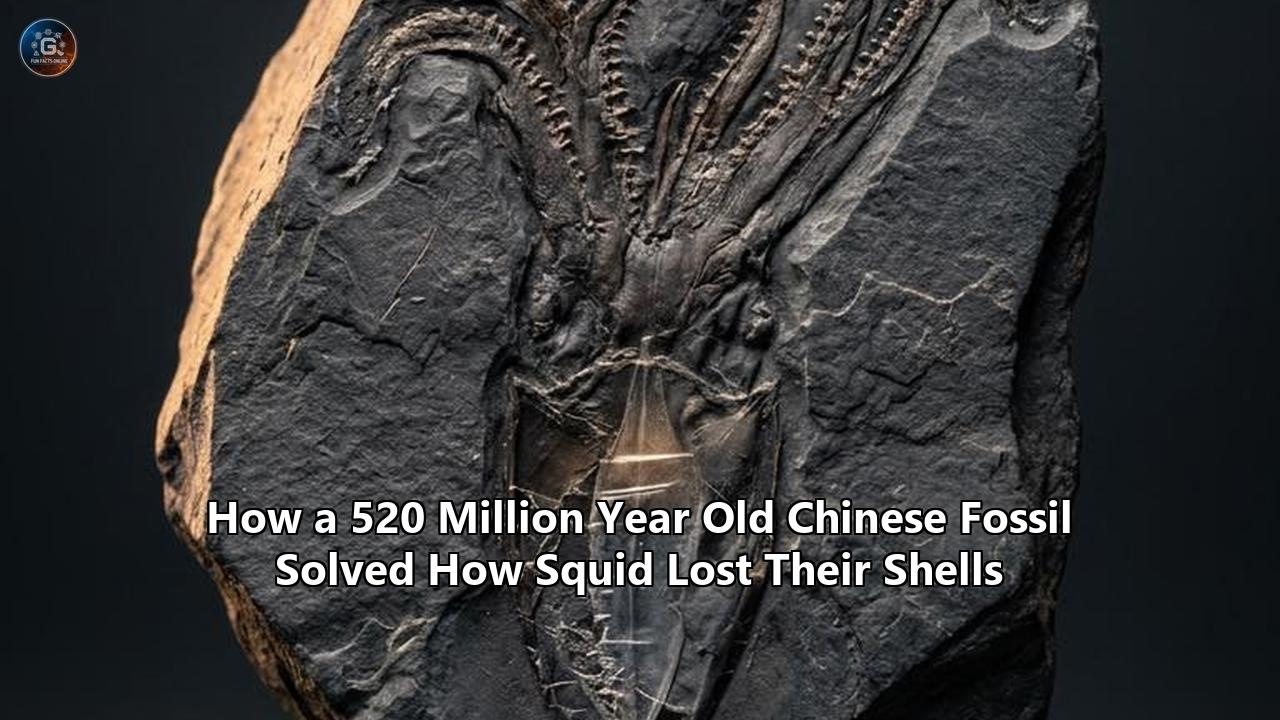
An international team of paleontologists revealed the discovery of a microscopic fossil in southern China that solves one of marine biology’s most enduring mysteries: how the squishy, shell-less ancestors of modern squid, octopuses, and cuttlefish first developed—and ultimately abandoned—their heavy external armor.
The finding, published in Nature by researchers from Chang’an University, the Nanjing Institute of Geology and Palaeontology, and the University of Bristol, centers on a 520-million-year-old fossilized organism named Eoceras shaanxiense. Unearthed from the Shuijingtuo Formation in Shaanxi Province, the fossilized specimens measure barely one millimeter in length—smaller than a single grain of rice. Yet despite their diminutive scale, these tiny shells preserve the oldest known example of a siphuncle: a specialized hydraulic tube that allowed ancient mollusks to manipulate gas and water inside their shells to control buoyancy.
CAMBRIAN SEAFOOD REVOLUTION
[ Benthic Crawlers ] ---> [ Eoceras shaanxiense ] ---> [ Shelled Orthocones ] ---> [ Internalized Pen / Gladius ]
(Solid Shell / Slugs)     (1 mm, First Siphuncle)      (Giant Swimming Armor)      (Modern Soft-Bodied Squid)
By pushing the physical record of this buoyancy mechanism back by 30 million years, Eoceras bridges a missing link between slow-moving, bottom-dwelling snails and the high-speed, jet-propelled predators that dominate the open sea today. Understanding this early biological innovation explains how ancient cephalopods lifted off the ocean floor, set off an underwater evolutionary arms race, and eventually abandoned their protective external shells altogether.
The 1-Millimeter Titan of the Shaanxi Rock Beds
The specimens behind the discovery were recovered from dark limestone deposits in the rugged terrain of Shaanxi Province. For decades, the early Cambrian fossil record was notoriously sparse regarding the earliest ancestors of cephalopods. While genetic studies—known as molecular clock analyses—suggested that cephalopods split from primitive crawling mollusks approximately 520 million years ago, the oldest verified cephalopod fossil previously on record was Plectronoceras cambria, which dated to roughly 490 million years ago during the Late Cambrian.
This 30-million-year discrepancy left paleontologists questioning whether molecular estimates were flawed or if early cephalopod fossils were simply too small and delicate to have survived in the fossil record.
CEPHALOPOD TIMELINE GAP CLOSED
+-----------------------------------------------------------------------------------+
| 520 Million Years Ago           490 Million Years Ago          Present Day        |
| Early Cambrian                  Late Cambrian                                     |
+-----------------------------------------------------------------------------------+
| *Eoceras shaanxiense*           *Plectronoceras cambria*       Modern Coleoids    |
| (Newly Discovered)              (Previous Record Holder)       (Squid, Octopus)   |
| [================ Siphuncle Origin Extended 30 Ma ================]              |
+-----------------------------------------------------------------------------------+
Led by Professor Junfeng Guo and lead author Zuchen Song of Chang’an University, alongside Dr. Jakob Vinther of the University of Bristol, the research team resolved the dilemma through acid-extraction techniques. By dissolving bulk limestone samples in weak acetic acid, they isolated 32 microscopic, cone-shaped fossil shells.
Under high-resolution electron microscopy and synchrotron X-ray microtomography, the researchers discovered that these tiny cones were not simple snail shells. Instead, they contained a complex internal architecture:
- Internal Septa: Transverse mineral walls dividing the interior of the shell into isolated chambers, known as a phragmocone.
- A Tilted Aperture: An asymmetrical shell opening indicating that the animal held its body at an inclined angle off the seafloor.
- A Primordial Siphuncle: A continuous, segmented tube running along the inner margin of the shell, connected to the internal chambers through microscopic canals.
This microscopic tube represents the primary architectural breakthrough that separated cephalopods from all other molluscan lineages.
Biological Hydraulics: How the Siphuncle Works
To grasp why a one-millimeter tube in an ancient fossil solves a major evolutionary problem, it helps to analyze how modern chambered cephalopods—such as the nautilus—navigate the water column.
Unlike clams or snails, which remain weighted down by solid calcium carbonate shells, a chambered cephalopod uses its shell as a variable-buoyancy floatation tank. As the animal grows, it secretes a new internal wall (septum) behind its soft body mass, sealing off a fresh chamber. Initially, this newly formed chamber is filled with a metabolic fluid.
THE SIPHUNCLE HYDRAULIC PUMP MECHANISM
+-----------------------------------------------------------------------+
|  Outer Shell (Phragmocone)                                            |
|  +-------------------+-------------------+-------------------+        |
|  | Chamber 1 (Gas)   | Chamber 2 (Gas)   | Chamber 3 (Fluid) | Body   |
|  |                   |                   |                   | Mass   |
|  +-----|-------------+-----|-------------+-----|-------------+        |
|        |                   |                   |                      |
|  =======[=================== Siphuncle Tube ===================]=======  |
|         Active Transport of Ions (Salts) Removes Water via Osmosis     |
+-----------------------------------------------------------------------+
This is where the siphuncle performs its hydraulic work:
- Ion Transport: The siphuncle—a strand of living tissue wrapped in a porous, vascularized organic sheath—actively pumps sodium and chloride ions out of the chamber fluid and into the animal’s bloodstream.
- Osmotic Drainage: This ion movement creates a osmotic pressure gradient. Water naturally flows out of the chamber and into the siphuncle tissue to balance the salt concentration.
- Gas Diffusion: As water drains from the sealed chamber, dissolved gases (primarily nitrogen, oxygen, and carbon dioxide) diffuse out of the surrounding tissues and fill the partial vacuum left behind.
- Neutral Buoyancy: By adjusting the volume of liquid and gas in these chambers, the animal offsets the weight of its shell, achieving neutral buoyancy—floating weightlessly in the water column without expending mechanical energy.
Before the discovery of Eoceras shaanxiense, paleontologists lacked direct fossil evidence showing how this complex osmotic drainage system was assembled. Eoceras reveals the primordial state of this mechanism: a simple, segmented organic conduit running along the belly of the shell. While its buoyancy control was likely crude—meaning Eoceras still spent most of its time creeping along the muddy sea bottom—it possessed the foundational machinery required to make a heavy shell float.
From Crawling Slugs to Swimming Hunters
To put Eoceras in context, it is helpful to look at what preceded it. During the early Cambrian period, the oceans were populated by primitive mollusks that looked more like flat, armored slugs than fast-moving squids.
A prime example is Shishania aculeata, another Early Cambrian fossil discovered in Yunnan Province, China. Shishania lacked a solid shell altogether; instead, its back was covered in hundreds of tiny, hollow, conical spines made of chitin, while its underside featured a broad, muscular foot used to drag itself across sediment.
EARLY MOLLUSKAN DIVERGENCE (CAMBRIAN PERIOD)

                [ Ancestral Stem Mollusk ]
                           |
         +-----------------+-----------------+
         |                                   |
  [ Aculiferans ]                     [ Conchiferans ]
  (e.g., *Shishania aculeata*)        (Solid Shells / Crawlers)
  (Spiny, chitinous armor,                    |
   naked muscular foot)              [ Early Cephalopods ]
                                     (e.g., *Eoceras shaanxiense*)
                                     (Phragmocone + Primordial Siphuncle)
                                              |
                                     (Achieved Buoyancy)
As early predators like Anomalocaris and Lyrarapax expanded across Cambrian ecosystems, early mollusks faced intense selection pressure to protect themselves. Many lineages responded by calcifying their outer skin into hard, unsegmented shells.
This strategy yielded effective defense, but it came with a severe trade-off: weight. Heavy shells locked early mollusks to the ocean floor, restricting them to a slow, benthic lifestyle.
CAMBRIAN SEAFOOD ECOLOGY: TRADE-OFFS
+-------------------+--------------------------------+--------------------------------+
| Trait             | Heavy External Shell           | Chambered Shell + Siphuncle    |
+-------------------+--------------------------------+--------------------------------+
| Primary Benefit   | High defense against crushers  | Freedom from the ocean floor   |
| Major Drawback    | Severe mobility restriction    | High metabolic upkeep          |
| Movement Type     | Slow benthic crawling          | Vertical floating / Swimming   |
| Lineage Examples  | Early gastropods, monoplacoph. | *Eoceras*, early cephalopods   |
+-------------------+--------------------------------+--------------------------------+
The emergence of the siphuncle in Eoceras shaanxiense fundamentally altered this dynamic. By trapping gas inside its shell chambers, Eoceras counteracted the downward pull of gravity.
Over subsequent millions of years, this structural innovation allowed cephalopods to grow larger shells without sinking. They evolved a muscular funnel—the siphon—which expelled water forcefully from their body cavity, inventing jet propulsion.
For the first time in Earth's history, an invertebrate group could rise off the seabed, hover in mid-water, and swim rapidly through the open ocean to hunt prey.
The Paradox of the Shell: From Asset to Vulnerability
If a chambered external shell was the ultimate evolutionary advantage during the Cambrian and Ordovician periods, why do modern squids, octopuses, and cuttlefish lack external shells today?
The answer lies in a prolonged ecological shift known as the Mesozoic Marine Revolution.
For nearly 200 million years following the Cambrian Explosion, shelled cephalopods—including straight-shelled orthocones and spiral-shelled ammonites—were dominant ocean predators. Orthocones such as Endoceras giganteum grew shells over 11 feet (3.5 meters) long, acting as terrifying apex hunters in Paleozoic seas.
PALEOZOIC vs. MESOZOIC MARINE ARMS RACE
+-----------------------------------------------------------------------------------+
| PALEOZOIC ERA (541 - 252 Ma)                                                      |
| Environment: Slow benthic prey, few fast competitors                              |
| Winning Strategy: Massive external shell (Armor + Buoyancy)                        |
| Key Lineages: Orthocones, Nautiloids, Early Ammonoids                             |
+-----------------------------------------------------------------------------------+
                                      |
                                      v  [Mesozoic Marine Revolution]
+-----------------------------------------------------------------------------------+
| MESOZOIC ERA (252 - 66 Ma)                                                        |
| Environment: Fast jawed fish, marine reptiles (Ichthyosaurs, Plesiosaurs)         |
| Winning Strategy: High maneuverability, body compression, speed over armor        |
| Key Innovation: Internalization and reduction of the shell                        |
+-----------------------------------------------------------------------------------+
However, during the Devonian and Jurassic periods, the ocean's competitive landscape shifted dramatically:
- The Rise of Jawed Fish: Advanced, agile fish with powerful, crushing jaws proliferated across marine environments.
- Marine Reptiles: Fast-swimming, warm-blooded predators such as ichthyosaurs, plesiosaurs, and mosasaurs entered the water column.
- Crushing Defenses: External shells, once an impenetrable fortress, became liability targets. Large, rigid shells restricted quick turn radii, limited top-speed acceleration, and were vulnerable to being smashed open by jawed predators.
Faced with fast, highly maneuvering predators, the ancestors of modern cephalopods entered an evolutionary crossroad. One group—the ammonites—doubled down on external armor, evolving intricate, highly folded shell structures; this group ultimately went extinct alongside the dinosaurs 66 million years ago.
The other group—the coleoids (the lineage containing modern squids, cuttlefishes, and octopuses)—took a different route. They began folding their soft tissue over their shells, gradually internalizing, reducing, and streamlining their rigid skeletons to prioritize speed and agility.
Step-by-Step: The Evolution of Squid Shells
The discovery of Eoceras shaanxiense provides the critical baseline for tracking the evolution of squid shells across half a billion years of deep time. By showing how the external chambered shell was first constructed, researchers can map out the precise sequence of transformations that led to its reduction and disappearance.
TRANSITION MATRIX: THE EVOLUTION OF SQUID SHELLS
+-----------------------+-------------------------+-------------------------+-------------------------+
| Stage                 | Representative Taxa     | Shell Position & Type   | Functional Role         |
+-----------------------+-------------------------+-------------------------+-------------------------+
| 1. Primordial         | *Eoceras shaanxiense*   | External, straight cone | Static buoyancy,        |
|    Chambered Shell    | (Early Cambrian)        | with primitive siphuncle| seabed elevation        |
+-----------------------+-------------------------+-------------------------+-------------------------+
| 2. Giant External     | *Endoceras*,            | External, chambered     | Heavy defensive armor,  |
|    Orthocone          | Nautiloids (Ordovician) | mineralized shell       | apex predator float     |
+-----------------------+-------------------------+-------------------------+-------------------------+
| 3. Mantle Enclosure   | *Phragmoteuthis*,       | Semi-internalized,      | Streamlining, early     |
|    & Internalization  | Belemnites (Jurassic)   | guarded by tissue fold  | high-speed swimming     |
+-----------------------+-------------------------+-------------------------+-------------------------+
| 4. Structural         | Modern Squids           | Fully internal chitinous| Flexible muscle spine,  |
|    Reduction          | (Teuthida order)        | rod (Gladius / Pen)     | jet acceleration anchor |
+-----------------------+-------------------------+-------------------------+-------------------------+
| 5. Complete Loss /    | Modern Octopuses        | Completely absent or    | Maximum flexibility,    |
|    Vestigial Stylets  | (Octopoda order)        | microscopic cartilage   | spatial crevice squeezing|
+-----------------------+-------------------------+-------------------------+-------------------------+
Stage 1: External Armor with Buoyancy Control (520 – 400 Million Years Ago)
As demonstrated by Eoceras, early cephalopods possessed rigid, external calcium carbonate shells divided into gas-filled chambers. The shell provided both physical protection from seabed predators and buoyancy regulation via the siphuncle.
Stage 2: Mantle Enclosure and Belemnite Guards (300 – 150 Million Years Ago)
During the late Paleozoic and early Mesozoic eras, ancestral coleoids began extending their muscular mantle outward, wrapping folds of living tissue over the exterior of their shells.
Extinct creatures called belemnites exemplify this transitional phase. Belemnites possessed an internal chambered shell (a phragmocone) capped by a heavy, bullet-shaped calcium carbonate counterweight called a guard. Because soft mantle tissue completely enclosed the shell, the animal could streamline its body, reduce hydrodynamic drag, and develop fins along its sides.
BELEMNITE SHELL INTERNALIZATION
+-----------------------------------------------------------------------+
| Soft Mantle Tissue Outer Layer                                        |
| +-------------------------------------------------------------------+ |
| | Solid Calcium Counterweight  | Internal Chambered Phragmocone     | |
| | (Belemnite Guard)            | (Retained Siphuncle Structure)     | |
| +-------------------------------------------------------------------+ |
+-----------------------------------------------------------------------+
Stage 3: Decalcification and the Chitinous Gladius (160 – 66 Million Years Ago)
As marine predators grew faster during the Jurassic and Cretaceous periods, the heavy calcium carbonate guard became a burden. Selection favored lineages that stopped depositing heavy minerals into their internal skeletons.
The heavy, multi-chambered shell was gradually reduced to a thin, highly flexible sheet made of chitin and protein. This vestigial internal shell is known as the gladius, or "pen," so named because it resembles a feather quill.
The loss of mineralized calcium transformed squid biology:
- Mass Reduction: Body weight dropped dramatically, permitting rapid acceleration.
- Muscular Jet Propulsion: Without a rigid outer shell restricting body shape, the mantle muscle expanded, allowing squids to forcibly compress their entire body cavity to blast water out of their siphon.
- Flexibility and Maneuverability: Squids gained the ability to dart backward, twist sharply, and compress their bodies into tight spaces.
Stage 4: Divergent Endpoints in Modern Coleoids
Today, the trajectory of the evolution of squid shells is visible across different families of cephalopods:
- Squids: Retain a delicate, transparent chitinous gladius running along the length of their mantle, providing structural support for muscular contraction during high-speed swimming.
- Cuttlefish: Retain an internal, highly porous calcium carbonate structure—the cuttlebone—which preserves microscopic chambered layers and functions as a neutral buoyancy float, directly descended from the ancient phragmocone.
- Octopuses: Have carried shell reduction to its absolute limit. In almost all octopus species, the shell has disappeared entirely, reduced at most to a pair of tiny, non-functional cartilage splints (stylets) embedded in their mantle muscle. This total loss of hard structures allows an octopus to squeeze its body through any opening larger than its soft, parrot-like beak.
MODERN CEPHALOPOD SHELL DIVERSITY
+------------------+-----------------------+------------------------+-------------------+
| Organism         | Internalized Structure| Composition            | Primary Function  |
+------------------+-----------------------+------------------------+-------------------+
| Nautilus         | External Shell        | Aragonite / Calcium    | Defense & Float   |
| Cuttlefish       | Internal Cuttlebone   | Porous Calcium / Chitin| Buoyancy Control  |
| Squid            | Internal Gladius (Pen)| Flexible Chitin        | Structural Spine  |
| Octopus          | Stylets / Absent      | Cartilaginous / None   | Unlimited Squeeze |
+------------------+-----------------------+------------------------+-------------------+
The Chemical and Mechanical Feat of Eoceras
Understanding how a 1-millimeter fossil like Eoceras shaanxiense sheds light on this macroevolutionary journey requires examining the imaging technology used by the team in China.
Fossils from the early Cambrian Shuijingtuo Formation are frequently replaced by phosphate minerals during early diagenesis (the rock-forming process). This micro-phosphatization preserves biological structures down to the sub-micrometer level.
FOSSIL PRESERVATION & ANALYSIS WORKFLOW
[ Limestone Matrix Extraction ]
             |
             v
[ Weak Acetic Acid Bath (Dissolves Matrix) ]
             |
             v
[ Isolation of 1mm Phosphatized Shells ]
             |
             v
[ Synchrotron Radiation Micro-CT Imaging ]
             |
             v
[ 3D Structural Reconstruction of Siphuncle & Septa ]
To reconstruct Eoceras without destroying the ultra-fragile specimens, researchers utilized Synchrotron Radiation X-ray Microtomography (SR-μCT). This process works by accelerating electrons in a particle accelerator to produce high-intensity, monochromatic X-ray beams. As these rays pass through the microscopic fossil, they generate high-resolution virtual slice images that can be assembled into interactive 3D digital models.
The 3D models revealed details that traditional optical microscopes could never capture:
- Septal Necks: Curving mineralized collars that supported the entrance of the siphuncle as it pierced each internal septum.
- Micro-Canals: Tiny transverse openings connecting the central siphuncular lumen directly to the empty air chambers.
- Segmented Sheaths: Clear evidence that the siphuncle was constructed from repeating tubular units rather than an unorganized hole through the shell.
These micro-structures confirm that Eoceras was actively engineering its buoyancy. It was not an animal whose shell accidentally trapped air; it was an organism actively pumping fluid out of its internal chambers via specialized physiological tissue.
Why the Discovery Matters for Evolutionary Biology
The implications of the Eoceras shaanxiense discovery extend beyond the history of squids. It addresses several core debates in macroevolution and paleontological methodology.
1. Reconciling Fossils with the Molecular Clock
For decades, evolutionary biologists who relied on genetic mutation rates (molecular clocks) disagreed with field paleontologists. Molecular clocks predicted that major animal phyla—including cephalopods—diversified rapidly during the early Cambrian Explosion, around 520 to 530 million years ago.
However, because early cephalopod fossils were missing from that timeframe, critics argued that molecular clock models overestimated the age of evolutionary splits. The discovery of Eoceras at 520 million years old proves that the molecular clocks were accurate all along. The "missing" fossils were simply tiny, fragile, and required advanced micro-extraction techniques to locate.
THE EVOLUTIONARY PUZZLE: RESOLVED
+-----------------------------------------------------------------------------------+
| PREVIOUS VIEW:                                                                    |
| Molecular Clock Estimate: ~520 Ma  <--- [30 Ma Gap] ---> Fossil Record: ~490 Ma   |
| (Conflict: Were molecular clocks wrong, or were fossils missing?)                 |
+-----------------------------------------------------------------------------------+
                                      |
                                      v
+-----------------------------------------------------------------------------------+
| CURRENT DISCOVERY (2026):                                                         |
| Molecular Clock: ~520 Ma  <--- [MATCH] ---> *Eoceras shaanxiense*: ~520 Ma         |
| (Resolution: Physical evidence matches genetic prediction perfectly)              |
+-----------------------------------------------------------------------------------+
2. Understanding Functional Novelty
A central question in evolutionary theory is how complex biological systems—such as the cephalopod buoyancy apparatus—first arise. Do they appear fully formed, or do they build upon pre-existing structures?
Eoceras shows that the buoyancy apparatus was assembled step-by-step. First came a simple, straight tubular shell with basic dividing walls. Next came a primitive siphuncle capable of slow osmotic fluid removal.Only later, as the siphuncle grew more efficient, did cephalopods evolve coiling shells, rapid jet funnels, and sophisticated sensory organs. The evolution of squid shells was not a sudden loss of armor, but a multi-stage process that began with the assembly of this microscopic hydraulic pump.
3. Reinterpreting Cambrian Ecosystems
The presence of buoyancy-controlled cephalopods 520 million years ago demonstrates that Cambrian marine ecosystems were far more complex than previously recognized.
Rather than being confined to organisms crawling on benthic mud, the Cambrian water column was populated by active swimming organisms earlier than once thought. This discovery shows that the evolutionary push toward floating, nektonic lifestyles was operating during the early stages of the Cambrian Explosion.
From Deep Time to Modern Oceans
Tracing the line from Eoceras shaanxiense to a modern giant squid reveals one of the most drastic transformations in structural anatomy in the history of life on Earth.
520 MILLION YEARS OF STRUCTURAL INNOVATION
+-----------------------------------------------------------------------------------+
| 1. *Eoceras shaanxiense* (Early Cambrian)                                         |
|    - Rigid external shell (1 mm)                                                  |
|    - Tiny internal siphuncle tube                                                 |
|    - Slow, partial buoyancy elevation                                             |
+-----------------------------------------------------------------------------------+
                                      |
                                      v
| 2. Ordovician / Silurian Shelled Giants                                          |
|    - Armor-plated orthocones (Up to 3.5 meters)                                   |
|    - Massive calcium weight, restricted turn capability                           |
|    - Dominant apex ocean floaters                                                 |
+-----------------------------------------------------------------------------------+
                                      |
                                      v
| 3. Mesozoic Internalized Coleoids (Jurassic / Cretaceous)                         |
|    - Soft mantle wraps around shell                                               |
|    - Decalcification: Minerals dropped in favor of flexible chitin                |
|    - Development of hydrodynamic fins and high-thrust jet propulsion              |
+-----------------------------------------------------------------------------------+
                                      |
                                      v
| 4. Modern Deep-Sea Squids (*Architeuthis*, *Dosidicus*)                            |
|    - Zero external shell; internal feather-like gladius                           |
|    - Extreme maneuverability, rapid acceleration, deep-water adaptability         |
|    - High intelligence, camera-like eyes, chromatophore camouflage                |
+-----------------------------------------------------------------------------------+
When an octopus squeezes through a tiny crevice in a coral reef, or when a Humboldt squid darts backward at speed to escape a predator, they rely on traits that emerged because their ancestors abandoned their shells.
By trading thick calcium carbonate walls for an internal organic rod and muscular jet propulsion, coleoid cephalopods transformed a heavy liability into an advantage. That evolutionary choice allowed squids to survive major extinction events—including the asteroid impact 66 million years ago that wiped out both the dinosaurs and their heavily armored ammonite cousins.
The microscopic fossil from Shaanxi Province provides the critical starting point for this evolutionary arc. It demonstrates that before cephalopods could lose their shells, they first had to learn how to make them float.
What Lies Ahead for Palaeontologists
While Eoceras shaanxiense answers how the cephalopod buoyancy system originated, it opens up new avenues for research.
Paleontologists are now turning their attention back to rock formations across China, Australia, and North America, searching for soft-tissue preservation (Lagerstätten) that could reveal what Eoceras looked like on the outside.
Key questions currently under investigation include:
- Soft-Tissue Morphology: Did Eoceras possess primitive tentacles, a defined head, or a muscular siphon, or were its soft tissues similar to those of basal creeping mollusks?
- Early Metabolic Rates: Did the development of a buoyant shell immediately drive higher metabolic rates, or did active hunting lifestyles evolve millions of years later?
- Unexamined Micro-Fossils: How many other "small shelly fossils" collected over the past century—previously dismissed as generic mollusk shells or tubeworms—are actually misidentified early cephalopods with micro-siphuncles waiting to be scanned?
As advanced imaging technologies like synchrotron microtomography become more accessible, paleontologists are re-examining micro-fossils from around the world. The discovery of Eoceras shaanxiense proves that the answers to major evolutionary questions can be found in the smallest details—embedded inside a one-millimeter speck of rock preserved for 520 million years.
Reference:
- https://www.earth.com/news/earliest-cephalopod-fossil-cambrian/
- https://www.sci.news/paleontology/eoceras-shaanxiense-14958.html
- https://en.wikipedia.org/wiki/Evolution_of_cephalopods
- https://www.zmescience.com/science/biology/octopuses-squids-lost-shells/
- https://en.people.cn/n3/2026/0730/c90000-20483777.html
- https://www.bignewsnetwork.com/news/279216071/world-earliest-cephalopod-fossil-discovered-in-china-shaanxi-province
- https://www.facebook.com/PDChinaScience/posts/the-earliest-cephalopod-fossil-has-been-discovered-in-northwest-chinas-shaanxi-p/1376104521367884/
- https://deepseanews.com/2017/10/how-the-squid-lost-its-shell/
- https://www.cbsnews.com/news/520-million-year-old-fossil-with-brain-intact-found-in-china/
- https://a-z-animals.com/articles/how-losing-their-shells-helped-squid-outlive-the-dinosaurs/
- https://timesofindia.indiatimes.com/world/rest-of-world/chinas-520-million-year-old-fossils-finally-solve-one-of-evolutions-biggest-mysteries/articleshow/132135961.cms
- https://www.kcentv.com/article/tech/science/520-million-year-old-fossil-discovered-organs-still-preserved/500-9891aab1-b29d-4ff5-82c3-26d01cf9bc14