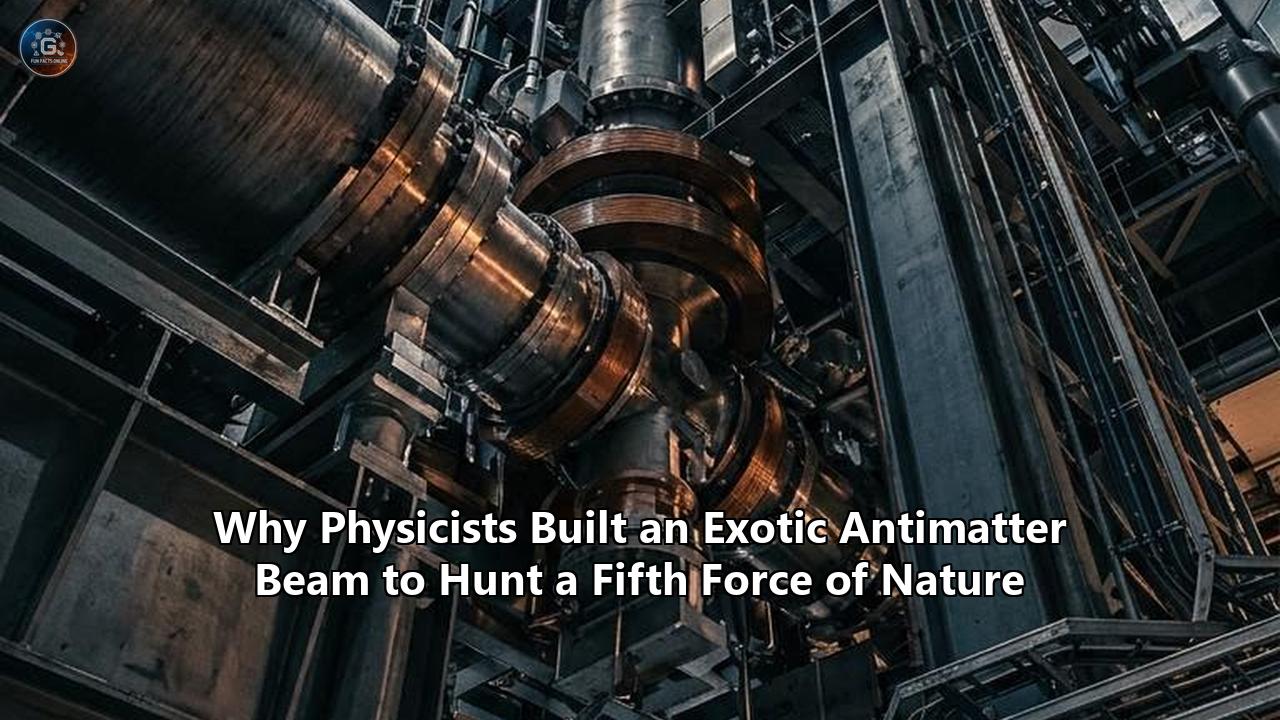
A team of particle physicists at ETH Zurich and the Paul Scherrer Institute (PSI) in Villigen, Switzerland, announced the creation of an orderly, high-intensity beam of muonium atoms ejected from a thin reservoir of superfluid helium chilled to near absolute zero. The experimental milestone, published in Nature Physics, resolves an experimental impasse that has frustrated particle physics for four decades: how to test the gravitational response of an exotic, second-generation antimatter atom before it disintegrates in millionths of a second.
The apparatus was not built merely to observe the trajectory of an exotic atom. It was designed to detect an invisible rift in the architecture of physical law. If the beam's neutral particles accelerate downward even fractionally faster or slower than ordinary matter, the result will contradict Albert Einstein’s Weak Equivalence Principle. Such a discrepancy would expose the operation of an uncataloged fifth force of nature, transmitted by hypothetical subatomic carriers that couple to the deeper, heavier generations of matter.
"We want to measure the gravitational interaction of the muon," explained corresponding author Anna Soter, a professor of physics at ETH Zurich and head of the Low Energy Particle Physics group. "The exotic muonium is very well suited to this because it is a neutral atom. After all, to make something fall, you need something neutral. If gravity acts differently on this exotic atom than it does on ordinary matter, that would indeed be surprising, and, in addition to other theories, it could point to the existence of a fifth force."
The road to this cryogenic atomic beam spans forty years of theoretical friction, disputed laboratory anomalies, and successive technical bottlenecks.
1986: The Eötvös Anomaly and the Fifth-Force Hypothesis
The search began with a 1986 paper that upended gravitational physics. Theoretical physicist Ephraim Fischbach, then at Purdue University, led a team that reanalyzed the archival data of Baron Loránd Eötvös. Between 1889 and 1908, Eötvös used delicate torsion balances to test whether different materials—such as brass, wood, platinum, and copper—fell toward Earth at identical rates. Eötvös concluded that the ratio of inertial mass to gravitational mass was uniform to within a few parts in a billion, cementing the foundation upon which Einstein erected General Relativity.
Fischbach discovered a subtle, neglected correlation buried within Eötvös’s data. The tiny residual differences in acceleration measured between test samples were not purely random noise; they tracked the ratio of the samples' baryon number to their atomic mass.
Eötvös Invariant:
η = 2 |a₁ - a₂| / |a₁ + a₂|  ~ 0

Fischbach Modification:
V(r) = - (G m₁ m₂) / r · [1 + α · exp(-r / λ)]
Fischbach postulated that alongside inverse-square Newtonian gravity, objects experience a feeble, short-range interaction. Mediated by an ultra-light vector boson, this potential carried a characteristic length scale ($\lambda$) of tens to hundreds of meters and coupled directly to fundamental charges like baryon number or hypercharge. Fischbach’s group put forward the first formalized hypothesis of a fifth force of nature, proposing that ordinary gravitational measurements were being perturbed by a non-gravitational exchange.
The announcement caused immediate tension. Throughout the late 1980s and 1990s, high-precision torsion-balance experiments—most notably those by the Eöt-Wash group at the University of Washington—scrutinized macroscopic materials with steadily increasing sensitivity. By the end of the century, experimentalists had measured the Eötvös parameter down to levels below $10^{-13}$, ruling out Fischbach’s original formulation for stable, first-generation matter made of up quarks, down quarks, and electrons.
Yet those limits applied only to stable matter. Fischbach’s equations left open a major loophole: what if the hypothetical fifth force ignored ordinary nucleons, coupling instead to leptons, antimatter, or the unstable particles of higher generations?
2015–2018: Nuclear Anomalies and the Resurgence of Dark Photons
The question of an undetected fundamental force erupted again in 2015, shifting from torsion balances to particle accelerators. At the Institute for Nuclear Research (ATOMKI) in Debrecen, Hungary, experimental physicist Attila Krasznahorkay and his collaborators were examining the decay of excited beryllium-8 nuclei ($^8\text{Be}^$) produced by bombarding a lithium-7 target with an energetic proton beam.
According to quantum electrodynamics, as the unstable beryllium nucleus drops to a lower energy state, it can emit a virtual photon that materializes into an electron-positron pair ($e^+ e^-$). As the opening angle between the emerging electron and positron widens, the count rate drops predictably and smoothly.
Instead of a smooth decline, Krasznahorkay’s spectrometers recorded a distinct, unexpected bump at an opening angle of 140 degrees.
The bump displayed a statistical significance exceeding $5\sigma$. The kinematically reconstructed invariant mass of the pair pointed to an unknown, short-lived intermediary particle weighing roughly 17 megaelectronvolts (MeV)—about 33 times the mass of an electron.
Standard Internal Pair Creation:
⁸Be*  ───>  ⁸Be  +  γ* (virtual)  ───>  ⁸Be  +  e⁻  +  e⁺

ATOMKI Anomaly:
⁸Be*  ───>  ⁸Be  +  X17  ───>  ⁸Be  +  e⁻  +  e⁺  (peak at 140°)
In 2016, a team of theoretical physicists at the University of California, Irvine, led by Jonathan Feng, published an analysis of the Hungarian data in Physical Review Letters. They proved that the anomaly could not be explained by a conventional dark photon, because existing constraints from electron-beam dump experiments ruled out universal electromagnetic mixing at that mass.
Feng’s team showed that the data could be explained by a "protophobic" vector gauge boson, designated the X17. This hypothetical particle possessed a quirky profile: its interaction with protons was suppressed by at least three orders of magnitude compared to its interaction with neutrons. Such a mediator would transmit a fifth force acting across a short range of roughly 12 femtometers.
The particle physics community split. Critics highlighted potential systematic detector errors, pointing out that nuclear scattering within the target geometry might mimic an angular excess. Proponents countered that subsequent ATOMKI tests observed the same 17 MeV excess in the decays of excited helium-4 ($^4\text{He}$) and carbon-12 ($^{12}\text{C}$) nuclei.
The standoff made one conclusion obvious: standard nuclear physics lacked the precision to settle whether the anomaly was real. Verifying a new force required an unambiguous, purely leptonic testing environment.
2018–2022: Positron Beams and Lepton Sector Escalation
To test the X17 hypothesis without the confounding backgrounds of multi-nucleon nuclear transitions, experimentalists deployed dedicated antimatter beams. At the National Institute for Nuclear Physics (INFN) in Frascati, Italy, physicists commissioned the Positron Annihilation into Dark Matter Experiment (PADME).
PADME took an alternative approach to beam physics. Instead of colliding protons with heavy targets, researchers guided a tunable beam of positrons ($e^+$)—antimatter electrons—from a linear accelerator into a 100-micrometer-thick polycrystalline diamond target. The objective was resonant production:
$$e^+ + e^- \to X17 \to e^+ + e^-$$
By adjusting the positron beam's momentum across narrow energy increments between 260 MeV and 300 MeV, PADME probed center-of-mass energies near the 17 MeV threshold. If a vector boson mediated an interaction between matter and antimatter, the annihilation rate would register a sharp resonance spike.
PADME Target Interaction:
e⁺ (positron beam) ──┐
                     ├──> [ Resonant State: X17 ] ──> e⁺ + e⁻  (or invisible decay)
e⁻ (diamond target) ─┘
Concurrently, a separate tension was escalating across the Atlantic. In 2021, the Muon $g-2$ collaboration at Fermi National Accelerator Laboratory released its initial run of measurements examining the muon’s anomalous magnetic dipole moment. The precision measurement diverged from the Standard Model’s baseline prediction by $4.2\sigma$, reinforcing earlier measurements recorded at Brookhaven National Laboratory.
The muon—a fundamental lepton identical to the electron in electric charge and spin, but 206.7 times more massive—appeared to wobble more than the known forces allowed.
Calculations suggested the excess precession could stem from virtual loops containing an undiscovered force mediator. Lepton universality—the foundational Standard Model principle stating that the electron, muon, and tau experience identical gauge interactions—was suddenly under scrutiny.
Yet attempts to resolve these questions struck a fundamental barrier: the particles themselves.
The Muon Dilemma: The Charge Mask and the Fleeting Lifetime
Testing whether the muon experiences a non-standard gravitational acceleration or a short-range leptonic fifth force presented two severe experimental hurdles.
The first hurdle was electromagnetic contamination. The gravitational attraction between two elementary particles is roughly $10^{36}$ times weaker than their electrostatic repulsion:
$$\frac{F_{\text{gravity}}}{F_{\text{Coulomb}}} = \frac{G m_1 m_2}{\frac{1}{4\pi\varepsilon_0} q_1 q_2} \sim 10^{-40}$$
Because bare muons carry a full unit of elementary charge ($e^-$ or $e^+$), any attempt to track their free fall under gravity is impossible in practice. A stray electric field of just one-millionth of a volt per meter ($10^{-6}\text{ V/m}$) imparts an acceleration that swamps Earth's surface gravity ($g \approx 9.81\text{ m/s}^2$) by a factor of 100 million. Patch potentials on the metal walls of vacuum chambers, thermal emissions, and subtle ambient magnetic fields completely obscure gravitational effects.
To measure gravity, physicists needed an electrically neutral system.
Enter muonium ($\text{Mu}$). Discovered by Vernon Hughes in 1960, muonium is a purely leptonic atom composed of a positive antimuon ($\mu^+$) acting as a central nucleus, orbited by a negative electron ($e^-$). It carries zero net electric charge.
Muonium Atomic Architecture:
       e⁻ (Electron, First-Generation Lepton)
       ○
      /
     /  r ≈ 0.053 nm (Bohr radius)
    /
   ●
  μ⁺ (Antimuon, Second-Generation Antilepton, ~207 mₑ)
Muonium is uniquely suited for probing physics beyond the Standard Model. Unlike ordinary hydrogen or antihydrogen—whose masses are 99% comprised of the binding energy of the strong nuclear force binding internal quarks—muonium's mass ($m_{\text{Mu}} \approx 106\text{ MeV}/c^2$) is dominated entirely by the elementary antimuon. It is completely free from nuclear size effects, hadronic structure uncertainties, and strong interaction forces.
The second hurdle was time. The antimuon does not endure. It decays through the weak interaction with a mean lifetime ($\tau$) of only 2.197 microseconds:
$$\mu^+ \to e^+ + \nu_e + \bar{\nu}_\mu$$
In two-millionths of a second, an atom moving at typical thermal velocities covers mere millimeters before decaying into a fast positron and a pair of neutrinos. During that microsecond flight, the downward displacement caused by Earth’s gravity is vanishingly small:
$$\Delta y = \frac{1}{2} g t^2 \approx \frac{1}{2} (9.81\text{ m/s}^2) (2.2 \times 10^{-6}\text{ s})^2 \approx 2.4 \times 10^{-11}\text{ meters}$$
A vertical drop of 24 picometers is smaller than the diameter of a hydrogen atom. Detecting that microscopic shift required an intense, coherent, and highly collimated atomic beam of muonium.
2022–2023: The Dead End of Thermal Diffusion
For decades, muonium was produced in laboratories through thermal diffusion.
At muon facilities like PSI, TRIUMF in Canada, and J-PARC in Japan, high-energy proton beams slammed into carbon targets to create positive pions ($\pi^+$), which decayed into low-energy "surface muons" with a kinetic energy around 4.1 MeV. These antimuons were directed into porous silica powders or silicon dioxide aerogels.
Inside the aerogel, an antimuon slowed down, captured an electron from the silica matrix to form muonium, and then diffused through the microscopic pores until it emerged into the surrounding vacuum.
The result was an experimental dead end. Thermal diffusion is an inherently disordered, chaotic process. The muonium atoms emerged in a wide, hemispherical spray with random thermal velocities dictated by Maxwell-Boltzmann statistics:
$$f(v) \propto v^3 \exp\left(-\frac{m v^2}{2 k_B T}\right)$$
The Thermal Diffusion Problem (Silica Aerogel):
Beam In:  μ⁺ ────> [ Porous Silica Target ]
                       │  │  │  (Chaotic collisions)
                       ▼  ▼  ▼
Emerging Atoms:        ↖  ↑  ↗   (Thermal spray)
                      ←   •   →  (Wide angular spread: >180°)
                       ↙  ↓  ↘   (Wide velocity spread: 500 – 10,000 m/s)
At room temperature ($300\text{ K}$), the atoms emerged with velocities ranging from 500 to more than 10,000 meters per second. They sprayed in every direction.
To conduct atom interferometry, an instrument requires a collimated beam of uniform speed. When physicists inserted collimation slits and apertures to select only the atoms traveling forward at matching velocities, they discarded more than 99.9% of the beam. The few atoms that survived the apertures decayed before reaching a detector.
Cooling the aerogel did not solve the issue. As the silica target was cooled to cryogenic temperatures to slow the atoms down, the muonium became trapped in the microscopic pores of the material by van der Waals forces, dropping the extraction yield close to zero.
Testing the gravitational acceleration of a second-generation lepton appeared to be an insurmountable experimental challenge.
2024–2025: The Superfluid Helium Architecture
Faced with this bottleneck, Anna Soter’s team at ETH Zurich and the Paul Scherrer Institute abandoned porous materials entirely. Supported by the Swiss National Science Foundation and the Muoniverse competence center, the LEMING collaboration (LEptons in Muonium INteracting with Gravity) designed an alternative approach: a quantum liquid target.
Rather than attempting to extract atoms from a solid grid, the researchers turned to superfluid helium-4 ($^4\text{He}$), chilled by a dilution refrigerator below 0.2 Kelvin.
Quantum State Comparison:
• Thermal Target: Porous SiO₂ Aerogel -> Entropic diffusion -> Spatial divergence
• Quantum Target: Superfluid ⁴He      -> Chemical repulsion -> Directed ejection
Below 2.17 Kelvin (the lambda point), liquid helium transitions into a macroscopic quantum fluid characterized by zero viscosity and the formation of a Bose-Einstein condensate.
In a paper establishing the core mechanics of the system, lead author Jesse Zhang and the LEMING team detailed how the quantum dynamics of superfluid helium invert the extraction process:
- Continuous Surface Muon Injection: The world’s most intense continuous surface muon beamline ($\pi$E5 at PSI's High Intensity Proton Accelerator) directs low-momentum antimuons ($\sim 28\text{ MeV}/c$) into a specialized vacuum chamber.
- Cryogenic Moderation: The antimuons pass through an ultra-thin window into a two-millimeter layer of high-purity superfluid helium. The liquid decelerates the incoming particles, stopping them roughly 100 to 200 micrometers below the surface.
- Electron Capture: As the antimuon comes to rest, it strips an electron from its own ionization wake within the helium, assembling into neutral muonium.
- The "Atomic Cannon" Mechanism: Inside the superfluid, muonium is an impurity. Helium atoms possess a tightly bound, closed electron shell ($1s^2$). Because the single electron orbiting the antimuon must maintain quantum orthogonality with the surrounding helium electrons, the Pauli exclusion principle generates a strong, short-range exchange repulsion.
The total energy of a muonium atom immersed in the liquid exceeds its energy in vacuum. This energy difference manifests as a positive chemical potential:
$$\mu_{\text{chem}} > 0$$
Superfluid helium will not accommodate the foreign atom. It ejects it.
The muonium atom travels ballistically through the zero-viscosity superfluid, without colliding or transferring energy to thermal phonons. Upon reaching the liquid-vacuum boundary, this positive chemical potential converts directly into directed, perpendicular kinetic energy.
The superfluid acts as a nanoscale atomic launcher, ejecting the atoms vertically into the vacuum chamber in a focused, unidirectional spray.
September 2026: The Milestone Announcement
The results published in Nature Physics* by the LEMING team confirm the operation of this cryogenic beam.
Instead of a chaotic thermal distribution, the atoms emerge from the superfluid surface in an orderly beam. By monitoring the decay signatures using cryogenic position-sensitive silicon detectors and tracking the timing of the emitted decay positrons, the team mapped the beam’s spatial and kinematic profile:
Beam Output Metrics
- Peak Beam Velocity: Measured at approximately $2,180\text{ meters per second}$.
- Conversion Efficiency: Roughly 8% to 20% of all antimuons stopped within the helium layer are converted into usable vacuum muonium.
- Angular Divergence: A tightly collimated envelope of roughly $30\text{ milliradians}$.
- Velocity Uniformity: A sharp velocity spectrum, yielding a monochromatic beam suitable for matter-wave interferometry.
The LEMING Superfluid Helium Target Architecture:

          Vacuum Chamber (10⁻⁸ mbar)
                      ▲  ▲  ▲
                      │  │  │  Superthermal Muonium Beam (v ≈ 2,180 m/s)
    ==================│==│==│================== Liquid-Vacuum Boundary
    ~~~~~~~~~~~~~~~~~~│~~│~~│~~~~~~~~~~~~~~~~~~
    Superfluid ⁴He    │  │  │  Ballistic Transport (Zero Viscosity)
    Target (T ≈ 0.2 K)●  ●  ●  Muonium Formation (μ⁺ + e⁻)
    ~~~~~~~~~~~~~~~~~~~~~~~~~~~~~~~~~~~~~~~~~~~
                      ▲  ▲  ▲
                      │  │  │  Incident Surface Antimuon Beam (πE5 Line)
The difference between this beam and previous sources is dramatic. By exploiting the quantum mechanics of the superfluid helium surface, the team produced an antimatter beam where the atoms emerge at uniform velocities and parallel trajectories.
With this milestone reached, the physical challenge shifts from generating the beam to measuring its fall. The current experimental setup sends the beam vertically upward. To measure gravity, researchers need the beam to travel horizontally so that the downward pull of gravity—or a fifth force of nature—can bend its trajectory downward before the muons decay.
The Next Phase: Three-Grating Atom Interferometry
The LEMING collaboration is now constructing the horizontal beamline and an atom interferometer designed to measure the gravitational deflection directly.
Because muonium is a composite quantum particle, it exhibits matter-wave properties dictated by the de Broglie wavelength:
$$\lambda_{\text{dB}} = \frac{h}{m_{\text{Mu}} v} \approx \frac{6.626 \times 10^{-34}\text{ J}\cdot\text{s}}{(1.88 \times 10^{-28}\text{ kg}) (2,180\text{ m/s})} \approx 1.6\text{ nanometers}$$
To measure gravitational deflection over an operational distance of just a few centimeters, the team cannot rely on classical shadow-imaging techniques. Instead, they employ a three-grating transmission interferometer ($G_1, G_2, G_3$) based on the Mach-Zehnder geometry:
Atom Interferometer Geometry:
Muonium Beam ───> [ G₁ ] ───> [ G₂ ] ───> [ G₃ ] ───> Detector Matrix
                   │             │           │
                   ├─────────────┴───────────┤
                   │       Length L ≈ 10 cm  │
                   ▼                         ▼
            Diffraction Split            Interference Fringe Pattern
The Interferometric Sequence
- Wavefront Splitting ($G_1$): The incoming muonium matter wave strikes the first silicon nitride transmission grating ($G_1$), whose sub-micron slit spacing diffracts the coherent wave into discrete quantum momentum states ($0, +1, -1$).
- Redirection ($G_2$): At a distance $L$ downstream, a second grating ($G_2$) acts as a refractive lens, redirecting the divergent matter paths back toward one another.
- Recombination and Readout ($G_3$): The overlapping paths form an interference pattern at the third grating ($G_3$).
As the atoms traverse the distance $2L$, gravitational acceleration ($g$) shifts the interference fringes downward. This deflection introduces an overall phase shift ($\Delta\Phi$) proportional to the acceleration:
$$\Delta\Phi = \frac{2\pi}{d} \cdot g \cdot T^2 = \frac{2\pi}{d} \cdot g \cdot \left(\frac{L}{v}\right)^2$$
Where:
- $d$ is the grating period (sub-micron scale).
- $g$ is the local acceleration experienced by the muonium atom.
- $T = L/v$ is the transit time between gratings.
Downstream detectors record the decay products: a fast Michel positron and a slower atomic electron. By coordinating the detection times and spatial positions of both particles, researchers can reconstruct the location of each decay to a fraction of a millimeter, mapping the interference fringes with extreme precision.
The LEMING timeline projects initial tests of the horizontal beam by late 2026, followed by the deployment of the full three-grating interferometer. Within 100 days of active data acquisition at PSI, the team expects to measure the gravitational acceleration of muonium to an initial precision of 1%:
$$\frac{g_{\text{Mu}}}{g} = 1.00 \pm 0.01$$
Theoretical Implications: If the Exotic Atom Breaks Away
The gravitational acceleration of all ordinary matter on Earth’s surface is constant: $g \approx 9.80665\text{ m/s}^2$.
In September 2023, CERN’s ALPHA-g collaboration achieved an experimental milestone by measuring the gravitational acceleration of neutral antihydrogen ($\bar{\text{H}} = \bar{p} e^+$). They confirmed that antihydrogen falls downward at $g_{\bar{\text{H}}} = (0.75 \pm 0.29) g$, ruling out repulsive "antigravity" for first-generation antimatter.
The antimuon, however, belongs to the second generation.
Generational Hierarchy of the Standard Model:
Generation I:   Electron (e⁻),    Up Quark (u),     Down Quark (d)     ──> Stable Matter / ALPHA-g
Generation II:  Muon (μ⁻),        Charm Quark (c),  Strange Quark (s)   ──> LEMING Target
Generation III: Tau (τ⁻),         Top Quark (t),    Bottom Quark (b)   ──> Highly Fleeting
No experiment in history has ever directly measured the gravitational interaction of an elementary second- or third-generation particle. Because gravity is so faint, our empirical knowledge of spacetime curvature is derived entirely from first-generation matter.
If LEMING observes an acceleration ratio where $g_{\text{Mu}} \neq g$, the result will shatter the Weak Equivalence Principle and expose a fifth force of nature.
Outcome A:  g_Mu / g = 1.000...
• Weak Equivalence Principle holds universally across generations.
• Stringent limits placed on second-generation scalar/vector couplings.

Outcome B:  g_Mu / g ≠ 1.000...
• Violation of General Relativity.
• Confirmation of a fifth fundamental force mediated by new gauge bosons.
Theorists have mapped out the physical pathways that could generate such an anomalous signal:
1. Gauged Lepton Flavor Symmetries: $U(1)_{L_\mu - L_\tau}$
The Standard Model accidentally conserves individual lepton flavor numbers ($L_e, L_\mu, L_\tau$) at low energies. Many Grand Unified Theories introduce a new gauge symmetry—most prominently $U(1)_{L_\mu - L_\tau}$—mediated by an ultra-light vector boson ($Z'$) that couples with opposite signs to second- and third-generation leptons.
Because Earth contains an abundance of electrons and nucleons but virtually zero muons or taus, a $Z'$ background field would mediate a generational, non-universal force. If this gauge field possesses a finite cosmological or terrestrial gradient, it would exert an anomalous force on the antimuon, altering its apparent free fall.
2. Scalar Dilatons and Dark Matter Couplings
In string theory compactifications and chameleon field models, extra dimensions yield light scalar fields (dilatons or moduli) whose couplings to matter violate universality.
If these scalar fields interact with standard fermions with strengths proportional to the fermion mass squared ($m_f^2$), their coupling to the muon would be enhanced relative to the electron by a factor of:
$$\left(\frac{m_\mu}{m_e}\right)^2 \approx (206.7)^2 \approx 42,700$$
A force completely undetectable in ordinary Eötvös experiments on silicon or platinum could easily produce a measurable signature in muonium.
3. The Purely Leptonic Gravitational Tensor
Muonium is entirely leptonic. If gravitational mass depends in part on the strong nuclear force field energy that binds quarks inside protons, a purely leptonic atom could exhibit an anomalous inertial-to-gravitational mass ratio.
Such a discrepancy would establish that the stress-energy tensor ($T_{\mu\nu}$) does not couple to the metric tensor ($g_{\mu\nu}$) in the universal manner prescribed by Einstein.
2026 and Beyond: The Global Escalation
The development of the superfluid helium muonium beam at PSI is not occurring in a vacuum. It represents the spearhead of a broader international race to probe low-energy physics beyond the Standard Model.
Global Hunt for Fifth-Force Phenomena (2026):
┌──────────────────────────────┬──────────────────────────────┬──────────────────────────────┐
│ Experiment                   │ Target Particle / System     │ Measurement Technique        │
├──────────────────────────────┼──────────────────────────────┼──────────────────────────────┤
│ LEMING (PSI / ETH Zurich)    │ Muonium (μ⁺e⁻)               │ Matter-Wave Interferometry   │
│ PADME (INFN Frascati)        │ Positron Beam on Diamond     │ Missing Mass Resonance       │
│ MEG II (PSI)                 │ Muon-to-Positron Transitions │ Rare Decay Branching Ratio   │
│ ALPHA-g (CERN)               │ Antihydrogen (p̄e⁺)           │ Magnetic Trap Free Fall      │
│ Mu-MASS (PSI / ETH)          │ Muonium 1S–2S Level          │ Precision Laser Spectroscopy │
└──────────────────────────────┴──────────────────────────────┴──────────────────────────────┘
At PSI, the laboratory is preparing for its IMPACT upgrade (Innovative Muon Project for Advanced Chemistry and Technology). Scheduled to come online before the end of the decade, the High Intensity Muon Beams (HIMB) project will increase surface muon yields by two orders of magnitude, delivering up to $10^{10}$ muons per second. This influx will supply the LEMING atomic cannon with an unprecedented particle flux, driving the gravity measurement from a 1% survey down to parts-per-thousand sensitivity.
Concurrently, the team plans to channel the cold muonium beam into precision laser spectroscopy. The Mu-MASS collaboration aims to measure the 1S–2S optical transition of muonium to a fraction of a kilohertz.
Because muonium lacks internal nuclear structure, comparing its experimental spectral lines to higher-order Quantum Electrodynamics (QED) calculations provides the cleanest test of whether a short-range fifth force is subtly shifting atomic orbital energies.
Meanwhile, Frascati's PADME experiment and CERN’s NA64 are upgrading their detectors to resolve the 17 MeV window opened by ATOMKI. In November 2024, the MEG II collaboration set tight bounds on the ATOMKI anomaly's simplest interpretations, but the 2.5$\sigma$ residual seen in PADME’s Run III maintains theoretical momentum.
The technical barrier that separated antimatter gravity from laboratory testing has been dismantled. By converting an exotic antiparticle into a neutral atom and firing it from a quantum liquid, physicists have constructed an instrument capable of measuring the weight of an unstable, second-generation lepton.
As the LEMING beamline prepares to track its first horizontal trajectory, physics stands before an empirical threshold. Either muonium will trace the parabolic curve drawn by Galileo and Einstein, cementing the universal rule of General Relativity, or it will diverge—exposing a fifth interaction that forces the Standard Model to be completely rewritten.
Reference:
- https://ethz.ch/en/news-and-events/eth-news/news/2026/09/novel-particle-beam-could-challenge-einsteins-theory-of-gravity.html
- https://www.thebrighterside.news/post/eth-zurich-physicists-built-an-atomic-cannon-to-put-einsteins-theory-of-gravity-to-the-test/
- https://studyfinds.com/atom-beam-put-einsteins-gravity-to-test/
- https://www.sciencealert.com/physicists-build-a-mad-scientist-antimatter-beam-to-test-einsteins-theory-of-general-relativity
- https://room.eu.com/news/have-researchers-uncovered-a-fifth-fundamental-force
- https://www.sciencedaily.com/releases/2026/09/260918024808.htm
- https://lepp.ethz.ch/
- https://sciencesources.eurekalert.org/news-releases/1144032
- https://www.npl.washington.edu/av/altvw15.html
- https://www.livescience.com/55283-has-a-fifth-force-been-discovered.html
- https://cerncourier.com/mixed-signals-from-x17/
- https://www.newsweek.com/fifth-force-nature-scientists-are-about-start-hunting-universes-hidden-realm-1145587
- https://www.space.com/41718-dark-photon-fifth-force.html
- https://www.infn.it/en/new-results-from-the-padme-experiment-in-the-search-for-the-x17-particle/
- https://arxiv.org/html/2405.07203v1
- https://conference-indico.kek.jp/event/302/timetable/?view=standard
- https://www.sciencealert.com/physicists-build-a-mad-scientist-antimatter-beam-to-test-einsteins-theory-of-general-relativity
- https://www.livescience.com/dark-photon-search-comes-up-empty.html
- https://lepp.ethz.ch/research/leming.html
- https://indico.global/event/10920/contributions/102234/attachments/47038/89122/FFK2023-Abstract_JesseZhang.pdf
- https://indico.global/event/15739/sessions/23264/
- https://media.springernature.com/original/springer-static/esm/art%3A10.1038%2Fs41567-026-03433-x/MediaObjects/41567_2026_3433_MOESM1_ESM.pdf
- https://www.researchgate.net/publication/400003409_Muon_beams_towards_muonium_physics_progress_and_prospects
- https://arxiv.org/html/2601.15818v2
- https://www.admin.ch/en/newnsb/IRaopou9KOOM
- https://www.admin.ch/en/newnsb/IRaopou9KOOM
- https://studyfinds.com/atom-beam-put-einsteins-gravity-to-test/
- https://indico.global/event/10920/contributions/102234/attachments/47038/89122/FFK2023-Abstract_JesseZhang.pdf
- https://arxiv.org/html/2601.15818v1
- https://indico.cern.ch/event/1198655/timetable/?view=standard
- https://www.physics.uci.edu/node/15029